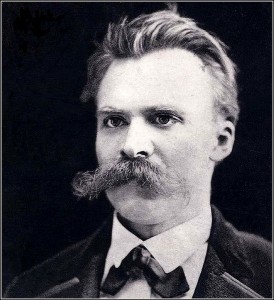
Friedrich Nietzsche (1844—1900)

NietzscheNietzsche was a German philosopher, essayist, and cultural critic. His writings on truth, morality, language, aesthetics, cultural theory, history, nihilism, power, consciousness, and the meaning of existence have exerted an enormous influence on Western philosophy and intellectual history.

Nietzsche spoke of “the death of God,” and foresaw the dissolution of traditional religion and metaphysics. Some interpreters of Nietzsche believe he embraced nihilism, rejected philosophical reasoning, and promoted a literary exploration of the human condition, while not being concerned with gaining truth and knowledge in the traditional sense of those terms. However, other interpreters of Nietzsche say that in attempting to counteract the predicted rise of nihilism, he was engaged in a positive program to reaffirm life, and so he called for a radical, naturalistic rethinking of the nature of human existence, knowledge, and morality. On either interpretation, it is agreed that he suggested a plan for “becoming what one is” through the cultivation of instincts and various cognitive faculties, a plan that requires constant struggle with one’s psychological and intellectual inheritances.

Nietzsche claimed the exemplary human being must craft his/her own identity through self-realization and do so without relying on anything transcending that life—such as God or a soul.  This way of living should be affirmed even were one to adopt, most problematically, a radical vision of eternity, one suggesting the “eternal recurrence” of all events. According to some commentators, Nietzsche advanced a cosmological theory of “will to power.” But others interpret him as not being overly concerned with working out a general cosmology. Questions regarding the coherence of Nietzsche’s views–questions such as whether these views could all be taken together without contradiction, whether readers should discredit any particular view if proven incoherent or incompatible with others, and the like–continue to draw the attention of contemporary intellectual historians and philosophers.

Table of Contents

  1. Life
  2. Periodization of Writings
  3. Problems of Interpretation
  4. Nihilism and the Revaluation of Values
  5. The Human Exemplar
  6. Will to Power
  7. Eternal Recurrence
  8. Reception of Nietzsche’s Thought
  9. References and Further Reading
    1. Nietzsche’s Collected Works in German
    2. Nietzsche’s Major Works Available in English
    3. Important Works Available in English from Nietzsche’s Nachlass
    4. Biographies
    5. Commentaries and Scholarly Researches
    6. Academic Journals in Nietzsche Studies

1. Life

Because much of Nietzsche’s philosophical work has to do with the creation of self—or to put it in Nietzschean terms, “becoming what one is”— some scholars exhibit uncommon interest in the biographical anecdotes of Nietzsche’s life. Taking this approach, however, risks confusing aspects of the Nietzsche legend with what is important in his philosophical work, and many commentators are rightly skeptical of readings derived primarily from biographical anecdotes.

Friedrich Wilhelm Nietzsche was born October 15, 1844, the son of Karl Ludwig and Franziska Nietzsche. Karl Ludwig Nietzsche was a Lutheran Minister in the small Prussian town of Röcken, near Leipzig. When young Friedrich was not quite five, his father died of a brain hemorrhage, leaving Franziska, Friedrich, a three-year old daughter, Elisabeth, and an infant son. Friedrich’s brother died unexpectedly shortly thereafter (reportedly, the legend says, fulfilling Friedrich’s dream foretelling of the tragedy). These events left young Friedrich the only male in a household that included his mother, sister, paternal grandmother and an aunt, although Friedrich drew upon the paternal guidance of Franziska’s father. Young Friedrich also enjoyed the camaraderie of a few male playmates.

Upon the loss of Karl Ludwig, the family took up residence in the relatively urban setting of Naumburg, Saxony. Friedrich gained admittance to the prestigious Schulpforta, where he received Prussia’s finest preparatory education in the Humanities, Theology, and Classical Languages. Outside school, Nietzsche founded a literary and creative society with classmates including Paul Deussen (who was later to become a prominent scholar of Sanskrit and Indic Studies). In addition, Nietzsche played piano, composed music, and read the works of Emerson and the poet Friedrich Hölderlin, who was relatively unknown at the time.

In 1864 Nietzsche entered the University of Bonn, spending the better part of that first year unproductively, joining a fraternity and socializing with old and new acquaintances, most of whom would fall out of his life once he regained his intellectual focus. By this time he had also given up Theology, dashing his mother’s hopes of a career in the ministry for him. Instead, he choose the more humanistic study of classical languages and a career in Philology. In 1865 he followed his major professor, Friedrich Ritschl, from Bonn to the University of Leipzig and dedicated himself to the studious life, establishing an extracurricular society there devoted to the study of ancient texts. Nietzsche’s first contribution to this group was an essay on the Greek poet, Theognis, and it drew the attention of Professor Ritschl, who was so impressed that he published the essay in his academic journal, Rheinisches Museum. Other published writings by Nietzsche soon followed, and by 1868 (after a year of obligatory service in the Prussian military), young Friedrich was being promoted as something of a “phenomenon” in classical scholarship by Ritschl, whose esteem and praise landed Nietzsche a position as Professor of Greek Language and Literature at the University of Basel in Switzerland, even though the candidate had not yet begun writing his doctoral dissertation. The year was 1869 and Friedrich Nietzsche was 24 years old.

At this point in his life, however, Nietzsche was a far cry from the original thinker he would later become, since neither he nor his work had matured. Swayed by public opinion and youthful exuberance, he briefly interrupted teaching in 1870 to join the Prussian military, serving as a medical orderly at the outbreak of the Franco-Prussian War. His service was cut short, however, by severe bouts of dysentery and diphtheria. Back in Basel, his teaching responsibilities at the University and a nearby Gymnasium consumed much of his intellectual and physical energy. He became acquainted with the prominent cultural historian, Jacob Burkhardt, a well-established member of the university faculty. But, the person exerting the most influence on Nietzsche at this point was the artist, Richard Wagner, whom Nietzsche had met while studying in Leipzig. During the first half of the decade, Wagner and his companion, Cosima von Bülow, frequently entertained Nietzsche at Triebschen, their residence near Lake Lucerne, and then later at Bayreuth.

It is commonplace to say that at one time Nietzsche looked to Wagner with the admiration of a dutiful son. This interpretation of their relationship is supported by the fact that Wagner would have been the same age as Karl Ludwig, had the elder Nietzsche been alive. It is also commonplace to note that Nietzsche was in awe of the artist’s excessive displays of a fiery temperament, bravado, ambition, egoism, and loftiness— typical qualities demonstrating “genius” in the nineteenth century. In short, Nietzsche was overwhelmed by Wagner’s personality. A more mature Nietzsche would later look back on this relationship with some regret, although he never denied the significance of Wagner’s influence on his emotional and intellectual path, Nietzsche’s estimation of Wagner’s work would alter considerably over the course of his life. Nonetheless, in light of this relationship, one can easily detect Wagner’s presence in much of Nietzsche’s early writings, particularly in the latter chapters of The Birth of Tragedy and in the first and fourth essays of 1874’s Untimely Meditations. Also, Wagner’s supervision exerted considerable editorial control over Nietzsche’s intellectual projects, leading him to abandon, for example, 1873’s Philosophy in the Tragic Age of the Greeks, which Wagner scorned because of its apparent irrelevance to his own work. Such pressures continued to bridle Nietzsche throughout the so-called early period. He broke free of Wagner’s dominance once and for all in 1877, after a series of emotionally charged episodes. Nietzsche’s fallout with Wagner, who had moved to Bayreuth by this time, led to the publication of 1878’s Human, All-Too Human, one of Nietzsche’s most pragmatic and un-romantic texts—the original title page included a dedication to Voltaire and a quote from Descartes.  If Nietzsche intended to use this text as a way of alienating himself from the Wagnerian circle, he surely succeeded. Upon its arrival in Bayreuth, the text ended this personal relationship with Wagner.

It would be an exaggeration to say that Nietzsche was not developing intellectually during the period, prior to 1877. In fact, figures other than Wagner drew Nietzsche’s interest and admiration. In addition to attending Burkhardt’s lectures at Basel, Nietzsche studied Greek thought from the Pre-Socratics to Plato, and he learned much about the history of philosophy from Friedrich Albert Lange’s massive History of Materialism, which Nietzsche once called “a treasure trove” of historical and philosophical names, dates, and currents of thought. In addition, Nietzsche was taken by the persona of the philosopher Arthur Schopenhauer, which Nietzsche claimed to have culled from close readings of the two-volume magnum opus, The World as Will and Representation.

Nietzsche discovered Schopenhauer while studying in Leipzig. Because his training at Schulpforta had elevated him far above most of his classmates, he frequently skipped lectures at Leipzig in order to devote time to [CE1] Schopenhauer’s philosophy. For Nietzsche, the most important aspect of this philosophy was the figure from which it emanated, representing for him the heroic ideal of a man in the life of thought: a near-contemporary thinker participating in that great and noble “republic of genius,” spanning the centuries of free thinking sages and creative personalities. That Nietzsche could not countenance Schopenhauer’s “ethical pessimism” and its negation of the will was recognized by the young man quite early during this encounter. Yet, even in Nietzsche’s attempts to construct a counter-posed “pessimism of strength” affirming the will, much of Schopenhauer’s thought remained embedded in Nietzsche’s philosophy, particularly during the early period. Nietzsche’s philosophical reliance on “genius”, his cultural-political visions of rank and order through merit, and his self-described (and later self-rebuked) “metaphysics of art” all had Schopenhauerian underpinnings. Also, Birth of Tragedy’s well-known dualism between the cosmological/aesthetic principles of Dionysus and Apollo, contesting and complimenting each other in the tragic play of chaos and order, confusion and individuation, strikes a familiar chord to readers acquainted with Schopenhauer’s description of the world as “will” and “representation.”

Despite these similarities, Nietzsche’s philosophical break with Schopenhauerian pessimism was as real as his break with Wagner’s domineering presence was painful. Ultimately, however, such triumphs were necessary to the development and liberation of Nietzsche as thinker, and they proved to be instructive as Nietzsche later thematized the importance of “self-overcoming” for the project of cultivating a free spirit.

The middle and latter part of the 1870s was a time of great upheaval in Nietzsche’s personal life. In addition to the turmoil with Wagner and related troubles with friends in the artist’s circle of admirers, Nietzsche suffered digestive problems, declining eyesight, migraines, and a variety of physical aliments, rendering him unable to fulfill responsibilities at Basel for months at a time. After publication of Birth of Tragedy, and despite its perceived success in Wagnerian circles for trumpeting the master’s vision for Das Kunstwerk der Zukunft (“The Art Work of the Future”) Nietzsche’s academic reputation as a philologist was effectively destroyed due in large part to the work’s apparent disregard for scholarly expectations characteristic of nineteenth-century philology. Birth of Tragedy was mocked as Zukunfts-Philologie (“Future Philology”) by Wilamowitz-Moellendorff, an up-and-coming peer destined for an illustrious career in Classicism, and even Ritschl characterized it as a work of “megalomania.” For these reasons, Nietzsche had difficulty attracting students. Even before the publication of Birth of Tragedy, he had attempted to re-position himself at Basel in the department of philosophy, but the University apparently never took such an endeavor seriously. By 1878, his circumstances at Basel deteriorated to the point that neither the University nor Nietzsche was very much interested in seeing him continue as a professor there, so both agreed that he should retire with a modest pension [CE2] . He was 34 years  old and now apparently liberated, not only from his teaching duties and the professional discipline he grew to despise, but also from the emotional and intellectual ties that dominated him during his youth. His physical woes, however, would continue to plague him for the remainder of his life.

After leaving Basel, Nietzsche enjoyed a period of great productivity. And, during this time, he was never to stay in one place for long, moving with the seasons, in search of relief for his ailments, solitude for his work, and reasonable living conditions, given his very modest budget. He often spent summers in the Swiss Alps in Sils Maria, near St. Moritz, and winters in Genoa, Nice, or Rappollo on the Mediterranean coast. Occasionally, he would visit family and friends in Naumburg or Basel, and he spent a great deal of time in social discourse, exchanging letters with friends and associates.

In the latter part of the 1880s, Nietzsche’s health worsened, and in the midst of an amazing flourish of intellectual activity which produced On the Genealogy of Morality, Twilight of the Idols, The Anti-Christ, and several other works (including preparation for what was intended to be his magnum opus, a work that editors later titled Will to Power) Nietzsche suffered a complete mental and physical breakdown. The famed moment at which Nietzsche is said to have succumbed irrevocably to his ailments occurred January 3, 1889 in Turin (Torino) Italy, reportedly outside Nietzsche’s apartment in the Piazza Carlos Alberto while embracing a horse being flogged by its owner.

After spending time in psychiatric clinics in Basel and Jena, Nietzsche was first placed in the care of his mother, and then later his sister (who had spent the latter half of the 1880’s attempting to establish a “racially pure” German colony in Paraguay with her husband, the anti-Semitic political opportunist Bernhard Foerster). By the early 1890s, Elisabeth had seized control of Nietzsche’s literary remains, which included a vast amount of unpublished writings. She quickly began shaping his image and the reception of his work, which by this time had already gained momentum among academics such as Georg Brandes. Soon the Nietzsche legend would grow in spectacular fashion among popular readers. From Villa Silberblick, the Nietzsche home in Weimar, Elisabeth and her associates managed Friedrich’s estate, editing his works in accordance with her taste for a populist decorum and occasionally with an ominous political intent that (later researchers agree) corrupted the original thought[CE3] . Unfortunately, Friedrich experienced little of his fame, having never recovered from the breakdown of late 1888 and early 1889. His final years were spent at Villa Silberblick in grim mental and physical deterioration, ending mercifully August 25, 1900. He was buried in Röcken, near Leipzig. Elisabeth spent one last year in Paraguay in 1892-93 before returning to Germany, where she continued to exert influence over the perception of Nietzsche’s work and reputation, particularly among general readers, until her death in 1935. Villa Silberblick stands today as a monument, of sorts, to Friedrich and Elisabeth, while the bulk of Nietzsche’s literary remains is held in the Goethe-Schiller Archiv, also in Weimar.

2. Periodization of Writings

Nietzsche scholars commonly divide his work into periods, usually with the implication that discernable shifts in Nietzsche’s circumstances and intellectual development justify some form of periodization in the corpus. The following division is typical:

(i.) before 1869—the juvenilia

Cautious Nietzsche biographers work to separate the facts of Nietzsche’s life from myth, and while a major part of the Nietzsche legend holds that Friedrich was a precocious child, writings from his youth bear witness to that part of the story. During this time Nietzsche was admitted into the prestigious Gymnasium Schulpforta; he composed music, wrote poetry and plays, and in 1863 produced an autobiography (at the age of 19). He also produced more serious and accomplished works on themes related to philology, literature, and philosophy. By 1866 he had begun contributing articles to a major philological journal, Rheinisches Museum, edited by Nietzsche’s esteemed professor at Bonn and Leipzig, Friedrich Ritschl. With Ritschl’s recommendation, Nietzsche was appointed professor of Greek Language and Literature at the University of Basel in January 1869.

(ii.) 1869-1876–the early period

Nietzsche’s writings during this time reflect interests in philology, cultural criticism, and aesthetics. His inaugural public lecture at Basel in May 1869, “Homer and Classical Philology” brought out aesthetic and scientific aspects of his discipline, portending Nietzsche’s attitudes towards science, art, philology and philosophy. He was influenced intellectually by the philosopher Arthur Schopenhauer and emotionally by the artist Richard Wagner. Nietzsche’s first published book, The Birth of Tragedy, appropriated Schopenhaurian categories of individuation and chaos in an elucidation of primordial aesthetic drives represented by the Greek gods Apollo and Dionysus. This text also included a Wagnerian precept for cultural flourishing: society must cultivate and promote its most elevated and creative types—the artistic genius. In the Preface to a later edition of this work, Nietzsche expresses regret for having attempted to elaborate a “metaphysics of art.” In addition to these themes, Nietzsche’s interest during this period extended to Greek philosophy, intellectual history, and the natural sciences, all of which were significant to the development of his mature thought. Nietzsche’s second book-length project, The Untimely Meditations, contains four essays written from 1873-1876. It is a work of acerbic cultural criticism, encomia to Schopenhauer and Wagner, and an unexpectedly idiosyncratic analysis of the newly developing historical consciousness. A fifth meditation on the discipline of philology is prepared but left unpublished. Plagued by poor health, Nietzsche is released from teaching duties in February 1876 (his affiliation with the university officially ends in 1878 and he is granted a small pension).

(iii.) 1877-1882—the middle period

During this time Nietzsche liberated himself from the emotional grip of Wagner and the artist’s circle of admirers, as well as from those ideas which (as he claims in Ecce Homo) “did not belong” to him in his “nature” (“Human All Too Human: With Two Supplements” 1).  Reworking earlier themes such as tragedy in philosophy, art and truth, and the human exemplar, Nietzsche’s thinking now comes into sharper focus, and he sets out on a philosophical path to be followed the remainder of his productive life. In this period’s three published works Human, All-Too Human (1878-79), Dawn (1881), and The Gay Science (1882), Nietzsche takes up writing in an aphoristic style, which permits exploration of a variety of themes. Most importantly, Nietzsche lays out a plan for  “becoming what one is” through the cultivation of instincts and various cognitive faculties, a plan that requires constant struggle with one’s psychological and intellectual inheritances. Nietzsche discovers that “one thing is needful” for the exemplary human being: to craft an identity from otherwise dissociated events bringing forth the horizons of one’s existence. Self-realization, as it is conceived in these texts, demands the radicalization of critical inquiry with a historical consciousness and then a “retrograde step” back (Human aphorism 20) from what is revealed in such examinations, insofar as these revelations threaten to dissolve all metaphysical realities and leave nothing but the abysmal comedy of existence. A peculiar kind of meaningfulness is thus gained by the retrograde step: it yields a purpose for existence, but in an ironic form, perhaps esoterically and without ground; it is transparently nihilistic to the man with insight, but suitable for most; susceptible to all sorts of suspicion, it is nonetheless necessary and for that reason enforced by institutional powers. Nietzsche calls the one who teaches the purpose of existence a “tragic hero” (GS 1), and the one who understands the logic of the retrograde step a “free spirit.” Nietzsche’s account of this struggle for self-realization and meaning leads him to consider problems related to metaphysics, religion, knowledge, aesthetics, and morality.

(iv.) Post-1882—the later period

Nietzsche transitions into a new period with the conclusion of The Gay Science (Book IV) and his next published work, the novel Thus Spoke Zarathustra, produced in four parts between 1883 and 1885. Also in 1885 he returns to philosophical writing with Beyond Good and Evil. In 1886 he attempts to consolidate his inquiries through self-criticism in Prefaces written for the earlier published works, and he writes a fifth book for The Gay Science. In 1887 he writes On the Genealogy of Morality. In 1888, with failing health, he produces several texts, including The Twilight of the Idols, The Anti-Christ, Ecce Homo, and two works concerning his prior relationship with Wagner. During this period, as with the earlier ones, Nietzsche produces an abundance of materials not published during his lifetime. These works constitute what is referred to as Nietzsche’s Nachlass. (For years this material has been published piecemeal in Germany and translated to English in various collections.) Philosophically, during this period, Nietzsche continues his explorations on morality, truth, aesthetics, history, power, language and identity. For some readers, he appears to be broadening the scope of his ideas to work out a cosmology involving the all encompassing “will to power” and the curiously related and enigmatic “eternal recurrence of the same.” Prior claims regarding the retrograde step are re-thought, apparently in favor of seeking some sort of breakthrough into the “abyss of light” (Zarathustra’s “Before Sunrise”) or in an encounter with “decadence” (“Expeditions of a Untimely Man” 43, in Twilight of the Idols). The intent here seems to be an overcoming or dissolution of metaphysics.  These developments are matters of contention, however, as some commentators maintain that statements regarding Nietzsche’s “cosmological vision” are exaggerated. And, some will even deny that he achieves (nor even attempts) the overcoming described above. Despite such complaints, interpreters of Nietzsche continue to reference these ineffable concepts.

3. Problems of Interpretation

Nietzsche’s work in the beginning was heavily influenced, either positively or negatively, by the events of his young life. His early and on-going interest in the Greeks, for example, can be attributed in part to his Classical education at Schulpforta, for which he was well-prepared as a result of his family’s attempts to steer him into the ministry. Nietzsche’s intense association with Wagner no doubt enhanced his orientation towards the philosophy of Schopenhauer, and it probably promoted his work in aesthetics and cultural criticism. These biographical elements came to bear on Nietzsche’s first major works, while the middle period amounts to a confrontation with many of these influences. In Nietzsche’s later  writings  we find the development of concepts that seem less tangibly related to the biographical events of his life.

Let’s outline four of these concepts, but not before adding a word of caution regarding how this outline should be received. Nietzsche asserts in the opening section of Twilight of the Idols that he “mistrusts systematizers” (“Maxims and Arrows” 26), which is taken by some readers to be a declaration of his fundamental stance towards philosophical systems, with the additional inference that nothing resembling such a system must be permitted to stand in interpretations of his thought. Although it would not be illogical to say that Nietzsche mistrusted philosophical systems, while nevertheless building one of his own, some commentators point out two important qualifications. First, the meaning of Nietzsche’s stated “mistrust” in this brief aphorism can and should be treated with caution. In Beyond Good and Evil Nietzsche claims that philosophers today, after millennia of dogmatizing about absolutes, now have a “duty to mistrust” philosophy’s dogmatizing tendencies (BGE 34). Yet, earlier in that same text, Nietzsche  claimed that all philosophical interpretations of nature are acts of will  power (BGE 9) and that his interpretations are subject to the same critique (BGE 22).   In Thus Spoke Zarathustra’s “Of Involuntary Bliss” we find Zarathustra speaking of his own “mistrust,” when he describes the happiness that has come to him in the “blissful hour” of the third part of that book. Zarathustra attempts to chase away this bliss while waiting for the arrival of his unhappiness, but his happiness draws “nearer and nearer to him,” because he does not chase after it. In the next scene we find Zarathustra dwelling in the “light abyss” of the pure open sky, “before sunrise.” What then is the meaning of this “mistrust”? At the very least, we can say that Nietzsche does not intend it to establish a strong and unmovable absolute, a negative-system, from which dogma may be drawn. Nor, possibly, is Nietzsche’s mistrust of systematizers absolutely clear. Perhaps it is a discredit to Nietzsche as a philosopher that he did not elaborate his position more carefully within this tension; or, perhaps such uncertainty has its own ground.  Commentators such as Mueller-Lauter have noticed ambivalence in Nietzsche’s work on this very issue, and it seems plausible that Nietzsche mistrusted systems while nevertheless constructing something like a system countenancing this mistrust. He says something akin to this, after all, in Beyond Good and Evil, where it is claimed that even science’s truths are matters of interpretation, while admitting that this bold claim is also an interpretation and “so much the better” (aphorism 22). For a second cautionary note, many commentators will argue along with Richard Schacht that, instead of building a system, Nietzsche is concerned only with the exploration of problems, and that his kind of philosophy is limited to the interpretation and evaluation of cultural inheritances (1995). Other commentators will attempt to complement this sort of interpretation and, like Löwith, presume that the ground for Nietzsche’s explorations may also be examined. Löwith and others argue that this ground concerns Nietzsche’s encounter with historical nihilism. The following outline should be received, then, with the understanding that Nietzsche’s own iconoclastic nature, his perspectivism, and his life-long projects of genealogical critique and the revaluation of values, lend credence to those anti-foundational readings which seek to emphasize only those exploratory aspects of Nietzsche’s work while refuting even implicit submissions to an orthodox interpretation of “the one Nietzsche” and his “one system of thought.” With this caution, the following outline is offered as one way of grounding Nietzsche’s various explorations.

The four major concepts presented in this outline are:

  • (i)  Nihilism and the Revaluation of Values, which is embodied by a historical event, “the death of God,” and which entails, somewhat problematically, the project of transvaluation;
  • (ii) The Human Exemplar, which takes many forms in Nietzsche’s thought, including the “tragic artist”, the “sage”, the “free spirit”, the “philosopher of the future”, the Übermensch (variously translated in English as “Superman,” “Overman,” “Overhuman,” and the like), and perhaps others (the case could be made, for example, that in Nietzsche’s notoriously self-indulgent and self-congratulatory Ecce Homo, the role of the human exemplar is played by “Mr. Nietzsche” himself);
  • (iii) Will to Power (Wille zur Macht), from a naturalized history of morals and truth developing through subjective feelings of power to a cosmology;
  • (iv)  Eternal Recurrence or Eternal Return (variously in Nietzsche’s work, “die ewige Wiederkunft” or “die ewige Wiederkehr”) of the Same (des Gleich), a solution to the riddle of temporality without purpose.


4. Nihilism and the Revaluation of Values

Although Michael Gillespie makes a strong case that Nietzsche misunderstood nihilism, and in any event Nietzsche’s Dionysianism would be a better place to look for an anti-metaphysical breakthrough in Nietzsche’s corpus (1995, 178), commentators as varied in philosophical orientation as Heidegger and Danto have argued that nihilism is a central theme in Nietzsche’s philosophy. Why is this so? The constellation of Nietzsche’s fundamental concepts moves within his general understanding of modernity’s historical situation in the late nineteenth century. In this respect, Nietzsche’s thought carries out the Kantian project of “critique” by applying the nineteenth century’s developing historical awareness to problems concerning the possibilities of knowledge, truth, and human consciousness. Unlike Kant’s critiques, Nietzsche’s examinations find no transcendental ego, given that even the categories of experience are historically situated and likewise determined. Unlike Hegel’s notion of historical consciousness, however, history for Nietzsche has no inherent teleology. All beginnings and ends, for Nietzsche, are thus lost in a flood of indeterminacy. As early as 1873, Nietzsche was arguing that human reason is only one of many peculiar developments in the ebb and flow of time, and when there are no more rational animals nothing of absolute value will have transpired (“On truth and lies in a non-moral sense”). Some commentators would prefer to consider these sorts of remarks as belonging to Nietzsche’s “juvenilia.” Nevertheless, as late as 1888’s “Reason in Philosophy” from Twilight of the Idols, Nietzsche derides philosophers who would make a “fetish” out of reason and retreat into the illusion of a “de-historicized” world. Such a philosopher is “decadent,” symptomatic of a “declining life”. Opposed to this type, Nietzsche valorizes the “Dionysian” artist whose sense of history affirms “all that is questionable and terrible in existence.”

Nietzsche’s philosophy contemplates the meaning of values and their significance to human existence. Given that no absolute values exist, in Nietzsche’s worldview, the evolution of values on earth must be measured by some other means. How then shall they be understood? The existence of a value presupposes a value-positing perspective, and values are created by human beings (and perhaps other value-positing agents) as aids for survival and growth. Because values are important for the well being of the human animal, because belief in them is essential to our existence, we oftentimes prefer to forget that values are our own creations and to live through them as if they were absolute. For these reasons, social institutions enforcing adherence to inherited values are permitted to create self-serving economies of power, so long as individuals living through them are thereby made more secure and their possibilities for life enhanced. Nevertheless, from time to time the values we inherit are deemed no longer suitable and the continued enforcement of them no longer stands in the service of life. To maintain allegiance to such values, even when they no longer seem practicable, turns what once served the advantage to individuals to a disadvantage, and what was once the prudent deployment of values into a life denying abuse of power. When this happens the human being must reactivate its creative, value-positing capacities and construct new values.

Commentators will differ on the question of whether nihilism for Nietzsche refers specifically to a state of affairs characterizing specific historical moments, in which inherited values have been exposed as superstition and have thus become outdated, or whether Nietzsche means something more than this. It is, at the very least, accurate to say that for Nietzsche nihilism has become a problem by the nineteenth century. The scientific, technological, and political revolutions of the previous two hundred years put an enormous amount of pressure on the old world order. In this environment, old value systems were being dismantled under the weight of newly discovered grounds for doubt. The possibility arises, then, that nihilism for Nietzsche is merely a temporary stage in the refinement of true belief. This view has the advantage of making Nietzsche’s remarks on truth and morality seem coherent from a pragmatic standpoint, in that with this view the problem of nihilism is met when false beliefs have been identified and corrected. Reason is not a value, in this reading, but rather the means by which human beings examine their metaphysical presuppositions and explore new avenues to truth.

Yet, another view will have it that by nihilism Nietzsche is pointing out something even more unruly at work, systemically, in the Western world’s axiomatic orientation. Heidegger, for example, claims that with the problem of nihilism Nietzsche is showing us the essence of Western metaphysics and its system of values (“The Word of Nietzsche: ‘God is dead’”). According to this view, Nietzsche’s philosophy of value, with its emphasis on the value-positing gesture, implies that even the concept of truth in the Western worldview leads to arbitrary determinations of value and political order and that this worldview is disintegrating under the weight of its own internal logic (or perhaps “illogic”). In this reading, the history of truth in the occidental world is the  “history of an error” (Twilight of the Idols), harboring profoundly disruptive antinomies which lead, ultimately, to the undoing of the Western philosophical framework. This kind of systemic flaw is exposed by the historical consciousness of the nineteenth century, which makes the problem of nihilism seem all the more acutely related to Nietzsche’s historical situation. But to relegate nihilism to that situation, according to Heidegger, leaves our thinking of it incomplete.

Heidegger makes this stronger claim with the aid of Nietzsche’s Nachlass. Near the beginning of the aphorisms collected under the title, Will To Power (aphorism 2), we find this note from 1887: “What does nihilism mean? That the highest values devalue themselves. The aim is lacking; ‘Why?’ finds no answer.”  Here, Nietzsche’s answer regarding the meaning of nihilism has three parts.

(i) The first part makes a claim about the logic of values: ultimately, given the immense breadth of time, even “the highest values devalue themselves.” What does this mean? According to Nietzsche, the conceptual framework known as Western metaphysics was first articulated by Plato, who had pieced together remnants of a declining worldview, borrowing elements from predecessors such as Anaximander, Parmenides, and especially Socrates, in order to overturn a cosmology that had been in play from the days of Homer and which found its fullest and last expression in the thought of Heraclitus. Plato’s framework was popularized by Christianity, which added egalitarian elements along with the virtue of pity. The maturation of Western metaphysics occurs during modernity’s scientific and political revolutions, wherein the effects of its inconsistencies, malfunctions, and mal-development become acute. At this point, according to Nietzsche, “the highest values devalue themselves,” as modernity’s striving for honesty, probity, and courage in the search for truth, those all-important virtues inhabiting the core of scientific progress, strike a fatal blow against the foundational idea of absolutes. Values most responsible for the scientific revolution, however, are also crucial to the metaphysical system that modern science is destroying. Such values are threatening, then, to bring about the destruction of their own foundations. Thus, the highest values are devaluing themselves at the core. Most importantly, the values of honesty, probity, and courage in the search for truth no longer seem compatible with the guarantee, the bestowal, and the bestowing agent of an absolute value. Even the truth of “truth” now falls prey to the workings of nihilism, given that Western metaphysics now appears groundless in this logic.

For some commentators, this line of interpretation leaves Nietzsche’s revaluation of values lost in contradiction. What philosophical ground, after all, could support revaluation if this interpretation were accurate? For this reason, readers such as Clark work to establish a coherent theory of truth in Nietzsche’s philosophy, which can apparently be done by emphasizing various parts of the corpus to the exclusion of others. If, indeed, a workable epistemology may be derived from reading specific passages, and good reasons can be given for prioritizing those passages, then consistent grounds may exist for Nietzsche having leveled a critique of morality. Such readings, however, seem incompatible with Nietzsche’s encounter with historical nihilism, unless nihilism is taken to represent merely a temporary stage in the refinement of Western humanity’s acquisition of knowledge.

With the stronger claim, however, Nietzsche’s critique of the modern situation implies that the “highest values [necessarily] devalue themselves.” Western metaphysics brings about its own disintegration, in working out the implications of its inner logic. Nietzsche’s name for this great and terrible event, capturing popular imagination with horror and disgust, is the “death of God.” Nietzsche acknowledges that a widespread understanding of this event, the “great noon” at which all “shadows of God” will be washed out, is still to come. In Nietzsche’s day, the God of the old metaphysics is still worshiped, of course, and would be worshiped, he predicted, for years to come. But, Nietzsche insisted, in an intellectual climate that demands honesty in the search for truth and proof as a condition for belief, the absence of foundations has already been laid bare. The dawn of a new day had broken, and shadows now cast, though long, were receding by the minute.

(ii) The second part of the answer to the question concerning nihilism states that “the aim is lacking.” What does this mean? In Beyond Good and Evil Nietzsche claims that the logic of an existence lacking inherent meaning demands, from an organizational standpoint, a value-creating response, however weak this response might initially be in comparison to how its values are then taken when enforced by social institutions (aphorisms 20-23).  Surveys of various cultures show that humanity’s most indispensable creation, the affirmation of meaning and purpose, lies at the heart of all fundamental values. Nihilism stands not only for that apparently inevitable process by which the highest values devalue themselves. It also stands for that moment of recognition in which human existence appears, ultimately, to be in vain. Nietzsche’s surveys of cultures and their values, his cultural anthropologies, are typically reductive in the extreme, attempting to reach the most important sociopolitical questions as neatly and quickly as possible. Thus, when examining so-called Jewish, Oriental, Roman, or Medieval European cultures Nietzsche asks, “how was meaning and purpose proffered and secured here? How, and for how long, did the values here serve the living? What form of redemption was sought here, and was this form indicative of a healthy life? What may one learn about the creation of values by surveying such cultures?” This version of nihilism then means that absolute aims are lacking and that cultures naturally attempt to compensate for this absence with the creation of goals.

(iii) The third part of the answer to the question concerning nihilism states that “‘why?’ finds no answer.” Who is posing the question here? Emphasis is laid on the one who faces the problem of nihilism. The problem of value-positing concerns the one who posits values, and this one must be examined, along with a corresponding evaluation of relative strengths and weaknesses. When, indeed, “why?” finds no answer, nihilism is complete. The danger here is that the value-positing agent might become paralyzed, leaving the call of life’s most dreadful question unanswered. In regards to this danger, Nietzsche’s most important cultural anthropologies examined the Greeks from Homer to the age of tragedy and the “pre-Platonic” philosophers. Here was evidence, Nietzsche believed, that humanity could face the dreadful truth of existence without becoming paralyzed. At every turn, the moment in which the Greek world’s highest values devalued themselves, when an absolute aim was shown to be lacking, the question “why?” nevertheless called forth an answer. The strength of Greek culture is evident in the gods, the tragic art, and the philosophical concepts and personalities created by the Greeks themselves. Comparing the creativity of the Greeks to the intellectual work of modernity, the tragic, affirmative thought of Heraclitus to the pessimism of Schopenhauer, Nietzsche highlights a number of qualitative differences. Both types are marked by the appearance of nihilism, having been drawn into the inevitable logic of value-positing and what it would seem to indicate. The Greek type nevertheless demonstrates the characteristics of strength by activating and re-intensifying the capacity to create, by overcoming paralysis, by willing a new truth, and by affirming the will. The other type displays a pessimism of weakness, passivity, and weariness—traits typified by Schopenhauer’s life-denying ethics of the will turning against itself. In Nietzsche’s 1888 retrospection on the Birth of Tragedy in Ecce Homo, we read that “Hellenism and Pessimism” would have made a more precise title for the first work, because Nietzsche claims to have attempted to demonstrate how

the Greeks got rid of pessimism—with what they overcame it….Precisely tragedy is the proof that the Greeks were no pessimists: Schopenhauer  blundered in this as he blundered in everything (“The Birth of Tragedy” in Ecce Homo section 1).

From Twilight of the Idols, also penned during that sublime year of 1888, Nietzsche writes that tragedy “has to be considered the decisive repudiation” of pessimism as Schopenhauer understood it:

affirmation of life, even in its strangest and sternest problems, the will to life rejoicing in its own inexhaustibility through the sacrifice of its highest types—that is what I called Dionysian….beyond [Aristotelian] pity and terror, to realize in oneself the eternal joy of becoming—that joy which also encompasses joy in destruction (“What I Owe the Ancients” 5).

Nietzsche concludes the above passage by claiming to be the “last disciple of the philosopher Dionysus” (which by this time in Nietzsche’s thought came to encompass the whole of that movement which formerly distinguished between Apollo and Dionysus). Simultaneously, Nietzsche declares himself, with great emphasis, to be the “teacher of the eternal recurrence.”

The work to overcome pessimism is tragic in a two-fold sense: it maintains a feeling for the absence of ground, while responding to this absence with the creation of something meaningful. This work is also unmodern, according to Nietzsche, since modernity either has yet to ask the question “why?,” in any profound sense or, in those cases where the question has been posed, it has yet to come up with a response. Hence, a pessimism of weakness and an incomplete form of nihilism prevail in the modern epoch. Redemption in this life is denied, while an uncompleted form of nihilism remains the fundamental condition of humanity. Although the logic of nihilism seems inevitable, given the absence of absolute purpose and meaning, “actively” confronting nihilism and completing our historical encounter with it will be a sign of good health and the “increased power of the spirit” (Will to Power aphorism 22). Thus far, however, modernity’s attempts to “escape nihilism” (in turning away) have only served to “make the problem more acute” (aphorism 28). Why, then, this failure? What does modernity lack?

5. The Human Exemplar

How and why do nihilism and the pessimism of weakness prevail in modernity? Again, from the notebook of 1887 (Will to Power, aphorism 27), we find two conditions for this situation:

1. the higher species is lacking, i.e., those whose inexhaustible fertility and power keep up the faith in man….[and] 2. the lower species (‘herd,’ ‘mass,’ ‘society,’) unlearns modesty and blows up its needs into cosmic and metaphysical values. In this way the whole of existence is vulgarized: insofar as the mass is dominant it bullies the exceptions, so they lose their faith in themselves and become nihilists.

With the fulfillment of “European nihilism” (which is no doubt, for Nietzsche, endemic throughout the Western world and anyplace touched by “modernity”), and the death of otherworldly hopes for redemption, Nietzsche imagines two possible responses:  the easy response, the way of the “herd” and “the last man,” or the difficult response, the way of the “exception,” and the Übermensch.

Ancillary to any discussion of the exception, per se, the compatibility of the Übermensch concept with other movements in Nietzsche’s thought, and even the significance that Nietzsche himself placed upon it, has been the subject of intense debate among Nietzsche scholars. The term’s appearance in Nietzsche’s corpus is limited primarily to Thus Spoke Zarathustra and works directly related to this text. Even here, moreover, the Übermensch is only briefly and very early announced in the narrative, albeit with a tremendous amount of fanfare, before fading from explicit consideration. In addition to these problems, there are debates concerning the basic nature of the Übermensch itself, whether “Über-” refers to a transitional movement or a transmogrified state of being, and whether Nietzsche envisioned the possibility of a community of Übermenschen, as opposed to a solitary figure among lesser types. So, what should be made of Nietzsche’s so-called “overman” (or even “superman”) called upon to arrive after the “death of God”?

Whatever else may be said about the Übermensch, Nietzsche clearly had in mind an exemplary figure and an exception among humans, one “whose inexhaustible fertility and power keep up the faith in man.” For some commentators, Nietzsche’s distinction between overman and the last man has political ramifications. The hope for an overman figure to appear would seem to be permissible for one individual, many, or even a social ideal, depending on the culture within which it appears. Modernity, in Nietzsche’s view, is in such a state of decadence that it would be fortunate, indeed, to see the emergence of even one such type, given that modern sociopolitical arrangements are more conducive to creating the egalitarian “last man” who “blinks” at expectations for rank, self-overcoming, and striving for greatness. The last men are “ the most harmful to the species because they preserve their existence as much at the expense of the truth as at the expense of the future” (“Why I am a Destiny” in Ecce Homo 1). Although Nietzsche never lays out a precise political program from these ideas, it is at least clear that theoretical justifications for complacency or passivity are antithetical to his philosophy. What, then, may be said about Nietzsche as political thinker?   Nietzsche’s political sympathies are definitely not democratic in any ordinary way of thinking about that sort of arrangement. Nor are they socialist or  Marxist.

Nietzsche’s political sympathies have been called “aristocratic,” which is accurate enough only if one does not confuse the term with European royalty, landed gentry, old money or the like and if one keeps in mind the original Greek meaning of the term, “aristos,” which meant “the good man, the man with power.” A certain ambiguity exists, for Nietzsche, in the term “good man.” On the one hand, the modern, egalitarian “good man,” the “last man,” expresses hostility for those types willing to impose measures of rank and who would dare to want greatness and to strive for it. Such hostilities are born out of ressentiment and inherited from Judeo-Christian moral value systems. (Beyond Good and Evil 257-260 and On the Genealogy of Morals essay 1). “Good” in this sense is opposed to “evil,” and the “good man” is the one whose values support the “herd” and whose condemnations are directed at those whose thoughts and actions might disrupt the complacent normalcy of modern life. On the other hand, the kind of “good man” who might overcome the weak pessimism of “herd morality,” the man of strength, a man to confront nihilism, and thus a true benefactor to humanity, would be decidedly “unmodern” and “out of season.” Only such a figure would “keep up the faith in man.” For these reasons, some commentators have found in Nietzsche an existentialist program for the heroic individual dissociated in varying degrees from political considerations. Such readings however ignore or discount Nietzsche’s interest in historical processes and the unavoidable inference that although Nietzsche’s anti-egalitarianism might lead to questionably “unmodern” political conclusions, hierarchy nevertheless implies association.

The distinction between the good man of active power and the other type also points to ambiguity in the concept of freedom. For the hopeless, human freedom is conceived negatively in the “freedom from” restraints, from higher expectations, measures of rank, and the striving for greatness. While the higher type, on the other hand, understands freedom positively in the “freedom for” achievement, for revaluations of values, overcoming nihilism, and self-mastery.

Nietzsche frequently points to such exceptions as they have appeared throughout history—Napoleon is one of his favorite examples. In modernity, the emergence of such figures seems possible only as an isolated event, as a flash of lightening from the dark cloud of humanity. Was there ever a culture, in contrast to modernity, which saw these sorts of higher types emerge in congress as a matter of expectation and design? Nietzsche’s early philological studies on the Greeks, such as Philosophy in the Tragic Age of the Greeks, The Pre-Platonic Philosophers, “Homer on Competition,” and “The Greek State,” concur that, indeed, the ancient world before Plato produced many exemplary human beings, coming forth independently of each other but “hewn from the same stone,” made possible by the fertile cultural milieu, the social expectation of greatness, and opportunities to prove individual merit in various competitive arenas. Indeed, Greek athletic contests, festivals of music and tragedy, and political life reflected, in Nietzsche’s view, a general appreciation for competition, rank, ingenuity, and the dynamic variation of formal structures of all sorts. Such institutions thereby promoted the elevation of human exemplars. Again, the point must be stressed here that the historical accuracy of Nietzsche’s interpretation of the Greeks is no more relevant to his philosophical schemata than, for example, the actual signing of a material document is to a contractarian political theory. What is important for Nietzsche, throughout his career, is the quick evaluation of social order and heirarchies, made possible for the first time in the nineteenth century by the newly developed “historical sense” (BGE 224) through which Nietzsche draws sweeping conclusions regarding, for example, the characteristics of various moral and religious epochs (BGE 32 and 55), which are themselves pre-conditioned by the material origins of consciousness, from which a pre-human animal acquires the capacity (even the “right”) to make promises and develops into the “sovereign individual” who then bears responsibility for his or her actions and thoughts (GM II.2).

Like these rather ambitious conclusions, Nietzsche’s valorization of the Greeks is partly derived from empirical evidence and partly confected in myth, a methodological concoction that Nietzsche draws from his philological training. If the Greeks, as a different interpretation would have them, bear little resemblance to Nietzsche’s reading, such a difference would have little relevance to Nietzsche’s fundamental thoughts. Later Nietzsche is also clear that his descriptions of the Greeks should not be taken programmatically as a political vision for the future (see for example GS 340).

The “Greeks” are one of Nietzsche’s best exemplars of hope against a meaningless existence, hence his emphasis on the Greek world’s response to the “wisdom of Silenus” in Birth of Tragedy. (ch. 5). If the sovereign individual represents history’s “ripest fruit”, the most recent millennia have created, through rituals of revenge and punishment, a “bad conscience.” The human animal thereby internalizes material forces into feelings of guilt and duty, while externalizing a spirit thus created with hostility towards existence itself (GM II.21). Compared to this typically Christian manner of forming human experiences, the Greeks deified “the animal in man” and thereby kept “bad conscience at bay” (GM II.23).

In addition to exemplifying the Greeks in the early works, Nietzsche lionizes the “artist-genius” and the “sage;” during the middle period he writes confidently, at first, and then longingly about the “scientist,” the “philosopher of the future,” and the “free spirit;” Zarathustra’s decidedly sententious oratory heralds the coming of the Übermensch; the periods in which “revaluation” comes to the fore finds value in the destructive influences of the “madman,” the “immoralist,” the “buffoon,” and even the “criminal.” Finally, Nietzsche’s last works reflect upon his own image, as the “breaker of human history into two,” upon “Mr. Nietzsche,” the “anti-Christian,” the self-anointed clever writer of great books, the creator of Zarathustra, the embodiment of human destiny and humanity’s greatest benefactor: “only after me,” Nietzsche claims in Ecce Homo, “is it possible to hope again” (“Why I am a Destiny” 1). It should be cautioned that important differences exist in the way Nietzsche conceives of each of these various figures, differences that reflect the development of Nietzsche’s philosophical work throughout the periods of his life. For this reason, none of these exemplars should be confused for the others. The bombastic “Mr. Nietzsche” of Ecce Homo is no more the “Übermensch” of Thus Spoke Zarathustra, for example, than the “Zarathustra” character is a “pre-Platonic philosopher” or the alienated, cool, sober, and contemptuous “scientist” is a “tragic artist,” although these figures will frequently share characteristics. Yet, a survey of these exceptions shows that Nietzsche’s philosophy, in his own estimation, needs the apotheosis of a human exemplar, perhaps to keep the search for meaning and redemption from abdicating the earth in metaphysical retreat, perhaps to avert the exhaustion of human creativity, to reawaken the instincts, to inspire the striving for greatness, to remind us that “this has happened once and is therefore a possibility,” or perhaps simply to bestow the “honey offering” of a very useful piece of folly. This need explains the meaning of the parodic fourth book of Zarathustra, which opens with the title character reflecting on the whole of his teachings: “I am he…who once bade himself, and not in vain: ‘Become what you are!’” The subtitle of Nietzsche’s autobiographical Ecce Homo, “How One Becomes What One Is,” strikes a similar chord.

6. Will to Power

The exemplar expresses hope not granted from metaphysical illusions. After sharpening the critique of art and genius during the positivistic period, Nietzsche seems more cautious about heaping praise upon specific historical figures and types, but even when he could no longer find an ideal exception, he nevertheless deemed it requisite to fabricate one in myth. Whereas exceptional humans of the past belong to an exalted “republic of genius,” those of the future, those belonging to human destiny, embody humanity’s highest hopes. As a result of this development, some commentators will emphasize the “philosophy of the future” as one of Nietzsche’s most important ideas. Work pursued in service of the future constitutes for Nietzsche an earthly form of redemption. Yet, exemplars of type, whether in the form of isolated individuals like Napoleon, or of whole cultures like the Greeks, are not caught up in petty historical politics or similar mundane endeavors. According to Nietzsche in Twilight of the Idols, their regenerative powers are necessary for the work of interpreting the meaning and sequence of historical facts.

My Conception of the genius—Great men, like great epochs, are explosive material in whom tremendous energy has been accumulated; their prerequisite has always been, historically and psychologically, that a protracted assembling, accumulating, economizing and preserving has preceded them—that there has been no explosion for a long time. If the tension in the mass has grown too great the merest accidental stimulus suffices to call the “genius,” the “deed,” the great destiny, into the world. Of what account then are circumstances, the epoch, the Zeitgeist, public opinion!…Great human beings are necessary, the epoch in which they appear is accidental… (“Expeditions of an Untimely Man,” 44).

It is with this understanding of the “great man” that Nietzsche, in Ecce Homo, proclaims even himself a great man, “dynamite,”“breaking the history of humanity in two” (“Why I am a Destiny” 1 and 8). A human exemplar, interpreted affirmatively in service of a hopeful future, is a “great event” denoting qualitative differences amidst the play of historical determinations. Thus, it belongs, in this reading, to Nietzsche’s cosmological vision of an indifferent nature marked occasionally by the boundary-stones of noble and sometimes violent uprisings.

To what extent is Nietzsche entitled to such a vision? Unlike nihilism, pessimism, and the death of God, which are historically, scientifically, and sometimes logically derived, Nietzsche’s “yes-saying” concepts seem to be derived from intuition, although Nietzsche will frequently support even these great hopes with bits of inductive reasoning. Nietzsche attempts to describe the logical structure of great events, as if a critical understanding of them pertains to their recurrence in modernity: great men have a “historical and psychological prerequisite.” Historically, there must be a time of waiting and gathering energy, as we find, for example, in the opening scene of Zarathustra. The great man and the great deed belong to a human destiny, one that emerges in situations of crisis and severe want. Psychologically, they are the effects of human energy stored and kept dormant for long periods of time in dark clouds of indifference. Primal energy gathers to a point before a cataclysmic event, like a chemical reaction with an electrical charge, unleashes some decisive, episodic force on all humanity. From here, the logic unfolds categorically: all great events, having occurred, are possibilities. All possibilities become necessities, given an infinite amount of time. Perhaps understanding this logic marks a qualitative difference in the way existence is understood. Perhaps this qualitative difference will spark the revaluation of values. When a momentous event takes place, the exception bolts from the cloud of normalcy as a point of extreme difference. In such ways, using this difference as a reference, as a “boundary-stone” on the river of eternal becoming, the meaning of the past is once again determined and the course of the future is set for a while, at least until a coming epoch unleashes the next great transvaluative event. Conditions for the occurrence of such events, and for the event of grasping this logic itself, are conceptualized, cosmologically in this reading, under the appellation “will to power.”

Before developing this reading further, it should be noted some commentators argue that the cosmological interpretation of will to power makes too strong a claim and that the extent of will to power’s domain ought to be limited to what the idea might explain as a theory of moral psychology, as the principle of an anthropology regarding the natural history of morals, or as a response to evolutionary theories placed in the service of utility. Such commentators will maintain that Nietzsche either in no way intends to construct a new meta-theory, or if he does then such intentions are mistaken and in conflict with his more prescient insights. Indeed, much evidence exists to support each of these positions. As an enthusiastic reader of the French Moralists of the eighteenth century, Nietzsche held the view that all human actions are motivated by the desire “to increase the feeling of power” (GS 13). This view seems to make Nietzsche’s insights regarding moral psychology akin to psychological egoism and would thus make doubtful the popular notion that Nietzsche advocated something like an egoistic ethic. Nevertheless, with this bit of moral psychology, a debate exists among commentators concerning whether Nietzsche intends to make dubious morality per se or whether he merely endeavors to expose those life-denying ways of moralizing inherited from the beginning of Western thought. Nietzsche, at the very least, is not concerned with divining origins. He is interested, rather, in measuring the value of what is taken as true, if such a thing can be measured. For Nietzsche, a long, murky, and thereby misunderstood history has conditioned the human animal in response to physical, psychological, and social necessities (GM II) and in ways that have created additional needs, including primarily the need to believe in a purpose for its very existence (GS 1). This ultimate need may be uncritically engaged, as happens with the incomplete nihilism of those who wish to remain in the shadow of metaphysics and with the laisser aller of the last man who overcomes dogmatism by making humanity impotent (BGE 188). On the other hand, a critical engagement with history is attempted in Nietzsche’s genealogies, which may enlighten the historical consciousness with a sort of transparency regarding the drive for truth and its consequences for determining the human condition. In the more critical engagement, Nietzsche attempts to transform the need for truth and reconstitute the truth drive in ways that are already incredulous towards the dogmatizing tendency of philosophy and thus able to withstand the new suspicions (BGE 22 and 34). Thus, the philosophical exemplar of the future stands in contrast, once again, to the uncritical man of the nineteenth century whose hidden metaphysical principles of utility and comfort fail to complete the overcoming of nihilism (Ecce Homo, “Why I am a Destiny” 4). The question of whether Nietzsche’s transformation of physical and psychological need with a doctrine of the will to power, in making an affirmative principle out of one that has dissolved the highest principles hitherto, simply replaces one metaphysical doctrine with another, or even expresses completely all that has been implicit in metaphysics per se since its inception continues to draw the interest of Nietzsche commentators today. Perhaps the radicalization of will to power in this way amounts to no more than an account of this world to the exclusion of any other. At any rate, the exemplary type, the philosophy of the future, and will to power comprise aspects of Nietzsche’s affirmative thinking. When the egoist’s “I will” becomes transparent to itself a new beginning is thereby made possible. Nietzsche thus attempts to bring forward precisely that kind of affirmation which exists in and through its own essence, insofar as will to power as a principle of affirmation is made possible by its own destructive modalities which pulls back the curtain on metaphysical illusions and dogma founded on them.

The historical situation that conditions Nietzsche’s will to power involves not only the death of God and the reappearance of pessimism, but also the nineteenth century’s increased historical awareness, and with it the return of the ancient philosophical problem of emergence. How does the exceptional, for example, begin to take shape in the ordinary, or truth in untruth, reason in un-reason, social order and law in violence, a being in becoming? The variation and formal emergence of each of these states must, according to Nietzsche, be understood as a possibility only within a presumed sphere of associated events. One could thus also speak of the “emergence,” as part of this sphere, of a given form’s disintegration. Indeed, the new cosmology must account for such a fate. Most importantly, the new cosmology must grant meaning to this eternal recurrence of emergence and disintegration without, however, taking vengeance upon it. This is to say that in the teaching of such a worldview, the “innocence of becoming” must be restored.  The problem of emergence attracted Nietzsche’s interest in the earliest writings, but he apparently began to conceptualize it in published texts during the middle period, when his work freed itself from the early period’s “metaphysics of aesthetics.” The opening passage from 1878’s Human, All Too Human gives some indication of how Nietzsche’s thinking on this ancient problem begins to take shape:

Chemistry of concepts and feelings. In almost all respects, philosophical problems today are again formulated as they were two thousand years ago: how can something arise from its opposite….? Until now, metaphysical philosophy has overcome this difficulty by denying the origin of the one from the other, and by assuming for the more highly valued things some miraculous origin…. Historical philosophy, on the other hand, the very youngest of all philosophical methods, which can no longer be even conceived of as separate from the natural sciences, has determined in isolated cases (and will probably conclude in all of them) that they are not opposites, only exaggerated to be so by the metaphysical view….As historical philosophy explains it, there exists, strictly considered, neither a selfless act nor a completely disinterested observation: both are merely sublimations. In them the basic element appears to be virtually dispersed and proves to be present only to the most careful observer. (Human, All Too Human, 1)

It is telling that Human begins by alluding to the problem of “emergence” as it is brought to light again by the “historical philosophical method.” A decidedly un-scientific “metaphysical view,” by comparison, looks rather for miraculous origins in support of the highest values. Next, in an unexpected move, Nietzsche relates the general problem of emergence to two specific issues, one concerning morals (“selfless acts”) and the other, knowledge—which is taken to include judgment (“disinterested observations”): “in them the basic element appears to be virtually dispersed” and discernable “only to the most careful observer.”

The logical structure of emergence, here, appears to have been borrowed from Hegel and, to be sure, one could point to many Hegelian traces in Nietzsche’s thought. But previously in 1874’s “On the Uses and Disadvantages of History for Life,” from Untimely Meditations, Nietzsche had steadfastly refuted the dialectical logic of a “world historical process,” the Absolute Idea, and cunning reason. What, then, is “the basic element”, dispersed in morals and knowledge? How is it dispersed so that only the careful observer can detect it? The most decisive moment in Nietzsche’s development of a cosmology seems to have occurred when Nietzsche plumbed the surface of his early studies on the pathos and social construction of truth to discover a more prevalent feeling, one animating all socially relevant acts. In Book One of the The Gay Science (certainly one of the greatest works in whole corpus) Nietzsche, in the role of “careful observer,” identifies, with a bit of moral psychology, the one motive spurring all such acts:

On the doctrine of the feeling of power. Benefiting and hurting others are ways of exercising one’s power upon others: that is all one desires in such cases…. Whether benefiting or hurting others involves sacrifices for us does not affect the ultimate value of our actions. Even if we offer our lives, as martyrs do for their church, this is a sacrifice that is offered for our desire for power or for the purpose of preserving our feeling of power. Those who feel “I possess Truth”—how many possessions would they not abandon in order to save this feeling!…Certainly the state in which we hurt others is rarely as agreeable, in an unadulterated way, as that in which we benefit others; it is a sign that we are still lacking power, or it shows a sense of frustration in the face of this poverty….(aphorism 13).

The “ultimate value” of our actions, even concerning those intended to pursue or preserve “truth,” are not measured by the goodness we bring others, notwithstanding the fact that intentionally harmful acts will be indicative of a desperate want of power. Nietzsche, here, asserts the significance of enhancing the feeling of power, and with this aphorism from 1882 we are on the way to seeing how “the feeling of power” will replace, for Nietzsche, otherworldly measures of value, as we read in finalized form in the second aphorism of 1888’s The Anti-Christ:

What is good?—All that heightens the feeling of power, the will to power, power itself in man. What is bad?—All that proceeds from weakness.  What is happiness?—The feeling that power increases—that a resistance is overcome.

No otherworldly measures exist, for Nietzsche. Yet, one should not conclude from this absence of a transcendental measure that all expressions of power are qualitatively the same. Certainly, the possession of a Machiavellian virtù will find many natural advantages in this world, but Nietzsche locates the most important aspect of “overcoming resistance” in self-mastery and self-commanding. In Zarathustra’s chapter, “Of Self-Overcoming,” all living creatures are said to be obeying something, while “he who cannot obey himself will be commanded. That is the nature of living creatures.” It is important to note the disjunction: one may obey oneself or one may not. Either way, one will be commanded, but the difference is qualitative. Moreover, “commanding is more difficult than obeying” (BGE 188 repeats this theme). Hence, one will take the easier path, if unable to command, choosing instead to obey the directions of another. The exception, however, will command and obey the healthy and self-mastering demands of a willing self. But why, we might ask, are all living things beholden to such commanding and obeying? Where is the proof of necessity here? Zarathustra answers:

Listen to my teaching, you wisest men! Test in earnest whether I have crept into the heart of life itself and down to the roots of its heart! Where I found a living creature, there I found will to power; and even in the will of the servant, I found the will to be master (Z “Of the Self-Overcoming”).

Here, apparently, Nietzsche’s doctrine of the feeling of power has become more than an observation on the natural history and psychology of morals. The “teaching” reaches into the heart of life, and it says something absolute about obeying and commanding. But what is being obeyed, on the cosmological level, and what is being commanded? At this point, Zarathustra passes on a secret told to him by life itself: “behold [life says], I am that which must overcome itself again and again…And you too, enlightened man, are only a path and a footstep of my will: truly, my will to power walks with the feet of your will to truth.” We see here that a principle, will to power, is embodied by the human being’s will to truth, and we may imagine it taking other forms as well. Reflecting on this insight, for example, Zarathustra claims to have solved “the riddle of the hearts” of the creator of values: “you exert power with your values and doctrines of good and evil, you assessors of values….but a mightier power and a new overcoming grow from out of your values…” That mightier power growing in and through the embodiment and expression of human values is will to power.

It is important not to disassociate will to power, as a cosmology, from the human being’s drive to create values. To be sure, Nietzsche is still saying that the creation of values expresses a desire for power, and the first essay of 1887’s On the Genealogy of Morality returns to this simple formula. Here, Nietzsche appropriates a well-known element of Hegel’s Phenomenology, the structural movement of thought between basic types called “masters and slaves.” This appropriation has the affect of emphasizing the difference between Nietzsche’s own historical “genealogies” and that of Hegel’s “dialectic” (as is worked out in Deleuze’s study of Nietzsche). Master and slave moralities, the truths of which are confirmed independently by feelings that power has been increased, are expressions of the human being’s will to power in qualitatively different states of health. The former is a consequence of strength, cheerful optimism and naiveté, while the latter stems from impotency, pessimism, cunning and, most famously, ressentiment, the creative reaction of a “bad conscience” coming to form as it turns against itself in hatred. The venom of slave morality is thus directed outwardly in ressentiment and inwardly in bad conscience. Differing concepts of “good,” moreover, belong to master and slave value systems. Master morality complements its good with the designation, “bad,” understood to be associated with the one who is inferior, weak, and cowardly. For slave morality, on the other hand, the designation, “good” is itself the complement of “evil,” the primary understanding of value in this scheme, associated with the one possessing superior strength. Thus, the “good man” in the unalloyed form of “master morality” will be the “evil man,” the man against whom ressentiment is directed, in the purest form of “slave morality.” Nietzsche is careful to add, at least in Beyond Good and Evil, that all modern value systems are constituted by compounding, in varying degrees, these two basic elements. Only a “genealogical” study of how these modern systems came to form will uncover the qualitative strengths and weaknesses of any normative judgment.

The language and method of The Genealogy hearken back to The Gay Science’s “doctrine of the feeling of power.” But, as we have seen, in the period between 1882 and 1887, and from out of the psychological-historical description of morality, truth, and the feeling of power, Nietzsche has given agency to the willing as such that lives in and through the embrace of power, and he generalizes the willing agent in order to include “life” and “the world” and the principle therein by which entities emerge embodied. The ancient philosophical problem of emergence is resolved, in part, with the cosmology of a creative, self-grounding, self-generating, sustaining and enhancing will to power. Such willing, most importantly, commands, which at the same time is an obeying: difference emerges from out of indifference and overcomes it, at least for a while. Life, in this view, is essentially self-overcoming, a self-empowering power accomplishing more power to no other end. In a notebook entry from 1885, Will to Power’s aphorism 1067, Nietzsche’s cosmological intuitions take flight:

And do you know what “the world” is to me? Shall I show it to you in my mirror? This world: a monster of energy, without beginning, without end…as force throughout, as a play of forces and waves of forces…a sea of forces flowing and rushing together, eternally changing and eternally flooding back with tremendous years of recurrence…out of the play of contradictions back to the joy of concord, still blessing itself as that which must return eternally, as a becoming that knows no satiety, no disgust, no weariness; this my Dionysian world of the eternally self-creating, the eternally self-destroying, this mystery world of the two-fold voluptuous delight, my “beyond good and evil,” without goal, unless the joy of the circle is itself a goal….This world is the will to power—and nothing besides! And you yourselves are also this will to power—and nothing besides!

Nietzsche discovers, here, the words to articulate one of his most ambitious concepts. The will to power is now described in terms of eternal and world-encompassing creativity and destructiveness, thought over the expanse of “tremendous years” and in terms of “recurrence,” what Foucault has described as the “play of domination” (1971). In some respects Nietzsche has indeed rediscovered the temporal structure of Heraclitus’ child at play, arranging toys in fanciful constructions of what merely seems like everything great and noble, before tearing down this structure and building again on the precipice of a new mishap. To live in this manner, according to Nietzsche in The Gay Science, to affirm this kind of cosmology and its form of eternity, is to “live dangerously” and to “love fate” (amor fati).

In spite of the positivistic methodology of The Genealogy, beneath the surface of this natural history of morals, will to power pumps life into the heart of both master and slave conceptual frameworks. Moreover, will to power stands as a necessary condition for all value judgments. How, one might ask, are these cosmological intuitions derived? How is knowledge of both will to power and its eternally recurring play of creation and destruction grounded? If they are to be understood poetically, then the question “why?” is misplaced (Zarathustra, “Of Poets”). Logically, with respect to knowledge, Nietzsche insists that principles of perception and judgment evolve co-dependently with consciousness, in response to physical necessities. The self is organized and brought to stand within the body and by the stimuli received there. This means that all principles are transformations of stimuli and interpretations thereupon: truth is “a mobile army of metaphors” which the body forms before the mind begins to grasp. Let us beware, Nietzsche cautions, of saying that the world possesses any sort of order or coherence without these interpretations (GS 109), even to the extent that Nietzsche himself conceives will to power as the way of all things. If all principles are interpretive gestures, by the logic of Nietzsche’s new cosmology, the will to power must also be interpretive (BGE 22). One aspect of the absence of absolute order is that interpretive gestures are necessarily called-forth for the establishment of meaning. A critical requirement of this interpretive gesture becoming transparent is that the new interpretation must knowingly affirm that all principles are grounded in interpretation. According to Nietzsche, such reflexivity does not discredit his cosmology: “so much the better,” since will to power, through Nietzsche’s articulation, emerges as the thought that now dances playfully and lingers for a while in the midst of what Vattimo might call a “weakened” (and weakening) “ontology” of indifference. The human being is thereby “an experimental animal” (GM II). Its truths have the seductive power of the feminine (BGE 1); while Nietzsche’s grandest visions are oriented by the “experimental” or “tempter” god, the one later Nietzsche comes to identify with the name Dionysus (BGE 295).

The philosopher of the future will posses a level of critical awareness hitherto unimagined, given that his interpretive gestures will be recognized as such. Yet, a flourishing life will still demand, one might imagine, being able to suspend, hide, or forget—at the right moments—the creation of values, especially the highest values. Perhaps the cartoonish, bombastic language of The Genealogy’s master and slave morality, to point to an example, which was much more soberly discussed in the previous year’s Beyond Good and Evil, is employed esoterically by Nietzsche for the rhetorical effect of producing a grand and spectacular diversion, hiding the all-important creative gesture that brought forth the new cosmology as a supreme value: “This world is the will to power and nothing besides!—And you yourselves are also this will to power–and nothing besides!” With this teaching, Nietzsche leaves underdeveloped many obvious themes, such as how the world’s non-animate matter may (or may not) be involved with will to power or whether non-human life-forms take part fully and equally in the world’s movement of forces. To have a perspective, for Nietzsche, seems sufficient for participating in will to power, but does this mean that non-human animals, which certainly seem to have perspectives, and without question participate in the living of life, have the human being’s capacity (or any capacity for that matter) to command themselves? Or, do trees and other forms of vegetation? Apparently, they do not. Such problems involve, again, the question of freedom, which interests Nietzsche primarily in the positive form. Of more importance to Nietzsche is that which pertains solely to the human being’s marshalling of forces but, even here (or perhaps especially here), a hierarchy of differences may be discerned. Some human forms of participation in will to power are noble, others ignoble. But, concerning these sorts of activities, Nietzsche stresses in Beyond Good and Evil (aphorism 9) the difference between his own cosmology, which at times seems to re-establish the place of nobility in nature, and the “stoic” view, which asserts the oneness of humanity with divine nature:

“According to nature” you want to live? Oh you noble Stoics, what deceptive words these are! Imagine a being like nature, wasteful beyond measure, indifferent beyond measure, without purposes and consideration, without mercy and justice, fertile and desolate and uncertain at the same time; imagine indifference itself as a power—how could you live according to this indifference? Living—is that not precisely wanting to be other than this nature? Is not livingestimating, preferring, being unjust, being limited, wanting to be different? ….But this is an ancient, eternal story: what formerly happened with the Stoics still happens today, too, as soon as any philosophy begins to believe in itself. It always creates the world in its own image; it cannot do otherwise. Philosophy is this tyrannical drive itself; the most spiritual will to power, to the “creation of  the world,” to the causa prima.

Strauss claims that here Nietzsche is replacing “divine nature” and its egalitarian coherence with “noble nature” and its expression of hierarchies, the condition for which is difference, per se, emerging in nature from indifference (1983). Other commentators have suggested that Nietzsche, here, betrays all of philosophy, lacking any sense of decency with this daring expose—that what is left after the expression of such a forbidden truth is no recourse to meaning.

The most generalized form of the philosophical problem of emergence and disintegration, of the living, valuing, wanting to be different, willing power, is described here in terms of the difference-creating gesture embodied by the human being’s essential work, its “creation of the world” and first causes. Within nature, one might say, energy disperses and accumulates in various force-points: nature’s power to create these force-points is radically indifferent, and this indifference towards what has been created also characterizes its power. Periodically, something exceptional is thrust out from its opposite, given that radical indifference is indifferent even towards itself (if one could speak of ontological conditions in such a representative tone, which Nietzsche certainly does from time to time). Nature is disturbed, and the human being, having thus become aware of its own identity and of others, works towards preserving itself by tying things down with definitions; enhancing itself, occasionally, by loosening the fetters of old, worn-out forms; creating and destroying in such patterns, so as to make humanity and even nature appear to conform to some bit of tyranny. From within the logic of will to power, narrowly construed, human meaning is thus affirmed. “But to what end?” one might ask. To no end, Nietzsche would answer. Here, the more circumspect view could be taken, as is found in Twilight of the Idol’s “The Four Great Errors”: “One is a piece of fate, one belongs to the whole, one is in the whole, there exist nothing which could judge, measure, compare, condemn our being, for that would be to judge, measure, compare, condemn the whole….But nothing exists apart from the whole!” Nietzsche conceptualizes human fate, then, in his most extreme vision of will to power, as being fitted to a whole, “the world,” which is itself “nothing besides” a “monster of energy, without beginning, without end…eternally changing and eternally flooding back with tremendous years of recurrence.” In such manner, will to power expresses itself not only through the embodiment of humanity, its exemplars, and the constant revaluation of values, but also in time. Dasein, for Nietzsche, is suspended on the cross between these ontological movements—between an in/different playing of destruction/creation—and time. But, what temporal model yields the possibility for these expressions? How does Nietzsche’s experimental philosophy conceptualize time?

7. Eternal Recurrence

The world’s eternally self-creating, self-destroying play is conditioned by time. Yet, Nietzsche’s skepticism concerning what can be known of telos, indeed his refutation of an absolute telos independent of human fabrication, demands a view of time that differs from those that place willing, purposiveness, and efficient causes in the service of goals, sufficient reason, and causa prima. Another formulation of this problem might ask, “what is the history of willing, if not the demonstration of progress and/or decay?”

Nietzsche’s solution to the riddle of time, nevertheless, radicalizes the Christian concept of eternity, combining a bit of simple observation and sure reasoning with an intuition that produces curious, but innovative results. The solution takes shape as Nietzsche fills the temporal horizons of past and future with events whose denotations have no permanent tether. Will to power, the Heraclitean cosmic-child, plays-on without preference to outcomes. Within the two-fold limit of this horizon, disturbances emerge from their opposites, but one cannot evaluate them, absolutely, because judgment implicates participation in will to power, in the ebb and flow of events constituting time. The objective perspective is not possible, since the whole consumes all possibilities, giving form to and destroying all that has come to fulfillment. Whatever stands in this flux, does so in the midst of the whole, but only for a while. It disturbs the whole, but does so as part of the whole. As such, whatever stands is measured, on the one hand, by the context its emergence creates. On the other hand, whatever stands is immeasurable, by virtue of the whole, the logic of which would determine this moment to have occurred in the never-ending flux of creation and destruction. Even to say that particular events seem better or worse suited to the functionality of the whole, or to its stability, or its health, or that an event may be measured absolutely by its fitted-ness in some other way, presupposes a standpoint that Nietzsche’s cosmology will not allow. One is left only to describe material occurrences and to intuit the passing of time.

The second part of Nietzsche’s solution to the riddle of time reasons that the mere observation of an occurrence, whether thought to be a simple thing or a more complex event, is enough to demonstrate the occurrence’s possibility. If “something” has happened, then its happening, naturally, must have been possible. Each simple thing or complex event is linked, inextricably, to a near infinite number of others, also demonstrating the possibilities of their happenings. If all of these possibilities could be presented in such a way as to account for their relationships and probabilities, as for example on a marvelously complex set of dice, then it could be shown that each of these possibilities will necessarily occur, and re-occur, given that the game of dice continues a sufficient length of time.

Next, Nietzsche considers the nature of temporal limits and duration. He proposes that no beginning or end of time can be determined, absolutely, in thought. No matter what sort of temporal limits are set by the imagination, questions concerning what lies beyond these limits never demonstrably cease. The question, “what precedes or follows the imagined limits of past and future?” never contradicts our understanding of time, which is thus shown to be more culturally and historically determined than otherwise admitted.

Finally, rather than to imagine a past and future extended infinitely on a plane of sequential moments, or to imagine a time in which nothing happens or will happen, Nietzsche envisions connecting what lies beyond the imagination’s two temporal horizons, so that time is represented in the image of a circle, through which a colossal, but definitive number of possibilities are expressed. Time is infinite with this model, but filled by a finite number of material possibilities, recurring eternally in the never-ending play of the great cosmic game of chance.

What intuition led Nietzsche to interpret the cosmos as having no inherent meaning, as if it were playing itself out and repeating itself in eternally recurring cycles, in the endless creation and destruction of force-points without purpose? How does this curious temporal model relate to the living of life?  In his philosophical autobiography, Ecce Homo, Nietzsche grounds eternal recurrence in his own experiences by relating an anecdote regarding, supposedly, its first appearance to him in thought. One day, Nietzsche writes, while hiking around Lake Silvaplana near Sils Maria, he came upon a giant boulder, took out a piece of paper and scribbled, “6000 Fuss jenseits von Mensch und Zeit.” From here, Nietzsche goes on to articulate “the eternal recurrence of the same,” which he then characterizes as “a doctrine” or “a teaching” of the “highest form of affirmation that can possibly be attained.”

It is important to note that at the time of this discovery, Nietzsche was bringing his work on The Gay Science to a close and beginning to sketch out a plan for Zarathustra. The conceptualization of eternal recurrence emerges at the threshold of Nietzsche’s most acute positivistic inquiry and his most poetic creation. The transition between the two texts is made explicit when Nietzsche repeats the final aphorism of The Gay Science’s Book IV in the opening scene of Zarathustra’s prelude. The repetition of this scene will prove to be no coincidence, given the importance Nietzsche places upon the theme of recurrence in Zarathustra’s climactic chapters. Moreover, in the penultimate aphorism of The Gay Science, as a sort of introduction to that text’s Zarathustra scene (which itself would seem quite odd apart from the later work), Nietzsche first lays out Zarathustra’s central teaching, the idea of eternal recurrence.

The greatest weight.—What, if some day or night a demon were to steal after you into your loneliest loneliness and say to you: “This life as you now live it and have lived it, you will have to live once more and innumerable times more; and there will be nothing new in it, but every pain and every joy and every thought and sigh and everything unutterably small or great in your life will have to return to you, all in the same succession and sequence—even this spider and this moonlight between the trees, and even this moment and I myself. The eternal hourglass of existence is turned upside down again and again, and you with it, speck of dust!” (GS 341).

“What if,” wonders Nietzsche, the thought took hold of us? Here, the conceptualization of eternal recurrence, thus, coincides with questions regarding its impact: “how well disposed would you have to become to yourself and to life to crave nothing more fervently than this ultimate eternal confirmation and seal?”

How would the logic of this new temporal model alter our experiences of factual life? Would such a thought diminish the willfulness of those who grasp it? Would it diminish our willingness to make normative decisions? Would willing cease under the pessimistic suspicion that the course for everything has already been determined, that all intentions are “in vain”? What would we lose by accepting the doctrine of this teaching? What would we gain? It seems strange that Nietzsche would place so much dramatic emphasis on this temporal form of determinism. If all of our worldly strivings and cravings were revealed, in the logic of eternal recurrence, to be no more than illusions, if every contingent fact of creation and destruction were understood to have merely repeated itself without end, if everything that happens, as it happens, both re-inscribes and anticipates its own eternal recurrence, what would be the affect on our dispositions, on our capacities to strive and create? Would we be crushed by this eternal comedy? Or, could we somehow find it liberating?

Even though Nietzsche has envisioned a temporal model of existence seemingly depriving us of the freedom to act in unique ways, we should not fail to catch sight of the qualitative differences the doctrine nevertheless leaves open for the living. The logic of eternity determines every contingent fact in each cycle of recurrence. That is, each recurrence is quantitatively the same. The quality of that recurrence, however, seems to remain an open question. What if the thought took hold of us? If we indeed understood ourselves to be bound by fate and thus having no freedom from the eternal logic of things, could we yet summon love for that fate, to embrace a kind of freedom for becoming that person we are? This is the strange confluence of possibility and necessity that Nietzsche announces in the beginning of Gay Science’s Book IV, with the concept of Amor fati: “I want to learn more and more to see as beautiful what is necessary in things; then I shall be one of those who make things beautiful. Amor fati: let that be my love henceforth!”

Responses to this “doctrine” have been varied. Even some of the most enthusiastic Nietzsche commentators have, like Kaufmann, deemed it unworthy of serious reflection. Nietzsche, however, appears to stress its significance in Twilight of the Idols and Ecce Homo by emphasizing Zarathustra’s importance in the “history of humanity” and by dramatically staging in Thus Spoke Zarathustra the idea of eternal recurrence as the fundamental teaching of the main character. The presentation of this idea, however, leaves room for much doubt concerning the literal meaning of these claims, as does the paucity of direct references to the doctrine in other works intended for publication. In Nietzsche’s Nachlass, we discover attempts to work out rational proofs supporting the theory, but they seem to present no serious challenge to a linear conception of time. Among commentators taking the doctrine seriously, Löwith takes it as a supplement to Nietzsche’s historical nihilism, as a way of placing emphasis on the problem of meaning in history after the shadows of God have been dissolved. For Löwith’s Nietzsche, nihilism is more than an historical moment giving rise to a crisis of confidence or faith. Rather, nihilism is the essence of Nietzsche’s thought, and it poses the sorts of problems that lead Nietzsche into formulating eternal return as a way of restoring meaning in history. For Löwith, then, eternal return is inextricably linked to historical nihilism and offers both cosmological and anthropological grounds for accepting imperatives of self-overcoming. Yet, this grand attempt fails to restore meaning after the death of God, according to Löwith, because of eternal return’s logical contradictions.

8. Reception of Nietzsche’s Thought

The reception of Nietzsche’s work, on all levels of engagement, has been complicated by historical contingencies that are related only by accident to the thought itself. The first of these complications pertains to the editorial control gained by Elizabeth in the aftermath of her brother’s mental and physical collapse. Elisabeth’s overall impact on her brother’s reputation is generally thought to be very problematic. Her husband, Bernhard Förster, whom Friedrich detested, was a leader of the late nineteenth-century German anti-Semitic political movement, which Friedrich often ridiculed and unambiguously condemned, both in his published works and in private correspondences. On this issue, Yovel demonstrates persuasively, with a contextual analysis of letters, materials from the Nachlass, and published works, that Nietzsche developed an attitude of “anti-anti-Semitism” after overcoming the culture of prejudice that formed him in his youth (Yovel, 1998). In the mid-1880s, Förster and wife led a small group of colonists to Paraguay in hopes of establishing an idyllic, racially pure, German settlement. The colony foundered, Bernhard committed suicide, and Elisabeth returned home, just in time to find her brother’s health failing and his literary career ready to soar.

Upon her return, Elisabeth devised a way to keep alive the memory of both husband and brother, legally changing her last name to “Förster-Nietzsche,” a gesture indicative of designs to associate the philosopher with a political ideology he loathed. The stain of Elisabeth’s editorial imprint can be seen on the many ill-informed and haphazard interpretations of Nietzsche produced in the early part of the twentieth century, the unfortunate traces of which remain in some readings today. During the 1930s, in the midst of intense activity by National Socialist academic propagandists such as Alfred Bäumler, even typically insightful thinkers such as Emmanuel Levinas confused the public image of Nietzsche for the philosopher’s stated beliefs. Counter-efforts in the 1930s to refute such propaganda, and the popular misconceptions it was fomenting at the time, can be found both inside and outside Germany, in seminars, for example, led by Karl Jaspers and Karl Löwith, and in Georges Bataille’s essay “Nietzsche and the Fascists.” Of course, the ad hominem argument that “Nietzsche must be a Fascist philosopher because the Fascists venerated him as one of their own,” may be ignored. (No one should find Kant’s moral philosophy reprehensible, by comparison, simply on the grounds that Eichmann attempted to exploit it in a Jerusalem court). Apart from the fallacy, here, even the premise itself regarding Nietzsche and the Fascists is not entirely above reproach, since some Fascists were skeptical of the commensurability of Nietzsche’s thought with their political aims. The stronger claim that Nietzsche’s thought leads to National Socialism is even more problematic. Nevertheless, intellectual histories pursuing the question of how Nietzsche has been placed into the service of all sorts of political interests are an important part of Nietzsche scholarship.

Since the middle part of the last century, Nietzsche scholars have come to grips with the role played by Elisabeth and her associates in obscuring Nietzsche’s anti-Nationalistic, anti-Socialist, anti-German views, his pan-European advocacy of race mixing, as well as his hatred for anti-Semitism and its place in the late-nineteenth-century politics of exploitation. The work Elisabeth performed as her brother’s publicist, however, undoubtedly fulfilled all of her own fantasies: in the early 1930’s, decades after Friedrich’s death, the Nietzsche-Archiv was visited, ceremoniously, by Adolf Hitler, who was greeted and entertained by Elisabeth (in perhaps the most symbolic gesture of her association with the Nietzsche image) with a public reading of the work of her late husband, Bernhard, the anti-Semite. Hitler later attended Elisabeth’s funeral as Chancellor of Germany.

In a matter related to Elizabeth’s impact on the reception of her brother’s thought, the relevance of Nietzsche’s biography to his philosophical work has long been a point of contention among Nietzsche commentators. While an exhaustive survey of the way this key issue has been addressed in the scholarship would be difficult in this context, a few influential readings may be briefly mentioned. Among notable German readers, Heidegger and Fink dismiss the idea that Nietzsche’s thought can be elucidated with the details of his life, while Jaspers affirms the “exceptional” nature of Nietzsche’s life and identifies the exception as a key aspect of his philosophy. French readers such as Bataille, Deleuze, Klossowski, Foucault, and Derrida assert the relevance of various biographical details to specific movements within Nietzsche’s writings. In the United States, the influential reading of Walter Kaufman follows Heidegger, for the most part, in denying relevance, while his student, Alexander Nehamas, tends the other way, linking Nietzsche’s various literary styles to his “perspectivism” and ultimately to living, per se, as an self-interpretive gesture. However difficult it might be to see the philosophical relevance of various biographical curiosities, such as Nietzsche’s psychological development as a child without a living father, his fascination and then fallout with Wagner, his professional ostracism, his thwarted love life, the excruciating physical ailments that tormented him, and so on, it would also seem capricious and otherwise inconsistent with Nietzsche’s work to radically severe his thought from these and other biographical details, and persuasive interpretations have argued that such experiences, and Nietzsche’s well-considered views of them, are inseparable from the multiple trajectories of his intellectual work.

Attempts to isolate Nietzsche’s philosophy from the twists and turns of a frequently problematic life may be explained, in part, as a reaction to several early, and rather detrimental, popular-psychological studies attempting to explain the work in a reductive and decidedly un-philosophical manner. Such was the reading proffered, for example, by Lou Salomè, a woman with whom Nietzsche briefly had an unconventional and famously complex romantic relationship, and who later befriended Sigmund Freud among other leaders of European culture at the fin-de-siècle. Salomè’s Friedrich Nietzsche in His Works (1894) helped cast the image of Nietzsche as a lonely, miserable, self-immolating, recluse whose “external intellectual work…and inner life coalesce completely.” In some commentaries, this image prevails yet today, but its accuracy is also a matter of debate. Nietzsche had many casual associates and a few close friends while in school and as a professor in Basel. Even during the period of his most intense intellectual activity, after withdrawing from the professional world of the academy and, like Marx and others before him in the nineteenth century, taking up the wandering life of a “good European,” the many written correspondences between Nietzsche and life-long friends, along with what is known about the minor details of his daily habits, his days spent in the company of fellow lodgers and travelers, taking meals regularly (in spite of a very closely regulated diet), and similar anecdotes, all put forward a different image. No doubt the affair with Salomè and their mutual friend, the philosopher Paul Rée, left Nietzsche embittered towards the two of them, and it seems likely that this bitterness clouded Salomè’s interpretation of Nietzsche and his works. Elisabeth, who had always loathed Salomè for her immoderation and perceived influence over Friedrich, attempted to correct her rival’s account by writing her own biography of Friedrich, which was effusive in its praise but did little to advance the understanding of Nietzsche’s thought. Perhaps these kinds of problems, then, provide the best argument for resisting the lure to reduce interpretations of Nietzsche’s thought to gossipy biographical anecdotes and clumsy, amateurish speculation, even if the other extreme has also been excessive at times.

Another key issue in the reception of Nietzsche’s work involves determining its relationship to the thoughts of other philosophers and, indeed, to the philosophical tradition itself. On both levels of this complex issue, the work of Martin Heidegger looms paramount. Heidegger began working closely with Nietzsche’s thought in the 1930s, a time rife with political opportunism in Germany, even among scholars and intellectuals. In the midst of a struggle over the official Nazi interpretation of Nietzsche, Heidegger’s views began to coalesce, and after a series of lectures on Nietzsche’s thought in the late 1930’s and 1940, Heidegger produces in 1943 the seminal essay, “Nietzsche’s Word: “God is Dead””.  Nietzsche, for Heidegger, brought “the consummation of metaphysics” in the age of subject-centered reasoning, industrialization, technological power, and the “enframing” (Ge-stell) of humans and all other beings as a “standing reserve.” Combining Nietzsche’s self-described “inversion of Platonism” with the emphasis Nietzsche had undoubtedly placed upon the value-positing act and its relatedness to subjective or inter-subjective human perspectives, Heidegger dubbed Nietzsche “the last metaphysician” and tied him to the logic of a historical narrative highlighted by the appearances of Plato, Aristotle, Roman Antiquity, Christendom, Luther, Descartes, Leibniz, Schopenhauer, and others. The “one thought” common to each of these movements and thinkers, according to Heidegger, and the path Nietzsche thus thinks through to its “consummation,” is the “metaphysical” determination of being (Sein) as no more than something static and constantly present. Although Nietzsche appears to reject the concept of being as an “empty fiction” (claiming, in Twilight of the Idols, to concur with Heraclitus in this regard), Heidegger nevertheless reads in Nietzsche’s Platonic inversion the most insidious form of the metaphysics of presence, in which the destruction and re-establishment of value is taken to be the only possible occasion for philosophical labor whereby the very question of being is completely obliterated. Within this diminution of thought, the Nietzschean “Superman” emerges supremely powerful and triumphant, taking dominion over the earth and all of its beings, measured only by the mundane search for advantages in the ubiquitous struggle for preservation and enhancement.

As is typically the case with Heidegger’s interpretations of the history of philosophy, many aspects of this reading are truly remarkable—Heidegger’s scholarship, for example, his feel for what is important to Nietzsche, and his elaboration of Nietzsche’s work in a way that seems compatible with a narrative of the concealing and revealing destiny of being. However, the plausibility of this reading has come into question almost from the moment the full extent of it was made known in the 1950s and 60s. In Germany, for example, Eugen Fink concludes his 1960 study of Nietzsche by casting doubt upon Heidegger’s claim that Nietzsche’s thought can be reduced to a metaphysics:

Heidegger’s Nietzsche interpretation is essentially based upon  Heidegger’s summary and insight into the history of being and in particular on his interpretation of the metaphysics of modernity. Nevertheless, the question remains open whether Nietzsche does not already leave the metaphysical dimensions of any problems essentially and intentionally behind in his conception of the cosmos. There is a non-metaphysical originality in his cosmological philosophy of “play.” Even the early writings indicate the mysterious dimension of play….

Fink’s reluctance to take a stronger position against the reading of his renowned teacher seems rather coy, given that Fink’s study, throughout, has stressed the meaning and importance of “cosmological play” in Nietzsche’s work. Other commentators have much more explicitly challenged Heidegger’s grand narrative and specifically its place for Nietzsche in the Western tradition, concurring with Fink that Nietzsche’s conceptualization of play frees his thought from the tradition of metaphysics, or that Nietzsche, purposively or not, offered conflicting views of himself, eluding the kind of summary treatment presented by Heidegger and much less-gifted readers (who consider Nietzsche to be no more than a late-Romantic, a social-Darwinist, or the like). In this sort of commentary, Nietzsche’s work itself is at play in deconstructing the all-too-rigid kinds of explanations.

While such a reading has proven to be popular, partly because it seems to make room for various points of entry into Nietzsche’s thought, it has understandably stirred a backlash of sorts among less charitable commentators who find pragmatic or neo-Kantian strains in Nietzsche’s critique of metaphysics and who wish to separate Nietzsche’s level-headed philosophy from his poorly-developed musings. Notable works by Schacht, Clark, Conway, and Leiter fall into this category. In a loosely related movement, many commentators bring Nietzsche into dialogue with the tradition by concentrating on aspects of his work relevant to particular philosophical issues, such as the problem of truth, the development of a natural history of morals, a philosophical consideration of moral psychology, problems concerning subjectivity and logo-centrism, theories of language, and many others. Finally, much work continues to be done on Nietzsche in the history of ideas, regarding, for example, Nietzsche’s philology, his intellectual encounters with nineteenth-century science; the neo-Kantians; the pre-Socratics (or “pre-Platonics,” as he called them); the work of his friend, Paul Rée; their shared affinity for the wit and style of La Rochefoucauld; historical affinities and influences such as those pertaining to Hölderlin, Goethe, Emerson, and Lange, detailed studies of what Nietzsche was reading and when he was reading it, and a host of other themes. Works by Habermas, Porter, Gillespie, Brobjer, Ansell-Pearson, Conway, and Strong are notable for historicizing Nietzsche in a variety of contexts.

The Anglo-American reception of Nietzsche is typically suspicious of Heidegger’s influence and strongly disapproves of gestures linking the “New Nietzsche” found in late twentieth-century discussions of postmodernism and literary criticism to a supposed end of philosophy, although some American scholars will admit, with Gillespie, that “the core of this postmodern reading cannot simply be dismissed,” despite this reading’s excesses (1995, 177). Due to these suspicions, moreover, common Nietzschean themes such as historical nihilism, Dionysianism, tragedy, and play, as well as cosmological readings of will to power, and eternal recurrence are downplayed in Anglo-American treatments, in favor of bringing out more traditional sorts of philosophical problems such as truth and knowledge, values and morality, and human consciousness. Nietzsche reception in the United States has been determined by a unique set of circumstances, as portrayed by Schacht (1995) and others. A very early stage of that reception is stained by the Nazi-misappropriation of Nietzsche, which popular American audiences were prepared to accept uncritically due on the one hand to their initial impression of Nietzsche as an enemy of Christianity who ultimately went insane and on the other hand to their lack of familiarity with Nietzsche’s work. The next stage of Nietzsche reception in the U.S. benefited greatly from Walter Kaufmann’s landmark treatment in the 1950’s. Kaufmann’s Nietzsche was certainly no fascist. Rather, he was a secular humanist and a forerunner of the existentialist movement enjoying a measure of popularity (and acceptability) on college campuses in the United States during the 1950’s and 1960’s. Whereas European commentators such as Jaspers, Löwith, Bataille, and even Heidegger had been busy in the 1930’s “marshalling” Nietzsche (as Jaspers described it) against the National Socialists, in the U.S. it was left to Kaufmann and others in the 1950’s to successfully refute the image of Nietzsche as a Nazi-prototype. So successful was Kaufmann in this regard, that Anglo-American readers had difficulty seeing Nietzsche in any other light, and philosophers who found existentialism shallow regarded Nietzsche with the same disdain. This image of Nietzsche was corrected, somewhat, by Danto’s Nietzsche as Philosopher, which attempted to cast Nietzsche as a forerunner to analytic philosophy, although doubts about Nietzsche’s suitability for this role surely remain even today. To the extent that Danto succeeded in the 1970’s in reshaping philosophical discussions regarding Nietzsche, a new difficulty emerged, related generally to a tension in the world of Anglo-American philosophy between Analytic and Continental approaches to the discipline. In such a light, Schacht sees his work on Nietzsche as an attempt to bridge this institutional divide, as do other Anglo-American readers. The work of Rorty may certainly be characterized in this manner. Despite these attempts, tensions remain between Anglo-American readers who cultivate a neo-pragmatic version of Nietzsche and those who, by comparison, seem too comfortable accepting uncritically the problematic aspects of the Continental interpretation.

In most cases, interpretations of Nietzsche’s thought, and what is taken to be most significant about it, when not directed solely by external considerations, will be determined by the texts in Nietzsche’s corpus given priority and by a decision regarding Nietzsche’s overall coherence, as concerns any given issue, throughout the trajectory of his intellectual development.

9. References and Further Reading

a. Nietzsche’s Collected Works in German

  • Samtliche Werke: Kritische Studienausgabe, ed. Giorgio Colli and Mazzino Montinari, 15 vols (Berlin: de Gruyter, 1980).
    • This “critical student edition” of collected works, commonly referenced as the KSA, contains Nietzsche’s major writings and most of the well-known essays and aphorisms found in his journals. Specialists and readers seeking Nietzsche’s letters, his lectures at Basel, and other writings from his vast Nachlass, will need to supplement the KSA with two additional sources.
  • Kritische Gesamtausgabe: Briefwechsel, ed. Giorgio Colli and Mazzino Montinari, 24 vols. (Berlin: de Gruyter, 1975-84).
    • This edition offers a comprehensive collection of Nietzsche’s correspondences.
  • Kritische Gesamtausgabe: Werke, ed. Giorgio Colli and Mazzino Montinari, (Berlin: de Gruyter, 1967-).
    • The project of publishing a “complete edition” of Nietzsche’s writings was started in 1967 by Colli and Montinari and has since enlisted the services of a number of other editors. At the present time, the project remains unfinished. The most important contribution of the KGW, as this edition is commonly referenced, is perhaps its publication of Nietzsche’s lectures from the University of Basel on topics such as pre-Platonic philosophy, the Platonic dialogues, and ancient rhetoric.

b. Nietzsche’s Major Works Available in English

Most of Nietzsche’s major works were published during his lifetime and are now available to English readers in competing translations. The following list is by no means exhaustive.

  • The Birth of Tragedy (Die Geburt der Tragödie,1872); published in English with The Case of Wagner (Der Fall Wagner, 1888), trans. Walter Kaufmann, (New York: Vintage, 1966).
    • These two texts are available separately in other editions
  • Untimely Meditations (Unzeitgemässe Betrachtungen, 1873-1876), trans. R.J. Hollingdale (Cambridge: Cambridge University Press, 1983).
    • The four essays of this work are available separately in other editions
  • Human, All Too Human (Menschliches, Allzumenschliches [vol. 1], 1878 and [vol. 2], 1879-1880), trans. R. J. Hollingdale (Cambridge: Cambridge University Press, 1986).
    • Volume one of this work and the two distinct parts of volume two, “Assorted Maxims and Aphorisms” and “The Wanderer and His Shadow,” are available separately in other editions.
  • Daybreak (Morgenröte, 1881), trans. R, J. Hollingdale (Cambridge: Cambridge University Press, 1996).
    • The later editions of this translation contain a helpful index.
  • The Gay Science (Die fröliche Wissenschaft, 1882; with important supplements to the second edition, 1887), trans. Walter Kaufman (New York: Vintage, 1974).
  • Thus Spoke Zarathustra (Also Sprach Zarathustra, bks I-II, 1883; bk III, 1884; bk IV [printed and distributed privately], 1885), trans. R. J. Hollingdale, (New York: Penguin, 1973).
  • Beyond Good and Evil (Jenseits von Gut und Böse, 1886), trans. Walter Kaufman (New York: Vintage, 1966).
  • On the Genealogy of Morality (Zur Genealogie der Moral, 1887), edited with important supplements from the Nachlass and other works by Keith Ansell-Pearson; trans. Carol Diethe (Cambridge: Cambridge University Press, 1995).
  • The Case of Wagner (Der Fall Wagner, 1888); published in English with The Birth of Tragedy (Die Geburt der Tragödie,1872), trans. Walter Kaufmann, (New York: Vintage, 1966)
  • Ecce Homo (Ecce Homo, 1888, first published 1908), trans. R. J. Hollingdale (New York: Penguin, 1992).
  • Nietzsche contra Wagner (Nietzsche contra Wagner, 1888, first published 1895), trans. Walter Kaufmann, in The Portable Nietzsche, ed. Walter Kaufmann (New York: Viking, 1954).
  • Twilight of the Idols (Götzen-Dämmerung, 1889); published in English with The Anti-Christ (Der Antichrist, 1888), trans. R. J. Hollingdale (New York: Penguin, 1968).

c. Important Works Available in English from Nietzsche’s Nachlass

Nietzsche’s Nachlass contains several developed essays and an overwhelming number of fragments, sketches of outlines, and aphorisms, some in thematically related successions. A number of these writings are available to English readers, and a few are accessible in a variety of editions, either as supplements to the major works or as part of assorted critical editions. The following list offers a sample of these writings.

  • “Homer on Competition” (“Homers Wettkampf,” 1872) and “The Greek State” (Der griechische Staat, 1872), included in On the Genealogy of Morality (Zur Genealogie der Moral, 1887), ed. Keith Ansell-Pearson; trans. Carol Diethe (Cambridge: Cambridge University Press, 1995).
  • “On Truth and Lies in a Nonmoral Sense” (“Über Wahrheit und Lüge im aussermoralischen Sinne,” 1873), collected in various editions, including Philosophy and Truth: Selections from Nietzsche’s Notebooks of the early 1870’s, ed. and trans. Daniel Breazeale (New Jersey: Humanities Press, 1979) and Friedrich Nietzsche on Rhetoric and Language, ed. and trans. Sander L. Gilman, Carole Blair, and David J. Parent (New York: Oxford University Press, 1989).
  • Philosophy in the Tragic Age of the Greeks (Die Philosophie im tragischen Zeitalter der Griechen, 1873), trans. Marianne Cowan (Washington, D. C.: Gateway Editions, 1962).
  • The Pre-Platonic Philosophers (Die vorplatonischen Philosophen, lectures during various semesters at Basel from 1869 to 1876; ed. by Fritz Bornmann and Mario Carpitella for the KGW, vol. II, part 4), ed. and trans. with an interpretive essay and appendix by Greg Whitlock (Urbana, IL: University of Illinois Press, 2001).
  • Unpublished Writings from the Period of Unfashionable Observations (vol. 11 of The Completed Works of Friedrich Nietzsche), based on the KGW, adapted by Ernst Behler; ed. Bernd Magnus; trans. Richard T. Gray (Stanford, CA: Stanford University Press, 1999).
  • The Will to Power (Der Wille zur Macht, writings from the Nachlass ed. and arranged by Elizabeth Förster-Nietzsche and Peter Gast and published in various forms after Nietzsche’s death), trans. Walter Kaufmann and R. J. Hollingdale (New York: Vintage, 1967).
  • Writings from the Late Notebooks (writings from the Nachlass), ed. Rüdigger Bittner; trans. Kate Sturge (Cambridge: Cambridge University Press, 2003).

d. Biographies

A firsthand and secondhand biographical narrative may be followed in the collected letters of Nietzsche and his associates:

  • Selected Letters of Friedrich Nietzsche, ed. Christopher Middleton (Indianapolis: Hackett, 1996)
  • Conversations with Nietzsche: A Life in the Words of His Contemporaries, ed. Sander L. Gilman, trans. David J. Parent (New York: Oxford University Press, 1987).

The following list includes a few of the most well known biographies in English.

  • Diethe, Carol. Nietzsche’s Sister and the Will to Power: A Biography of Elisabeth Förster-Nietzsche (Urbana: University of Illinois Press, 2003).
  • Hayman, Ronald. Nietzsche: A Critical Life (New York: Oxford University Press, 1980).
  • Hollingdale, R. J. Nietzsche, the Man and His Philosophy (Baton Rouge: Louisiana State University Press, 1965).
  • Pletsch, Carl. Young Nietzsche: Becoming a Genius (New York: The Free Press, 1991).
  • Safranski, Rüdiger. Nietzsche: Biographie Seines Denkens (Muenchen: Carl Hanser, 2000).
  • Nietzsche: A Philosophical Biography, trans. Shelley Frisch (New York: Norton, 2002).
  • Salomé, Lou. Nietzsche, ed. and trans. Siegfried Mandel (Redding Ridge, CT: Black Swan, 1988).

e. Commentaries and Scholarly Researches

Hollingdale once wrote that Nietzsche anticipated what would soon become “part of the consciousness of every thinking person” living in the twentieth century and, no doubt, beyond. During the last forty years, Nietzsche scholarship has generated a considerable amount of commentary and research, and some of the most important of these texts were produced by the twentieth century’s most significant thinkers. Even so, the work of elucidating Nietzsche’s thought seems unfinished. The following list is by no means comprehensive, nor does it purport to represent all of the major themes prevalent in Nietzsche scholarship today. It is designed for the reader seeking to learn more about the intellectual history of Nietzsche reception in the twentieth century.

  • Allison, David B. ed.,  The New Nietzsche: Contemporary Styles of Interpretation, (Cambridge, Mass.: MIT Press, 1985).
  • Allison, David B. Reading the New Nietzsche (Lanham, MD: Rowman and Littlefield, 2001).
  • Ansell-Pearson, Keith. An Introduction to Nietzsche as Political Thinker (Cambridge: Cambridge University Press, 1994).
  • Aschheim, Steven E. The Nietzsche Legacy in Germany: 1890-1990 (Berkeley: University of California Press, 1994).
  • Bambach, Charles R. Heidegger’s Roots: Nietzsche, National Socialism, and the Greeks (Ithaca: Cornell University Press, 2003).
    • This text delivers a scholarly, critical account of Heidegger’s intellectual encounter with Nietzsche against the politically charged backdrop of Germany in the 1930s.
  • Bataille, Georges. Sur Nietzsche (Paris, Gallimard, 1945), available in English under the title, On Nietzsche, trans. Bruce Boon (New York: Paragon House, 1992).
  • Bataille, Georges. “Nietzsche and the Fascists,” available in Visions of Excess: Selected Writings, 1927-1939 (which includes other essays devoted to Nietzsche), ed. Allan Stoekl, trans. Stoekl, et. al (Minneapolis: University of Minnesota Press, 1985).
  • Brobjer, Thomas. Nietzsche’s Philosophical Context: An Intellectual Biography (Urbana: University of Illinois Press, 2008).
    • Brobjer delivers invaluable resource for collating Nietzsche’s writings with the texts that he was himself reading.
  • Clark, Maudemarie. Nietzsche on Truth and Philosophy (Cambridge: Cambridge University Press, 1990).
    • This study is representative of the trend in American scholarship emphasizing those parts of Nietzsche’s thought apparently commensurate with pragmatic and neo-Kantian concerns. It is, perhaps, the best point of entry for readers hoping to gain such insight. For Clark, many of Nietzsche’s remarks on truth are simply confused, although he is redeemed as a philosopher by conclusions drawn in 1887 and thereafter.
  • Conway, Daniel W. Nietzsche’s Dangerous Game: Philosophy in the Twilight of the Idols (Cambridge: Cambridge University Press, 2002).
  • Conway, Daniel W. Nietzsche and the Political (London: Routledge, 1997).
  • Danto, Authur C. Nietzsche as Philosopher (New York: Columbia University Press, 1965).
    • According to Danto, a surprisingly rigorous analytic system of thought is embedded in Nietzsche’s writings, which for Danto are rather poorly executed from a philosophical perspective. In this reading, Nietzsche’s architectonic shortcomings are redeemed, even unconsciously, by the consistency of his polemics.
  • Deleuze, Gilles. Nietzsche et la philosophie, (Paris: Presses Universitaires de France, 1962), available in English under the title, Nietzsche and Philosophy, trans. Hugh Thomlinson (New York: Columbia University Press, 1983).
    • Deleuze’s seminal work delivers the classic statement on Nietzsche as a thinker of processes and relations of active and reactive forces. For Deleuze, Nietzsche is a post-Kantian thinker of historical consciousness and a genealogist refuting the dialectic rationalism of Hegel
  • Derrida, Jacques. Spurs: Nietzsche’s Styles (Èperons: Les Styles de Nietzsche), published with French and English facing pages, trans. Barbara Harlow (Chicago: The University of Chicago Press, 1979).
  • Derrida, Jacques . “Interpreting Signatures (Nietzsche/Heidegger): Two Questions,” trans. Diane P. Michelfelder and Richard E. Palmer in Dialogue and Deconstruction: The Gadamer-Derrida Encounter (Albany: State University of New York Press, 1989).
  • Fink, Eugen. Nietzsches Philosophie (Stuttgart: Kohlhammer, 1960); available in English under the title, Nietzsche’s Philosophy, trans. Goetz Richter (London: Continuum, 2003).
  • Foucault, Michel. “Nietzsche, la généalogie, l’historiè,” in Hommage à Jean Hyppolite (Paris: Presses Universitaires de France, 1971), available in English under the title, “Nietzsche, Genealogy, History,” trans. Donald F. Bouchard and Sherry Simon in The Foucault Reader, ed. Paul Rabinow (New York: Pantheon Books, 1984), 76-100.
    • According to Foucault, Nietzsche’s genealogies eschew the search for origins and teleology with the result of uncovering simply the “play of dominations” in history.
  • Gillespie, Michael Allen. Nihilism Before Nietzsche (Chicago: University of Chicago Press, 1995).
  • Gillespie, Michael Allen and Strong, Tracy B. ed. Nietzsche’s New Seas (Chicago: University of Chicago Press, 1988).
  • Golomb, Jacob and Robert S. Wistrich ed. Nietzsche, Godfather of Fascism? On the Uses and Abuse of a Philosophy (Princeton: Princeton University Press, 2002).
  • Habermas, Jürgen. Der philosophische Diskurs der Moderne (Frankfurt: Suhrkamp, 1985), available in English under the title, The Philosophical Discourse of Modernity, trans. Frederick Lawrence (Cambridge, MA: MIT Press, 1987).
    • These lectures offer a historical reading of Nietzsche’s decisive role in interrupting “the discourse of Modernity” and abandoning its emancipatory content. Habermas detects two dominant strains of post-Nietzschean philosophical rhetoric: a Dionysian messianism (transmitted through Heidegger and Derrida) which longs for the absent god and a fetishization of power, heterogeneity, and subversion (found in Bataille and Foucault).
  • Heidegger, Martin. “Nietzsches Wort‘Gott is tot,’” in Holzwege (Frankfurt: Vittorio Klostermann, 1952 [written in 1943]). The essay is available to English readers as “Nietzsche’s Word: God is dead” in The Question Concerning Technology and other essays, trans. William Lovitt; co-edited J. Glenn Gray and Joan Stambaugh (New York: Harper, 1977).
    • This essay is Heidegger’s first published and most concise treatment of Nietzsche.
    • Heidegger’s preparation for this essay includes several lecture courses devoted entirely to Nietzsche’s philosophy, taught at the University of Freiburg from 1936 to 1940.
    • The published form of these lectures first appeared during 1961 in two volumes.
  • Heidegger, Martin. Nietzsche I-II (Pfulligen: Neske, 1961).
    • Beginning in 1979, Heidegger’s Nietzsche lectures at Freiberg became available to English readers in piecemeal fashion, along with other materials in a somewhat confusing manner, in a two edition, four-volume, set.
  • Heidegger, Martin . Nietzsche, vol. I-IV, trans. David Farrell Krell, (San Francisco: Harper, 1979ff).
    • The philosophy of Nietzsche plays a prominent role in several other works by Heidegger.
  • Heidegger, Martin.  “Platons Lehre von der Wahrheit,”(written in 1930, revised in 1940), published in Wegmarken (Frankfurt am Main: Klostermann, 1967); available in English under the title, “Plato’s Doctrine of Truth,” in Pathmarks, ed. William McNeill (Cambridge: Cambridge University Press, 1998).
  • Heidegger, Martin. “Was Heisst Denken?” (Tübingen: Niemeyer, 1954); available in English under the title, “What is Called Thinking?,” trans. J. Glenn Gray and Fred Wieck (San Francisco: Harper, 1968).
  • Heidegger, Martin. “Wer ist Nietzsches Zarathustra?” in Vorträge und Aufsätze (Stuttgart: Neske, 1954); available in English under the title, “Who is Nietzsche’s Zarathustra?” in Nietzsche vol. II trans. David Farrell Krell, (San Francisco: Harper, 1979), 209-233.
  • Jaspers, Karl. Nietzsche. Einführung in das Verständnis seines Philosophierens (Berlin: de Gruyter, 1936); available in English under the title, Nietzsche: An Introduction to the Understanding of His Philosophical Activity, trans. Charles F. Wallraff and Frederick J. Schmitz (Baltimore: Johns Hopkins University Press, 1997)
  • Kaufmann, Walter. Nietzsche: Philosopher, Psychologist, Antichrist, 4th edition: (Princeton: PUP, 1974). Kaufmann’s study was a watershed text in the history of Nietzsche reception in the United States
  • Klossowski, Pierre. Nietzsche et le cercle vicieux (Paris: Mercure de France, 1969), available in English under the title, Nietzsche and the Vicious Circle, trans. Daniel W. Smith (Chicago and London: University of Chicago Press and Athlone Press, 1997)
  • Lambert, Laurence. Leo Strauss and Nietzsche (Chicago: University of Chicago Press, 1996)
  • Lambert, Laurence. Nietzsche’s Teaching: An Interpretation of ‘Thus Spoke Zarathustra,’ (New Haven: Yale University Press, 1986)
  • Leiter, Brian. Nietzsche on Morality (London: Routledge, 2002).
    • Leiter plays down the ineffable aspects of Nietzsche’s thought in order to elaborate formally and concisely Nietzsche’s writings on morality, especially from the Genealogy. This approach lends credit to the claim that Nietzsche was foremost a moral philosopher with pragmatic, even analytic consistency
  • Löwith, Karl. Nietzsche’s Philosophy of the Eternal Return of the Same, trans. J. Harvey Lomax (Berkley: University of California Press, 1997).
    • Löwith’s study was originally produced in the mid 1930’s, during a wave of interest that included treatments by Heidegger and Jaspers. Like these works, Löwith attempted to correct Alfred Bäumler’s political misappropriation. While National Socialist renditions glorify subjectivity and power in will to power and to the exclusion of eternal return and other ineffable concepts, Löwith places eternal return at the forefront of Nietzsche’s thought, arguing that such thought is thereby flawed with internal contradictions
  • MacIntyre, Ben. Forgotten Fatherland: The Search for Elisabeth Nietzsche (New York: Farrar, Strauss, Giroux 1992).
    • This study offers a somewhat informative, if rather sensationalistic, account of Elizabeth and Bernhard Förster’s sordid misadventure in Paraguay. This title should not be counted on, however, for any sort of understanding of Nietzsche’s philosophy
  • Michelfelder, Diane P. and Palmer, Richard E. eds. Dialogue and Deconstruction: The Gadamer-Derrida Encounter (Albany: SUNY Press, 1989).
    • This text chronicles an interesting confrontation on Nietzsche reception between two landmark philosophers of the late twentieth century. The encounter regards Heidegger’s reading of Nietzsche and what it implies for post-Heideggerian thought
  • Montinari, Mazzino. Reading Nietzsche trans. Greg Whitlock (Urbana: University of Illinois Press, 2003).
    • With Giorgio Colli, Montinari was coeditor of the KSA and the first volumes of the KGW. This translation of his collection of lectures and essays originally published in 1982 portrays Nietzsche being primarily interested in science, albeit taken off course for a time by Wagner and their shared interest in Schopenhauer. Montinari’s Nietzsche is best characterized as having a lifelong “passion for knowledge.” However, Montinari’s insights into previous editions of Nietzsche’s corpus, and the editorial politics behind these editions, may be the most valuable parts of this interesting work
  • Mueller-Lauter,Wolfgang. Nietzsche: His Philosophy of Contradictions and the Contradictions of His Philosophy, trans. David J. Parent (Urbana: University of Illinois Press, 1999)
  • Nehamas, Alexander. Nietzsche: Life as Literature, (Cambridge, Massachusetts: Harvard University Press, 1985).
  • Porter, James I.  Nietzsche and the Philology of the Future (Stanford: Stanford University Press, 2000).
    • Porter’s study places Nietzsche’s philology in historical context and shows how this training prepared hermeneutic gestures found in later Nietzsche’s philosophy of interpretation
  • Porter, James I. The Invention of Dionysus: An Essay on the Birth of Tragedy (Stanford: Stanford University Press, 2000)
  • Schacht, Richard. Nietzsche: The Great Philosophers (London: Routledge, 1983)
  • Schacht, Richard. Making Sense of Nietzsche: Reflections Timely and Untimely (Champagne/Urbana, IL: University of Illinois Press, 1995)
  • Schrift, Alan D. Nietzsche’s French Legacy: A Genealogy of Poststructuralism (New York: Routledge, 1995).
    • As the title promises, this text surveys aspects of the French reception of Nietzsche
  • Schutte, Ofelia. Beyond Nihilism: Nietzsche Without Masks (Chicago: University of Chicago Press, 1984)
  • Strauss, Leo. “Note on the Plan of Nietzsche’s Beyond Good and Evil” in Studies in Platonic Political Philosophy (Chicago: University of Chicago Press, 1983).
    • Strauss’ take on Nietzsche, here and elsewhere, has generated quite a bit of scholarship on its own
  • Strong, Tracy B. Friedrich Nietzsche and the Politics of Transfiguration: Expanded Edition, (Berkley: University of California Press, 1988).
    • Strong’s reading is somewhat esoteric, but it nevertheless brings out important political tensions seemingly implied in Nietzsche’s encounter with Socrates, Aeschylus, and other Greeks
  • Vattimo, Gianni. The End of Modernity trans. Jon R. Snyder (Baltimore: Johns Hopkins, 1988)
  • Vattimo, Gianni. Nihilism and Emancipation (New York: Columbia University Press, 2004).
    • With these titles and several others, Vattimo takes up Heidegger’s transmission of Nietzsche and works out the issue of “completed nihilism” with impressive results. Vattimo’s Nietzsche emerges as one of the best philosophical resources for grounding emancipatory discourse in the twentieth first century
  • Waite, Geoff. Nietzsche’s Corps/e, (Durham, NC: Duke University Press, 1996).
    • Waite offers a richly thematized, innovative Kulturkampf using Nietzsche-reception itself as a wedge for breaking open a variety of late-twentieth century issues
  • Yovel, Yirmiyahu. Dark Riddle: Hegel, Nietzsche, and the Jews (University Park, PA: Penn State University Press, 1998)
  • Zimmerman, Michael. Heidegger’s Confrontation with Modernity: Technology, Politics, Art (Bloomington: Indiana University Press, 1990).
    • Zimmerman delivers a useful text for understanding this key conduit of Nietzsche reception.

f. Academic Journals in Nietzsche Studies

In addition to a typically large number full-length manuscripts on Nietzsche published every year, scholarly works in English may be found in general, academic periodicals focused on Continental philosophy, ethical theory, critical theory, the history of ideas and similar themes. In addition, some major journals are devoted entirely to Nietzsche and aligned topics. Related both to the issue of orthodoxy and to the backlash against multiplicity in Nietzsche interpretation, the value of having so many outlets available for Nietzsche commentators has even been questioned. The following journals are devoted specifically to Nietzsche studies.

  • Nietzsche-Studien (Berlin: de Gruyter).
  • The Journal of Nietzsche Studies (University Park, PA: The Pennsylvania State University Press).
  • New Nietzsche Studies: The Journal of the Nietzsche Society (New York: Nietzsche Society).

Author Information

Dale Wilkerson
Email: dale.wilkerson@utrgv.edu
University of Texas Rio Grande Valley
U. S. A.

Reliabilism

Reliabilism encompasses a broad range of epistemological theories that try to explain knowledge or justification in terms of the truth-conduciveness of the process by which an agent forms a true belief. Process reliabilism is the most common type of reliabilism. The simplest form of process reliabilism regarding knowledge of some proposition p implies that agent S knows that p if and only if S believes that p,  p is true, and S’s belief that p is formed by a reliable process. A truth-conducive or reliable process is sometimes described as a belief-forming process that produces either mostly true beliefs or a high ratio of true to false beliefs. Process reliabilism regarding justification, rather than knowledge, says that S’s belief that p is justified if and only if S’s belief that p is formed by a reliable process.  This article discusses process reliabilism, including its background, motivations, and well-known problems. Although the article primarily emphasizes justification, it also discusses knowledge, followed by brief descriptions of other versions of reliabilism such as proper function theory, agent and virtue reliabilism, and tracking theories.

Table of Contents

  1. Background and Anti-Luck Predecessors of Process Reliabilism
    1. Brief Background
    2. Anti-Luck Predecessors of Process Reliabilism
  2. Process Reliabilist Theories of Justification and Knowledge
    1. Goldman’s “What Is Justified Belief?”
    2. Some Unresolved Issues
    3. Some Theoretical Commitments of Reliabilism
  3. Objections and Replies
    1. Reliably Formed True Belief Is Insufficient for Justification
    2. Reliably Formed True Belief Is Not Necessary for Justification
    3. The Problem of Easy Knowledge
    4. The Value Problem for Reliabilism
    5. The Generality Problem
  4. Proper Function and Agent and Virtue Reliabilism
    1. Plantinga’s Proper Function Account
    2. Agent and Virtue Reliabilism
  5. Tracking and Anti-Luck Theories
    1. Sensitivity
    2. Safety
  6. Conclusion
  7. References and Further Reading

1. Background and Anti-Luck Predecessors of Process Reliabilism

a. Brief Background

The nature of the knowledge-constituting link between truth and belief is a principal issue in epistemology.  Nearly all philosophers accept that a person, S, knows that p (where p is a proposition), only if S believes that p and p is true.  But true belief alone is insufficient for knowledge because S may believe that p without adequate or perhaps any grounds or evidence.  If, for example, S believes that p merely because he or she guesses that p, then the connection between S’s belief that p and the truth that p is too flimsy to count as knowledge.  S might just as easily have guessed that not-p and thus have been wrong.

Dating back to Plato’s Theaetetus, philosophical tradition held that knowledge is justified true belief (although it is debatable whether Plato’s ‘logos’, often translated simply as account, corresponds to the contemporary idea of justification, and Plato himself found the true belief with logos explication of knowledge wanting).   Although the nature of justification is a matter of considerable debate, a central idea is that when a belief is justified it is far likelier to be true than when it is not justified.  Reliabilists put this notion of truth-conduciveness front-and-center in their accounts of justification and knowledge.

F.P. Ramsey (1931) is often credited with the first articulation of a reliabilist account of knowledge.  He claimed that knowledge is true belief that is certain and obtained by a reliable process.  That idea lay more-or-less dormant until the 1960s, when reliabilist theories emerged in earnest.  A crucial development occurred when Edmund Gettier (1963) demonstrated that even justified true belief is insufficient for knowledge.  The diagnosis of the counterexamples Gettier provided is that an agent can obtain true beliefs with very solid grounds and yet the agent could still easily have been wrong.  It is only by luck or coincidence that the agent’s source of justification leads to true belief.  That is, the agent’s true belief is infected by knowledge-precluding “epistemic luck. It is difficult to say just how much Gettier’s paper motivated reliabilist accounts of justification and knowledge, especially since, as discussed below, process reliabilism regarding justification is somewhat detached from concerns about epistemic luck.  It is nonetheless clear that Gettier’s counterexamples led to fresh thinking about the knowledge-constituting link between belief and truth, and that process reliabilism emerged as a theory-type from some of the responses to Gettier.  This section briefly addresses precursors to process reliabilism that aim to eliminate luck, with the aim of giving a partial, reconstructed genealogy of process reliabilism.  Section 5 discusses other versions of reliabilism that explicitly address epistemic luck.

b. Anti-Luck Predecessors of Process Reliabilism

Alvin Goldman is perhaps the most influential proponent of reliabilism.  Goldman (1967) responded to Gettier by arguing that knowledge is true belief caused in an appropriate way. Goldman left the notion of “appropriate” open-ended, awaiting scientific discovery of causal mechanisms that reliably yield true belief.  To see how Goldman’s causal theory attempts to eliminate epistemic luck, consider the following Gettier counterexample.  Smith has very good evidence that Jones owns a Ford, but has no idea of the whereabouts of his friend, Brown.  Smith forms the belief, via competent deduction from the justified premise that Jones owns a Ford, that either Jones owns a Ford or Brown is in Barcelona.  It turns out that Jones does not own a Ford—perhaps Jones showed Smith a fake title while giving Smith a ride home in the Ford—but Brown is, by coincidence, in Barcelona.  Smith’s disjunctive belief is true and justified, but clearly not a case of knowledge.  Goldman’s causal theory correctly diagnoses this case, because the specific fact that makes Smith’s disjunctive belief true—that Brown is in Barcelona—is not a causal antecedent of Smith’s belief.  Rather, Smith believes what he does because he has evidence that Jones owns a Ford.

Goldman recognized that his causal theory still permitted knowledge-precluding epistemic luck (Goldman, 1976).  A crucial counterexample to the causal theory (and to many others) is the famous barn facsimile case.  Driving through the countryside, Henry points out a barn to his son, saying, “That’s a barn.”  It so happens that all the other “barns” in the area are mere façades meant to look exactly like barns from the road.  Does Henry know that the ostended object is a barn?  On Goldman’s causal theory, the answer is “yes,” since perception of the actual barn causes Henry to believe that it is a barn.  But Henry just got lucky.  He could very easily have pointed to a façade and formed the false belief that it is a barn, and therefore Henry does not know that the object he pointed to is a barn.

Although the fake barn example does not fit the precise mold of Gettier’s cases, it is nonetheless a case of epistemic luck, whose common feature is that the agent has a true belief that could easily have been false—the link between belief and truth is too weak to constitute knowledge.  To shore up that link, Goldman (1976) introduced his discrimination account of perceptual knowledge.  Goldman says, “S has perceptual knowledge if and only if not only does his perceptual mechanism produce true belief, but there are no relevant counterfactual situations in which the same belief would be produced via an equivalent percept and in which the belief would be false” (Goldman 1976, 786).  In the fake barns case, because the countryside is filled with barn façades that Henry cannot distinguish from actual barns, there is a relevant counterfactual situation where what Henry sees matches his perception of the real barn, leading him to believe falsely that he sees a barn.  Because Henry’s belief thereby fails to satisfy Goldman’s discrimination requirement, Henry does not know that what he sees is a barn.

Goldman’s discrimination theory makes reference to the notion of a relevant alternative, which is now a staple of epistemological theorizing.  Usually, when a theorist exploits the idea of relevant alternatives, it signals a commitment to fallibilism.  In many cases, an agent knows that p because she can distinguish the state of affairs where p is true from possibilities where p is false—she can “rule out” those other possibilities.  For example, S knows the cat is on the mat when she sees that it is, because if the cat were not on the mat she would see that it is not and would not believe that the cat is on the mat.  But S cannot and, on many relevant alternatives accounts, need not rule out all logical counter-possibilities, such as a scenario where S is a brain-in-a-vat (BIV), having her experiences “fed” to her by a mad scientist through electrodes connected to the brain, in which case all her beliefs about the external world would be false.  S knows (says the fallibilist) but she is not infallible.

A full discussion of the myriad ways in which philosophers construe relevant alternatives is beyond the scope of this article.  On Goldman’s discrimination account, an alternative is relevant if it is a situation that occurs in a nearby possible world.  Though appeals to possible worlds are controversial—Which worlds are possible?  How do we know which are nearby and which are distant?—intuitively, a possible world where the cat is not on the mat but is on her bird-watching perch is closer to the actual world than one where S is a BIV having cat-on-the-mat images fed directly to her brain.  This may sound question-begging against the skeptic who insists that, for all S knows, the actual world could be one where S is a BIV, and so S cannot achieve any empirical knowledge because she cannot rule out that possibility.  However, it is uncontroversial that S knows that p only if p is true.  So when analyzing ‘S knows that p’—that is, when explicating the conditions in which ‘S knows that p’ is true—the actual world is one where p is true; where, for example, the cat is on the mat.  (More on the distinction between formulating necessary and sufficient conditions for ‘S knows that p’ and arguing that human agents in fact have knowledge, below.)  Given that it is true that the cat is on the mat, the possibility that the cat is on her perch is far closer to the actual world than the possibility that there are no cats, mats or perches and that S is just a BIV being fed such images.

To this point, there has been little discussion of process reliabilism.  But the preceding description of Goldman’s early views is useful because it provides the background to his well-known reliabilist theory of justification.  In addition, when the previous discussion is coupled with the following section on reliabilism regarding justification, a broader picture of the basic theoretical commitments of process reliabilism emerges.  The following section looks first at process reliabilism (2a) and then, after canvassing some of its unresolved issues (2b), aims to unpack some of its basic theoretical commitments (2c).  Section 5 of this article discusses tracking theories, often seen as versions of reliabilism that are close in spirit to, and aim to eliminate the kind of epistemic luck revealed in, Goldman’s discrimination account.

2. Process Reliabilist Theories of Justification and Knowledge

Goldman’s process reliabilism is a descendant of his earlier causal and discrimination accounts of knowledge, but constitutes a major change of focus.  For one thing, neither of the earlier theories is explicitly intended as an account of epistemic justification, whereas providing such an account is a central project of Goldman’s process reliabilism.  For another, the requisite knowledge-constituting link between belief and truth, whether or not conceived of as a form of justification, is radically reconstrued.  The causal account asks whether the specific cause of a true belief is sufficient for knowledge.  The discrimination account asks whether there are relevant counterfactual situations in which the percept upon which the given true belief is based would lead S to form a false belief, in which case S does not know that p in the actual case.  Because both accounts focus on specific features of a particular belief , they are versions of local reliabilism.  Process reliabilism, by contrast, asks whether the general belief-forming process by which S formed the belief that p would produce a high ratio of true beliefs to false beliefs.  As with the causal and discrimination accounts, the central question is whether the belief at issue is reliably formed.  But here the answer is determined not by the belief’s unique causal ancestry, or by the nature of the specific percept upon which the belief is based, but by appeal to the truth-conduciveness of the general cognitive process by which it was formed.  This is sometimes called global reliabilism.  It should be noted, however, that Goldman gestures in the direction of process reliabilism, of a global account, in his discrimination paper when he says: “a cognitive mechanism or process is reliable if it not only produces true beliefs in actual situations, but would produce true beliefs…in relevant counterfactual situations” (1976, 771).

a. Goldman’s “What Is Justified Belief?”

Goldman proposed an account of process (or global) reliabilist justification in “What Is Justified Belief?” (1979). In the causal and discrimination accounts discussed above, Goldman demurred from describing the knowledge-constituting link between belief and truth as justification.  In summarizing  his discrimination theory, Goldman said, “If one wishes, one can so employ the term ‘justification’ [such] that belief causation of [the discriminatory] kind counts as justification.  In this sense, of course, my theory does require justification.  But this is entirely different from the sort of justification demanded by Cartesianism” (1979, 790).  At least since Descartes, philosophers have traditionally thought of justification internalistically, such that S’s belief is justified only if S is in a position to produce reasons or evidence to support her belief.  Goldman balked at the claim that he was offering a theory of justification because his theories do not require justification as traditionally conceived.  On the other hand, what one calls “justification” is a matter of debate, so it is not implausible to think of any theory aiming to explicate the knowledge-constituting link between truth and belief as a theory of justification.  If, however, one insists that the very idea of justification demands being in a position to offer grounds for belief, one will refrain from calling Goldman’s causal and discrimination accounts theories of justification.  That leaves open the possibility that one could accept some version of a causal or discrimination account of the belief-truth link as a theory of knowledge, and simply deny that knowledge requires justification.  (See Kornblith (2008).  Internalists about knowledge will still be unsatisfied, as they will demand that knowledge itself requires being in a position to offer grounds for belief.  An early and influential version of reliabilism about knowledge is David Armstrong’s Belief, Truth and Knowledge.)

The main point of contention here revolves around how one understands the word “justification”.  The term connotes having good reasons or even the act of giving good reasons.  Thus it is not surprising that many philosophers would reject a theory of justification that did not require an agent at least to be able to give reasons for her belief.  But if one thinks of epistemic justification as whatever sufficiently ties an agent’s belief to the truth, externalist accounts like Goldman’s will count as theories of justification.  The debate about justification is why some reliabilists, local and/or global, eschew justification altogether, aiming to directly explicate “knowledge” as true belief with an appropriate link between belief and truth.  These are reliabilist theories of knowledge as opposed to accounts of justification.

(The preceding discussion may seem to suggest that debates about justification are merely terminological, based solely on whether the term “justified” is applicable to a belief when the agent lacks cognitive access to the factors that tie her belief to the truth.  That is, perhaps, too simplistic.  See, for example, Bergmann’s Justification Without Awareness for an extended study and defense of externalism that directly engages internalist arguments and positions.)

Goldman (1979) sets out to provide substantive conditions for when a belief is justified (hence this version is explicitly a reliabilist theory of justification as a necessary condition for knowledge).  Now, “justified” is both an epistemic and an evaluative term, and presumably evaluative because epistemic.  If knowledge is justified true belief, the only epistemic constituent of knowledge is justification.  Belief is a psychological notion, and truth is a metaphysical or semantic— at any rate not epistemic— concept.  In addition, the concepts of belief and truth are not evaluative—to believe that p is by itself neither good nor bad, and the truth by itself is neither good nor bad.  (One might think, though, that true belief (or having a true belief) is good.  But as we have seen, an agent can acquire a true belief in all kinds of bad ways—guessing, wishful thinking, hasty generalization, and the like.  There may of course be some instrumental value in having a true belief through some such means—it may help the agent achieve some end—but acquiring a true belief in some such deficient way warrants a negative appraisal of the agent’s belief.  In addition, even if it makes sense to say that true belief is good, it does not follow that truth  or belief  themselves are good; thus of the three constituents of knowledge, only ‘justification’ is by itself an evaluative term, and it is also the only epistemic one.)

Why must a substantive (or illuminating) account of justification eschew epistemic-cum-evaluative terms?  Consider a couple rudimentary alternatives.  1) A belief that p is justified for an agent S if and only if S has good reasons to believe that p.  2) A belief that p is justified for an agent S if and only if S has solid evidence that p.  In both cases there is an obvious next question: Q1) What are good reasons?  Q2) What is solid evidence?  Because the notions of “good reasons” and “solid evidence” are similarly evaluative, they do not cast much light on the epistemic and evaluative concept of justification.  Goldman canvasses several possible theories of justification to show that, when construed as free of epistemic terms, they do not plausibly explicate the notion of justification, and when construed as containing epistemic terms, they leave open the central questions about justification, as seen in our two questions above.

Goldman diagnoses the failure of putative theories or analyses of justification that are properly cashed out in non-epistemic terms.  Though he does not use this terminology (in this paper, but see Goldman (2008)), it will be helpful to introduce the distinct concepts of propositional and doxastic justification.  Suppose we have an analysis of justification which says that a belief that p is justified for S if and only if (some condition) x obtains.  We can then say that a proposition p is justified for S if and only if, whether or not S believes that p, x obtains.  Here, S may not believe that p but may be considering whether p.  Now suppose that S does believe that p.  Then, S is doxastically justified in believing that p if and only if p is propositionally justified for S and S believes that p because x obtains.  Suppose, for example, that Jones sees a blue jay in her back yard and is thus justified in believing there is a blue jay in the back yard.  The existence of a blue jay in the back yard entails that there is at least one animal in the back yard.  Whether or not Jones draws that inference, the proposition that there is at least one animal in the back yard is propositionally justified for Jones.  Now suppose Jones believes that there is at least one animal in the back yard.  Is that belief doxastically justified?  Not if Jones believes it because a notorious liar asserted it.  That there exists propositional justification for an agent does not entail that the agent is doxastically justified in believing the proposition.  Goldman’s insight is that doxastic justification requires that the belief has an appropriate cause, and he goes on to characterize “appropriate cause” as having been produced by a reliable belief-forming process— that is, a process that produces mostly true beliefs or a high ratio of true to false beliefs.  Guessing, wishful thinking, and hasty generalization are unreliable, whereas believing on the basis of a distinct memory, attentive viewing, or valid deduction is reliable.

Philosophers sometimes use other terminology to draw a distinction similar to the one between propositional and doxastic justification.  Feldman and Conee (1985) distinguish justification from “well-foundedness”, where the latter requires not only that the agent have (propositional) justification, but also that the agent’s belief is based on that justification.  Others (for example, Moser (1989)) employ the notion of a basing relation to distinguish between an agent’s (merely) having a reason to believe and an agent’s believing because of that reason.  Knowledge requires doxastic justification, or well-founded belief, or belief based on reasons or formed on the basis of a reliable process.

Goldman also distinguishes between basic beliefs and non-basic beliefs.  Basic beliefs are not justified by reference to other beliefs, whereas non-basic beliefs are so justified.  Basic beliefs are justified if and only if they result from (are causal outputs of) an unconditionally reliable process—a process none of whose inputs consist of other beliefs (perceptual beliefs are plausible candidates here).  Non-basic beliefs are justified if and only if they result from a belief-dependent process that is conditionally reliable— that is, a process whose inputs consist partially of other beliefs and which, given that the inputs are true, produces beliefs that are likely to be true.  Memory, which is based on previously formed beliefs, induction on a large and varied base, and deduction might be considered reliable belief-dependent processes.

Because basic beliefs do not have other beliefs as sources of justification, they invite no regress of reasons or justification.  The traditional internalist who insists that justification requires that the agent be in a position to give reasons in support of her belief encounters trouble here.  Where does the justification end?  If an agent offers her belief that q in support of her belief that p, the obvious question is: Why believe that q?  If the answer is, “because r“, a potential regress threatens.  It may be infinite, and one might wonder whether an embodied human agent can make use of such an infinite chain to justify her beliefs, or whether such a regress is vicious.  (For a defense of infinitism, see Klein (1999).)  Alternatively, the chain of justification might go round in a circle, where no single belief is independently justified, which raises the concern that the circle is vicious.  Toy version: S believes that p on the basis of q, q on the basis of r, and r on the basis of p.  Third, all of one’s beliefs might be deemed justified because they properly cohere in the sense that they are interdependent and mutually supporting.  But one can have interdependent and mutually supporting beliefs all of which are false.  Whatever else justification is, we noted above that a common thread in epistemological discussions is that a justified belief is more likely to be true than one that is not justified, whereas coherence is compatible with one’s having all false beliefs.  The reliabilist externalist simply opts out of the requirement that reasons are reflectively accessible to the agent by identifying justified beliefs with those that are the outputs of reliable processes, whether or not the process itself includes other beliefs.  If it does not, then the process is belief-independent and the beliefs produced by it are basic.  Put differently, reliabilism makes plausible a form of structural foundationalism which stops the regress of justification, whereas it is difficult for the internalist to cite regress-stopping basic beliefs that are justified but not by other beliefs.

BonJour (1985, chapter 2) presents a master argument against foundationalism in general, and then (chapter 4) presents a dilemma faced by internalist foundationalists who appeal to “the given” as foundational.  The latter goes something like this.  If the given, as what constitutes the justificatory foundation, itself has propositional content, then for that reason it may provide rational justification for the beliefs based on it, but then one wants to know how the foundation is justified, and the regress begins.  If, on the other hand, the given does not have propositional content, then it’s not the sort of thing that needs justification, but then how can it be a reason at all?  How can it justify other beliefs?  This dilemma is part of Bonjour’s larger argument against foundationalism in general, because he recognizes that one could avoid the dilemma faced by internalists by ‘going externalist’— that is, by not requiring that all beliefs must be supported by reflectively accessible reasons (by other justified beliefs) to be justified, so long as they are the result of a reliable process.  BonJour rejects this maneuver because he thinks the very ideas of knowledge and justification require reflectively accessible reasons.

A feature of this account that Goldman himself touts is that process reliabilism is an historical theory.  Whereas traditional Cartesian justification and many other theories construe justification as a function of only current mental states of an agent, Goldman emphasizes the belief’s causal history.  An historical account is naturally coupled with externalism because on the traditional internalist theory of justification one’s reasons must be reflectively accessible at the time of belief.  If the latter requirement is rejected, it opens the possibility that a belief may be partly justified by past events in the causal chain leading to belief.  And if those justificatory factors were reflectively accessible at the time of belief, that they occurred in the past would be irrelevant.  Thus reflective accessibility (internalism) naturally pairs with what Goldman calls “current time-slice” theories, whereas externalism naturally pairs with an historical theory.

When naturally coupled with externalism, an historical conception of justification makes intelligible some intuitive cases of knowledge that an internalist conception fails to capture. For example, suppose S read years ago about a certain fact in a reliable source.  S now recalls that fact, but cannot remember the source from which she obtained it.  S is not in a position to offer reasons for her belief— in response to a challenge about why she believes what she does, she may say, “I just do”—but, if her memory is reliable, then the belief might plausibly be considered justified.

As mentioned briefly in §1, Goldman’s process reliabilism is not designed to handle some forms of epistemic luck, such as Gettier cases.  It is conceived, rather, as an alternative to (and improvement over) traditional theories of justification, and we saw above how a belief can be true and justified but not a case of knowledge because of luck.  Thus Goldman: “Justified beliefs…have appropriate causal histories; but they may fail to be knowledge either because they are false or because they founder on some other requirement for knowing of the kind discussed in the post-Gettier knowledge-trade” (1979, 15).

In sum, Goldman proposes a theory of justification according to which a belief is doxastically justified for an agent S just in case S’s belief is formed from a reliable, that is truth-conducive, belief-independent process (for basic beliefs) or from a conditionally reliable belief-dependent process (for non-basic beliefs).  Further details need to be filled in, but on some of these issues Goldman offers suggestions but remains agnostic.

b. Some Unresolved Issues

First, what exactly does one mean by a process that is “truth-conducive” or “has a tendency to produce true belief”?  Does it mean that, in the long run, the process actually produces mostly true beliefs?  Or does it mean that it would produce mostly true beliefs if it were used?  For example, suppose that Jones, blind from birth, undergoes  new eye surgery that provides him with 20-20 vision.  He wakes up, sees a very realistic-looking  stuffed cat, hears a creature “meowing”  nearby, and forms the false belief that the stuffed cat is a real cat.  Deathly afraid of cats, he goes into cardiac arrest and dies.  He has formed one belief based on vision, but it is false.  Ought we to conclude that his vision is unreliable because it produced only false belief?  Presumably not, and so reliability should not be construed in terms of the actual outputs of a process.  Goldman sees this and says: “For the most part, we simply assume that the ‘observed’ frequency of truth versus error would be approximately replicated in the actual long-run, and also in relevant counterfactual situations, i.e. ones that are highly ‘realistic’, or conform closely to circumstances of the actual world” (1979, 11).  Is the suggestion, then, that we use observed frequency as a guide to what would happen in the long run, or in worlds similar to the actual world?  This won’t work in the case just described.  Or is the suggestion that we can dispense with observed frequency and think instead in terms of how the process would perform in the long run or in close possible worlds?  And if so, what is the basis of our understanding of how it would perform?  Reliabilists owe answers to these questions, but so far no one set of answers is generally accepted.

Second, which are the worlds in which a process must be reliable to constitute justification?  Suppose there is a possible world where a benevolent demon arranges things such that beliefs based on wishful-thinking always turn out to be true.  Wishful-thinking would be truth-conducive, but we would hesitate to say that those beliefs are justified.  One way to repair this defect is to say that a belief in a possible world w is justified if and only if it is formed from a process that is reliable in the actual world.  But what if, unbeknownst to us, wishful-thinking is reliable in the actual world?  Goldman’s suggestion here is that what we seek is an explanation of why we deem some beliefs justified and others not, and what we deem justified depends not on actual facts about reliability but on what we believe about reliability.  So even if wishful-thinking were in fact reliable, because we do not believe it to be, it would not count as a basis for justification.

It is worth pausing here to note a consequence of the distinction between reliabilist theories of justification and reliabilist theories of knowledge.  The consequence is not a logical one, but it appears real enough.  Goldman wants to improve upon the traditional notion of justification, and as a result he must take seriously basic judgments about when a belief is justified.  Because it seems counterintuitive to deem wishful-thinking a basis for justification (even in a benevolent demon world), Goldman suggests a shift from actual reliability to what we believe about reliability as the basis for justification.  But in so doing, the original novel insight that justification depends on facts, some historical, about reliability loses its grip.  If, on the other hand, a theorist were not concerned to elucidate “justification” in a reliabilist theory of knowledge, she would be less inclined to feel the pull of intuitions about justification.  She could say that knowledge is reliably formed true belief and leave it at that.  If some cases of knowledge lacked features typically associated with justification, so be it.

Third, what is a process?  Fundamentally, it simply takes inputs (such as percepts or other beliefs) and yields belief outputs.  But how are processes individuated?  Is vision a process?  Vision in good lighting conditions might well be reliable, but vision in the dark is not.  The point is that processes can be individuated coarsely, such as a process by which beliefs are formed on the basis of vision, or finely, such as where beliefs are formed on the basis of vision in good lighting at close range, and so forth.  Such questions about process individuation must be settled in advance of answers to questions about justification.  This is, again, because process reliabilism is intended to be a substantive account of justification, such that whether a belief is justified is determined by whether the process is reliable.  Because processes can be individuated in myriad ways, one could always cite some suitably refined reliable process to answer to the antecedent judgment that a belief is justified.  But this gets things backwards, since the reliabilist wants to derive facts about justification from antecedent understanding of when a belief is reliably produced.  This is the heart of the generality problem for reliabilism, which will be discussed further in the following section.

c. Some Theoretical Commitments of Reliabilism

Having described both process reliabilism and its historical predecessors, some theoretical commitments common to both come to light.

First, it was noted earlier (1a) that Goldman’s early appeal to relevant alternatives signals a commitment to fallibilism.  Process reliabilism is also fallibilist.  So long as a belief-forming process produces mostly true beliefs, it is a source of justification and knowledge that p, even if the process does not provide the agent with the ability to rule out all counter-possibilities where not-p.  On this view, a belief can be justified but false (which is generally accepted), and, more importantly, S can know that p even when S is susceptible to error because she cannot rule out all the possibilities in which not-p.

Second, closely related to the commitment to fallibilism is a strategy to undermine the skeptic.  The skeptic says that, because S cannot rule out the possibility that she is a BIV (or is dreaming or is deceived by an evil demon), S cannot know even mundane truths about her environment, for example that the cat is on the mat.  But if it is correct that the BIV scenario is an irrelevant alternative, and that one need rule out only relevant alternatives to know that p, it follows that one can know ordinary empirical truths even though the skeptic may be right that one cannot know that one is not a BIV.

Reliabilists need not be committed to the claim that one cannot know that radical skeptical hypotheses, like the BIV scenario, are false, and there are strong theoretical considerations for rejecting it.  Suppose S knows (on some or other reliable grounds) that the cat is on the mat.  Upon reflection, S will also know that if the cat is on the mat, then S is not a BIV (because, ex hypothesi, there are no real cats and mats in the BIV world).  And it would seem that S could easily know, by deduction from known premises, which is a paradigm reliable process, that she is not a BIV.  To claim that there are cases where S cannot achieve knowledge through valid logical deduction from known premises is to deny the principle that knowledge is closed under known entailment, which strikes many as preposterous.  And accepting the closure principle appears to imply either that we can know that radical skeptical hypotheses are false, which strikes many as intuitively incorrect, or that we know nothing about the external world, because if we did, we could logically infer that radical skeptical hypotheses are false.  This issue arises again in section 5 when the discussion turns to particular reliabilist tracking theories that explicitly deny closure.

Third, it is important to understand that the reliabilist primarily aims to produce an account of the nature of knowledge, whereas it is a secondary objective to show that human agents in fact have knowledge.  The skeptical appeal to the BIV scenario is meant as the basis of an a priori argument that knowledge is impossible: S knows a priori that she cannot rule out the BIV possibility because any perceptual experience she could have is compatible with the BIV scenario, and the skeptic argues a priori that S therefore cannot even know that the cat is on the mat, because for all S knows she is a BIV.  Goldman’s causal and discrimination accounts and his subsequent process reliabilist theory counter the skeptic’s claim by saying that if, as a matter of fact, S’s belief that p is caused in the right way (or S can discriminate p from close counter-possibilities or S’s belief is formed from a reliable process), then S knows that p.  Surely any or all of these conditions might hold for S’s belief, and no a priori skeptical argument can demonstrate otherwise.  This is a significant advance against skepticism, because the skeptic must adopt the more defensive position of having to show that these conditions never hold, which is not something that can be proved a priori.  On the other hand, when the reliabilist goes further and tries to show that empirical knowledge is not only possible but actual, she needs to show that her favored conditions for knowledge in fact obtain, and that is a far more difficult task.  This also raises a concern about bootstrapping—where one uses some or other reliable process to infer that her belief-forming processes are in fact reliable—and this smacks of question-begging.  (See “the problem of easy knowledge,” section 3.)

Fourth, and perhaps most importantly, reliabilism is typically construed as a paradigm version of epistemological externalism, which is the thesis that not all aspects of the knowledge-constituting link between belief and truth need be cognitively available to the agent.  (See Steup (2003) for a defense of the claim that any factors that justify belief or constitute the requisite link between belief and truth must be cognitively available to the agent, or “recognizable on reflection”.)  When the skeptic claims that S cannot know that p because, for all S knows, she might be a BIV, the externalist replies that, if in fact the relevant causal, discriminatory, or process reliabilist conditions obtain, whether or not the agent is able to recognize on reflection that they do, and in general whether or not facts about their obtaining are cognitively available to her, S knows that p.  Internalists are often seen as playing into the hands of the skeptic because the cognitively available factors that confer justification on one’s empirical beliefs, such as perceptual evidence, are compatible with the BIV scenario.  Because there are no further means cognitively available to rule out the BIV scenario, the skeptic’s claim that one cannot achieve even ordinary empirical knowledge appears to be more damaging to the internalist than to the externalist.

The points about anti-skepticism and externalism can be brought out in another way.  Because internalists typically demand reflectively accessible reasons for justification, they encounter more difficulty in accounting for cases of unreflective knowledge in adults, and of the kind of knowledge had by unsophisticated or unreflective persons, or perhaps even animals.  A stock example is the chicken-sexer, a person who can reliably determine the sex of a young chick, but does not know how she does it.  If asked, “How do you know that one is male?” the chicken-sexer can offer no reasons.  Still, for many it is quite plausible to say that the chicken-sexer knows the sex of the chick simply because, somehow, she is very successful in distinguishing males from females.  The point generalizes.  Many true beliefs held by very young people, who are less reflective than adults, and basic perceptually based beliefs even in adults, plausibly count as cases of knowledge because the processes from which those beliefs are formed allow the believer to distinguish what is true (for example, that the chick is male) from what is false (that the chick is female).  The externalist can account for these more easily than the internalist can, and such cases suggest that both the skeptic and the internalist may be setting the bar for knowledge too high.  For fuller discussion, see “Grandma, Timmy, and Lassie.”

Finally, it is worthwhile to note further theoretical inspirations for process reliabilism.  One inspiration is epistemological naturalism— very roughly, the view that finding answers to epistemological questions requires more than just armchair inquiry, but also empirical investigation.  Some naturalists, for instance Quine (1969), will find this characterization too weak-kneed, arguing that armchair epistemological inquiry should be replaced by scientific investigation into what actually produces true beliefs.  Present purposes allow us to construe naturalism more broadly, because the crucial idea is that science can inform philosophy, which undermines the “traditional” idea of philosophy as providing the foundation of science.  (“Traditional” is in scare quotes because the history of philosophy prior to the twentieth century shows that the relationship between philosophy and science has not always been conceived of as that between foundation and superstructure.)  In particular, reliabilists look to cognitive science to understand the nature of our belief-forming processes and to tell us which among them are reliable.  Goldman himself is a leading figure in naturalistic epistemology, and has held joint appointments in philosophy and cognitive science.  Reliabilism intimately connects what previously were considered two distinct inquiries—the nature of cognition and the nature of knowledge.

3. Objections and Replies

a. Reliably Formed True Belief Is Insufficient for Justification

Perhaps the most basic objection to reliabilism is that reliably formed belief is not sufficient for justification.  Laurence BonJour (1980) has famously argued this point by way of counterexample.  Suppose S is reliably clairvoyant but has reason to believe there is no such thing as clairvoyance.  Still, on the basis of her clairvoyant powers, she believes truly that the President is in New York City.  Bonjour argues that S’s belief is not justified because S is being irrational—believing on the basis of a power she believes not to exist.  Goldman (1979) “replies” to this sort of problem (though Goldman’s paper came first) by tweaking his account of reliability.  For S’s belief that p to be justified, not only must it be produced by a reliable process, but there must be no other reliable process available to S such that, had S used that process, S would not believe that p.  Suppose S has scientific evidence that clairvoyance does not exist, scientific evidence typically being a reliable source of knowledge.  Had S based her belief on that evidence, it would override her clairvoyance-based belief, hence she would not believe that the President is in New York, supporting the conclusion that her actual belief is not in fact justified.

But what if, BonJour asks, S has no evidence in support of or against the existence of clairvoyance?  Then, there would be no other reliable process available to her such that, had her belief been based on it, she would not believe what she does.  In that case, S seems to believe blindly where, unlike typical perceptually based beliefs, she has no reason to think her clairvoyant powers are real.  A similar case is provided by Keith Lehrer (1990).  Mr. Truetemp has had a device implanted in his head, a “tempucomp”, which is an accurate thermometer “hooked up” to his brain in such a way that he automatically forms true beliefs about the ambient temperature but does not know anything about the thermometer.  Imagine that it was implanted while he was in the hospital for some other procedure.  Truetemp has reliably formed beliefs about the temperature, but does he know the temperature?  Here again, he appears to believe blindly, which seems irrational, hence unjustified.  A thoroughgoing externalist about knowledge may be willing to bite this bullet and say that S knows that the President is in New York (and that Truetemp knows the temperature), citing the reliability of the basis of the belief.  An externalist about justification might also bite this bullet and say that S’s belief is justified, but this seems to some a bit harder to swallow, since blind belief appears to undermine justification.

In Epistemology and Cognition (Goldman, 1986), Goldman suggested that a belief is justified if and only if it is reliable in normal worlds.  Normal worlds are those that are consistent with our most “general beliefs about the sorts of objects, events, and changes that occur in” the actual world (Goldman 1986, 107).  The suggestion addresses the benevolent demon and clairvoyance objections, and perhaps too the Truetemp objection, because none of those scenarios is consistent with our general beliefs about the actual world (though this is less clear for the Truetemp case).  Thus on the normal worlds approach, beliefs based on help from the demon, on clairvoyance, and on a thermometer implanted in one’s head “feeding” temperature data directly into one’s cognition would not count as genuinely reliable, and so are not justified.

As an account of when we would deem a belief justified, the normal worlds approach is promising, but one might wonder whether it is a plausible account of when one is actually justified.  After all, if our general beliefs about the actual world are not themselves justified, it would seem that beliefs formed against that backdrop are unjustified.  (See Pollock and Cruz (1999).)

Sensitive to this kind of objection, Goldman proposed yet another version of process reliabilism in his “Strong and Weak Justification” (Goldman, 1988).  The basic idea is that a belief is strongly justified when formed from a process that is actually reliable, but weakly justified when formed by a process that is deemed reliable (say, by one’s community). As we have seen, the two kinds of justification can come apart.  Imagine a community where astrology is deemed reliable and where an agent has no reason to believe that his community’s beliefs about which processes typically yield true beliefs are false or misguided.  Because the agent’s beliefs are blameless—she would not be faulted by her community peers for forming her astrology-based beliefs—there is a sense in which her beliefs are justified.  This is weak justification and is a plausible basis for when justification is properly attributed to an agent’s belief or believing.  But because astrology is not in fact reliable, she is not strongly justified.  On the other hand, reliably formed beliefs in the benevolent demon world, and beliefs formed from clairvoyance or from a tempucomp implanted in one’s head, are strongly justified.  However, because our community does not recognize such processes as actually reliable (or existent), such beliefs are not weakly justified.  In addition, one could view weak justification as an account of when it is proper to attribute justification, and strong justification as an account of when one is actually justified.  (Or, one could say that a belief is fully justified only if it is both strongly and weakly justified.)

Goldman subsequently offers another theory of justification attribution in “Epistemic Folkways and Scientific Epistemology” (Goldman, 1992), which proceeds in two stages.  In the first stage, an agent constructs a mental list based on her community’s beliefs about which processes are reliable.  Processes deemed reliable are thought of as virtuous, others as vicious.  In the second stage, the agent attributes justification only if a belief is virtuously formed— that is, formed according to whether the belief-forming process is on her list of virtues.  Most of us do not have clairvoyance or benevolent-helper-demon processes on our list of virtues, which explains why we do not attribute justification to beliefs formed on those bases.  Analogous to Goldman’s earlier strong and weak distinction, here a belief is deemed justified only if formed from a process that appears on one’s list of virtues, but is actually justified only if formed from a process that is in fact reliable.  This discussion of the non-sufficiency objection to reliabilism reveals how accounting for de facto reliability and believed reliability make different demands on the theorist, requiring her to distinguish actual world reliable processes from processes that may not actually be reliable, but because they answer to our basic beliefs about what is reliable, they form the basis of our practices of attributing justification.

b. Reliably Formed True Belief Is Not Necessary for Justification

A second objection to reliabilism holds that reliably formed belief is not even necessary for justification.  Suppose there is a world where an evil demon furnishes people with false perceptions, such that their senses are unreliable bases of belief (Cohen, 1984; sometimes called ‘the New Evil Demon problem’).  In the actual world, many of our beliefs are justified on the basis of perception, and in the evil demon world, people’s perceptions are just like ours.  It would seem to follow that their beliefs are justified to the same extent as ours, in which case reliability is not necessary for justification.  Here again one can see the pressure exerted on reliabilist attempts to capture the intuitive notion of justification within an externalist framework.

Though the first and second objections to reliabilism are clearly distinct, the former challenging the sufficiency of reliably formed belief for justification, the latter the necessity of reliably formed belief, one or another of the strategies countenanced above to reply to the sufficiency objection may also help here.  Once one distinguishes the grounds for how we attribute justification from the grounds for when a belief is actually justified—believed reliability from factual reliability—one could say that in the new evil demon world, attributions of justification are appropriate because perception is believed to be reliable.  Goldman’s distinction between strong and weak justification can help here, as can his proposal in “Epistemic Folkways,” and perhaps even the normal worlds approach, because even in the demon world, we attribute justification to perceptually grounded beliefs because it is consistent with our general beliefs about that world.

c. The Problem of Easy Knowledge

A third problem which has stimulated much recent discussion charges reliabilism with illicit bootstrapping (or circularity), allowing knowledge (and justification) to be achieved too easily—the “problem of easy knowledge”.  (See, for example, Jonathan Vogel (2000) and Stewart Cohen (2002).)  Cohen is explicit that the concern about “easy knowledge” reaches beyond reliabilism; in fact, in the paper cited, he presents it as a worry for evidentialism as well.  Because the problem arises, according to Cohen, for any view with a basic knowledge structure—that is, in Cohen’s usage, any view which denies that one must know that one’s source of belief is reliable in order to obtain knowledge from that source—it is unclear to what extent reliabilism in particular is threatened by it.  (Cohen’s overall strategy is to force a dilemma: If one denies basic knowledge, insisting that a belief source must be known to be reliable in order for one to achieve knowledge from that source, skepticism becomes a threat.  This motivates a consideration of basic knowledge, which leads to the problem of easy knowledge.)

Cohen presents two versions of the problem.  One begins with the closure principle—that if S knows that p and S knows that p entails q, then S is in a position to know that q, via competent deduction from what she knows.  If a theorist makes space for basic knowledge, here’s an illustration of the problem.  S knows that the table is red on the (reliable) basis of its looking red and without having certified that what looks red usually is red—again, we begin with basic knowledge.  But S also knows that if the table is red, then it is not merely white and illuminated by red light, creating the red appearance, and by closure S knows the latter.  And if S knows that, it’s a short step from there to concluding that visual appearances are reliable indicators of the truth.  So from basic knowledge that does not require knowledge of the reliability of its source, we somehow obtain knowledge of the reliability of the source.  Could it really be that easy?  (No, it would seem.)

Here is Cohen’s other version, which echoes presentations of the problem by Vogel (2000) and Richard Fumerton (1995):

Suppose I have reliable color vision. Then I can come to know e.g. that the table is red, even though I do not know that my color vision is reliable. But then I can note that my belief that the table is red was produced by my color vision.  Combining this knowledge with my knowledge that the table is red, I can infer that in this instance, my color vision worked correctly.  By repeating this process enough times, I would seem to be able to amass considerable evidence that my color vision is reliable, enough for me to come to know my color vision is reliable (316).

This smacks of illicit bootstrapping because one’s only grounds for concluding that one’s color vision is reliable are basic beliefs that, while by hypothesis de facto reliable, were never certified as such.  See Cohen’s paper and Peter Markie (2005) for two proposed solutions that incorporate basic knowledge.

d. The Value Problem for Reliabilism

A fourth problem for reliabilism has also received a lot of attention recently, namely, the value problem for reliabilism.  What the many forms of reliabilism have in common, as noted at the outset, is a concern to explicate the way in which knowledge and/or justification requires that beliefs are formed on a truth-conducive basis, highlighting the crucial link between belief and truth that constitutes knowledge.  The value problem begins with the thought, expressed in Plato’s Meno, that knowledge, whatever it is, is surely more valuable than mere true belief.  But given reliabilism’s exclusive focus on truth-conduciveness, it seems hard-pressed to explain why knowledge is more valuable than true belief.  After all, if one has a true belief, one already has what matters to the reliabilist, so how could it matter whether the belief is reliably formed?  How could that add any value?  Linda Zagzebski (2003) offers the following analogy.  If what you care about is a good cup of espresso (/truth), it does not matter to you, once you have it, whether it was made from a reliable espresso maker (/belief forming process) or not.  A good cup of espresso is not made better by having been reliably produced.

Here again, this problem plausibly extends to any theory of justification (or knowledge) where the crucial knowledge-constituting link between truth and belief is cast in truth-conducivist terms.  Zagzebski (2003, 16) argues this point, citing BonJour’s (1985) claim that “the basic role of justification is that of a means to truth.”  It is important here not to be misled by adjectives that indicate a positive evaluation of belief, like ‘justified’ and ‘reliable’ (or ‘reliably formed’).  One might easily think that being justified is a good thing, hence that a justified true belief is better than a mere true belief—a quick “solution” to the value problem.  But if justification is understood primarily as a means to truth, the implication is that truth is the source of value, and we’re back to the value problem: once an agent has true belief, she has what is valuable, so who cares how she got it?  So again, it’s not clear whether the reliabilist in particular needs a response.  That said, the reliabilist is not without resources.  Wayne Riggs (2002), although not a reliabilist, has argued that the added value of reliably formed belief might accrue to the agent insofar as it was to the agent’s credit that she formed a true belief.  When one achieves true belief unreliably, perhaps merely luckily, no such credit accrues to the agent.  A similar approach is to focus on the agent directly (as opposed to indirectly, through her reliable processes).  Roughly, when an agent forms true beliefs on the basis of good epistemic character traits or virtues, she is due credit, which explains the extra “goodness” accruing to knowledge over mere true belief.  This sort of position will be discussed further in section 4, below.

e. The Generality Problem

The final objection to reliabilism discussed herein—the previously mentioned generality problem—is especially thorny because it appears to imply that, even if it is conceded that reliability could be a plausible basis for justification and knowledge, the reliabilist project cannot succeed even on its own terms.  One begins to see the generality problem by noticing that every belief token is formed from a process that instantiates many types of process, and then wondering which process type is relevant to assessing reliability.  After all, on one way of individuating the relevant process, it may be truth-conducive (/reliable), whereas on another, it may not be truth-conducive (/may not be reliable).  “For example, the process token leading to my current belief that it is sunny today is an instance of all the following types: the perceptual process, the visual process, processes that occur on Wednesday, processes that lead to true beliefs, etc.  Note that these process types are not equally reliable.  Obviously, then, one of these types must be the one whose reliability is relevant to the assessment of my belief” (Feldman 1985, 159-60).  If the question about process type individuation cannot be answered independently of our basic judgments about when a belief is justified, reliabilism will not be a substantive, informative theory of justified belief.  (See also Conee and Feldman, 1998.)

Another way to understand the difficulty of the problem is to present it as a dilemma.  If processes are individuated too narrowly, the process will be applicable to only one instance of belief formation.  But then the reliability of the process will be determined simply by whether the one belief in question is true (because its truth ratio will be either horrible or impeccable), which is implausible.  If processes are individuated too widely, then every belief formed from the process will be deemed either reliable or unreliable, depending on the truth-conduciveness of that process, whereas, intuitively, some of those beliefs will be justified and others not.  Feldman dubs the former horn of the dilemma “the single case problem,” and the latter horn “the no-distinction problem” (Feldman 1985, 161).  A solution to the generality problem, then, requires a principled means of individuating processes that steers between the single case and the no-distinction problems, and which also plausibly answers to judgments about justification.

The generality problem has spawned a lot of philosophical work, and as of now it’s fair to say that there is no widely accepted solution to it.  Conee and Feldman (1998) provide a nice survey and critique of possible solutions, finding them wanting.  Since then a variety of new solutions have been proposed.  Mark Heller (1996) argues that the context of evaluation partly determines whether a process is rightly deemed reliable, hence that context is useful for individuating process types.  Juan Comesaña (2006) argues that any theory of justification needs to incorporate an account of the basing relation.  Recall the distinction between propositional and doxastic justification (from section 2).  Doxastic justification demands not only that one has adequate grounds for belief, or (for the reliabilist) not only that one possesses a process that would be reliable if used, but that the belief is actually based on those grounds or that reliable process. Comesaña argues that an adequate account of the basing relation can solve the generality problem, and because everyone owes an account of the basing relation, the reliabilist is in no worse shape than anyone else.  If that’s right, then perhaps the generality problem, like the bootstrapping and value problems, is not unique to reliabilism after all.

James Beebe (2004) proposes a two-stage approach to solving the generality problem.  The first stage narrows the field of relevant process types, including only those that: (i) solve the same type of information-processing problem as the token process at issue; (ii) use the same information-processing procedure; and (iii) share the same cognitive architecture.  Beebe notes that this still leaves a range of possible process types.  At the second stage, then, Beebe argues that we can further define the relevant process by partitioning the remaining candidate processes, concluding that “the relevant process type for any process token t is the subclass of [the candidates remaining from stage one] which is the broadest objectively homogeneous subclass of [the candidates] within which t falls.  A subclass S is objectively homogeneous if there are no statistically relevant partitions of S that can be effected” (Beebe 2004, 181).

Finally, Kelly Becker (2008) approaches the problem from the perspective of epistemic luck, and argues that an anti-luck epistemology requires both local and global (or process) reliability conditions.  Satisfying the local condition ensures that the truth of the acquired belief will not be due merely to some coincidental but fortuitous feature of the specific, actual circumstances in which the belief is formed.  (More on “local” reliabilism in section 5.)  The suggestion is that the local condition eliminates luck accruing to specific instances—single cases—of belief formation.  We are then free to characterize the relevant global process very narrowly, including in its description any and all features of the process that are causally operative in producing belief, short of implicating the specific content of the belief in the description.  We thereby avoid the no-distinction problem, given the specificity of the process description, and the single-case problem, since the process is repeatable, given that it is applicable to beliefs with contents other than the specific content of the target belief.

4. Proper Function and Agent and Virtue Reliabilism

There are relatives of process reliabilism that deserve mention in this article.  This section includes a discussion of global alternatives to process reliabilism, and the following section discusses local alternatives.  Because the central topic of this article is process reliabilism, these final two sections will be rather brief.

a. Plantinga’s Proper Function Account

Alvin Plantinga (1993) argues that not just any de facto reliable process provides a basis for justified belief.  For example, suppose S has a brain lesion that causes her to believe that she has a brain lesion, but she has no other evidence for that belief (and perhaps has some evidence against it).  Is her belief that she has a brain lesion warranted?  Plantinga thinks not, and concludes that a belief is warranted, hence constitutes knowledge, only if formed from a properly functioning cognitive process or faculty.  Because it is natural to suppose that the brain lesion case involves an improperly functioning process, one can conclude that S’s belief is unwarranted.

John Greco (2003) cites cases from Oliver Sacks that suggest that the proper function requirement is too strong.  One is the case of autistic twins with extraordinary mathematical abilities, another of “a man whose illness resulted in an increase in detail and vividness concerning childhood memory” (Greco 2003, 357).  If one wants to say that these are not improperly functioning faculties, then one might say the same about the brain lesion.  More plausibly, one would say that, like the brain lesion case, there is a reliable but improperly functioning process at work.  And because it is intuitively arbitrary, or just wrong, to say that the autistic twins are not warranted (or justified) in their mathematical beliefs, and that the man’s illness induced abilities cannot be the basis of warranted belief, it follows that the proper functioning of one’s cognitive processes is not required for warrant (/justification) and knowledge.

b. Agent and Virtue Reliabilism

Greco concludes that what really matters is whether belief is formed from a stable character trait, and this brings us to agent reliabilism.  One crucial insight here is that a true belief constitutes knowledge only if having achieved that true belief can be credited  to the agent.  This helps to eliminate the possibility that mere luck is responsible for one’s true belief, and it discounts very strange and fleeting processes as a basis for knowledgeable beliefs because they are not stable.  The brain lesion case might be such a fleeting process, if we imagine that there are lots of nearby worlds where it fails to produce true beliefs, whereas the Oliver Sacks cases involves processes that are not so susceptible to failure.

Ernest Sosa’s virtue reliabilism (1991 and 2007) bears an important similarity to Greco’s agent reliabilism.  The basis idea is that one knows that p only if one’s belief that p is formed from an epistemic virtue that reliably produces true belief.  S’s belief that p can be true but not based on an epistemic virtue, just as someone with little skill can sometimes make a shot in basketball.  S’s belief can be true and based on an epistemic virtue but not a case of knowledge because S does not achieve true belief because it was based on the epistemic virtue, just as a skilled shooter can make a basket even when the ball is partially blocked by a defender.  The shot is skillful—it demonstrates his basketball virtue—but it went in the basket because the trajectory was altered.  Finally, S’s belief that p can be true, based on an epistemic virtue, and true because based on that virtue.  Only then is the true belief a case of knowledge.  It is not just a matter of luck, as it is in the cases of the unskilled shooter and the skilled shooter whose shot is blocked.

With these distinctions in place, Sosa then distinguishes animal knowledge and reflective knowledge such that, roughly, animal knowledge is based on an epistemic virtue (say, on vision) and is thus reliably produced and non-accidental, whereas reflective knowledge is animal knowledge plus an understanding of how the bit of animal knowledge at issue came about.  That is, reflective knowledge requires metabeliefs about, among other things, how one’s target object-level belief was produced and how it coheres with one’s other object-level beliefs.  One potential problem here—and pretty much anywhere that meta-belief is introduced as a necessary condition—is the threat of regress.  If meta-belief is required to certify an instance of reflective knowledge, then what certifies that meta-belief?  A meta-meta-belief?  And if that question-and-answer is proper, then what principle can be presented to stop the question from being asked anew?  That is, what prevents us from rightly asking about the meta-meta-belief?

If we think of Greco’s stable character traits as epistemic virtues, then Greco’s and Sosa’s positions are both virtue epistemologies—they both say that knowledge is true belief formed from epistemically virtuous processes or faculties, and that it is to the agent’s credit that she has achieved true belief.  Virtue or agent reliabilism is also touted as the basis of a solution to the value problem for reliabilism, discussed above.  The idea is that knowledge is more valuable than true belief, but the added value is not in the belief itself, but “in” the agent, insofar as she deserves credit for her true belief.

5. Tracking and Anti-Luck Theories

This final section discusses local versions of reliabilism, whose aim is to develop an account of knowledge that eliminates knowledge-precluding epistemic luck.  Instead of focusing on the reliability of general processes with a view toward explicating justification, they focus on the specific belief at issue, together with the token method by which the belief is formed, and ask, “Though the belief is true, might it have easily been false?”  If “yes,” this is an indication that the belief is true partly by luck, and is thus not an instance of knowledge.  If the answer is “no,” then the belief, given the method by which it was formed, tracks the truth, is therefore not merely lucky, and is a case of knowledge.  Because the theories discussed in this section share process reliabilism’s commitments to externalism and fallibilism, and because these theories aim to explicate how knowledge requires more than an accidental connection between belief and truth—it requires a reliable link—they belong in the reliabilist family.

a. Sensitivity

Perhaps the most well-known, widely discussed, but also widely criticized tracking theory is Robert Nozick’s (1981) sensitivity theory.  Nozick presents two tracking conditions necessary for knowledge, both modalized— that is, both appealing to considerations about what would be the case in nearby possible worlds.  He calls the combination of the two conditions “sensitivity”.

The first condition is variance: S knows that p only if, were p false, S would not believe that p. For example, suppose Smith believes truly that the cat is on the mat, but the method by which she forms the belief is tea-leaf reading.  On the plausible assumption that this method is not a good means to form true belief, if it were false that the cat is on the mat, Smith would believe it anyway, using her method.  She is just lucky to have actually achieved true belief, and thus does not know.

Second, adherence: S knows that p only if, were p true, S would believe that p.

Suppose Jones believes truly that today is Friday, but her method is to believe that it is Friday whenever Johnson wears a green shirt.  If Johnson had shown up wearing a red shirt on a Friday, Jones would believe that it is not Friday, violating the adherence condition.  Jones would have a lucky true belief, which is not a case of knowledge.

Somehow over the intervening three decades since Nozick’s book was published, the term “sensitivity” has come to apply just to the variance condition, which is arguably the most interesting and crucial of the two because it clearly establishes a discrimination requirement for knowledge—one knows that p only if one can discriminate the actual world where p is true from various close worlds where p is false.  (See also Dretske (1971) and Goldman (1976) for versions of a discrimination requirement that anticipate Nozick’s sensitivity.)  The ensuing discussion focuses on variance, which will be referred to as “sensitivity”.

Sensitivity has faced numerous problems in the literature.  First, it appears to violate the very plausible principle that knowledge is closed under known entailment—that if S knows that p, and S knows that p entails q, then S is at least in a position to know that q (and would know that q if she deduced it from what she knows).  For example, suppose that S knows she is typing at her computer.  If it were false, she would not believe it based on her actual method of forming belief, which involves, say, at least vision, because she would be doing something else and would see that she’s not typing.  S knows, too, that if she is typing at her computer, then she is not a BIV.  Among other things, BIVs don’t have hands, so they cannot type.  It would seem that, by closure, S could simply deduce that she’s not a BIV.  But that belief is insensitive—by hypothesis, if S were a BIV, she would not believe that she is, because she would have exactly the same experiences she does in the actual world.  Closure failure. Tim Black (2002) argues for a version of Nozickean sensitivity that construes the methods by which one forms belief externalistically, thereby showing how sensitivity-based knowledge that one is not a BIV is possible, thus restoring closure. The basic idea is that one can know one is not a BIV because, in a BIV world, one’s method would be different than the method one uses in the actual world; in particular, BIV world beliefs are not really perceptual (because BIVs don’t have the normal sensory apparatus). Thus one’s actual perceptual method (on this construal of methods) would not lead one to believe, in a BIV world, that one is not a BIV. Some other method would or might do this, but not the actual method.

Second and third, it has been argued that sensitivity is incompatible with higher-level knowledge (Vogel, 2000)—knowledge that one knows—and with inductive knowledge (Vogel 2000; Sosa 1999).  Suppose that S knows that p.  Does she know that she knows that p, or even that she has a true belief that p?  Of course, many philosophers reject the thesis that knowledge requires knowing that one knows, but the objection is that sensitivity is incompatible with ever knowing that one knows.  Why?  Because if it were false that one knows that p, one would still believe that one knows that p.  (See Vogel for a precisely rendered version of this argument.  See Becker (2006a) for a counterargument meant to show how sensitivity is compatible with higher-level knowledge.)  Sensitivity is claimed to be incompatible with inductive knowledge because when one’s true belief is formed from reliable induction, there are nearby worlds where one’s inductive base is the same and so one forms the same belief, but the belief is false.  Sosa’s trash chute case is a widely cited example.  As I often do, I go to the trash chute to dump some garbage and believe that it will fall to the basement.  But if it were false that it will fall, I would still believe that it will fall.  Sosa argues that his preferred safety condition, the second of the two tracking conditions to be discussed herein, can handle inductive knowledge better than sensitivity.

A fourth problem for sensitivity is based on Timothy Williamson’s (2000) margins-for-error considerations.  Suppose Jones is six-foot-ten, and Smith believes that Jones is at least six feet tall.  If Jones were only five-foot-eleven-and-a-half inches tall, Smith might very well believe that Jones is at least six feet tall.  Smith is a decent judge of height, but not perfect.  Sensitivity is violated even though, intuitively, surely Smith knows that [the six-foot-ten] Jones is at least six feet tall.  The problem is that knowledge (or knowledgeable belief) requires a margin for error, and the sensitivity condition fails to account for this.  Williamson argues that the need for an error margin motivates a safety condition on knowledge.  Becker (2009) argues that, on a Nozickean construal of the methods by which one forms belief, Williamson’s counterexamples can be defanged.  The idea, applied to the present case, is to distinguish the method that Smith actually uses in coming to believe that Jones is at least six feet tall from the method that Smith would use in believing that Jones is at least six feet tall if Jones were only five-foot-eleven-and-a-half.  If the methods are distinct, then one can say that Smith would not believe, using her actual method, that Jones is at least six feet tall in the closest worlds where this is false, hence Smith actually knows that Jones is at least six feet tall.  And if the methods were not distinguishable, one might rightly argue that Smith is simply a terrible judge of height and does not know that Jones is at least six feet tall in the actual case.

b. Safety

There is another anti-luck condition receiving a lot of recent attention, and it was designed in large part as a response to the problems with sensitivity.  It is called “safety”, and, like sensitivity, is sometimes cast in subjunctive terms, but often given a possible worlds construal.  Safety says that S knows that p only if, were S to believe that p, p would be true.  Alternatively put, S knows that p only if, in many, most, nearly all, or all nearby worlds (depending on the strength of the principle endorsed by the particular theorist) where S believes that p, p is true.  The anti-luck intuition at the heart of safety is that S knows that p only if S’s belief could not easily have been false.  That safety requires true belief throughout nearby worlds ensures this result.

Notice that safety sounds, on first hearing, like the contrapositive of sensitivity.  (“If S were to believe that p, p would be true” versus “If p were false, S would not believe that p.”)  It is important to see that subjunctive conditionals do not contrapose, else the principles would be equivalent.  The difference can be illustrated by means of an example, which also serves to demonstrate one of the major advantages claimed for safety over sensitivity.  Take the proposition I am not a BIV (where “I” refers to the agent, S).  If that were false, by hypothesis, S would believe that it is true anyway, and therefore, according to the sensitivity principle, S does not know that she is not a BIV.  But in all the nearby worlds were S believes that she is not a BIV, it is true (assuming, of course, that the actual world is rather like we believe it to be).  So safety is compatible with knowledge that radical skeptical hypotheses are false, and in turn safety upholds the closure principle.  For example, S knows—has a safe belief—that she is typing at her computer, that this entails that she is not a BIV, and also that she is not a BIV.  Safety, then, promises a Moorean response to the skeptic, thereby achieving a stronger anti-skeptical result than sensitivity, and is not committed to obvious closure violations.

Sosa (1999) explains how safety overcomes the higher-level knowledge and inductive knowledge objections to sensitivity.  Suppose S knows that p.  Is safety compatible with S’s knowing that she knows that p?  Because her belief that p is safe, p is true in the nearby worlds where she believes that p.  Then, S’s belief that her belief that p is also safe, because the first-level belief is true throughout nearby worlds, and in those worlds, S believes that her first-level belief is true.  That is, S’s belief that q—her belief that p is true—is true throughout nearby worlds, because her belief that p is true is itself true throughout nearby worlds.

Safety also appears to be compatible with inductive knowledge.  In the previously mentioned trash chute case, S’s belief is safe because, in most nearby worlds where S believes that the garbage will fall to the basement, it is true.  John Greco (2003) questions this result by juxtaposing two cases.  In order to reconcile safety with inductive knowledge, the principle needs a somewhat weak reading: S’s belief is safe if and only if it is true throughout most nearby worlds.  On the other hand, in order to account for the intuition that one does not know that one’s lottery ticket will lose, safety requires a stronger formulation: S’s belief is safe if and only if it is true throughout all nearby worlds.  Why?  Because given the incredible odds against winning the lottery, say, 1 in 10 million, there are extremely few nearby worlds where one wins.  If we carry the strong reading over to the trash chute case, then it would seem that S’s belief is not safe.  After all, there are many nearby possible worlds where, for whatever reason, the bag does not fall to the basement.  Presumably, S would believe that the bag will fall anyway, and therefore her belief violates safety.

Duncan Pritchard (2005, chapter 6) argues that this conflict is illusory, and that paying close attention to the details of the cases described can resolve it.  “As Sosa describes [the trash chute case], there clearly isn’t meant to be a nearby possible world where the bag snags on the way down” (Pritchard 2005, 164).  Thus even the strengthened version of safety is claimed to be compatible with inductive knowledge in the trash chute case.  On the other hand, if there are nearby worlds where the bag gets snagged, then safety is violated, but in that case, perhaps it is correct to say that S does not knows that the bag will drop.

It is worth noting, too, that Pritchard’s path to endorsing the safety principle begins with his general characterization of luck, the central element of which is this: “If an event is lucky, then it is an event that occurs in the actual world but which does not occur in a wide class of the nearest possible worlds where the relevant initial conditions for that event are the same as in the actual world” (Pritchard 2005, 128).  Knowledge-precluding epistemic luck, then, occurs where one’s belief is true, but there are nearby worlds where her belief, formed in the same way as in the actual world, is false.  Thus Pritchard has a more general, independent motivation for safety than just a desire to overcome problems with sensitivity.

Timothy Williamson (2000) has also advocated safety.  One crucial consideration in his work is that knowledge, as we saw above in the discussion of sensitivity, requires a margin for error.  He argues that sensitivity does not always respect those margins.  (Recall the case of Smith’s belief that Jones [who is six-foot-ten] is at least six feet tall—if Jones were five-eleven-and-a-half, Smith (by hypothesis) would believe falsely that Jones is at least six feet tall, even though Jones knows in the actual case.)  Safety is designed with the need for an error margin in mind, precisely because it requires that S’s belief is true throughout nearby worlds.

One of safety’s central positive features also constitutes a potential problem for it—that it grounds the Moorean strategy for defeating the skeptic and thereby upholds closure.  For many philosophers, it is very difficult to see how a person could know she is not a BIV.  Putting the point in a way that perhaps sounds question-begging in favor of sensitivity, one might say that S simply cannot know that radical skeptical hypotheses are false because she would believe, for example, that she is not a BIV even if she were one—she simply cannot tell the difference between BIV worlds and normal worlds.  Whether one deems this a serious problem depends on whether one believes that knowledge always requires a capacity to discriminate worlds where p is true from worlds where p is false.  If one is not moved by any such discrimination requirement, one will not be moved by this objection.

See Becker (2006b) for a criticism of safety that does not hinge on discrimination per se, but which shows how safety is compatible with knowledge-precluding luck when a safe belief is formed by an unreliable belief forming process.  Sosa (2000, note 10) seems to have anticipated a similar concern: “what is required for a belief to be safe is not just that it would be held only if true, but rather that it be held on a reliable indication,” whereas Becker’s examples hinge on unreliably formed belief.  Whether the reliability requirement ought to be built into safety or added as a further necessary condition for knowledge is a separate issue.

This section provided an overview of the two main anti-luck tracking principles discussed in the contemporary literature.  Together with the preceding discussions of precursors to process reliabilism, process reliabilism itself, and close cousins, such as proper function theory and agent reliabilism, the reader should now be well-placed to investigate the varieties of reliabilism in some depth.

6. Conclusion

There are many possible motivations for a reliabilist account of knowledge: its naturalistic orientation makes it ripe for interdisciplinary investigation, particularly with cognitive science; its externalist underpinning makes possible both an account of unreflective knowledge and a strategy against the skeptic; its aim to elucidate a real link between belief and truth makes it a plausible basis for justification and suggests ways of handling knowledge-precluding luck.  Though reliabilism takes many forms, each focuses on the truth-conduciveness of the process or specific method through which belief is formed.  Reliabilism makes no antecedent commitment to traditional ideas about knowledge— for example, that one must have accessible reasons for belief, or that one must fulfill one’s epistemic duty to count as knowing— and therefore admits of more flexibility in its possible developments.

7. References and Further Reading


  • Armstrong, D. 1973. Belief, Truth, and Knowledge (London: Cambridge University Press).
    • This is an early reliabilist account of knowledge, according to which knowledge requires a law-like connection between the state of affairs that p and one’s belief that p.
  • Becker, K. 2006a. “Is Counterfactual Reliabilism Compatible with Higher-Level Knowledge?” dialectica 60:1, 79-84.
    • Replies to Vogel’s (2000) argument that sensitivity is incompatible with knowing that one knows, or knowing that one has a true belief.
  • Becker, K. 2006b. “Reliabilism and Safety,” Metaphilosophy 37:5, 691-704.
    • Argues that safety (or any tracking principle) is insufficient, by itself, to eliminate knowledge-precluding luck due to faulty belief-forming processes.
  • Becker, K. 2008. “Epistemic Luck and The Generality Problem,” Philosophical Studies 139, 353-66.
    • Argues that there are two distinct sources of epistemic luck, so an anti-luck theory requires two distinct “reliability” conditions: one local, one global.  Together, the two conditions provide a basis for a solution to the generality problem.
  • Becker, K. 2009. “Margins for Error and Sensitivity: What Nozick Might Have Said,” Acta Analytica 24:1, 17-31.
    • Explains how, on a particular Nozickean conception of the methods by which an agent forms belief, sensitivity theorists can avoid Timothy Williamson’s counterexamples to sensitivity that are based on the plausible idea that knowledge requires a margin for error.
  • Beebe, J. 2004. “The Generality Problem, Statistical Relevance and the Tri-Level Hypothesis,” Noûs 38:1, 177-95.
    • Argues that the generality problem can be solved by appeal to the tri-level hypothesis for cognitive processing, which distinguishes three basis levels of explanation: computational, algorithmic, and implementation.
  • Bergmann, M. 2006. Justification Without Awareness (Oxford: Oxford University Press).
    • Defends externalism about justification, after presenting a dilemma for internalism—that it leads either to vicious regress or to skepticism.
  • Black, T. 2002. “A Moorean Response to Brain-in-a-vat Skepticism,” Australasian Journal of Philosophy 80, 148–163.
    • Explains how, on an externalist conception of the methods by which one forms belief, Nozickean sensitivity can account for knowledge that radical skeptical hypotheses are false, which in turn can allow sensitivity theorists to uphold closure.
  • BonJour, L. 1980. “Externalist Theories of Empirical Knowledge,” Midwest Studies in Philosophy 5, 53-73.
    • Argues that externalist theories of justification and knowledge are insufficient because one can have, say, reliably formed belief, but in some cases those beliefs will be irrational.
  • BonJour, L. 1985. The Structure of Empirical Knowledge (Cambridge, MA: Harvard University Press).
    • Presents a master argument against foundationalism, and then a dilemma for internalist foundationalists who appeal to “the given”, while arguing that externalism, as a plausible way out of the dilemma, fails to answer to our concept of justification.
  • Cohen, S. 1984. “Justification and Truth,” Philosophical Studies 46:3, 279-95.
    • Presents the New Evil Demon problem, which aims to show that one could have lots of justified beliefs, all of which are false.
  • Cohen, S. 2002. “Basic Knowledge and the Problem of Easy Knowledge,” Philosophy and Phenomenological Research LXV:2, 309-29.
    • Presents two arguments to show that theories that allow basic knowledge—knowledge from a reliable source but where one need not know that the source is reliable—permit implausible bootstrapping from the basic source to achieve knowledge that the source itself is reliable.
  • Comesaña, J. 2006. “A Well-Founded Solution to the Generality Problem,” Philosophical Studies 129, 27-47.
    • Argues that any adequate epistemological theory requires an account of the basing relation, and that such an account can be the basis of a solution to the generality problem for reliabilism.
  • Conee, E. and Feldman, R. 1998. “The Generality Problem for Reliabilism,” Philosophical Studies 89, 1-29.
    • Formulates the generality problem for reliabilism and argues that proffered solutions extant in the literature fail to solve it.
  • Dretske, F. 1971. “Conclusive Reasons,” Australasian Journal of Philosophy 49:1, 1-22.
    • Presents an account of knowledge-constituting reasons that anticipates Nozick’s variance condition (which has come to be known as sensitivity).
  • Feldman, R. 1985.  “Reliability and Justification,” The Monist 68:2, 159-74.
    • Formulates the generality problem for reliabilism in terms of a dilemma, where one horn is the single case problem, and the other horn is the no-distinction problem.
  • Feldman, R. and Conee, E. 1985. “Evidentialism,” Philosophical Studies 48, 15-34.
    • Offers an account of justification and well-foundedness in terms of the fit between one’s doxastic attitude and one’s evidence.
  • Fumerton, R. 1995.  Metaepistemology and Skepticism (Rowman & Littlefield, Lanham, MD).
    • Elicits relationships between metaepistemological topics, such as the analysis of knowledge, and skepticism, and argues that externalism fails to take skeptical concerns seriously.
  • Gettier, E. 1963. “Is Justified True Belief Knowledge?” Analysis 23:6, 121-2
    • Presents two widely accepted counterexamples to the tripartite analysis of knowledge as justified true belief.
  • Goldman, A. 1967. “A Causal Theory of Knowing,” Journal of Philosophy 64:12, 355-72.
    • Argues that knowledge requires a causal connection between an agent’s belief and the state of affairs that makes the belief true, partly motivated by Gettier’s counterexamples.
  • Goldman, A. 1976. “Discrimination and Perceptual Knowledge,” Journal of Philosophy 73:20, 771-91.
    • Argues that perceptual knowledge requires a capacity to distinguish the fact that p from close possibilities where p is false, anticipating Nozick’s sensitivity condition.
  • Goldman, A. 1979. “What Is Justified Belief?” in G. Pappas, ed. Justification and Knowledge (Dordrecht: D. Reidel), 1-23.
    • Aims to provide a substantive account of justification, in non-evaluative terms, by reference to reliable, that is, truth-conducive, belief-forming processes.
  • Goldman, A. 1986. Epistemology and Cognition (Cambridge, MA: Harvard University Press).
    • Continues and elaborates the reliabilist theory of justification.  Explains how thinking of reliability in terms of truth-conduciveness in “normal worlds” helps to answer the objection that (actual) reliably formed belief is insufficient for justification.
  • Goldman, A. 1988. “Strong and Weak Justification,” in J. Tomberlin, ed. Philosophical Perspectives 2, 51-69.
    • By distinguishing strong justification (as actually reliably formed belief) from weak justification (as believed reliably formed belief), replies to the objections that reliability is neither necessary nor sufficient for justification.
  • Goldman, A. 1992. “Epistemic Folkways and Scientific Epistemology,” Liaisons: Philosophy Meets the Cognitive and Social Sciences (Cambridge, MA: MIT Press), 155-75.
    • Offers a virtue-theoretic approach to understanding reliably formed belief, which in turn is the basis for justification.
  • Goldman, A. 2008. “Immediate Justification and Process Reliabilism,” in Q. Smith, ed. Epistemology: New Essays (Oxford: Oxford University Press), 63-82.
    • Argues that reliabilism is uniquely suited to account for basic beliefs—those not justified by reference to other beliefs—thereby permitting a foundational epistemology that is not threatened by a regress of reasons.
  • Greco, J. 2003. “Virtue and Luck, Epistemic and Otherwise,” Metaphilosophy 34:3, 353-66.
    • Argues that epistemic luck is better handled by agent reliabilism, where knowledge requires true belief acquired through the exercise of an agent’s character traits, than it is by extant versions of modal principles (like safety) or by proper function accounts.
  • Heller, M. 1995. “The Simple Solution to the Problem of Generality,” Noûs 29, 501-515.
    • Argues that the notion of reliability is context-sensitive, which provides a basis for a solution to the generality problem.
  • Klein, P. 1999. “Human Knowledge and the Infinite Regress of Reasons,” in J. Tomberlin, ed. Philosophical Perspectives 13, 297-325.
    • Argues that an infinite regress of reasons is not always vicious and thus infinitism is a better alternative to foundationalism and coherentism.
  • Kornblith, H. 2008. “Knowledge Needs No Justification,” in Q. Smith, ed. Epistemology: New Essays (Oxford: Oxford University Press), 5-23.
    • See the title.
  • Lehrer, K. 1990. Theory of Knowledge (Boulder: Westview Press).
    • His “Truetemp” example aims to show that reliably formed true belief is sufficient neither for justification nor for knowledge.
  • Markie, P. 2005. “Easy Knowledge,” Philosophy and Phenomenological Research LXX:2, 406-16.
    • Aims to avoid the problem of easy knowledge for theories that allow basic beliefs to be justified, by distinguishing between when a belief is justified—say, the belief that one’s belief-forming process is reliable—and when that justification is of use against the skeptic.  We can bootstrap our way into the former justification, but it does not put us in a position to satisfy the skeptic.
  • Moser, P. 1989. Knowledge and Evidence (Cambridge: Cambridge University Press).
    • Presents a causal theory of the basing relation—of the reasons for which a belief is held.
  • Nozick, R. 1981. Philosophical Explanations (Cambridge, MA: Harvard University Press).
    • Epistemological concerns constitute less than one-fourth of this impressive book (which also includes discussions of metaphysics, ethics, and the meaning of life).  Nozick presents his subjunctive conditional, or ‘tracking’ theory, which includes his variance condition, now known simply as sensitivity.
  • Plantinga, A. 1993. Warrant and Proper Function (New York: Oxford University Press).
    • Argues that warrant—whatever it is that ties one’s belief to the truth, constituting knowledge—depends on the proper functioning of cognitive faculties.
  • Plato. Meno. (Many translations)
    • A dialogue on the nature of virtue and whether it can be taught.  The question of the value of knowledge is first presented here.
  • Plato. Theaetetus. (Many translations)
    • A dialogue on the nature of knowledge.  Near the end, Socrates considers the view that knowledge is true opinion or judgment with an account, closely related to the traditional tripartite analysis of knowledge as justified true belief, and finds it deficient.
  • Pollock, J. and Cruz, J. 1999. Contemporary Theories of Knowledge, 2nd edition (Lanham, MD: Rowman and Littlefield).
    • Surveys contemporary epistemology and its problems.  Also presents a problem for Goldman’s ‘normal worlds’ approach to understanding reliability.
  • Pritchard, D. 2005. Epistemic Luck (Oxford: Oxford University Press).
    • Offers a general characterization of luck, in which terms epistemic luck is formulated.  Argues that epistemic luck is best eliminated by a safety condition on knowledge.
  • Quine, W.V. 1969. “Epistemology Naturalized,” Ontological Relativity and Other Essays (New York: Columbia University Press), 69-90.
    • Argues, largely on the basis of failed attempts to understand how philosophy can provide foundations for science, that science itself needs to be pressed into the service of answering philosophical questions.
  • Ramsey, F.P. 1931. “Knowledge,” in R.B. Braithwaite, ed. The Foundations of Mathematics and Other Essays (New York: Harcourt Brace).
    • Proposes the first version of a reliabilist account of knowledge.
  • Riggs, W. 2002. “Reliability and the Value of Knowledge,” Philosophy and Phenomenological Research 64:1, 79-96.
    • Argues that reliabilists can cite a source of value in reliably formed belief because the latter indicates credit due to the agent.
  • Sosa, E. 1991. Knowledge in Perspective (Cambridge: Cambridge University Press).
    • Presents a virtue-theoretic account of justification, where the concept of justification attaches primarily to beliefs formed from intellectual virtues, or stable dispositions for acquiring beliefs.
  • Sosa, E. 1991. 1999. “How to Defeat Opposition to Moore,” Philosophical Perspectives 13, 141-53.
    • Criticizes sensitivity on the grounds that it is incompatible with inductive and higher-level knowledge, and argues that safety better handles these kinds of knowledge and provides the basis for a neo-Moorean anti-skeptical strategy.
  • Sosa, E.. 2000. “Skepticism and Contextualism,” Philosophical Issues 10, 1-18.
    • Criticizes contextualism but, more importantly for present purposes, claims that safety must somehow be wedded to a “reliable indication” requirement to be sufficient, in addition to true belief, for knowledge.
  • Sosa, E.. 2007. A Virtue Epistemology: Apt Belief and Reflective Knowledge,Volume I (Oxford: Oxford University Press).
    • Distinguishes animal knowledge (apt belief) from adult human, or reflective knowledge, and takes a virtue-theoretic approach to both.
  • Steup, M. 2003. “A Defense of Internalism,” in L. Pojman, ed. The Theory of Knowledge, 3rd edition (Belmont, CA: Wadsworth), 310-21.
    • Defends internalism about justification, and characterizes internalism as the thesis that all factors that justify belief must be recognizable on reflection, thus discounting mere de facto reliability as justificatory.
  • Vogel, J. 2000. “Reliabilism Leveled,” The Journal of Philosophy 97:11, 602-23.
    • Criticizes both local and global versions of reliabilism.  Among other things, on the former, Vogel argues that sensitivity is incompatible with knowing that one has a true belief, and on the latter, presents the problem of easy knowledge.
  • Williamson, T. 2000. Knowledge and its Limits (New York: Oxford University Press).
    • Presents a wide range of novel theses about knowledge, including the claims that knowledge is a mental state, that it cannot be analyzed, and that it requires a margin for error, which prompts Williamson to argue for a version of safety.
  • Zagzebski, L. 2003. “The Search for the Source of Epistemic Good,” Metaphilosophy 34:1/2, 12-28.
    • Criticizes the machine-product model of knowledge on which reliabilism seems to depend for not being able to explain the unique value of knowledge.  Replaces this model with an agent-act model.

Author Information

Kelly Becker
Email: kbecker “at” unm “dot” edu
University of New Mexico
U. S. A.

Śāntideva (fl. 8th c.)

Śāntideva (literally “god of peace”) was the name given to an Indian Mahāyāna Buddhist philosopher-monk, known as the author of two texts, the Bodhicaryāvatāra and the Śikṣāsamuccaya. These works both express the ideal of the bodhisattva — the ideal person of Mahāyāna Buddhism. The term Mahāyāna, literally “Great Vehicle,” came into use to mean the idea of attempting to become a bodhisattva (and eventually a buddha) oneself, rather than merely following the teachings set out by Siddhārtha Gautama (considered the original Buddha). This was the earliest usage of the term mahāyāna in Sanskrit, although even by Śāntideva’s time, understandings of what becoming a bodhisattva involved had undergone many changes; the Mahāyāna had come to be understood as a separate school rather than as a vocation (see Nattier 2003; Harrison 1987).

Both of Śāntideva’s texts explore the bodhisattva ideal as an ethical one, in that they prescribe how a person should properly live, and provide reasons for living in that way. Śāntideva’s close attention to ethics makes him relatively unusual among Indian philosophers, for whom metaphysics (or theoretical philosophy more generally) was more typically the primary concern. Śāntideva’s ethical thought is widely known, cited  and loved among Tibetan Buddhists, and is increasingly coming to the attention of Western thinkers. Śāntideva’s metaphysics is of interest primarily because of its close connection to his ethics.

Table of Contents

  1. History and Works
    1. Writings
    2. Life
    3. Reception and Influence
  2. The Progress of the Bodhisattva
  3. Excellence in Means
  4. Good and Bad Karma
  5. The Perfections
    1. Giving
      1. Giving as Giving Up
      2. Upward Gifts: Expressing Esteem
      3. Downward Gifts: Attracting Others
    2. Good Conduct
    3. Patient Endurance
      1. Happiness from Enduring Suffering
      2. The Case Against Anger
    4. Heroic Strength
    5. Meditation
      1. Equalization of Self and Other
      2. Exchange of Self and Other
      3. Meditations Against the Three Poisons
    6. Metaphysical Insight
      1. Content
      2. Practical Implications
  6. References and Further Reading
    1. Primary Works
    2. Translations Cited
    3. General Studies of Śāntideva
    4. Specialized Studies
    5. Related Interest

1. History and Works

a. Writings

The name “Śāntideva” is associated above all with two extant texts: the Bodhicaryāvatāra (hereafter BCA) and the Śikṣāsamuccaya (hereafter ŚS). The Bodhicaryāvatāra (often rendered “Guide to the Bodhisattva’s Way of Life”), in its most widely known form, is a work of just over 900 verses. Tibetan legends suggest that the text was originally recited orally (see de Jong 1975), as do the text’s own literary features. Although it has been translated into Tibetan multiple times and is revered throughout Tibetan Buddhist tradition, it was originally composed and redacted in Sanskrit. Its Sanskrit is relatively close to Pānini’s official standards of grammar, with a Buddhist vocabulary.  Its ten chapters lead their reader through the path to becoming a bodhisattva — which is to say a future Buddha, and therefore a being on the way to perfection, according to Mahāyāna tradition.

The Śikṣāsamuccaya (“Training Anthology”) is a longer prose work in nineteen chapters. The ŚS is organized as a commentary on twenty-seven short mnemonic verses known as the Śikṣāsamuccaya Kārikā (hereafter ŚSK). It consists primarily of quotations (of varying length) from sūtras, authoritative texts considered to be the word of the Buddha — generally those sūtras associated with Mahāyāna tradition. Most scholars have taken the ŚS to be composed almost entirely of such quotations. However, Paul Harrison (2007) has recently claimed that a substantial portion of it is original to the redactor.

Like the BCA, the ŚS was originally composed in Sanskrit, as were the sūtras it quotes. However, while Śāntideva’s own portions are in relatively standard Sanskrit, the quotations are mostly in the heavily vernacularized language usually known as Buddhist Hybrid Sanskrit. It is considerably less accessible to a novice reader than the BCA, and its organization can be bewildering. Richard Mahoney (2002) has recently provided a clear account of the text’s structure, which will be discussed later in this article.

Who were these texts written for? One can infer from the texts that they are intended for an audience of men whose sexual desires are directed toward women, as the auditor’s sexual cravings are always discussed in those terms. Therefore, the use of masculine forms to refer to the implied audience is unproblematic. This auditor also understands Sanskrit, and lives in or after the seventh century CE. His knowledge of Sanskrit implies, at the least, that he is well educated, and therefore well versed in the ideas of classical Sanskritic culture. And he is not necessarily on the bodhisattva path when he begins reading or hearing the texts, but is motivated to enter that path by studying them.

The texts’ implied audience includes monks, and may also include householders (nonmonks). While monks are a significant component of the text’s implied audience (Onishi 2003), and are in some respects the ideal audience, they are not necessarily the only such audience. The principles of conduct put forth in the BCA’s fifth chapter resemble those of vinaya monastic codes, and indeed some of them have been taken directly from the prātimokṣa monastic rule books (Crosby and Skilton 1995, 32), but few of them would be impossible or absurd for a householder to follow. In the ŚS, too, Śāntideva certainly considers monasticism better and more praiseworthy than the householder life, but part of his task is to convince householding readers to pursue the monastic life. He claims that “in every birth the great bodhisattva goes forth [as a monk] . . . from the household life” (ŚS 14). But this is a process renewed in every lifetime, beginning with the household life; and Śāntideva does refer on multiple occasions to householding bodhisattvas (for example at ŚS 120 and 267). This text, then, is addressed in part to householders.

b. Life

Tibetan hagiographic histories (Bu ston, Tāranātha, Ye shes dPal ‘byor and Sum pa mKhan po) provide the most detailed accounts of Śāntideva’s life, although most contemporary historians doubt their veracity. In brief, they tell of a prince from Saurāstra (in contemporary Gujarat) who joined the great monastic university of Nālandā. His fellow monks, unaware of his wisdom, saw only a lazy man unworthy of their company. To prove his presumed lack of knowledge, they asked him to recite a Buddhist sūtra text. Śāntideva, undaunted, asked whether they would like to hear something old or something new. Asked for something new, he proceeded to recite the BCA. When he reached verse IX.34 — “When neither an entity nor a nonentity remain before thought, then thought, with no object, is pacified because it has no other destination” — he rose into the air and his body disappeared. The remainder of the text was recited by a disembodied voice. The written text of the ŚS, the voice told the audience, could be found in Śāntideva’s room, along with a text called the Sūtrasamuccaya (Pezzali 1968, 4-20). There is some debate among scholars as to the nature of the latter work, but all agree that the title does not refer to any additional surviving work of Śāntideva’s, and that the BCA and ŚS constitute his extant corpus (see Lele 2007, 17n8).

Beyond the hagiographies, most of what we know of Śāntideva comes from the ideas found in extant recensions of his texts. This article treats Śāntideva’s works together, as the works of a single author, as Indian and Tibetan Buddhist tradition has always done; similarly, it refers to the ideas found in the canonical Sanskrit recensions of the texts, not to the Tibetan or to the BCA recension found at Dunhuang. Since the article’s approach is to examine the ideas of this author, Śāntideva, it spends relatively little time on the structure of each of his two texts as separate units. For an overview of the relevant textual issues and a defense of this article’s approach to the texts, see Lele 2007, 9-31. More specifically, for a discussion of the Dunhuang recension, see Saito 1993. For discussions of the structure of the BCA, see Crosby and Skilton 1995; Saito 1993. For discussions of the structure of the ŚS, see Clayton 2006; Griffiths 1999, 133-43; Hedinger 1984; Mahoney 2002; Mrozik 2007. On both, see Pezzali 1968.

It is difficult to learn much about the texts’ historical composer, or their redactor, beyond what is found in the texts themselves. As noted, Tibetan historians recount the life story of a Śāntideva identified as the texts’ author, but it is difficult to sort fact from legend with so little corroborating evidence. There seems little reason to doubt that someone by the name of Śāntideva wrote some portion of the two texts, or that he was a monk at Nālandā. (The Tibetan historians agree on this last point, and based on what we know of Indian Buddhist history it seems a likely place for historically significant Buddhist works to have been composed.) Paul Griffiths (1999, 114-24) uses the accounts of Chinese and Tibetan visitors to reconstruct a detailed account of what life and literary culture at Nālandā might have looked like.

Beyond these points, we can say relatively little beyond the approximate date of the texts’ composition. The Tibetan translator Ye shes sde, who rendered the BCA into Tibetan, worked under the king Khri lde srong brtsan (816-838 CE), so it must have been composed before that time (Bendall 1970, v). Since the Chinese pilgrim Yijing (or I-tsing) mentions all the major Indian Mahāyāna thinkers known in India but does not mention Śāntideva, it is likely that these texts were composed, or at least became famous, after Yijing left India in 685 CE (Pezzali 1968, 38). We may therefore assign Śāntideva an approximate date of  sometime in the eighth century.

c. Reception and Influence

As historical evidence on India is difficult to come by, it is relatively difficult to ascertain Śāntideva’s influence in the later Indian Buddhist philosophical tradition. Nevertheless, a significant number of later Indian texts do refer to the BCA and ŚS (Bendall 1970, viii-x), so Śāntideva’s work must have been relatively important there.

It is far easier to speak of Śāntideva’s influence in Tibet. Tibetan Buddhists revere Śāntideva and his work, especially the BCA. All the major Tibetan texts on the stages of the bodhisattva path, such as those of Tsong kha pa and sGam po pa, quote it at length (Sweet 1977, 4-5); it is a key  source for the entire Tibetan literary genre of blo sbyong or lojong (“mental purification”) (Sweet 1996, 245). The present Dalai Lama cites it as the highest inspiration for his ideals and practices (Williams 1995, ix). Tibetan commentators have written many commentaries on the text over the years, several of which are now available in English translation (e.g. Gyatso 1986; Rinpoche 2002; Tobden 2005). While the ŚS was less influential overall, the tradition has not ignored it. In 1998 the present Dalai Lama gave public teachings on the ŚS, referring to it as a “key which can unlock all the teachings of the Buddha” (quoted in Clayton 2006, 2). Śāntideva’s work has played a significant role in other cultures influenced by Tibetan Buddhism, such as Mongolia (see, for example, de Rachewiltz 1996; Kanaoka 1963). A less influential translation of the BCA was also made into Chinese (Bendall 1970, xxix-xxx).

The BCA has also been widely translated, studied, and admired in the West. (See Onishi 2003 for a thesis-length discussion of the text’s Western reception.) Luís Gómez (1999, 262-3) even suggests that it is now the third most frequently translated text in all of Indian Buddhism, after the Dhammapāda and the Heart Sūtra. A recent introductory text (Cooper 1998) also treats the BCA as one of “the classic readings” in ethics, alongside such works as Plato’s Gorgias and Mill’s Utilitarianism.  The BCA is an appropriate choice for a reading in Buddhist ethics, for relatively few Buddhist texts make explicit ethical arguments. This situation even leads one scholar (Keown 2005, 50) to proclaim that Buddhism “does not have normative ethics,” though he does not appear to have taken Śāntideva’s work into account in making this claim (see Lele 2007, 48-52).

2. The Progress of the Bodhisattva

The central concern of both of Śāntideva’s texts is the bodhisattva, literally “awakening-being.” A bodhisattva is a being aiming to become a buddha (literally “awakened one”); the process of the final transformation into a buddha is called bodhi, “awakening,” sometimes referred to as “enlightenment.” The title Bodhicaryâvatāra, “introduction to conduct for awakening,” is usually taken to be short for Bodhisattvacaryâvatāra — “introduction to the conduct of a bodhisattva,” or “A Guide to the Bodhisattva Way of Life,” as one major translation (Wallace and Wallace 1997) has it. “Introduction to the conduct of a bodhisattva” is an appropriate description of the contents of the text, although “introduction to conduct for awakening” would be equally appropriate. Śāntideva also introduces the Śikṣāsamuccaya by claiming he will explain the sugatâtmajasamvārâvatāra, a similar phrase meaning “introduction to the requirements for the sons of the Sugatas” (ŚS 1). (Throughout Buddhist literature sugata, literally “gone well,” is a common term for buddhas, and Mahāyāna literature regularly refers to bodhisattvas as the buddhas’ sons.) The term “bodhisattva” occurs at least seven times in the nineteen chapters of the ŚS. This section examines the bodhisattva’s progress from being an ordinary person through to being a buddha, as this progress is discussed in Śāntideva’s texts.

To describe those who are neither bodhisattvas nor buddhas, Śāntideva most frequently uses the term “ordinary person,” prithagjana. He refers at one point to “all buddhas, bodhisattvas, solitary buddhas, noble searchers and ordinary people” (ŚS 9) — suggesting that ordinary people are the residual category of all those who do not fall into the previous categories. It is standard in Mahāyāna texts to refer to three “vehicles” (yāna) or paths, with the vehicles of the searcher (śrāvaka) and solitary buddha (pratyekabuddha) being distinguished from the Great Vehicle (mahāyāna) of the bodhisattva. It is quite rare, however, for Śāntideva to refer to searchers and solitary buddhas, and even buddhas appear relatively infrequently, so in practice the most important distinction in his texts is between bodhisattvas and ordinary people.

Śāntideva’s view of ordinary people is not flattering. The term “ordinary person” frequently occurs in his work alongside the term “fool” (bāla) — sometimes with the latter as a modifier (“foolish ordinary person,” bālaprithagjana, as at ŚS 61) and sometimes with the two terms used synonymously and interchangeably, as at ŚS 194. Ordinary people’s foolishness traps them in suffering; the way for them to escape from suffering is to enter the bodhisattva path and become a bodhisattva.

To become a bodhisattva, one must possess the awakening mind (bodhicitta). This mental transformation brings one out of the status of ordinary person and points one toward awakening. Śāntideva makes an important distinction between two kinds of the awakening mind: the mind resolved on awakening (bodhipraṇidhicitta) and the mind proceeding to awakening (bodhiprasthānacitta). The first, he tells us, can be reached quickly; it exists when the thought “I must become a buddha” arises as a vow (ŚS 8). He is not as explicit about the nature of the second, but in describing the first he notes that “the awakening mind is productive even without conduct” (ŚS 9), suggesting that conduct (caryā, bodhicaryā) may be what makes the difference between the mind resolved on awakening and the mind proceeding to awakening. (Brassard 2000 is a book-length study of the awakening mind and the BCA.)

It would appear, however, that possession of the mind resolved on awakening     is sufficient to make its possessor into a bodhisattva. The BCA, recall, suggests that it is intended to be ritually recited. Its reader develops the awakening mind while reciting the third chapter sincerely — saying “Therefore I will produce the awakening mind for the welfare of the world” (BCA III.23). Two verses later, the reciter, apparently not having done anything else in the intervening time, declares: “Today I have been born into the family of the buddhas; now I am a child of the buddhas,” which is to say a bodhisattva(BCA III.25).

This is not, of course, the end of the story. Such a beginning bodhisattva has just started on the path; he has a long task ahead of him. Śāntideva does not spell out the different levels of attainment that a bodhisattva may reach, but he suggests that he agrees with the account of ten stages (bhūmi) of a bodhisattva’s achievement, as set out in the Daśabhūmika Sūtra and followed in Candrakīrti’s Madhyamakâvatāra (see Sprung 1979 for a partial translation of, and commentary on, this latter text). The ŚS quotes the Daśabhūmika six times. In this context, Śāntideva distinguishes between “one who has entered a stage” (bhūmipraviṣṭa) and a beginning (ādikarmika) bodhisattva (ŚS 11), suggesting that beginning bodhisattvas have not even entered the first of the ten stages.

Notice, however, that the BCA’s reciter does not become a bodhisattva, even a beginning one, until taking the vow in the third chapter. So Śāntideva’s audience, it would seem, is not limited to bodhisattvas — a point strengthened by the profuse praises of the awakening mind in the opening chapters of both texts. The reader who starts the text might not have generated the awakening mind, hence not have started trying to become a bodhisattva, and needs to be convinced of the importance of doing so.

The eighteenth chapter of the ŚS gives some account of the end of the path. It gives a fantastical description of the buddhas — their great beauty, virtue and power (ŚS 318-22). Shortly afterwards, it also describes the qualities of bodhisattvas in similar terms  and at greater length. It is difficult to imagine how a reader who had just become a bodhisattva, taking the vow, could see himself as described by these qualities — spontaneously emitting perfumes and garlands and pearls from his body, for example (ŚS 327) — so this is likely the culmination of a long period of effort, in the last stages of which one becomes a fully realized bodhisattva. The distinctions between buddhas and fully realized bodhisattvas are not clearly spelled out; one suspects that being one of these advanced bodhisattvas is almost as good as being an actual buddha.

3. Excellence in Means

To interpret Śāntideva’s ethics in the BCA and ŚS, it is important to turn to the concept of excellence in means (upāyakauśalya). This common Mahāyāna concept is best known as a way of explaining the existence of other Buddhist traditions, as in texts like the Lotus Sūtra: the Buddha preached mainstream Buddhism as a clever way to reach people who were not ready to receive the superior teaching of the Mahāyāna. (See Pye 1978 for a book-length discussion.)

The term has a number of different senses in Buddhist tradition (see Harvey 2000, 134-40). Some Mahāyāna texts treat excellence in means as the seventh of ten perfections or virtues (pāramitā); Śāntideva does not do this, as he adheres to the conception that there are only six perfections (on which see below). For him, there are two senses in which the idea is important. The first is hermeneutical: different teachings are intended for people at different levels of ability, with the idea of ultimate truth at the very highest level (see BCA IX.2-8). For this reason the BCA is usually understood as a progressive text, leading its audience through progressively deeper levels of practice and understanding (e.g. see Crosby and Skilton 1995, 83-6). Śāntideva does not specifically use the term “excellence in means” to refer to this idea, although it is a common name for the idea in other Mahāyāna texts (Harvey 2000, 134). The second sense of the term is ethical; the idea most frequently comes up when he quotes the Upāyakauśalya Sūtra, a text which claims that bodhisattvas may break standard precepts or rules out of compassion. (The sūtra exists in Chinese and has been translated into English twice: Chang 1991, 427-68, and Tatz 1994.)

This second sense of excellence in means takes on considerable importance in contemporary discussions of Śāntideva’s ethics (e.g. Clayton 2006, 102-9) because it is under this rubric that Śāntideva comes closest to addressing the “hard cases” so beloved of contemporary moral philosophy, such as situations when one seems called on to kill in order to prevent a greater evil. While discussing excellence in means, he explains that behaviors normally forbidden, including sexual activity, can be permitted out of compassion. So too, it is to explain the importance of excellence in means that Śāntideva notes that one is permitted to kill someone about to commit a grave wrong. The idea is important to this article for similar reasons, in that it seems to be a key principle involved in what we might call Śāntideva’s casuistry — his examination of particular cases where different pieces of advice seem to collide.

For Śāntideva, a key component of excellence in means is that it is an excellence — a skill and a virtue which allows one to respond appropriately to difficult situations, if not a virtue on the official list of six perfections. There is no one formula or principle for action that Śāntideva sets out in advance (along the lines of “act to bring about the greatest happiness for the greatest number” or “act only according to that maxim you can also will to be a universal law”). As we will shortly see, there are definite elements of consequentialist reasoning in Śāntideva, but more often the bodhisattva is called on to exercise judgment, once his character is already well developed: When Śāntideva says that “even the forbidden is permitted,” it is specifically “for a compassionate one who has sight of the purpose” (BCA V.84); that is, it depends on the agent’s ability to exercise discretion in the name of compassion.

This level of discretion is evinced in the numerous places in Śāntideva’s work where difficult cases are considered. When he approves of the killing of someone about to commit a grave wrong, he says only that there is “permission” (anujñāna), not that it must be done. Similarly, in the case of alcoholics, alcohol may be given; Śāntideva uses the gerundive form deya (ŚS 271), and the gerundive in -ya does not have the imperative force of the gerundive in -tavya.

Śāntideva explicitly refers to consequences in the case of giving a weapon: one may do so after the “consideration of good or bad consequences” (ŚS 271). This is still a consideration or reflection rather than a maximizing or weighing; “consideration,” vicāra, is literally “moving around (in the mind).” A weighing of some sort comes across in introducing the possibility that one might have sex out of compassion: “even then, if one should see a greater benefit (artha) to beings, one may discard the training” (ŚS 167). Some sort of consequentialist maximizing appears to be at work here. Clayton (2006, 107) suggests that such concern for consequences means that these “examples of upāya become problematic from the perspective of a virtue ethic.” However, for Śāntideva, any true “benefit” to other beings will ultimately be an increase in their virtue. Goodman (2008) argues strongly for a consequentialist interpretation of Śāntideva’s ethics, but on the understanding that it is a “perfectionist consequentialism,” in which the consequences to be maximized consist of virtue in oneself and others.

4. Good and Bad Karma

The terms “good karma” and “bad karma,” respectively, translate the Sanskrit terms puṇya and pāpa. These terms appear very frequently in Śāntideva’s work — often as justifications for acting and feeling in a certain way. They refer to a kind of ethical causality: the process by which ethically good and bad actions (respectively) have positive and negative results. These results most characteristically, but not exclusively, include better and worse rebirths. The Sanskrit terms parallel the English usage of “good and bad karma,” thought of as the way in which one’s good or bad actions come back to affect one positively or negatively in the future. This usage corresponds exactly to the meaning of the Buddhist terms puṇya and pāpa, even though those terms do not themselves involve the Sanskrit word karma or karman (which simply means “action”). There is, at any rate, no disputing the close connection between Sanskrit karma, on the one hand, and puṇya and pāpa on the other; the latter are typically referred to in Sanskrit as karmaphala, the fruits of action.

The concepts of good and bad karma are central to Śāntideva’s thought. The ŚS is typically thought to be structured around the idea, presented inŚSK 4, that one should “protect, purify and enhance” one’s person, one’s possessions and one’s good karma, though one should also be prepared to give all of these things away (Bendall 1970, xi). ŚS 356 connects each of these verbs to good and bad karma: to “protect” something is to prevent new karmically bad mental states (dharmas) related to it; to “purify” it is to reduce the existing karmically bad states related to it; and to “enhance” it is to increase the karmically good states related to it. (Mahoney 2002, 32-9 identifies the significance of these verbs with respect to the traditional Buddhist samyakprahānas or “right strivings”.) In a certain sense, one might see the ŚS as being all about good and bad karma — a sense strengthened by the long discussions of bad karma in ŚS III, IV and VIII, and of the good karma deriving from worship in ŚS XVII. In the BCA, too, the final chapter — the highest and most important, if one adheres strictly to a progressive understanding of the text — deals with the redirection (pariṇāmanā) of good karma. Dayal (1970, 189-90) goes so far as to say that Śāntideva substituted karmic redirection for metaphysical insight as the ultimate goal of the bodhisattva path. Clayton (2006, 83) and Lele (2007, 96-7) argue that Dayal’s claim is overstated, but neither dispute that good and bad karma are vitally important to Śāntideva’s work. Clayton (2006, 67) identifies three terms closely related to good karma (kuśala, śīla and puṇya) as the most central ethical concepts in the ŚS, and even as “probably the most important ethical concepts in Indian Buddhism” more generally.

The redirection of good karma (often called “transference of merit”) is a central part of Śāntideva’s understanding of karma’s workings. He urges his readers to redirect any good karma that they acquire, so that it does not merely result in a worldly form of well-being, such as a more prosperous rebirth for oneself. This redirection can sometimes be to ensure that the good karma brings one closer to awakening instead of worldly rebirths (bodhipariṇāmanā, ŚS 158); see Kajiyama 1989 for a discussion of this first form, which is often neglected in studies of karmic redirection. More frequently, though, it means the giving up of one’s good karma to others (puṇyotsarga). This is a common idea in Buddhist texts. Buddhist stories often emphasize the supernatural nature of karmic redirection. Especially, they commonly claim or imply that ghosts (pretas or petas) are incapable of receiving physical gifts. If one wishes to give them something, it must be one’s good karma(Kajiyama 1989, 7-8).

In contemporary philosophical terms, Śāntideva’s idea of karma suggests, though not conclusively, an internal connection between virtue or ethical excellence and well-being. That is, he often uses these terms in a way that suggests that virtue is well-being in many significant senses. He does this by using puṇya in ways that make it equivalent both to virtue or excellence and to well-being or flourishing. Śāntideva uses the term for good karma (puṇya) interchangeably with the terms for good conduct (śīla) and excellence (kuśala) (see Lele 2007, 79-82)(Clayton 2006, 73). Even more frequently, however, he equates it with well-being or welfare, śubha, as Clayton (2006, 48-51) notes. This equivalence suggests a sense in which, on Śāntideva’s understanding, good karma not only produces well-being, but is well-being — constitutive of a good life, at least at the level of conventional truth. There does remain some ambiguity, however, in the sense that Śāntideva’s work also suggests that well-being is the product of the result or “ripening” (vipāka) of good karma.

This ambiguity may be compared to that in Greek conceptions of eudaimonia, which also means human welfare or flourishing, but includes a strong element of excellence (aretē) as well. To the extent that good karma is equated with excellence, Śāntideva’s thought resembles that of the Stoics, who thought that excellence alone constituted well-being. To the extent that good karma is equated with the results of excellent action, however, it looks more like Aristotle’s view, where “external goods,” outside the control of the agent’s excellence or lack thereof, are intrinsic components of well-being. (See Greek Philosophy and Stoicism.) However, Śāntideva does not ever suggest, as Aristotle does, that everyone aims at well-being but not everyone knows what it is (NE 1095a).

However we interpret the relation between action and result, it would seem that for Śāntideva good karma, as a complex of virtue and well-being, effectively constitutes its own intrinsic reason for action, as eudaimonia does. That a given action or mental state is karmically good, and that it is good per se, seem to be one and the same; Śāntideva does not make claims of the form “one should refrain from an action or mental state in spite of the good karma it generates,” or “one should have an action or mental state even though it is karmically bad.” Amod Lele argues that “there are a number of cases where it would seem like Śāntideva is saying it is not good to have more good karma, but in nearly all such cases, he actually ends up saying that the apparent loss of good karma turns out to bring more good karma” (Lele 2007, 85-7, emphasis in original).

5. The Perfections

Śāntideva typically describes the bodhisattva in terms of his six “perfections” (pāramitās); e.g., ŚS 97, 187. The perfections are beneficial and valuable traits of character, similar to Aristotelian virtues or excellences. This article renders Śāntideva’s term pāramitā as the literal “perfection” rather than as “virtue” because Śāntideva does discuss other virtues — beneficial traits of character — which are not themselves considered pāramitās, such as nonattachment and esteem.

The six perfections are nearly always arranged in ascending order: giving or generosity (dāna), good conduct (śīla), patient endurance (kṣānti), heroic strength (vīrya), meditation (dhyāna) and metaphysical insight (prajñā). An observer might be tempted to apply Aristotle’s classification  of the virtues  here and identify the first four as “moral” virtues, the sixth (and possibly the fifth) as “intellectual.” However, one should bear in mind the significance of Aristotle’s distinction: intellectual virtues are primarily attained through teaching, moral virtues through habituation (NE 1103a). Śāntideva does not distinguish the perfections in this regard; as we will see in the section on metaphysical insight below, in many ways it too is acquired through habituation.

The perfections are sufficiently important to Śāntideva’s ethical thought that  both of his texts are to some extent structured around them. The final four perfections are explicitly identified, in turn, as the topics of the BCA’s chapters VI through IX. Patient endurance and heroic strength are also identified as the topics of ŚS chapters IX and X. While the first two perfections — giving or generosity (dāna) and good conduct (śīla) — do not receive their own chapter headings, they do have an important place in Śāntideva’s ethical worldview, as we will see.

a. Giving

Śāntideva uses the term dāna to refer both to the act of giving, and to the perfection which might more idiomatically be rendered into English as generosity (dānapāramitā). He does not usually distinguish between the two. This article follows his usage and uses “giving” and “generosity” as synonyms.

Giving has relatively little role in the BCA except for its role in the redirection of good karma, mentioned above. In the ŚS, however, it takes pride of place. The first chapter of the ŚS closes by claiming that “giving alone is the bodhisattva’s awakening” (ŚS 34).  Richard Mahoney (2002), undertaking a detailed study of the ŚS’s structure, has demonstrated that the entire text is effectively organized around the idea of protecting, purifying and enhancing one’s person, possessions and good karma — culminating in giving each of these three things away.

Why is giving so important to Śāntideva? For him, giving serves at least three important and distinct purposes: first, the development of nonattachment; second, the “upward” expression of esteem (śraddhā); and third, “downward” compassionate benefit to others. Each of these three, for him, is an essential component of the bodhisattva path, and giving allows one to realize each component, though in different ways.

i. Giving as Giving Up

The first reason Śāntideva offers for giving is that one should not be attached to things in the first place; one should be ready to give them away. Śāntideva sometimes uses terms, utsarga and tyāga, which have both the sense of “giving” and of “renunciation.” By giving something to another person, one both demonstrates one’s own lack of attachment to it and minimizes the risk that it will cause future attachment. As a result, one generates a great deal of good karma. Here giving is primarily “giving up”; “giving to” is a secondary function. Śāntideva expresses this rationale for giving most forcefully in a long passage excerpted here:

What is given must no longer be guarded; what is at home must be guarded. What is given is [the cause] for the reduction of craving (triṣṇā); what is at home is the increase of craving. What is given is nonattachment (aparigraha); what is at home is with attachment (saparigraha). What is given is safe; what is at home is dangerous. What is given is [the cause] for supporting the path of awakening; what is at home is [the cause] for supporting Māra [the demonic tempter]. What is given is imperishable; what is at home is perishable. From what is given [comes] happiness; having obtained what is at home, [there is] suffering. (ŚS 19)

This passage indicates a common theme in Śāntideva’s work, one more radical than some other Buddhist takes on attachment and possession. It is not merely that a bodhisattva should avoid attachment to possessions, but that the possessions are themselves potentially harmful, because having them creates a danger of increasing one’s attachment to them. Thus Śāntideva claims elsewhere that a bodhisattva “should have fear of material gain (lābha) and of honour,” (ŚSK 16) and that “great gain is among the obstacles to the Mahāyāna” (ŚS 145).

ii. Upward Gifts: Expressing Esteem

The second reason for giving is to express one’s esteem or trust (śraddhā) in beings who have achieved a higher level on the bodhisattva path. The term śraddhā has a number of different and related senses, usually blending together: esteem, trust, confidence, devotion, faith. Maria Hibbets’s (2000) rendering “esteem” may come closest overall to the sense in which Śāntideva uses the term, though it loses the important connotation of trust. Śraddhā, Śāntideva says, is the prasāda (peaceful pleasure) of an unsoiled mind, rooted in respect (gaurava, literally “weightiness,” like the Latin gravitas), without arrogance (ŚS 5). Those without esteem oppose or ridicule buddhas (ŚS 174). One with esteem will listen whenever the Buddha’s word is spoken (ŚS 15); esteem is that by which one approaches the noble ones (Buddhas) and does not do what should not be done (ŚS 316).

When a householder makes a gift to a monk, especially a gift of food, it is called a śraddhādeya, a gift by esteem (ŚS 137-8). Similarly, when the aspiring bodhisattva makes offerings to advanced bodhisattvas and buddhas as part of the seven-part Anuttarapūjā ritual worship in BCA II.10-19, the act expresses esteem. Śāntideva does not use the word śraddhā in this passage, but the feelings it evokes match his descriptions of esteem elsewhere: a pleasurable trust in more advanced beings, recognizing their status as more advanced, that leads to better actions. Just before describing the fabulous offerings he gives, Śāntideva’s narrator describes the esteem he places in the buddhas and bodhisattvas and the good action that will result from doing so:

by becoming your possession, I am in a state of fearlessness; I make the well-being of all beings. I overcome previous bad karma and will make no further bad karma. (BCA II.9)

This esteem has deeply important benefits. It is a pleasure taken in good actions; it is “a maker of gladness about renunciation, a maker of excitement about the Jinas’ (Buddhas’) dharma” (ŚS 3). This combination of trust and pleasure leads one on to good action; as Śāntideva says, those who always have esteem toward a respectable Buddha will abandon neither good conduct nor training (ŚS 3). So the practice of esteem helps increase one’s good karma (ŚS 317).  Moreover, to encourage the growth of esteem in a giver, when an aspiring bodhisattva receives a gift, he encourages the giver and makes him feel excited about giving it (ŚS 150).

iii. Downward Gifts: Attracting Others

When one gives for either of the above reasons (expressing nonattachment or expressing esteem), one effectively does so for one’s own spiritual benefit. But Śāntideva also says that one gives to all beings (sarvasatvebhyas, ŚSK 4), for their enjoyment (ŚSK 5), adding that one also preserves the gift for the sake of their enjoyment (satvôpabhogārtham, ŚSK 6). Here he is advocating a different kind of giving, motivated by compassion and aimed at benefitting the recipient. The distinction between the second two types of giving corresponds to Maria Heim’s (Heim 2004, 74-5) distinction between “upward” and “downward” giving, out of esteem and out of compassion.

The reasons Śāntideva offers for downward giving are not as straightforward as they may first appear. For Śāntideva, the recipient of a gift benefits less from possessing the gift object, and more from receiving it in a gift encounter. When a bodhisattva gives a gift, he attracts the recipient to the bodhisattva path, so that the recipient is more likely to become a virtuous bodhisattva. The gift object itself provides little benefit, and could even be harmful (2007, 136-75).

As well as giving possessions and more conventional goods, one also gives good karma to others through its redirection (parināmanā), as noted above. Since Śāntideva tends to see good karma as intrinsically good, in this case the recipient is more likely to benefit from the gift itself. Even so, good karma involves a potential danger, since if it is not redirected it can lead merely to dangerous wealth rather than to awakening.

b. Good Conduct

Of all the perfections, Śāntideva tells us the least about the second one, śīla. This Sanskrit and Pali term has a general sense of “good conduct” or “good habits,” but its particular meaning is less clear. Unlike the final four perfections, it is not identified specifically as the single topic of a chapter in the BCA, and the chapters identified with it in the ŚS (II and V) make little reference to it. Unlike giving, it is not discussed at systematic length in either text. Śāntideva sometimes uses the term in a broad sense that would seem to encompass all of the perfections, to the point of using it interchangeably with puṇya, good karma, or śubha, well-being (Clayton 2006, 73). ŚS chapter V, entitled Śīlapāramitāyām Anarthavarjanam — abandoning of the worthless with respect to the perfection of good conduct — seems like a miscellany of topics, describing a wide variety of actions that Śāntideva endorses. A reader may then be tempted to take up the common usage in which this good conduct refers to “morality,” “virtue” or “ethics” in a general sense (see Clayton 2006, 72-3) — perhaps even a sense that includes the other perfections.

Yet Śāntideva does give some further specification of a way in which he understands “good conduct,” conceptually distinct from the other perfections, even though he does not stick consistently to this usage. His one reference to the perfection of good conduct in the BCA proclaims: “when the mind of cessation (viraticitta) is obtained, the perfection of good conduct is understood [to exist]” (BCAP 53). The ŚS specifies the goal of good conduct in a similar vein, but is more specific about what constitutes good conduct: “whichever practices are causes of meditative concentration (samādhi), those are included in good conduct” (ŚS 121). It seems that good conduct, when understood as a single perfection, consists primarily of practices that aid one to concentrate one’s mind and still its uncontrolled activity.

This suggestion is borne out by the content of the fifth BCA chapter, which, following up the claim about the mind of cessation, details exactly these sorts of practices. (Since this chapter comes immediately before the chapter on patient endurance — the third perfection — it would be a logical place for Śāntideva to discuss good conduct, the second perfection.) The chapter begins by warning the reader of the dangers of an unrestrained mind, comparing it to a mad, rutting elephant, and then specifies a number of practices that Śāntideva claims will help the mind remain under control.  We may imagine, then, that this chapter gives us some idea of what Śāntideva means by the perfection of good conduct.

The practices bear some resemblance to Buddhist monastic rules (vinaya), although they could all be followed by lay householders and the text does not restrict them to monks. Śāntideva urges his readers to walk with a downcast gaze, as if continually meditating, but notes that they may look outward to rest their eyes or to greet someone. One should look ahead (or behind) before moving there, he says, and think about one’s actions before undertaking them; one should continually observe the positioning of one’s body. Each of these actions, Śāntideva specifies, allows one to restrain the mind (BCA V.35-40). Similarly, one should avoid idle chatter, or purposeless nervous tics (BCA V.45-6). In general, as Susanne Mrozik notes, “Close careful attention to one’s bodily movements and gestures generates mindfulness and awareness. Disciplining the body is thus a means of disciplining one’s thoughts and feelings” (Mrozik 1998, 63).

Śāntideva notes that the relationship between good conduct and meditative concentration is two-way: “One aiming at meditative concentration should have good conduct, for mindfulness and introspection; so too, one aiming at good conduct should make effort at meditative concentration.” He claims that the “complete perfection of mental action” will comes from the two “mutually enhancing causes” that are good conduct and meditative concentration (ŚS 121).

The second half of the fifth BCA chapter involves details about bodily comportment which aim at pleasing others, rather than at focusing the mind; similar instructions are found in the sixth chapter of the ŚS. It is possible, though not clear, that Śāntideva also intends these to be included under good conduct. Śāntideva here enjoins etiquette of various kinds (do not spit in public, do not make noises while eating) and a pleasant tone of speaking (BCA V.71-96, ŚS 124-7). Mrozik (2007, 75-6) notes that such actions are intended to generate prasāda, a kind of peaceful pleasure, in those who observe the bodhisattva. Lele (2007, 151-9) suggests further that the goal of generating this prasāda is to attract them to the bodhisattva path, making them more likely to enter that path and increase their well-being.

c. Patient Endurance

Śāntideva divides patient endurance (kṣānti) into three major varieties: first, enduring suffering (duṣkhâdhivāsanakṣānti); second, dharmic patience, the patient endurance that comes from reflecting on the Buddha’s teaching, the dharma (dharmanidhyānakṣānti); and third, patience toward others’ wrongdoing (parâpakāramarṣanakṣānti, ŚS 179). The first, which Śāntideva opposes to frustration (daurmanasya), is closer to the English word “endurance”; the third, which Śāntideva opposes to anger (dveṣa), is closer to the English word “patience.” For this reason it is helpful to use a two-word term like “patient endurance” to encapsulate the idea of kṣānti as a whole. Śāntideva does not link these phenomena under the rubric of patient endurance merely for the sake of convenience or etymology; rather, patient endurance has common elements that pervade them all. In all three cases, one remains calm and even happy in the face of various undesired events — pains, frustrations, wrongs — that one might face.

Dharmic patience, the second variety — as Śāntideva describes it in BCA VI.22-32 — is juxtaposed against anger, and involves being patient with others’ bad actions. For this reason, it seems largely like a subtype of the third type, patience toward wrongdoing, which involves reflecting on the fact that their actions all have causes. Śāntideva likely treats the two as distinct in order to emphasize the particular importance of metaphysical reasons for patient endurance. In terms of the actions and mental dispositions that they entail, they do not appear to be different from each other. So we may here subsume this second variety under the third, except as otherwise specified.

There are at least two ways in which enduring suffering and patience toward wrongdoing are closely related in Śāntideva’s work. First, there is a logical or analytical relationship. When one is wronged by others, it is likely to be an undesired event, and therefore experienced as suffering. So, effectively, the events that evoke patience toward wrongdoing are a subset of those that evoke the endurance of  suffering. The appropriate reactions are intertwined as well. We see this when Śāntideva discusses being the victim of theft. While he addresses theft in the context of anger, and more generally of patience toward wrongdoing, the reason he gives to remain patient is that possessions are dangerous to have anyway (BCA VI.100) — a central part of Śāntideva’s justifications for nonattachment, which itself is very closely tied to enduring suffering.

Second, there is a causal relationship. Enduring suffering, as Śāntideva discusses it, requires that one fight frustration; patience toward wrongdoing requires that one fight anger. And both of Śāntideva’s texts (ŚS 179 and BCA VI.7-8) note that anger feeds on frustration; so enduring suffering makes it easier to have patience toward wrongdoing.

i. Happiness from Enduring Suffering

Śāntideva’s case for enduring suffering is relatively straightforward: one will feel less suffering and be happier. Early in his discussion of frustration (daurmanasya), Śāntideva makes the pragmatic point that it accomplishes little. So it is not only an unpleasant mental state, but an unnecessary one: “If indeed there is a remedy, then what’s the point of frustration? And if there is no remedy, then what’s the point of frustration?” (BCA VI.10).

Enduring suffering can lead to happiness, for Śāntideva, in a particularly extreme meditative state (samādhi). He refers to this state as the sarvadharmasukhakrānta, “making happiness toward all phenomena.” The passage describing this meditative state is one of the most provocative in the entire ŚS. Śāntideva says that “for a bodhisattva who has obtained this meditative state, with respect to all sense objects, pain is felt as happiness indeed, not as suffering or as indifference” (ŚS 181). He proceeds to describe a panoply of graphic tortures in a startlingly upbeat manner. For example:

[The bodhisattva who has attained this meditative state], while being fried in oil, or while pounded like pounded sugarcane, or while crushed like a reed, or while being burned in the way that oil or ghee or yogurt are burned — has a happy thought arisen. (ŚS 181)

While a reader might cringe at the literal masochism in this passage, it is also not hard to see the power of its appeal: It strongly suggests that a bodhisattva can be happy anywhere, any time, in any condition. And there is a particular practice that the bodhisattva pursues to reach this state. Whenever he is subjected to such an unpleasant fate, he makes a mental determination or vow (pranidhāna) that everyone, from those who honor him to those who torture him, should reach the great awakening (ŚS 182). In the BCA he suggests starting with small pains to learn to endure bigger ones: “because of the practice of mild distress, even great distress is tolerable” (BCA VI.14). Prajñākaramati draws a direct connection between the two, quoting the ŚS passage in his commentary on the BCA verse.

ii. The Case Against Anger

Śāntideva’s arguments for patience toward wrongdoing consist of arguments against anger, against which this patience is juxtaposed. He lays out these arguments primarily in the sixth chapter of the BCA; for a detailed commentary on this chapter, see Thurman 2004. His arguments here derive from premises both naturalistic and supernaturalistic: “One who destroys anger is happy in this world and the next” (BCA VI.6).

Śāntideva’s naturalistic arguments against anger rest first on psychological grounds: “The mind does not get peace, nor enjoy pleasure and happiness, nor find sleep or satisfaction, when the dart of anger rests in the heart” (BCA VI.3). This set of psychological claims has a strong intuitive plausibility, in our context as well as his; it is probably not difficult for anyone to remember times that anger has negatively affected her peace of mind or pleasure or sleep.

Beyond this, Śāntideva seeks to minimize the significance of others’ wrongdoing (apakāra). He is especially concerned to neutralize insults and the destruction of praise. He asks: “The gang of contempt, harsh speech and infamy does not bind my body. Why, O mind, do you get enraged by it?” (BCA VI.53)

Śāntideva also offers severe warnings concerning the karmic consequences of anger. There is no bad karma equal to anger, he says, so patient endurance is the most effective means to reduce bad karma (BCA VI.2). He warns that anger leads to suffering in the hell realms far greater than the suffering that originally provoked the anger:

If suffering merely here and now cannot be endured, why is anger, the cause of distress in hell, not restrained? In the same way, for the sake of anger I have been placed in hells thousands of times; I have done this neither for my own sake nor for anyone else’s. (BCA VI.73-4)

There is only one kind of anger that Śāntideva seems to approve of, effectively an exception that proves the rule. He approves of anger when it is directed at anger itself: “Let anger toward anger be my choice” (BCA VI.41). More generally, he suggests elsewhere that anger at “my enemies, craving, anger and so on” (BCA IV.28) might be valuable: “Lodged in my own mind, these well-stood ones still harm me. In this very case I do not get angry. Damn, what unsuitable patience (sahiṣṇutā)!” (BCA IV.29).

Śāntideva also makes the case for dharmic patience (dharmanidhyānakṣānti) in BCA VI.22-32; this, as mentioned earlier, is patience toward wrongdoing which is informed by metaphysical insight. Śāntideva’s point here is that the emotion of anger comes out of an incorrect belief about the world — namely that other agents can appropriately be blamed for their actions. “I have no anger at my bile and so on, though they make great suffering. Why is there anger at sentient beings? They too are angry due to a cause” (BCA VI.22). Anger, whether my own or another’s, has its causes. It is not chosen; it is merely another product of the universe’s dependent arising (BCA VI.23-26). Moreover, there is no self which is capable of being an agent of anger (BCA VI.27-30). And “therefore, whether one has seen an enemy or a friend doing something wrong, having considered that the act has causes, one should become happy” (BCA VI.33). Mark Siderits (2005) refers to this argument for dharmic patience as “paleo-compatibilist,” and suggests that it can help resolve contemporary debates on free will and determinism.

These arguments against anger are phrased in terms that could convince someone not already on the path. Other arguments are directed specifically at bodhisattvas. As has been mentioned before, it is crucial for the bodhisattva to win beings over; and anger interferes with this activity, where desire (rāga) might be able on some occasions to help with it. This is why anger, in Śāntideva’s eyes, is far worse than desire, though desire and anger are both afflictions (kleṣas) that cloud the mind and lead one on to suffering (ŚS 164).

He claims further that “bodhisattvas who are not excellent in means (upāyakuśala) fear downfalls connected with desire (rāga); bodhisattvas who are excellent in means fear downfalls connected with anger, not downfalls connected with desire” (ŚS 164-5). Excellence in means (upāyakauśalya), the ability to teach others in the appropriate way to bring them onto the path, is deeply hindered by anger. Unlike desire, anger has no saving graces. Anger both creates suffering for oneself and interferes with one’s ability to benefit others; this is why nothing is as karmically bad as anger, or as karmically good as patient endurance.

d. Heroic Strength

Śāntideva devotes relatively little attention to the fourth perfection, heroic strength (vīrya). Each of his texts has a short chapter (BCA VII and ŚS X) devoted to it; parallel discussions occur in the fourth chapter of the BCA. He defines heroic strength as “excellent effort” (kuśalotsaha, BCA VII.2), effort that is both skillful and virtuous — a tireless striving on the bodhisattva path. In BCA VII, he contrasts heroic strength with laziness (ālasya, BCA VII.3). The primary point of BCA VII is to insist on the urgency of the bodhisattva’s task. It is rare to be born as a human, and a short human life leaves one with little time for adequate spiritual development, so it is crucial to devote oneself wholeheartedly to the task.

ŚS X, the shortest chapter in the text — a mere four pages — explains the importance of listening to sacred texts (śruta). The topic is surprising, since it seems tangentially related, at best, to the more straightforward heroic strength addressed in BCA VII. The connection seems to be that, to listen to sacred texts properly, one must do so tirelessly. If one does not do so, Śāntideva claims, even a sacred text can lead to  “destruction” (vināśa), probably because one reads and applies the text too selectively (ŚS 189).

e. Meditation

The fifth perfection, discussed in BCA VIII and ŚS XI-XIII, is meditation (dhyāna). Meditation for Śāntideva is very much an intellectual and even philosophical exercise, not merely a stilling of the mind; some of Śāntideva’s most famous arguments appear in a context of discussions of meditation. Śāntideva emphasizes that a calming and stilling of the mind is essential to meditation, and enjoins his reader to flee society and find a solitary spot in the wilderness in order to achieve the proper degree of undistracted calm (BCA VIII.1-40, ŚS 193-201). But becoming calm and solitary, in both texts, is only the first step to grasping arguments and transformative techniques with an explicit cognitive content.

In the BCA, the first meditation that Śāntideva describes sharpens his emphasis on solitude: one considers the foulness of the human body. Specifically, his male audience is urged to reflect on the foulness of a potential female lover. He notes that the beloved will invariably become a corpse, highlights the repulsiveness of corpses, and asks the reader rhetorically why the living beloved seems any less repulsive (VIII.41-7). He then calls attention to the repulsiveness of the body’s waste products, natural smells, and fluids (VIII.48-71). Next he notes the great effort one must take in finding and keeping a lover, and the ultimate vanity of such efforts (VIII.72-83).

This meditation takes on a strongly misogynist tone, describing as it does the repulsiveness of female bodies. A contemporary reader should keep in mind its intent as a critique of lust, the passion which so easily distracts the mind from the bodhisattva’s path. While the argument is phrased in terms of the foulness of a woman’s body, its logic would apply equally well to the foulness of a man’s body, if imagined by a heterosexual female or homosexual male meditator. (Śāntideva never inverts the argument this way himself. As Wilson 1996 notes, historically Buddhists have never turned the arguments about female foulness around to have it apply to men, even when speaking to a female audience. The point is noted here to stress the relevance of these meditations for a contemporary philosophical audience, rightly skeptical of misogynistic claims.) The ideal to achieve in this lifetime, for Śāntideva, is that of a male or female monk who forswears lust and sexuality, and he calls attention to the body’s repulsive aspects in order to convince his readers of this ideal’s value.

i. Equalization of Self and Other

The two meditations which follow in BCA VIII, on the relationship between oneself and another, are Śāntideva’s most famous. The first of these is known as the equalization of self and other (parātmasamatā). In this meditation Śāntideva argues for an ethical conclusion from a metaphysical premise: because the self is empty and unreal, it makes little sense to protect only oneself from suffering and not others.

The arguments are framed against a hypothetical objector (pūrvapakṣin) who wishes to prevent only his own suffering, but not that of others. Suffering here has a strong normative force; that suffering is bad and worthy of prevention is taken as self-evident, and Śāntideva assumes that his readers will share that assumption. When an imagined objector asks why suffering should be prevented at all, he responds, “No one disputes that!” (BCA VIII.103) If we substitute “the absence of suffering” for “pleasure,” Śāntideva’s claim here seems to work like Alasdair MacIntyre’s interpretation of Mill’s claim that we know pleasure is desirable because men desire it:

He treats the thesis that all men desire pleasure as a factual assertion which guarantees the success of an ad hominem apeal to anyone who denies his conclusion. If anyone denies that pleasure is desirable, then we can ask him, But don’t you desire it? and we know in advance that he must answer yes, and consequently must admit that pleasure is desirable. (MacIntyre 1966, 239)

To deny that suffering should be prevented at all, in other words, is to argue in bad faith: anyone who makes such a claim does not really believe it. It is not hard to see the intuitive force of Śāntideva’s claim about suffering; while one might come up with exceptions, in general most human beings in most contexts have viewed suffering as something bad and undesirable.

The selfish objector is right, then, to believe that suffering should be prevented. Where he goes awry is in focusing only on his own suffering; this focus turns out to be absurd. There is no self that endures from moment to moment, so one’s own future self is as different from one’s present self as other beings are: “If [someone else] is not protected because his suffering cannot hurt me — the sufferings of a future body are not mine. Why is that hurt protected against?” (BCA VIII.97) Śāntideva’s arguments here have been compared to those of Derek Parfit (1984), who also attacks the metaphysical premise of selfhood as a premise for an altruistic ethics.

Paul Williams (1998a, 30) notes that most commentators, including Prajñākaramati, have read this verse so that the “future body” (āgāmikāya) means only the bodies one will inhabit in future rebirths, not the future state of one’s body in the present life. A literal reading of this verse and the next would suggest that they are right; the next verse adds that “one is dead, a very different other one is born” (BCA VIII.98). So Williams thinks that “from a textual point of view” this verse must be correct. However, later Tibetan commentators, especially rGyal tshab rje, interpret the verse so that it could refer to any present suffering one might try to prevent (Williams 1998a, 32-6). The “death” and “birth” would likely then refer to the body’s non-enduring nature — dying as the present moment passes away and being born anew in the following moment — rather than to literal death and rebirth. Logically this seems a more satisfying reading. The argument seems entirely superfluous if it refers only to future births; based on everything else that Śāntideva says, one concerned with better future births should, above all, prevent the suffering of others.

Śāntideva makes an additional argument beyond the point about future selves. Even the present self should be broken up into its parts. When the opponent objects that one who suffers should only prevent the suffering that belongs to him, Śāntideva retorts: “The foot’s suffering is not the hand’s. Why does [the hand] protect [the foot]?” (BCA VIII.99)

Williams (1998b) has attempted to refute Śāntideva’s arguments against egoism, claiming that the concept of suffering or pain makes little sense without a subject or self to feel the suffering. Williams’s refutation has been controversial, provoking Barbra Clayton (Clayton 2001), John Pettit (1999) and Mark Siderits (Siderits 2000) all to defend Śāntideva’s claims.

Why do these arguments appear in the chapter on meditation, when the primary focus of that chapter seems to concern the kind of metaphysical insight that is the topic of the following chapter? Two reasons suggest themselves. First, the arguments prepare the audience for the more imaginatively focused practice of the exchange and self and other. Second, as Crosby and Skilton suggest(1995, 84-5), these meditations derive from Cittamātra (Yogācāra) metaphysical views on the ultimate equivalence of self and other.   Śāntideva considers these Cittamātra views to be only a step on the road to the highest Madhyamaka view (see BCA IX). These arguments, then,  are really true only at the level of conventional truth, not at the level of wordless ultimate reality, the object of real metaphysical insight.

ii. Exchange of Self and Other

The last meditation in the chapter is called the exchange of self and other (parātmaparivartana). In it, Śāntideva attempts to put the equalization of self and other into practice, even taking it a step further to dissolve all the meditator’s vestiges of egoism. Here he urges his readers to create “a sense of self in inferiors and others, and a sense of other in oneself,” (VIII.140) to literally form a concept of “I” (ahamkāra) with respect to others, just as one would do with respect to the “drops of semen and blood” (VIII.158) which created the entity that one would normally consider a self. The intervening verses manifest this idea in practice. Here Śāntideva switches pronouns and grammatical persons so that the third person refers to the meditator and the first person to “others.” The new “I” that is the others can then feel envy and contempt toward the “he” that was oneself.

One now imagines how “he” — that is, oneself — seems happy, wealthy and praised, while “I” — others — “am” miserable, poor and despised; “I” should envy “him” (BCA VIII.141-2). Having imagined oneself from the viewpoint of an envious inferior, one then imagines the inverse viewpoint of a contemptuous superior:

We joyous ones see him finally mistreated, and the mocking laughter of all the people here and there. That wretch even had a rivalry with me! . . . Even if he were to have wealth, we should take it forcibly, having given him a mere pittance, if he does any work for us. And he should be caused to fall from happiness. (BCA VIII.150-4)

This sadomasochistic advice and the play of pronouns work together to end  feelings of egoism or attachment to self. Meditating in this way, one comes to live entirely for others.

iii. Meditations Against the Three Poisons

The above meditations from the BCA, while Śāntideva’s most famous, are not the only meditations that he prescribes. In the ŚS, after briefly advising solitude and the control of thoughts, Śāntideva presents in turn three meditations intended to counter the three mental “poisons” which, in Buddhist thought, are responsible for suffering: desire (rāga), anger (dveṣa) and delusion (moha).

Against desire, Śāntideva describes a meditation on the foulness of the body, as in the BCA (ŚS 209-12).  To counteract anger, Śāntideva prescribes the practice of friendliness or love (maitrī, ŚS 212-19). This practice takes a number of forms, but the most notable is the redirection (parināmanā) of good karma toward others’ benefit. (This will be discussed below under “good and bad karma.”) Such acts are discussed at a number of places in Śāntideva’s texts; at ŚS 213-16 he specifically refers to the practice of friendliness, which is intended to counteract anger. The way that one redirects good karma, in practice, is through an expressly stated wish: for example, “Whoever is suffering distress of body or mind in any of the ten directions — may they obtain oceans of happiness and joy through my good karma” (BCA X.2). This rationale for karmic redirection could apply even to those skeptical whether a supernatural process of karmic causality will actually work: by regularly wishing that one’s own good deeds will benefit others’ well-being, one can at least diminish the anger that one feels toward them.

Finally, to counteract delusion, one meditates on dependent origination (pratītyasamutpāda), the Buddhist theory that all things come to exist in dependence upon other causes (ŚS 219-28). This meditation leads into Śāntideva’s discussion of the final perfection, metaphysical insight.

f. Metaphysical Insight

The sixth and final perfection in Śāntideva’s thought is prajñā, a complex term which this article renders as “metaphysical insight.” The term “insight” emphasizes the depth and transformative nature of this knowledge — as we will see, Śāntideva makes strong claims about the effects that prajñā has on its possessor, so that it is classified as a perfection alongside patient endurance and restrained good conduct. The term “metaphysical” emphasizes the specific content of this knowledge: claims about the nature of reality. This is a relatively loose and nontechnical sense of the term “metaphysics” that one may find in introductory textbooks on philosophy — for example, “Metaphysics is the attempt to say what reality is” (Solomon 2006, 113). This section begins with a discussion of the ideas and arguments that Śāntideva includes as the content of metaphysical insight, and then proceeds to discuss their significance for ethics and the conduct of life.

i. Content

Śāntideva’s views on metaphysics follow those of the Madhyamaka school of thought, associated with Nāgārjuna. (See Nagarjuna and Madhyamaka Buddhism for more detail.) For Madhyamaka, all things, especially the self, are empty (śūnya) and dependently originated (pratītyasamutpanna) — they have no essential or abiding existence. Tibetan tradition has typically associated Śāntideva with the more radical Prāsangika Mādhyamika school, as his metaphysical arguments follow their approach of reductio ad absurdum (prasanga) argument rather than the independent syllogisms (svatantra) of the Svātantrika school. On the other hand, Akira Saito (1996, 261) has argued that “we cannot be too careful” in using the term Prāsangika with reference to Śāntideva.  (See McClintock and Dreyfus 2002 for a discussion of the distinction between the Prāsangika and Svātantrika schools.)

Śāntideva’s metaphysics is widely studied and commented on, both in Tibetan tradition and in the West. (For Tibetan commentaries see Dalai Lama XIV 1988; Palden and Seunam 1993. For Western commentaries see Oldmeadow 1994; Sweet 1977.) Nevertheless, the content of Śāntideva’s metaphysics does not seem particularly original; as Michael Sweet’s book-length study of Śāntideva’s metaphysics notes,

we do not find that his philosophical concerns or patterns of argumentation differ in any significant manner from those of Nāgārjuna, and especially from those of Candrakīrti, the great systematizer of the Prāsangika-Mādhyamika who preceded Śāntideva by at least a century. (Sweet 1977, 14)

Where Śāntideva’s approach innovates is in the way that he draws ethical conclusions directly from his metaphysical premises. Many Buddhist texts draw soteriological conclusions of some sort from metaphysical premises — the nature of the universe is such that everyday life is filled with suffering but one can be liberated from it. Moreover, texts often draw ethical conclusions from these soteriological ideas. So in earlier texts there is an indirect connection from metaphysics to ethics by way of soteriology. Śāntideva, on the other hand, argues directly from metaphysics to advice about conduct in life, in a way that is relatively unusual in South Asian Buddhist literature. One exception is Candrakīrti himself, who derives ethical conclusions from metaphysics in his Catuhṣataka commentary (see Lang 2003), though his approach to doing so is significantly different from Śāntideva’s.

Śāntideva’s prasanga arguments avoid foundational claims, in the stricter sense of attempts to definitively establish a position from which other claims can be deduced. Any such position would itself be considered empty and therefore in some sense flawed. Indeed, an earlier Madhyamaka text, the Vigrahavyāvartani of Nāgārjuna, famously refuted its opponents by proclaiming: “If I had any position, then I would have a flaw [in my argument]. But I have no position; therefore I have no flaw at all” (VV 29). Rather, the approach is intended to be purely dialectical and critical, examining alternative positions and knocking them down, as Śāntideva does in BCA IX. Because Śāntideva is deconstructing concepts and deriving ethical significance from this deconstruction, William Edelglass (2007) compares his philosophy to that of Emmanuel Lévinas.

Claims to have no position may seem absurd at first glance, especially when associated with a thinker like Śāntideva who seems to make many positive claims about how one should live. Śāntideva’s response relies on the central Madhyamaka distinction between conventional (samvriti) and ultimate (paramārtha) truth (e.g. BCA IX.2). The ultimate truth is inexpressible (anabhilāpya), untaught (adeṣita) and unmanifest (aprakāśita, ŚS 256); it is nonconceptual, and therefore nonrational. But because we are caught up in illusion, seeing substance, we still need to make provisional statements at a conventional level to make ourselves and others aware of this illusion and free ourselves from it. Since the ultimate truth is inexpressible, all of Śāntideva’s actual claims need to be understood at the conventional level.

The above is what Śāntideva appears to say in his own words, at any rate. It is worth noting here that the Tibetan dGe lugs (Geluk) school argues that such claims cannot be taken literally and that in fact the ultimate truth is accessible to the intellect, although other commentators from the Sa skya (Sakya) and rNying ma (Nyingma) schools accept a more literal interpretation like the one I have just provided (Sweet 1977, 20).

The distinction between ultimate and conventional truth lends support to a number of Śāntideva’s practical arguments. Especially, it supports his self-interested case for altruism on the grounds of the bodhisattva’s happiness: “All who are suffering in the world [are suffering] because of desire for their own happiness. All who are happy in the world [are happy] because of desire for others’ happiness” (BCA VIII.129). Śāntideva does not explain how this psychological claim is supposed to work. Lele (2007, 65-6) ties the claim to Śāntideva’s theory of nonattachment (aparigraha); concern for oneself and one’s own particular interests leads to painful feelings of grief, loss, and fear when, as inevitably happens, those interests are harmed. But however such arguments are supposed to work, they would seem to be undercut by another claim of Śāntideva’s: namely, that bodhisattvas still suffer in a sense, because of their compassion for others. He claims: “Just as one whose body is on fire has no joy at all, even through all pleasures, exactly so there is no way to joy with respect to the distress of beings, for those made of compassion” (BCA VI.123; see also ŚS 156, 166).

The distinction between conventional and ultimate, however, helps one resolve this apparent problem — for the claim that bodhisattvas suffer is made merely at the conventional level of truth. Śāntideva argues that suffering itself is unreal (BCA IX.88-91); and only one who realizes the ultimate truth, it seems, will be able to really recognize this unreality. This recognition is the way in which it is possible for suffering to end, as the Third Noble Truth of Buddhism promises. It is also probably part of the reason that Śāntideva proclaims that happy people are happy because they desire others’ happiness — a bodhisattva, who has lost the illusion of self, can also lose the illusion of suffering and thereby escape it.

If suffering is unreal, however, one may wonder why it should be prevented. A similar worry applies to good and bad karma. Śāntideva claims, after all, that good and bad karma themselves arise out of illusion (BCA IX.11); like everything else we can speak of, they are ultimately empty. Clayton (2006, 97-8) argues that this point implies that ethical action, good karma, or eliminating suffering are unnecessary or insignificant. She quotes Richard Hayes (1994, 38) to the effect that maintaining a sense of the importance of ethics in such a philosophy is merely “philosophical rigour and integrity being compromised by the perceived need to preserve a social institution.” She finds herself “not quite cynical enough” to doubt Śāntideva’s sincerity in accordance with Hayes’s quote, but provides no alternative explanation for why Śāntideva might have still believed in ethical action. Lele (2007, 89-90) argues to the contrary that Śāntideva maintains his philosophical integrity through the conventional-ultimate distinction. Ultimately good and bad karma are unreal, but they are very real at the conventional level. Most people remain trapped in the conventional level, where suffering occurs, and so they experience the suffering as real. For them, it is this conventional level of truth that matters.

ii. Practical Implications

Metaphysical insight has three major ethical and soteriological implications for Śāntideva, some of which we have already seen. First, knowing the nonexistence of self will lead one to benefit others. Second, one who knows dependent origination can become more patient with others’ wrongdoing, because he will know to avoid blaming them. Finally, “one who knows emptiness is not emotionally attached to worldly phenomena, because he is independent [of them]” (ŚS 264); recognizing the emptiness of things allows one to attach less significance to them.

These implications, for Śāntideva, are not merely a matter of logical implication. There is also a practical, cause-and-effect relationship between one’s realization of the metaphysical claims and one’s actions and mental states. For this reason Luis Gómez (1994, 121) notes that the closing verses of BCA IX “leave no room for doubt that we are dealing with a technology of the self” which is also a philosophical discourse. The passage quoted above does not merely state that one who knows emptiness also knows that he should not be emotionally attached to worldly phenomena; it states further that he himself is not in fact so attached (na samhriyate). Elsewhere in the text Śāntideva makes other, similar, causal claims that metaphysical insight will cause one to feel and act differently. For example, after having made a series of logical arguments for the equivalence of self and other, he immediately comes to add: “Those whose mental dispositions are developed in this way (evam), for whom the suffering of others is equal to their loves, go down into the Avīci hell like geese [into] a lotus pond” (BCA VIII.107, emphasis added). The “in this way” (Sanskrit evam) indicates that the logical arguments themselves are a way to develop mental dispositions; hearing these arguments is the thing that develops one’s mind to treat others’ suffering equally to one’s own. Metaphysical insight is not merely an idea added to a stock of knowledge, with which one can do as one pleases; it has direct consequences for one’s emotional states.

Such a view seems perplexing to contemporary Western ears, including some informed by Buddhism. Understanding ideas often seems not to have this liberating effect. David Burton puts the problem well, in terms of his personal experience:

I do not seem to be ignorant about the impermanence of entities. I appear to understand that entities have no fixed essence and that they often change in disagreeable ways. I seem to understand that what I possess will fall out of my possession. I apparently accept that all entities must pass away. And I seem to acknowledge that my craving causes suffering. Yet I am certainly not free from craving and attachment. . . . How, then, might one preserve the common Buddhist claim that knowledge of the three characteristics of existence [i.e. nonself, impermanence and suffering] results in liberation in the face of this objection? (Burton 2004, 31)

Burton explores several potential hypotheses to resolve his question. He labels the hypothesis which seems to come closest to Śāntideva’s view as “insufficient attentiveness and reflection.” That is, that for those who have not experienced the beneficial ethical, emotional or soteriological consequences that are presumed to accrue from knowledge of Buddhist ideas, their belief in such ideas “is something they have thought about from time to time perhaps, but they do not bring it to mind often enough” (Burton 2004, 48-9).

Śāntideva suggests such a hypothesis in two ways. First, he frequently mentions the shifting and changing nature of the mind; for example, he notes that the mind is “like a river flow, unstable, broken up and dissolved when produced,” and “like lightning, unsteadily cut off in a moment” (ŚS 234). Second, within the chapter of the BCA on metaphysical insight, he speaks of “cultivating,” or meditating on, arguments: “this reasoning (vicāra) is meditated on as an antidote to that [fixation on imagination]” (BCA IX.92). This point is reinforced elsewhere in the text; as we have seen, his most famous metaphysical argument, on the equivalence of self and other (BCA VIII.90-119), occurs in the context of a particular meditation, within the BCA’s chapter on meditation (dhyāna). It is not enough, for Śāntideva, to find an argument persuasive and then move on to other things; it must be fixed in one’s mind.

6. References and Further Reading

a. Primary Works

BCA — Śāntideva, Bodhicaryāvatāra. Edition: Bodhicaryāvatāra of Śāntideva with the commentary Pañjikā of Prajñākaramati; ed. P.L. Vaidya (1960), Buddhist Sanskrit Texts XII, Darbhanga, India: Mithila Institute. References given are to chapter and verse numbers.

BCAP — Prajñākaramati, Bodhicaryāvatārapañjikā. Edition: Bodhicaryāvatāra of Śāntideva with the commentary Pañjikā of Prajñākaramati; ed. P.L. Vaidya (1960), Buddhist Sanskrit Texts XII, Darbhanga, India: Mithila Institute. Page references given are to the Poussin edition (listed with “P” in the Vaidya edition’s margins).

NE — Aristotle, Nicomachean Ethics. Edition: J. Bywater, available for download and online search at www.perseus.tufts.edu as of 14 Aug 2007.

ŚS — Śāntideva, Śikṣāsamuccaya. Edition: Çikshāsamuccaya: a compendium of Buddhistic teachings, compiled by Çāntideva chiefly from earlier Mahāyāna sūtras; ed. Cecil Bendall (1970), Bibliotheca Buddhica I, Osnabruck, Germany: Biblio Verlag.

ŚSK — Śāntideva, Śikṣāsamuccaya Kārikā, in the Bendall edition of the ŚS above.

VV — Nāgārjuna, Vigrahavyāvartani. Edition: Vigrahavyāvartani of Nāgārjuna: Sanskrit Text, eds. Christian Lindtner and Richard Mahoney (2003), available for download at http://indica-et-buddhica.org as of 14 Aug 2007.

b. Translations Cited

  • Bendall, Cecil. 1970. Introduction. In Çikshāsamuccaya: A Compendium of Buddhistic Teaching Compiled By Çāntideva Chiefly From Earlier Mahāyāna-Sūtras. Osnabrück: Biblio Verlag.
  • Crosby, Kate, and Andrew Skilton. 1995. The Bodhicaryāvatāra: A New Translation. Oxford: Oxford University Press.
  • Wallace, Vesna A., and B. Alan Wallace, eds. 1997. A Guide to the Bodhisattva Way of Life. Ithaca, NY: Snow Lion.

c. General Studies of Śāntideva

  • Brassard, Francis. 2000. The Concept of Bodhicitta in Śāntideva’s Bodhicaryāvatāra. Albany, NY: State University of New York Press.
  • Clayton, Barbra. 2006. Moral Theory in Śāntideva’s Śikṣāsamuccaya: Cultivating the Fruits of Virtue. London and New York: RoutledgeCurzon.
  • Cooper, David E., ed. 1998. Ethics: The Classic Readings. Oxford: Blackwell Publishers.
  • Dayal, Har. 1970. The Bodhisattva Doctrine in Buddhist Sanskrit Literature. Delhi: Motilal Banarsidass.
  • Griffiths, Paul J. 1999. Religious Reading: The Place of Reading in the Practice of Religion. Oxford, UK: Oxford University Press.
  • Gyatso, Geshe Kelsang. 1986. Meaningful to Behold: A Commentary to Shantideva’s Guide to the Bodhisattva’s Way of Life. London: Tharpa Publications.
  • Harvey, Peter. 2000. An Introduction to Buddhist Ethics: Foundations, Values and Issues. Cambridge, UK: Cambridge University Press.
  • Hedinger, Jürg. 1984. Aspekte der Schulung in der Laufbahn eines Bodhisattva: Dargestellt nach dem Śikṣāsamuccaya des Śāntideva. Wiesbaden: Otto Harrassowitz.
  • Lele, Amod. 2007. Ethical Revaluation in the Thought of Śāntideva. Unpublished PhD dissertation, Harvard University.
  • Mahoney, Richard. 2002. Of the Progress of the Bodhisattva: The Bodhisattvamārga in the Śikṣāsamuccaya. University of Canterbury.
  • Pezzali, Amalia. 1968. Śāntideva: Mystique Bouddhiste Des Viie Et Viiie Siècles. Florence: Vallecchi Editore.
  • Rinpoche, Thrangu. 2002. A Guide to the Bodhisattva’s Way of Life of Shantideva: A Commentary. Delhi: Sri Satguru Publications.
  • Tobden, Geshe Yeshe. 2005. The Way of Awakening: A Commentary on Shantideva’s Bodhicharyavatara. Somerville, MA: Wisdom.
  • Williams, Paul. 1995. General Introduction: Śāntideva and His World. In The Bodhicaryāvatāra. Ed. Kate Crosby, and Andrew Skilton, Oxford: Oxford University Press.

d. Specialized Studies

  • Clayton, Barbra. 2001. Compassion as a Matter of Fact: The Argument From No-Self to Selflessness in Śāntideva’s Śikṣāsamuccaya. Contemporary Buddhism 2 (1): 83-97.
  • Dalai Lama XIV. 1988. Transcendent Wisdom: A Commentary on the Ninth Chapter of Śāntideva’s Guide to the Bodhisattva Way of Life. Ithaca, NY: Snow Lion.
  • de Jong, J.W. 1975. La légende de Śāntideva. Indo-Iranian Journal 16 (3): 161-82.
  • de Rachewiltz, Igor. 1996. The Mongolian Tanjur Version of the Bodhicaryāvatāra, Edited and Transcribed, With a Word-Index and a Photo-Reproduction of the Original Text (1748). Wiesbaden, Germany: Harrassowitz.
  • Edelglass, William. 2007. Ethics and the Subversion of Conceptual Reification in Lévinas and Śāntideva. In Deconstruction and the Ethical in Asian Thought. Ed. Youru Wang, London and New York: Routledge.
  • Gómez, Luis O. 1994. Presentations of Self: Personal Dimensions of Ritualized Speech. In Other Selves: Autobiography and Biography in Cross-Cultural Perspective. Ed. Phyllis Granoff, and Koichi Shinohara, Oakville, ON and Buffalo, NY: Mosaic Press.
  • Gómez, Luis O. 1999. The Way of the Translators: Three Recent Translations of Śāntideva’s Bodhicaryāvatāra. Buddhist Literature 1 262-354.
  • Goodman, Charles. 2008. Consequentialism, Agent-Neutrality, and Mahāyāna Ethics. Philosophy East and West 58 (1): 17-35.
  • Harrison, Paul. 2007. The Case of the Vanishing Poet: New Light on Śāntideva and the Śikṣā-Samuccaya. In Festschrift für Michael Hahn, zum 65. Geburtstag von Freunden und Schülern Überreicht. Ed. Konrad Klaus, and Jens-Uwe Hartmann. Vienna: Arbeitskreis für Tibetische und Buddhistische Studien.
  • Kanaoka, S. 1963. Regional Characteristics of Mongolian Buddhism: A Study on the Basis of the “Bodhicaryāvatāra”. Bukkyo Shigaku 10 (4): 15-24.
  • Palden, Khentchen Kunzang, and Minyak Kunzang Seunam. 1993. Comprendre La Vacuité: Deux Commentaires Du Chapitre Ix De La Marche Vers L’éveil De Shāntideva. Peyzac-le-Moustier, France: Éditions Padmakara.
  • Mrozik, Susanne. 1998. The Relationship Between Morality and the Body in Monastic Training According to the Śikṣāsamuccaya. Harvard University.
  • Mrozik, Susanne. 2007. Virtuous Bodies: The Physical Dimensions of Morality in Buddhist Ethics. Oxford: Oxford University Press.
  • Oldmeadow, P.R. 1994. A Study of the Wisdom Chapter (Prajñāparamitā Pariccheda) of the Bodhicaryāvatārapañjikā of Prajñākaramati. Australian National University.
  • Onishi, Kaoru. 2003. The Bodhicaryāvatāra and Its Monastic Aspects: On the Problem of Representation. University of Michigan.
  • Pettit, John. 1999. Altruism and Reality: Studies in the Philosophy of the Bodhicharyavatara. Journal of Buddhist Ethics 6.
  • Saito, Akira. 1993. A Study of Akṣayamati (=Śāntideva)’s Bodhisattvacaryāvatāra as Found in the Tibetan Manuscripts From Tun-Huang. Faculty of Humanities, Miye University.
  • Saito, Akira. 1996. Śāntideva in the History of Mādhyamika Philosophy. In Buddhism in India and Abroad: An Integrating Influence in Vedic and Post-Vedic Perspective. Ed. Kalpakam Sankarnarayan, Motohiro Yoritomi, and Shubhada A. Joshi. Mumbai: Somaiya Publications Pvt. Ltd.
  • Siderits, Mark. 2000. The Reality of Altruism: Reconstructing Śāntideva. Philosophy East and West 50 (3): 412-24.
  • Siderits, Mark. 2005. Freedom, Caring and Buddhist Philosophy. Contemporary Buddhism 6 (2): 87-113.
  • Sweet, Michael J. 1977. Śāntideva and the Mādhyamika: The Prajñāpāramitā-Pariccheda of the Bodhicaryāvatāra. University of Wisconsin-Madison.
  • Sweet, Michael J. 1996. Mental Purification (Blo Sbyong): A Native Tibetan Genre of Religious Literature. In Tibetan Literature: Studies in Genre. Ed. José Ignacio Cabezón, and Roger R. Jackson. Ithaca, NY: Snow Lion.
  • Thurman, Robert A.F. 2004. Anger: The Seven Deadly Sins. Oxford: Oxford University Press.
  • Williams, Paul. 1998a. Altruism and Reality: Studies in the Philosophy of the Bodhicaryāvatāra. Richmond, UK: Curzon Press.
  • Williams, Paul. 1998b. The Absence of Self and the Removal of Pain: How Śāntideva Destroyed the Bodhisattva Path. In Altruism and Reality: Studies in the Philosophy of the Bodhicaryāvatāra, Richmond, UK: Curzon Press.

e. Related Interest

  • Burton, David. 2004. Buddhism, Knowledge, and Liberation: A Philosophical Analysis of Suffering. Aldershot, England; Burlington, VT: Ashgate.
  • Chang, Garma C.C., ed. 1991. A Treasury of Mahāyāna Sūtras: Selections From the Mahāratnakūṭa Sūtra. Delhi: Motilal Banarsidass.
  • Harrison, Paul. 1987. Who Gets to Ride in the Great Vehicle? Self-Image and Identity Among Followers of the Early Mahāyāna. Journal of the International Association of Buddhist Studies 10 (2): 67-89.
  • Hayes, Richard. 1994. The Analysis of Karma in Vasubandhu’s Abhidharmakośabhāṣya. In Hermeneutical Paths to the Sacred Worlds of India. Ed. Katherine K. Young, Atlanta: Scholars Press.
  • Heim, Maria. 2004. Theories of the Gift in South Asia: Hindu, Buddhist and Jain Reflections on Dāna. New York and Oxford: Routledge.
  • Hibbets, Maria. 2000. The Ethics of Esteem. Journal of Buddhist Ethics 7 26-42.
  • Kajiyama, Yuichi. 1989. Transfer and Transformation of Merits in Relation to Emptiness. In Studies in Buddhist Philosophy (Selected Papers). Ed. Katsumi Minaki. Kyoto: Rinsen Book Co.
  • Keown, Damien. 2005. Buddhism: Morality Without Ethics? In Buddhist Studies From India to America: Essays in Honor of Charles S. Prebish. Ed. Damien Keown. London: Routledge.
  • Lang, Karen. 2003. Four Illusions: Candrakīrti’s Advice to Travelers on the Bodhisattva Path. Oxford: Oxford University Press.
  • MacIntyre, Alasdair. 1966. A Short History of Ethics: A History of Moral Philosophy From the Homeric Age to the Twentieth Century. New York: Touchstone.
  • McClintock, Sara, and Georges Dreyfus, eds. 2002. The Svātantrika-Prāsaṅgika Distinction: What Difference Does a Difference Make? Somerville, MA: Wisdom Publiccations.
  • Nattier, Jan. 2003. A Few Good Men: The Bodhisattva Path According to the Inquiry of Ugra (Ugraparipṛcchā). Honolulu: University of Hawai’i Press.
  • Parfit, Derek. 1984. Reasons and Persons. Oxford: Oxford University Press.
  • Pye, Michael. 1978. Skilful Means: A Concept in Mahayana Buddhism. London: Duckworth.
  • Solomon, Robert C. 2006. The Big Questions: A Short Introduction to Philosophy. Belmont, CA: Thomson Wadsworth.
  • Sprung, Mervyn. 1979. Lucid Exposition of the Middle Way: The Essential Chapters From the Prasannapadā of Candrakīrti. Boulder, CO: Prajñā Press.
  • Tatz, Mark. 1994. The Skill in Means (Upāyakauśalya) Sūtra. Delhi: Motilal Banarsidass.
  • Wilson, Liz. 1996. Charming Cadavers: Horrific Figurations of the Feminine in Indian Buddhist Hagiographic Literature. Chicago: University of Chicago Press.

Author Information

Amod Lele
Boston University
U.S.A.