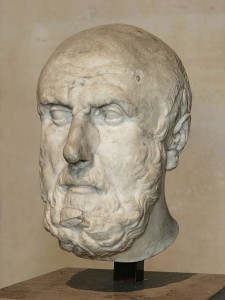
Chrysippus (c. 280—207 B.C.E.)

Chrysippus

Chrysippus was among the most influential philosophers of the Hellenistic period. He is usually thought of as the most important influence on Stoicism. A later Stoic catchphrase ran, “If Chrysippus had not existed, neither would the Stoa.” (Lives 292). Carneades, the fourth Chair of the New Academy, modified the phrase to, “If Chrysippus had not existed, neither would I.” (Lives 438) Chrysippus defended and developed an empiricist epistemology and psychology. He offered important alternatives to the metaphysical theories of Aristotle and Plato, defending a thoroughgoing materialist ontology. His views concerning freedom and determinism continue to generate interest, and he is thought to have endorsed a form of compatibilism countenancing both freedom of the will and a deterministic cosmos. His work in logic was considerable, as he developed, as an alternative to the logic of Aristotle, a kind of propositional logic. As an ethicist, he maintained that the life of human happiness and the life of virtue are one and the same. He seems to have thought virtue is best understood as related essentially, if not entirely reducible, to wisdom. And he thought wisdom derives especially from the study of natural philosophy. That Chrysippus would take wisdom to derive primarily from the study of natural philosophy may be explained, in part, by his conviction that the cosmos exists in accordance with proper ends.

Table of Contents

  1. Life and Times
  2. Sources
  3. Epistemology
    1. Perception
    2. Epistemic Criteria
  4. Logic
    1. Arguments
    2. Propositions
    3. Modality
  5. Metaphysics
    1. Ontology
    2. Being, Being Something, and the Nature of Properties
    3. The Growing Argument
    4. Freedom and Necessity
  6. Ethics
    1. Eudaimonism
    2. The Unity of Virtues
  7. References and Further Reading
    1. Primary Sources
    2. Secondary Sources
    3. Other References

1. Life and Times

Chrysippus was born in Soli, near what is today known as Mersin, Turkey. He died in the 143rd Olympiad at the age of seventy-three (living c. 280-207 B.C.E.). Diogenes Laertius, in his Lives of the Philosophers, reports that before becoming a student of Cleanthes, Chrysippus used to practice as a long-distance runner (287 B.C.E.). He was a master dialectician. Most people thought, according to Diogenes Laertius, that if the gods took to dialectic, they would adopt no other system than that of Chrysippus (289 B.C.E.). Cleanthes had succeeded Zeno, who had founded the school at the Stoa Poikilê in 262 B.C.E. Chrysippus, having taught outside the school for a number of years, returned to succeed his former teacher in 230 B.C.E. Stoicism continued to flourish after his death, as the work begun by early Stoics was continued in the era of Panaetius and Posidonius, and later into the Roman Imperial period by thinkers such as Seneca, Epictetus, and Marcus Aurelius.

2. Sources

Chrysippus was a prolific writer. He is reported to have written more than 705 books (SVF 2.1). No single treatise remains, and we have something in the neighborhood of 475 fragments. Two doxographies stand out—Diogenes Laertius’ Lives of the Philosophers, hereafter, and above, (Lives), and pseudo-Plutarch’s Philosopher’s Opinions on Nature. Cicero writes several works that are of use in reconstructing Stoic thought: Academica, De Finibus, and De Natura Deorum, are among the most important. These contain summaries and critical evaluations of the views of the Hellenistic schools, and although Cicero identifies with the Academics, he is not without sympathy for Stoic philosophy. It is from these sources primarily that scholars have attempted to cobble together a set of fragments and testimonia that present a coherent picture of Stoicism and Stoic philosophers. The Stoicorum Veterum Fragmenta, hereafter (SVF), compiled in three volumes by H. von Arnim, is one of the more important collections of fragments in Greek and Latin, and it is customary to refer to Stoic fragments by making use of von Arnim’s volume numbers and numbering system. More recently, David Sedley and A.A. Long have produced an English translation and commentary of the principal sources of Hellenistic philosophy, The Hellenistic Philosophers, hereafter (LS). Corresponding Greek and Latin texts, with notes and bibliography, can be found in the second volume of this work.

3. Epistemology

a. Perception

Zeno, the founder of Stoicism, defined ‘presentation’ as an impression (phantasia) upon the soul (SVF I 58). That he neglected to indicate what he meant by ‘impression’ is suggested by the controversy between Cleanthes and Chrysippus concerning the exegesis of this term. Cleanthes maintained that an object impresses itself on the soul just as a signet ring impresses itself upon a wax seal—a metaphor Plato had made use of in the Theaetetus (191c8). Chrysippus rejects this model by arguing that if the soul were like a piece of wax (with only one surface exposed), it might only receive one impression at a time. Furthermore, every impression would be lost as the next image impinged upon the former. The soul, however, as Chrysippus argues, receives a number of impressions at once, and it does, in fact, retain some impression while receiving others (Lives 7.50). In place of the wax model, Chrysippus argues that the soul is more akin to air, as air is able to undergo a number of alterations simultaneously, as when a number of individuals are speaking at the same time in the same place. (In fact, the soul, according to Chrysippus, who was a thoroughgoing materialist, is a mixture of air and fire). Chrysippus seems, therefore, to accept an indirect realist view of perception, whereby an impression can represent an external object, i.e., a phantaston:

Chrysippus says that these four, [impression, impressor, imagination, and figment] are to be distinguished from one another. An impression is an affection occurring in the soul that reveals itself and its cause. Thus, when through sight we observe something white, the affection is what is engendered in the soul through vision; and it is this affection (pathos) that enables us to say there is a white object that activates us. The word ‘impression’ (phantasia) is derived from the word light (phõs); just as light reveals itself and whatever else it includes in its range, so impression reveals itself and its cause. (SVF 2.54)

Not every presentation is, however, accurate. Some presentations lack a corresponding ‘impressor’. Although we see what appears to be Clint Eastwood on the silver screen, nobody believes that Clint is actually up there (LS 236). Chrysippus considers a presentation such as this one to be the result of imagination, or a phantastikon. A presentation that is believed, but which lacks an underlying real object, as for example the dragoness of Hades as it appears to Orestes, would be classified as a figment, or a phantasma.

Imagination is an empty attraction, an affection in the soul which arises from no impressor…A figment is that to which we are attracted in the empty attraction of imagination; it occurs in people who are melancholic and mad. (SVF 2.54)

b. Epistemic Criteria

So how does the ruling element of the soul distinguish a real presentation from a mere figment? According to Diogenes Laertius, the Stoics maintained the following (Lives 155):

[W]ith respect to presentations, on the one hand there is the cataleptic, and on the other there is the non-cataleptic. The cataleptic, which they say is the criterion of things, is that which comes to be from an existent object, agrees with the real object itself, having been stamped and imprinted. The non-cataleptic does not come to be from the existent object, or if it does, fails to accord with that which exists; it is neither clear nor distinct.

A cataleptic (“apprehending” or “grasping”) presentation (i) comes from a real object (ii) accurately corresponds to that object, (iii) is imprinted on the sense faculty, and, as we might add, (iv) is clear and distinct. The Stoics, moreover, take the cataleptic impression to be the criterion by means of which one may discern fact from fiction. Needless to say, the Skeptics were eager to ask how it is that one may discern the cataleptic from the non-cataleptic. The conceptual landscape here is filled out aptly by Cicero in his Academica (2.83):

There are four headings to prove there is nothing that can be known, cognized, or grasped, which is the subject of this whole controversy. The first of these is that (i) some false impression does exist. The second is that (ii) it is not cognitive. The third is that (iii) impressions between which there is no difference cannot be such that some are cognitive and others not. The fourth is that (iv) no true impression arises from sensation that does not have alongside it another impression, no different from it, that is not cognitive. Everyone accepts the second and third of these. Epicurus does not grant the first, but you…[Stoics], with whom we are dealing, admit that one. The entire battle is about the fourth.

The Stoics seemed to have denied that a true and a false impression might nevertheless be qualitatively indistinguishable. But, as Cicero goes on to ask, what mark (notum) of a cataleptic impression might one have such that it could not be false? In response to Cicero’s question, the Stoics developed several strategies (Lives 162):

The standard of truth they claim is the cataleptic presentation, i.e., that which comes to be from a real object, according to Chrysippus in the twelfth book of his Physics, and to Antipater and Apollodorus. Boëthus, however, admits a plurality of standards, namely intelligence, sense-perception, appetency, and knowledge. But Chrysippus contradicts himself…and says that the criterion is sensation and preconception (prolepsis). And preconception is a natural concept of the universal. Again, certain others of the older Stoics make orthos logos the criterion; so also does Posidonius in his treatise On the Criterion.

The pivotal question for understanding Chrysippus’ epistemology seems to concern the meaning he attaches to prolepsis. On one reading, these preconceptions might be considered innate concepts. This reading, however, rings inconsonant with the empiricist leanings associated with the Stoics (SVF 2.83):

The Stoics say that whenever a person is born, the hegemonic part of his soul is like a sheet prepared to be written upon. Upon this he writes each one of his conceptions. The first method of inscription is via the senses. For by perceiving something, e.g., white, they have a memory of it when it has departed. And when many memories of a similar kind have occurred, we then say we have experience. For the plurality of similar experiences is experience. Some conceptions arise naturally in the previously mentioned ways without deliberation, others by means of our own instruction and attention. The latter are called merely conceptions. The former are called preconceptions (prolepseis) as well. Reason, for (possessing) which we are called rational, is said to be completed by means of our preconceptions during our first seven years.

The above passage suggests that Stoics viewed the mind as a tabula rasa. Concepts, or prolepseis, are acquired causally by the repetition of similar presentations. (See Aristotle’s Posteria Analytica II.9) Chrysippus seems to have thought that one might compare a given token presentation with the concept one has of the type thereof. When, for example, the sage rejects the presentation of a dragoness, one may note that the dragoness does not match the prolepsis one has of females. If this is his line of thinking, it is fair to say that Chrysippus is sanguine indeed with respect to the reliability of the cognitive mechanism responsible for the acquisition of prolepseis. Optimism at this level, however, accords well with the Stoic view that the world is constructed in accordance with reason (Lives VII.134):

[The Stoics] think that there are two principles of the universe—that which acts, and that which is acted upon. That which is acted upon is unqualified substance, i.e. matter; that which acts is the reason (logos) in it, i.e. god.

Understood in this way, Chrysippus’s view seems to share certain features with those more contemporary epistemologists who are keen to emphasize the proper function of one’s cognitive abilities—more so than one’s subjective relationship to a belief—in the production of beliefs that meet the requirements for warrant or knowledge. The Stoics saw the presence of the divine in terrestrial things. The epistemic faculties, like other faculties, are there for a reason.

4. Logic

The Stoics’ appreciation for logic probably originated with the school’s founder. Zeno studied with Stilpo the Megarian. And Megara was the home of a number of important philosophers engaging in a discipline that we would today call logic. Chrysippus, without question, is the philosopher most responsible for the logic associated with the Stoics. In the following section, we will consider some of the elements that set his logic apart from that of his predecessors, as well as the propositional logic that most students of philosophy are familiar with today.

a. Arguments

One way of understanding Chrysippus’ contribution to logic is to see what Stoic arguments are not. Consider the following argument:

All mammals are warm-blooded animals.
All warm-blooded animals are sanguineous.
So: All mammals are sanguineous.

Aristotle called an argument of this variety a syllogism. He took it as evident that given the truth of the premises, the conclusion is likewise true. Indeed, one need not know the meaning of the terms in the argument to determine that the conclusion follows logically from the premises. One may simply consider the form of the argument:

All A are B A = mammals
All B are C B = warm-blooded animals
So: All A are C C = sanguineous

Logicians consider arguments wherein the conclusion follows from the premises, in just this way, to be valid. It is important to recognize that an argument’s having true premises provides neither necessary nor sufficient grounds for it to be valid. The following argument is valid, as the conclusion follows from the premises, even though the premises would rightly be resisted. The argument thereafter has true premises, but it is clearly invalid, as the premises may be true although the conclusion is false.

All trout are mammals. No viviparous animal is a trout.
All mammals are oviparous. No trout is a mammal.
So: All trout are oviparous. So: No viviparous animal is a mammal.

Consider, next, the following argument. It is clearly valid, but how would one fit it into an Aristotelian syllogism?

If Plato walks, then Plato moves. p = Plato walks.
Plato walks. q = Plato moves.
So: Plato moves.

Aristotle resisted the idea that there could be a scientific demonstration that concerned individuals. (Notice that the Aristotelian arguments above made use of classes). The argument currently under discussion resists an Aristotelian formulation, for the relata herein are propositions—Stoics called these ‘sayables’—rather than classes. In Aristotelian logic, the key connectives are ‘all’, ‘some’, ‘is’, and ‘is not’. In Chrysippus’ logic, the key connectives are ‘if’, ‘or’, ‘and’, and ‘not’. In the forms below, the former represents the form of our argument above; the latter a form that is clearly fallacious:

If p, then q If p, then q p = Plato walks.
p q q = Plato moves.
So: q So: p

Stoics built arguments in this way. Following Aristotle’s lead in the Prior Analytics, they listed a number of indemonstrable modes of argument—forms whose validity is clearly not in question—to which, they were optimistic, all other valid arguments may be reduced. The following is a list of the five indemonstrable forms (the first four have names):

Modus ponens: If p, q; p; ergo, q.
Modus tollens: If p, q; not q; ergo, not p.
Modus ponendo tollens: Either p or q; p; ergo not q.
Modus tollendo ponens: Either p or q; not q; ergo p.
Not both p and q; p; ergo, not q.

b. Propositions

That the Stoics distinguished between simple and complex propositions should be clear from what has been said heretofore. The sayable Plato walks is simple, and the sayable If Plato walks, then Plato moves is complex, as the statements Plato walks and Plato moves are connected by the particles ‘if’ and ‘then’. But Chrysippus’s account of what makes complex ‘sayables’ true or false differs in interesting ways with the truth-functional accounts that many modern philosophers make use of (a sentence is truth-functional when the truth of the sentence is a function of the values of its subsentences). Consider ponendo tollens above and let the value of p be the car won’t start because of a dead battery, and the value of q be the car won’t start because of a bad alternator. When your mechanic asserts the disjunction of these claims, and subsequently finds the former to be true, an inference to the falsity of the latter is not deductively valid. (It might be that you have a bad alternator as well.) This is not the way that Chrysippus seems to have viewed the matter. The Stoics were keen to understand all legitimate disjunctions to present mutually exclusive alternatives, for example, p or q, but not both p and q:

But all the disjuncts must mutually conflict, and their contradictories…must also be mutually opposed. Of all disjuncts, one must be true, the other false. But if neither of them is true, or all or more than one of them are true, or the disjuncts do not conflict, or the contradictories of the disjuncts are not incompatible, then that is false as a disjunctive proposition (LS 301).

For Chrysippus the paradigmatically true conditional is one where the contradictory of the consequent conflicts with the antecedent. In the conditional below, the contradictory of the consequent is Plato does not move. And this claim can reasonably be said to be in conflict with our antecedent: Plato walks.

If (antecedent) Plato walks, then (consequent) Plato moves.

And although there is no detailed or precise account of how Chrysippus understood this notion of conflict, it is likely the case that the conflict in question is of the conceptual variety rather than mere empirical incompatibility (See LS 211). The type of conditional in question can be contrasted with the material conditional of the propositional calculus favored by many modern logicians, where a conditional is true provided the antecedent is false or the consequent is true (or is understood inclusively here). Consider the claim If we have pie, then we will have coffee. The contradictory of our consequent is We will not have coffee, and this claim does not present any real conflict with the antecedent of our claim, namely, We will have pie. Furthermore, a conditional of the material variety is truth-functional, that is, true just by virtue of the truth of its constituents. (The Stoics preferred to express claims of this sort as ‘it is not the case that we will have pie and not have coffee’.) Notice how a Chrysippean conditional, mutatis mutandis a Chrysippean disjunction, depends upon more than the truth-value of its constituents. Not only does it depend upon the contradictory of the consequent, it depends as well on a semantic understanding of what it is to conflict.

c. Modality

As we saw above, the Stoics classified certain kinds of sayables with reference to certain properties that are not part of linguistic form. In addition, Stoics classified sayables in terms of their modal properties, that is, possibility, necessity, impossibility, and non-necessity. (They also considered the properties of plausibility and probability as well (Bobzien 2003). For the Stoics’ account of modality, the Megarians are again an important influence (LS 231):

Diodorus defines the possible as ‘what is or will be’; the impossible as ‘what, being false, will not be true’; the necessary as ‘what being true, will not be false’; and the non-necessary as ‘what either is now, or will be false’.

An account such as this one fixes the possible to the temporal. If something is possible, say a sea-battle, then it occurs at some time. If something is impossible, say a triangle with less than three sides, then there will not be an instance of it at some time. The necessary sayable, for example, triangles have fewer than four sides, is that which will not be false at some time. And the non-necessary, Cypselus is ruling, is a claim that will be false at some time. One difficulty that accounts such as this face is that they do not explain sentences such as the following:

A golden mountain is at the top of Hannah Street.

This coat might have been shredded, but it was burned instead.

Sometimes we express a possibility that we believe will never actualize. Chrysippus offers a criticism similar in kind. He seems to argue that a jewel might never be smashed, but that insofar as one might receive credit for not smashing it, we would nevertheless consider it possible to smash the jewel (LS 235).

The set of modal definitions preferred by the Stoics is difficult to reconstruct. But there is some reason for thinking that Chyrsippus followed Philo in taking possible propositions to be those wherein the internal nature is capable of truth. Precisely what one is to make of the locution ‘internal nature is capable of truth’ is not known. But it is tempting to understand Chrysippus on the basis of his objections to Diodorus, and his account of conditionals, as saying something akin to “a proposition is possible if conceptually self-consistent, and (if) there are no external circumstances preventing it”. The remaining modalities would be defined in relation to the possible.

5. Metaphysics

For reasons similar to those of the Epicureans, the Stoics were materialists. Only that which can affect or be affected may be said to exist, so the argument runs; and only that which is corporeal may affect or be affected (Academica I.39). Nevertheless, their view does admit of a kind of dualism, as everything in the cosmos is the result of an active principle, namely God, upon a passive, or causally inert, indeterminate substrate (Lives VII.134). And for Chrysippus, divine presence in terrestrial things comes in the form of pneuma–a fiery kind of air, or ether (Lives 7.138-9), which gives form and quality to that which is per se devoid of quality. Although the Epicureans, following in the tradition of Democritus and Leucippus, were arguing that everything is made up of the discrete and the indivisible (atomon), the Stoics maintained that the prima materia upon which the active principle exercised its influence is continuous, serving as the substrate for everything from basic continua such as earth, water, air, and fire, to individual organisms such as Socrates and Secretariat. Where the Peripatetic would characterize Secretariat as an individual substance or thing, and brown as a property, or modification, thereof; Chrysippus, and the Stoics in general, would consider Secretariat to be a property or modification of the passive element, and the brown color to be, in turn, a disposition thereof.

a. Ontology

As Simplicius reports in his commentary on Aristotle’s Categories (SVF 2.369):

The Stoics see fit to reduce the number of primary genera, and others they take over with changes in the reduced list. For they make their division a fourfold one, into substrates, the qualified, the disposed, and the relatively disposed.

Thus, the Stoics recognized four main levels of existence, and, as Long and Sedley have argued, there is some reason for thinking that these categories originated with Chrysippus (165). The first category is that of substrate (hupokeimenon). To locate an entity in this first category is to assign it existence without reference to its qualities. This characterless substance is being, or ousia, in its primary sense. The next level of being is that of quality. To be more precise, this level of being is something qualified by the inseparable god, reason, or soul, that pervades the substrate, and on the account of Chrysippus, this takes the form of pneuma (LS 46A). In the second category the Stoics placed modifications or qualified substrates (poia) of the prima materia and, interestingly, it is in this category of qualities, or poia, that the Stoics include people, and organisms, in general. Organisms are, therefore in an important sense, adjectival in being. The third category concerns dispositions of the things that are qualified, or things that are qualified, disposed in some way (põs echonta). Grammatical knowledge, for example, would be a disposition of the grammarian. In the fourth category, the Stoics countenanced dispositions that are relatively so, or pros ti põs echonta. These dispositions bear a resemblance to the so called Cambridge properties that may change without any change to the item under consideration, as, for example, your being to the right of me may occur without my having changed my position.

b. Being, Being Something, and the Nature of Properties

The Stoics were, moreover, materialists. Only corporeals, or somata, exist. Existence, however, is not the highest ontological category. In the Sophist, Plato had suggested that for something x to be some thing was for x to exist. But the Stoics reject Plato’s suggestion, maintaining that reality may be divided on the one hand into corporeals (somata), which may be said to exist; and on the other hand into incorporeals (asomata), which may be said to subsist (SVF 1.65). The Stoics thought that the latter category was comprised of such things as time, place, void, and ‘sayable’ (lekta). The Stoics’ reason for saying that the incoporeals are real has, to be sure, a Meinongian ring. In order to be an object of one’s thought, a lekta, for example, must be something. Otherwise there is nothing one is ex hypothesi thinking about.

Understood in this way, the Stoic ontological classification implicitly rules out properties of a certain kind. Socrates and Glaucon, for example, both have the attribute of being a man. And this invites the question: Does this so called entity Man, under which both are said to be classified, exist? Plato on the received view (but see Grabowski 2008), and Aristotle, held that (i) the property of being a man exists independently of our recognition thereof, and, (ii) that the property, that of being a man, which belongs to Socrates, is numerically identical to the property, similarly described, which belongs to Callias. Though the philosophical literature on properties is less than univocal, in terminology and criteria, those who accept the received view, attributed here to Plato and Aristotle, are frequently referred to as Realists. Those who maintain that properties described in this way do not exist are frequently called Nominalists.

Chrysippus resolutely rejects the views of Plato and Aristotle concerning properties. But the committed Nominalist will have to say something about propositions which are taken to be true, and which, importantly, seem to refer to such entities, call them for present purposes, universals. Consider the following proposition:

(A) Man is a rational mortal animal.

Chrysippus, as we will see below, relies upon the truth of this proposition in his ethical philosophy. The advocate of this proposition, however, would seem to be committed to the universal Man. In order to avoid this ontological commitment, Chrysippus understands the claim as conditional rather than existential in form (LS 301):

(A*) If something is a man, that thing is a rational mortal animal.

Although (A*), as one might argue, is identical in meaning to (A), (A*) does not make use of the abstract term Man, and if (A*) does not require the use of the abstract term Man, Chrysippus needn’t countenance any entity to which the term may refer in order to count (A*) to be true. And, since he takes the meaning of (A) and (A*) to be one and the same, he can take (A) to be true as well. Of course, there are propositions in addition to (A) that one might consider orthodox, which seem to make reference to abstract entities. Chrysippus is optimistic that a similar kind of paraphrase will apply, mutatis mutandis, to these.

Having argued that one need not posit the existence of universals to account for certain propositions of the orthodox variety, Chrysippus developed an argument in support of the claim that the Platonic account is unintelligible (LS 30 E):

Indeed, Chrysippus too raises problems as to whether the Idea will be called a certain this (tode ti)…Namely: if someone is in Athens, he is not in Megara; <but man is in Athens; therefore man is not in Megara>. For man is not someone, since the universal is not someone; but we took him as someone in the argument. And that is why the argument has this name, being called the ‘Not-someone’ argument.

The argument is a little impressionistic, but we might begin to reconstruct it as follows:

(1) If someone (or something) is in Athens, he (or it) is not in Megara.
(2) Man is in Athens.
So: (3) Man is not in Megara.

The argument seems to be a reductio ad absurdum built upon the idea that the Platonist will accept claims (1) and (2). The acceptance of (1) and (2), however, with an application of modus ponens, entails something the Platonist will not willingly accept. At this point, the Platonist might feel pushed to claim that Man is not to be classified by the terms, that is, someone or something, in the first premise. This, however, comes dangerously close to conceding a point to which the Platonist is not entitled, that is, Man is not something. Perhaps a more appealing move for the Platonist would be to give up (1) maintaining that universals are something, and that they are things that may be found in objects that are in different places, such as Athens and Megara, at the same time. This of course flushes out the very queer nature of universals. It seems that countenancing universals countenances entities that may be located simultaneously in a number of places, if they are located at all. It is, of course, open to the Platonist to argue that the properties in question do not exist in space, so it is a mistake to say that they are ‘located’ in a number of places at the same time.

c. The Growing Argument

As Long and Sedley argue, the fourfold ontological distinction seems to have emerged in response to Academic criticism, and Chrysippus seems to have been the central respondent (172). The Academics had made use of an argument known as the Growing Argument, which is traced to the fifth-century comic poet named Epicharmus, in order to generate skepticism with respect to the idea that an organism may endure, or exist diachronically (LS 28A). The argument begins by making use of an analogy that may be adapted to suit our purposes as follows: Suppose that I have a stack of pennies in my garage on Tuesday, and I remove one of the pennies on Wednesday. The resultant stack of pennies in my garage is, arguably, not the same stack that was in my garage on Tuesday, but a new stack altogether. To drive the idea home, we might suppose that the stack is not composed, as it were, of pennies, but rather of fifty dollar bills. Suppose I promise Helena, on Tuesday, that she may have the stack of bills provided that she cleans the garage. Were I to remove one of the fifties before giving her the stack, she can fairly protest that I did not give her the same stack I had promised her. The moral to glean, then, is that when it comes to stacks or lumps, the removal (or addition) of one (or more) of the constituents results in the destruction of the old (or the generation of a new) lump or stack. As the Academics were inclined to point out, on the Stoic view, people are composed entirely of matter. And who can deny that in, say, drinking a cup of coffee, or a glass of wine, there is an influx (and later there will be an efflux) of material constituents? What is more, work central to Stoic cosmology involved the study of natural processes. Where growth and decay are among the most fundamental of these, the Academics challenged the idea that any coherent account may here be provided (Sedley 1982, 258).

Those who are familiar with John Locke’s treatment of diachronic identity, in The Essay Concerning Human Understanding, will spot a certain resemblance in Chrysippus’s response. For Chrysippus seems to believe that a single object may, under different descriptions, have incompatible properties ascribed thereto (Sedley 1982, 259). Under the description ‘this lump of matter’, one’s identity may change continually from one moment to the next. Under the description ‘this person’, this need not be the case. For Chrysippus, moreover, a thing’s constitutive matter is a hupokeimenon. And, as a substrate, as Chrysippus concedes, things do not exist diachronically. Nevertheless, lumps of matter possess unique sets of qualities, and may be classified under the second category of the Stoic ontology. These items can be said to be idiõs poioi, ‘peculiarly qualifieds’, which can indeed endure through time. It is in this way that living things are said to exist diachronically.

Having disarmed the Growing Argument in this way, Chrysippus seems to have taken his case on the offensive. The text we have to work with derives from Philo of Alexandria:

Chrysippus, the most distinguished member of their school, in his work On the Growing Argument, creates a freak of the following kind. Having first established that it is possible for two peculiarly qualified individuals to occupy the same substance jointly, he says: “For the sake of argument, let one individual be thought of as whole-limbed; the other as minus one foot. Let the whole-limbed one be called Dion, the defective one Theon. Then let one of Dion’s feet be amputated…”

Chrysippus’ thought-experiment here bears a striking resemblance to a more modern puzzle that has been discussed by David Wiggins (1968): consider a cat by the name of Tibbles, and focus for the moment on that portion of Tibbles that includes everything save Tibbles tale. Designate the portion that includes everything but Tibbles’ tale with the name Tib. Tibbles and Tib, heretofore, do not occupy the same space at the same time. Thus, Tibbles and Tib are not identical. Suppose, however, that we amputate Tibbles’ tale. Tibbles and Tib now occupy the same region of space. If Tibbles is still a cat, it will be difficult to discern a criterion by which one could deny that Tib is a cat. Nevertheless, Tibbles and Tib are distinct individuals as they have had different histories. Hence, two cats occupy, and of course don’t occupy (so runs the reductio), the same place. And the puzzle, for Wiggins, is to see where the reasoning has gone astray. Chrysippus’ puzzle is very similar: Dion and Theon are said to occupy the same substance (rather than the same space), and where Dion has a right foot, Theon lacks one. However, when Dion’s foot is amputated, Chrysippus’s approach is not that of considering the conclusion to be validly derived from faulty premises. Instead, Chrysippus rejects the idea that Theon continues to exist. By all appearances, Chrysippus seems to have argued that after the amputation, when a bystander poses the question ‘Whose foot has been severed?’ the only intelligible answer is: that of Dion. As Theon could not have lost a foot he never had, and whoever is being bandaged there just lost a foot, Dion is the better candidate for survival. Of course, the paradox cannot be said to be constructed on Stoic premises. Sedley argues that Chrysippus turns the Growing Argument back on the Academics by showing that although they assume that material growth and diminution are fatal to the idea of an enduring entity, diminution is indeed part of the condition of Dion’s enduring, while the undiminished, unchanged Theon is the one who perishes (1982, 270).

d. Freedom and Necessity

Providence plays the leading role in Stoic cosmology. An instance of causation is, after all, the operation of the active principle, namely god, on that which is passive or inert. This providence gives way, for Chrysippus, to an outlook on the cosmos that is very deterministic (SVF2.1000).

In On Providence book 4, Chrysippus says that fate is a certain natural, everlasting ordering of the whole: one set of things follows and succeeds another, and the interconnection is inviolable.

Chrysippus’s deterministic outlook invites the following question: If the cosmos is ordered in a deterministic fashion, and we are part of it, then it would seem that we are ordered in a deterministic fashion. Thus, our actions will follow the one upon the other in a succession where the nexus is never violable. And, if we may never deviate from the course ordered by fate, we never have the control to act otherwise. Chrysippus’s cosmology seems not to accommodate the view that we are sometimes morally responsible for our actions. Stoic philosophy is, however, a philosophy of moral rigor, so Chrysippus owes an answer. Epicurean philosophers maintained a minimal level of indeterminacy at the atomic level (De Rerum Natura 2.216). As we have seen, this option is not open to Chrysippus and, in any case, the indeterminacy view is not without difficulty. (As Hume argued in the Enquiry, one has no control over that which lacks a cause). The acceptance of determinism taken with an optimistic outlook concerning the possibility of free action suggests that Chrysippus countenances the latter as compatible with the former. Precisely how the two are going to be understood as compatible has, however, been the subject of some controversy.

One possibility for understanding Chrysippus’ view can be derived from the following text (Long and Sedley 62a):

They too [Zeno and Chrysippus] affirmed that everything is fated, with the following model: When a dog is tied to a cart, if it wants to follow it is pulled and follows, making its spontaneous act coincide with necessity, but if it does not want to follow it will be compelled in any case. So it is with men too: even if they do not want to, they will be compelled in any case to follow what is destined.

This passage has been interpreted in a variety of ways. One might understand the point to be as follows. The threat that fatalism or determinism poses for moral responsibility seems to enter with the idea that if we cannot act otherwise than we do, we are not free. But consider our dog Maddy, fettered as she is to her master’s cart. We may assume that she follows her master, who is pulling the cart, with a canine sense of alacrity, and that she would do so, in much the same way, even were she not tied to the cart. It seems that she freely follows her master when, nevertheless, she could not act otherwise. Read in this way, the passage is a counterexample to the claim that if one cannot act otherwise, one is not free.

Susanne Bobzien has argued that the simile was authored by neither Zeno nor Chrysippus, but instead has its source in the Roman Stoa, and although she does acknowledge that it is probably an interpretation of a number of verses belonging to Cleanthes (2001 354), she finds nothing in the passage that meets up with accommodating free will. The point of the passage, on her view, is simply that it is in vain that one revolts from what fate administers.

Another important passage for exegetes is the following:

For although assent cannot occur unless it is prompted by an impression, nevertheless, since it has that impression as its proximate, not its primary cause, Chrysippus wants it to have the rationale which I mentioned just now. He does not want assent, at least, to be able to occur without the stimulus of external force (for assent must be prompted by an impression). But he resorts to his cylinder and spinning-top; these cannot begin to move without a push; but once that has happened, he holds that it is thereafter through their own nature that the cylinder rolls and the top spins. “Hence”, he says, “just as the person who pushed the cylinder gave it its beginning of motion but not its capacity for rolling, likewise, although the impression encountered will print and, as it were, emblazon its appearance on the mind, assent will be in our power. And assent, just as we said in the case of the cylinder, although prompted from will, thereafter moves through its own force”.

The above passage is important in connection with Chrysippus’s epistemology, meeting up as it does with the issue of whether belief or acceptance is a voluntary process. But it may also hold a clue concerning Chrysippus’ account of free action in general. The idea seems to be that the cylinder needs to be pushed in order to be set in motion, and considerations of the Newtonian variety aside, the power to keep rolling is specific to its nature. And, just as the power to keep rolling is found in the nature of the cylinder, so too the power of assent or dissent issues from the agent’s power. Of course, one might object that one may have little to no control over the dispositions that drive one to assent or dissent. And, if one doesn’t haven’t any control over certain antecedent events, that necessitate certain other events, then it seems that one doesn’t have any control over the subsequent events either. That this latter claim is true is not obvious however (McKay and Johnson 1996): Suppose with fair dice I roll snake eyes. From this fact, it follows by necessity that I am playing dice. But does it follow that my playing dice was not up to me? I certainly cannot roll snake eyes without playing dice. But is my playing dice necessitated in the same way? Perhaps the way is unimpeded for Chrysippus to make use of a similar kind of reasoning in his account of free action.

6. Ethics

a. Eudaimonism

As Aristotle observed, although most people agree that happiness or eudaimonia is the goal of life, there is less agreement concerning just what happiness consists in (1095a17). The Stoics agree with Aristotle that living a happy life is the end for the sake of which all things are done, and that such an activity is not done for the sake of anything else (SVF 3.16). Having set eudaimonia or eu zên as the summum bonum, the Stoics are left with the task of indicating wherein happiness consists. And, for the Stoics, happiness consists in nothing other than virtue (De Finibus III.44):

We deem health to be deserving of a certain value, but we do not reckon it a good; at the same time we rate no value so highly as to place it above virtue. This is not the same view held by the Peripatetics, who are going to say that an action which is both moral (honesta) and without pain is more desirable than the same action with pain. We [Stoics] think otherwise.

Nothing, then, is valued more than virtue. One might take happiness to be of a higher value than virtue, as the former may be thought of as a means to the latter, but this would be a mistake, for it seems that Chrysippus was willing to simply identify the virtuous life and the happy life (LS 63h):

He (Chrysippus) maintains that vice is the essence of unhappiness, insisting in every book that he writes on ethics and physics that living viciously is identical to living unhappily.

Of course, in identifying happiness with virtue, Chrysippus is obligated to provide an account of virtue. Zeno, the founder of the school at the Stoa Poikilê, had maintained that the final end of life was to live consistently and harmoniously (SVFI.79). His successor, Cleanthes, understood living consistently and harmoniously as living consistently with nature (SVF3.12.) Chrysippus further explicated the idea with the following formulation: “To live in accordance with one’s experience of the things which come about by nature” (SVF1.12). But it is still unclear what living in accordance with nature means. Friedrich Nietzsche, a German philosopher of the 19th century, attempted to parody the idea by saying:

According to nature you want to live? O you noble Stoics, what deceptive words these are…And supposing your imperative, “live according to nature,” meant at bottom as much as “living according to life”—how could you not do that? Why make a principle out of what you yourselves are and must be?

As we have seen, a fairly thorough determinism pervades the thought of the Stoics, and the course to understanding Chrysippus’s views on action is not without difficulty. So one might fairly ask the question: How might one not live according to nature? In order to understand what the Stoics have in mind, it is important to note that a recurring debate among philosophical circles in antiquity concerned whether what is good is so in virtue of nature (physis) or convention (nomos). As Aristotle points out in the Nichomachean Ethics, there is such diversity among opinions concerning which actions are just that they are thought to exist according to convention rather than nature (1094b 14-16). So, living in conformity with nature or with what is good by nature, contrasts with living in accordance with mere opinion, or convention, concerning what is good. Now, when Chrysippus says, one ought to live in accordance with one’s experience of the things which come about by nature, there is some reason for thinking the nature he has in mind is the nature that is peculiar to human beings. The proprium or nature of the human species is the use of reason. So it seems that Chrysippus’s position is that the man who lives in accordance with reason lives in accordance with virtue. This is a position that enjoys some popularity and that rings reminiscent of Aristotle’s in Nichomachean Ethics. The problem of accounting for free action has not, thus, been cleared away. Nor has the gap between is and ought, hereby, closed. But the imperative ‘live according to nature’ may simply mean ‘live according to your nature qua human being by living in accordance with reason’. And, as an account of virtue, this view had a few considerations in its favor.

b. The Unity of Virtues

Although Chrysippus’s views on virtue share a great deal with those of Aristotle, another clear similarity concerns the connections that Chrysippus and Socrates found to obtain among the cardinal virtues. Socrates seems to have thought that virtues may be reduced to one thing (Protagoras 361a-b), namely, the ability to discern good from evil. In the Laches, for example, it is suggested that courage may be reduced to wisdom by arguing that courage is the knowledge of what inspires fear and confidence. That which issues in fear is evil, and that which inspires confidence is good. Courage is, so the argument goes, knowledge of what is good and what is evil (198b2-199e). Arguments similar in kind reduce the other virtues to knowledge of good and evil, and Chrysippus seems to have retained Socrates’s line of thinking. Prudence is the knowledge of things to be chosen; temperance is the knowledge, for example, of that for which one must be resolute (SVF3.95). Of course, understanding virtue as reducible, in some way, to knowledge dovetails nicely with the idea that virtue is living in accordance with reason.

It is usually thought that the source of knowledge requisite for virtue, according to Chrysippus, is the study of natural philosophy. However, in recent years there has been some debate concerning whether or not the science of ethics, according to Zeno, Cleanthes, and Chrysippus depends crucially upon claims about the nature of the cosmos. A number of scholars now believe that the founders of Stoic philosophy should be freed from the interpretation that ethics relies heavily upon a cosmology that is un- controversially providential. Julia Annas, for example, finds it hard to swallow the idea that ethics depends on cosmology as it “…lead[s] us…to accept counterintuitive conclusions such as nothing but vice is bad, and that emotions like regret are all mistaken”. Accepting the view, however, that the Stoics did not think ethics inextricably tied to physics has its own set of counterintuitive consequences, for it becomes difficult to take them at their word in more than a few key texts. The following is taken from Plutarch (admittedly not the most charitable reader of Stoicism), from his De Stoicorum Repugnantis (LS 60A):

Again in his Physical Postulates, [Chrysippus] says, “There is no other or more appropriate way of approaching the theory of good and bad things or the virtues or happiness than from universal nature (koinê physis), and from the administration of the world”. And later: “For the theory of good and bad, things must be attached to these, since there in no other starting point or reference for them that is better, and physical speculation (physika theoria) is to be adopted for no other purpose than for the differentiation of good and bad things”.

A straightforward reading of Plutarch’s quotation here—this is the reading, for example, of Long and Sedley (LS 374)—is that an account of the rational and providential features of god, which pervade the natural world, are indispensable when determining that which constitutes the good of man. Read in this way, Chrysippus comes across as a teleologist countenancing the good, the scientific, and the pious lives to be one and the same.

7. References and Further Reading

The following lists some important work that has been done on Chrysippus and Stoic philosophy. It is not intended to be a comprehensive bibliography.

a. Primary Sources

  • Stoicorum Veterum Fragmenta in Four Volumes (Leipzig: Teubner, 1903-1924)
    • This work, originally compiled by Hans von Arnim, consisted of three volumes of testimonia and fragments intended for individuals with a background in Latin and Greek literature. Volume one contains fragments relating to Zeno and his followers. Volume two contains fragments related to Chrysippus’s logical and natural philosophy. The third volume contains material related to Chrysippus’s ethical philosophy. A fourth volume containing general indices was added in 1924 by Maximillian Adler.
  • The Hellenistic philosophers, Volume 1: Translations of the Principal Sources, with Philo-Sophical Commentary, by A.A. Long and D.N. Sedley, Cambridge: Cambridge University Press, 1987.
    • This work is probably indispensable for anyone interested in Hellenistic philosophy. It contains English translations and astute commentary. An accompanying volume contains the Greek and Latin texts from which the translations are derived.

b. Secondary Sources

  • Josiah B. Gould, The Philosophy of Chrysippus, Albany, SUNY Press, 1970.
    • This is one of the few monographs limited to discerning the thought of Chrysippus. It is a common starting point for exegetes interested in Chrysippus’s influence on Stoicism.
  • Susanne Bobzien, Determinism and Freedom in Stoic Philosophy, Oxford: Oxford University Press, 2001.
    • Although this work treats the issue of free action in Stoic thought in general, there is a great deal that focuses upon Chrysippus’s views specifically. A number of other articles by Bobzien, including the following, will also be rewarding:
  • Susanne Bobzien, ‘Chrysippus and the Epistemic Theory of Vagueness’, Proceedings of the Aristotelian Society 102 (2002), 217-38.
  • Susanne Bobzien,‘Chrysippus’s Theory of Causes’, Topics in Stoic Philosophy, ed. K. Ierodiakonou, Oxford: Oxford University Press, 1999, 196-242.
  • Susanne Bobzien, ‘Logic’, Cambridge Companion to the Stoics, ed. Brad Inwood, Cambridge: Cambridge University Press, 2003, 85-123.
  • J. Bowin, ‘Chrysippus’s Puzzle about Identity’, Oxford Studies in Ancient Philosophy 24 (2003), 239-251.
  • God and Cosmos in Stoicism, ed. Ricardo Salles Oxford: Oxford University Press, 2009.
    • Readers interested in questions concerning nature, and how humans fit therein, will find a number of interesting essays in God and Cosmos. Recent interest in how humans fit into the environment has issued an interest in the Stoic conception of how humans fit into nature. Several of the essays in this work treat primarily Chrysippus’s views.

c. Other References

  • Annas, J. ‘Ethics in Stoic Philosophy’, Phronesis, 52, 58-87.
  • Caston, V. ‘Something and Nothing: The Stoics on Concepts and Universals’, Oxford Studies in Ancient Philosophy 17, 145-213.
  • Grabowski, F. Plato, Metaphysics and the Forms. Continuum Studies in Ancient Philosophy, New York/London: Continuum, 2008.
  • McKay, Thomas and David Johnson (1996). “A Reconsideration of an Argument against Compatibilism”, Philosophical Topics 24: 113-122.
  • Nietzsche, F. Beyond Good and Evil, in Basic Writings of Nietzsche, tr. and ed. Walter Kaufmann, New York: Modern Library, 1992: 205.

Author Information

Jeremy Kirby
Email: jkirby@albion.edu
Albion College
U. S. A.
Immortality

Immortality is the indefinite continuation of a person’s existence, even after death. In common parlance, immortality is virtually indistinguishable from afterlife, but philosophically speaking, they are not identical. Afterlife is the continuation of existence after death, regardless of whether or not that continuation is indefinite. Immortality implies a never-ending existence, regardless of whether or not the body dies (as a matter of fact, some hypothetical medical technologies offer the prospect of a bodily immortality, but not an afterlife).

Immortality has been one of mankind’s major concerns, and even though it has been traditionally mainly confined to religious traditions, it is also important to philosophy. Although a wide variety of cultures have believed in some sort of immortality, such beliefs may be reduced to basically three non-exclusive models: (1) the survival of the astral body resembling the physical body; (2) the immortality of the immaterial soul (that is an incorporeal existence); (3) resurrection of the body (or re-embodiment, in case the resurrected person does not keep the same body as at the moment of death). This article examines philosophical arguments for and against the prospect of immortality.

A substantial part of the discussion on immortality touches upon the fundamental question in the philosophy of mind: do souls exist? Dualists believe souls do exist and survive the death of the body; materialists believe mental activity is nothing but cerebral activity and thus death brings the total end of a person’s existence. However, some immortalists believe that, even if immortal souls do not exist, immortality may still be achieved through resurrection.

Discussions on immortality are also intimately related to discussions of personal identity because any account of immortality must address how the dead person could be identical to the original person that once lived. Traditionally, philosophers have considered three main criteria for personal identity: the soul criterion , the body criterion  and the psychological criterion.

Although empirical science has little to offer here, the field of parapsychology has attempted to offer empirical evidence in favor of an afterlife. More recently, secular futurists envision technologies that may suspend death indefinitely (such as Strategies for Engineered Negligible Senescence, and mind uploading), thus offering a prospect for a sort of bodily immortality.

Table of Contents

  1. Semantic Problems
  2. Three Models of Immortality
    1. The Survival of the Astral Body
    2. The Immaterial Soul
    3. The Resurrection of the Body
  3. Pragmatic Arguments for the Belief in Immortality
  4. Plato’s Arguments for Immortality
  5. Dualism
    1. Descartes’ Arguments for Dualism
    2. More Recent Dualist Arguments
    3. Arguments against Dualism
  6. A Brief Digression: Criteria for Personal Identity
    1. The Soul Criterion
    2. The Body Criterion
    3. The Psychological Criterion
    4. The Bundle Theory
  7. Problems with the Resurrection of the Body
  8. Parapsychology
    1. Reincarnation
    2. Mediums and Ghostly Apparitions
    3. Electronic-Voice Phenomena
    4. Near-Death Experiences
    5. Extrasensory Perception
  9. The Technological Prospect of Immortality
    1. Cryonics
    2. Strategies for Engineered Negligible Senescence
    3. Mind Uploading
  10. References and Further Reading

1. Semantic Problems

Discourse on immortality bears a semantic difficulty concerning the word ‘death’. We usually define it in physiological terms as the cessation of biological functions that make life possible. But, if immortality is the continuation of life even after death, a contradiction appears to come up (Rosemberg, 1998). For apparently it makes no sense to say that someone has died and yet survived death. To be immortal is, precisely, not to suffer death. Thus, whoever dies, stops existing; nobody may exist after death, precisely because death means the end of existence.

For convenience, however, we may agree that ‘death’ simply means the decomposition of the body, but not necessarily the end of a person’s existence, as  assumed in most dictionary definitions. In such a manner, a person may ‘die’ in as much as their body no longer exists (or, to be more precise, no longer holds vital signs: pulse, brain activity, and so forth), but may continue to exist, either in an incorporeal state, with an ethereal body, or with some other physical body.

Some people may think of ‘immortality’ in vague and general terms, such as the continuity of a person’s deeds and memories among their friends and relatives. Thus, baseball player Babe Ruth is immortal in a very vague sense: he is well remembered among his fans. But, philosophically speaking, immortality implies the continuation of personal identity. Babe Ruth may be immortal in the sense that he is well remembered, but unless there is someone that may legitimately claim “I am Babe Ruth,” we shall presume Babe Ruth no longer exists and hence, is not immortal.

2. Three Models of Immortality

Despite the immense variety of beliefs on immortality, they may be reduced to three basic models: the survival of the astral body, the immaterial soul and resurrection (Flew, 2000). These models are not necessarily mutually exclusive; in fact, most religions have adhered to a combination of them.

a. The Survival of the Astral Body

Much primitive religious thought conceives that human beings are made up of two body substances: a physical body, susceptible of being touched, smelt, heard and seen; and an astral body made of some sort of mysterious ethereal substance. Unlike the physical body, the astral body has no solidity (it can go through walls, for example.) and hence, it cannot be touched, but it can be seen. Its appearance is similar to the physical body, except perhaps its color tonalities are lighter and its figure is fuzzier.

Upon death, the astral body detaches itself from the physical body, and mourns in some region within time and space. Thus, even if the physical body decomposes, the astral body survives. This is the type of immortality most commonly presented in films and literature (for example, Hamlet’s ghost). Traditionally, philosophers and theologians have not privileged this model of immortality, as there appears to be two insurmountable difficulties: 1) if the astral body does exist, it should be seen depart from the physical body at the moment of death; yet there is no evidence that accounts for it; 2) ghosts usually appear with clothes; this would imply that, not only are there astral bodies, but also astral clothes – a claim simply too extravagant to be taken seriously (Edwards, 1997: 21).

b. The Immaterial Soul

The model of the immortality of the soul is similar to the ‘astral body’ model, in as much as it considers that human beings are made up of two substances. But, unlike the ‘astral body’ model, this model conceives that the substance that survives the death of the body is not a body of some other sort, but rather, an immaterial soul. In as much as the soul is immaterial, it has no extension, and thus, it cannot be perceived through the senses. A few philosophers, such as Henry More, have come to believe that for something to exist, it must occupy space (although not necessarily physical space), and hence, souls are located somewhere in space (Henry, 2007). Up until the twentieth century, the majority of philosophers believed that persons are souls, and that human beings are made up of two substances (soul and body). A good portion of philosophers believed that the body is mortal and the soul is immortal. Ever since Descartes in the seventeenth century, most philosophers have considered that the soul is identical to the mind, and, whenever a person dies, their mental contents survive in an incorporeal state.

Eastern religions (for example, Hinduism and Buddhism) and some ancient philosophers (for example, Pythagoras and Plato) believed that immortal souls abandon the body upon death, may exist temporarily in an incorporeal state, and may eventually adhere to a new body at the time of birth (in some traditions, at the time of fertilization). This is the doctrine of reincarnation.

c. The Resurrection of the Body

Whereas most Greek philosophers believed that immortality implies solely the survival of the soul, the three great monotheistic religions (Judaism, Christianity and Islam) consider that immortality is achieved through the resurrection of the body at the time of the Final Judgment. The very same bodies that once constituted persons shall rise again, in order to be judged by God. None of these great faiths has a definite position on the existence of an immortal soul. Therefore, traditionally, Jews, Christians and Muslims have believed that, at the time of death, the soul detaches from the body and continues on to exist in an intermediate incorporeal state until the moment of resurrection. Some others, however, believe that there is no intermediate state: with death, the person ceases to exist, and in a sense, resumes existence at the time of resurrection.

As we shall see, some philosophers and theologians have postulated the possibility that, upon resurrection, persons do not rise with the very same bodies with which they once lived (rather, resurrected persons would be constituted by a replica). This version of the doctrine of the resurrection would be better referred to as ‘re-embodiment’: the person dies, but, as it were, is ‘re-embodied’.

3. Pragmatic Arguments for the Belief in Immortality

Most religions adhere to the belief in immortality on the basis of faith. In other words, they provide no proof of the survival of the person after the death of the body; actually, their belief in immortality appeals to some sort of divine revelation that, allegedly, does not require rationalization.

Natural theology, however, attempts to provide rational proofs of God’s existence. Some philosophers have argued that, if we can rationally prove that God exists, then we may infer that we are immortal. For, God, being omnibenevolent, cares about us, and thus would not allow the annihilation of our existence; and being just, would bring about a Final Judgement (Swinburne, 1997). Thus, the traditional arguments in favor of the existence of God (ontological, cosmological, teleological) would indirectly prove our immortality. However, these traditional arguments have been notoriously criticized, and some arguments against the existence of God have also been raised (such as the problem of evil) (Martin, 1992; Smith, 1999).

Nevertheless, some philosophers have indeed tried to rationalize the doctrine of immortality, and have come up with a few pragmatic arguments in its favor.

Blaise Pascal proposed a famous argument in favor of the belief in the existence of God, but it may well be extended to the belief in immortality (Pascal, 2005). The so-called ‘Pascal’s Wager’ argument goes roughly as follows: if we are to decide to believe whether God exists or not, it is wiser to believe that God does exist. If we rightly believe that God exists, , we gain eternal bliss; if God does not exist, we lose nothing, in as much as there is no Final Judgment to account for our error. On the other hand, if we rightly believe God does not exist, we gain nothing, in as much as there is no Final Judgment to reward our belief. But, if we wrongly believe that God does not exist, we lose eternal bliss, and are therefore damned to everlasting Hell. By a calculation of risks and benefits, we should conclude that it is better to believe in God’s existence. This argument is easily extensible to the belief in immortality: it is better to believe that there is a life after death, because if in fact there is a life after death, we shall be rewarded for our faith, and yet lose nothing if we are wrong; on the other hand, if we do not believe in a life after death, and we are wrong, we will be punished by God, and if we are right, there will not be a Final Judgment to reward our belief.

Although this argument has remained popular among some believers, philosophers have identified too many problems in it (Martin, 1992). Pascal’s Wager does not take into account the risk of believing in a false god (What if Baal were the real God, instead of the Christian God?), or the risk of believing in the wrong model of immortality (what if God rewarded belief in reincarnation, and punished belief in resurrection?). The argument also assumes that we are able to choose our beliefs, something most philosophers think very doubtful.

Other philosophers have appealed to other pragmatic benefits of the belief in immortality. Immanuel Kant famously rejected in his Critique of Pure Reason the traditional arguments in favor of the existence of God; but in his Critique of Practical Reason he put forth a so-called ‘moral argument’. The argument goes roughly as follows: belief in God and immortality is a prerequisite for moral action; if people do not believe there is a Final Judgment administered by God to account for deeds, there will be no motivation to be good. In Kant’s opinion, human beings seek happiness. But in order for happiness to coincide with moral action, the belief in an afterlife is necessary, because moral action does not guarantee happiness. Thus, the only way that a person may be moral and yet preserve happiness, is by believing that there will be an afterlife justice that will square morality with happiness. Perhaps Kant’s argument is more eloquently expressed in Ivan Karamazov’s (a character from Dostoevsky’s The Brothers Karamazov) famous phrase: “If there is no God, then everything is permitted… if there is no immortality, there is no virtue”.

The so-called ‘moral argument’ has been subject to some criticism. Many philosophers have argued that it is indeed possible to construe secular ethics, where appeal to God is unnecessary to justify morality. The question “why be moral?” may be answered by appealing to morality itself, to the need for cooperation, or simply, to one’s own pleasure (Singer, 1995; Martin, 1992). A vigilant God does not seem to be a prime need in order for man to be good. If these philosophers are right, the lack of belief in immortality would not bring about the collapse of morality. Some contemporary philosophers, however, align with Kant and believe that secular morality is shallow, as it does not satisfactorily account for acts of sacrifice that go against self-interest; in their view, the only way to account for such acts is by appealing to a Divine Judge (Mavrodes, 1995).

Yet another pragmatic argument in favor of the belief in immortality appeals to the need to find meaning in life. Perhaps Miguel de Unamuno’s Del sentimiento tràgico de la vida is the most emblematic philosophical treatise advocating this argument: in Unamuno’s opinion, belief in immortality is irrational, but nevertheless necessary to avoid desperation in the face of life’s absurdity. Only by believing that our lives will have an ever-lasting effect, do we find motivation to continue to live. If, on the contrary, we believe that everything will ultimately come to an end and nothing will survive, it becomes pointless to carry on any activity.

Of course, not all philosophers would agree. Some philosophers would argue that, on the contrary, the awareness that life is temporal and finite makes living more meaningful, in as much as we better appreciate opportunities (Heidegger, 1978). Bernard Williams has argued that, should life continue indefinitely, it would be terribly boring, and therefore, pointless (Williams, 1976). Some philosophers, however, counter that some activities may be endlessly repeated without ever becoming boring; furthermore, a good God would ensure that we never become bored in Heaven (Fischer, 2009).

Death strikes fear and anguish in many of us, and some philosophers argue that the belief in immortality is a much needed resource to cope with that fear. But, Epicurus famously argued that it is not rational to fear death, for two main reasons: 1) in as much as death is the extinction of consciousness, we are not aware of our condition (“if death is, I am not; if I am, death is not”); 2) in the same manner that we do not worry about the time that has passed before we were born, we should not worry about the time that will pass after we die (Rist, 1972).

At any rate, pragmatic arguments in favor of the belief in immortality are also critiqued on the grounds that the pragmatic benefits of a belief bear no implications on its truth. In other words, the fact that a belief is beneficial does not make it true. In the analytic tradition, philosophers have long argued for and against the pragmatic theory of truth, and depending on how this theory is valued, it will offer a greater or lesser plausibility to the arguments presented above.

4. Plato’s Arguments for Immortality

Plato was the first philosopher to argue, not merely in favor of the convenience of accepting the belief in immortality, but for the truth of the belief itself. His Phaedo is a dramatic representation of Socrates’ final discussion with his disciples, just before drinking the hemlock. Socrates shows no sign of fear or concern, for he is certain that he will survive the death of his body. He presents three main arguments to support his position, and some of these arguments are still in use today.

First, Socrates appeals to cycles and opposites. He believes that everything  has an opposite that is implied by it. And, as in cycles, things not only come from opposites, but also go towards opposites. Thus, when something is hot, it was previously cold; or when we are awake, we were previously asleep; but when we are asleep, we shall be awake once again. In the same manner, life and death are opposites in a cycle. Being alive is opposite to being dead. And, in as much as death comes from life, life must come from death. We come from death, and we go towards death. But, again, in as much as death comes from life, it will also go towards life. Thus, we had a life before being born, and we shall have a life after we die.

Most philosophers have not been persuaded by this argument. It is very doubtful that everything has an opposite (What is the opposite of a computer?) And, even if everything had an opposite, it is doubtful that everything comes from its opposite, or even that everything goes towards its opposite.

Socrates also appeals to the theory of reminiscence, the view that learning is really a process of ‘remembering’ knowledge from past lives. The soul must already exist before the birth of the body, because we seem to know things that were not available to us. Consider the knowledge of equality. If we compare two sticks and we realize they are not equal, we form a judgment on the basis of a previous knowledge of ‘equality’ as a form. That knowledge must come from previous lives. Therefore, this is an argument in favor of the transmigration of souls (that is, reincarnation or metempsychosis).

Some philosophers would dispute the existence of the Platonic forms, upon which this argument rests. And, the existence of innate ideas does not require the appeal to previous lives. Perhaps we are hard-wired by our brains to believe certain things; thus, we may know things that were not available to us previously.

Yet another of Socrates’ arguments appeals to the affinity between the soul and the forms. In Plato’s understanding, forms are perfect, immaterial and eternal. And, in as much as the forms are intelligible, but not sensible, only the soul can apprehend them. In order to apprehend something, the thing apprehending must have the same nature as the thing apprehended. The soul, then, shares the attributes of the forms: it is immaterial and eternal, and hence, immortal.

Again, the existence of the Platonic forms should not be taken for granted, and for this reason, this is not a compelling argument. Furthermore, it is doubtful that the thing apprehending must have the same nature as the thing apprehended: a criminologist need not be a criminal in order to apprehend the nature of crime.

5. Dualism

Plato’s arguments take for granted that souls exist; he only attempts to prove that they are immortal. But, a major area of discussion in the philosophy of mind is the existence of the soul. One of the doctrines that hold that the soul does exist is called ‘dualism’; its name comes from the fact that it postulates that human beings are made up of two substances: body and soul. Arguments in favor of dualism are indirectly arguments in favor of immortality, or at least in favor of the possibility of survival of death. For, if the soul exists, it is an immaterial substance. And, in as much as it is an immaterial substance, it is not subject to the decomposition of material things; hence, it is immortal.

Most dualists agree that the soul is identical to the mind, yet different from the brain or its functions. Some dualists believe the mind may be some sort of emergent property of the brain: it depends on the brain, but it is not identical to the brain or its processes. This position is often labeled ‘property dualism’, but here we are concerned with substance dualism, that is, the doctrine that holds that the mind is a separate substance (and not merely a separate property) from the body, and therefore, may survive the death of the body (Swinburne, 1997).

a. Descartes’ Arguments for Dualism

René Descartes is usually considered the father of dualism, as he presents some very ingenuous arguments in favor of the existence of the soul as a separate substance (Descartes, 1980). In perhaps his most celebrated argument, Descartes invites a thought experiment: imagine you exist, but not your body. You wake up in the morning, but as you approach the mirror, you do not see yourself there. You try to reach your face with your hand, but it is thin air. You try to scream, but no sound comes out. And so on.

Now, Descartes believes that it is indeed possible to imagine such a scenario. But, if one can imagine the existence of a person without the existence of the body, then persons are not constituted by their bodies, and hence, mind and body are two different substances. If the mind were identical to the body, it would be impossible to imagine the existence of the mind without imagining at the same time the existence of the body.

This argument has been subject to much scrutiny. Dualists certainly believe it is a valid one, but it is not without its critics. Descartes seems to assume that everything that is imaginable is possible. Indeed, many philosophers have long agreed that imagination is a good guide as to what is possible (Hume, 2010). But, this criterion is disputed. Imagination seems to be a psychological process, and thus not strictly a logical process. Therefore, perhaps we can imagine scenarios that are not really possible. Consider the Barber Paradox. At first, it seems possible that, in a town, a man shaves only those persons that shave themselves. We may perhaps imagine such a situation, but logically there cannot be such a situation, as Bertrand Russell showed. The lesson to be learned is that imagination might not be a good guide to possibility. And, although Descartes appears to have no trouble imagining an incorporeal mind, such a scenario might not be possible. However, dualists may argue that there is no neat difference between a psychological and a logical process, as logic seems to be itself a psychological process.

Descartes presents another argument. As Leibniz would later formalize in the Principle of Identity of Indiscernibles, two entities can be considered identical, if and only if, they exhaustively share the same attributes. Descartes exploits this principle, and attempts to find a property of the mind not shared by the body (or vice versa), in order to argue that they are not identical, and hence, are separate substances.

Descartes states: “There is a great difference between a mind and a body, because the body, by its very nature, is something divisible, whereas the mind is plainly indivisible. . . insofar as I am only a thing that thinks, I cannot distinguish any parts in me. . . . Although the whole mind seems to be united to the whole body, nevertheless, were a foot or an arm or any other bodily part amputated, I know that nothing would be taken away from the mind” (Descartes, 1980: 97).

Descartes believed, then, that mind and body cannot be the same substance. Descartes put forth another similar argument: the body has extension in space, and as such, it can be attributed physical properties. We may ask, for instance, what the weight of a hand is, or what the longitude of a leg is. But the mind has no extension, and therefore, it has no physical properties. It makes no sense to ask what the color of the desire to eat strawberries is, or what the weight of Communist ideology is. If the body has extension, and the mind has no extension, then the mind can be considered a separate substance.

Yet another of Descartes’ arguments appeals to some difference between mind and body. Descartes famously contemplated the possibility that an evil demon might be deceiving him about the world. Perhaps the world is not real. In as much as that possibility exists, Descartes believed that one may be doubt the existence of one’s own body. But, Descartes argued that one cannot doubt the existence of one’s own mind. For, if one doubts, one is thinking; and if one thinks, then it can be taken for certain that one’s mind exists. Hence Descartes famous phrase: “cogito ergo sum”, I think, therefore, I exist. Now, if one may doubt the existence of one’s body, but cannot doubt the existence of one’s mind, then mind and body are different substances. For, again, they do not share exhaustively the same attributes.

These arguments are not without critics. Indeed, Leibniz’s Principle of Indiscernibles would lead us to think that, in as much as mind and body do not exhaustively share the same properties, they cannot be the same substance. But, in some contexts, it seems possible that A and B may be identical, even if that does not imply that everything predicated of A can be predicated of B.

Consider, for example, a masked man that robs a bank. If we were to ask a witness whether or not the masked man robbed the bank, the witness will answer “yes!”. But, if we were to ask the witness whether his father robbed the bank, he may answer “no”. That, however, does not imply that the witness’ father is not the bank robber: perhaps the masked man was the witness’ father, and the witness was not aware of it. This is the so-called ‘Masked Man Fallacy’.

This case forces us to reconsider Leibniz’s Law: A is identical to B, not if everything predicated of A is predicated of B, but rather, when A and B share exhaustively the same properties. And, what people believe about substances are not properties. To be an object of doubt is not, strictly speaking, a property, but rather, an intentional relation. And, in our case, to be able to doubt the body’s existence, but not the mind’s existence, does not imply that mind and body are not the same substance.

b. More Recent Dualist Arguments

In more recent times, Descartes’ strategy has been used by other dualist philosophers to account for the difference between mind and body. Some philosophers argue that the mind is private, whereas the body is not. Any person may know the state of my body, but no person, including even possibly myself, can truly know the state of my mind.

Some philosophers point ‘intentionality’ as another difference between mind and body. The mind has intentionality, whereas the body does not. Thoughts are about something, whereas body parts are not. In as much as thoughts have intentionality, they may also have truth values. Not all thoughts, of course, are true or false, but at least those thoughts that pretend to represent the world, may be. On the other hand, physical states do not have truth values: neurons activating in the brain are neither ‘true’, nor ‘false’.

Again, these arguments exploit the differences between mind and body. But, very much as with Descartes’ arguments, it is not absolutely clear that they avoid the Masked Man Fallacy.

c. Arguments against Dualism

Opponents of dualism not only reject their arguments; they also highlight conceptual and empirical problems with this doctrine. Most opponents of dualism are materialists: they believe that mental stuff is really identical to the brain, or at the most, an epiphenomenon of the brain. Materialism limits the prospects for immortality: if the mind is not a separate substance from the brain, then at the time of the brain’s death, the mind also becomes extinct, and hence, the person does not survive death. Materialism need not undermine all expectations of immortality (see resurrection below), but it does undermine the immortality of the soul.

The main difficulty with dualism is the so-called ‘interaction problem’. If the mind is an immaterial substance, how can it interact with material substances? The desire to move my hand allegedly moves my hand, but how exactly does that occur? There seems to be an inconsistency with the mind’s immateriality: some of the time, the mind is immaterial and is not affected by material states, at other times, the mind manages to be in contact with the body and cause its movement. Daniel Dennett has ridiculed this inconsistency by appealing to the comic-strip character Casper. This friendly ghost is immaterial because he is able to go through walls. But, all of a sudden, he is also able to catch a ball. The same inconsistency appears with dualism: in its interaction with the body, sometimes the mind does not interact with the body, sometimes it does (Dennett, 1992).Dualists have offered some solutions to this problem. Occasionalists hold that God directly causes material events. Thus, mind and body never interact. Likewise, parallelists hold that mental and physical events are coordinated by God so that they appear to cause each other, but in fact, they do not. These alternatives are in fact rejected by most contemporary philosophers.

Some dualists, however, may reply that the fact that we cannot fully explain how body and soul interact, does not imply that interaction does not take place. We know many things happen in the universe, although we do not know how they happen. Richard Swinburne, for instance, argues as follows: “That bodily events cause brain events and that these cause pains, images, and beliefs (where their subjects have privileged access to the latter and not the former), is one of the most obvious phenomena of human experience. If we cannot explain how that occurs, we should not try to pretend that it does not occur. We should just acknowledge that human beings are not omniscient, and cannot understand everything” (Swinburne, 1997, xii).

On the other hand, Dualism postulates the existence of an incorporeal mind, but it is not clear that this is a coherent concept. In the opinion of most dualists, the incorporeal mind does perceive. But, it is not clear how the mind can perceive without sensory organs. Descartes seemed to have no problems in imagining an incorporeal existence, in his thought experiment. However, John Hospers, for instance, believes that such a scenario is simply not imaginable:

You see with eyes? No, you have no eyes, since you have no body. But let that pass for a moment; you have experiences similar to what you would have if you had eyes to see with. But how can you look toward the foot of the bed or toward the mirror? Isn’t looking an activity that requires having a body? How can you look in one direction or another if you have no head to turn? And this isn’t all; we said that you can’t touch your body because there is no body there; how did you discover this?… Your body seems to be involved in every activity we try to describe even though we have tried to imagine existing without it. (Hospers, 1997: 280)

Furthermore, even if an incorporeal existence were in fact possible, it could be terribly lonely. For, without a body, could it be possible to communicate with other minds. In Paul Edward’s words: “so far from living on in paradise, a person deprived of his body and thus of all sense organs would, quite aside from many other gruesome deprivations, be in a state of desolate loneliness and eventually come to prefer annihilation”. (Edwards, 1997:48). However, consider that, even in the absence of a body, great pleasures may be attained. We may live in a situation the material world is an illusion (in fact, idealists inspired in Berkley lean towards such a position), and yet, enjoy existence. For, even without a body, we may enjoy sensual pleasures that, although not real, certainly feel real. However, the problems with dualism do not end there. If souls are immaterial and have no spatial extension, how can they be separate from other souls? Separation implies extension. Yet, if the soul has no extension, it is not at all clear how one soul can be distinguished from another. Perhaps souls can be distinguished based on their contents, but then again, how could we distinguish two souls with exactly the same contents? Some contemporary dualists have responded thus: in as much as souls interact with bodies, they have a spatial relationships to bodies, and in a sense, can be individuated.

Perhaps the most serious objection to dualism, and a substantial argument in favor of materialism, is the mind’s correlation with the brain. Recent developments in neuroscience increasingly confirm that mental states depend upon brain states. Neurologists have been able to identify certain regions of the brain associated with specific mental dispositions. And, in as much as there appears to be a strong correlation between mind and brain, it seems that the mind may be reducible to the brain, and would therefore not be a separate substance.

In the last recent decades, neuroscience has accumulated data that confirm that cerebral damage has a great influence on the mental constitution of persons. Phineas Gage’s case is well-known in this respect: Gage had been a responsible and kind railroad worker, but had an accident that resulted in damage to the frontal lobes of his brain. Ever since, Gage turned into an aggressive, irresponsible person, unrecognizable by his peers (Damasio, 2006).

Departing from Gage’s case, scientists have inferred that frontal regions of the brain strongly determine personality. And, if mental contents can be severely damaged by brain injuries, it does not seem right to postulate that the mind is an immaterial substance. If, as dualism postulates, Gage had an immortal immaterial soul, why didn’t his soul remain intact after his brain injury?

A similar difficulty arises when we consider degenerative neurological diseases, such as Alzheimer’s disease. As it is widely known, this disease progressively eradicates the mental contents of patients, until patients lose memory almost completely. If most memories eventually disappear, what remains of the soul? When a patient afflicted with Alzheimer dies, what is it that survives, if precisely, most of his memories have already been lost? Of course, correlation is not identity, and the fact that the brain is empirically correlated with the mind does not imply that the mind is the brain. But, many contemporary philosophers of mind adhere to the so-called ‘identity theory’: mental states are the exact same thing as the firing of specific neurons.

Dualists may respond by claiming that the brain is solely an instrument of the soul. If the brain does not work properly, the soul will not work properly, but brain damage does not imply a degeneration of the soul. Consider, for example, a violinist. If the violin does not play accurately, the violinist will not perform well. But, that does not imply that the violinist has lost their talent. In the same manner, a person may have a deficient brain, and yet, retain her soul intact. However, Occam’s Razor requires the more parsimonious alternative: in which case, unless there is any compelling evidence in its favor, there is no need to assume the existence of a soul that uses the brain as its instrument.

Dualists may also suggest that the mind is not identical to the soul. In fact, whereas many philosophers tend to consider the soul and mind identical, various religions consider that a person is actually made up of by three substances: body, mind and soul. In such a view, even if the mind degenerates, the soul remains. However, it would be far from clear what the soul exactly could be, if it is not identical to the mind.

6. A Brief Digression: Criteria for Personal Identity

Any philosophical discussion on immortality touches upon a fundamental issue concerning persons–personal identity. If we hope to survive death, we would want to be sure that the person that continues to exist after death is the same person that existed before death. And, for religions that postulate a Final Judgment, this is a crucial matter: if God wants to apply justice, the person rewarded or punished in the afterlife must be the very same person whose deeds determine the outcome.

The question of personal identity refers to the criterion upon which a person remains the same (that is, numerical identity) throughout time. Traditionally, philosophers have discussed three main criteria: soul, body and psychological continuity.

a. The Soul Criterion

According to the soul criterion for personal identity, persons remains the same throughout time, if and only if, they retain their soul (Swinburne, 2004). Philosophers who adhere to this criterion usually do not think the soul is identical to the mind. The soul criterion is favored by very few philosophers, as it faces a huge difficulty: if the soul is an immaterial non-apprehensible substance (precisely, in as much as it is not identical to the mind), how can we be sure that a person continues to be the same? We simply do not know if, in the middle of the night, our neighbor’s soul has transferred into another body. Even if our neighbor’s body and mental contents remain the same, we can never know if his soul is the same. Under this criterion, it appears that there is simply no way to make sure someone is always the same person.

However, there is a considerable argument in favor of the soul criterion. To pursue such an argument, Richard Swinburne proposes the following thought experiment: suppose John’s brain is successfully split in two, and as a result, we get two persons; one with the left hemisphere of John’s brain, the other with the right hemisphere. Now, which one is John? Both have a part of John’s brain, and both conserve part of John’s mental contents.  So, one of them must presumably be John, but which one? Unlike the body and the mind, the soul is neither divisible nor duplicable. Thus, although we do not know which would be John, we do know that only one of the two persons is John. And it would be the person that preserves John’s souls, even if we have no way of identifying it. In such a manner, although we know about John’s body and mind, we are not able to discern who is John; therefore, John’s identity is not his mind or his body, but rather, his soul (Swinburne, 2010: 68).

b. The Body Criterion

Common sense informs that persons are their bodies (in fact, that is how we recognize people ) but, although many philosophers would dispute this,  ordinary people seem generally to adhere to such a view). Thus, under this criterion, a person continues to be the same, if, and only if, they conserve the same body. Of course, the body alters, and eventually, all of its cells are replaced. This evokes the ancient philosophical riddle known as the Ship of Theseus: the planks of Theseus’ ship were gradually replaced, until none of the originals remained. Is it still the same ship? There has been much discussion on this, but most philosophers agree that, in the case of the human body, the total replacement of atoms and the slight alteration of form do not alter the numerical identity of the human body.

However, the body criterion soon runs into difficulties. Imagine two patients, Brown and Robinson, who undergo surgery simultaneously. Accidentally, their brains are swapped in placed in the wrong body. Thus, Brown’s brain is placed in Robinson’s body. Let us call this person Brownson. Naturally, in as much as he has Brown’s brain, he will have Brown’s memories, mental contents, and so forth. Now, who is Brownson? Is he Robinson with Brown’s brain; or is he Brown with Robinson’s body? Most people would think the latter (Shoemaker, 2003). After all, the brain is the seat of consciousness.

Thus, it would appear that the body criterion must give way to the brain criterion: a person continues to be the same, if and only if, she conserves the same brain. But, again, we run into difficulties. What if the brain undergoes fission, and each half is placed in a new body? (Parfit, 1984). As a result, we would have two persons pretending to be the original person, but, because of the principle of transitivity, we know that both of them cannot be the original person. And, it seems arbitrary that one of them should be the original person, and not the other (although, as we have seen, Swinburne bites the bullet, and considers that, indeed, only one would be the original person). This difficulty invites the consideration of other criteria for personal identity.

c. The Psychological Criterion

John Locke famously asked what we would think if a prince one day woke up in a cobbler’s body, and the cobbler in a prince’s body (Locke, 2009). Although the cobbler’s peers would recognize him as the cobbler, he would have the memories of the prince. Now, if before that event, the prince committed a crime, who should be punished? Should it be the man in the palace, who remembers being a cobbler; or should it be the man in the workshop, who remembers being a prince, including his memory of the crime?

It seems that the man in the workshop should be punished for the prince’s crime, because, even if that is not the prince’s original body, that person is the prince, in as much as he conserves his memories. Locke, therefore, believed that a person continues to be the same, if and only if, she conserves psychological continuity.

Although it appears to be an improvement with regards to the previous two criteria, the psychological criterion also faces some problems. Suppose someone claims today to be Guy Fawkes, and conserves intact very vividly and accurately the memories of the seventeenth century conspirator (Williams, 1976). By the psychological criterion, such a person would indeed be Guy Fawkes. But, what if, simultaneously, another person also claims to be Guy Fawkes, even with the same degree of accuracy? Obviously, both persons cannot be Guy Fawkes. Again, it would seem arbitrary to conclude that one person is Guy Fawkes, yet the other person isn’t. It seems more plausible that neither person is Guy Fawkes, and therefore, that psychological continuity is not a good criterion for personal identity.

d. The Bundle Theory

In virtue of the difficulties with the above criteria, some philosophers have argued that, in a sense, persons do not exist. Or, to be more precise, the self does not endure changes. In David Hume’s words, a person is “nothing but a bundle or collection of different perceptions, which succeed each other with an inconceivable rapidity, and are in a perpetual flux and movement” (Hume, 2010: 178). This is the so-called ‘bundle theory of the self’.

As a corollary, Derek Parfit argues that, when considering survival, personal identity is not what truly matters (Parfit, 1984). What does matter is psychological continuity. Parfit asks us to consider this example.

Suppose that you enter a cubicle in which, when you press a button, a scanner records the states of all the cells in your brain and body, destroying both while doing so. This information is then transmitted at the speed of light to some other planet, where a replicator produces a perfect organic copy of you. Since the brain of your replica is exactly like yours, it will seem to remember living your life up to the moment when you pressed the button, its character will be just like yours, it will be every other way psychologically continuous with you. (Parfit, 1997: 311)

Now, under the psychological criterion, such a replica will in fact be you. But, what if the machine does not destroy the original body, or makes more than one replica? In such a case, there will be two persons claiming to be you. As we have seen, this is a major problem for the psychological criterion. But, Parfit argues that, even if the person replicated is not the same person that entered the cubicle, it is psychologically continuous. And, that is what is indeed relevant.

Parfit’s position has an important implication for discussions of immortality. According to this view, a person in the afterlife is not the same person that lived before. But, that should not concern us. We should be concerned about the prospect that, in the afterlife, there will at least be one person that is psychologically continuous with us.

7. Problems with the Resurrection of the Body

As we have seen, the doctrine of resurrection postulates that on Judgment Day the bodies of every person who ever lived shall rise again, in order to be judged by God. Unlike the doctrine of the immortality of the soul, the doctrine of resurrection has not been traditionally defended with philosophical arguments. Most of its adherents accept it on the basis of faith. Some Christians, however, consider that the resurrection of Jesus can be historically demonstrated (Habermas, 2002; Craig, 2008). And, so the argument goes, if it can be proven that God resurrected Jesus from the dead, then we can expect that God will do the same with every human being who has ever lived.

Nevertheless, the doctrine of resurrection runs into some philosophical problems derived from considerations on personal identity; that is, how is the person resurrected identical to the person that once lived? If we were to accept dualism and the soul criterion for personal identity, then there is not much of a problem: upon the moment of death, soul and body split, the soul remains incorporeal until the moment of resurrection, and the soul becomes attached to the new resurrected body. In as much as a person is the same, if and only if, she conserves the same soul, then we may legitimately claim that the resurrected person is identical to the person that once lived.

But, if we reject dualism, or the soul criterion for personal identity, then we must face some difficulties. According to the most popular one conception of resurrection, we shall be raised with the same bodies with which we once lived. Suppose that the resurrected body is in fact made of the very same cells that made up the original body, and also, the resurrected body has the same form as the original body. Are they identical?

Peter Van Inwagen thinks not (Van Inwagen, 1997). If, for example, an original manuscript written by Augustine is destroyed, and then, God miraculously recreates a manuscript with the same atoms that made up Augustine’s original manuscript, we should not consider it the very same manuscript. It seems that, between Augustine’s original manuscript, and the manuscript recreated by God, there is no spatio-temporal continuity. And, if such continuity is lacking, then we cannot legitimately claim that the recreated object is the same original object. For the same reason, it appears that the resurrected body cannot be identical to the original body. At most, the resurrected body would be a replica.

However, our intuitions are not absolutely clear. Consider, for example, the following case: a bicycle is exhibited in a store, and a customer buys it. In order to take it home, the customer dismantles the bicycle, puts its pieces in a box, takes it home, and once there, reassembles the pieces. Is it the same bicycle? It certainly seems so, even if there is no spatio-temporal continuity.

Nevertheless, there is room to doubt that the resurrected body would be made up of the original body’s same atoms. We know that matter recycles itself, and that due to metabolism, the atoms that once constituted the human body of a person may later constitute the body of another person. How could God resurrect bodies that shared the same atoms? Consider the case of cannibalism, as ridiculed by Voltaire:

A soldier from Brittany goes into Canada; there, by a very common chance, he finds himself short of food, and is forced to eat an Iroquis whom he killed the day before. The Iroquis had fed on Jesuits for two or three months; a great part of his body had become Jesuit. Here, then, the body of a soldier is composed of Iroquis, of Jesuits, and of all that he had eaten before. How is each to take again precisely what belongs to him? And which part belongs to each? (Voltaire, 1997: 147)

However, perhaps, in the resurrection, God needn’t resurrect the body. If we accept the body criterion for personal identity, then, indeed, the resurrected body must be the same original body. But, if we accept the psychological criterion, perhaps God only needs to recreate a person psychologically continuous with the original person, regardless of whether or not that person has the same body. John Hick believes this is how God could indeed proceed (Hick, 1994).

Hick invites a thought experiment. Suppose a man disappears in London, and suddenly someone with his same looks and personality appears in New York. It seems reasonable to consider that the person that disappeared in London is the same person that appeared in New York. Now, suppose that a man dies in London, and suddenly appears in New York with the same looks and personality. Hick believes that, even if the cadaver is in London, we would be justified to claim that the person that appears in New York is the same person that died in London. Hick’s implication is that body continuity is not needed for personal identity; only psychologically continuity is necessary.

And, Hick considers that, in the same manner, if a person dies, and someone in the resurrection world appears with the same character traits, memories, and so forth, then we should conclude that such a person in the resurrected world is identical to the person who previously died. Hick admits the resurrected body would be a replica, but as long as the resurrected is psychologically continuous with the original person, then it is identical to the original person.

Yet, in as much as Hick’s model depends upon a psychological criterion for personal identity, it runs into the same problems that we have reviewed when considering the psychological criterion. It seems doubtful that a replica would be identical to the original person, because more than one replica could be recreated. And, if there is more than one replica, then they would all claim to be the original person, but obviously, they cannot all be the original person. Hick postulates that we can trust that God would only recreate exactly one replica, but it is not clear how that would solve the problem. For, the mere possibility that God could make more than one replica is enough to conclude that a replica would not be the original person.

Peter Van Inwagen has offered a somewhat extravagant solution to these problems: “Perhaps at the moment of each man’s death, God removes his corpse and replaces it with a simulacrum which is what is burned or rots. Or perhaps God is not quite so wholesale as this: perhaps He removes for ‘safekeeping’ only the ‘core person’ – the brain and central nervous system – or even some special part of it” (Van Inwagen, 1997: 246). This would seem to solve the problem of spatio-temporal continuity. The body would never cease to exist, it would only be stored somewhere else until the moment of resurrection, and therefore, it would conserve spatio-temporal continuity. However, such an alternative seems to presuppose a deceitful God (He would make us believe the corpse that rots is the original one, when in fact, it is not), and would thus contradict the divine attribute of benevolence (a good God would not lie), a major tenet of monotheistic religions that defend the doctrine of resurrection.

Some Christian philosophers are aware of all these difficulties, and have sought a more radical solution: there is no criterion for personal identity over time. Such a view is not far from the bundle theory, in the sense that it is difficult to precise how a person remains the same over time. This position is known as ‘anti-criterialism’, that is, there is no intelligible criterion for personal identity; Trenton Merricks (1998) is its foremost proponent. By doing away with criteria for personal identity, anti-criterialists purport to show that objections to resurrection based on difficulties of personal identity have little weight, precisely because we should not be concerned about criteria for personal identity.

8. Parapsychology

The discipline of parapsychology purports to prove that there is scientific evidence for the afterlife; or at least, that there is scientific evidence for the existence of paranormal abilities that would imply that the mind is not a material substance. Originally founded by J.B.S. Rhine in the 1950s, parapsychology has fallen out of favor among contemporary neuroscientists, although some universities still support parapsychology departments.

a. Reincarnation

Parapsychologists usually claim there is a good deal of evidence in favor of the doctrine of reincarnation. Two pieces of alleged evidence are especially meaningful: (1) past-life regressions; (2) cases of children who apparently remember past lives.

Under hypnosis, some patients frequently have regressions and remember events from their childhood. But, some patients have gone even further and, allegedly, have vivid memories of past lives. A few parapsychologists take these as so-called ‘past-life regressions’ as evidence for reincarnation (Sclotterbeck, 2003).

However, past-life regressions may be cases of cryptomnesia, that is, hidden memories. A person may have a memory, and yet not recognize it as such. A well-known case is illustrative: an American woman in the 1950s was hypnotized, and claimed to be Bridey Murphy, an Irishwoman of the 19th century. Under hypnosis, the woman offered a fairly good description of 19th century Ireland, although she had never been in Ireland. However, it was later discovered that, as a child, she had an Irish neighbor. Most likely, she had hidden memories of that neighbor, and under hypnosis, assumed the personality of a 20th century Irish woman.

It must also be kept in mind that hypnosis is a state of high suggestibility. The person that conducts the hypnosis may easily induce false memories on the person hypnotized; hence, alleged memories that come up in hypnosis are not trustworthy at all.

Some children have claimed to remember past lives. Parapsychologist Ian Stevenson collected more than a thousand of such cases (Stevenson, 2001). And, in a good portion of those cases, children know things about the deceased person that, allegedly, they could not have known otherwise.

However, Stevenson’s work has been severely critiqued for its methodological flaws. In most cases, the child’s family had already made contact with the deceased’s family before Stevenson’s arrival; thus, the child could pick up information and give the impression that he knows more than what he could have known. Paul Edwards has also accused Stevenson of asking leading questions towards his own preconceptions (Edwards, 1997: 14).

Moreover, reincarnation runs into conceptual problems of its own. If you do not remember past lives, then it seems that you cannot legitimately claim that you are the same person whose life you do not remember. However, a few philosophers claim this is not a good objection at all, as you do not remember being a very young child, and yet can still surely claim to be the same person as that child (Ducasse, 1997: 199).

Population growth also seems to be a problem for reincarnation: according to defenders of reincarnation, souls migrate from one body to another. This, in a sense,  presupposes that the number of souls remains stable, as no new souls are created, they only migrate from body to body. Yet, the number of bodies has consistently increased ever since the dawn of mankind. Where, one may ask, were all souls before new bodies came to exist? (Edwards, 1997: 14). Actually, this objection is not so formidable: perhaps souls exist in a disembodied form as they wait for new bodies to come up (D’Souza, 2009: 57).

b. Mediums and Ghostly Apparitions

During the heyday of Spiritualism (the religious movement that sought to make contact with the dead), some mediums gained prominence for their reputed abilities to contact the dead. These mediums were of two kinds: physical mediums invoked spirits that, allegedly, produced physical phenomena (for example, lifting tables); and mental mediums whose bodies, allegedly, were temporarily possessed by the spirits.

Most physical mediums were exposed as frauds by trained magicians. Mental mediums, however, presented more of a challenge for skeptics. During their alleged possession by a deceased person’s spirit, mediums would provide information about the deceased person that, apparently, could not have possibly known. William James was impressed by one such medium, Leonora Piper, and although he remained somewhat skeptical, he finally endorsed the view that Piper in fact made contact with the dead.

Some parapsychologists credit the legitimacy of mental mediumship (Almeder, 1992). However, most scholars believe that mental mediums work through the technique of ‘cold reading’: they ask friends and relatives of a deceased person questions at a fast pace, and infer from their body language and other indicators, information about the deceased person (Gardner, 2003).

Parapsychologists have also gathered testimonies of alleged ghost appearances, especially cases where the spirit communicates something that no person could have known (for example, the location of a hidden treasure), and yet it is corroborated. This evidence seems far too anecdotal to be taken seriously; it does not go through the rigorous control that such a claim would require.

c. Electronic-Voice Phenomena

Some parapsychologists have tried to record white noise generated by vacant radio stations, and in places where it is known that no person is present (Raudive, 1991). Allegedly, some of those recordings have produced noises similar to human voices with strange messages, and these voices are believed to come from ghosts. Skeptics claim that such messages are too vague to be taken seriously, and that the tendency of the human mind to find purpose everywhere, promotes the interpretation of simple noises as human voices.

d. Near-Death Experiences

Ever since ancient times (for example, Plato’s myth of Er in The Republic), there have been reports of people who have lost some vital signs, and yet, regained them after a brief period of time. Some people have claimed to have unique experiences in those moments: an acute noise, a peaceful and relaxed sensation; the feeling of abandoning the body, floating in the air and watching the body from above; a passage thorough a dark tunnel; a bright light at the end of the tunnel; an encounter with friends, relatives, and religious characters; a review of life’s most important moments. These are described as near death experiences (Moody, 2001).

Some parapsychologists claim near death experiences are evidence of life after death, and some sort of window revealing the nature of the afterlife. Skeptical scientists, however, have offered plausible physiological explanations for such experiences. Carl Sagan considered the possibility that near death experiences evoke memories from the moment of birth: the transit through the tunnel would evoke the birth canal, and the sensation of floating in the air would evoke the sensation of floating in amniotic acid during gestation (Sagan, 1980).

There are still other physiological explanations. These experiences can be induced by stimulating certain regions of the brain. In moments of intense crises, the brain releases endorphins, and this may account for the peaceful and relaxed sensation. The experience of going through a tunnel may be due to anoxia (lack of oxygen), or the application of anesthetics containing quetamine. The review of life’s most important moments may be due to the stimulation of neurons in the temporal lobules. Encounters with religious characters may be hallucinations as a result of anoxia (Blackmore, 2002) Some patients that have undergone near death experiences have allegedly provided verifiable information that they had no way to know. Some parapsychologists take this as evidence that patients float through the air during near death experiences and, during the ordeal, they are capable to travel to other locations. This evidence is, however, anecdotal. And there is contrary evidence: Researchers have placed computer laptops with random images in the roof of emergency rooms, so that only someone watching from above could know the content of the images, but, so far, no patient has ever accurately described such images (Roach, 2005).

e. Extrasensory Perception

Parapsychologists have designed some experiments that purport to prove that some people have the ability of extrasensory perception or ESP (Radin, 1997). If this ability does indeed exist, it would not prove immortality, but it would seem to prove dualism; that is, the mind is not reducible to the brain.

The best formulated experiment is the so-called Ganzfeld experiment. Person A relaxes in a cabin, her eyes are covered with ping-pong ball halves, and listens to white noise for fifteen minutes. This is intended to promote sense deprivation. In another cabin, person B is shown a target image. Afterwards, subject A is shown the target image, along with three other images. We should expect a 25% chance probability that subject A will choose the target image, but when experiments are performed, 32% of the time, subject A is successful. Parapsychologists claim this is evidence that something strange is going on (as it defies the expectancy of chance), and their explanation is that some people have the ability of extra sensory perception.

However, this experiment is not without critics. There may be sensory leakage (perhaps the cabins are not sufficiently isolated from each other). The experiment’s protocols have not adequately presented the images in random sequences. And, even if, indeed, the results come out 32% accurate when only 25% is expected by chance, it should not be assumed that a paranormal phenomenon is going on; at most, further research would be required to satisfactorily reach a conclusion.

9. The Technological Prospect of Immortality

Most secular scientists have little patience for parapsychology or religiously-inspired immortality. However, the exponential growth of technological innovation in our era has allowed the possibility to consider that, in a not-too-distant future, bodily immortality may become a reality. A few of these proposed technologies raise philosophical issues.

a. Cryonics

Cryonics is the preservation of corpses in low temperatures. Although it is not a technology that purports to bring persons back to life, it does purport to conserve them until some future technology might be capable of resuscitating dead bodies. If, indeed, such technology were ever developed, we would need to revise the physiological criterion for death. For, if brain death is a physiological point of no return, then bodies that are currently cryogenically preserved and will be brought back to life, were not truly dead after all.

b. Strategies for Engineered Negligible Senescence

Most scientists are skeptical of the prospect of resuscitating already dead people, but some are more enthusiastic about the prospect of indefinitely procrastinating death by stopping the aging processes. Scientist Aubrey De Grey has proposed some strategies for engineered negligible senescence: their goal is to identify the mechanisms accountable for aging, and attempt to stop, or even, reverse them (by, say cell repair) (De Grey and Rae, 2008). Some of these strategies involve genetic manipulation and nanotechnology, and hence they bring forth ethical issues. These strategies also bring concern about the ethics of immortality, that is, is immortality even desirable? (See section 3 of this article).

c. Mind Uploading

Yet other futurists consider that, even if it were not possible to indefinitely suspend the body’s death, it would at least be possible to emulate the brain with artificial intelligence (Kurzweil, 1993; Moravec, 2003). Thus, some scientists have considered the prospect of ‘mind-uploading’, that is, the transfer of the mind’s information to a machine. Hence, even if the organic brain dies, the mind could continue to exist once it is uploaded in a silicon-based machine.

Two crucial philosophical issues are raised by this prospect. First, the field of philosophy of artificial intelligence raises the question: could a machine ever really be conscious? Philosophers who adhere to a functionalist understanding of the mind would agree; but other philosophers would not (Consider Searle’s Chinese Room Argument in Searle, 1998).

Even if we were to claim that a machine could in fact be conscious, the technological prospect of mind uploading raises a second philosophical issue: would an emulation of the brain preserve personal identity? If we adhere to a soul or body criterion of personal identity, we should answer negatively. If we adhere to a psychological criterion of personal identity, then we should answer affirmatively, for the artificial brain would indeed be psychologically continuous with the original person.

10. References and Further Reading

  • Almeder, Robert. Death & Personal Survival. Rowan & Littlefield. 1992.
  • Armstrong, D. M. A Materialist Theory of the Mind. Routledge & Kegan Paul. 1968.
  • Baggini, Julian and Fosl, Peter. The Philosopher’s Toolkit. John Wiley and Sons. 2009.
  • Barnes, Jonathan. The Presocratic Philosophers: Thales to Zeno. Routledge. 1979.
  • Beloff, John. Parapsychology: A Concise History. Palgrave. 1997.
  • Bernstein, Morey. The Search for Bridey Murphy. Doubleday. 1956.
  • Blackmore, Susan. “Near-Death Experiencies”. in Shermer, Michael (Ed.). Skeptic Encyclopedia of Pseudoscience. ABC Clio. 2002, p. 150-155.
  • Blackmore, Susan. Consciousness: A Very Short Introduction. Oxford University Press. 2005.
  • Blum, Deborah. Ghost Hunters: William James and the Search for Scientific Proof of Life After Death. Penguin. 2007.
  • Broad, C.D. “On Survival Without a Body” in Edwards, Paul (Ed.) Immortality. Prometheus. 1997, pp. 276-278.
  • Carter, Matt. Minds and Computers: An Introduction to the Philosophy of Artificial Intelligence. Edinburgh University Press. 2007.
  • Chalmers, David. The Conscious Mind: In Search of a Fundamental Theory. Oxford University Press. 1996.
  • Chisholm, Roderick. Person and Object. Routledge. 2002.
  • Churchland, Paul. Neurophilosophy at Work. Cambridge University Press. 2007.
  • Craig. William. Reasonable Faith: Christian Truth and Apologetics. Crossway Books. 2008.
  • Cranston, S.L. and Williams, Carey. Reincarnation: A New Horizon in Science, Religion and Society. Julian Press, 1984.
  • Damasio, Antonio. Descartes’ Error: Emotion, Reason and The Human Brain. Vintage Books. 2006.
  • Damer, T. Edward. Attacking Faulty Reasoning. Cengage Learning. 2008.
  • De Grey, Aubrey and Rae, Michael. Ending Aging: The Rejuvenation Breakthroughs That Could Reverse Human Aging in Our Lifetime. St. Martin’s Griffin. 2008
  • Dehaene, Stanislas. The Cognitive Neuroscience of Consciousness. MIT Press. 2002.
  • Dennett, Daniel. Conciousness Explained. Back Bay Books. 1992.
  • Descartes, René. Discourse on Method and Meditations on First Philosophy, Donald A. Cress trans. Hackett Publishing Co 1980.
  • D’Souza, Dinseh. Life After Death. Regnery Publishing. 2009
  • Ducasse, C.J. “Survival as Transmigration” in Edwards, Paul (Ed.). Immortality. Prometheus. 1997, pp. 194-199.
  • Edwards, Paul. “Introduction” in Edwards, Paul (Ed.) Immortality. Prometheus. 1997, pp.1-70
  • Feser, Edward. Philosophy of Mind. Oneworld. 2008.
  • Fischer, John Martin. Our Stories: Essays on Life, Death and Free Will. Oxford University Press. 2009.
  • Flew, Antony. Merely Mortal: Can You Survive Your Own Death? Prometheus. 2000.
  • Frohock, Fred. Lives of the Psychics: The Shared Worlds of Science and Mysticism. University of Chicago Press. 2000
  • Gardner, Martin. Are Universes Thicker Than Blackberries? W.W. Norton. 2003.
  • Garrett, Brian. “Personal Identity” in Routledge Encyclopedia of Philosophy. Taylor & Francis. 1998, pp. 320-330.
  • Gazzaniga, Michael. Human. Harper Perennial. 2008.
  • Geach, Peter. “Reincarnation” in Flew, Antony (Ed.). Readings in the Philosophical Problems of Parapsychology. Prometheus. 1987, pp. 320-330.
  • Graham, George. Philosophy of Mind: An Introduction. Wiley Blackwell. 1998.
  • Guiley, Rosemary. The Guinness Encyclopedia of Ghosts and Spirits. Guinness Publishing. 1994.
  • Habermas, Gary and Moreland, J.P. Beyond Death: Exploring the Evidence for Immortality. Wipf & Stock Publishers. 2004.
  • Habermas, Gary. In Defence of Miracles. Inter Varsity Press. 2002.
  • Harman, Gilbert. Thought. Princeton University Press. 1973.
  • Harpur, Tom. Life After Death. McClelland and Stewart. 1991.
  • Hasker, William. The Emergent Self. Cornell University Press. 2001.
  • Heidegger, Martin. Being and Time. Wiley-Blackwell. 1978.
  • Henry, John. “Henry More”. Stanford Encyclopedia of Philosophy. 2007.
  • Hick, John. Death and Eternal Life. Westminster John Knox Press. 1994.
  • Hines, Terence. Pseudoscience and the Paranormal: A Critical Examination of the Evidence. Prometheus. 1988.
  • Hospers, John. “Is the Notion of Disembodied Existence Intelligible?” in Edwards, Paul (Ed.). Immortality. Prometheus. 1997, pp. 279-281.
  • Hume, David. A Treatise of Human Nature. Nabu Press. 2010.
  • Hume, David. An Enquiry Concerning Human Understanding. Nuvision Publications. 2008.
  • Irwin, Harvey. An Introduction to Parapsychology. MacFarland. 2004.
  • Jordan, Jeff. Pascal’s Wager: Pragmatic Arguments and the Existence of God. Oxford University Press. 2006.
  • Kant, Immanuel. Critique of Practical Reason. Forgotten Books. 1999.
  • Kurzweil, Raymond. Age of Spiritual Machines: When Computers Exceed Human Intelligence. Allen & Unwin. 1999.
  • Kurzweil, Raymond. The Singularity is Near: When Humans Transcend Biology. Viking. 2005.
  • Lamont, Corliss. The Illusion of Immortality. Philosophical Library. 1959.
  • Lewis, James. Encyclopedia of Afterlife Beliefs and Phenomena. Visible Ink. 1995.
  • Locke, John. An Essay Concerning Human Understanding. WLC. 2009.
  • Ludemann, Gerd. The Resurrection of Christ: A Historical Enquiry. Prometheus. 2004.
  • Martin, Michael. Atheism: A Philosophical Justification. Temple University Press. 1992.
  • Martin, Raymond and Barresi, John. The Rise and Fall of Soul and Self. Columbia University Press. 2006.
  • Mavrodes, George. “Religion and the Queerness of Morality” in Pojman, Louis (Ed.). Ethical Theory: Classical and Contemporary Readings. 1995.
  • Merricks, Trenton. “There are No Criteria of Identity Over Time.” Noûs 32: 106-124. 1998.
  • Minsky, Marvin. The Emotion Machine: Commonsense Thinking, Artificial Intelligence, and the Future of the Human Mind. Simon & Schuster. 2007.
  • Moody, Raymond. Life After Life. Rider. 2001.
  • Moravec, Hans. Robot: Mere Machine to Transcendent Mind. Oxford University Press. 2003.
  • Noonan, Harold. Personal Identity. Routledge. 2003.
  • Parfit, Derek. Reasons and Persons. Oxford University Press. 1984.
  • Parfit, Derek. “Divided Minds and the Nature of Persons” in Edwards, Paul (Ed.). Immortality. Prometheus. 1997, pp. 308-315.
  • Pascal, Blaise. Pensées. Hackett Publishing. 2005.
  • Perry, John. A Dialogue on Personal Identity and Immortality. Hackett Publishers. 1978.
  • Plato. Phaedo. Forgotten Books. 1959.
  • Putnam, Hilary. Representation and Reality. MIT Press. 1988
  • Radin, Dean. The Conscious Universe: The Scientific Truth of Psychic Phenomena. Harper Edge. 1997.
  • Raudive, Konstantin. Breakthrough: An Amazing Experiment in Electronic Communication with the Dead. Smythe. 1991.
  • Rhine, J.S.B. Extra-Sensory Perception. Forgotten books. 1964.
  • Rist, John. Epicurus: An Introduction. CUP Archive. 1972.
  • Roach, Mary. Spook. W.W. Norton Company. 2005.
  • Rosemberg, John. Thinking Clearly About Death. Hackett Publishing. 1998.
  • Ryle, Gilbert. El concepto de lo mental. Paidos. 2005.
  • Sagan, Carl. Brocca’s Brain. Newsweek Books. 1980.
  • Sclotterbeck, Karl. Living Your Past Lives: The Psychology of Past-Life Regression. Iuniverse. 2003.
  • Searle, John. The Philosophy of Mind. The Teaching Company. 1998.
  • Singer, Peter. How Are We to Live: Ethics in an Age of Self-Interest. Prometheus. 1995.
  • Shoemaker, Sydney. Identity, Cause, and Mind: Philosophical Essays. Oxford University Press. 2003.
  • Smith, G.H. Atheism: The Case Against God. Buffalo. 1999.
  • Stevenson, Ian. Children Who Remember Previous Lives: A Question of Reincarnation. McFarland. 2001
  • Strokes, Douglas. The Nature of Mind: Parapsychology and the Role of Consciousness in the Physical World. Macfarland. 1997.
  • Swinburne, Richard. The Evolution of the Soul. Oxford University Press. 1997.
  • Swinburne, Richard. The Existence of God. Oxford University Press. 2004.
  • Swinburne, Richard. Is There a God? Oxford University Press. 2010.
  • Taliaferro, Charles. Philosophy of Religion. Oneworld. 2009.
  • Tart, Charles, Huston Smith and Kendra Smith. The End of Materialism: How Evidence of the Paranormal Is Bringing Science and Spirit Together. New Harbinger Publications. 2009
  • Turing, Alan. “Computing Machinery and Intelligence” in Dawkins, Richard (Ed.). The Oxford Book of Modern Science Writing. Oxford University Press. 2008, pp. 305-314.
  • Unamuno, Miguel. Del sentimiento trágico de la vida. Ediciones Akal. 1983.
  • Van Inwagen, Peter. “The Possibility of Resurrection” in Edwards, Paul (Ed). Immortality. Prometheus. 1997 pp. 242-246.
  • Voltaire. “The Soul, Identity and Immortality” in Edwards, Paul (Ed). Immortality. Prometheus. 1997 pp. 141-147.
  • Whasker, William. “Afterlife”. Stanford Encyclopedia of Philosophy (2005 Edition). .
  • Wilkes, Kathleen V. Real People: Personal Identity without Thought Experiments. Clarendon Press. 1988.
  • Williams, Bernard. Problems of the Self: Philosophical Papers. 1956-1972. Cambridge University Press. 1976.
  • Wright, N.T. The Resurrection of the Son of God. Fortress Press. 2006.
  • Zimmermann, Dean. “The Compatibility of Materialism and Survival: The ‘Falling Elevator’ Model.” Faith and Philosophy 16; 1999, pp. 194-212.

Author Information

Gabriel Andrade
Email: Gabrielernesto2000@yahoo.com
La Universidad del Zulia
Venezuela

William James (1842—1910)

William James is considered by many to be the most insightful and stimulating of American philosophers, as well as the second of the three great pragmatists (the middle link between Charles Sanders Peirce and John Dewey).  As a professor of psychology and of philosophy at Harvard University, he became the most famous living American psychologist and later the most famous living American philosopher of his time.  Avoiding the logically tight systems typical of European rationalists, such as the German idealists, he cobbled together a psychology rich in philosophical implications and a philosophy enriched by his psychological expertise.  More specifically, his theory of the self and his view of human belief as oriented towards conscious action raised issues that required him to turn to philosophy.  There he developed his pragmatic epistemology, which considers the meaning of ideas and the truth of beliefs not abstractly, but in terms of the practical difference they can make in people’s lives.  He explored the implications of this theory in areas of religious belief, metaphysics, human freedom and moral values, and social philosophy. His contributions in these areas included critiques of long-standing philosophical positions on such issues as freedom vs. determinism, correspondence vs. coherence, and dualism vs. materialism, as well as a thorough analysis of a phenomenological understanding of the self and consciousness, a “forward-looking” conception of truth (based on validation and revisable experience), a thorough-going metaphysical pluralism, and a commitment to a full view of agency in connection with communal and social concerns. Thus he created one of the last great philosophical systems in Western thought, even if he did not live quite long enough to complete every aspect of it. The combination of his provocative ideas and his engaging writing style has contributed to the enduring impact of his work.

Table of Contents

  1. Life and Works
  2. Philosophical Psychology
    1. The Stream of Consciousness and the Self
    2. Sensation, Perception, Imagination, and Belief
    3. Emotion and Will
  3. Epistemology
    1. The Pragmatic Method
    2. The Pragmatic Theory of Truth
    3. The Pragmatic Approach to Belief
  4. Philosophy of Religion
    1. The Will to Believe in God
    2. The Varieties of Religious Experience
    3. James’s Own Religious Views
  5. Metaphysics
    1. Realms of Reality
    2. The Philosophical Importance of Metaphysics
    3. Monism vs. Pluralism
  6. Freedom and Morality
    1. Human Freedom
    2. Moral Responsibility
    3. The Meaningfulness of Life
  7. Social Philosophy
    1. Individuals and Their Communities
    2. War and Peace
    3. Democratic Tolerance and Social Progress
  8. References and Further Readings
    1. Primary Sources
    2. Secondary Sources

1. Life and Works

Born in New York City on January 11, 1842, William James was the oldest of the five children of Henry James, Sr., and Mary Walsh James.  His oldest brother, Henry James, Jr., the renowned writer of fiction, was followed by two other brothers and a sister.  The family frequently moved between America and Europe, the father having inherited an amount of money sufficient to allow him to enjoy the life of an intellectual.  While growing up, William had a passion for drawing.  Since he wanted to become a painter, the family moved to Newport, Rhode Island in 1860, where William studied with the leading American portraitist, William Morris Hunt.  Although he had talent, he gave up this career goal in less than a year.  He had decided that it was insufficient for him to do first-rate work.  All this is indicative of three things:  the family’s remarkable support for his aspirations; his own quest to achieve excellence; and his restless, indecisive difficulty in remaining committed to a career path.

In 1861, the American Civil War erupted.  In response to President Lincoln’s call for volunteers, James committed himself to a short-term enlistment.  However, already in delicate health, he left when it expired after three months.  (His younger brothers Wilky and Bob served in the Union Army.)  He then enrolled in the Lawrence Scientific School at Harvard University, his family moving to Boston.  There he studied chemistry and then physiology, prior to his entering Harvard’s Medical School in 1863.  A couple of years later, he took a year off to join a scientific expedition to Brazil, led by Louis Agassiz.  But bad health eventually forced him to quit the expedition, and he returned to medical school (the James family moving from Boston to Cambridge, Massachusetts).   Again he left, this time to study physiology and medicine in Germany and to recover his health.  He failed to find a cure for his curious back pains, but returned to Harvard, passed his medical exams, and received his medical degree in 1869.  Nevertheless, he did not plan to practice medicine and seemed lost as to what to do with the rest of his life.

By the end of that same year, James’s neurological symptoms had become worse.  His training in hard science was making it impossible for him to believe in human freedom and, thus, in the value of struggling for moral ideals; the despair of materialism was leading him to the depression of determinism.  In a barely disguised case history in his Varieties of Religious Experience, he tells of visiting an asylum while he was a medical student, and seeing an epileptic patient whose condition had reduced him to an idiotic state.  James could not dispel the realization that if universal determinism prevails, he could likewise sink into such a state, utterly incapable of preventing it (Varieties, pp. 135-136).  His dread over the sense of life’s absolute insecurity pushed him to become a virtual invalid in his parents’ home.  He considered suicide.  By the spring of 1870, when James was twenty-eight years old, he experienced a critical moment while reading a treatment of human freedom by the French neo-Kantian Charles Renouvier.  He discovered the solution to his problem in the voluntaristic act of will whereby he could commit himself to believing in his own freedom despite any lack of objective evidence.  He started down the road to recovery, though the remainder of his life would be plagued by seemingly psychosomatic troubles (serious eye strain, mysterious back pains, digestive problems, and periods of exhaustion, as well as chronic mood swings, including times of brooding depression).  Unfortunately, he still lacked a constructive career goal.

In 1872, one of James’s former chemistry professors, now Harvard’s President, offered him a job teaching physiology.  He accepted and began his career of more than a third of a century as a faculty member there.  The next year, he became an instructor of anatomy and physiology.  By the mid-eighteen-seventies, he was teaching psychology there, using the physiological approach he had learned in Germany and establishing the first psychology laboratory in America.  He met a schoolteacher named Alice Howe Gibbens, whom he married in 1878.  Like his parents, they had five children, naming the first two Henry and William.  Alice was adept at handling his neurotic obsessions and emotional moodiness, and they seem to have had a good marriage, living comfortably in Cambridge.  The year they married, James agreed to write a psychology textbook; however, by then he was already drifting away from psychology into philosophy.  He was a member of a Metaphysical Club that included Oliver Wendell Holmes, who taught law at Harvard and would go on to serve on the U. S. Supreme Court, and Charles Sanders Peirce, a philosopher of science, who would become the founder of American pragmatism.  In 1879, James began teaching philosophy at Harvard, becoming an assistant professor of philosophy the next year.  He published “The Sentiment of Rationality,” his first important article in his new discipline.  As he got deeper into philosophy, he developed a negative attitude towards psychology.  After becoming a full professor of philosophy in 1885 and of psychology in 1889, he published his Principles of Psychology in 1890.  It had taken him close to twelve years to finish it, and, though it would be extremely successful, he was dissatisfied with it and disgusted with psychology (Letters, vol. 1, pp. 294, 296, & vol. 2, pp. 2-3).  Nevertheless, he agreed to prepare an abridged version, which was published two years later as Psychology:  Briefer Course; it too would be widely used and help to establish his reputation as the foremost living American psychologist.  He resigned his directorship of Harvard’s psychology lab and committed himself to teaching and writing philosophy.

In 1897, James’s first philosophical book, The Will to Believe and Other Essays in Popular Philosophy, was published, dedicated to Charles Sanders Peirce.  The following year, at the University of California at Berkeley, he delivered a lecture, “Philosophical Conceptions and Practical Results,” which helped to launch pragmatism as a nationwide philosophical movement.  In 1899, his Talks to Teachers on Psychology and to Students on Some of Life’s Ideals was published.  Overworked at Harvard and jeopardizing his fragile health, he suffered a physical breakdown that same year.  While recovering his health, he studied a wide range of accounts of religious experience and prepared his Gifford Lectures, which he delivered at the University of Edinburgh in 1901-02.  These were published as The Varieties of Religious Experience in 1902 and proved to be quite successful, although James himself was displeased, believing them to contain too much reporting on facts and too little philosophical analysis.

For the remainder of his life, James focused on the development of his own philosophy, writing essays and lectures that would later be collected and published in four books.  In the spring of 1906, he took a leave of absence from Harvard to take a visiting professorship at Stanford University, though his lecture series in California was interrupted by the great San Francisco earthquake.  In late 1906 and early 1907, he delivered his lectures on Pragmatism in Boston and at Columbia University, publishing them in the spring of 1907.  That was also the year he resigned from Harvard, worried that he might die before being able to complete his philosophical system, as he was suffering from angina and shortness of breath.  He delivered the Hibbert Lectures in England in 1908, published the next year as A Pluralistic Universe, aimed at combating the neo-Hegelian idealism that was then prevalent in Great Britain.  Meanwhile, he was under intellectual assault by mainstream philosophers for his pragmatic treatment of truth, which he defended in a collection of essays published in 1909 as The Meaning of Truth.

By the next year, James’s heart trouble left him so plagued by fatigue that normal activities became quite difficult.  He was attempting to complete his textbook on Some Problems of Philosophy, but died on August 26, 1910.  In 1911, his textbook, edited by his son Henry, and his Memories and Studies were posthumously published.  In 1912, his Essays in Radical Empiricism was published, followed, in 1920, by some of his Collected Essays and Reviews and The Letters of William James, edited in two volumes by his son Henry.  His writings have survived in part because of the provocative honesty of his ideas, but also because of the vibrant, sometimes racy, style in which he expressed them.  In A Pluralistic Universe, he castigates philosophers who use technical jargon instead of clear, straightforward language.  He practiced the spontaneous thinking and freshness of expression he advocates there (Universe, pp. 129-130).  It has been said (by the novelist Rebecca West) that, while Henry James wrote fiction as though it were philosophy, his older brother, William, wrote philosophy in a colorful style typical of fiction.

2. Philosophical Psychology

By the early 1890s, when James published his two books on psychology, the discipline was in the process of splitting off from philosophical speculation (“psychology” literally means  “the study of the soul”) to establish itself as an empirical social science.  Despite impatience with the process of that development, he contributed significantly to moving it along, regarding psychology as the science of our mental phenomena or states of consciousness, such as thoughts, feelings, desires, volitions, and so forth.

a. The Stream of Consciousness and the Self

In analyzing what can broadly be termed human thinking, James delineates five generic characteristics:  (1) all thought is owned by some personal self; (2) all thought, as experienced by human consciousness, is constantly in flux and never static; (3) nevertheless, there is an ongoing continuity of thought for every thinker, as it moves from one object to another (like the alternating times of flight and perching in a bird’s life), constantly comprising shifting foci and the contextual fringes within which they are given; (4) thought typically deals with objects different from and independent of consciousness itself, so that two minds can experience common objects; and (5) consciousness takes an interest in particular objects, choosing to focus on them rather than on others (Principles, vol. 1, pp. 224-226, 236-237, 239, 243, 258-259, 271-272, 284; Psychology, pp. 152-154, 157-160, 166-167, 170).  The self can be viewed as an object of thought or as the subject of thought.  The former is the empirical self or “me,” while the latter is the pure ego or “I.”  The dimensions of the empirical self (“me”) include the “material” self (comprised of one’s body and such extensions of it as one’s clothing, immediate family, and home), the “social” self (or significant interpersonal relations), and the “spiritual” self (one’s personality, character, and defining values).  The pure ego (“I”), identifiable with the soul of traditional metaphysics, cannot be an object of science and should not be assumed to be a substance (Principles, vol. 1, pp. 291-294, 296, 319, 343-344, 348, 350; Psychology, pp. 176-181, 194, 196, 198, 200, 202-203, 215-216).

b. Sensation, Perception, Imagination, and Belief

James states that if we track the dynamic of mental activity, we discern a standard pattern from sensation to perception to imagination to belief.  Through sensation, we become acquainted with some given fact.  This can, but need not, lead to knowledge about that fact, achieved by perceiving its relations to other given facts.  Both sensation and perception involve an immediate intuition of some given objects.  Imagination, less immediate, retrieves mental copies of past sensations and perceptions, even when their external stimuli are no longer present.  Belief is the sense or feeling that ideas or propositions formed in the imagination correspond to reality.  Every proposition can be analyzed in terms of its object and whether that object is believed.  The object of a proposition comprises a subject (such as my horse), a predicate (wings), and a relation between them (my horse has sprouted wings).  The belief is the psychic attitude a mind has towards that object (for example, I believe it or deny it or am in doubt about it) (Principles, vol. 2, pp. 1-3, 44, 76-77, 82-83, 283-284, 287-290; Psychology, pp. 12-14, 302, 312, 316-317).

c. Emotion and Will

Like other animals, we have primitive instincts, such as fear, some desires, and certain forms of sympathy, which do not require being taught them or consciously focusing on ends.  However, we also have emotions that are learned behavior and do involve such a focus—for example, a fear of failure and the desire for an academic degree.  Instincts and emotions thus overlap, the latter tending to cover a broader range of objects than the former.  We tend to assume that perceptions trigger emotional responses, eventuating in bodily expressions—that we suddenly see a bear, become frightened, and then tremble and run away.  But James thinks the actual sequence is perception, followed by bodily expressions, followed by emotional feeling—that we see the bear, tremble and run away, then feel those physical events as what we call fear.  The idea that emotions ultimately have physical causes emphasizes the intimate relationship between our bodies and our mental life (Principles, vol. 2, pp. 383, 410, 442, 449-453, 467; Psychology, pp. 391, 375-376, 378-381).

The human will is crucial for deliberately acting on our beliefs and emotions.  Sometimes we consider alternative courses of action and seem to select one among them, as if making a voluntary decision.  James maps out five sorts of decision-making:  (1) the reasonable sort, whereby we accede to rational arguments; (2) the sort that is triggered by external circumstances, such as overhearing a rumor; (3) the sort that is prompted by our submission to something within ourselves, such as a habit formed by past actions; (4) the sort that results from a sudden change of mood such as might be caused by a feeling of grief; and (5) the rare sort that is a consequence of our own voluntary choice, which will be identified as the “will to believe.”  Whether we have free will or not is a metaphysical issue that cannot be scientifically determined (Principles, vol. 2, pp. 486-488, 528, 531-534, 572-573; Psychology, pp. 415, 419-420, 428-434, 456-457).

3. Epistemology

Even if philosophically interesting matters such as freedom vs. determinism cannot be scientifically resolved, some sort of epistemological methodology is needed if we are to avoid arbitrary conclusions.  Whatever approach is chosen, it is clear that James repudiates rationalism, with its notions of a priori existential truths.  He is particularly hostile to German idealism, which he identifies especially with Hegel and which he attacks in many of his essays (this identification leads him to be remarkably unfair to Kant, an earlier German idealist).  As he makes clear in “The Sentiment of Rationality,” the personality of the would-be knower and various practical concerns are far too relevant to allow for such abstract intellectualism.  The tradition of modern empiricism is more promising, yet too atomistic to allow us to move much beyond the knowledge of acquaintance to genuine comprehension (Will, pp. 63-67, 70, 75-77, 82-86, 89, 92).  Fortunately, James had already learned about the pragmatic approach from Peirce.

a. The Pragmatic Method

James’s book of lectures on Pragmatism is arguably the most influential book of American philosophy.  The first of its eight lectures presents pragmatism as a more attractive middle ground between the two mainstream approaches of European philosophy.  The “tender-minded” approach tends to be rationalistic, intellectualistic, idealistic, optimistic, religious, committed to freedom, monistic, and dogmatic; by contrast, the “tough-minded” approach tends to be empirical, grounded in sensations, materialistic, pessimistic, irreligious, fatalistic, pluralistic, and skeptical.  It is difficult to identify many pure types of either of these in the history of philosophy, and some thinkers (such as Kant) are deliberately mixed, as is James himself.  He thinks that most of us want a philosophical method that is firmly anchored in empirical facts, while being open to, rather than dismissive of, moral and religious values.  He offers pragmatism as a philosophy that coherently meets both demands.  James’s second lecture is committed to showing how the pragmatic method helps us establish meaning by making it a function of practical consequences (the word “pragmatic” means having to do with action and is etymologically related to our English word “practical”).  Before we invest much time or effort in seeking the meaning of anything, we should consider what practical difference it would make if we could find out.  Providing an example to illustrate his point, James refers to the Hegelian notion of God as the all-encompassing Absolute Spirit.  How should we decide whether this is what we should mean by God?  Consider the practical consequences for a believer:  on the one hand, it would provide us with the optimistic, comforting assurance that everything will work out for the best; but, on the other, it also undermines the values of human individuality, freedom, and responsibility.  From that pragmatic perspective, James rejects the Hegelian notion.  Undoubtedly, philosophy provides us with only one legitimate approach to belief, as he observes in his fifth lecture, others being common sense (with its basic concepts derived from experience) and science.  However, these others are impotent in dealing with questions of freedom and value (Pragmatism, pp. 10-13, 18, 26-28, 30-38, 79-80, 83-85).

b. The Pragmatic Theory of Truth

It seems that anything knowable must be true.  But what does it mean to call a proposition or belief “true” from the perspective of pragmatism?  This is the subject of James’s famous sixth lecture.  He begins with a standard dictionary analysis of truth as agreement with reality.  Accepting this, he warns that pragmatists and intellectualists will disagree over how to interpret the concepts of “agreement” and “reality,” the latter thinking that ideas copy what is fixed and independent of us.  By contrast, he advocates a more dynamic and practical interpretation, a true idea or belief being one we can incorporate into our ways of thinking in such a way that it can be experientially validated.  For James, the “reality” with which truths must agree has three dimensions:  (1) matters of fact, (2) relations of ideas (such as the eternal truths of mathematics), and (3) the entire set of other truths to which we are committed.  To say that our truths must “agree” with such realities pragmatically means that they must lead us to useful consequences.  He is a fallibilist, seeing all existential truths as, in theory, revisable given new experience.  They involve a relationship between facts and our ideas or beliefs.  Because the facts, and our experience of them, change we must beware of regarding such truths as absolute, as rationalists tend to do (Pragmatism, pp. 91-97, 100-101).  This relativistic theory generated a firestorm of criticism among mainstream philosophers to which he responded in The Meaning of Truth.

c. The Pragmatic Approach to Belief

Western philosophers have traditionally viewed knowledge as justified, true belief.  So long as the idea of truth is pragmatically analyzed and given a pragmatic interpretation of justification, James seems to accept that view.  His entire philosophy can be seen as fundamentally one of productive beliefs.  All inquiry must terminate in belief or disbelief or doubt; disbelief is merely a negative belief and doubt is the true opposite of both.  Believing in anything involves conceiving of it as somehow real; when we dismiss something as unreal (disbelief), it is typically because it somehow contradicts what we think of as real.  Some of our most fundamental and valuable beliefs do not seem sufficiently justified to be regarded as known.  These “postulates of rationality” include the convictions that every event is caused and that the world as a whole is rationally intelligible (Principles, vol. 2, pp. 283-284, 288-290, 670-672, 675, 677).  As he holds in “The Sentiment of Rationality,” to say that such beliefs, however crucial, are not known, is to admit that, though they involve a willingness to act on them, doubt as to their truth still seems theoretically possible.  He identifies four postulates of rationality as value-related, but unknowable, matters of belief; these are God, immortality, freedom, and moral duty (Will, pp. 90, 95).  He proceeds to deal with each of them individually.

4. Philosophy of Religion

James is arguably the most significant American philosopher of religion in intellectual history, and many of his writings, in addition to the obligatory “Will to Believe” essay and his book on The Varieties of Religious Experience, offer provocative insights into that area.

a. The Will to Believe in God

Because we do not naturally experience the supernatural, James, the radical empiricist, thinks of faith in God as falling short of knowledge.  Yet such faith is pragmatically meaningful to many people, and it is reasonable to wonder whether, how, and to what extent it can be justified.  For James, the logical philosopher trained in science, both logic and science have limits beyond which we can legitimately seek the sentiment of rationality.  His notorious “Will to Believe” essay is designed to be a defense of religious faith in the absence of conclusive logical argumentation or scientific evidence.  It focuses on what he calls a “genuine option,” which is a choice between two hypotheses, which the believer can regard as “living” (personally meaningful), “forced” (mutually exclusive), and “momentous” (involving potentially important consequences).  Whether an option is “genuine” is thus relative to the perspective of a particular believer.  James acknowledges that in our scientific age, there is something dubious about the voluntaristic view that, in some circumstances, we can legitimately choose to believe in the absence of any objective justification.  However, he claims we naturally do so all the time, our moral and political ideas being obvious examples.  When you believe that your mother loves you or in the sincerity of your best friend, you have no conclusively objective evidence.  In addition, you will never be able to secure such evidence.  Yet it often seems unreasonable to refuse to commit to believing such matters; if we did so, the pragmatic consequences would be a more impoverished social life.  Indeed, in some cases, believing and acting on that belief can help increase the chances of the belief being true.  Now let us apply this argument to religious belief.  What does religion in general propose for our belief?  The two-pronged answer is that ultimate reality is most valuable and that we are better off if we believe that.  Committing to that two-pronged belief is meaningful, as is the refusal to do so.  At any given moment, I must either make that two-pronged commitment or not; and how I experience this life, as well as prospects for a possible after-life, may be at stake.  Whether one makes that commitment or not, pragmatic consequences can be involved.  Nor should we imagine that we could avoid having to make a choice, as the commitment not to commit is itself a commitment (Will, pp. 1-4, 7-9, 11-14, 22-30; see also Problems, pp. 221-224).

b. The Varieties of Religious Experience

If religious faith is not to be reduced to arbitrary whimsy (the “will to make believe”), it must rest on some sort of personal experience.  As psychologist and philosopher, James deliberately defines “religion” broadly as the experiences of human individuals insofar as they see themselves related to whatever they regard as divine.  This definition indicates that religion does not require faith in a transcendent, monotheistic God, and that it does not mandate the social dimension of religious community.  James distinguishes between “healthy-mindedness” and the “sick soul” as two extreme types of religious consciousness, the former being characterized by optimistic joy and the latter by a morbid pessimism.  In between these extremes are “the divided self” and the stable, well-integrated believer.  James develops lengthy analyses of religious conversion, saintliness, and mysticism.  In going beyond these, he considers what philosophy might contribute to establishing “over-beliefs” regarding the existence and nature of the divine.  He critically considers traditional arguments for God—the cosmological argument, the argument from design, the moral argument, and the argument from popular consensus—finding none of them particularly cogent, but exhibiting the most respect for the argument from design.  He likewise weighs in the balance and finds wanting arguments for metaphysical and moral divine attributes, finding the latter of more pragmatic relevance to human values, choices, and behavior than the former.  In his final lecture, he draws conclusions regarding three beliefs that experience finds in religions in general:  (1) that our sensible world is part of and derives its significance from a greater spiritual order; (2) that our purpose is fulfilled by achieving harmonious union with it; and (3) that prayer and spiritual communion are efficacious.  Furthermore, religions typically involve two psychological qualities in their believers:  (1) an energetic zest for living; and (2) a sense of security, love, and peace.  Given that thought and feeling both determine conduct, James thinks that different religions are similar in feeling and conduct, their doctrines being more variable, but less essential.  Most generally, these doctrines attempt to diagnose a fundamental uneasiness about our natural state and to prescribe a solution whereby we might be saved (Varieties, pp. 42, 83, 121, 124, 137, 142, 145-147, 330, 334-341, 367, 380-383).

c. James’s Own Religious Views

Although James is somewhat vague regarding his own religious “over-beliefs,” they can be pieced together from various passages.  He believes there is more to reality than our natural world and that this unseen realm generates practical effects in this world.  If we call the supreme being “God,” then we have reason to think the interpersonal relationship between God and humans is dynamic and that God provides us with a guarantee that the moral values we strive to realize will somehow survive us.  James describes himself as a supernaturalist (rather than a materialist) of a sort less refined than idealists and as unable to subscribe to popular Christianity.  He is unwilling to assume that God is one or infinite, even contemplating the polytheistic notion that the divine is a collection of godlike selves (Varieties, pp. 384-386, 388-390, 392-393, 395-396).  In “The Dilemma of Determinism,” James depicts his image of God with a memorable analogy, comparing God to a master chess player engaged in a give-and-take with us novices.  We are free to make our own moves; yet the master knows all the moves we could possibly make, the odds of our choosing one over the others, and how best to respond to any move we choose to make.  This indicates two departures from the traditional Judeo-Christian concept of God, in that the master is interacting with us in time (rather than eternal) and does not know everything in the future, to the extent that it is freely chosen by us.  In “Reflex Action and Theism,” James subscribes to a theistic belief in a personal God with whom we can maintain interpersonal relations, who possesses the deepest power in reality (not necessarily omnipotent) and a mind (not omniscient).  We can love and respect God to the extent that we are committed to the pursuit of common values.  In “Is Life Worth Living?” James even suggests that God may derive strength and energy from our collaboration (Will, pp. 181-182, 116, 122, 141, 61).  Elsewhere, rejecting the Hegelian notion of God as an all-encompassing Absolute, he subscribes to a God that is finite in knowledge or in power or in both, one that acts in time and has a history and an environment, like us (Universe, pp. 269, 272; see Letters, vol. 2, pp. 213-215, for James’s responses to a 1904 questionnaire regarding his personal religious beliefs).

5. Metaphysics

a. Realms of Reality

In contrast to monists such as Hegel, James believes in multiple worlds, specifying seven realms of reality we can experience:  (1) the realm that serves as the touchstone of reality for most of us is the world of physical objects of sense experience; (2) the world of science, things understood in terms of physical forces and laws of nature, is available to the educated; (3) philosophy and mathematics expose us to a world of abstract truth and ideal relations; (4) as humans, we are all subject to the distortions of commonplace illusion and prejudices; (5) our cultures expose us to the realms of mythology and fiction; (6) each of us has his or her own subjective opinions, which may or may not be expressed to others; and (7) the world of madness can disconnect us from the reality in which others can readily believe.  Normally we can inhabit more than one of these and be able to discriminate among them.  What we take to be real must connect with us personally because we find it interesting and/or important, which emphasizes elements of both subjectivity and pragmatic relevance (Principles, vol. 2, pp. 292-299).

b. The Philosophical Importance of Metaphysics

Part of what makes James a great philosopher in the grand tradition is that, unlike so many post-Hegelian Western philosophers, he advocates the pivotal importance of metaphysics.  The theory of reality in general provides a crucial foundational context for philosophy of human nature, philosophy of religion, ethics, social philosophy, and so forth.  Philosophy essentially is an intellectual attempt to come to grips with reality, as he says on the first page of Pragmatism.  In its third lecture, James approaches four standard metaphysical issues using his pragmatic method, those of (1) physical and spiritual substance, (2) materialism vs. theism as explanations of our world, (3) whether the natural world indicates intelligent design, and (4) freedom vs. universal determinism.  For each of these, we cannot conclusively establish where we should stand based merely on what experience discloses about the past, but can take reasonable positions based on pragmatic anticipated future consequences.  As modern philosophy demonstrates, we can never directly and immediately experience any sort of substance; however, we do experience physical qualities and mental events and can best make sense of them by attributing them to bodies and minds.  The world is what it is, regardless of whether it is the result of divine activity or of the random interactions of atoms moving in space; whether or not it was intelligently designed in the distant past has no bearing on the fact that we experience it as we do.  But a world intelligently designed by a deity pragmatically involves the possibility of a promising future, whereas one resulting from unconscious physical forces promises nothing more than a collapse into meaningless obliteration.  On the one hand, if everything we may do or fail to do is determined, why bother doing anything?  On the other hand, if we are free to choose at least some of our actions, then effort can be meaningful.  In the fourth lecture, James states that our world can be viewed as one (monism) or as an irreducible many (pluralism).  There are certain ways in which we humans generate a unity of the objects of our experience, yet the absolute unity to which monism is committed remains a perpetually vanishing ideal.  In his seventh lecture, James identifies three dimensions of reality:  (1) the objects of factual experience; (2) relationships between our sensations and our ideas and among our ideas; and (3) the entire network of truths to which we are committed at any given time.  Again, we see here a combination of subjectivity and pragmatic relevance that views reality as a process of development, which he calls “humanism” (Pragmatism, pp. 7, 43-55, 62-69, 71, 73-74, 110-111, 115-116; see also Truth, pp. 100-101).

c. Monism vs. Pluralism

James intended Some Problems of Philosophy to be largely a textbook in metaphysics, which he defines in terms of the ultimate principles of reality, both within and beyond our human experience.  Much of it concerns the issue of the one and the many, which is arguably the oldest problem of Western philosophy and represents the split between collective monism (such as Hegel’s) and distributive pluralism (such as James himself advocates).  Monism, pursued to its logical extreme, is deterministic, setting up a sharp dichotomy between what is necessary and what is impossible, while pluralism allows for possibilities that may, but need not, be realized.  The former must be either optimistic or pessimistic in its outlook, depending on whether the future that is determined is seen as attractive or unattractive.  In contrast, pluralism’s possibilities allow for a “melioristic” view of the future as possibly better, depending on choices we freely make.  Pluralism need not specify how much unnecessary possibility there is in the world; by contrast, monism must say that everything about the future is locked in from all eternity—to which pluralism says, “Ever not quite.”  James is advocating what he calls the possibility of “novelty” in the world.  Pluralism, being melioristic, calls for our trusting in and cooperating with one another in order to realize desirable possibilities that are not assured (Problems, pp. 31, 114, 139-143, 205, 228-230).  In his Essays in Radical Empiricism, James attempts to distance himself from the philosophical dualism that sees physical reality (bodies) and spiritual reality (minds) as essentially distinct.  He claims that the “philosophy of pure experience” is more consonant with the theory of novelty, indeterminism, moralism, and humanism that he advocates, though it is less than clear why.  We never experience mind in separation from body, and he dismisses as an illusion the notion of consciousness as substantial; however, he does not want to reject the reality of mind as a materialist might do.  So after years of opposing monism, he adopts an admittedly vague sort of neutral (neither materialistic nor idealistic) monism that sees thoughts and things as fundamentally the same stuff, the further definition of which eludes us (Empiricism, pp. 48, 115-117, 120).

6. Freedom and Morality

In the eighth lecture of Pragmatism, James sees monism as tending to a passive sort of quietism rather than to a vital life of active effort.  By contrast, pluralistic pragmatism emphasizes the possibilities that may be if we work to realize them.  Monism determines the future optimistically as working out for the best, whatever we do, or pessimistically as working out for the worst, whatever we do.  By contrast, pluralistic meliorism holds that it can get better if we freely try to make it so.  Whether we embrace the option of freedom and moral responsibility or not is ultimately a matter of personal faith rather than one of objective logic or scientific evidence (Pragmatism, pp. 125, 127-128, 132).

a. Human Freedom

Like God and human immortality, the possibility of which James defends without firmly committing himself to believing in it (Immortality, pp. 3, 6-7, 10-18, 20, 23-24, 28-31, 35-37, 39-41, 43-45), freedom is a postulate of rationality, an unprovable article of faith.  James wrote an essay on the topic, called “The Dilemma of Determinism.”  After admitting that human freedom is an old and shopworn topic about which we may suspect that nothing new can be said, and that he will not pretend to be able to prove or disprove, he launches a pragmatic justification for believing in it.  Indeterminism, the belief in freedom, holds that there is some degree of possibility that is not necessitated by the rest of reality, while determinism must deny all such possibilities.  These beliefs constitute exhaustive and mutually exclusive alternatives, so that if we reject either, we logically should accept the other.  Let us consider a commonplace example such as walking home from campus.  Before the fact neither the determinist nor the indeterminist can infallibly predict which path will be taken, but after the fact the determinist can irrefutably claim that the path taken was necessary, while the indeterminist can irrefutably claim that it was freely chosen.  Thus far, there is no advantage on either side.  But now consider the example of a man gruesomely murdering his loving wife.  We hear the awful details recounted and naturally regret what the wicked man did to her.  Now, what are we to make of that regret from the perspective of determinism?  What sense can it make to regret what had to occur?  From that perspective, we logically must embrace pessimism (all of reality is determined to be bad) or optimism (everything is destined to work out for the best) or subjectivism (good and evil are merely subjective interpretations we artificially cast on things).  All of these can be logically coherent positions, but each of them minimizes the evil we experience in the world and trivializes our natural reaction of regret as pointless.  From a practical (as opposed to a logical) point of view, can we live with that?  James deliberately puts the point quite personally.  Though thoughtful and reflective pessimists, optimists, and subjectivists can live with it, he would not, because its pragmatic implications would render life not worth living.  In that sense, determinism, though logically tenable, is pragmatically unacceptable, and James commits to indeterminism (Will, pp. 145-146, 150-152, 155-156, 160-161, 175-176, 178-179).

b. Moral Responsibility

In addition to God, immortality, and freedom, moral duty is a fourth postulate of rationality.  James offers us one remarkable essay on the topic, entitled “The Moral Philosopher and the Moral Life.”  He addresses three questions:  (1) the psychological one, regarding the origins of our moral values and judgments, (2) the metaphysical one, regarding the grounds of meaning for our basic moral concepts, and (3) the casuistic one, regarding how we should order conflicting values.  First, our human nature comprises a capacity for an intuitive moral sense, but this must be developed in a context of values that socially evolve.  Second, our basic moral concepts of good and bad, right and wrong, and so forth, are all person-relative, grounded in the claims people make on their environment.  Third, when values conflict, those which would seem to satisfy as many personal demands as possible, while frustrating the fewest, should have priority regardless of the nature of those demands.  This represents a pragmatic form of moral relativism, in which no action can be absolutely good or evil in all conceivable circumstances.  Finally, James distinguishes between “the easy-going mood” that tries to avoid conflict, and “the strenuous mood” that strives to achieve ideals, apparently preferring the latter (Will, pp. 185-186, 190, 194-195, 197, 201, 205, 209, 211).

c. The Meaningfulness of Life

In answering the question of what is the primary objective of human life, James maintains that a natural answer is happiness.  It is this, which motivates us to act and endure.  Evolution is often seen as a progressive advance towards happiness (Varieties, pp. 76, 85).  The person who seems incapable of achieving it may well wonder whether life is worth living; suicide deciding that it is not.  For James there is no absolute answer, and it is relative to the life being lived.  A human life involves an ongoing series of possibilities.  Some of these “maybes” may be realized if we believe in our own capacity to realize them; others will not be, either because we do not try or because we try and fail.  Life can become worth living if we believe that it is and act on that belief, our commitment giving it meaning (Will, pp. 37, 59-62).  Our happiness seems to require that we have ideals, that we strive to achieve them, and that we think we are making some progress towards doing so (Talks, pp. 185-189).

7. Social Philosophy

a. Individuals and Their Communities

James’s philosophy is so individualistic that it does not allow for a robust theory of community.  Still, he offers us some interesting insights and one great paper.  “Great Men and Their Environment” views one’s society as not only a context in which great individuals emerge, but even as playing a selective role in allowing their greatness to develop. In turn, that social environment is affected by them.  Whether or not an individual will be able to have an impact is, to some extent, determined by society.  Thus socially significant individuals and their communities have a dynamic, correlative relationship.  In a follow-up article, “The Importance of Individuals,” he maintains that agents of social change, beyond being gifted in some way(s), tend to take greater advantage of given circumstances than more ordinary persons do (Will, pp. 225-226, 229-230, 232, 259).

b. War and Peace

In the last decade of his life, following the Spanish-American War, in which Theodore Roosevelt, his former student, was the hero, James gave a talk at the banquet of the Universal Peace Congress.  Regarding human nature as essentially antagonistic, he warns against our permanent tendencies to mass violence and the romantic idealization of war.  We have to forever be on our guard to resist those dangerous, destructive tendencies; however, he doubts that humanity will ever be able to achieve universal disarmament and peace.  What we can and should do is work to minimize conflicts and to resolve them non-violently.  The great paper James wrote in the area of social relations, written just a few years before the outbreak of World War I and first published the month he died, is “The Moral Equivalent of War.”  In it he warns of the extreme challenge of suppressing our martial tendencies.  Warfare has become so costly, in terms of treasure and carnage, thanks to modern technology, that we need to find some way of rechanneling the primitive tendencies inherited from our ancestors.  How can we create an atmosphere in which peace is the norm rather than that interim period between wars?  Identifying himself as a “pacifist,” he nevertheless admits that there are desirable human qualities—such as patriotism, loyalty, social solidarity, and national vigor—that have traditionally been nurtured by war and the preparation for conducting it.  The question at hand is whether a “moral equivalent” might be found that would generate such martial virtues without involving the horrible destructiveness of war. Since wars are the results of human choices rather than fatalistically determined, he anticipates a time when they will be formally outlawed among civilized societies.  But then how can these martial virtues still be nurtured?  His answer is that we should draft young adults into national service, as opposed to military service, fighting against adverse natural conditions rather than against fellow human beings, working for a time in coal mines, on constructing roads, and so forth.  Thus they could cultivate those desirable qualities by serving society in a way that would yield good consequences rather than more suffering (Studies, pp. 300-301, 303-306, 267, 269, 275-276, 280, 283, 286-292).

c. Democratic Tolerance and Social Progress

In “What Makes a Life Significant,” James advocates the move towards mutual non-interference with people who are not threatening us with violence.  Tolerance of others is an antidote to cruelty and injustice.  He maintains that the trend of social evolution is in the direction of democratic progress.  Yet this trend requires effort, and its continuation poses challenges for us, including that of striving for a more equitable distribution of wealth (Talks, pp. 170, 178, 189).  His commitments to individual freedom, mutual respect, peaceful interrelationships, and tolerance converge to point us in the direction of progressing towards what he calls “the intellectual republic” (Will, p. 30).  This is the pragmatically beneficial ideal towards which social progress can take us, if we have faith in it and commit ourselves to acting on that belief.

8. References and Further Readings

a. Primary Sources

  • William James, Essays in Radical Empiricism and A Pluralistic Universe (called “Empiricism” and “Universe,” respectively).  New York:  E. P. Dutton, 1971.
  • William James, The Letters of William James, Two Volumes in One, ed. Henry James (called “Letters”).  Boston:  Little, Brown, 1926.
  • William James, The Meaning of Truth (called “Truth”).  Ann Arbor:  University of Michigan Press, 1970.
  • William James, Memories and Studies (called “Studies”).  Westport:  Greenwood Press, 1968)
  • William James, Pragmatism (called “Pragmatism”), ed. Bruce Kuklick.  Indianapolis:  Hackett, 1981.
  • William James, The Principles of Psychology, Two Volumes (called “Principles”).  New York:  Dover, 1950.
  • William James, Psychology:  Briefer Course (called “Psychology”).  New York:  Henry Holt, 1910.
  • William James, Some Problems of Philosophy, ed. Henry James (called “Problems”).  New York:  Longmans, Green, 1931.
  • William James, Talks to Teachers on Psychology:  and to Students on some of Life’s Ideals (called “Talks”).  New York:  W. W. Norton, 1958.
  • William James, The Varieties of Religious Experience (called “Varieties”).  New York:  New American Library, 1958.
  • William James, The Will to Believe and Other Essays in Popular Philosophy and Human Immortality (called “Will” and ”Immortality,” respectively).  New York:  Dover, 1956.

b. Secondary Sources

  • Jacques Barzun, A Stroll with William James.  Chicago:  University of Chicago Press, 1984.
    • This is a non-technical discussion of James’s life and thought.
  • Patrick Kiaran Dooley, Pragmatism as Humanism:  The Philosophy of William James.  Totowa:  Littlefield, Adams, 1975.
    • This is a brief but good introduction to James’s philosophy of human nature.
  • Richard M. Gale, The Philosophy of William James:  An Introduction.  New York:  Cambridge University Press, 2005.
    • This is a monograph on the theory and vision of James.
  • R. W. B. Lewis, The Jameses:  A Family Narrative.  New York:  Farrar, Straus and Giroux, 1991.
    • This is a monumental collective biography of the James family.
  • Gerald E. Myers, William James:  His Life and Thought.  New Haven:  Yale University Press, 1986.
    • This is a long, comprehensive, in-depth analysis of James’s psychology and philosophy.
  • Ralph Barton Perry, The Thought and Character of William James:  Briefer Version.  Cambridge:  Harvard University Press, 1948.
    • This is a classic intellectual biography of James by one of his famous students.
  • Ruth Anna Putnam, The Cambridge Companion to William James.  New York:  Cambridge University Press, 1997.
    • This is a collection of critical analyses of important parts of James’s thought.
  • Robert D. Richardson, William James:  In the Maelstrom of American Modernism.  Boston:  Houghton Mifflin, 2006.
    • This intellectual biography of James studies the man through his work.
  • Robert J. Vanden Burgt, The Religious Philosophy of William James.  Chicago:  Nelson-Hall, 1981.
    • This is a short but illuminating treatment of James’s philosophy of religion.

Author Information

Wayne P. Pomerleau
Email: Pomerleau@calvin.gonzaga.edu
Gonzaga University
U. S. A.

Surrogate Parenting

Surrogate parenting is an arrangement in which one or more persons, typically a married infertile couple (the intended rearing parents), contract with a woman to gestate a child for them and then to relinquish it to them after birth. Surrogate parenting is also sometimes referred to as “contract pregnancy,” in part, so as not to beg the question about who is the child’s real mother, but also to refer to the non-nuclear-familial nature of the arrangement.  That is, this is a mode of parenting which allows a couple to have a child by involving a third party to their relationship who serves as birth mother, whether there is a contract or not. As will become apparent, surrogate parenting complicates the parenting terrain and, as such, raises significant philosophical and ethical issues. This article briefly examines some of the principal differences between commercial and non-commercial forms of surrogate/contract parenting arrangements, including the presentation of arguments against and for the moral appropriateness of this sort of parenting arrangement. After raising some of the principal challenges, four legal remedies for this complex mode of parenting are considered. This is followed by a brief summary of some healthcare organizations’ and professionals’ attitudes toward surrogacy/contract parenting arrangements. The article concludes with an assessment of the current availability and accessibility of surrogacy services and some observations about the future of surrogacy/contract parenting arrangements.

Table of Contents

  1. Introduction
  2. Traditional Surrogacy versus Gestational Surrogacy
  3. Commercial Surrogacy vs. Noncommercial Surrogacy
  4. Moral Arguments against Surrogacy vs. Moral Arguments for Surrogacy
  5. Legal Remedies for Surrogacy Arrangements
    1. Banning
    2. Endorsement
    3. Assimilation
    4. Hands-off
  6. Healthcare Organizations’ and Professionals’ Attitudes toward Surrogacy Arrangements
  7. Conclusion
  8. References and Further Reading
    1. Primary Sources
    2. Secondary Sources

1. Introduction

Based on available statistics, which are quite incomplete due to a lack of reporting regulations, about 1,500 to 2,000 surrogate/contracted babies are born per annum in the United States (Ali and Kelley 2008, 44). In addition, several thousands more are born each year as the result of a surrogate arrangement in a wide-variety of nations worldwide. Australia, Canada, and Brazil report numbers at least as large as those reported in the United States (Covington and Burns 2006, 371); and in India, where commercial surrogacy was legalized in 1992, poor women are recruited to gestate what may amount to hundreds (more likely thousands) of babies for couples throughout the world (Gentleman 2008, A9).

Although surrogate parenting arrangements are spreading across the globe, such arrangements apparently remain the exception rather than the rule. Most people prefer not to involve third parties in their attempts to procreate, and most people cannot afford to finance expensive third-party pregnancies. Still, the existence and use of surrogacy arrangements lead society to raise substantial questions about the nature of parenthood. What makes a parent the real parent of a child? The fact that she or he is genetically related to the child? The fact that she or he rears the child? Or the fact that she gestates the child (at present, gestation is an exclusively female task)? Is surrogate parenting just one of a series of steps towards what some term “collaborative reproduction”? In the future, will an increasing number of people form families that consist of an egg and/or sperm donor(s), a gestational mother, and one or more men and women who collaboratively produce and rear a child to adulthood? Or will most people continue to form the kind of nuclear, biologically-based families that exist today?

2. Traditional Surrogacy versus Gestational Surrogacy

There are two basic types of surrogate parenting: traditional surrogacy and gestational surrogacy. In traditional surrogacy, the surrogate is inseminated with the sperm of the man who intends to be the child’s rearing parent. Because the surrogate is both the genetic mother and the gestational mother of the child, she must legally terminate her parental rights to the child after its birth, at which point the intended female rearing parent may adopt the child as her stepchild. The intended male rearing parent does not need to adopt the child because he is the child’s genetic father.

The situation is quite different in a gestational surrogacy arrangement where both of the intended rearing parents may have a genetic connection to the child. The intended rearing mother’s eggs are fertilized with the intended rearing father’s sperm in vitro (outside the womb). The resulting embryo(s) are then implanted in the surrogate’s womb. The surrogate’s only connection to the child is gestational. In a variation on this arrangement, the intended rearing parents provide the surrogate with an embryo(s) to gestate for them. If the intended rearing parents are also the child’s genetic parents, they are not required to adopt the child. However, if one or both of the intended rearing parents do not have a genetic connection to the child, they may be required to adopt the child. For example, if a couple adopt surplus frozen embryos from an assisted reproduction clinic, they may be required to adopt any child(ren) that result from the embryo(s)’ gestation in a surrogate.

Infertile, heterosexual couples are the group most likely to contract a surrogate mother. However, single people, lesbian couples, gay couples, and even fertile people may also seek the services of a contracted mother. Collaborative reproductive and/or parenting arrangements have a long history throughout the world. For example, in the Judeo-Christian tradition, the Old Testament octogenarian couple, Abraham and Sarah, used a surrogate mother to carry a child to term for them. Much later, throughout the European continent and England, middle- and upper-class women used wet nurses to nurture their infant children. Moreover, in polygamous families, two or more wives of one husband collaboratively raise all of his children. Thus, it should not surprise us that people are increasingly entering into formal surrogacy/contract parenting arrangements.

3. Commercial Surrogacy vs. Noncommercial Surrogacy

Of particular significance in any discussion of surrogate parent arrangements is the fact that some of them are commercial while others are noncommercial. Commercial surrogate parenting arrangements involve monetary payments both to the surrogate and to other third parties. Depending on state laws regulating commercial surrogacy, the cost of such arrangements in the early 21st Century ranged anywhere from $20,000 to as high as $150,000 in the United States. Surrogates typically received about $20,000 with the rest of the costs being paid out to healthcare professionals, counselors, screeners, lawyers, and surrogate brokers. In an effort to hold their costs down, some intended parents have engaged in reproductive tourism, traveling to developing nations, where the total cost for a surrogate parenting arrangement ranges from $5,000 to $12,000 largely because women are willing to rent their wombs for a relatively low sum of money.

In contrast to commercial surrogacy, non-commercial surrogacy involves an arrangement where the intended rearing parents use the services of a family member or a friend. The surrogate’s compensation supposedly consists in the satisfaction she derives from giving the gift of a new human life to people for whom she personally cares. Typically, the surrogate does not expect or want monetary compensation for her gestational services. At the most, she will accept funds to cover costs such as physician’s bills.

4. Moral Arguments against Surrogacy vs. Moral Arguments for Surrogacy

As noted above, the number of surrogate babies born annually in the United States or elsewhere is relatively small. In large measure, it is probably failed, highly-publicized surrogate parenting arrangements such as the notorious Baby M case that continue to put a damper on intended rearing parents using surrogate parenting arrangements. In the 1980s New Jersey Baby M case, Mary Beth Whitehead contracted with William Stern to be artificially inseminated with his sperm, to get pregnant (if possible), to carry the child to term, and then to relinquish the child to Stern. Whitehead and Stern also agreed that Whitehead would receive $10,000 for a healthy child, but only $1,000 for a miscarried or still-born child. In addition, Whitehead agreed not to engage in sexual relations with her husband until she was pregnant; to abstain from harmful substances during the pregnancy; to undergo amniocentesis; and to submit to abortion if Stern so requested. Finally, Whitehead agreed that, upon the child’s birth, she would terminate her maternal rights so that Stern’s wife could adopt the baby.

Whitehead became pregnant and gave birth to a baby girl. But she did not relinquish the baby to Stern. Feeling very attached to the baby, Whitehead refused to abide by the terms of the contract. At first, lawyer Noel Keane, who had brokered the surrogacy arrangement, did not take Whitehead that seriously. He managed to persuade Whitehead to give the baby to the Sterns for an overnight stay. But when Whitehead became extremely upset the next day, the Sterns gave the baby back to her. They thought that within a short time, the $10,000 fee would start looking better to Whitehead than the responsibility of adding another child to her existing two-child family. The Sterns’ speculation turned out to be false. Whitehead soon told the Sterns she had reached a final decision and would never relinquish the child to them. Money was not nearly as important to her as love for the baby. At one point, the entire Whitehead family fled to Florida with the baby to escape the arm of the law, but the New Jersey police tracked the Whiteheads down and seized the baby. By then the Sterns had persuaded Judge Harvey Sorkow to grant them sole custody of the baby.

After a prolonged custody battle between Whitehead and Stern, presided over by none other than Judge Sorkow, the court determined it was in the best interests of “Baby M” to enforce the surrogacy contract. Judge Sorkow thought that Whitehead was unfit parent material because of her emotional instability and the fact that she had entered into the arrangement at all. Stern was given custody of the baby, Whitehead was stripped of her parental rights, and Stern’s wife was permitted to adopt the baby. Whitehead appealed the court’s decision and, after another protracted legal battle, the New Jersey Supreme Court overturned Sorkow’s decision, invalidating commercial surrogacy contracts as a disguised form of baby-selling. As the immediate consequence of its decision, the New Jersey Supreme Court voided the termination of Whitehead’s parental rights and invalidated Mrs. Stern’s adoption of the baby. However, the high court allowed the Sterns to keep the baby with the proviso that Whitehead be given visitation rights. The high court reasoned it was in the best interests of the two-year-old child to remain in the home of the only family she had ever known: the Sterns. Although many people thought this decision was fair, others complained it was an instance where privileged people, the Sterns, were presumed by virtue of their wealth and status to be better parents than poor, working-class people like the Whiteheads.

Cases like the Baby M case have prompted opponents of commercial surrogacy to emphasize that such parenting arrangements tend to exploit poor, young, single, or ethnic/minority women desperate for money, and that some surrogacy agencies instruct surrogates to view themselves as mere incubators for intended rearing parent(s)’ babies. In addition, some opponents of surrogacy object to non-commercial surrogacy for at least two reasons. First, a female family member may be pressured to demonstrate love for another female family member, for example, by serving as a surrogate mother for her. Second, a child may be deeply troubled upon discovering that not the mother who is raising her but actually her aunt is her gestational and perhaps also genetic mother. Finally, yet other opponents of surrogacy object that surrogacy arrangements risk the commoditization of babies as goods or products that can be contracted for as if they were mere things rather than human persons.

Advocates of surrogate parenting accuse its opponents of distorting empirical facts to rationalize their discomfort about breaking the formerly seamless web between genetic, gestational, and rearing forms of parentage. Although those who favor surrogacy concede that intended rearing parents are typically more affluent than most of the surrogates they hire, they deny that intended rearing parents routinely exploit surrogates. They note that, truth be told, most surrogates are white, between 20 and 30 years old, working class (not underclass), and married. Moreover, most surrogacy agencies prefer to use surrogates who have had at least one child and are altruistically as well as financially motivated to work as surrogates. Advocates of surrogate parenting also stress that when intended rearing parents and surrogates have and maintain good relationships with each other, no harm befalls the very-much wanted child. If anything, such a child generally finds him or herself in a particularly loving family. Finally, they claim that in a society that increasingly favors open adoptions and celebrates blended families, surrogate parenting is just another way for people to establish a family.

5. Legal Remedies for Surrogacy Arrangements

In the United Sates, four legal remedies (each with varying permutations) have been proposed at the state level to regulate surrogate parenting. They are: (1) banning commercial surrogate parenting arrangements; (2) legally enforcing most commercial and even non-commercial surrogate parenting arrangements; (3) assimilating most surrogate parenting arrangements into either traditional or modified adoption law; and (4) refusing to legally enforce any surrogate parenting arrangement whatsoever. Each of these remedies has its strengths and weaknesses, and none of them is the clear winner in attempts to properly regulate surrogate parenting arrangements.

a. Banning

A relatively small number of states ban commercial surrogacy, imposing civil and criminal penalties on surrogacy brokers in particular. Michigan is probably the most anti-surrogacy state in the Union. In 1993, Michigan legislators ruled it is a misdemeanor to be party to a surrogacy contract and a felony to serve as a “surrogate broker,” with a maximum penalty of a $50,000 fine and five years in prison (MICH. COMP. LAWS, 1993). Even though states like Michigan typically do not prohibit non-commercial surrogate parenting arrangements, they do refuse to enforce them as binding contracts. States that ban commercial surrogacy do so on the grounds that it is a disguised form of baby-selling that exploits women and commodifies children. They dismiss arguments that the intended rearing parents do not actually pay for the baby, but only for the surrogate’s gestational services. Such states also dismiss arguments that most women who serve as surrogates do so freely, and that the children to which they give birth are not viewed as merchandise but as very much wanted children. Whether outright bans of commercial surrogate parenting arrangements are constitutionally permissible remains an open question, however. Advocates of these arrangements argue that if the only way a married infertile couple, for example, can have child genetically-related to them is to use a surrogate mother service, then prohibiting them from doing so is probably a violation of their fundamental right to procreate.

b. Endorsement

An increasing number of states use codified law to recognize and enforce properly negotiated surrogate parenting contracts. One state, California, uses case law to enforce parenting contracts. Importantly, these states regulate the terms of the surrogacy contract. For example, in most states, intended rearing parents are not permitted to pay for more than the surrogate’s medical and ancillary expenses; and, in all states, intended rearing parents may not interfere with a surrogate’s abortion rights. Interestingly, most states that enforce surrogacy contracts are maximally supportive of intended rearing parents who are also the genetic parents of the child. These states reason that the intended rearing parents have two parental claims—one based on the intent to rear the child and the other based on genetics—which in combination trump any parental claim a surrogate might make solely on the basis of her gestational relationship to the child. In instances of gestational surrogacy where the intended rearing parents supply the surrogate with an embryo that is genetically unrelated to them, codified law and case law rely solely on the intended rearing parents’ intent to establish legal parenthood. Moreover, in some states where intent is recognized as the factor which establishes parenthood, the intended rearing parents may apply for an order, prior to the baby’s birth, directing that their names rather than the names of the surrogate and her husband (if she has one) be entered on the birth certificate.

c. Assimilation

Some states that recognize surrogate parenting arrangements maintain features of adoption law in their codified-law and case-law frameworks. Typically, these states provide the surrogate with a change-of-heart period, usually around 72 hours, during which she may decide not to revoke her parental rights to the child. In the estimation of some legal theorists, intent alone does not necessarily determine rightful parenthood. They believe that the “sweat equity” of gestation should count as establishing some sort of parental claim to a child.

d. Hands-off

Nearly half of the states do not view surrogate parenting arrangements as legally enforceable. Deeming a contract for a mother unenforceable means that, if either the surrogate mother or the intended rearing parents breach the contract, the state will not intervene. The parties to the contract will need to work out their differences in custody court. So, for example, if the intended rearing parents fail to pay the surrogate mother her fee, the state will not help her collect it. Or if the intended rearing parents refuse to take the child from the surrogate mother because they no longer want the child, the state will not force them to become rearing parents. Instead, the state will require the surrogate mother either to maintain her parental relationship with the child or to put the child up for adoption. In the former case, she may be entitled to child support from the genetic or intended rearing father.

As it so happens, a non-enforcement situation is just as risky for the intended rearing parents as it is for the surrogate. If the surrogate mother refuses to relinquish the child to the intended parents, they will not be able to secure custody of the child based solely on the contract they made with the surrogate mother. However, because of the state’s interest in the well-being of the child, a family-law court will rely on the traditional “best interests of the child” standard to resolve custody disputes between the surrogate and the intended rearing parents. In cases of traditional surrogacy, virtually all family law courts will view the custody dispute as one between two genetic parents: the surrogate mother and the intended father. In cases of gestational surrogacy, some family-law courts will view the custody dispute as a conflict between the gestational mother (the surrogate mother) and the genetic mother (most typically the intended mother but in some instances an egg donor) to be decided by appeal to the original intention of the involved parties.

6. Healthcare Organizations’ and Professionals’ Attitudes toward Surrogacy Arrangements

Largely because the legal remedies for surrogacy arrangements in many states are either non-existent or ambiguous, healthcare leaders have been cautious about either total bans of or wholesale endorsements of surrogate parenting. The two main medical societies that set the gold standards for assisted-reproduction accept with some reservations surrogate parenting arrangements. The American College of Obstetrics and Gynecology (ACOG) accepts surrogacy arrangements only when they are medically necessary, and the compensation to the surrogate or gestational mother is based on her services and not on her ability to produce a child for the intended rearing parents. Adopting the assimilationist view described above, ACOG also suggests that private nonprofit agencies, similar to adoption agencies, oversee surrogacy arrangements (ACOG 1990, 133), and that subsequent to the birth of the child, the surrogate or gestational mother be given a short period of time during which she can change her mind about giving up the child.

The other main assisted-reproduction medical society, the American Society for Reproductive Medicine (ASRM), recommends that intended rearing parents avoid a traditional surrogacy arrangement and instead use a gestational surrogacy arrangement. Although the ASRM is not enthusiastic about any widespread use of surrogate mothers, it recognizes surrogacy arrangements as a way for a limited number of people to exercise their procreative freedom. Like ACOG, the ASRM frowns on assisting surrogacy arrangements unless there is a medical reason to do so.

7. Conclusion

Because the assisted-reproduction industry is regulated primarily by non-enforceable practice guidelines, assisted reproduction centers and infertility clinics usually decide their own policies and procedures for surrogacy arrangements. Some centers and clinics limit their services to infertile married couples, whereas other centers and clinics welcome anyone who can pay for their services. Limiting one’s practice to certain groups of people is sometimes a covert form of discrimination against other groups of people, however. It may be morally and legally justifiable for a center or clinic to refuse to assist people who do not have a medical reason, specifically infertility, to contract a surrogate mother. After all, physicians and nurses have no clear obligation to use their skills and/or connections to serve people who do not suffer from a disease, disability, or medical abnormality. However, when physicians and nurses refuse to help gay or lesbian individuals or couples who need to enter into a surrogacy arrangement in order to have a child, their refusal to extend help to these individuals or couples may constitute an act of discrimination.

As surrogate/contract parenting arrangements are normalized and routinized, the U.S. public will probably press federal and state authorities to pass clear legislation governing surrogacy. People in the United States view their procreative rights as sacrosanct: too important to be left to the unpredictable rulings of courts and/or the sometimes arbitrary policies of infertility clinics and assisted reproduction centers. Developing ideal laws to govern surrogate parenting arrangements will be no easy matter, however, not when a gay man can use donor sperm and donor eggs to produce embryos that are then implanted in the womb of a gestational mother. Should the law, on the basis of this gay man’s intentions alone, deem him the legal father of the child? Perhaps so, despite the fact that it will be quite some time before the majority of the U.S. population and the feminist community is comfortable with such a novel surrogate parenting arrangement.

8. References and Further Reading

a. Primary Sources

  • Ali, Lorraine and Raina Kelley. “The Curious Lives of Surrogates.” Newsweek, April 7, 2008, vol. 151, Issue 14, pp. 44-51.
  • American College of Obstetricians and Gynecologists. “Ethical Issues in Surrogate Motherhood.” (ACOG Committee Opinion 88). Washington, DC: ACOG, 1990.
  • Andrews, Lori B. “The Aftermath of Baby M: Proposed Laws on Surrogate Motherhood.” In Richard T. Hull (ed.). Ethical Issues in the New Reproductive Technologies. Belmont: Wadsworth, 1990.
  • Andrews, Lori B. “Alternative Modes of Reproduction.” In Sherrill Cohen and Nadine Taub (eds.). Reproductive Laws for the 1990s. Clifton, NJ: Humana Press, 1988, pp. 361-403.
  • Andrews, Lori B. “Beyond Doctrinal Boundaries: A Legal Framework for Surrogate Motherhood.” Virginia Law Review, November 1995, 81, 2343.
  • Annas, George J. “Death without Dignity for Commercial Surrogacy: The Case of Baby M.” Hastings Center Report, 1988, vol. 18, no. 2, pp. 23-24.
  • ASRM. Third Party Reproduction (Sperm, Egg, and Embryo Donation and Surrogacy. American Society for Reproductive Medicine: Birmingham, Alabama, 2006.
  • Bayles, Michael D. “Genetic Choice.” In Richard T. Hull (ed.). Ethical Issues in the New Reproductive Technologies. Belmont: Wadsworth, 1990, pp. 241-253.
  • Binion, Gayle. “Baby M, Surrogate Parenting and Public Policy.” Policy Studies Review, Spring, 1992, vol. 11, Issue 1, pp. 126-140.
  • Capron, Alexander, and M.S. Radin. “Choosing Family Law over Contract Law as a Paradigm for Surrogate Motherhood.” Law, Medicine, and Health Care, 1988, vol. 16, no. 2, p. 3a.
  • Chesler, Phyllis. The Sacred Bond: The Legacy of Baby M. New York: Times Books, 1988.
  • Covington, Sharon N. and Linda Hammer Burns. Infertility Counseling: A Comprehensive Handbook for Clinicians. Cambridge University Press: Cambridge, 2006.
  • Daar, Judith F. “Assisted Reproductive Technologies and the Pregnancy Process: Developing and Equality Model to Protect Reproductive Liberties.” American Journal of Law and Medicine, vol. 25, no. 4, 1988, pp. 453-478.
  • Davis, Peggy C. “Alternative Modes of Reproduction: Determinants of Choice.” In Sherrill Cohen and Nadine Taub (eds.). Reproductive Laws for the 1990s. Clifton, NJ: Humana Press, 1988, pp. 421-431.
  • Ethics Committee of the American Fertility Society. “Ethical Considerations of Assisted Reproductive Technologies.” Fertility and Sterility, vol. 62, no. 5, Suppl.1, November 1994, pp. 15-125S.
  • Gentleman, Amelia. “India Nurtures Business of Surrogate Motherhood.” New York Times, March 10, 2008, A9.
  • Hull, Richard T. (ed.). Ethical Issues in the New Reproductive Technologies. Belmont, CA: Wadsworth, 1990.
  • In re Baby M (1988), 537 A.2d 1227, N.J.
  • Jaggar, Alison M. “Feminist Ethics.” In Lawrence Becker with Caroline Becker (eds.). Encyclopedia of Ethics. New York: Garland Press, 1993, pp. 361-370.
  • Johnson v. Calvert, 851 P. 2d., 776 (Cal. 1993), cert. denied, 1145. Ct. 206 (1993), and cert. dismissed, 114 S. Ct. 374 (1993).
  • Kass, Leon. “Making Babies Revisited.” In John Arras and Robert Hunt (eds.). Ethical Issues in Modern Medicine. Palo Alto, CA: Mayfield, 1983, pp. 407-413.
  • Ketchum, Sara Ann. “New Reproductive Technologies and the Definition of Parenthood: A Feminist Perspective.” Paper presented at Feminism and Legal Theory: Women and Intimacy, a conference sponsored by the Institute for Legal Studies at the University of Wisconsin-Madison.
  • Krimmel, Herbert T. “The Case against Surrogate Parenting.” The Hastings Center Report. October, 1983, vol. 13, no. 5, pp. 35-39.
  • Mich. Comp. Laws Ann. 722.855 (West 1993).
  • O’Brien, Mary. The Politics of Reproduction. Boston: Routledge and Kegan Paul, 1981.
  • Overall, Christine. Ethics and Human Reproduction: A Feminist Analysis. Boston: Allen and Unwin, 1987.
  • Rich, Adrienne. Of Woman Born. New York: Norton, 1979.
  • Robertson, John A. “Surrogate Mothers: Not So Novel after All.” The Hastings Center Report, vol. 13, no. 5, October 1983, pp. 28-34.
  • Robertson, John A. “Assisted Reproductive Technology and the Family.” Hastings Law Journal, vol. 47, no. 4, April 1996, pp. 911-933.
  • Rothman, Barbara Katz. Recreating Motherhood Ideology and Technology in a Patriarchal Society. New York: W. W. Norton and Co., 1989.
  • Schultz, Marjorie Maguire. “Reproductive Technology and Intention-based Parenthood: An Opportunity for Gender Neutrality.” Wisconsin Law Review, 1990, vol. 2, pp. 377-378.
  • Shannon, Thomas A. and Lisa S. Cahill. Religion and Artificial Reproduction: An Inquiry into the Vatican ‘Instruction on Respect for Human Life’. New York: Crossroad, 1988.
  • Singer, Peter and Deane Wells. Making Babies: The New Science and Ethics of Conception. New York: Charles Scribner’s Sons, 1984.
  • Spallone, Patricia and Deborah Lynn Steinberg. Made to Order: The Myth of Reproductive and Genetic Progee. Oxford: Pergamon Press, 1987.
  • Surrogacy Arrangements Act, 1985, United Kingdom, Chapter 49, p. 2. (1) (a) (b) (c).
  • United States Congress, Office of Technology Assessment. Infertility: Medical and Social Choices. Washington, DC: US Government Printing Office, 1988, OTA-BA-358.

b. Secondary Sources

  • Andrews, Lori B. Between Strangers: Surrogate Mothers, Expectant Fathers, & Brave New World Babies (New York: Harper & Row, 1989).
    • Andrews’ well-balanced and accessible examination of surrogate parenting arrangements provides many case studies, statistics, and detailed policies for readers to ponder.
  • Chesler, Phyllis. Sacred Bond: The Legacy of Baby M (New York Times Books, 1988).
    • Chesler analyzes every aspect of the Baby M case and provides a deep examination of the factors that truly make for good parents.
  • Corea, Gena. The Mother Machine: Reproductive Technologies from Artificial Insemination to Artificial Wombs (New York: Harper & Row, 1985).
    • Corea’s classic radical feminist case against all forms of assisted reproduction is accessible and spirited. Although her claims are sometimes exaggerated, she does prompt readers to consider some of the harmful consequences that might result from breaking the links between genetic, gestational, and rearing parentage.
  • Overall, Christine. Reproduction: Principles, Practices, Policies (Toronto: Oxford University Press, 1993).
    • Overall’s discussion of assisted reproduction and surrogate parenting is an excellent contribution to the literature. Its style is that of the probing philosopher with more questions than answers.
  • Robertson, John. Children of Choice: Freedom and the New Reproductive Technologies (Princeton, NJ: Princeton University Press, 1994).
    • Robertson provides the best case for a nearly absolute right to procreative liberty. Strong arguments for state enforcement of properly-framed surrogate parenting arrangements can be found in his very comprehensive survey of laws governing assisted reproduction in the United States.
  • Blythe, Eric and Ruth Landau. Third Party Assisted Conception across Cultures: Social, Legal, and Ethical Perspectives (London: Jessica Kingsley Publishers, 2004).
    • Blythe and Landau provide a survey of assisted reproductive technologies throughout the world. They help readers understand why some cultures accept and others reject surrogate parenting arrangements.
  • Markens, Susan. Surrogate Motherhood and the Politics of Reproduction (Berkeley: University of California Press, 2007). Markens compares and contrasts California’s and New York’s statutes involving surrogate contracts.
    • She explores how voices on all sides of reproductive technology at times converge with regards to creating surrogate policy.
  • Shevory, Thomas C. Body/Politics: Studies in Reproduction, Production, and (Re)Construction (Westport, CT: Praeger Publishers, 2000).
    • Shevory devotes a chapter of his book to a discussion of the complex nature of surrogacy contracts.

Author Information

Rosemarie Tong
Email: rotong@uncc.edu
University of North Carolina, Charlotte
U. S. A.