
Conspiracy Theories

The term “conspiracy theory” refers to a theory or explanation that features a conspiracy among a group of agents as a central ingredient. Popular examples are the theory that the first moon landing was a hoax staged by NASA, or the theory that the 9/11 attacks on the World Trade Center were not (exclusively) conducted by al-Qaeda, but that the US government conspired to let these attacks succeed. Conspiracy theories have long been an element of popular culture; and cultural theorists, sociologists and psychologists have had things to say about conspiracy theories and the people who believe in them. This article focuses on the philosophy of conspiracy theories, that is, on what philosophers have had to say about conspiracy theories. Conspiracy theories meet philosophy when it comes to questions concerning epistemology, science, society and ethics.

After giving a brief history of philosophical thinking about conspiracy theories in section 1, this article considers in more detail the definition of the term “conspiracy theory” in section 2. As it turns out, the definition of the term has received a lot of attention in philosophy, mainly because the common usage of the term has negative connotations (as in, “It’s just a conspiracy theory!”), raising the question whether our definition should reflect these. As there is a great variety of conspiracy theories on offer, section 3 considers ways of classifying conspiracy theories into distinct types. Such a classification may be useful when it comes to identifying possible problems with a conspiracy theory.

The main part of this article, section 4, is devoted to the question when one should believe in a conspiracy theory. In general, the philosophical literature has been more positive about conspiracy theories than other fields, being careful not to dismiss such theories too easily. Hence, it becomes important to come up with criteria that one may use to evaluate a given conspiracy theory. Section 4 provides such a list of criteria, distilled from the philosophical literature.

Turning from questions about belief to questions about society, ethics and politics, section 5 addresses the societal effects of conspiracy theories that philosophers have identified, also asking to what extent these are positive or negative. Given these effects, the last question this article addresses, in section 6, is what, if anything, we should do about conspiracy theories. Answering this question does not, of course, depend on philosophical thinking alone. For this reason, section 7 briefly mentions some relevant work outside of philosophy.

Table of Contents

  1. History of Philosophizing about Conspiracy Theories
  2. Problems of Definition
  3. Types of Conspiracy Theories
  4. Criteria for Believing in a Conspiracy Theory
    1. Criteria concerning Scientific Methodology
      1. Internal Faults (C1)
      2. Progress: Is the Conspiracy Theory Part of a Progressive Research Program? (C2)
      3. Inference to the Best Explanation: Evidence, Prior, Relative and Posterior Probability (C3)
      4. Errant Data (C4)
    2. Criteria Concerning Motives
      1. Cui Bono: Who Benefits from the Conspiracy? (C5)
      2. Individual Trust (C6)
      3. Institutional Trust (C7)
    3. Other Realist Criteria
      1. Fundamental Attribution Error (C8)
      2. Ontology: Existence Claims the Conspiracy Theory Makes (C9)
      3. Übermensch: Does the Conspiracy Theory Ascribe Superhuman Qualities to Conspirators? (C10)
      4. Scale: The Size and Duration of the Conspiracy (C11)
    4. Non-Realist Criteria
      1. Instrumentalism: Conspiracy Theories as “as if” Theories (C12)
      2. Pragmatism (C13)
  5. Social and Political Effects of Conspiracy Theories
  6. What to Do about Conspiracy Theories?
  7. Related Disciplines
  8. References and Further Reading

1. History of Philosophizing about Conspiracy Theories

Philosophical thinking about conspiracies can be traced back at least as far as Niccolo Machiavelli. Machiavelli discussed conspiracies in his most well-known work, The Prince (for example in chapter 19), but more extensively in his Discourses on the First Ten Books of Titus Livius, where he devotes the whole sixth chapter of the third book to a discussion of conspiracies. Machiavelli’s aim in his discussion of conspiracies is to help the ruler guard against conspiracies directed against him. At the same time, he warns subjects not to engage in conspiracies, partly because he believes these rarely achieve what they desire.

Where Machiavelli discussed conspiracies as a political reality, Karl Raimund Popper is the philosopher who put conspiracy theories on the philosophical agenda. The philosophical discussion of conspiracy theories begins with Popper’s dismissal of what he calls “the conspiracy theory of society” (Popper, 1966 and 1972). Popper sees the conspiracy theory of society as a mistaken approach to the explanation of social phenomena: It attempts to explain a social phenomenon by discovering people who have planned and conspired to bring the phenomenon about. While Popper thinks that conspiracies do occur, he thinks that few conspiracies are ultimately successful, since few things turn out exactly as intended. It is precisely the unforeseen consequences of intentional human action that social science should explain, according to Popper.

Popper’s comments on the conspiracy theory of society comprised only a few pages, and they did not trigger critical discussion until many years later. It was only in 1995 that Charles Pigden critically examined Popper’s views (Pigden, 1995). Besides Pigden’s critique of Popper, it was Brian Keeley (1999) and his attempt at defining what he called “unwarranted conspiracy theories” that started the philosophical literature on conspiracy theories. The question raised by Keeley’s paper is essentially the demarcation problem for conspiracy theories: Just as Popper’s demarcation problem was to separate science from pseudoscience, within the realm of conspiracy theories, the problem Keeley raised was to separate warranted from unwarranted conspiracy theories. However, Keeley concluded that the problem is a difficult one, admitting that the five criteria he proposed were not adequate for specifying when we are (un)warranted to believe in a conspiracy theory. This article returns to this problem in section 4.

After Popper’s work in the late 1960s and early 1970s, and Pigden’s and Keeley’s in the 1990s, philosophical work on conspiracy theories took off in the first decade of the 21st century. Particularly important in this development is the collection of essays by Coady (2006a), which made visible that there is a philosophical debate about conspiracy theories to a wider audience, as well as within philosophy. Since this collection of essays, philosophical thinking has been continuously evolving, as evidenced by special issues of Episteme (volume 4, issue 2, 2007), Critical Review (volume 28, issue 1, 2016), and Argumenta (volume 3, no.2, 2018).

Looking at the history of philosophizing about conspiracy theories, a useful distinction that has been applied to philosophers writing about conspiracy theories is the distinction between generalists and particularists (Buenting and Taylor, 2010). Following in the footsteps of Popper, generalists believe that conspiracy theories in general have an epistemic problem. For them, there is something about a theory being a conspiracy theory that should lower its credibility. It is this kind of generalism which underlies the popular dismissal, “It’s just a conspiracy theory.” Particularists like Pigden, on the other hand, argue that there is nothing problematic about conspiracy theories per se, but that each conspiracy theory needs to be evaluated on its own (de)merits.

2. Problems of Definition

The definition of the term “conspiracy theory” given at the beginning of this article is neutral in the sense that it does not imply that a conspiracy theory is wrong or unlikely to be true. In popular discourse, however, an epistemic deficit is often implied. Tracking this popular use, the Wikipedia entry on the topic (consulted 26 July 2019) defined a conspiracy theory as “an explanation of an event or situation that invokes a conspiracy by sinister and powerful actors, often political in motivation, when other explanations are more probable.”

We can order possible definitions of the term “conspiracy theory” in terms of logical strength. The definition given at the beginning of this article is minimal in this sense; it says that a conspiracy theory is a theory that involves a conspiracy. Slightly more elaborate, but still in line with this weak notion of conspiracy theory, Keeley (1999, p.116) sees a conspiracy theory as an explanation of an event by the causal agency of a small group of people acting in secret. What Keeley has added to the minimal definition is that the group of conspirators is small. Other additions that have been considered are that the group is powerful and/or that it has nefarious intentions. While these additions create a stronger notion of conspiracy theory, they all remain epistemically neutral; that is, they do not state that the explanation is unlikely or otherwise problematic. On the other end of the logical spectrum, definitions like the Wikipedia definition cited above are not only logically stronger than the minimal definition—the conspirators are powerful and sinister—but are also epistemically laden: A conspiracy theory is unlikely.

Within this spectrum of possibilities, philosophers have generally opted for a rather minimal definition that is epistemically neutral. As explicated by Dentith (2016, p.577), the central ingredients of a conspiracy are (a) a group of conspirators, (b) secrecy and (c) a shared goal. Similarly separating out the different ingredients of a conspiracy theory, Mandik (2007, p.206) states that conspiracy theories postulate “(1) explanations of (2) historical events in terms of (3) intentional states of multiple agents (the conspirators) who, among other things, (4) intended the historical events in question to occur and (5) keep their intentions and actions secret.” He sees these five conditions as necessary conditions for being a conspiracy theory, but he remains agnostic as to whether they are jointly sufficient.

A second approach to defining conspiracy theories has been proposed by Coady (2006b, p.2). He sees conspiracy theories as explanations that are opposed to the official explanation of an event at a given time. Coady points out that usually explanations that are conspiracy theories in this sense are also conspiracy theories in the sense discussed earlier, but not vice versa, as also official theories can refer to conspiracies, for example the official account of 9/11. Often, according to Coady, an explanation will be a conspiracy theory in both senses.

Which definition to adopt—strong or weak, epistemically neutral or not—is ultimately a question of what purpose the definition is to serve. No matter what definition one chooses, such a choice will have consequences. As an example, Watergate will not count as a conspiracy theory under the Wikipedia definition, but it will under the minimal definition given at the beginning of this article. Furthermore, this minimal definition of conspiracy theories will have as a consequence that an explanation of a surprise party will be considered a conspiracy theory. Hence, to be put to use, the minimal definition may need to be supplemented by an extra condition like nefariousness.

Finally, besides using the term “conspiracy theory,” some authors also use the term “conspiracism.” This latter term has been used in different ways in the literature. Pipes (1997) has used the term to indicate a particular paranoid style of thinking. Muirhead and Rosenblum (2019) have used it to describe an evolving phenomenon of political culture, distinguishing classic conspiracism from new conspiracism. While classic conspiracism involves the development of conspiracy theories as alternative explanations of phenomena, new conspiracism has shed the interest in explanation and theory building. Instead, it is satisfied with bare assertion or insinuation of a conspiracy and aims at political delegitimation and destabilization.

3. Types of Conspiracy Theories

Conspiracy theories come in great variety, and typologies can help to order this variety and to further guide research to a particular type of conspiracy theory that is particularly interesting or problematic. Räikkä (2009a, p.186 and 2009b, p.458-9) distinguishes political from non-political conspiracy theories. Räikkä mentions conspiracy theories about the death of Jim Morrison or Elvis Presley as examples of non-political conspiracy theories. He furthermore divides political conspiracy theories into local, global and total conspiracy theories depending on the scale of the event to be explained.

Huneman and Vorms (2018, p.251) provide further useful categories for distinguishing different types of conspiracy theories. They distinguish scientific from non-scientific conspiracy theories—that is, whether or not the theories deal with the domain of science, like the AIDS conspiracy theory—ideological from neutral conspiracy theories—whether there is a strong ideology driving the conspiracy theory, like anti-Semitism—official from anti-institutional conspiracy theories—as exemplified by official versus unofficial conspiracy theories about 9/11—and alternative explanations from denials—providing a different explanation for an event versus denying that the event took place.

A further way to distinguish conspiracy theories is by looking at what kind of theoretical object we are dealing with. In general, a conspiracy theory is an explanation of some event or phenomenon, but one can examine what kind of explanation it is. Some conspiracy theories may be full-blown theories, whereas others may not be theories in the scientific or philosophical sense. Clarke (2002 and 2007) thinks that some conspiracy theories are actually only proto-theories, not worked out sufficiently to count as theories, while others may be degenerating research programs in the sense defined by Imre Lakatos. There is more on the relationship between conspiracy theories and Lakatosian research programs in section 4, but here it is important to realize that while all conspiracy theories are explanations of some sort, certain conspiracy theories may be theories, others may be proto-theories or research programs.

4. Criteria for Believing in a Conspiracy Theory

A number of criteria have been offered, sometimes implicitly, in the philosophical literature to evaluate whether we should believe in a particular conspiracy theory, and these are surveyed below. Partly, such criteria will be familiar from scientific theory choice, but given that we are dealing with a specific type of theory, more can be said and more has been said. Due to the number of criteria, it is useful to group them into categories. There are different ways of grouping these criteria. The one adopted here tries to stay close to the labels and classifications common in the philosophy of science.

Although not explicitly stated, the dominant view in the philosophical literature from which the criteria below are taken is a realist view: Our (conspiracy) theories and beliefs should aim at the truth. Alternatively, one may propose an instrumentalist criterion which advocates a (conspiracy) theory or belief for its usefulness, for example in making predictions. Finally, while instrumentalism still has epistemic aims, we can also identify a more radical pragmatist view which focuses more generally on the consequences, for example political and social consequences, of holding a particular (conspiracy) theory or belief.

As mentioned, most of the criteria from the philosophical literature fit into the realist view. Within this view, we can distinguish three groups of criteria. First, we have criteria coming from the philosophy of science. These criteria have to do with the scientific methodology of theory choice, and here the question is how these play out when applied to conspiracy theories. Second, we have criteria dealing with motives. These can be the motives of the agents proposing a conspiracy theory, the motives of institutions relevant to the propagation of a conspiracy theory, or, finally, the motives of the agents the conspiracy theory is about. Third, there are a number of other criteria neither dealing with motives nor with scientific methodology. The picture arising from this way of organizing the criteria is presented in figure 1. The figure is not intended as a decision tree. Rather, it is more like an organized toolbox from which multiple tools may be chosen, depending, for example, on one’s philosophical commitments and one’s existing beliefs.
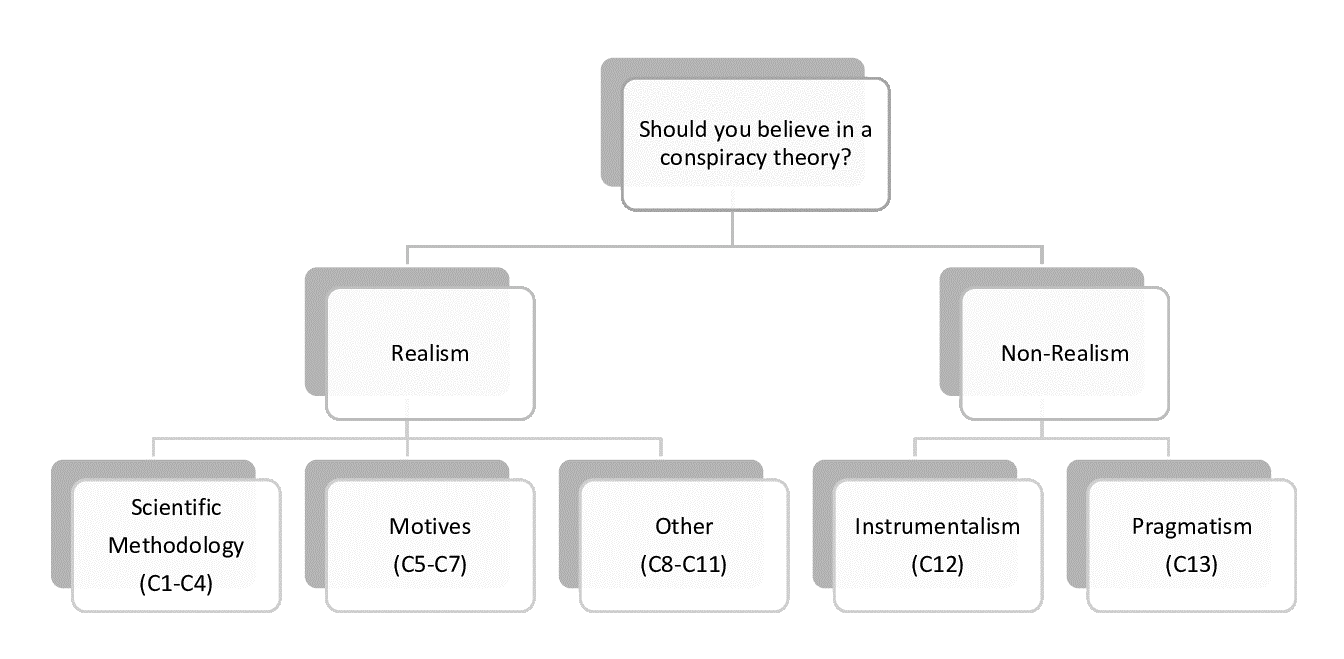
Figure 1 

a. Criteria concerning Scientific Methodology

i. Internal Faults (C1)

Basham (2001, p.275) advocates skepticism of a conspiracy theory if it suffers from what he calls “internal faults,” among which he lists “problems with self-consistency, explanatory gaps, appeals to unlikely or obviously weak motives and other unrealistic psychological states, poor technological claims, and the theory’s own incongruencies with observed facts it grants (including failed predictions).” Räikkä (2009a, p.196f) also refers to a similar list of criteria. Basham thinks that this criterion, while seemingly straightforward, will already exclude many conspiracy theories. An historical example he mentions is the theory that sees the antichrist of the biblical Book of Revelations to be Adolf Hitler. According to Basham, the fact that Hitler is dead and the kingdom of God nowhere near shows that this theory has internal faults, presumably a big explanatory gap or failed prediction.

Note that the list of things mentioned by Basham as internal faults is rather diverse, and one can debate whether all of these faults should really be considered internal to the theory. More narrowly, one could restrict internal faults to problems with self-consistency. Most of the other elements mentioned by Basham return below as separate criteria. For instance, an appeal to “unlikely or obviously weak motives” is discussed as C5.

ii. Progress: Is the Conspiracy Theory Part of a Progressive Research Program? (C2)

Clarke (2002; 2007) sees conspiracy theories as degenerating research programs in the sense developed by Lakatos (1970). In Clarke’s description of a degenerating research program, “successful novel predictions and retrodictions are not made. Instead, auxiliary hypotheses and initial conditions are successively modified in light of new evidence, to protect the original theory from apparent disconfirmation” (Clarke 2002, p.136). By contrast, a progressive research program would make successful novel predictions and retrodictions. Clarke cites the Watergate conspiracy theory as an example of a progressive research program: It led the journalists to make successful predictions and retrodictions about the behavior of those involved in the conspiracy. By contrast, Clarke uses the conspiracy theory about Elvis Presley’s fake funeral as an example of a degenerating research program (p.136-7), since it did not come up with novel predictions that were confirmed, for example, concerning the unusual behavior of Elvis’s relatives. Going further, Clarke (2007) also views other conspiracy theories—the controlled demolition theory of 9/11, for instance—as only proto-theories, something that is not sufficiently worked out to count as a theoretical core of a degenerating or progressive research program. Proto-theories are similar to what Muirhead and Rosenblum (2019) call new conspiracism.

Pigden (2006, footnote 17 and p.29) criticizes Clarke for not providing any evidence that conspiracy theories are in fact degenerating research programs and points to the many conspiracy theories accepted by historians as counterevidence. In any case, we might consider evaluating a given conspiracy theory by trying to see to what extent it is, or is part of, a progressive or a degenerating research program. Furthermore, as Lakatos’s notion of a research program comes with a hard core—the central characteristic claims not up for modification—and a protective belt—auxiliary hypotheses which can be changed—applying this notion also gives us tools to analyze a conspiracy theory in more detail. Such an analysis might yield, for example, that the problematic aspects of a conspiracy theory all concern its protective belt rather than its hard core.

iii. Inference to the Best Explanation: Evidence, Prior, Relative and Posterior Probability (C3)

Dentith (2016) views conspiracy theories as inferences to the best explanation. To judge such inferences using a Bayesian framework, we need to look at the prior probability of the conspiracy theory, the prior probability of the evidence and its likelihood given the conspiracy theory, thereby allowing us to calculate the posterior probability of the conspiracy theory. Furthermore, we need to look at the relative probability of the conspiracy theory when comparing it to competing hypotheses explaining the same event. Crucial in this calculation is our estimation of the prior probability of the conspiracy theory, which Dentith thinks we usually set too low (p.584) because we tend to underestimate how often conspiracies occur in history.

There is some disagreement between authors about whether conspiracy theories may be selective in their choice of evidence. Hepfer (2015, p.78) warns against the selective acceptance of evidence which he calls selective coherentism (p.92), which for Hepfer explains, for example, the wealth of different conspiracy theories surrounding the assassination of John F. Kennedy. Dentith (2019, section 2), on the other hand, argues that scientific theories are also selective in their use of evidence, and that conspiracy theories are not different from other theories, such as scientific ones, in the way they use evidence. Dentith compares conspiracy theories about 9/11 to the work that historians usually do. In both cases, says Dentith, we see a selection of only part of the total evidence as salient.

Finally, Keeley (2003, p.106) considers whether lack of evidence for a conspiracy should count against a theory positing such a conspiracy. On the one hand, he points out that it is in general true that we should not confuse absence of evidence for a conspiracy with evidence of absence of a conspiracy. After all, since we are dealing with a conspiracy, we should expect that evidence will be hard to come by. This is also why falsifiability is in general not advocated as a criterion for evaluating conspiracy theories (see, e.g., Keeley 1999, p.121 and Basham 2003, p.93): In the case of conspiracy theories, something approaching unfalsifiability is a consequence of the theory. Nonetheless, Keeley (2003, p.106) thinks that if diligent efforts to find evidence for a conspiracy fail where similar efforts in other similar cases have succeeded, we are justified in lowering the credibility of the conspiracy theory.

iv. Errant Data (C4)

While the previous criterion already discussed how conspiracy theories relate to data, there is a particular kind of data that receives special attention both by conspiracy theorists and in the philosophical literature about conspiracy theories. Many conspiracy theories claim that they can explain “errant data” (Keeley, 1999, p.117), data which either contradicts the official theory or which the official theory leaves unexplained. According to Keeley (1999), conspiracy theories place great emphasis on errant data, an emphasis that also exists in periods of scientific innovation. However, Keeley thinks that conspiracy theories wrongly claim that errant data by itself is a problem for a theory, which Keeley thinks it is not, since not all the available data will in fact be true. Clarke (2002 p.139f) and Dentith (2019, section 3) are skeptical of Keeley’s argument: Clarke points out that the data labelled as “errant” will depend on the theory one adheres to, and Dentith thinks that conspiracy theories are no different from other theories in relation to such data.

Dentith (2014, 129ff), following Coady (2006c), points out that any theory, official or unofficial, will have errant data. While advocates of a conspiracy theory will point to data problematic for the official theory which the conspiracy theory can explain, there will usually also be data problematic to the conspiracy theory which the official theory can explain. As an example of data errant with regard to the official theory, Dentith mentions that the official theory about the assassination of John F. Kennedy does not explain why some witnesses heard more gunshots than the three gunshots Oswald is supposed to have fired. As an example of data errant with regard to a conspiracy theory, Dentith points out that some of the conspiracy theories about 9/11 cannot explain why there is a video of Osama Bin Laden claiming responsibility for the attacks. When it comes to evaluating a specific conspiracy theory, the conclusion is that we should be looking at the errant data of both the conspiracy theory and alternative theories.

b. Criteria Concerning Motives

i. Cui Bono: Who Benefits from the Conspiracy? (C5)

Hepfer (2015, p.98ff) uses the assassination of John F. Kennedy in 1963 to illustrate how motives enter into our evaluation of conspiracy theories. While there seems to be widespread agreement that the assassin was in fact Lee Harvey Oswald, conspiracy theories doubt the official theory that he was acting on his own. There are a number of possible conspirators with plausible motives that may have been behind Oswald: The military-industrial complex, the American mafia, the Russian secret service, the United States Secret Service and Fidel Castro. Which of these conspiracy theories we should accept also depends on how plausible we find the ascribed motives given our other beliefs about the world.

According to Hepfer (2015, p.98 and section 2.3), a conspiracy theory should be (a) clear about the motives or goals of the conspirators and (b) rational in the means-ends sense of rationality; that is, if successful, the conspiracy should further the goals the conspirators are claimed to have. If the goals of the conspirators are not explicitly part of the theory, we should be able to infer these goals, and they should be reasonable. Problematic conspiracy theories are those where the motives or goals of the conspirators are unclear, the goals ascribed to the conspirators conflict with our other knowledge about the goals of these agents, or a successful conspiracy would not further the goals the theory itself ascribes to the conspirators.

ii. Individual Trust (C6)

Trust plays a role in two different ways when it comes to conspiracy theories. First, Räikkä (2009b, section 4) raises the question of whether we can trust the motives of the author(s) or proponents of a conspiracy theory. Some conspiracy theorists may not themselves believe the theory they propose, and instead may have other motives for proposing the theory; for example, to manipulate the political debate or make money. Other conspiracy theorists may genuinely believe the conspiracy theory they propose, but the fact that the alleged conspirators are the political enemy of the theory’s proponent may cast doubt on the likelihood of the theory. The general question here is whether the author or proponent of a conspiracy theory has a motive to lie or mislead. Here, Räikkä uses as an example the conspiracy theory about global warming (p.462). If a person working for the fossil-fuel industry claims that there is a global conspiracy propagating the idea of global warming, the financial motive is clear. Conversely, people who reject a particular theory as “just” a conspiracy theory may also have a motive to mislead. As an example, Pidgen disscusses the case of Tony Blair,who labeled the idea that the Iraq war was fought for oil a mere conspiracy theory.

A second way in which trust enters into the analysis of conspiracy theories is in terms of epistemic authority. Many conspiracy theories refer to various authorities for the justification of certain claims. For instance, a 9/11 conspiracy theory may refer to a structural engineer who made a certain claim regarding the collapse of the World Trade Center. The question arises as to what extent we should trust claims of alleged epistemic authorities, that is, people who have relevant expertise in a particular domain. Levy (2007) takes a radically socialized view of knowledge: Since knowledge can only be produced by a complex network of inquiry in which the relevant epistemic authorities are embedded, a conspiracy theory conflicting with the official story coming out of this network is “prima facie unwarranted” (p.182, italics in the original). According to Levy, the best epistemic strategy is simply to “adjust one’s degree of belief in an explanation of an event or process to the degree to which the epistemic authorities accept that explanation” (p.190). Dentith (2018) criticizes Levy’s trust in epistemic authority. First, Dentith argues that since conspiracy theories cross disciplinary boundaries, there is no obvious group of experts when it comes to evaluating a conspiracy theory, since a conspiracy theory will usually involve claims connecting various disciplines. Furthermore, Dentith points out that the fact that a theory has authority in the sense of being official does not necessarily mean that it has epistemic authority, a point Levy also makes. Related to our first point about trust, Dentith also points out that epistemic authorities might have a motive to mislead, for example, when the funding sources might have influenced research. Finally, our trust in epistemic authority will also depend on the trust we place in the institutions accrediting expertise, and hence questions of individual trustworthiness relate to questions of institutional trustworthiness.

iii. Institutional Trust (C7)

As mentioned when discussing individual trust, when we want to assess the credibility of experts, part of that credibility judgment will depend on the extent to which we trust the institution accrediting the expertise, assuming there is such an institution to which the expert is linked. The question of institutional trust is relevant more generally when it comes to conspiracy theories, and this issue has been discussed at length in the philosophical literature on conspiracy theories.

The starting point of the discussion of institutional trust is Keeley (1999, p.121ff) who argues that the problem with conspiracy theories is that these theories cast doubt on precisely those institutions which are the guarantors of reliable data. If a conspiracy theory contradicts an official theory based on scientific expertise, this produces skepticism not only with regard to the institution of science, but may also produce skepticism with regard to other public institutions, for example the press, which accepts the official story instead of uncovering the conspiracy, the parliament and the government, which produce or propagate the conspiracy theory in the first place. Thus, the claim is that believing in a conspiracy theory implies a quite widespread distrust of our public institutions. If this implication is true, it can be used in two ways: Either to discredit the conspiracy theory, which is the route Keeley advocates, or to discredit our public institutions. In any case, our trust in our public institutions will influence the extent to which we hold a particular conspiracy theory to be likely. For this reason, both Keeley (1999, p.121ff) and Coady (2006a, p.10) think that conspiracy theories are more trustworthy in non-democratic societies.

Basham (2001, p.270ff) argues that it would be a mistake to simply assume our public institutions to be trustworthy and dismiss conspiracy theories. His position is one he calls “studied agnosticism” (p.275): In general, we are not in a position to decide for or against a conspiracy theory, except—and this is where the “studied” comes in—where a conspiracy theory can be dismissed due to internal faults (see C1). In fact, we are caught in a vicious circle: “We cannot help but assume an answer to the essential issue of how conspirational our society is in order to derive a well justified position on it” (p.274). Put differently, while an open society provides fewer grounds for believing in conspiracy theories, we cannot really know how open our society actually is (Basham 2003, p.99). In any case, an individual who tries to assess a particular conspiracy theory should thus also consider to what extent they trust or distrust our public institutions.

Clarke (2002,p.139ff) questions Keeley’s link between belief in conspiracy theories and general distrust in our public institutions. He claims that conspiracy theories actually do not require general institutional skepticism. Instead, in order to believe in a conspiracy theory, it will usually suffice to confine one’s skepticism to particular people and issues. Räikkä (2009a) also criticizes Keeley’s supposed link between conspiracy theories and institutional distrust, claiming that most conspiracy theories do not entail such pervasive institutional distrust, but that if such pervasive distrust were entailed by a conspiracy theory, it would lower the conspiracy theory’s credibility. A global conspiracy theory like the Flat Earth theory tends to involve more pervasive institutional distrust, since it involves multiple institutions from various societal domains, than a local conspiracy theory like the Watergate conspiracy. According to Clarke, even the latter does not have to engender institutional distrust with regard to the United States government as an institution, since distrust could remain limited to specific agents within the government.

c. Other Realist Criteria

i. Fundamental Attribution Error (C8)

Starting with Clarke (2002; see also his response to criticism in 2006), philosophers have discussed whether conspiracy theories commit the fundamental attribution error (FAE). In psychology, the fundamental attribution error refers to the human tendency to overestimate dispositional factors and underestimate situational factors in explaining the behavior of others. Clarke (p.143ff) claims that conspiracy theories commit this error: They tend to be dispositional explanations whereas official theories often are more situational explanations. As an example, Clarke considers the funeral of Elvis Presley. The official account is situational since it explains the funeral in terms of his death due to heart problems. On the other hand, the conspiracy theory which claims Elvis is still alive and staged his funeral is dispositional since it sees Elvis and his possible co-conspirators as having the intention to deceive the public.

Dentith (2016, p.580) questions whether conspiracy theories are generally more dispositional than other theories. Also, like in the case of 9/11, the official theory may also be dispositional. Pigden (2006, footnotes 27 and 30, and p.29) is critical of the psychological literature about the FAE, claiming that “if we often act differently because of different dispositions, then the fundamental attribution error is not an error” (footnote 30). Pigden is also critical of Clarke’s application of the FAE to conspiracy theories: Given that conspiracies are common, what Pigden calls “situationism” is either false or it does not imply that conspiracies are unlikely. Hence, Pigden concludes, the FAE has no relevant implications for our thinking about conspiracy theories. Coady (2003) is also critical of the existence of the FAE. Furthermore, he claims that belief in the FAE is paradoxical in that it commits the FAE: Believing that people think dispositionally rather than situationally is itself dispositional thinking.

ii. Ontology: Existence Claims the Conspiracy Theory Makes (C9)

Some conspiracy theories claim the existence or non-existence of certain entities. Among the examples Hepfer (2015, p.45) cites is a theory by Heribert Illig that claims that the years between 614 and 911 never actually happened. Another example would be a theory claiming the existence of a perpetual motion machine that is kept secret. Both existence claims go against the scientific consensus of what exists and what does not. Hepfer (2015, p.42) claims that the more unusual a conspiracy theory’s existence claims are, the more we should doubt its truth. This is because of the ontological baggage (p.49) that comes with such existence claims: Accepting these claims will force us to revise a major part of our hitherto accepted knowledge, and the more substantial the revision needed, the more we should be suspicious of such a theory.

iii. Übermensch: Does the Conspiracy Theory Ascribe Superhuman Qualities to Conspirators? (C10)

Hepfer (2015, p.104) and Räikkä (2009a, p.197) note that some conspiracy theories ascribe superhuman qualities to the conspirators that border on divine attributes like omnipotence and omniscience. Examples here might be the idea that Freemasons, Jews or George Soros control the world economy or the world’s governments. Sometimes the superhuman qualities ascribed to conspirators are moral and negative, that is, conspirators are demonized (Hepfer, 2015, p.131f). The antichrist has not only been seen in Adolf Hitler but also in the pope. In general, the more extraordinary the qualities ascribed to the conspirators, the more they should lower the credibility of the conspiracy theory.

iv. Scale: The Size and Duration of the Conspiracy
(C11)

The general claim here is that the more agents that are supposed to be involved in a conspiracy—its size—and the longer the conspiracy is supposed to be in existence—its duration—the less likely the conspiracy theory. Hepfer (2015, p.97) makes this point, and similarly Keeley (1999, p.122) says that the more institutions are supposed to be involved in a conspiracy, the less believable the theory should become. To some extent, this point is simply a matter of logic: The claim that A and B are involved in a conspiracy cannot be more likely than that A is involved in a conspiracy. Similarly, the claim that a conspiracy theory has been going on for at least 20 years cannot be more likely than the claim that it has been going on for at least 10 years. In this sense, conspiracy theories involving many agents over a long period of time will tend to be less likely than conspiracy theories involving fewer agents over a shorter period of time. Furthermore, Grimes (2016) has conducted simulations showing that large conspiracies with 1000 agents or more are unlikely to succeed due to problems with maintaining secrecy.

Basham (2001, p.272; 2003, p.93) takes an opposing view by referring to social hierarchies and mechanisms of control, saying that “the more fully developed and high placed a conspiracy is, the more experienced and able are its practitioners at controlling information and either co-opting, discrediting, or eliminating those who go astray or otherwise encounter the truth” (Basham 2001, p.272). Dentith (2019, section 7) also counters the scale argument by pointing out that any time an institution is involved in a conspiracy, only very few people of that institution actually are involved in the conspiracy. This reduces the number of total conspirators and questions the relevance of the results by Grimes of which Dentith is very critical.

d. Non-Realist Criteria

i. Instrumentalism: Conspiracy Theories as “as if” Theories (C12)

Grewal (2016) has shown how the philosophical opposition between scientific realism and various kinds of anti-realism also shows up in how we evaluate conspiracy theories. While most authors implicitly seem to interpret the claims of conspiracy theories along the lines of realism, Grewal has suggested that adherents of conspiracy theories may interpret or at least use these theories instrumentally. Viewed this way, conspiracy theories are “as-if”-theories which allow their adherents to make sense of a world that is causally opaque in a way that may often yield quite adequate predictions. “An assumption that the government operated as if it were controlled by a parallel and secret government may fit the historical data…while also providing better predictions than would, say, an exercise motivated by an analysis of constitutional authority or the statutory limitations to executive power” (p.36). As a more concrete example, Grewal mentions that “the most parsimonious way to understand financial decision making in the Eurozone might be to treat it as if it were run by and for the benefit of the Continent’s richest private banks” (p.37). Hence, our evaluation of a given conspiracy theory will also depend on basic philosophical commitments like what we expect our theories to do for us.

ii. Pragmatism (C13)

The previous arguments have mostly been epistemic or epistemological arguments, arguments that bear on the likelihood of a conspiracy theory to be true or at least epistemically useful. However, similar to Blaise Pascal’s pragmatic argument for belief in God (Pascal, 1995), some arguments concerning conspiracy theories that have nothing to do with their epistemic value can be reinterpreted pragmatically as arguments about belief: Pragmatically, our belief or disbelief should depend on the consequences the (dis)belief has for us personally or for society more generally.

Basham (2001) claims that epistemic rejection of conspiracy theories will often not work, and we have to be agnostic about their truth. Still, we should reject them for pragmatic reasons because “[t]here is nothing you can do,” given the impossibility of finding out the truth, and “[t]he futile pursuit of malevolent conspiracy theory sours and distracts us from what is good and valuable in life” (p.277). Similarly, Räikkä (2009a) says that “a person who strives for happiness in her personal life should not ponder on vicious conspiracies too much” (p.199). Then again, contrary to Basham’s claim, what you can do with regard to conspiracy theories will depend on your role. As a journalist, you may decide to investigate certain claims, and Räikkä (2009a, p.199f) thinks that “it is important that in every country there are some people who are interested in investigative journalism and political conspiracy theorizing.”

Like journalists, politicians play a special role when it comes to conspiracy theories. Muirhead and Rosenblum (2016) argue that politicians should oppose conspiracy theories if they (1) are fueled by hatred, or (2) when they present political opposition as treason and illegitimate, or (3) when they undermine epistemic or expert authority generally. Similarly, Räikkä (2018, p.213) argues that we must interfere with conspiracy theories when they include libels or hate speech. The presumed negative consequences of such conspiracy theories would be pragmatic reasons for disbelief.

Räikkä (2009b) lists both positive and negative effects of conspiracy theorizing, and we may apply these to concrete conspiracy theories to see which ones to believe in. The two positive effects he mentions are (a) that “the information gathering activities of conspiracy theorists and investigative journalists force governments and government agencies to watch out for their decisions and practices” (p.460) and (b) that conspiracy theories help to maintain openness in society. As negative effects, he mentions that a conspiracy theory “tends to undermine trust in democratic political institutions and its implications may be morally questionable, as it has close connections to populist discourse, as well as anti-Semitism and racism” (p.461). When a conspiracy theory blames certain people, Räikkä points out that there are moral costs for the people blamed. Furthermore, he thinks that the moral costs will depend on whether the people blamed are private individuals or public figures (p.463f).

5. Social and Political Effects of Conspiracy Theories

Räikkä (2009b, section 3) and Moore (2016, p.5) survey some of the social and political effects of conspiracy theories and conspiracy theorizing. One may look at the positive and negative effects of conspiracy theorizing in general, but it is also useful to consider the effects of a specific conspiracy theory, by looking at which effects mentioned below are likely to obtain for the conspiracy theory in question. Such an evaluation is related to the pragmatist evaluation criterion C13 just discussed, so some of the points mentioned there are revisited in what follows. Also, the effects of a conspiracy theory may be related to the type of conspiracy theory we are dealing with; see section 3 of this article.

On the positive side, conspiracy theories may be tools to uncover actual conspiracies, with the Watergate scandal as the standard example. When these conspiracies take place in our public institutions, conspiracy theories can thereby also help us to keep these institutions in check and to uncover institutional problems. Conspiracy theories can help us to remain critical of those holding power in politics, science and the media. One of the ways they can achieve this is by forcing these institutions to be more transparent. Since conspiracy theories claim the secret activity of certain agents, transparent decision making, open lines of communication and the public availability of documents are possible responses to conspiracy theories which can improve a democratic society, independent of whether they suffice to convince those believing conspiracy theories. We may call this the paradoxical effect of conspiracy theories: Conspiracy theories can help create or maintain the open society whose existence they deny.

Turning from positive to possible negative effects of conspiracy theories, a central point that already came up when discussing criterion C7 is institutional trust. Conspiracy theories can contribute to eroding trust in the institutions of politics, science and the media. The anti-vaccination conspiracy theory which claims that politicians and the pharmaceutical industry are hiding the ineffectiveness or even harmfulness of vaccines is an example of a conspiracy theory which can undermine public trust in science. Huneman and Vorms (2018) discuss how at times it can be difficult to draw the line between rational criticism of science and unwarranted skepticism. One fear is that eroding trust in institutions leads us via unwarranted skepticism to an all-out relativism or nihilism, a post-truth world where it suffices that a claim is repeated by a lot of people to make it acceptable (Muirhead and Rosenblum, 2019). Conspiracy theories have also been linked to increasing polarization, populism and racism (see Moore, 2016). Finally, as alluded to in section 1, Popper’s dislike of conspiracy theories was also because they create wrong ideas about the root causes of social events. By seeing social events as being caused by powerful people acting in secret, rather than as effects of structural social conditions, conspiracy theories arguably undermine effective political action and social change.

Bjerg and Presskorn-Thygesen (2017) have claimed that conspiracy theories cause a state of exception in the way introduced by Giorgio Agamben. Just like terrorism undermines democracy in such a way that it licenses a state of political exception justifying undemocratic measures, a conspiracy theory undermines rational discourse in such a way that it licenses a state of epistemic exception justifying irrational measures. Those measures consist in placing conspiracy theories outside of official public discourse, labeling them as irrational, as “just” conspiracy theories, and as not worthy of serious critical consideration and scrutiny. Seen in this way, conspiracy theories appear as a form of epistemic terrorism, through their erosion of trust in our knowledge-producing institutions.

6. What to Do about Conspiracy Theories?

Besides deciding to believe or not to believe in a conspiracy theory (section 4), there are other actions one may consider with regard to conspiracy theories. Philosophical discussion has mainly focused on what actions governments and politicians can or should take.

The seminal article concerning the question of government action is by Sunstein and Vermeule (2009). Besides describing different psychological and social mechanisms underlying belief in conspiracy theories, they consider a number of policy and legal responses a government might take when it comes to false and harmful conspiracy theories: banning conspiracy theories, taxing the dissemination of conspiracy theories, counterspeech and cognitive infiltration of groups producing conspiracy theories. While dismissing the first two options, Sunstein and Vermeule consider counterspeech and cognitive infiltration in more detail. First, the government may itself speak out against a conspiracy theory by providing its own account. However, Sunstein and Vermeule think that such official counterspeech will have only limited success, in particular when it comes to conspiracy theories involving the government. Alternatively, the government may try to involve private parties to infiltrate online fora and discussion groups associated with conspiracy theories in order to introduce cognitive diversity, breaking up one-sided discussion and introducing non-conspirational views.

The proposals by Sunstein and Vermeule have led to strong opposition, most explicitly by Coady (2018). He points out that Sunstein and Vermeule too easily assume good intentions on the part of the government. Furthermore, these policy proposals, coming from academics who have also been involved in governmental policy making, will only confirm the fears of the conspiracy theorists that the government is involved in conspirational activities. If the cognitive infiltration proposed by Sunstein and Vermeule were discovered, conspiracy theorists would be led to believe in conspiracy theories even more. Put differently, we are running the risk of a pragmatic inconsistency: The government would try to deceive, via covert cognitive infiltration, a certain part of the population to make it believe that it does not deceive, that it is not involved in conspiracies.

As mentioned when discussing evaluation criterion C13 in section 4, Muirhead and Rosenblum (2016) consider three kinds of conspiracy theories that should give politicians cause for official opposition. These are conspiracy theories that fuel hatred, equate political opposition with treason, or that express a general distrust of expertise. In these cases, politicians are called to speak truth to conspiracy, even though this might create a divide between them and their electorate. Muirhead and Rosenblum (2019) also consider what to do against new conspiracism (see the end of section 2). They note that such conspiracism is rampant in our society despite ever more transparency. As a counter measure, they not only advocate speaking truth to conspiracy, but also what they call “democratic enactment,” by which they mean “a strenuous adherence to the regular processes and forms of public decision-making” (p.175).

Both Sunstein and Vermeule, as well as Muirhead and Rosenblum, agree that what we should do about conspiracy theories will depend on the theory we are dealing with. They do not advocate action against all theories about groups acting in secret to achieve some aim. However, when a theory is of a particularly problematic kind—false and harmful, fueling hatred, and so forth—political action may be needed.

7. Related Disciplines

Philosophy is not the only discipline dealing with conspiracy theories, and in particular when it comes to discussing what to do about conspiracy theories, research from other fields is important. We have already seen some ways in which philosophical thinking about conspiracy theories touches on other disciplines, in particular in the previous section’s discussion of political science and law. As for other related fields, psychologists have done a lot of research about conspirational thinking and the psychological characteristics of people who believe in conspiracy theories. Historians have presented histories of conspiracy theories in the United States, the Arab world and elsewhere. Sociologists have studied how conspiracy theories can target racial minorities, as well as the structure and group dynamics of specific conspirational milieus. Uscinski (2018) covers many of the relevant disciplines which this article does not cover and also includes an interdisciplinary history of conspiracy theory research.

8. References and Further Reading

To get an overview of the philosophical thinking about conspiracy theories, the best works to start with are Dentith (2014), Coady (2006a) and Uscinski (2018).

  • Basham, L. (2001). “Living with the Conspiracy”, The Philosophical Forum, vol. 32, no. 3, p.265-280.
  • Basham, L. (2003). “Malevolent Global Conspiracy”, Journal of Social Philosophy, vol. 34, no. 1, p.91-103.
  • Bjerg, O. and T. Presskorn-Thygesen (2017). “Conspiracy Theory: Truth Claim or Language Game?”, Theory, Culture and Society, vol. 34, no. 1, p.137-159.
  • Buenting, J. and J. Taylor (2010). “Conspiracy Theories and Fortuitous Data”, Philosophy of the Social Sciences, vol. 40, no. 4, p. 567-578.
  • Clarke, St. (2002). “Conspiracy Theories and Conspiracy Theorizing”, Philosophy of the Social Sciences, vol. 32, no. 2, p.131-150.
  • Clarke, St. (2006). “Appealing to the Fundamental Attribution Error: Was it All a Big Mistake?”, in Conspiracy Theories: The Philosophical Debate. Edited by David Coady. Ashgate, p.129-132.
  • Clarke, St. (2007). “Conspiracy Theories and the Internet: Controlled Demolition and Arrested Development”, Episteme, vol. 4, no. 2, p.167-180.
  • Coady, D. (2003). “Conspiracy Theories and Official Stories”, International Journal of Applied Philosophy, vol. 17, no. 2, p.197-209.
  • Coady, D., ed. (2006a). Conspiracy Theories: The Philosophical Debate. Ashgate.
  • Coady, D. (2006b). “An Introduction to the Philosophical Debate about Conspiracy Theories”, in Conspiracy Theories: The Philosophical Debate. Edited by David Coady. Ashgate, p.1-11.
  • Coady, D. (2006c). “Conspiracy Theories and Official Stories”, in Conspiracy Theories: The Philosophical Debate. Edited by David Coady. Ashgate, p.115-128.
  • Coady, D. (2018). “Cass Sunstein and Adrian Vermeule on Conspiracy Theories”, Argumenta, vol. 3, no.2, p.291-302.
  • Dentith, M. (2014). The Philosophy of Conspiracy Theories. Palgrace MacMillan.
  • Dentith, M. (2016). “When Inferring to a Conspiracy might be the Best Explanation”, Social Epistemology, vol. 30, nos. 5-6, p.572-591.
  • Dentith, M. (2018). “Expertise and Conspiracy Theories”, Social Epistemology, vol. 32, no. 3, p.196-208.
  • Dentith, M. (2019). “Conspiracy theories on the basis of the evidence”, Synthese, vol. 196, no. 6, p.2243-2261.
  • Grewal, D. (2016). “Conspiracy Theories in a Networked World”, Critical Review, vol. 28, no. 1, p.24-43.
  • Grimes, D. (2016). “On the Viability of Conspirational Beliefs”, PLoS ONE, vol. 11, no. 1.
  • Hepfer, K. (2015). Verschwörungstheorien: Eine philosophische Kritik der Unvernunft. Transcript Verlag.
  • Huneman, Ph. and M. Vorms (2018). “Is a Unified Account of Conspiracy Theories Possible?”, Argumenta, vol. 3, no. 2, p.247-270.
  • Keeley, B. (1999). “Of Conspiracy Theories”, The Journal of Philosophy, vol. 96, no. 3, p.109-126.
  • Keeley, B. (2003). “Nobody Expects the Spanish Inquisition! More Thoughts on Conspiracy Theory”, Journal of Social Philosophy, vol. 34, no. 1, p.104-110
  • Lakatos, I. (1970). “Falsification and the Methodology of Scientific Research Programmes”, in I. Lakatos and A. Musgrave, editors, Criticism and the Growth of Knowledge. Cambridge University Press, p.91-196.
  • Levy, N. (2007). “Radically Socialized Knowledge and Conspiracy Theories”, Episteme, vol. 4 no. 2, p.181-192.
  • Mandik, P. (2007). “Shit Happens”, Episteme, vol. 4 no. 2, p.205-218.
  • Moore, A. (2016). “Conspiracy and Conspiracy Theories in Democratic Politics”, Critical Review, vol. 28, no. 1, p.1-23.
  • Muirhead, R. and N. Rosenblum (2016). “Speaking Truth to Conspiracy: Partisanship and Trust”, Critical Review, vol. 28, no. 1, p.63-88.
  • Muirhead, R. and N. Rosenblum (2019). A Lot of People are Saying: The New Conspiracism and the Assault on Democracy. Princeton University Press.
  • Pascal, B. (1995). Pensées and Other Writings, H. Levi (trans.). Oxford University Press.
  • Pigden, Ch. (1995). “Popper Revisited, or What Is Wrong With Conspiracy Theories?” Philosophy of the Social Sciences, vol. 25, no. 1, p.3-34.
  • Pigden, Ch. (2006). “Complots of Mischief”, in David Coady (ed.), Conspiracy Theories: The Philosophical Debate. Ashgate, p.139-166.
  • Pipes, D. (1997). Conspiracy: How the Paranoid Style Flourishes and Where It Comes From. Free Press.
  • Popper, K.R. (1966). The Open Society and Its Enemies, vol. 2: The High Tide of Prophecy, 5th edition, Routledge and Kegan Paul.
  • Popper, K.R. (1972). Conjectures and Refutations. 4th edition, Routledge and Kegan Paul.
  • Räikkä, J. (2009a). “On Political Conspiracy Theories”, Journal of Political Philosophy, vol. 17, no. 2, p.185-201.
  • Räikkä, J. (2009b). “The Ethics of Conspiracy Theorizing”, Journal of Value Inquiry, vol. 43, p.457-468.
  • Räikkä, J. (2018). “Conspiracies and Conspiracy Theories: An Introduction”, Argumenta, vol. 3, no. 2, p.205-216.
  • Sunstein, C. and A. Vermeule (2009). “Conspiracy Theories: Causes and Cures”, Journal of Political Philosophy, vol. 17, no. 2, p.202-227.
  • Uscinski, J.E., editor (2018). Conspiracy Theories and the People Who Believe Them. Oxford University Press.

Author Information

Marc Pauly
Email: m.pauly@rug.nl
University of Groningen
The Netherlands
René Descartes: Ethics

This article describes the main topics of Descartes’ ethics through discussion of key primary texts and corresponding interpretations in the secondary literature. Although Descartes never wrote a treatise dedicated solely to ethics, commentators have uncovered an array of texts that demonstrate a rich analysis of virtue, the good, happiness, moral judgment, the passions, and the systematic relationship between ethics and the rest of philosophy. The following ethical claims are often attributed to Descartes: the supreme good consists in virtue, which is a firm and constant resolution to use the will well; virtue presupposes knowledge of metaphysics and natural philosophy; happiness is the supreme contentment of mind which results from exercising virtue; the virtue of generosity is the key to all the virtues and a general remedy for regulating the passions; and virtue can be secured even though our first-order moral judgments never amount to knowledge.

Descartes’ ethics was a neglected aspect of his philosophical system until the late 20th century. Since then, standard interpretations of Descartes’ ethics have emerged, debates have ensued, and commentators have carved out key interpretive questions that anyone must answer in trying to understand Descartes’ ethics. For example: what kind of normative ethics does Descartes espouse? Are the passions representational or merely motivational states? At what point in the progress of knowledge can the moral agent acquire and exercise virtue? Is Descartes’ ethics as systematic as he sometimes seems to envision?

Table of Contents

  1. Methodology
    1. Identifying the Texts
    2. The Tree of Philosophy and Systematicity
    3. The Issue of Novelty
  2. The Provisional Morality
    1. The First Maxim
    2. The Second Maxim
    3. The Third Maxim
    4. The Fourth Maxim
  3. Cartesian Virtue
    1. The Unity of the Virtues
    2. Virtue qua Perfection of the Will
  4. The Epistemic Requirements of Virtue
    1. Knowledge of the Truth
      1. Theoretical Knowledge of the Truth
      2. Practical Knowledge of the Truth
    2. Intellect, Will, and Degrees of Virtue
  5. Moral Epistemology
    1. The Contemplation of Truth vs. The Conduct of Life
    2. Moral Certainty and Moral Skepticism
    3. Virtue qua Resolution
  6. The Passions
    1. The Definition of the Passions
    2. The Function of the Passions
    3. Whether the Passions are Representational or Motivational
  7. Generosity
    1. Component One: What Truly Belongs to Us
    2. Acquiring Generosity
    3. Generosity and the Regulation of the Passions
    4. The Other-Regarding Nature of Generosity
  8. Love
    1. The Metaphysical Reading
    2. The Practical Reading
  9. Happiness
  10. Classifying Descartes’ Ethics
    1. Virtue Ethics
    2. Deontological Virtue Ethics
    3. Perfectionism
  11. Systematicity Revisited
    1. The Epistemological Reading
    2. The Organic Reading
  12. References and Further Reading
    1. Abbreviations
    2. Primary Sources
    3. Secondary Sources

1. Methodology

a. Identifying the Texts

When one considers the heyday of early modern ethics, the following philosophers come to mind: Hobbes, Hutcheson, Hume, Butler, and, of course, Kant. Descartes certainly does not. Indeed, many philosophers and students of philosophy are unaware that Descartes wrote about ethics. Standard interpretations of Descartes’ philosophy place weight on the Discourse on the Method, Rules for the Direction of the Mind, Meditations on First Philosophy (with the corresponding Objections and Replies), and the Principles of Philosophy. Consequently, Descartes’ philosophical contributions to the early modern period are typically understood as falling under metaphysics, epistemology, philosophy of mind, and natural philosophy. When commentators do consider Descartes’ ethical writings, these writings are often regarded as an afterthought to his mature philosophical system. Indeed, Descartes’ contemporaries often did not think much of Descartes’ ethics. For example, Leibniz writes: “Descartes has not much advanced the practice of morality” (Letter to Molanus, AG: 241).

This view is understandable. Descartes certainly does not have a treatise devoted solely to ethics. This lack, in and of itself, creates an interpretive challenge for the commentator. Where does one even find Descartes’ ethics? On close inspection of Descartes’ corpus, however, one finds him tackling a variety of ethical themes—such as virtue, happiness, moral judgment, the regulation of the passions, and the good—throughout his treatises and correspondence. The following texts are of central importance in unpacking Descartes’ ethics: the Discourse on Method, the French Preface to the Principles, the Dedicatory Letter to Princess Elizabeth for the Principles, the Passions of the Soul, and perhaps most importantly, the correspondence with Princess Elizabeth of Bohemia, Queen Christina of Sweden, and the envoy Pierre Chanut (for more details on these important interlocutors—Princess Elizabeth in particular—and how they all interacted with each other in bringing about these letters see Shapiro [2007: 1–21]).

These ethical writings can be divided into an early period and a later—and possibly mature—period. That is, the early period of the Discourse (1637) and the later period spanning (roughly) from the French Preface to the Passions of the Soul (1644–1649).

b. The Tree of Philosophy and Systematicity

Why should we take seriously Descartes’ interspersed writings on ethics, especially since he did not take the time to write a systematic treatment of the topic? Indeed, one might think that we should not give much weight to Descartes’ ethical musings, given his expressed aversion to writing about ethics. In a letter to Chanut, Descartes writes:

It is true that normally I refuse to write down my thoughts concerning morality. I have two reasons for this. One is that there is no other subject in which malicious people can so readily find pretexts for vilifying me; and the other is that I believe only sovereigns, or those authorized by them, have the right to concern themselves with regulating the morals of other people. (Letter to Chanut 20 November 1647, AT V: 86–7/CSMK: 326)

However, one should take this text with a grain of salt. For in other texts, Descartes clearly does express a deep interest in ethics. Consider the famous tree of philosophy passage:

The whole of philosophy is like a tree. The roots are metaphysics, the trunk is physics, and the branches emerging from the trunk are all the other sciences, which may be reduced to three principal ones, namely, medicine, mechanics, and morals. By ‘morals’ I understand the highest and most perfect moral system, which presupposes a complete knowledge of the other sciences and is the ultimate level of wisdom.

Now just as it is not the roots or the trunk of a tree from which one gathers the fruit, but only the ends of the branches, so the principal benefit of philosophy depends on those parts of it which can only be learnt last of all. (French Preface to the Principles, AT IXB: 14/CSM I: 186)

This passage is surprising, to say the least. Descartes seems to claim that the proper end of his philosophical program is to establish a perfect moral system, as opposed to (say) overcoming skepticism, proving the existence of God, and establishing a mechanistic science. Moreover, Descartes seems to claim that ethics is systematically grounded in metaphysics, physics, medicine, and mechanics. Ethics is not supposed to float free from the metaphysical and scientific foundations of the system.

The tree of philosophy passage is a guiding text for many commentators in interpreting Descartes’ ethics, primarily because of its vision of philosophical systematicity (Marshall 1998, Morgan 1994, Rodis-Lewis 1987, Rutherford 2004, Shapiro 2008a). Indeed, the nature of the systematicity of Descartes’ ethics has been one of the main interpretive questions for commentators. Two distinct questions of systematicity are of importance here, which the reader should keep in mind as we engage Descartes’ ethical writings.

The first question of systematicity is internal to Descartes’ ethics itself. The early period of Descartes’ ethics, that is, the Discourse, is characterized by Descartes’ provisional morality. Broadly construed, the provisional morality seems to be a temporary moral guide—a stop gap, as it were—so that one can still live in the world of bodies and people while simultaneously engaging in hyperbolic doubt for the sake of attaining true and certain knowledge (scientia). As such, one might expect Descartes to revise the four maxims of the provisional morality once foundational scientia is achieved. Presumably, the perfect moral system that Descartes envisions in the tree of philosophy is not supposed to be a provisional morality. However, some commentators have claimed that the provisional morality is actually Descartes’ final moral view (Cimakasky & Polansky 2012). Others, however, take a developmental view, arguing that Descartes’ later period, although related to the provisional morality, makes novel and distinct advancements (Marshall 1998, Shapiro 2008a).

The second question of systematicity concerns how Descartes’ ethics relates to the rest of his philosophy. To fully understand this question, we must distinguish two senses of ethics (la morale) in the tree of philosophy (Parvizian 2016). First, there is ethics qua theoretical enterprise. This concerns a theory of virtue, happiness, the passions, and other areas. Second, there is ethics qua practical enterprise. That is, the exercise of virtue, the attainment of happiness, the regulation of the passions. Thus, one may distinguish, for example, the question of whether a theory of virtue depends on metaphysics, physics, and the like, from whether exercising virtue depends on knowledge of metaphysics, physics, and the like. Commentators tend to agree that theoretical ethics presupposes the other parts of the tree, although how this is supposed to work out with respect to each field has not been fully fleshed out. For example: what is the relationship between mechanics and ethics? However, there is substantive disagreement about whether exercising virtue presupposes knowledge of metaphysics or contributes to knowledge of metaphysics.

c. The Issue of Novelty

Another broad interpretive question concerns how Descartes’ ethics relates to past ethical theories, and whether Descartes’ ethics is truly novel (as he sometimes claims). It is undeniable that Descartes’ ethics is, in certain respects, underdeveloped. Given that Descartes is well versed in the ethical theories of his predecessors, one might be tempted to fill in the details Descartes does not spell out by drawing on other sources (for example, the Stoics).

This is a complicated matter. In section 3, Descartes claims that he is advancing beyond ancient ethics, particularly with his theory of virtue. This is in line with Descartes’ more general tendency to claim that his philosophical system breaks from the ancient and scholastic philosophical tradition (Discourse I, AT VI: 4–10/CSM I: 112–115). However, in some texts Descartes suggests that he is building upon past ethical theories. For example, Descartes tells Princess Elizabeth:

To entertain you, therefore, I shall simply write about the means which philosophy provides for acquiring that supreme felicity which common souls vainly expect from fortune, but which can be acquired only from ourselves.

One of the most useful of these means, I think, is to examine what the ancients have written on this question, and try to advance beyond them by adding something to their precepts. For in this way we can make the precepts perfectly our own and become disposed to put them into practice. (Letter to Princess Elizabeth 21 July 1645, AT IV: 252/CSMK: 256; emphasis added)

Given such a text, a commentator would certainly be justified in drawing on other sources to illuminate Descartes’ ethical positions (such as the nature of happiness vis-à-vis the Stoics). Thus, although Descartes claims that he is breaking with the past, one still ought to explore the possibility that his ethics builds on, for example, the Aristotelian and Stoic ethics with which he was surely acquainted. Indeed, some commentators have argued that Descartes’ ethics is indebted to Stoicism (Kambouchner 2009, Rodis-Lewis 1957, Rutherford 2004 & 2014).

2. The Provisional Morality

Descartes’ first stab at ethics is in Discourse III. In the Discourse, Descartes lays out a method for conducting reason in order to acquire knowledge. This method requires an engagement with skepticism, which raises the question of how one should live in the world when one has yet to acquire knowledge and must suspend judgment about all dubitable matters. Perhaps to ward off the classic apraxia objection to skepticism, that is, the objection that one cannot engage in practical affairs if one is truly a skeptic (Marshall 2003), Descartes offers a “provisional morality” to help the temporary skeptic and seeker of knowledge still act in the world. Descartes writes:

Now, before starting to rebuild your house, it is not enough simply to pull it down, to make provision for materials and architects (or else train yourself in architecture), and to have carefully drawn up the plans; you must also provide yourself with some other place where you can live comfortably while building is in progress. Likewise, lest I should remain indecisive in my actions while reason obliged me to be so in my judgements, and in order to live as happily as I could during this time, I formed for myself a provisional moral code consisting of just three or four maxims, which I should like to tell you about. (Discourse III, AT VI: 22/CSM I: 122)

Notice that Descartes is ambiguous about whether the provisional morality consists of three or four maxims. There is some interpretive debate about this matter. We will discuss all four candidate maxims. Furthermore, we will bracket the issue of how to understand the provisional nature of this morality (see, for example, LeDoeuff 1989, Marshall 1998 & 2003, Morgan 1994, Shapiro 2008a). However, it should be noted that Descartes does refer to the provisional morality even in his later ethical writings, which suggests that the maxims are not entirely abandoned once skepticism is defeated (see Letter to Princess Elizabeth 4 August 1645, AT IV: 265–6/CSMK: 257–8).

a. The First Maxim

Maxim One can be divided into three claims:

M1a: The moral agent ought to obey the laws and customs of her country.

M1b: The moral agent ought to follow their religion.

M1c: In all other matters not addressed by M1a and M1b, the moral agent ought to follow the most commonly accepted and sensible opinions of her community. (Discourse III, AT VI: 23/CSM I: 122)

Descartes claims that during his skeptical period he found his own “opinions worthless” (Ibid.). In the absence of genuine moral knowledge to guide our practical actions, Descartes claims that the best we can do is conform to the moral guidelines offered in the laws and customs of one’s country, religion, and the moderate and sensible opinions of one’s community. As Vance Morgan notes, M1 is strikingly anti-Cartesian, as it calls the moral agent to an “unreflective social conformism” (1994: 45). But as we see below, M1, at least partially, does not seem to be abandoned in Descartes’ later ethical writings.

b. The Second Maxim

Maxim Two states:

M2: The moral agent ought to be firm and decisive in her actions, and to follow even doubtful opinions once they are adopted, with no less constancy than if they were certain.

The motivation for M2 seems to be the avoidance of irresolution, which Descartes later characterizes as an anxiety of the soul in the face of uncertainty that prevents or delays the moral agent from taking up a course of action (Passions III.170, AT XI: 459–60/CSM I: 390–1). Descartes writes that, since “in everyday life we must often act without delay, it is a most certain truth that when it is not in our power to discern the truest opinions, we must follow the most probable” (Discourse III, AT VI: 25/CSM I: 123). Descartes discusses a traveler lost in a forest to illustrate the usefulness of M2. The traveler is lost, and he does not know how to get out of the woods. Descartes’ advice is that the traveler should pick a route, even if it is uncertain, and resolutely stick to it:

Keep walking as straight as he can in one direction, never changing it for slight reasons even if mere chance made him choose it in the first place; for in this way, even if he does not go exactly where he wishes, he will at least end up in a place where he is likely to be better off than in the middle of a forest. (Ibid.)

Descartes claims that following M2 prevents the moral agent from undergoing regret and remorse. This is important because regret and remorse prevent the moral agent from attaining happiness. The notion of sticking firmly and constantly to one’s moral judgments, even if they are not certain, is a recurring theme in Descartes’ later ethical writings (it is indeed constitutive of his virtue theory).

c. The Third Maxim

Maxim Three states:

M3: The moral agent ought to master herself rather than fortune, and to change her desires rather than the order of the world.

The justification for M3 is that “nothing lies entirely within our power except our thoughts” (Ibid.). Knowing this truth will lead the moral agent to orient her desires properly, because she will have accepted that “after doing our best in dealing with matters external to us, whatever we fail to achieve is absolutely impossible so far as we are concerned” (Ibid.). To be clear, the claim is that we should consider “all external goods as equally beyond our power” (Discourse III, AT VI: 26/CSM I: 124). Unsurprisingly, Descartes claims that it takes much work to accept M3: “it takes long practice and repeated meditation to become accustomed to seeing everything in this light” (Ibid.). The claim that only our thoughts lie within our power—and that knowing this is a key to regulating the passions—is another recurring theme in Descartes’ ethical writings, particularly in his theory of the passions and generosity (see section 7).

d. The Fourth Maxim

When reading Discourse III, it seems that the provisional morality ends after the discussion of M3. Indeed, in some texts Descartes refers to “three rules of morality” (see, for instance, Letter to Princess Elizabeth 4 August 1645, AT IV: 265/CSMK: 257). However, Descartes does seem to tack on a final Fourth Maxim:

M4: The moral agent ought to devote their life to cultivating reason and acquiring knowledge of the truth, according to the method outlined in the Discourse.

M4 has a different status than the other three maxims: it is the “sole basis of the foregoing three maxims” (Discourse III, AT VI: 27/CSM I: 124). It seems that M4 is not truly a maxim of morality, however, but a re-articulation of Descartes’ commitment to acquiring genuine knowledge. The moral agent must not get stuck in skepticism, resorting to a life of provisional morality, but rather must continue and persist in her search for knowledge of the truth (with the hope of establishing a well-founded morality—perhaps the “perfect moral system” of the tree of philosophy).

3. Cartesian Virtue

 We now turn to Descartes’ later ethical writings (ca. 1644–1649). Arguably, the centerpiece of these writings is a theory of (moral) virtue. Though formulated in different ways, Descartes offers a consistent definition of virtue throughout his later ethical writings, namely, that virtue consists in the firm and constant resolution to use the will well (see Letter to Princess Elizabeth 18 August 1645, AT IV: 277/CSMK: 262; Letter to Princess Elizabeth 4 August 1645, AT IV: 265/CSMK: 258; Letter to Princess Elizabeth 6 October 1645, AT IV: 305/CSMK: 268; Passions II.148, AT XI: 442/CSM I: 382; Letter to Queen Christina 20 November 1647, AT V: 83/CSMK: 325). This resolution to use the will well has two main features: (1) the firm and constant resolution to arrive at one’s best moral judgments, and (2) the firm and constant resolution to carry out these best moral judgments to the best of one’s abilities. It is important to note that the scope of the discussion here concerns moral virtue, not epistemic virtue (for an account of epistemic virtue see Davies 2001, Shapiro 2013, Sosa 2012).

a. The Unity of the Virtues

Descartes claims that his definition of virtue is wholly novel, and that he is breaking off from Scholastic and ancient definitions of virtue:

He should have a firm and constant resolution to carry out whatever reason recommends without being diverted by his passions or appetites. Virtue, I believe, consists precisely in sticking firmly to this resolution; though I do not know that anyone has ever so described it. Instead, they have divided it into different species to which they have given various names, because of the various objects to which it applies. (Letter to Princess Elizabeth 4 August 1645, AT IV: 265/CSMK: 258)

It is unclear what conception of virtue Descartes is criticizing here, but it is not far-fetched that he has in mind Aristotle’s account of virtue (arete) in the Nicomachean Ethics. For, according to Aristotle, there are a number of virtues—such as courage, temperance, and wisdom—each of which are distinct characterological traits that consist of a mean between an excess and a deficiency and guided by practical wisdom (phronesis) (Nicomachean Ethics II, 1106b–1107a). For example, the virtue of courage is the mean between rashness and cowardice. Although Descartes is willing to use a similar conceptual apparatus for distinguishing different virtues—for example, he will talk extensively about a “distinct” virtue of generosity—at bottom he thinks that there are no strict metaphysical divisions between the virtues. All of the so-called virtues have one and the same nature—they are reducible to the resolution to use the will well. As he tells Queen Christina:

I do not see that it is possible to dispose it [that is, the will] better than by a firm and constant resolution to carry out to the letter all the things which one judges to be best, and to employ all the powers of one’s mind in finding out what these are. This by itself constitutes all the virtues. (Letter to Queen Christina 20 November 1647, AT V: 83/CSMK: 325)

Similarly, he writes in the Dedicatory Letter to Princess Elizabeth for the Principles:

The pure and genuine virtues, which proceed solely from knowledge of what is right, all have one and the same nature and are included under the single term ‘wisdom’. For whoever possesses the firm and powerful resolve always to use his reasoning powers correctly, as far as he can, and to carry out whatever he knows best, is truly wise, so far as his nature permits. And simply because of this, he will possess justice, courage, temperance, and all the other virtues; but they will be interlinked in such a way that no one virtue stands out among the others. (AT VIIIA: 2–3/CSM:191)

In these passages, Descartes is espousing a unique version of the unity of the virtues thesis. An Aristotelian unity of the virtues entails a reciprocity or inseparability among distinct virtues (Nichomachean Ethics VI, 1144b–1145a). According to Descartes, however, there is a unity of the “virtues” because, strictly speaking, there is only one virtue, namely, the resolution to use the will well (Alanen and Svensson 2007: fn. 8; Naaman-Zauderer 2010: 179–181). When the virtues are unified in this way, they exemplify wisdom.

b. Virtue qua Perfection of the Will

But what exactly is the nature of this resolution to use the will well? And how does one go about exercising this virtue? There are three main issues that need to be addressed in order to unpack Cartesian virtue. The first and foundational issue is Descartes’ rationale for locating virtue in a perfection of the will (section 3b). The second concerns the distinct epistemic requirements for virtue (section 4a). The third concerns Descartes’ characterization of virtue as a resolution of the will (section 5c).

According to Descartes, virtue is our “supreme good” (Letter to Princess Elizabeth 6 October 1645, AT IV: 305/CSMK: 268, Letter to Queen Christina 20 November 1647, AT V: 83/CSMK: 325; see also Svensson 2019b). One avenue for tackling this claim about the supreme good is to think about what we can be legitimately praised or blamed for (Parvizian 2016). According to Descartes, virtue is certainly something that we can be praised for, and vice is certainly something that we can be blamed for. Now, in order to be legitimately praised or blamed for some property, f, f must be fully within our control. If f is not fully within our control, then we cannot truly be praised or blamed for possessing f. For example, Descartes cannot be praised or blamed for being French. This is a circumstantial fact about Descartes that is wholly outside of his control. However, Descartes can be praised or blamed for his choice to join the army of Prince Maurice of Nassau, for this is presumably a decision within his control, and it is either virtuous or vicious.

But what does it mean for f to be within our control? According to Descartes, control needs to be understood vis-à-vis the freedom to dispose of our volitions. The will is the source of our power and control—it is through the will that we affirm and deny perceptions at the cognitive level, and correspondingly act at the bodily level (Fourth Meditation, AT VII: 57/CSM II: 40). We have control over f insofar as f is fully under the purview of the will. As such, the reason why our supreme good lies in our will—or more specifically a virtuous use of our will—is because our will is the only thing we truly have control over. At bottom, everything else—our bodies, historical circumstances, and even intellectual capacities—are beyond the scope of our finite power.

This is not to deny that things outside of our control might be perfections or goods. Descartes clearly recognizes that wealth, beauty, intelligence and so forth are perfections, and desirable ones (Passions III.158, AT XI: 449/CSM I: 386). They can certainly contribute, in some sense, to well-being (see section 9). However, they are neither necessary nor sufficient for virtue and happiness. Descartes certainly allows for the possibility of the virtuous moral agent who is tortured “on the rack.” What matters is how we respond to the contingencies of the world, and how we incorporate contingent perfections into our life. Such responses are, of course, dependent on the will. Thus, it is through the will alone that we attain virtue.

As such, the will is also the only legitimate source of our personal value, and thus justified self-esteem. Indeed, Descartes claims that it is through the will alone that we bear any similarity to God. For it is through the will that we can become masters of ourselves, just as God is a master of Himself (Passions III.152, AT XI: 445/CSM I: 384).

4. The Epistemic Requirements of Virtue

Although virtue is located in a perfection of the will, the intellect does have a role in Cartesian virtue. One cannot use the will well in practical affairs unless the will is guided by the right kinds of perceptions—leaving open for now what we mean by ‘right’ (Morgan 1994: 113–128; Shapiro 2008: 456–7; Williston 2003: 308–310). Nonetheless, Descartes clearly claims that the virtuous will must be guided by the intellect:

Virtue unenlightened by the intellect is false: that is to say, the will and resolution to do well can carry us to evil courses, if we think them good; and in such a case the contentment which virtue brings is not solid. (Letter to Princess Elizabeth 4 August 1645, AT IV: 267/CSMK: 258)

More specifically, Descartes claims that we need knowledge of the truth to exercise virtue. However, Descartes recognizes that this knowledge cannot be comprehensive given our limited intellectual capacities:

It is true that we lack the infinite knowledge which would be necessary for a perfect acquaintance with all the goods between which we have to choose in the various situations of our lives. We must, I think, be contented with a modest knowledge of the most necessary truths. (Letter to Princess Elizabeth 6 October 1645, AT IV: 308/CSMK: 269)

This section tackles the issue of how to judge well based on knowledge of the truth, in other words how to arrive at our best moral or practical judgments. Notice that this seems to mark a departure from the provisional morality of the Discourse, in particular M1, where our moral judgments are not guided by any knowledge given the background engagement with skepticism.

a. Knowledge of the Truth

According to Descartes, in order to judge (and act) well we need to have knowledge of the truth in both a theoretical and practical sense. That is, we must assent to a certain set of truths at a theoretical level. However, in order to judge well in a moral situation, we need to have these truths ready at hand, that is, we need practical habits of belief.

i. Theoretical Knowledge of the Truth

In a letter to Princess Elizabeth, Descartes identifies six truths that we need in order to judge well in moral situations. Four of these truths are general in that they apply to all of our actions, and two of these truths are particular in that they are applicable to specific moral situations. Let us first examine what these truths are at a theoretical level, before turning to how these truths must be transformed into practical habits of belief.

Broadly put, the four general truths are:

T1: The existence of God

T2: The real distinction between mind and body

T3: The immensity of the universe

T4: The interconnectedness of the parts of the universe

The two particular truths are:

T5: The passions can misguide us.

T6: One can follow customary moral opinions when it is reasonable to do so.

On T1: Descartes claims that we must know that “there is a God on whom all things depend, whose perfections are infinite, whose power is immense and whose decrees are infallible” (Letter to Princess Elizabeth 15 September 1645, AT IV: 291/CSMK: 265) Knowing T1 is necessary for virtue, because it “teaches us to accept calmly all the things which happen to us as expressly sent by God,” and it engenders love for God in the moral agent (Ibid.).

On T2: Descartes says that we must know the nature of the soul, “that it subsists apart from the body, and is much nobler than the body, and that it is capable of enjoying countless satisfactions not to be found in this life” (Letter to Princess Elizabeth 15 September 1645, AT IV: 292/CSMK: 265–6). Knowing T2 is necessary for virtue because it prevents the moral agent from fearing death and helps her prioritize her intellectual pursuits over her bodily pursuits.

On T3: Descartes says that we must have a “vast idea of the extent of the universe” (Ibid.). He says this vast idea of the universe is conveyed in Principles III, and that it would be useful for moral agents to have read at least that part of his physics. Having knowledge of physics is necessary for virtue, because it prevents the moral agent from thinking that the universe was only created for her, thus wishing to “belong to God’s council” (Ibid.). It is important to note that this is one of the few places where Descartes draws out any connection between his physics and ethics, although he claims in a number of places that there are fundamental connections between these two disparate fields (Letter to Chanut 15 June 1646, AT IV: 441/CSMK: 289, Letter to Chanut 26 February 1649, AT V: 290-1/CSMK: 368).

On T4: Descartes says that “though each of us is a person distinct from others, whose interests are accordingly in some way different from those of the rest of the world, we ought still to think that none of us could subsist alone and that each one of us is really one of the many parts of the universe” (Letter to Princess Elizabeth 15 September 1645, AT IV: 293/CSMK: 266). Knowing T4 is necessary for virtue, because it helps engender an other-regarding character—perhaps love and generosity—that is particularly relevant to Cartesian virtue. Indeed, virtue requires that the “interests of the whole, of which each of us is a part, must always be preferred to those of our own particular person” (Ibid.).

On T5: Descartes seems to claim that the passions exaggerate the value of the goods they represent (and thus are misrepresentational), and that the passions correspondingly impel us to the pleasures of the body. Knowing T5 is necessary for virtue, because it helps us suspend our judgments when we are in the throes of the passions, so that we are not “deceived by the false appearances of the goods of this world” (Letter to Princess Elizabeth 15 September 1645, AT IV: 294–5/CSMK: 267).

On T6: Descartes claims that “one must also examine minutely all the customs of one’s place of abode to see how far they should be followed” (Ibid.). T6 is necessary for virtue because “though we cannot have demonstrations of everything, still we must take sides, and in matters of custom embrace the opinions that seem the most probable, so that we may never be irresolute when we need to act” (Ibid.). T6 seems to be a re-articulation of M1 in the provisional morality, specifically M1a above.

ii. Practical Knowledge of the Truth

T1–T6 must be known at a theoretical level. However, Descartes claims that we also need to transform T1–T6 into habits of belief:

Besides knowledge of the truth, practice is also required if one is to be always disposed to judge well. We cannot continually pay attention to the same thing; and so, however clear and evident the reasons may have been that convinced us of some truth in the past, we can later be turned away from believing it by some false appearances unless we have so imprinted it on our mind by long and frequent meditation that it has become a settled disposition within us. In this sense the Scholastics are right when they say that virtues are habits; for in fact our failings are rarely due to lack of theoretical knowledge of what we should do, but to lack of practical knowledge—that is, lack of a firm habit of belief. (Letter to Princess Elizabeth 15 September 1645, AT IV: 295–6/CSMK: 267)

The idea seems to be this: in order to actually judge well in a moral situation, T1–T6 need to be ready at hand. We need to bring them forth before the mind swiftly and efficiently in order to respond properly in a moral situation. In order to do that, we must meditate on T1–T6 until they become habits of belief.

b. Intellect, Will, and Degrees of Virtue

There seems to be an inconsistency between Descartes’ theory of virtue and his account of the epistemic requirements for virtue. Descartes is committed to the following two claims:

  • Theoretical and practical knowledge of T1–T6 is a necessary condition for virtue.
  • One can be virtuous even if they do not have theoretical and practical knowledge of T1–

We have seen that Descartes is committed to claim (1). But why is he committed to claim (2)? Consider the following passage from the Dedicatory Letter to Elizabeth:

Now there are two prerequisites for the kind of wisdom [that is, the unity of the virtues] just described, namely the perception of the intellect and the disposition of the will. But whereas what depends on the will is within the capacity of everyone, there are some people who possess far sharper intellectual vision than others. Those who are by nature somewhat backward intellectually should make a firm and faithful resolution to do their utmost to acquire knowledge of what is right, and always to pursue what they judge to be right; this should suffice to enable them, despite their ignorance on many points, to achieve wisdom according to their lights and thus to find great favour with God. (AT VIIIA: 3/CSM I: 191)

Descartes clearly commits himself to (2) in this passage. But in the continuation of this passage he offers a way to reconcile (1) and (2):

Nevertheless, they will be left far behind by those who possess not merely a very firm resolve to act rightly but also the sharpest intelligence combined with the utmost zeal for acquiring knowledge of the truth.

According to Descartes, virtue, at its essence, is a property of the will, not the intellect. Virtue consists in the firm and constant resolution to use the will well, which requires determining one’s best practical judgments and executing them to the best of one’s abilities. However, virtue comes in degrees, in accordance with what these best practical judgments are based on. The more knowledge one has (essentially, the more perfected one’s intellect is), the higher one’s degree of virtue.

In its ideal form, virtue presupposes, at a minimum, theoretical and practical knowledge of T1–T6 (and arguably one’s virtue would be improved by acquiring further relevant knowledge). But Descartes acknowledges that not everyone has the capacity or perhaps is in a position to acquire knowledge of the truth (for instance the peasant). Nonetheless, Descartes does not want to exclude such moral agents from acquiring virtue. Virtue is not just for the philosopher. If such moral agents resolve to acquire as much knowledge as they can, and have a firm and constant resolution to use their will well (according to that knowledge), then they will secure virtue (even if they have the wrong metaphysics, epistemology, natural philosophy, or the like). Claims (1) and (2) are rendered consistent, then, once they are properly revised:

(1)*     Theoretical and practical knowledge of T1–T6 is a necessary condition for ideal virtue.

(2)*     One can be non-ideally virtuous while lacking full theoretical and practical knowledge of T1–T6, so long as they do their best to acquire as much relevant knowledge as they can, and to have the firm and constant resolution to use their will well accordingly.

It is clear that Descartes is usually talking about an ideal form of virtue, whenever he uses the term ‘virtue.’ When he wants to highlight discussion of non-ideal forms of virtue, he is usually clear about his target (see, for example, Dedicatory Letter to Elizabeth, AT VIIIA: 2/CSM I: 190–1). In what follows, then, the reader should assume that the virtue being discussed is of the ideal variety, that is, it is based on some perfection of the intellect. As flagged earlier, there is disagreement, of course, about how much knowledge one must have to acquire certain virtues (for example, generosity).

5. Moral Epistemology

Does Descartes have a distinct moral epistemology? In the epistemology of the Meditations, Descartes distinguishes three different kinds of epistemic states: scientia/perfecte scire (perfect knowledge), cognitio (awareness), and persuasio (conviction or opinion). Broadly construed, the distinction between these three epistemic states is as follows. Scientia is an indefeasible judgment (it is true and absolutely certain), whereas cognitio and persuasio are both defeasible judgments. Nonetheless, cognitio is of a higher status than persuasio because there is—to some degree—better justification for cognitio than persuasio. Persuasio is mere opinion or belief, whereas cognitio is an opinion or awareness backed by some legitimate justification. For example, the atheist geometer can have cognitio of the Pythagorean theorem, and can justify that cognitio with a geometrical proof. However, this cognitio fails to achieve the status of scientia because the atheist geometer is unaware of God, and thus does not know the Truth Rule, namely, that her clear and distinct perceptions are true because God is not a deceiver (Second Replies, AT VII: 141/CSM II: 101; Third Meditation, AT VII: 35/CSM II: 24; Fourth Meditation, AT VII: 60–1/CSM II: 41).

a. The Contemplation of Truth vs. The Conduct of Life

There is an important question that must be raised about the epistemic status of our best moral judgments. In what sense is a “best moral judgment” the best? That is, is a best moral judgment the best because it amounts to scientia or does it fall short—that is, is it the best cognitio or persuasio? In the Meditations, where Descartes is engaged in a sustained hyperbolic doubt, he identifies two jointly necessary and sufficient conditions for knowledge in the strict sense, that is, scientia. In the standard interpretation, a judgment will amount to scientia when it is both true and absolutely certain (Principles I.45, AT VIIIA: 21–22/CSM I: 207). A judgment can meet the conditions of truth and absolute certainty when it is grounded in divinely guaranteed clear and distinct perceptions. Though the details are tricky, it is ultimately clear and distinct perceptions that make scientia indefeasible, because the intellect and its clear and distinct perceptions are epistemically guaranteed, in some sense, by God’s benevolence and non-deceptive nature. According to Descartes, however, the epistemic standards that we must abide by in theoretical matters or “the contemplation of the truth” should not be extended to practical matters or the “conduct of life.” As he writes in the Second Replies,

As far as the conduct of life is concerned, I am very far from thinking that we should assent only to what is clearly perceived. On the contrary, I do not think that we should always wait even for probable truths; from time to time we will have to choose one of many alternatives about which we have no knowledge, and once we have made our choice, so long as no reasons against it can be produced, we must stick to it as firmly as if it had been chosen for transparently clear reasons. (AT VII: 149/CSM II: 106)

This passage tells us that our best practical judgments cannot be the best in virtue of meeting the strict standards for scientia. This is because of the distinguishing factors between the contemplation of truth from the conduct of life. First and foremost, unlike the contemplation of truth, where the goal is to arrive at a true and absolutely certain theoretical judgment that amounts to knowledge, the conduct of life is concerned with arriving at a best practical moral judgment for the sake of carrying out a course of action. Given that in morality we are ultimately concerned with action in the conduct of life, we must keep in mind that there is a temporally indexed window of opportunity to act in a moral situation (Letter to Princess Elizabeth 6 October 1645 AT IV: 307/CSMK: 269). If a moral agent tries to obtain clear and distinct perceptions in moral deliberation—something that can take weeks or even months to attain according to Descartes (Second Replies, AT VII: 131/CSM II: 94; Seventh Replies, AT VII: 506/CSM II: 344)—the opportunity to act will pass and thus the moral agent will have failed to use her will well. In short, attaining clear and distinct perceptions in a moral situation is not advisable.

Second, and perhaps more importantly, it seems that we cannot attain clear and distinct perceptions in the conduct of life. Although our best moral judgments are guided by knowledge of the truth (which are presumably based on clear and distinct perceptions), we also base our best moral judgments, in part, on perceptions of the relevant features of the moral situation. These include information about other mind-body composites, bodies, and the consequences of our action. For example, in the famous trolley problem, the moral agent has to consider her perceptions of the people tied to the track, the train and the rails, and the possible consequences that follow from directing the train one way or another at the fork in the tracks. Such information about the other mind-body composites and bodies in this moral situation is ultimately provided by sensations. And sensations, according to Descartes, provide obscured and confused content to the mind about the nature of bodies (Principles I.45, AT VIIIA: 21–2/CSM I: 207–8, Principles I.66–68, AT VIIIA: 32–33/CSM I: 126–7). As for predicting the consequences of an action, this is done through the imagination, for these consequences do not exist yet. I need to represent to my myself, through imagination, the potential consequences my action will produce in the long run. And such fictitious representations can only be obscure and confused. In short, given the imperfect kinds of perceptions that are involved in moral deliberation, our best moral judgments can never be fully grounded in clear and distinct perceptions.

b. Moral Certainty and Moral Skepticism

These perceptual facts help explain why Descartes claims that our best moral judgments can achieve only moral certainty, that is,

[C]ertainty which is sufficient to regulate our behaviour, or which measures up to certainty we have on matters relating to the conduct of life which we never doubt, though we know that it is possible, absolutely speaking, that they may be false. (Principles IV.204, AT VIIIA: 327/CSM I: 289, fn. 1; see also Schachter 2005, Voss 1993)

Given that even our best moral judgments can achieve only moral certainty, Descartes seems to be claiming that we cannot have first-order moral knowledge. That is, when I make a moral judgment of the following form “I ought to f in x moral situation,” that moral judgment will never amount to knowledge in the strict sense. Nonetheless, morally certain moral judgments are certainly not persuasio, as they are backed with some justification. Thus, we should regard them as attaining the status of cognitio—just shy of scientia (but for different reasons than the cognitio of the atheist geometer, presuming that the moral agent has completed the Meditations and knows that her faculties—in normal circumstances—are reliable).

However, it is important to note that Descartes is not claiming that first-order moral knowledge is impossible tout court. That is, Descartes is not a non-cognitivist about moral judgments, claiming that moral judgments are neither true nor false. Cartesian moral judgments are truth-evaluable; that is, they are capable of being true or false. Descartes, then, is a cognitivist about moral judgments. As Descartes says, we must recognize that although our best practical moral judgments are morally certain, they may still, “absolutely speaking,” be false. If Descartes is a moral skeptic of some stripe, he should be understood as making a plausible claim about our limitations as finite minds. A finite mind, given its limited and imperfect perceptions, cannot attain first-order moral knowledge because it cannot ultimately know whether its first-order moral judgments are true or false. However, an infinite mind—God—surely knows whether the first-order moral judgments of finite minds are true or false. First-order moral knowledge is possible—finite minds just cannot attain it.

One final remark. One might resist the standard interpretation that we cannot have first-order moral knowledge, by claiming that Descartes is not a moral skeptic at all, because the standards for knowledge shift from the contemplation of truth to the conduct of life. That is, Descartes might be an epistemic contextualist. Epistemic contextualism is the claim that the meaning of the term ‘knows’ shifts depending on the context, in the same way the meaning of the indexical ‘here’ shifts depending on the context. If Jones utters the sentence ‘Brown is here,’ the meaning of the sentence will shift depending on where Jones is when he utters it (Rysiew 2007). This kind of contextualist view has been suggested in passing by Lex Newman (2016), who argues that Descartes’ epistemic standards shift depending on whether he is doing metaphysics or science (Principles IV.205–6, AT VIIIA: 327–9/CSM I: 289–291). Although Newman does not extend this contextualist interpretation to Descartes’ moral epistemology, it would take only a few steps to do so. Nonetheless, it strains credulity to think that first-order moral judgments could ever meet the standards of scientia in the Meditations.

c. Virtue qua Resolution

We can now clarify why Descartes characterizes virtue in terms of a resolution. The conduct of life presents us with a unique epistemic challenge that does not arise in the contemplation of truth. That is: (1) we have a short of window of opportunity to arrive at a moral judgment and then act, and (2) the perceptions that in part serve as the basis for our judgments are ultimately obscure and confused. These two features can give rise to irresolution.  Irresolution, according to Descartes, is a kind of anxiety which causes a person to withhold from performing an action, creating a cognitive space for the person to make a choice (Passions III.170, AT XI: 459/CSM I: 390). As such, irresolution can be a good cognitive trait. However, irresolution becomes problematic when one has “too great a desire to do well” (Passions III. 170, AT XI: 460/CSM I: 390). If one wants to arrive at the most perfect moral judgment (such as through grounding their moral judgments in clear and distinct perceptions), they will ultimately fall into an excessive kind of irresolution which prevents them from judging and acting at all. Given the nature of moral situations and what is at stake within them (essentially, how we ought to treat other people), the conduct of life is ripe for producing this excessive kind of irresolution. Arguably, we do want perfection in our moral conduct.

This is why Descartes says virtue involves a resolution: we need to establish a firm and constant resolve to arrive at our best moral judgments and to carry them out, even though we realize that these judgments are only morally certain and can be false. So long as we have this firm resolve (which is of course guided by knowledge of the truth), we can be assured that we have done our duty, even if it turns out that we retrospectively determine that what we did was wrong. For we can control only our will—how our action plays out in the real world is beyond our control, and there is no way we can guarantee that we will always produce the right consequences. As Descartes tells Princess Elizabeth:

There is nothing to repent of when we have done what we judged best at the time when we had to decide to act, even though later, thinking it over at our leisure, we judge that we made a mistake. There would be more ground for repentance if we had acted against our conscience, even though we realized afterwards that we had done better than we thought. For we are only responsible for our thoughts, and it does not belong to human nature to be omniscient, or always to judge as well on the spur of the moment as when there is plenty of time to deliberate.

(Letter to Princess Elizabeth 6 October 1645, AT IV 308/CSMK: 269; see also Letter to Queen Christina 20 November 1647, AT V: 83/CSMK: 325)

Consistent with Descartes’ grounding of virtue in a perfection of the will, Descartes’ view of moral responsibility is that we are responsible only for what is truly under our control—that is, our thoughts (or more specifically our volitions). Notice that the seeds of this full analysis of virtue qua resolution is present in the provisional morality, namely, M2.

6. The Passions

Strictly speaking, Descartes’ Passions of the Soul is not an ethical treatise. As Descartes writes, “my intention was to explain the passions only as a natural philosopher, and not as a rhetorician or even as a moral philosopher” (Prefatory Letters, AT XI: 326/CSM I: 327). Nonetheless, the passions have a significant status within Descartes’ ethics. At the end of Passions, Descartes writes: “it is on the passions alone that all the good and evil of this life depends” and “the chief use of wisdom lies in its teaching us to be masters of our passions and to control them with such skill that the evils which they cause are quite bearable, and even become a source of joy” (Passions III.212, AT XI: 488/CSM I: 404). Thus, it is important to discuss Cartesian passions in order to understand Descartes’ ethics. We will consider (1) the function of the passions and (2) whether the passions are merely motivational or representational states.

a. The Definition of the Passions

Descartes identifies a general sense of the term ‘passion,’ which covers all states of the soul that are not, in any way, active. That is, passions are passive and thus are perceptions: “all our perceptions, both those we refer to objects outside us and those we refer to the various states of our body, are indeed passions with respect to our soul, so long as we use the term ‘passion’ in its most general sense” (Passions I.25, AT XI: 347–8/CSM I: 337). Thus, a general use of the term ‘passion’ would include the following kinds of perceptions: smells, sounds, colors, hunger, pain, and thirst, all of which are states that we refer to objects outside of us (Passions I.29, AT XI: 350/CSM I: 339). However, the more narrow and strict sense of passions that is examined in the Passions are “those perceptions, sensations, or emotions of the soul which we refer particularly to it, and which are caused, maintained and strengthened by some movement of the spirits” (Passions I.27, AT XI: 349/CSM I: 338–9). Descartes identifies six primitive passions, out of which all of the other more complex passions are composed. These are wonder, love, hatred, joy, sadness, and desire. Each primitive and complex passion is distinguished from the others in terms of its physiological and causal basis (roughly, the animal spirits which give rise to it) and its cognitive nature and specific function (Passions II.51–2, AT XI: 371–2/CSM I: 349).

b. The Function of the Passions

Given Descartes’ general resistance to teleology, there is much to be said about how to understand the nature of Cartesian functions in general, and specifically the function of the passions (Brown 2012). Setting aside the issue of reconciling any metaphysical inconsistencies, it is clear that Descartes does think that the passions have some kind of function, and we must be mindful of this in interpreting Descartes.

In Passions II.52, Descartes identifies the general function of the passions:

I observe, moreover, that the objects which stimulate the senses do not excite different passions in us because of differences in the objects, but only because of the various ways in which they may harm or benefit us or in general have importance for us. The function of all the passions consists solely in this, that they dispose our soul to want the things which nature deems useful for us, and to persist in this volition; and the same agitation of the spirits which normally causes the passions also disposes the body to make movements which help us to attain these things. (AT XI: 372/CSM I: 349, cf. Passions I.40, AT XI: 359/CSM I: 343)

Descartes claims that the general function of the passions is to dispose the soul to want the things which nature deems useful for us, and to also dispose the body to move in the appropriate ways so as to attain those things. Put more simply, the passions are designed to preserve the mind-body composite. How exactly that plays out will depend on the kind of passion under consideration. As Descartes writes in Passions I.40, fear disposes the soul to want to flee (a bodily action) and courage disposes the soul to want to fight (a bodily action as well).

It is important to note that the general function assigned to the passions is similar to, but slightly different than, the one assigned to sensations in the Sixth Meditation. In the context of his sensory theodicy, Descartes writes: “the proper purpose of the sensory perceptions given me by nature is simply to inform the mind of what is beneficial or harmful for the composite of which the mind is a part” (Sixth Meditation, AT VII: 83/CSM II: 57). Supposing that Descartes does not have passions in mind in the Sixth Meditation, and given Descartes’ strict distinction between sensations and passions in the Passions, it seems that passions and sensations have different functions. The function of a passion is to dispose the soul to want what is beneficial or harmful for it, while the function of a sensation is to inform the soul of what is beneficial or harmful for it. This would suggest that sensations are perhaps representational states (De Rosa 2007, Gottlieb & Parvizian 2018, Hatfield 2013, Simmons 1999), whereas the passions are merely motivational.

But matters are more complicated. A vexing issue for commentators has been how the passions fulfill their function of disposing the soul to want certain things. It is clear that the passions are motivational. But the interpretive issue for commentators has been whether the passions are merely motivational (and thus non-intentional, affective states), or whether they are, to some degree, representational as well. Settling this issue is important, because it helps clarify whether the passions ought to serve as guides to our practical behavior.

c. Whether the Passions are Representational or Motivational

The standard interpretation is that the passions are representational in addition to being motivational (Alanen 2003a & 2003b, Brown 2006, Clarke 2005, Franco 2015). Sometimes commentators describe the passions as being informative, but the best way to cash this out given Descartes’ philosophy of mind is in terms of representation. There are broad reasons for claiming that the passions are representational. If one thinks that the passions are a type of idea, then it seems that they must be representational, for Descartes claims in the Third Meditation that all ideas have intentionality: “there can be no ideas which are not as it were of things” (AT VII: 44/CSM II: 30). Moreover, Descartes seems to make a representationalist claim about the passions in T5: “all our passions represent to us the goods to whose pursuit they impel us as being much greater than they really are” (Letter to Princess Elizabeth 15 September 1645, AT IV: 294–295/CSMK: 267; see also Passions II. 90, AT XI: 395/CSM I: 360). Strictly speaking, the claim here seems to be that the passions have representational content—they represent goods for the mind-body composite—but they are ultimately misrepresentational because they exaggerate the value of those goods. However, it is claimed that the passions can be a guide to our survival and preservation once they are regulated by reason. According to John Marshall, once the passions are regulated they can become accurate representations of goods (1998: 119–125). As such, the passions can be reliable guides to our survival and preservation under the right circumstances.

Alternatively, it has been argued that, despite the textual evidence, Descartes’ considered view is that the passions are merely motivational states (Greenberg 2007, Brassfield 2012). Shoshana Brassfield has argued that the passions are motivational states which serve to strengthen and prolong certain thoughts which are good for the soul to cognitively sustain. When Descartes speaks of the passions representing, we need to re-read him as actually saying one of two things. First, he may be clarifying a representational content (distinct from a passion) that a particular passion strengthens and prolongs. Second, he may be discussing how the passions lead us to exaggerate the value of objects in our judgments, by prolonging and strengthening certain judgments, which thus make us mistakenly affirm that a particular object is more valuable than it actually is.

The upshot of this type of motivational reading of the passions is that the passions are not intrinsic guides to our survival and preservation, and that we should suspend judgment about how to act when we are moved by the passions. It is reason alone that is the guide to what is good and beneficial for the mind-body composite. The passions are, in some sense, beneficial when they are regulated by reason (and thus lead, for example, to proper experiences of joy and thus happiness), but they are not beneficial when reason is guided by the passions.

7. Generosity

According to Descartes, generosity—a species of wonder—is both a passion and a virtue (Passions III.153, AT XI: 445–6/CSM I: 384, Passions III.161, AT XI: 453–4/CSM I: 387–8). Generosity transitions from a passion to a virtue once the passion becomes a habit of the soul (Passions III.161, AT XI: 453–4/CSM I: 387–8). Having already discussed passions, we will focus on generosity qua virtue. Generosity is the chief virtue in Descartes’ ethics because it is the “key to all the virtues and a general remedy for every disorder of the passions” (Passions III.161, AT XI: 454/CSM I: 388). Descartes defines generosity as that:

Which causes a person’s self-esteem to be as great as it may legitimately be, [and] has only two components. The first consists in his knowing that nothing truly belongs to him but this freedom to dispose his volitions, and that he ought to be praised or blamed for no other reason than his using this freedom well or badly. The second consists in his feeling within himself a firm and constant resolution to use it well—that is, never to lack the will to undertake and carry out whatever he judges to be best. To do that is to pursue virtue in a perfect manner. (Passions III.153, AT XI: 445–6/CSM I: 384)

Generosity has two components. The first, broadly construed, consists in the knowledge that the only thing that truly belongs to us is our free will. The second, broadly construed, consists in feeling the firm and constant resolution to use this free will well.

a. Component One: What Truly Belongs to Us

What is particularly noteworthy about Descartes’ definition of generosity is the first component. Descartes claims that the first component of generosity consists in knowledge of the following proposition: the only thing that truly belongs to me is my free will. This is certainly a strong claim, which goes beyond Descartes’ account of the role of the will in virtue, as discussed in section 3. Recall that we claimed that virtue is grounded in a perfection of the will, because only our volitions are under our control. Descartes is taking this a step further here: he now seems to be claiming that the only thing that truly belongs to us is free will. In claiming that free will “truly belongs” to us, Descartes seems to be making a new metaphysical claim about the status of free will within a finite mind. But how exactly should this claim be interpreted?

The locution “belongs” and “truly belongs” is typically used by Descartes to make a metaphysical claim about the essence of a substance. For example, Descartes claims that his body does not truly belong to his essence (see Sixth Meditation, AT VII: 78/CSM II: 54). If Descartes is making a claim about our metaphysical essence in the definition of generosity, then this claim seems to be in clear contradiction with the account of our metaphysical essence in the Meditations and Principles. There, Descartes claims that he is essentially a thinking thing, res cogitans (Second Meditation, AT VII: 28/CSM II: 19). Although a body also belongs to him in some sense (Sixth Meditation, AT VII: 80/CSM II: 56; see also Chamberlain 2019), he can still draw a real distinction between his mind and body, which implies that what truly belongs to him is thought. Thought, in the Meditations, has a broad scope: in particular, it includes both the intellect and the will as well as all of the different types of perceptions and volitions that fall under these two faculties (Principles I.9, AT VIIIA: 7–9/CSM I: 195). However, in the first component of generosity, Descartes seems to be claiming that there is a particular kind of thought that truly belongs to us, namely, our free will and its corresponding volitions. As such, the moral agent is not strictly speaking a res cogitans; rather, she is a willing thing, res volans (Brown 2006: 25; Parvizian 2016).

Commentators have picked up on this difficulty in Descartes’ definition of generosity. There are two interpretations in the literature. One reading goes in for a metaphysical reading of ‘truly belongs,’ according to which Descartes is making a metaphysical claim about our true essence (Boehm 2014: 718–19). Another reading takes an evaluative reading which approximates the standard account of why virtue is a perfection of the will, namely, that Descartes is making a claim about what is under our control—that is, our volitions—and thus what we can be truly praised and blamed for (Parvizian 2016). In this reading, there is a sense in which a human being is truly a res volans, but this does not metaphysically exclude the other properties of a res cogitans from its nature.

b. Acquiring Generosity

How is the chief virtue of generosity acquired? Descartes writes:

If we occupy ourselves frequently in considering the nature of free will and the many advantages which proceed from a firm resolution to make good use of it—while also considering, on the other hand, the many vain and useless cares which trouble ambitious people—we may arouse the passion of generosity in ourselves and then acquire the virtue. (Passions III. 161, AT XI: 453–4/CSM I: 388)

Here, Descartes claims that we need to reflect on two aspects of the will. First, we need to reflect on the very nature of the will. This includes facts such as its freedom, its being infinite in scope, and its different functional capacities. Second, we need to reflect on the advantages and disadvantages that come from using it well and poorly, respectively. This reflection on the advantages and disadvantages, interestingly, seems to require observation of other people’s behavior. As Descartes writes, we need to observe “the main vain and useless cares which trouble ambitious people,” which will help us appreciate the value and efficacy of the will. There are some commentators who have claimed that this process for acquiring generosity is exemplified in the Second or Fourth Meditation (Boehm 2014, Shapiro 2005), while other commentators have argued that the meditator cannot engage in the process of acquiring generosity until after the Meditations have been completed (Parvizian 2016).

c. Generosity and the Regulation of the Passions

Throughout the Passions, Descartes indicates different ways to remedy the disorders of the passions. Descartes claims, for example, that the exercise of virtue is a remedy against the disorders of the passions, because then “his conscience cannot reproach him,” which allows the moral agent to be happy amidst “the most violent assaults of the passions” (Passions II.148, AT XI: 441–2/CSM I: 381–2). However, Descartes claims that generosity is a “general remedy for every disorder of the passions” (Passions III.161, AT XI: 454/CSM I: 388). Descartes writes:

They [generous people] have mastery over their desires, and over jealousy and envy, because everything they think sufficiently valuable to be worth pursuing is such that its acquisition depends solely on themselves; over hatred of other people, because they have esteem for everyone; over fear, because of the self-assurance which confidence in their own virtue gives them; and finally over anger, because they have little esteem for everything that depends on others, and so they never give their enemies any advantage by acknowledging that they are injured by them. (Passions III.156, AT XI: 447–8/CSM I: 385)

Generosity is a general remedy for the disorders of the passions because it ultimately leads the moral agent to a proper conception of what she ought to esteem. At bottom, the problem of the passions is that they lead us to misunderstand the value of various external objects, and to place our own self-esteem in them. Once we understand that the only property that is truly valuable is a virtuous will, then all the passions will be regulated.

d. The Other-Regarding Nature of Generosity

Although Descartes’ definition of generosity is certainly not standard, his account of how generosity manifests in the world does coincide with our standard intuitions about what generosity looks like. According to Descartes, the truly generous person is fundamentally other-regarding:

Those who are generous in this way are naturally led to do great deeds, and at the same time not to undertake anything of which they do not feel themselves capable. And because they esteem nothing more highly than doing good to others and disregarding their own self-interest, they are always perfectly courteous, gracious, and obliging to everyone. (Passions III.156, AT XI: 447–8/CSM I: 385)

The fundamental reason why the generous person is other-regarding is that she realizes that the very same thing that causes her own self-esteem, a virtuous will, is present or at least capable of being present in other people (Passions III.154, AT XI: 446–7/CSM I: 384). That is, since others have a free will, they are also worthy of value and esteem and thus must be treated in the best possible way. A fundamental task of the generous person is to help secure the conditions for other people to realize their potential to acquire a virtuous will.

8. Love

Love is a passion that has direct ethical implications for Descartes, for in its ideal form love is altruistic, other-regarding, and requires self-sacrifice. Descartes distinguishes between different kinds of love: affection, friendship, devotion, sensory love, and intellectual love (Passions II. 83 AT XI: 389–90/CSM I: 357–8; Letter to Chanut 1 February 1647, AT IV: 600–617/CSMK: 305–314). We examine love in general:

Love is an emotion of the soul caused by a movement of the spirits, which impels the soul to join itself willingly to objects that appear to be agreeable to it. (Passions II.79, AT XI: 387/CSM I: 356)

In explicating what it means for the soul to join itself willingly to objects, Descartes writes:

In using the word ‘willingly’ I am not speaking of desire, which is a completely separate passion relating to the future. I mean rather the assent by which we consider ourselves henceforth as joined with what we love in such a manner that we imagine a whole, of which we take ourselves to be only one part, and the thing loved to be the other. (Passions II.80 AT XI: 387/CSM I: 356)

In short, love involves an expansion of the self. The lover regards herself and the beloved as two parts of a larger whole. But this raises an important question: is there a metaphysical basis for this part-whole relationship? Or is the part-whole relationship merely a product of the imagination and the will?

a. The Metaphysical Reading

One could try to provide a metaphysical basis for love by arguing that people are metaphysical parts of larger wholes. If so, then there would be metaphysical grounds “to justify a very expansive love” (Frierson 2002: 325). Indeed, Descartes seems to claim as much in his account of T4:

Though each of us is a person distinct from others, whose interests are accordingly in some way different from those of the rest of the world, we ought still to think that none of us could subsist alone and that each one of us is really one of the many parts of the universe, and more particularly a part of the earth, the state, the society and the family to which we belong by our domicile . . . and the interests of the whole, of which each of us is a part, must always be preferred to those of our own particular person. (Letter to Princess Elizabeth 15 September 1645, AT IV: 293/CSMK: 266)

Descartes uses suggestive metaphysical language here. Indeed, he claims that people cannot subsist without the other parts of the universe (which includes other people), and that we are parts of a larger whole. Given this metaphysical basis of love, then, the interests of the whole should be preferred to the interests of any given part.

There are interpretive problems for a metaphysical basis of love, however. For one, Descartes does not spell out this metaphysical relation in any detail. Moreover, such a metaphysical relation seems to fly in the face of Descartes’ account of the independent nature of substances and the real distinction between minds and bodies. To say that persons (mind-body composites) are parts of larger wholes would seem to suggest that (1) mind-body composites are modes and not substances, and consequently that (2) there is no real distinction between mind-body composites.

b. The Practical Reading

Alternatively, one could give a practical basis for love, by arguing that we ought to consider or imagine ourselves as parts of larger wholes, even though metaphysically we are not (Frierson 2002). As Descartes writes to Princess Elizabeth:

If we thought only of ourselves, we could enjoy only the goods which are peculiar to ourselves; whereas, if we consider ourselves as parts of some other body, we share also in the goods which are common to its members, without losing any of those which belong only to ourselves. (Letter to Princess Elizabeth 6 October 1645, AT IV: 308/CSMK: 269)

There are practical reasons for loving others, because doing so allows us to partake in their joy and perfections. Of course, this raises the problem that we will also partake in their imperfections and suffering. On this issue Descartes writes:

With evils, the case is not the same, because philosophy teaches that evil is nothing real, but only a privation. When we are sad on account of some evil which has happened to our friends, we do not share in the defect in which this evil consists. (Letter to Princess Elizabeth 6 October 1645, AT IV: 308/CSMK: 269)

In either the metaphysical or practical reading, however, it is clear that love has a central role in Descartes’ ethics. According to Descartes, inculcating and exercising love is central for curbing one’s selfishness and securing the happiness, well-being, and virtue of others (see also Letter to Chanut 1 February 1647, AT VI: 600–617/CSMK: 305–314). For further important work on Cartesian love see Frigo (2016), Boros (2003), Beavers (1989), Williston (1997).

9. Happiness

In general, Descartes characterizes happiness as an inner contentment or satisfaction of the mind that results from the satisfaction of one’s desires. However, he draws a distinction between mere happiness (bonheur) and genuine happiness or blessedness (felicitas; félicité/béatitude). Mere happiness, according to Descartes, is contentment of mind that is acquired through luck and fortune. This occurs through the acquisition of goods—such as honors, riches, and health—that do not truly depend on the moral agent (that is, her will) but external conditions. Although the moral agent is satisfying her desires, these desires are not regulated by reason. As such, she seeks things beyond her control. Blessedness, however, is a supreme contentment of mind achieved when the moral agent satisfies desires that are regulated by reason, and reason dictates that we ought to prioritize and desire virtue and wisdom. This is because virtue and wisdom are goods that truly depend on the moral agent, as they truly proceed from the right use of the will, and do not depend on any external conditions. As Descartes writes:

We must consider what makes a life happy, that is, what are the things which can give us this supreme contentment. Such things, I observe, can be divided into two classes: those which depend on us, like virtue and wisdom, and those which do not, like honors, riches, and health. For it is certain that a person of good birth who is not ill, and who lacks nothing, can enjoy a more perfect contentment than another who is poor, unhealthy and deformed, provided the two are equally wise and virtuous. Nevertheless, a small vessel may be just as full as a large one, although it contains less liquid; and similarly if we regard each person’s contentment as the full satisfaction of all his desires duly regulated by reason, I do not doubt that the poorest people, least blest by nature and fortune, can be entirely content and satisfied just as much as everyone else, although they do not enjoy as many good things. It is only this sort of contentment which is here in question; to seek the other sort would be a waste of time, since it is not in our own power. (Letter to Princess Elizabeth 4 August 1645, AT IV: 264–5/CSMK: 257)

It is important to note that Descartes is not denying that honors, riches, beauty, health, and so on are genuine goods or perfection. Nor is he claiming that they are not desirable. Rather, he is merely claiming that such goods are neither necessary nor sufficient for blessedness. Virtue alone is necessary and sufficient for blessedness (Svensson 2015).

However, such external goods are conducive to well-being (the quality of life), and for that reason they are desirable (Svensson 2011). Compare a virtuous person, S, who is poor, unhealthy, and ugly and a virtuous person, S*, who is rich, healthy, and beautiful. In Svensson’s reading, S and S* will have the same degree of happiness. However, Descartes does have room to acknowledge that S* has more well-being than S, because S* possesses more perfections.

10. Classifying Descartes’ Ethics

We have examined the main features of Descartes’ ethics. But what kind of ethics does Descartes espouse? There are three distinct classifications of Descartes’ ethics in the literature: virtue ethics, deontological virtue ethics, and perfectionism.

a. Virtue Ethics

Given that virtue is the undeniable centerpiece of Descartes’ ethics, it is natural to read Descartes as a virtue ethicist. Broadly construed, according to virtue ethics, the standard for morality in ethics is possession of the right kinds of character traits (virtues), as opposed to producing the right sorts of consequences, or following the right kinds of moral laws, duties, or rules.

Lisa Shapiro has argued that Descartes is a virtue ethicist. Her contention is that Descartes’ commitment to virtue (as opposed to happiness) being the supreme good makes Descartes a virtue ethicist (2008a: 454). In this view, the ultimate explanation for why an action is good or bad is whether it proceeds from virtue. This would place Descartes in the tradition of Aristotelian virtue ethics, but Shapiro notes that there are significant differences. For Aristotle, virtue must be successful: “virtue requires the world cooperate with our intentions” (2008a: 455). Whereas given Descartes’ moral epistemology, for Descartes “good intentions are sufficient for virtue” (Ibid.).

b. Deontological Virtue Ethics

Noa Naaman-Zauderer (2010) agrees with Lisa Shapiro that Descartes is a virtue ethicist, due to his commitment to virtue being the supreme good. However, Naaman-Zauderer claims that Descartes has a deontological understanding of virtue, and thus Descartes is actually a deontological virtue ethicist. Broadly construed, deontological ethics maintain that the standard of morality consists in the fulfillment of imperatives, duties, or ends.

Descartes indeed speaks of virtue in deontological terms. For example, he writes that the supreme good (virtue) is “undoubtedly the thing we ought to set ourselves as the goal of all our actions” (Letter to Princess Elizabeth 18 August 1645, AT IV: 275/CSMK: 2561). According to Naaman-Zauderer, Descartes is claiming that we have a duty to practice virtue: “the practice of virtue as a command of reason, as a constitutive moral imperative that we must fulfill for its own sake” (2010: 185).

c. Perfectionism

Frans Svensson (2010; compare 2019a) has argued that Descartes is not a virtue ethicist, and that other commentators have mistakenly classified him as such due to a misunderstanding of the criteria of virtue ethics. Recall that Shapiro and Naaman-Zauderer claim that Descartes must be a virtue ethicist (of whatever stripe) due to his claim that virtue is the supreme good. However, Svensson claims that virtue ethics, deontological ethics, and consequential ethics alike can, strictly speaking, admit that virtue is the supreme good, in the sense that virtue should be the goal in all of our actions (2010: 217). Descartes’ account of the supreme good, then, does not make him a virtue ethicist.

The criterion for being a virtue ethicist is that “morally right conduct should be grounded ultimately in an account of virtue or a virtuous agent” (Ibid. 218). This requires an explanation of the nature of virtue that does not depend on some independent account of morally right conduct. The problem, however, is that although Descartes agrees that virtue can be explained without reference to some independent account of morally right conduct, Descartes departs from the virtue ethicist in that he thinks that virtue is not constitutive of morally right conduct.

Instead, Svensson proposes that Descartes is committed to perfectionism. In this view, what Descartes’ ethics demands is that the moral agent pursue “everything in his power in order to successfully promote his own overall perfection as far as possible” (Ibid. 221). As such, Svensson claims that Descartes’ ethics is “outcome-based, rather than virtue-based, and it is thus best understood as a kind of teleological, or even consequentialist ethics” (Ibid. 224).

11. Systematicity Revisited

Are there systematic connections between Descartes’ ethics and his metaphysics, epistemology, and natural philosophy? There are broadly two answers to this question in the literature: the epistemological reading and the organic reading.

a. The Epistemological Reading

In the epistemological reading, the tree of philosophy conveys an epistemological order to Cartesian philosophy (Marshall 1998, 2–4, 72– 74, 59–60; Morgan 1994, 204–211; Rutherford 2004, 190). One must learn philosophy in the following order: metaphysics and epistemology, physics, and then the various sub-branches of natural philosophy, and finally ethics. As applied to ethics, proponents of the epistemological reading are primarily concerned with an epistemological order to ethics qua practical enterprise, not theoretical enterprise. For example, in order to acquire virtue and happiness, one must have knowledge of metaphysics and epistemology. As Donald Rutherford writes: virtue and happiness “can be guaranteed only if reason itself has been perfected through the acquisition and proper ordering of intellectual knowledge” (2004: 190).

A consequence of the epistemological reading is that one cannot read any ethical practices into the Meditations. While there may be ethical themes in the Meditations, the meditator cannot acquire or exercise any kind of moral virtue (epistemic virtue is a separate matter). The issue of whether virtue has a role in the Meditations has been a contemporary topic of debate. In particular, there has been a debate about whether the meditator acquires the virtue of generosity. Recall that the virtue of generosity consists of two components: the knowledge that the only thing that truly belongs to us is free will, and the firm and constant resolution to use the will well. It seems that the meditator, in the Fourth Meditation, acquires both of these components through her reflection on the nature of the will and her resolution to use the will well. Indeed, Lisa Shapiro has argued extensively that this is exactly what is happening, and thus generosity—and ethics more generally—has a role in the epistemic achievements of the meditator and the regulation of her passions. Omri Boehm (2014) has also argued that the virtue of generosity is actually acquired in the Second Meditation vis-à-vis the cogito. Parvizian (2016) has argued against Shapiro and Boehm’s view, arguing that generosity presupposes the knowledge of T1–T6 explained in section 4, which the meditator does not have access to by the Second or Fourth Meditation. But let us turn to the view that argues that ethics does have a role in metaphysics and epistemology.

b. The Organic Reading

In the organic reading, the tree of philosophy does not represent strict divisions between philosophical fields, and there is not a strict epistemological order to philosophy, and especially ethics qua practical enterprise. Rather the tree is organic. This reading is drawn from Lisa Shapiro (2008a), Genevieve Rodis-Lewis (1987), Amy Schmitter (2002), and Vance Morgan (1994) (although Morgan does not draw the same conclusion about ethics as the rest of these commentators). Morgan writes: “in a living organism such as a tree, all the connected parts grow simultaneously, dependent upon one another . . . hence the basic structure of the tree, branches and all, is apparent at the very early stage in its development” (1994, 25). Developing Rodis-Lewis’ interpretation, Shapiro writes:

Generosity is a seed-bearing fruit, and that seed, if properly cultivated, will grow into the tree of philosophy. In this way, morals is not simply one branch among the three branches of philosophy, but provides the ‘ultimate level of wisdom’ by leading us to be virtuous and ensuring the tree of philosophy continues to thrive. (2008a: 459)

Applying this view to generosity, Shapiro claims that generosity is “the key to Cartesian metaphysics and epistemology” (2008a: 459). Placing generosity in the Meditations has interpretive benefits. In particular, it may be able to explain the presence and regulation of the meditator’s passions from the First to Sixth Meditation (Shapiro 2005). Moreover, it shows the deep systematicity of Descartes’ ethics, for ethical themes are present right at the foundations of the system.

12. References and Further Reading

a. Abbreviations

  • AG: Philosophical Essays (cited by page)
  • AT: Oeuvres de Descartes (cited by volume and page)
  • CSM: The Philosophical Writings of Descartes, vol. 1 & 2 (cited by volume and page) ‘CSMK’: The Philosophical Writings of Descartes, vol. 3 (cited by page).

b. Primary Sources

  • Aristotle. (2000). Nicomachean Ethics. Translated by Terence Irwin (Second Edition). Indianapolis: Hackett.
  • Descartes, R. (1996), Oeuvres de Descartes. (C. Adam, & P. Tannery, Eds.) Paris: J. Vrin.
  • Descartes, R. (1985). The Philosophical Writings of Descartes (Vol. II). (J. Cottingham, R. Stoothoff, & D. Murdoch, Trans.) Cambridge: Cambridge University Press.
  • Descartes, R. (1985). The Philosophical Writings of Descartes (Vol. I). (J. Cottingham, R. Stoothoff, & D. Murdoch, Trans.) Cambridge: Cambridge University Press.
  • Descartes, R. (1991). The Philosophical Writings of Descartes: The Correspondence (Vol. III). (J. Cottingham, R. Stoothoff, D. Murdoch, & A. Kenny, Trans.) Cambridge: Cambridge University Press.
  • Leibniz, G. W. (1989). Philosophical Essays. Trans. Ariew, R. and Garber, D. Indianapolis: Hackett.
  • Princess Elizabeth and Descartes (2007). The Correspondence Between Princess Elizabeth of Bohemia and René Descartes. Edited and Translated by Lisa Shapiro. University of Chicago Press.

c. Secondary Sources

  • Alanen, L. (2003a). Descartes’s Concept of Mind. Harvard University Press.
  • Alanen, L. (2003b). “The Intentionality of Cartesian Emotions,” in Passion and Virtue in Descartes, edited by B. Williston and A. Gombay. Amherst, NY: Humanity Books. 107–27.
  • Alanen, L. and Svennson, F. (2007). Descartes on Virtue. In Hommage à Wlodek Philosophical Papers Dedicated to Wlodek Rabinowicz, ed. by J.B. Petersson, D. Josefsson, and T. Egonsson. Rønnow-Rasmussen. http://www.fil.lu.se/hommageawlodek.
  • Ariew, R. (1992). “Descartes and the Tree of Knowledge,” Synthese, 1:101–116.
  • Beardsley, W. (2005), “Love in the Ruins: Passions in Descartes’ Meditations.” In J. Jenkins, J. Whiting, & C. Williams (Eds.), Persons and Passions: Essays in Honor of Annette Baier (pp. 34–47). Notre Dame: University of Notre Dame Press.
  • Beavers, A. F. (1989). “Desire and Love in Descartes’s Late Philosophy.” History of Philosophy Quarterly 6 (3):279–294.
  • Boehm, O. (2014), “Freedom and the Cogito,” British Journal for the History of Philosophy, 22: 704–724.
  • Boros, G. (2003). “Love as a Guiding Principle of Descartes’s Late Philosophy.” History of Philosophy Quarterly, 20(2), 149–163.
  • Brassfield, S. (2013), “Descartes and the Danger of Irresolution.” Essays in Philosophy, 14: 162–78.
  • Brown, D. J. (2006), Descartes and the Passionate Mind. Cambridge: Cambridge University Press.
  • Brown, D. J. (2012). Cartesian Functional Analysis. Australasian Journal of Philosophy 90 (1):75–92.
  • Chamberlain, C. (2019). “The body I call ‘mine’”: A sense of bodily ownership in Descartes. European Journal of Philosophy 27 (1): 3–24.
  • Clarke, D. M. (2005). Descartes’s Theory of Mind. Oxford University Press.
  • Cimakasky, Joseph & Polansky, Ronald (2012). Descartes’ ‘provisional morality’. Pacific Philosophical Quarterly 93 (3):353–372.
  • Davies, R. (2001), Descartes: Belief, Skepticism, and Virtue. London: Routledge.
  • Des Chene, D. (2012), “Using the Passions,” in M. Pickavé and L. Shapiro (eds.), Emotion and Cognitive Life in Medieval and Early Modern Philosophy. Oxford: Oxford University Press.
  • De Rosa, R. (2007a). ‘The Myth of Cartesian Qualia,’ Pacific Philosophical Quarterly 88(2), pp. 181–207.
  • Franco, A. B. (2015). “The Function and Intentionality of Cartesian Émotions.” Philosophical Papers 44 (3):277–319.
  • Franco, A. B. (2016). “Cartesian Passions: Our (Imperfect) Natural Guides Towards Perfection.” Journal of Philosophical Research 41: 401–438
  • Frierson, Patrick (2002). “Learning to love: From egoism to generosity in Descartes.” Journal of the History of Philosophy 40 (3):313–338.
  • Frigo, Alberto (2016). A very obscure definition: Descartes’s account of love in the Passions of the Soul and its scholastic background. British Journal for the History of Philosophy 24 (6):1097–1116.
  • Gottlieb, Joseph & Parvizian, Saja (2018). “Cartesian Imperativism.” Pacific Philosophical Quarterly (99): 702–725
  • Greenberg, Sean (2007). Descartes on the passions: Function, representation, and motivation. Noûs 41 (4):714–734.
  • Hatfield, G. (2013). ‘Descartes on Sensory Representation, Objective Reality, and Material Falsity,’ in K. Detlefsen (ed.) Descartes’ Meditations: A Critical Guide. Cambridge: Cambridge University Press, pp. 127–150.
  • Kambouchner, D. (2009). Descartes, la philosophie morale, Paris: Hermann.
  • LeDoeuff, M. (1989). “Red Ink in the Margins.” In The Philosophical Imaginary, trans. C. Gordon. Standford: Stanford Unviersity Press.
  • Marshall, J. (1998), Descartes’s Moral Theory. Ithaca: Cornell University Press.
  • Marshall, J. (2003). “Descartes’ Morale Par Provision,” in Passion and Virtue in Descartes, edited by B. Williston and A. Gombay. Amherst, NY: Humanity Books.191–238
  • Mihali, A. (2011). “Sum Res Volans: The Centrality of Willing for Descartes.” International Philosophical Quarterly 51 (2):149–179.
  • Morgan, V. G. (1994), Foundations of Cartesian Ethics. Atlantic Highlands: Humanities Press.
  • Murdoch, D. (1993). “Exclusion and Abstraction in Descartes’ Metaphysics,” The
  • Philosophical Quarterly, 43: 38–57.
  • Naaman-Zauderer, N. (2010), Descartes’ Deontological Turn: Reason, Will, and Virtue in the Later Writings. Cambridge: Cambridge University Press.
  • Newman, L., “Descartes’ Epistemology”, The Stanford Encyclopedia of Philosophy (Winter 2014 Edition), Edward N. Zalta (ed.), URL = .
  • Parvizian, Saja (2016). “Generosity, the Cogito, and the Fourth Meditation.” Res Philosophica 93 (1):219–243
  • Pereboom, Derk, 1994. “Stoic Psychotherapy in Descartes and Spinoza,” Faith and Philosophy, 11: 592–625.
  • Rodis-Lewis, G. (1957). La morale de Descartes. [1. ed.] Paris: Presses universitaires de France
  • Rodis-Lewis, G. (1987), “Le Dernier Fruit de la Métaphysique Cartésienne: la Generosity”, Etudes Philosophiques, 1: 43–54.
  • Rutherford, D. (2004), “On the Happy Life: Descartes vis-à-vis Seneca,” in S. K. Strange, & J. Zupko (eds.), Stoicism: Traditions and Transformations. Cambridge: Cambridge University Press.
  • Rutherford, D. (2014). “Reading Descartes as a Stoic: Appropriate Actions, Virtue, and the Passions,” Philosophie antique, 14: 129–155.
  • Rysiew, Patrick, “Epistemic Contextualism”, The Stanford Encyclopedia of Philosophy (Winter 2016 Edition), Edward N. Zalta (ed.), URL = .
  • Schmitter, A. M. (2002), “Descartes and the Primacy of Practice: The Role of the Passions in the Search for Truth,” Philosophical Studies (108), 99–108.
  • Shapiro, L. (1999), “Cartesian Generosity,” Acta Philosophica Fennica, 64: 249–75.
  • Shapiro, L. , “What Are the Passions Doing in the Meditations?,” in J. Jenkins, J. Whiting, & C. Williams (eds.), Persons and Passions: Essays in Honor of Annette Baier. Notre Dame: University of Notre Dame Press.
  • Shapiro, L. (2008a), “Descartes’s Ethics,” In J. Broughton, & J. Carriero (eds.), A Companion to Descartes. Malden: Blackwell Publishing.
  • Shapiro, L. (2008b), ‘”Turn My Will in Completely the Opposite Direction”: Radical Doubt and Descartes’s Account of Free Will,” in P. Hoffman, D. Owen, & G. Yaffe (eds.), Contemporary Perspectives on Early Modern Philosophy. Buffalo: Broadview Press.
  • Shapiro, L. (2011), “Descartes on Human Nature and the Human Good,” in C. Fraenkel, J. E. Smith, & P. Dario (eds.), The Rationalists: Between Tradition and Innovation. New York: Springer.
  • Shapiro, L. (2013), “Cartesian Selves,” in K. Detlefsen (ed.), Descartes’ Meditations: A Critical Guide. Cambridge: Cambridge University Press.
  • Simmons, A. (1999). ‘Are Cartesian Sensations Representational?’ Noûs 33(3), pp. 347–369.
  • Svensson, F. (2010). The Role of Virtue in Descartes’ Ethical Theory, Or: Was Descartes a Virtue Ethicist?. History of Philosophy Quarterly 27(3): 215–236
  • Svensson, F. (2011). Happiness, Well-being, and Their Relation to Virtue in Descartes’ Ethics. Theoria 77 (3):238–260.
  • Svensson, F. (2015). Non-Eudaimonism, The Sufficiency of Virtue for Happiness, and Two Senses of the Highest Good in Descartes’s Ethics. British Journal for the History of Philosophy 23 (2):277–296.
  • Svensson, F. (2019a) “A Cartesian Distinction in Virtue: Moral and Perfect.” In Mind, Body, and Morality: New Perspectives on Descartes and Spinoza edited by Martina Reuter, Frans Svensson. Routledge.
  • Svensson, F. (2019b). “Descartes on the Highest Good.” American Catholic Philosophical Quarterly 93 (4):701–721.
  • Sosa, E. (2012), “Descartes and Virtue Epistemology,” in K. J. Clark, & M. Rea (eds.), Reason, Metaphysics, and Mind: New Essays on the Philosophy of Alvin Plantinga. Oxford: Oxford University Press.
  • Williston, B. (1997). Descartes on Love and/as Error. Journal of the History of Ideas 58 (3):429–444.
  • Williston, B. (2003). “The Cartesian Sage and the Problem of Evil” in Passion and Virtue in Descartes, edited by B. Williston and A. Gombay. Amherst, NY: Humanity Books. 301–331.

Author Information

Saja Parvizian
Email: sparvizia@coastal.edu
Coastal Carolina University
U. S. A.