Angélique de Saint Jean Arnauld d’Andilly (1624–1684)

d'AndillyAngélique de Saint-Jean Arnauld d’Andilly, an abbess of the convent of Port-Royal, was a leader of the intransigent party in the Jansenist movement.  A prolific author, Mère Angélique de Saint-Jean translated her determined opposition to civil and ecclesiastical authorities in the Jansenist controversy into a militant version of the neo-Augustinian philosophy she shared with other Jansenists.

Often citing the works of Saint Augustine himself, the abbess defends a dualistic metaphysics where mental reason opposes the physical senses and where supernatural faith opposes a reason ravaged by strong desires. Her moral theory presents an Augustinian account of virtue: the alleged natural virtues of the classical pagans are only disguised vices; authentic moral virtue can spring only from the theological virtues, infused through God’s sovereign grace.  Her epistemology criticizes the exercise of doubt in the religious domain, since such doubt often serves the interests of the civil and religious powers opposed to the Jansenist minority.  Power rather than a disinterested search for truth often characterizes dialogues inviting the minority to entertain doubts which will lead the minority to surrender its convictions to the stronger partner.  Strongly polemical in character, the writings of Mère Angélique de Saint-Jean detail a code of ethical resistance by which an embattled minority can refuse the coercion of the majority through a politics of non-compliance, silence, and spiritual solitude.

Table of Contents

  1. Biography
  2. Works
  3. Philosophical Themes
    1. Virtue Theory
    2. Code of Resistance
    3. Metaphysical Dualism
    4. Epistemology and Certitude
  4. Interpretation and Relevance
  5. References and Further Reading
    1. Primary Sources
    2. Secondary Sources

1. Biography

Born on November 28, 1624 Angélique Arnauld d’Andilly belonged to a noblesse de robe family prominent at the French court.  Her father Robert Arnauld d’Andilly was the superintendent of the estate of the Duc d’Orléans, the brother of Louis XIII; her mother Catherine Le Fèvre de la Broderie Arnauld d’Andilly was the daughter of an ambassador.  The family was closely tied to the Parisian convent of Port-Royal and the Jansenist movement with which the convent was allied.  Angélique’s aunts Angélique Arnauld and Agnès Arnauld served as Port-Royal’s abbesses during the convent’s reform in the early seventeenth century; her uncle Antoine Arnauld emerged as Jansenism’s leading philosopher and theologian; her uncle Henri Arnauld, bishop of Angers, become one of the movement’s leading defenders in the episcopate.  Four other aunts and her widowed grandmother became nuns at Port-Royal; four of her sisters would follow.  Her father, one brother, and three cousins would join the solitaires, a community of priests and laymen devoted to meditation and scholarship on the grounds of Port-Royal.  Her father would distinguish himself by his translations of Latin Christian classics; her cousin Louis-Isaac Le Maître de Sacy would become France’s leading biblical exegete and translator.  From infancy, Angélique Arnauld d’Andilly imbibed the convent’s radical Augustinian philosophy and her family’s taste for patristic literature.

Angélique Arnauld d’Andilly entered the convent school of Port-Royal in 1630.  She quickly established herself as an outstanding scholar, renowned for her fluency in Greek and Latin.  Madame de Sévigné praised her as a precocious genius; although hostile to Port-Royal, the Jesuit literary critic Réné Rapin praised her grasp of the works and thought of Saint Augustine.  Now known as Soeur Angélique de Saint-Jean, she pronounced her vows as a nun of Port-Royal in 1644.  Authorities confided a series of key convent positions to her: headmistress of the convent school, novice mistress, subprioress.  In the 1650s as the dispute over Jansenism intensified, the nun commissioned a series of memoirs by and on the nuns central to the convent’s reform.  Apologetic works to prove the convent’s orthodoxy, the memoirs would survive as key literary documents attesting to the personalities and theories of Port-Royal.  Although respected for her intellectual and managerial skill, Mère Angélique de Saint-Jean did not impress all by her emotional temperament.  Even her uncle Antoine Arnauld and her aunt Mère Angélique Arnauld rebuked their niece for what they perceived as an intellectual vanity that often presented itself as icy imperiousness.

When the quarrel over Jansenism turned into “the crisis of the signature,” Mère Angélique de Saint-Jean quickly imposed herself as the head of the most intransigent group of nuns at Port-Royal.  In 1661 Louis XIV had declared that all priests, religious, and teacher must sign a formulary that assented to the Vatican’s condemnation of five theological errors allegedly contained in Cornelius Jansen’s work Augustinus.  Using the droit/fait distinction, Antoine Arnauld had argued that Jansenists could sign the formulary inasmuch as it touched on matters of droit (matters of faith and morals, in this case five theological propositions condemned by the church as heretical) but that they could not assent on matters of fait (empirical fact, in this case the church’s judgment that Jansen himself had defended the heretical propositions).  In June 1661 Soeur Angélique de Saint-Jean reluctantly signed the formulary but, against her uncle’s advice, added a postscript that indicated the strictly reserved nature of her assent.  When the Vatican annulled the reserved signatures and demanded new signatures without any postscript, Soeur Angélique de Saint-Jean cleverly added a new preface to the formulary which explained the conditional nature of the assent of the nuns.  In face of the nuns’ recalcitrance, authorities took stronger measures against the convent.  In 1664 Soeur Angelique was exiled to the convent of the Anonciades, where she lived under virtual house arrest.  In 1665 the nun was regrouped with the other nonsigneuse nuns at Port-Royal.  Deprived of the sacraments and placed under armed guard, the nuns still managed to maintain surreptitious contact with their external allies through the strategies of Soeur Angélique de Saint-Jean.  Throughout the period of persecution, the nun bitterly criticized moderates, such as Madame de Sablé, who sought to negotiate a compromise between the Jansenists and their opponents, as well as the minority of nuns who had signed the formularly without reservation.  Only with reluctance did she accept the “Peace of the Church” (1669-79), which lifted the sanctions from Port-Royal in return for minor concessions in a modified formularly.

Elected abbess in 1678, Mère Angélique de Saint-Jean delivered an extensive cycle of abbatial conferences at Port-Royal.  The conferences were largely commentaries on Scripture, the Rule of Saint Benedict, and the Constitutions of Port-Royal.  Her extensive correspondence, often promoting the works and theories of Saint Augustine to her spiritual directees, and writings of questions dealing with persecution received a large circulation among laity allied with Port-Royal.  In 1679, the persecution of Port-Royal abruptly recommenced.  Archbishop François Harlay de Champvallon ordered the closure of the convent’s school and novitiate; without the ability to accept younger members, the convent was doomed to a slow death.  The convent’s chaplain and confessors were expelled.  Although the nuns were free to pursue their cloistered activities, the newly imposed clerics clearly attempted to convince the nuns to renounce their alleged Jansenist heresies.

During the rest of her abbacy, Mère Angélique de Saint-Jean protested the injustice of this new persecution through letters addressed to bishops, courtiers, aristocrats, and ambassadors.  Her correspondence with the pope and the king shows her characteristic boldness.  Her appeal to Pope Innocent XI is a thinly veiled attack on the Jesuits: “If Your Holiness could finally be informed about all we have suffered, brought about only by the jealousy and malice of certain people against some very learned and very pious theologians, some of whom have participated in the governance of this convent, I am sure that the narrative of these sufferings, which has few parallels in recent centuries, would soften the heart of Your Holiness [L; letter of May 29, 1679 to Pope Innocent XI].”  Her protest to Louis XIV is a rebuke of the refusal of the throne to explain on what grounds this new persecution is justified: “Sire, it is the gravest sorrow of those who have such sentiments [of loyalty toward you] to perceive that you see us as something evil, but we have no way to leave this very painful state of affairs since we are not permitted to know what has placed us in this situation and what still keeps us here [L; letter of February 6, 1680 to King Louis XIV].”  Despite her protests, the sanctions against Port-Royal remained in place and the aging convent became increasingly isolated.

Still in office as abbess, Mère Angélique de Saint-Jean Arnauld d’Andilly died on January 29, 1684.

2. Works

In terms of philosophical significance the most important works of Mère Angélique de Saint-Jean Arnauld d’Andilly are the commentaries produced during her abbacy (1678-84).  Discourses on the Rule of Saint Benedict gives the ancient monastic rule a radical Augustinian edge by its insistence on the absolute necessity of grace to cultivate any of the moral virtues praised by Saint Benedict.  Conferences on the Constitutions of Port-Royal emphasizes the rights of nuns to limited self-government and the right of the abbess to act as the principal spiritual director and theologian of the convent.  Reflections to Prepare the Nuns for Persecution, a commentary on Mère Agnès Arnauld’s earlier Counsels, stresses the opposition between the world and the disciple;  it limits the moral virtues and spiritual dispositions necessary to resist persecution for the sake of personal conscience.

Other opuscules develop Mère Angélique de Saint Jean’s epistemology and political philosophy.  On the Danger of Hesitation and Doubt Once We Know Our Duty analyzes the act of doubt in terms of power relationships. Never neutral, the exercise of self-doubt by a persecuted minority often serves the interests of a majority determined to vanquish the minority and coerce a change in its opinions.  Three Conferences on the Duty to Defend the Church argues that authentic religious obedience is not servility; it can express itself by staunch opposition to civil and ecclesiastical authorities when the latter endorse error or illegitimately invade the sanctuary of conscience.

The extensive correspondence of the abbess also indicates how her militant brand of Augustinianism differs from the more moderate version promoted by the clerical advisers of Port-Royal.  Her epistolary exchange with her uncle Antoine Arnauld details her opposition to compromise over the issue of the Augustinus and expresses the stark opposition between world and self which she considers the fate of concupiscent humanity.

The abbess’s best known-work, the autobiographical Report of Capitivity, details her house arrest at the Anonciade convent; it illustrates how Mère Angélique de Saint-Jean personally used the techniques of resistance to oppression she champions in her more theoretical works.  Discourses of Mère Angélique de Saint-Jean Called “Miséricordes” provides a radical Augustinian framework for the Port-Royal genre of miséricorde, a type of eulogy for deceased nuns and lay benefactors given by the abbess in chapter.  In Mère Angélique de Saint-Jean’s version, the moral virtues of the deceased are clearly the work of divine grace, not of human will; they are an earnest of the election to which God’s inscrutable sovereignty has summoned them.

3. Philosophical Themes

Militancy is the salient trait of the philosophy developed by Mère Angélique de Saint-Jean.  Drawing on the general Augustinian philosophy of Port-Royal, the abbess stresses the stark opposition to the world which should characterize such a philosophy.  Her virtue theory conceives the monastic vows as a species of martyrdom against a corrupt society.  Her dualistic metaphysics studies the drama of the human will as a war between the opposed loves of self and of God.  In her theory of knowledge, the abbess condemns the exercise of doubt as a subtle acquiescence to powerful ecclesiastical and civic authorities who seek to coerce conscience.  In analyzing possible material cooperation with the persecutors of the convent, Arnauld d’Andilly insists on resistance rather than compromise as the path of authentic virtue.

a. Virtue Theory

In Discourses on the Rule of Saint Benedict [DRSB], Mère Angélique de Saint-Jean provides a commentary on the founding rule of Benedictine monasticism.  The commentary develops a theory of virtue which indicates the radical Augustinian moral orientation of the abbess’s moral philosophy.  The traditional monastic virtues assume a distinctive Jansenist coloration in the abbess’s treatment of them.

The virtue of obedience, embodied through the monastic vow of obedience to one’s superior, acquires a new necessity because of the radically disordered nature of human reason.  In this Augustinian account of human concupiscence, fallen reason is no longer capable of self-governance.  “In the original state of creation, there was a perfect relationship between human reason and will.  At the present time, however, this is no longer the case.  Reason has become an instrument in the hands of self-will, which uses it in an improper and destructive way by arming itself with the false appearances of reason to find justice in injustice itself [DRSB, 243].”  The virtue of silence also serves to curb the passions generated by the concupiscent will.  “In maintaining silence we mortify vanity, curiosity, self-love, and all the other poisons that use the tongue to spill outside and to encourage their impetuous, disordered movements [DRSB, 267].”  Similarly, the virtue of humility, the most prized moral virtue in Benedict’s original rule, is tied by the abbess to the controversial Jansenist doctrine of the small number of the elect.  “It is quite certain that only a few will be saved, since one must be saved through humility, which consists in the love of humility and abasement [DRSB, 311].”

The lack of such self-denying moral virtues in the majority of humanity indicates the depth of the depravity of the postlapsarian will.  “There is something perverted in humanity: its will….Humanity is wounded because it turned on itself by acting through its own will [DRSB, 326].”  In its state of weakness, humanity is utterly dependent on God’s grace to heal its concupiscence and to permit it to exercise its will on behalf of the moral good.  “We need God to give us his grace and light.  Without this assistance we move away from the path of salvation rather than toward it.  We are only shadows by ourselves.  We are mistaken about any light we seem to have if it is not God himself who lights our lamps and illumines us [DRSB, 53].”  In this Augustinian perspective, all authentic moral virtue is the result of God’s grace, not of human initiative.  Alleged natural virtue is an illusion of human pride.

In a distinctive recasting of the Augustinian framework of virtue, Mère Angélique de Saint-Jean underscores the militant nature of the moral virtues inspired by grace.  The monastic virtue of humility entails martyrdom as the nun confronts a persecutory world.  “We are obliged to be in the situation of suffering martyrdom….We do not know what God will expose us to, but we do know that as Christians and as nuns we are called to follow Jesus Christ and Jesus Christ crucified, to carry our cross after him and to renounce ourselves.  This cannot be done without suffering [DRSB, 381].”  Rather than providing a sinecure from the warfare of a fallen world, the monastic virtues steel the nuns for a spiritual combat demanding the loss of one’s very self.

b. Code of Resistance

The Augustinian theory of virtue grounds Mère Angélique de Saint Jean’s ethical code of resistance, developed abundantly in Reflections to Prepare the Nuns for Persecution [RPNP].  A commentary on Mère Agnès Arnauld’s earlier Counsels on the Conduct Which the Nuns Should Maintain In the Event of a Change in the Governance of the Convent, the abbess systematically substitutes exhortations to militant resistance for her aunt’s earlier counsels of prudent moderation.

This militant conception of the moral life appears clearly in Mère Angélique de Saint-Jean’s martial transposition of the theological virtues, the source of all authentic moral virtue.  The virtue of faith is no longer the simple assent of the mind to the truths revealed by God; it is a militant witness to the truth of this revelation through long-suffering combat.  “It is faith that supports us in all our afflictions.  Only on faith can we lean for the hope of our salvation.  It obliges us to believe in the mercy of God and to have recourse to this mercy in all our difficulties [RPNP, 20].”  Interpreted from a neo-Platonic dualistic perspective, this combative faith opposes the intellectual and moral inclination of the senses.  “We are everywhere in our senses.  If we are not careful, we follow their judgment rather than that of faith….Our faith should penetrate all the veils that fall before our eyes [RPNP, 288].”  It combats the passions, which can easily induce the believer to flee her moral duties during persecution.  “Faith lifts us up and makes us the master of our passions, while love for ourselves makes us slaves of an infinite number of masters, under whose domination we lose, if we are not careful, the true freedom of the children of God [RPNP, 168].”  Echoing the fideism of Sant-Cyran, the abbess argues that faith must oppose reason itself, when this all too human reason rationalizes away the persecution that is the price of witness to the truth.  “There is still one thing essential to make our suffering perfect: to arm ourselves against the reasoning of the human mind opposed to the principles of faith, which teaches us to find glory in disdain, riches in poverty, life in death [RPNP, 160].”  In this martial recasting of the theological virtues, Mère Angélique de Saint-Jean condemns fear as the most dangerous of the passions and cowardice as the gravest of the vices.

To endure persecution by the opponents of Port-Royal, Mère Angélique de Saint-Jean constructs a code of resistance to the oppressive authorities which is more rigorous than the supple code proposed by her aunt earlier in the persecution.  Whereas Mère Agnès had argued that nuns should largely follow the directives given by superiors in a foreign convent, Mère Angélique de Saint-Jean counsels strict non-compliance.  Whereas her aunt had recommended limited communications with certain appointed confessors and lecturers, Mère Angélique de Saint-Jean insists on determined refusal.  The abbess stresses in particular the need to refuse dialogue with all the imposed authorities.  Although apparently innocent, the purpose of such dialogue is to break the convictions of the persecuted nun and coerce her into surrender.  “People who find themselves removed from all occupations can easily become too preoccupied with considering only the faults and imperfections of their past life…They permit themselves to be overwhelmed by this view of things, which beats them down into mistrust and convinces them that they do not have enough proof that God was in them to persevere in that state to which he had called them.  So they wanted to seek counsel and light elsewhere and consulted other persons instead of those persons whom God had removed in order to be replaced by God in all things [RPNP, 116].”  In the psychological warfare imposed by the enemies of Port-Royal, isolation can easily lead to a pervasive remorse, easily exploited by one’s opponents.  The natural desire to seek dialogue in such persecutory solitude must be repressed in the knowledge that such communication will only be used to shake one’s religious convictions and to destroy one’s grace-inspired willingness to bear witness to the truth in the midst of persecution.

To survive persecution and its attendant psychological solitude, Mère Angélique de Saint-Jean develops a spirituality for the oppressed.  The imposed solitude, in which the nuns are deprived of the sacraments and of the celebration of the divine office, should be received as a grace and not only as a punishment.  The isolation imposed on the protesting nuns invites them to a more immediate communion with God, no longer accessed through the mediation of sacrament, ordained priest, and communal prayer.  “We can say that God in his goodness has put us in a place where we must serve him and that he has given us many means to accomplish this which we would not have otherwise encountered.  We must believe that the heavenly fire that descended apparently to steal certain goods will only turn this assistance into something of a more spiritual nature.  This will teach us to belong to God in a more perfect manner through suffering and privation than through peace and abundance [PNRP, 222].”  In the ecclesiastical deprivations provoked by their refusal to assent to falsehoods, the nuns have discovered a communion with God that transcends the limits of sacrament and social intercourse.  The recognition of God as pure Spirit actually intensifies when the only access to God becomes the solitary prayer of the individual persecuted for the sake of justice.

c. Metaphysical Dualism

Tied to the Augustinian account of virtue is a broader Augustinian metaphysical dualism.  The struggle to embrace the good reflects a deeper struggle in humanity between the peccatory will, locked into the self’s vanity, and the redeemed will, freed toward the love of God.  This civil war within humanity reflects a fundamental polarity between the forces of light and darkness that agitate the cosmos itself.  The Conferences on the Constitutions of the Monastery of Port-Royal exhibit this pervasive metaphysical dualism, even in Mère Angélique de Saint-Jean’s commentary on the legal provisions of the convent’s constitution.

Often citing Saint Augustine’s City of God, Mère Angélique de Saint-Jean conceives human nature primarily in terms of the orientation of its will.  The moral agent turns either toward the self in sin or toward God in authentic love.  “We must always arrive at the principle of Saint Augustine: love has built two cities; we are necessarily citizens of one or the other.  The love of God right up to the contempt of ourselves constitutes the City of God and the kingdom of Jesus Christ.  The love of ourselves right up to the contempt of God builds Babylon, which is the kingdom of the demon [CCPR, I: 321].”  In Mère Angélique’s dualistic universe, there is no middle ground between the virtuous and the vicious, the divine and the demonic.  The central volitional act of love turns either toward the creature or toward the Creator in an itinerary of damnation or salvation.

Only grace can free the concupiscent human will from its downward inclination.  Jesus Christ is not only the unsurpassable model of moral righteousness; he is the cause of this righteousness in the will of the disciple through the redemption wrought by the cross.  “Jesus Christ is not only our model; in order to become a source of grace for us, he annihilated himself.  As Saint Paul says, he shed his own blood to purify us from our dead works [CCPR, I: 384].”  It is the cross that frees the moral agent from the losing spiritual combat with vice into which the agent has been conceived.  Grace’s instauration or restoration of the virtuous life within the will and action of the disciple is as radical as grace’s resurrection of the dead.

d. Epistemology and Certitude

The ethics of resistance developed by Mère Angélique de Saint-Jean has its own epistemology.  The abbess repeatedly warns her embattled subjects that the very willingness to engage in doubt concerning one’s contested religious convictions is to prepare a moral surrender to the opponents of the truth concerning grace.  The opuscule On the Danger of Hesitation and Doubt Once We Know Our Duty [DHD] elaborates the abbess’s argument that rather than being a neutral exercise, the entertainment of doubt on one’s central theological beliefs constitutes a moral danger for the subject who engages in it.

When people are persecuted for their beliefs, the natural inclination of the persecuted is to seek the end of duress by negotiating with their opponents.  A compromise on the disputed points is seen as a supreme good, since it would promise the end of persecution.  Mère Angélique de Saint-Jean warns, however, that persecution is the normal state for the Christian.  The fact that’s one witness provokes the violent opposition of the world’s powerful normally indicates that one is on the path of truth rather than that of error.  “The servants of God know that they could never be in a stronger state of assurance than when they must suffer.  When their enemies hold them in a state of captivity, they find themselves in a greater freedom.  They are in less danger than when they are in the greatest of dangers [DHD, 290].”  Rather than encouraging doubt and debilitating self-scrutiny, the taste of persecution should assure the persecuted that their witness, in this case their testimony on behalf of the sovereignty of divine grace, defends a truth which a vain self-sufficient world desires to crush.  The fact of persecution should strengthen rather than weaken the certitude with which the persecuted hold their well-considered beliefs.

Another problem with the exercise of doubt is the network of power in which all acts of doubt and certitude are embedded.  Any dialogue between the Port-Royal Jansenists and their opponents is based on inequality.  The wealth and juridical/military power available to the persecuting members of state and church far outweigh the meager resources of the persecuted nuns.  Furthermore, the political concerns of the opponents of the nuns will dominate a dialogue in which the nuns’ concerns for the faith will be marginalized.  “These types [of negotiations] only open the door to purely human types of reasoning and all too carnal thoughts.  In these negotiations they claim to be willing to examine everything.  In such a case, one would have to be willing to disarm faith itself…We often speak without thinking through our greatest enemies, the senses, which borrow from reason what they need to plead their cause and often clothe themselves with the most beautiful verbal appearances [DHD, 291].”  To engage in doubt in such a rigged dialogue is not to enter into a mutual pursuit of the truth.  It is to surrender to those who will dominate the discussions through their superior power, eloquence, and emotional appeals to the interest of the persecuted in survival and freedom.  The most powerful and seductive arguments, not the most truthful, will determine the course and outcome of the proposed dialogue.  Moreover, the hypothetical willingness to abandon carefully developed convictions regarding grace and salvation borders on the gravely sinful. Fidelity to truth must trump the instinct for personal or corporate survival.  “Our faith is worth more than a convent and our conscience should be preferred to a building that in God’s sight would only be our tomb if we ever clung to it by defiling our conscience [DHD, 294].”

4. Interpretation and Relevance

Beginning with the eighteenth-century editions of her work, Mère Angélique de Saint-Jean has fascinated her commentators by her combative personality and by the high-profile persecution she and her convent endured.  The literary critic Sainte-Beuve and the dramatist Montherlant have continued this emphasis on the personality of the militant abbess and have provided a negative portrait of a sectarian whose stubbornness plunged her community into an isolation which more diplomatic leadership might have avoided.  The problem with this emphasis on the headstrong personality of the abbess lies in its obfuscation of the philosophical and theological positions which the abbess defended in her numerous works.  Drama trumps theory.  The originality of Mère Angélique de Saint-Jean’s philosophy has also been obscured by its assimilation to the generic Augustinianism of the Jansenist movement.  Her disagreements with the Jansenist mainstream, expressed in the stormy correspondence with her uncle Antoine Arnauld, have often been ignored.

The current philosophical retrieval of Mère Angèlique de Saint-Jean has stressed the philosophy of resistance to oppression and the radical Augustinian recasting of moral virtue which the abbess develops in her writings.  Her epistemological analysis of the exercise of doubt as an expression of power imbalances between the majority and an ostracized minority constitutes one of the most contemporary traits of her philosophy of the duty to resist a peccatory and persecutory world.

5. References and Further Reading

The translations from French to English above are by the author of this article.

a. Primary Sources

  • Arnauld d’Andilly, Mère Angélique de Saint-Jean. Conférences de la Mère Angélique de Saint-Jean sur les Constitutions du monastère de Port-Royal du Saint-Sacrement, ed. Dom Charles Clémencet, 3 vols. (Utrecht: Aux dépens de la Compagnie, 1760).
    • The abbess’s commentary on the constitutions of Port-Royal stresses the rights of the nun and the abbess concerning the governance of the monastery.
  • Arnauld d’Andilly, Mère Angélique de Saint-Jean. Discours de la Révérende Mère Marie Angélique de S. Jean, Abbesse de P.R. des Champs, sur la Règle de S. Benoît (Paris: Osmont et Delespine, 1736).
    • The abbess’s commentary on the Rule of Saint Benedict has a neo-Augustinian stress on the grace essential for any practice of the Benedictine moral virtues.  The actual text of Mère Angélique de Saint-Jean’s commentary must be distinguished from Mère Angélique Arnauld’s earlier commentary on the Rule, which has been interpolated into the printed text.
  • Arnauld d’Andilly, Mère Angélique de Saint-Jean. Discours de la R. Mère Angélique de S. Jean, appellés Miséricordes, ou Recommandations, faites en chapitre, de plusieurs personnes unies à la Maison de Port-Royal des Champs (Utrecht: C. Le Fevre, 1735).
    • This collection of eulogies stresses that divine grace rather than human effort is the ultimate cause of the moral virtues apparent in the lives of righteous nuns and laity associated with Port-Royal.
  • Arnauld d’Andilly, Mère Angélique de Saint-Jean. Lettres de la Mère Angélique de Saint-Jean, ed. Rachel Gillet (P.R. Let 358-61).
    • Extant only in manuscript form at the Bibliothèque de la Société de Port-Royal in Paris, this three-volume collection of letters shows the metaphysical and ethical dualism of the abbess, especially in her letters to Antoine Arnauld.
  • Arnauld d’Andilly, Mère Angélique de Saint-Jean. Réflexions de la Mère Angélique de Saint-Jean Arnauld d’Andilly, Sur le danger qu’il y a d’hésiter et de douter, quand une fois l’on connaît son devoir, in Vies intéressantes et édifiantes des religieuses de Port-Royal et de plusieurs personnes qui y étaient attachées (Utrecht: Aux dépens de la Compagnie, 1750), I: 289-97.
    • This epistemological opuscule analyzes the exercise of doubt in terms of the power imbalance between majority and minority in times of persecution.
  • Arnauld d’Andilly, Mère Angélique de Saint-Jean. Réflexions de la R. Mère Angélique de S. Jean Arnauld, Abbesse de P.R. des Champs, Pour preparer ses soeurs à la persécution, conformément aux Avis que la R. Mère Agnès avait laissés sur cette matière aux religieuses de ce monastère (n.p.: 1737).
    • This address analyzes the virtues and dispositions necessary to resist oppression in the domain of religious conscience.
  • Arnauld d’Andilly, Mère Angélique de Saint-Jean. Relation de la capitivité, ed. Louis Cognet (Paris: Gallimard, 1954.)
    • This autobiographical narrative relates Soeur Angélique de Saint-Jean’s internment at the Anonciade convent during the crisis of the signature in 1664-65.  The work illustrates the nun’s methods of resistance to what she considered illegitimate authority.  A digital version of this work is available at Gallica: Bibliothèque numérique on the webpage of the Bibliothèque nationale de France.

b. Secondary Sources

  • Carr, Thomas M. Voix des Abbesses au grand siècle; La prédication au féminin à Port-Royal (Tübingen: Narr, 2006).
    • The monograph studies the varied literary genres and the moral pragmatism of the discourses given by Mère Angélique de Saint-Jean during her abbacy.
  • Conley, John J. Adoration and Annihilation: The Convent Philosophy of Port-Royal (Notre Dame, IN: University of Notre Dame Press: 2009): 175-236.
    • This philosophical study of the abbess stresses her Augustinian virtue theory, defense of women’s freedom, and theory and practice of resistance to oppressive authorities.
  • Grébil, Germain. “L’image de Mère Angélique de Saint-Jean au XVIIIe siècle,” Chroniques de Port-Royal 35 (1985): 110-25.
    • The article offers a Cartesian interpretation of the abbess’s treatise on the danger of doubt.
  • Montherlant, Henri de. Port-Royal (Paris: Gallimard, 1954).
    • The dramatic tragedy presents Mère Angélique de Saint-Jean as a haughty but heroic strategist of resistance.
  • Orcibal, Jean. Port-Royal entre le miracle et l’obéissance: Flavie Passart et Angélique de St.-Jean Arnauld d’Andilly (Paris: Desclée de Brouwer, 1957).
    • The monograph studies the complex theological background in the dispute between the signeuse Soeur Flavie and the nonsigneuse Soeur Angélique de Saint Jean during the crisis of the signature.
  • Sainte-Beuve, Charles-Augustin. Port-Royal, 3 vols., ed. Maxime Leroy (Paris: Gallimard, 1953-55).
    • The nineteenth-century literary critic presents a critical portrait of Mère Angélique de Saint-Jean as a willful, intolerant sectarian.
  • Sibertin-Blanc, Brigitte. “Biographie et personnalité de la séconde Angélique,” Chroniques de Port-Royal 35 (1985): 74-82.
    • This biographical sketch justifiably expresses skepticism about the abbess’s claim of ignorance concerning the philosophical and theological disputes behind the controversy over Jansen’s Augustinus.
  • Weaver, F. Ellen. “Angélique de Saint-Jean: Abbesse et ‘mythographe’ de Port-Royal,” Chroniques de Port-Royal 35 (1985): 93-108.
    • The historian of Port-Royal demonstrates the apologetic nature and ends of the numerous memoirs written and commissioned by Mère Angélique de Saint-Jean.

Author Information

John J. Conley
Email: jconley1@loyola.edu
Loyola University
U. S. A.
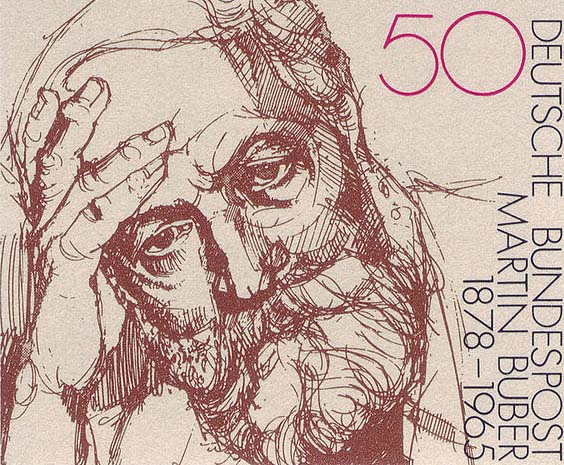
Martin Buber (1878—1965)

Martin Buber was a prominent twentieth century philosopher, religious thinker, political activist and educator. Born in Austria, he spent most of his life in Germany and Israel, writing in German and Hebrew. He is best known for his 1923 book, Ich und Du (I and Thou), which distinguishes between “I-Thou” and “I-It” modes of existence. Often characterized as an existentialist philosopher, Buber rejected the label, contrasting his emphasis on the whole person and “dialogic” intersubjectivity with existentialist emphasis on “monologic” self-consciousness. In his later essays, he defines man as the being who faces an “other” and constructs a world from the dual acts of distancing and relating. His writing challenges Kant, Hegel, Marx, Kierkegaard, Nietzsche, Dilthey, Simmel and Heidegger, and he influenced Emmanuel Lévinas.

Buber was also an important cultural Zionist who promoted Jewish cultural renewal through his study of Hasidic Judaism. He recorded and translated Hasidic legends and anecdotes, translated the Bible from Hebrew into German in collaboration with Franz Rosenzweig, and wrote numerous religious and Biblical studies. He advocated a bi-national Israeli-Palestinian state and argued for the renewal of society through decentralized, communitarian socialism. The leading Jewish adult education specialist in Germany in the 1930s, he developed a philosophy of education based on addressing the whole person through education of character, and directed the creation of Jewish education centers in Germany and teacher-training centers in Israel.

Most current scholarly work on Buber is done in the areas of pedagogy, psychology and applied social ethics.

Table of Contents

  1. Biography
  2. Philosophical Anthropology
    1. Introduction
    2. “I-Thou” and “I-It”
    3. Distance and Relation
    4. Confirmation and Inclusion
    5. Good and Evil
    6. Hindrances to Dialogue
  3. Religious Writings
    1. Hasidic Judaism
    2. Biblical Studies
  4. Political Philosophy
  5. Philosophy of Education
  6. References and Further Reading
    1. General
    2. Mythology
    3. Philosophical Works
    4. Political and Cultural Writing
    5. Religious Studies
    6. Secondary Sources

1. Biography

Mordecai Martin Buber was born in Vienna in February 8, 1878. When he was three, his mother deserted him, and his paternal grandparents raised him in Lemberg (now, Lviv) until the age of fourteen, after which he moved to his father’s estate in Bukovina. Buber would only see his mother once more, when he was in his early thirties. This encounter he described as a “mismeeting” that helped teach him the meaning of genuine meeting. His grandfather, Solomon, was a community leader and scholar who edited the first critical edition of the Midrashim traditional biblical commentaries. Solomon’s estate helped support Buber until it was confiscated during World War II.

Buber was educated in a multi-lingual setting and spoke German, Hebrew, Yiddish, Polish, English, French and Italian, with a reading knowledge of Spanish, Latin, Greek and Dutch. At the age of fourteen he began to be tormented with the problem of imagining and conceptualizing the infinity of time. Reading Kant’s Prolegomena to All Future Metaphysics helped relieve this anxiety. Shortly after he became taken with Nietzsche’s Thus Spoke Zarathustra, which he began to translate into Polish. However, this infatuation with Nietzsche was short lived and later in life Buber stated that Kant gave him philosophic freedom, whereas Nietzsche deprived him of it.

Buber spent his first year of university studies at Vienna. Ultimately the theatre culture of Vienna and the give-and-take of the seminar format impressed him more than any of his particular professors. The winters of 1897-98 and 1898-99 were spent at the University of Leipzig, where he took courses in philosophy and art history and participated in the psychiatric clinics of Wilhelm Wundt and Paul Flecksig (see Schmidt’s Martin Buber’s Formative Years: From German Culture to Jewish Renewal, 1897-1909 for an analysis of Buber’s life during university studies and a list of courses taken). He considered becoming a psychiatrist, but was upset at the poor treatment and conditions of the patients.

The summer of 1899 he went to the University of Zürich, where he met his wife Paula Winkler (1877-1958, pen name Georg Munk). Paula was formally converted from Catholicism to Judaism. They had two children, Rafael (1900-90) and Eva (1901-92).

From 1899-1901 Buber attended the University of Berlin, where he took several courses with Wilhelm Dilthey and Georg Simmel. He later explained that his philosophy of dialogue was a conscious reaction against their notion of inner experience (Erlebnis) (see Mendes-Flohr’s From Mysticism to Dialogue: Martin Buber’s Transformation of German Social Thought for an analysis of the influence of Dilthey and Simmel). During this time Buber gave lectures on the seventeenth century Lutheran mystic Jakob Böhme, publishing an article on him in 1901 and writing his dissertation for the University of Vienna in 1904 “On the History of the Problem of Individuation: Nicholas of Cusa and Jakob Böhme.” After this he lived in Florence from 1905-06, working on a habilitation thesis in art history that he never completed.

In 1904 Buber came across Tzevaat Ha-RIBASH (The Testament of Rabbi Israel, the Baal-Shem Tov), a collection of sayings by the founder of Hasidism. Buber began to record Yiddish Hasidic legends in German, publishing The Tales of Rabbi Nachman, on the Rabbi of Breslov, in 1906, and The Legend of the Baal-Shem in 1907. The Legend of the Baal-Shem sold very well and influenced writers Ranier Maria Rilke, Franz Kafka and Herman Hesse. Buber was a habitual re-writer and editor of all of his writings, which went through many editions even in his lifetime, and many of these legends were later rewritten and included in his later two volume Tales of the Hasidim (1947).

At the same time Buber emerged as a leader in the Zionist movement. Initially under the influence of Theodor Herzl, Buber’s Democratic Faction of the Zionist Party, but dramatically broke away from Herzl after the 1901 Fifth Zionist Congress when the organization refused to fund their cultural projects. In contrast to Herzl’s territorial Zionism, Buber’s Zionism, like that of Ahad Ha’am, was based on cultural renewal. Buber put together the first all-Jewish art exhibition in 1901, and in 1902 co-founded Jüdischer Verlag, a publishing house that produced collections of Jewish poetry and art, with poet Berthold Feiwel, graphic artist Ephraim Mosche Lilien and writer Davis Trietsche. This dedication to the arts continued through the 1910s and 20s, as Buber published essays on theatre and helped to develop both the Hellerau Experimental Theatre and the Dusseldorf Playhouse (see Biemann and Urban’s works for Buber’s notion of Jewish Renaissance and Braiterman for Buber’s relation to contemporaneous artistic movements).

Buber was the editor of the weekly Zionist paper Die Welt in 1901 and of Die Gesellschaft, a collection of forty sociopsychological monographs, from 1905-12 (On Die Gesellschaft see Mendes-Flohr’s From Mysticism to Dialogue: Martin Buber’s Transformation of German Social Thought). His influence as a Jewish leader grew with a series of lectures given between 1909-19 in Prague for the Zionist student group Bar Kochba, later published as “Speeches on Judaism,” and was established by his editorship of the influential monthly journal Der Jude from 1916-24. He also founded, and from 1926-29 co-edited, Die Kreatur with theologian Joseph Wittig and physician Viktor von Weizsäcker. Always active in constructing dialogue across borders, this was the first high level periodical to be co-edited by members of the Jewish, Protestant and Catholic faiths. Buber continued inter-religious dialogue throughout his life, corresponding for instance with Protestant theologians Paul Tillich and Reinhold Niebuhr.

Despite his prolific publishing endeavors, Buber struggled to complete I and Thou. First drafted in 1916 and then revised in 1919, it was not until he went through a self-styled three-year spiritual ascesis in which he only read Hasidic material and Descartes’ Discourse on Method that he was able to finally publish this groundbreaking work in 1923. After I and Thou, Buber is best known for his translation of the Hebrew Bible into German. This monumental work began in 1925 in collaboration with Franz Rosenzweig, but was not completed until 1961, more than 30 years after Rosenzweig’s death.

In 1923 Buber was appointed the first lecturer in “Jewish Religious Philosophy and Ethics” at the University of Frankfurt. He resigned after Hitler came into power in 1933 and was banned from teaching until 1935, but continued to conduct Jewish-Christian dialogues and organize Jewish education until he left for British Palestine in 1938. Initially Buber had planned to teach half a year in Palestine at Hebrew University, an institution he had helped to conceive and found, and half a year in Germany. But Kristallnacht, the devastation of his library in Heppenheim and charges of Reichsfluchtsteuer (Tax on Flight from the Reich), because he had not obtained a legal emigration permit, forced his relocation.

Buber engaged in “spiritual resistance” against Nazism through communal education, seeking to give a positive basis for Jewish identity by organizing the teaching of Hebrew, the Bible and the Talmud. He reopened an influential and prestigious Frankfurt center for Jewish studies, Freies jüdisches Lehrhaus (Free Jewish House of Learning) in 1933 and directed it until his emigration. In 1934 he created and directed the “Central Office for Jewish Adult Educationfor the Reichsvertretung der deutschen Juden (National Representation of German Jews).

After giving well-attended talks in Berlin at the Berlin College of Jewish Education and the Berlin Philharmonie, Buber, who as one of the leading Jewish public figures in Germany became known as the “arch-Jew” by the Nazis, was banned from speaking in public or at closed sessions of Jewish organizations. Despite extreme political pressure, he continued to give lectures and published several essays, including “The Question to the Single One” in 1936, which uses an analysis of Kierkegaard to attack the foundations of totalitarianism (see Between Man and Man).

After his emigration Buber became Chair of the Department of Sociology of Hebrew University, which he held until his retirement in 1951. Continuing the educational work he had begun in Germany, Buber established Beth Midrash l’Morei Am (School for the Education of Teachers of the People) in 1949 and directed it until 1953. This prepared teachers to live and work in the hostels and settlements of the newly arriving emigrants. Education was based on the notion of dialogue, with small classes, mutual questioning and answering, and psychological help for those coming from detention camps.

From the beginning of his Zionist activities Buber advocated Jewish-Arab unity in ending British rule of Palestine and a binational state. In 1925 he helped found Brit Shalom (Covenant of Peace) and in 1939 helped form the League for Jewish-Arab Rapprochement and Cooperation, which consolidated all of the bi-national groups. In 1942, the League created a political platform that was used as the basis for the political party the Ichud (or Ihud, that is, Union). For his work for Jewish-Arab parity Dag Hammarskjöld (then Secretary-General of the United Nations) nominated him for the Nobel Peace Prize in 1959.

In addition to his educational and political activities, the 1940s and 50s saw an outburst of more than a dozen books on philosophy, politics and religion, and numerous public talks throughout America and Europe. Buber received many awards, including the Goethe Prize of the University of Hamburg (1951), the Peace Prize of the German Book Trade (1953), the first Israeli honorary member of the American Academy of Arts and Sciences (1961), and the Erasmus Prize (1963). However, Buber’s most cherished honor was an informal student celebration of his 85th birthday, in which some 400 students from Hebrew University rallied outside his house and made him an honorary member of their student union.

On June 13, 1965 Martin Buber died. The leading Jewish political figures of the time attended his funeral. Classes were cancelled and hundreds of students lined up to say goodbye as Buber was buried in the Har-Hamenuchot cemetery in Jerusalem.

2. Philosophical Anthropology

a. Introduction

Martin Buber’s major philosophic works in English are the widely read I and Thou (1923), a collection of essays from the 1920s and 30s published as Between Man and Man, a collection of essays from the 1950s published as The Knowledge of Man: Selected Essays and Good and Evil: Two Interpretations (1952). For many thinkers Buber is the philosopher of I and Thou and he himself often suggested one begin with that text. However, his later essays articulate a complex and worthy philosophical anthropology.

Buber called himself a “philosophical anthropologist” in his 1938 inaugural lectures as Professor of Social Philosophy at the Hebrew University of Jerusalem, entitled “What is Man?” (in Between Man and Man). He states that he is explicitly responding to Kant’s question “What is man?” and acknowledges in his biographic writings that he has never fully shaken off Kant’s influence. But while Buber finds certain similarities between his thought and Kant’s, particularly in ethics, he explains in “Elements of the Interhuman” (in The Knowledge of Man, 1957) that their origin and goal differ. The origin for Buber is always lived experience, which means something personal, affective, corporeal and unique, and embedded in a world, in history and in sociality. The goal is to study the wholeness of man, especially that which has been overlooked or remains hidden. As an anthropologist he wants to observe and investigate human life and experience as it is lived, beginning with one’s own particular experience; as a philosophic anthropologist he wants to make these particular experiences that elude the universality of language understood. Any comprehensive overview of Buber’s philosophy is hampered by his disdain for systemization. Buber stated that ideologization was the worst thing that could happen to his philosophy and never argued for the objectivity of his concepts. Knowing only the reality of his own experience, he appealed to others who had analogous experiences.

Buber begins these lectures by asserting that man only becomes a problem to himself and asks “What is man?” in periods of social and cosmic homelessness. Targeting Kant and Hegel, he argues that while this questioning begins in solitude, in order for man to find who he is, he must overcome solitude and the whole way of conceiving of knowledge and reality that is based on solitude. Buber accuses Hegel of denigrating the concrete human person and community in favor of universal reason and argues that man will never be at home or overcome his solitude in the universe that Hegel postulates. With its emphasis on history, Hegel locates perfection in time rather than in space. This type of future-oriented perfection, Buber argues, can be thought, but it cannot be imagined, felt or lived. Our relationship to this type of perfection can only rest on faith in a guarantor for the future.

Instead, Buber locates realization in relations between creatures. Overcoming our solitude, which tends to oscillate between conceiving of the self as absorbed in the all (collectivism) and the all as absorbed into the self (solipsistic mysticism), we realize that we always exist in the presence of other selves, and that the self is a part of reality only insofar as it is relational. In contrast to the traditional philosophic answers to “What is man?” that fixate on reason, self-consciousness or free will, Buber argues that man is the being who faces an “other”, and a human home is built from relations of mutual confirmation. 

b. “I-Thou” and “I-It”

Martin Buber’s most influential philosophic work, I and Thou (1923), is based on a distinction between two word-pairs that designate two basic modes of existence: I-Thou” (Ich-Du) and “I-It” (Ich-Es). The “I-Thou” relation is the pure encounter of one whole unique entity with another in such a way that the other is known without being subsumed under a universal. Not yet subject to  classification or limitation, the “Thou” is not reducible to spatial or temporal characteristics. In contrast to this the “I-It” relation is driven by categories of “same” and “different” and focuses on universal definition. An “I-It” relation experiences a detached thing, fixed in space and time, while an “I-Thou” relation participates in the dynamic, living process of an “other”.

Buber characterizes “I-Thou” relations as “dialogical” and “I-It” relations as “monological.” In his 1929 essay “Dialogue,” Buber explains that monologue is not just a turning away from the other but also a turning back on oneself (Rückbiegung). To perceive the other as an It is to take them as a classified and hence predictable and manipulable object that exists only as a part of one’s own experiences. In contrast, in an “I-Thou” relation both participants exist as polarities of relation, whose center lies in the between (Zwischen).

The “I” of man differs in both modes of existence. The “I” may be taken as the sum of its inherent attributes and acts, or it may be taken as a unitary, whole, irreducible being. The “I” of the “I-It” relation is a self-enclosed, solitary individual (der Einzige) that takes itself as the subject of experience. The “I” of the “I-Thou” relation is a whole, focused, single person (der Einzelne) that knows itself as subject. In later writings Buber clarified that inner life is not exhausted by these two modes of being. However, when man presents himself to the world he takes up one of them.

While each of us is born an individual, Buber draws on the Aristotelian notion of entelechy, or innate self-realization, to argue that the development of this individuality, or sheer difference, into a whole personality, or fulfilled difference, is an ongoing achievement that must be constantly maintained. In I and Thou, Buber explains that the self becomes either more fragmentary or more unified through its relationships to others. This emphasis on intersubjectivity is the main difference between I and Thou and Buber’s earlier Daniel: Dialogues on Realization (1913). Like I and Thou, Daniel distinguishes between two modes of existence: orienting (Rientierung), which is a scientific grasp of the world that links experiences, and realization (Verwirklichung), which is immersion in experience that leads to a state of wholeness. While these foreshadow the “I-It” and “I-Thou” modes, neither expresses a relationship to a real “other”. In I and Thou man becomes whole not in relation to himself but only through a relation to another self. The formation of the “I” of the “I-Thou” relation takes place in a dialogical relationship in which each partner is both active and passive and each is affirmed as a whole being. Only in this relationship is the other truly an “other”, and only in this encounter can the “I” develop as a whole being.

Buber identifies three spheres of dialogue, or “I Thou” relations, which correspond to three types of otherness. We exchange in language, broadly conceived, with man, transmit below language with nature, and receive above language with spirit. Socrates is offered as the paradigmatic figure of dialogue with man, Goethe, of dialogue with nature, and Jesus, of dialogue with spirit. That we enter into dialogue with man is easily seen; that we also enter into dialogue with nature and spirit is less obvious and the most controversial and misunderstood aspect of I and Thou. However, if we focus on the “I-Thou” relationship as a meeting of singularities, we can see that if we truly enter into relation with a tree or cat, for instance, we apprehend it not as a thing with certain attributes, presenting itself as a concept to be dissected, but as a singular being, one whole confronting another.

Dialogue with spirit is the most difficult to explicate because Buber uses several different images for it. At times he describes dialogue with spirit as dialogue with the “eternal Thou,” which he sometimes calls God, which  is eternally “other”. Because of this, I and Thou was widely embraced by Protestant theologians, who also held the notion that no intermediary was necessary for religious knowledge. Buber also argues that the precondition for a dialogic community is that each member be in a perpetual relation to a common center, or “eternal Thou”. Here the “eternal Thou” represents the presence of relationality as an eternal value. At other times, Buber describes dialogue with spirit as the encounter with form that occurs in moments of artistic inspiration or the encounter with personality that occurs in intensive engagement with another thinker’s works. Spiritual address is that which calls us to transcend our present state of being through creative action. The eternal form can either be an image of the self one feels called to become or some object or deed that one feels called to bring into the world.

Besides worries over Buber’s description of man’s dialogue with nature and spirit, three other main complaints have been raised against I and Thou. The first, mentioned by Walter Kaufmann in the introduction to his translation of I and Thou, is that the language is overly obscure and romantic, so that there is a risk that the reader will be aesthetically swept along into thinking the text is more profound than it actually is. Buber acknowledges that the text was written in a state of inspiration. For this reason it is especially important to also read his later essays, which are more clearly written and rigorously argued. E. la B. Cherbonnier notes in “Interrogation of Martin Buber” that every objective criticism of Buber’s philosophy would belong, by definition, to the realm of “I-It”. Given the incommensurability of the two modes, this means no objective criticism of the “I-Thou” mode is possible. In his response Buber explains that he is concerned to avoid internal contradiction and welcomes criticism. However, he acknowledges that his intention was not to create an objective philosophic system but to communicate an experience.

Finally, I and Thou is often criticized for denigrating philosophic and scientific knowledge by elevating “I-Thou” encounters above “I-It” encounters. It is important to note that Buber by no means renounces the usefulness and necessity of “I-It” modes. His point is rather to investigate what it is to be a person and what modes of activity further the development of the person. Though one is only truly human to the extent one is capable of “I-Thou” relationships, the “It” world allows us to classify, function and navigate. It gives us all scientific knowledge and is indispensable for life. There is a graduated structure of “I-It” relations as they approximate an “I-Thou” relationship, but the “I-Thou” remains contrasted to even the highest stage of an “I-It” relation, which still contains some objectification. However, each “Thou” must sometimes turn into an “It”, for in responding to an “other” we bind it to representation. Even the “eternal Thou” is turned into an It for us when religion, ethics and art become fixed and mechanical. However, an “I-It” relation can be constituted in such a way as to leave open the possibility of further “I-Thou” encounters, or so as to close off that possibility.

c. Distance and Relation

In I and Thou Martin Buber discusses the a priori basis of the relation, presenting the “I-Thou” encounter as the more primordial one, both in the life of humans, as when an infant reaches for its mother, and in the life of a culture, as seen in relationships in primitive cultures. However, in the 1951 essay “Distance and Relation,” written in the midst of the Palestinian conflicts, he explains that while this may be true from an anthropological perspective, from an ontological one it must be said that distance (Urdistanz) is the precondition for the emergence of relation (Beziehung), whether “I-Thou” or “I-It”. Primal distance sets up the possibility of these two basic word pairs, and the between (Zwischen) emerges out of them. Humans find themselves primally distanced and differentiated; it is our choice to then thin or thicken the distance by entering into an “I-Thou” relation with an “other” or withdrawing into an “I-It” mode of existence.

Only man truly distances, Buber argues, and hence only man has a “world.” Man is the being through whose existence what “is” becomes recognized for itself. Animals respond to the other only as embedded within their own experience, but even when faced with an enemy, man is capable of seeing his enemy as a being with similar emotions and motivations. Even if these are unknown , we are able to recognize that these unknown qualities of the other are “real” while our fantasies about the other are not. Setting at a distance is hence not the consequence of a reflective, “It” attitude, but the precondition for all human encounters with the world, including reflection.

Buber argues that every stage of the spirit, however primal, wishes to form and express itself. Form assumes communication with an interlocutor who will recognize and share in the form one has made. Distance and relation mutually correspond because in order for the world to be grasped as a whole by a person, it must be distanced and independent from him and yet also include him, and his attitude, perception, and relation to it. Consequently, one cannot truly have a world unless one receives confirmation of one’s own substantial and independent identity in one’s relations with others.

Relation presupposes distance, but distance can occur without genuine relation. Buber explains that distance is the universal situation of our existence; relation is personal becoming in the situation. Relation presupposes a genuine other and only man sees the other as other. This other withstands and confirms the self and hence meets our primal instinct for relation. Just as we have the instinct to name, differentiate, and make independent a lasting and substantial world, we also have the instinct to relate to what we have made independent. Only man truly relates, and when we move away from relation we give up our specifically human status.

d. Confirmation and Inclusion

Confirmation is a central theme of Martin Buber’s philosophic texts as well as his articles on education and politics. Buber argues that, while animals sometimes turn to humans in a declaring or announcing mode, they do not need to be told that they are what they are and do not see whom they address as an existence independent of their own experience. But because man experiences himself as indeterminate, his actualization of one possibility over another needs confirmation. In confirmation one meets, chooses and recognizes the other as a subject with the capacity to actualize one’s own potential. In order for confirmation to be complete one must know that he is being made present to the other.

As becomes clear in his articles on education, confirmation is not the same as acceptance or unconditional affirmation of everything the other says or does. Since we are not born completely focused and differentiated and must struggle to achieve a unified personality, sometimes we have to help an “other” to actualize themselves against their own immediate inclination. In these cases confirmation denotes a grasp of the latent unity of the other and confirmation of what the other can become. Nor does confirmation imply that a dialogic or “I-Thou” relation must always be fully mutual. Helping relations, such as educating or healing, are necessarily asymmetrical.

In the course of his writing Buber uses various terms, such as “embrace” or “inclusion” (Umfassung), “imagining the real” (Realphantasie), and in reference to Kant, “synthesizing apperception,” to describe the grasp of the other that is necessary for confirmation and that occurs in an “I-Thou” relation. “Imagining the real” is a capacity; “making present” is an event, the highest expression of this capacity in a genuine meeting of two persons. This form of knowledge is not the subsumption of the particularity of the other under a universal category. When one embraces the pain of another, this is not a sense of what pain is in general, but knowledge of this specific pain of this specific person. Nor is this identification with them, since the pain always remains their own specific pain. Buber differentiates inclusion from empathy. In empathy one’s own concrete personality and situation is lost in aesthetic absorption in the other. In contrast, through inclusion, one person lives through a common event from the standpoint of another person, without giving up their own point of view.

e. Good and Evil

Martin Buber’s 1952 Good and Evil: Two Interpretations answers the question “What is man?” in a slightly different way than the essays in Between Man and Man and The Knowledge of Man. Rather than focusing on relation, Good and Evil: Two Interpretations emphasizes man’s experience of possibility and struggle to become actualized. Framing his discussion around an analysis of psalms and Zoroastrian and Biblical myths, Buber interprets the language of sin, judgment and atonement in purely existential terms that are influenced by Hasidic Judaism, Kant’s analysis of caprice (Willkür) and focused will (Wille), and Kierkegaard’s discussion of anxiety. Buber argues that good and evil are not two poles of the same continuum, but rather direction (Richtung) and absence of direction, or vortex (Wirbel). Evil is a formless, chaotic swirling of potentiality; in the life of man it is experienced as endless possibility pulling in all directions. Good is that which forms and determines this possibility, limiting it into a  particular direction. We manifest the good to the extent we become a singular being with a singular direction.

Buber explains that imagination is the source of both good and evil. The “evil urge” in the imagination generates endless possibilities. This is fundamental and necessary, and only becomes “evil” when it is completely separated from direction. Man’s task is not to eradicate the evil urge, but to reunite it with the good, and become a whole being. The first stage of evil is “sin,” occasional directionlessness. Endless possibility can be overwhelming, leading man to grasp at anything, distracting and busying himself, in order to not have to make a real, committed choice. The second stage of evil is “wickedness,” when caprice is embraced as a deformed substitute for genuine will and becomes characteristic. If occasional caprice is sin, and embraced caprice is wickedness, creative power in conjunction with will is wholeness. The “good urge” in the imagination limits possibility by saying no to manifold possibility and directing passion in order to decisively realize potentiality. In so doing it redeems evil by transforming it from anxious possibility into creativity. Because of the temptation of possibility, one is not whole or good once and for all. Rather, this is an achievement that must be constantly accomplished.

Buber interprets the claim that in the end the good are rewarded and the bad punished as the experience the bad have of their own fragmentation, insubstantiality and “non-existence.” Arguing that evil can never be done with the whole being, but only out of inner contradiction, Buber states that the lie or divided spirit is the specific evil that man has introduced into nature. Here “lie” denotes a self that evades itself, as manifested not just in a gap between will and action, but more fundamentally, between will and will. Similarly, “truth” is not possessed but is rather lived in the person who affirms his or her particular self by choosing direction. This process, Buber argues, is guided by the presentiment implanted in each of us of who we are meant to become.

f. Hindrances to Dialogue

Along with the evasion of responsibility and refusal to direct one’s possibilities described in Good and Evil: Two Interpretations (1952), Buber argues in “Elements of the Interhuman” (1957, in The Knowledge of Man) that the main obstacle to dialogue is the duality of “being” (Sein) and “seeming” (Schein). Seeming is the essential cowardice of man, the lying that frequently occurs in self-presentation when one seeks to communicate an image and make a certain impression. The fullest manifestation of this is found in the propagandist, who tries to impose his own reality upon others. Corresponding to this is the rise of “existential mistrust” described in Buber’s 1952 address at Carnegie Hall, “Hope for this Hour” (in Pointing the Way). Mistrust takes it for granted that the other dissembles, so that rather than genuine meeting, conversation becomes a game of unmasking and uncovering unconscious motives. Buber criticizes Marx, Nietzsche and Freud for meeting the other with suspicion and perceiving the truth of the other as mere ideology. Similarly, in his acceptance speech for the 1953 Peace Prize of the German Book Trade, “Genuine Dialogue and the Possibilities of Peace” (in Pointing the Way), Buber argues the precondition for peace is dialogue, which in turn rests on trust. In mistrust one presupposes that the other is likewise filled with mistrust, leading to a dangerous reserve and lack of candor.

As it is a key component of his philosophic anthropology that one becomes a unified self through relations with others, Buber was also quite critical of psychiatrist Carl Jung and the philosophers of existence. He argued that subsuming reality under psychological categories cuts man off from relations and does not treat the whole person, and especially objected to Jung’s reduction of psychic phenomenon to categories of the private unconscious. Despite his criticisms of Freud and Jung, Buber was intensely interested in psychiatry and gave a series of lectures at the Washington School of Psychiatry at the request of Leslie H. Farber (1957, in The Knowledge of Man) and engaged in a public dialogue with Carl Rogers at the University of Michigan (see Anderson and Cissna’s The Martin Buber-Carl Rogers Dialogue: A New Transcript With Commentary). In these lectures, as well as his 1951 introduction to Hans Trüb’s Heilung aus der Begegnung (in English as “Healing Through Meeting” in Pointing the Way), Buber criticizes the tendency of psychology to “resolve” guilt without addressing the damaged relations at the root of the feeling. In addition to Farber, Rogers and Trüb, Buber’s dialogical approach to healing influenced a number of psychologists and psychoanalysts, including Viktor von Weizsäcker, Ludwig Binswanger and Arie Sborowitz.

Often labeled an existentialist, Buber rejected the association. He asserted that while his philosophy of dialogue presupposes existence, he knew of no philosophy of existence that truly overcomes solitude and lets in otherness far enough. Sartre in particular makes self-consciousness his starting point. But in an “I-Thou” relation one does not have a split self, a moment of both experience and self-reflection. Indeed, self-consciousness is one of the main barriers to spontaneous meeting. Buber explains the inability to grasp otherness as perceptual inadequacy that is fostered as a defensive mechanism in an attempt to not be held responsible to what is addressing one. Only when the other is accorded reality are we held accountable to him; only when we accord ourselves a genuine existence are we held accountable to ourselves. Both are necessary for dialogue, and both require courageous confirmation of oneself and the other.

In Buber’s examples of non-dialogue, the twin modes of distance and relation lose balance and connectivity, and one pole overshadows the other, collapsing the distinction between them. For example, mysticism (absorption in the all) turns into narcissism (a retreat into myself), and collectivism (absorption in the crowd) turns into lack of engagement with individuals (a retreat into individualism). Buber identifies this same error in Emmanuel Lévinas’ philosophy. While Lévinas acknowledged Buber as one of his main influences, the two had a series of exchanges, documented in Levinas & Buber: Dialogue and Difference, in which Buber argued that Lévinas had misunderstood and misapplied his philosophy. In Buber’s notion of subject formation, the self is always related to and responding to an “other”. But when Lévinas embraces otherness, he renders the other transcendent, so that the self always struggles to reach out to and adequately respond to an infinite other. This throws the self back into the attitude of solitude that Buber sought to escape.

3. Religious Writings

a. Hasidic Judaism

In his 1952 book Eclipse of God, Martin Buber explains that philosophy usually begins with a wrong set of premises: that an isolated, inquiring mind experiences a separate, exterior world, and that the absolute is found in universals. He prefers the religious, which in contrast, is founded on relation, and means the covenant of the absolute with the particular. Religion addresses whole being, while philosophy, like science, fragments being. This emphasis on relation, particularity and wholeness is found even in Buber’s earliest writings, such as his 1904 dissertation on the panentheistic German mystics Nicholas of Cusa and Jakob Böhme, “On the History of the Problem of Individuation: Nicholas of Cusa and Jakob Böhme.” Nicholas of Cusa postulates that God is a “coincidence of opposites” and that He “contracts” himself into each creature, so that each creature best approximates God by actualizing its own unique identity. Böhme similarly presents God as both transcendent and immanent, and elaborates that perfection of individuality is developed through mutual interaction.

The same elements that attracted Buber to Nicholas of Cusa and Böhme he found fulfilled in Hasidism, producing collections of Hasidic legends and anecdotes (Tales of Rabbi Nachman, The Legend of the Baal-Shem and Tales of the Hasidim) as well as several commentaries (including On Judaism, The Origin and Meaning of Hasidism and The Way of Man: According to the Teaching of Hasidism). The Hebrew tsimtsum expresses God’s “contraction” into the manifold world so that relation can emerge. In distinction from the one, unlimited source, this manifold is limited, but has the choice and responsibility to effect the unification (yihud) of creation. The restoration of unity is described as “the freeing of the sparks,” understood as the freeing of the divine element from difference through the hallowing of the everyday.

In addition to defining Hasidism by its quest for unity, Buber contrasts the Hasidic insistence on the ongoing redemption of the world with the Christian belief that redemption has already occurred through Jesus Christ. Each is charged with the task to redeem their self and the section of creation  they occupy. Redemption takes place in the relation between man and creator, and is neither solely dependent on God’s grace nor on man’s will. No original sin can prohibit man from being able to turn to God. However, Buber is not an unqualified voluntarist. As in his political essays, he describes himself as a realistic meliorist. One cannot simply will redemption. Rather, each person’s will does what it can with the particular concrete situation that faces it.

The Hebrew notions of kavana, or concentrated inner intention, and teshuva, or (re)turning to God with one’s whole being, express the conviction that no person or action is so sinful that it cannot be made holy and dedicated to God. Man hallows creation by being himself and working in his own sphere. There is no need to be other, or to reach beyond the human. Rather, one’s ordinary life activities are to be done in such a way that they are sanctified and lead to the unification of the self and creation. The legends and anecdotes of the historic zaddikim (Hasidic spiritual and community leaders) that Buber recorded depict persons who exemplify the hallowing of the everyday through the dedication of the whole person.

If hallowing is successful, the everyday is the religious, and there is no split between the political, social or religious spheres. Consequently Buber rejects the notion that God is to be found through mystical ecstasy in which one loses one’s sense of self and is lifted out of everyday experience. Some commentators, such as Paul Mendes-Flohr and Maurice Friedman, view this as a turn away from his earlier preoccupation with mysticism in texts such as Ecstatic Confessions (1909) and Daniel: Dialogues on Realization (1913). In later writings, such as “The Question to the Single One” (1936, in Between Man and Man) and “What is Common to All” (1958, in The Knowledge of Man), Buber argues that special states of unity are experiences of self-unity, not identification with God, and that many forms of mysticism express a flight from the task of dealing with the realities of a concrete situation and working with others to build a common world into a private sphere of illusion. Buber is especially critical of Kierkegaard’s assertion that the religious transcends the ethical. Drawing on Hasidic thought, he argues that creation is not an obstacle on the way to God, but the way itself.

Buber did not strictly follow Judaism’s religious laws. Worried that an “internal slavery” to religious law stunts spiritual growth, he did not believe that revelation could ever be law-giving in itself, but that revelation becomes legislation through the self-contradiction of man. Principles require acting in a prescribed way, but the uniqueness of each situation and encounter requires each to be approached anew. He could not blindly accept laws but felt compelled to ask continually if a particular law was addressing him in his particular situation. While rejecting the universality of particular laws, this expresses a meta-principle of dialogical readiness.

Buber’s interpretation of Hasidism is not without its critics. Gershom Scholem in particular accused Buber of selecting elements of Hasidism to confirm his “existentialist” philosophy. Scholem argued that the emphasis on particulars and the concrete that Buber so admired does not exist in Hasidism and that Buber’s erroneous impressions derive from his attention to oral material and personalities at the expense of theoretical texts. In general Buber had little historical or scholarly interest in Hasidism. He took Hasidism to be less a historical movement than a paradigmatic mode of communal renewal and was engaged by the dynamic meaning of the anecdotes and the actions they pointed to. In a 1943 conversation with Scholem, Buber stated that if Scholem’s interpretation of Hassidism was accurate, then he would have labored for forty years over Hasidic sources in vain, for they would no longer interest him.

b. Biblical Studies

In addition to his work with Hasidism, Martin Buber also translated the Bible from Hebrew into German with Franz Rosenzweig, and produced several religious analyses, including Kingship of God, Moses: The Revelation and the Covenant, On the Bible: Eighteen Studies, The Prophetic Faith and Two Types of Faith. Counter to religious thinkers such as Karl Barth and Emmanuel Lévinas, Buber argues that God is not simply a wholly transcendent other, but also wholly same, closer to each person than his or her own self. However, God can be known only in his relation to man, not apart from it. Buber interprets religious texts, and the Bible in particular, as the history of God’s relation to man from the perspective of man. Thus, it is not accurate to say that God changes throughout the texts, but that the theophany, the human experience of God, changes. Consequently, Buber characterizes his approach as tradition criticism, which emphasizes experiential truth and uncovers historical themes, in contrast to source criticism, which seeks to verify the accuracy of texts.

When translating the Bible, Buber’s goal was to make the German version as close to the original oral Hebrew as possible. Rather than smoothing over difficult or unclear passages, he preferred to leave them rough. One important method was to identify keywords (Leitworte) and study the linguistic relationship between the parts of the text, uncovering the repetition of word stems and same or similar sounding words. Buber also tried to ward against Platonizing tendencies by shifting from static and impersonal terms to active and personal terms. For instance, whereas kodesh had previously been translated “holy,” he used the term “hallowing” to emphasize activity. Similarly, God is not the “Being” but the “Existing,” and what had been rendered “Lord” became “I,” “Thou” and “He.”

Buber made two important distinctions between forms of faith in his religious studies. In the 1954 essay “Prophecy, Apocalyptic, and the Historical Hour” (in Pointing the Way), he distinguishes between “apocalyptic” approaches, which dualistically separate God from world, and regard evil as unredeemable, and “prophetic” stances, which preserve the unity of God with the world and promise the fulfillment of creation, allowing evil to find direction and serve the good. In the prophetic attitude one draws oneself together so that one can contribute to history, but in the apocalyptic attitude one fatalistically resigns oneself. The tension between these two tendencies is illustrated in his 1943 historical novel Gog and Magog: A Novel (also published as For the Sake of Heaven: A Hasidic Chronicle-Novel).

In Two Types of Faith (1951), Buber distinguishes between the messianism of Jesus and the messianism of Paul and John. While he had great respect for Jesus as a man, Buber did not believe that Jesus took himself to be divine. Jesus’ form of faith corresponds to emunah, faith in God’s continual presence in the life of each person. In contrast, the faith of Paul and John, which Buber labels pistis, is that God exists in Jesus. They have a dualistic notion of faith and action, and exemplify the apocalyptic belief in irredeemable original sin and the impossibility of fulfilling God’s law. Buber accuses Paul and John of transforming myth, which is historically and biographically situated, into gnosis, and replacing faith as trust and openness to encounter with faith in an image.

4. Political Philosophy

Martin Buber’s cultural Zionism, with its early emphasis on aesthetic development, was inextricably linked to his form of socialism. Buber argues that it is an ever-present human need to feel at home in the world while experiencing confirmation of one’s functional autonomy from others. The development of culture and aesthetic capacities is not an end in itself but the precondition for a fully actualized community, or “Zionism of realization” (Verwirklichungszionismus). The primary goal of history is genuine community, which is characterized by an inner disposition toward a life in common. This refutes the common misconception that an “I-Thou” relation is an exclusive affective relation that cannot work within a communal setting. Buber critiques collectivization for creating groups by atomizing individuals and cutting them off from one another. Genuine community, in contrast, is a group bound by common experiences with the disposition and persistent readiness to enter into relation with any other member, each of whom is confirmed as a differentiated being. He argues that this is best achieved in village communes such as the Israeli kibbutzim.

In his 1947 study of utopian socialism, Paths in Utopia, and 1951 essay “Society and the State” (in Pointing the Way), Buber distinguished between the social and political principles. The political principle, exemplified in the socialism of Marx and Lenin, tends towards centralization of power, sacrificing society for the government in the service of an abstract, universal utopianism. In contrast, influenced by his close friend, anarchist Gustav Landauer, Buber postulates a social principle in which the government serves to promote community. Genuine change, he insists, does not occur in a top-down fashion, but only from a renewal of man’s relations. Rather than ever-increasing centralization, he argues in favor of federalism and the maximum decentralization compatible with given social conditions, which would be an ever-shifting demarcation line of freedom.

Seeking to retrieve a positive notion of utopianism, Buber characterizes genuine utopian socialism as the ongoing realization of the latent potential for community in a concrete place. Rather than seeking to impose an abstract ideal, he argues that genuine community grows organically out of the topical and temporal needs of a given situation and people. Rejecting economic determinism for voluntarism, he insists that socialism is possible to the extent that people will a revitalization of communal life. Similarly, his Zionism is not based on the notion of a final state of redemption but an immediately attainable goal to be worked for. This shifts the notion of utopian socialism from idealization to actualization and equality.

Despite his support of the communal life of the kibbutzim, Buber decried European methods of colonization and argued that the kibbutzim would only be genuine communities if they were not closed off from the world. Unlike nationalism, which sees the nation as an end in itself, he hoped Israel would be more than a nation and would usher in a new mode of being. The settlers must learn to live with Arabs in a vital peace, not merely next to them in a pseudo-peace that he feared was just a prelude to war. As time went on, Buber became increasingly critical of Israel, stating that he feared a victory for the Jews over the Arabs would mean a defeat for Zionism.

Buber’s criticism of Israeli policies led to many public debates with its political leaders, in particular David Ben-Gurion, Israel’s first Prime Minister. In a relatively early essay, “The Task” (1922), Buber argued that the politicization of all life was the greatest evil facing man. Politics inserts itself into every aspect of life, breeding mistrust. This conviction strengthened over time, and in his 1946 essay “A Tragic Conflict” (in A Land of Two Peoples) he described the notion of a politicized “surplus” conflict. When everything becomes politicized, imagined conflict disguises itself as real, tragic conflict. Buber viewed Ben-Gurion as representative of this politicizing tendency. Nevertheless, Buber remained optimistic, believing that the greater the crisis the greater the possibility for an elemental reversal and rebirth of the individual and society.

Buber’s relationship to violence was complicated. He argued that violence does not lead to freedom or rebirth but only renewed decline, and deplored revolutions whose means were not in alignment with their end. Afraid that capital punishment would only create martyrs and stymie dialogue, he protested the sentencing of both Jewish and Arab militants and called the execution of Nazi Adolf Eichmann a grave mistake. However, he insisted that he was not a pacifist and that, sometimes, just wars must be fought. This was most clearly articulated in his 1938 exchange of letters with Gandhi, who compared Nazi Germany to the plight of Indians in South Africa and suggested that the Jews use satyagraha, or non-violent “truth-force.” Buber was quite upset at the comparison of the two situations and replied that satyagraha depends upon testimony. In the face of total loss of rights, mass murder and forced oblivion, no such testimony was possible and satyagraha was ineffective (see Pointing the Way and The Letters of Martin Buber: A Life of Dialogue).

5. Philosophy of Education

In addition to his work as an educator, Martin Buber also delivered and published several essays on philosophy of education, including “Education,” given in 1925 in Heidelberg (in Between Man and Man). Against the progressive tone of the conference, Buber argued that the opposite of compulsion and discipline is communion, not freedom. The student is neither entirely active, so that the educator can merely free his or her creative powers, nor is the student purely passive, so that the educator merely pours in content. Rather, in their encounter, the educative forces of the instructor meet the released instinct of the student. The possibility for such communion rests on mutual trust.

The student trusts in the educator, while the educator trusts that the student will take the opportunity to fully develop herself. As the teacher awakens and confirms the student’s ability to develop and communicate herself, the teacher learns to better encounter the particular and unique in each student. In contrast to the propagandist, the true educator influences but does not interfere. This is not a desire to change the other, but rather to let what is right take seed and grow in an appropriate form. Hence they have a dialogical relationship, but not one of equal reciprocity. If the instructor is to do the job it cannot be a relationship between equals.

Buber explains that one cannot prepare students for every situation, but one can guide them to a general understanding of their position and then prepare them to confront every situation with courage and maturity. This is character or whole person education. One educates for courage by nourishing trust through the trustworthiness of the educator. Hence the presence and character of the educator is more important than the content of what is actually taught. The ideal educator is genuine to his or her core, and responds with his or her “Thou”, instilling trust and enabling students to respond with their “Thou”. Buber acknowledges that teachers face a tension between acting spontaneously and acting with intention. They cannot plan for dialogue or trust, but they can strive to leave themselves open for them.

In “Education and World-View” (1935, in Pointing the Way), Buber further elaborates that in order to prepare for a life in common, teachers must educate in such a way that both individuation and community are advanced. This entails setting groups with different world-views before each other and educating, not for tolerance, but for solidarity. An education of solidarity means learning to live from the point of view of the other without giving up one’s own view. Buber argues that how one believes is more important than what one believes. Teachers must develop their students to ask themselves on what their world-view stands, and what they are doing with it.

6. References and Further Reading

a. General

  • “Interrogation of Martin Buber.” Conducted by M.S. Friedman. Philosophic Interrogations. Ed. S. and B. Rome. New York: Holt, Rinehart and Winston, 1964.
    • Questions by more than 50 major thinkers and Buber’s responses.
  • Martin Buber Werkausgabe. Ed. Paul Mendes-Flohr and Peter Schäffer. Gütersloh: Gütersloher Verlagshaus, 2001.

    • A critical 21-volume compilation of the complete writings of Buber in German, designed to replace Buber’s self-edited Werke.
  • The Letters of Martin Buber: A Life of Dialogue. Ed. Nahum N. Glatzer and Paul Mendes-Flohr. Trans. Richard and Clara Winston and Harry Zohn. Syracuse, N.Y.: Syracuse University Press, 1996.
    • Includes letters to his wife and family as well as many notable thinkers, including Gandhi, Walter Benjamin, Albert Einstein, Herman Hesse, Franz Kafka, Albert Camus, Gustav Landauer and Dag Hammarskjöld.
  • The Martin Buber Reader. Ed. Asher Biemann. New York: Macmillan, 2002.
  • The Philosophy of Martin Buber: The Library of Living Philosophers, 12. Ed. Paul A. Schilpp and Maurice Friedman. La Salle, I.L.: Open Court, 1967.
    • Large collection of essays by Gabriel Marcel, Charles Hartshorne, Emmanuel Lévinas, Hugo Bergman, Jean Wahl, Ernst Simon, Walter Kaufmann and many others, with Buber’s replies and autobiographical statements.
  • Werke. 3 vols. Vol I: Schriften zur Philosophie. Vol 2: Schriften zur Bible. Vol. 3: Schriften zur Chassidismus. Munich and Heidelberg: Kösel Verlag and Lambert Schneider, 1962-63.
    • Comprehensive collection (more than four thousand pages long), edited by Buber. Lacks some very early and very late essays, which may be found in the Martin Buber Archives of the Jewish National and University Library at the Hebrew University of Jerusalem.

b. Mythology

  • Tales of Rabbi Nachman. Trans. Maurice Friedman. Amherst, N.Y.: Humanity Books, 1988.
  • The Legend of the Baal-Shem. Trans. Maurice Friedman. London: Routledge, 2002.
  • Tales of the Hasidim (The Early Masters and The Later Masters). New York: Schocken Books, 1991.
  • Gog and Magog: A Novel. Trans. Ludwig Lewisohn. Syracuse, N.Y.: Syracuse University Press, 1999.
  • Previously published as For the Sake of Heaven: A Hasidic Chronicle-Novel.

c. Philosophical Works

  • Between Man and Man. Trans. Ronald Gregor-Smith. New York: Routledge, 2002.
    • Good introduction to Buber’s thought that includes “Dialogue,” “What is Man?” “The Question to the Single One” (on Kierkegaard), and lectures on education.
  • Daniel: Dialogues on Realization. Trans. Maurice S. Friedman. New York: McGraw-Hill, 1965.
    • Early work, important for understanding the development to I and Thou.
  • Eclipse of God: Studies in the Relation Between Religion and Philosophy. Trans. Maurice Friedman. Atlantic Highlands, N.J.: International Humanities Press, 1988.
    • Includes critiques of Heidegger, Sartre and Jung.
  • Good and Evil: Two Interpretations. Pt. 1: Right and Wrong, trans. R.G. Smith. Pt. 2: Images of Good and Evil, trans. M. Bullock. Upper Saddle River, N.J.: Prentice Hall, 1997.
    • Very helpful to an understanding of Buber’s moral philosophy and relation to existentialism.
  • I and Thou. Trans. Ronald Gregor-Smith. New York: Scribner, 1984.
  • I and Thou. Trans. Walter Kaufmann. New York: Simon and Schuster, 1996.
  • The Knowledge of Man: Selected Essays. Trans. Maurice Friedman and Ronald Gregor-Smith. Amherst, N.Y.: Prometheus Books, 1998.
    • Mature and technical, with the important “Distance and Relation” and lectures given for the Washington School of Psychiatry.

d. Political and Cultural Writing

  • A Land of Two Peoples: Martin Buber on Jews and Arabs. Ed. Paul R. Mendes-Flohr. Chicago: University of Chicago Press, 2005.
  • Israel and the World: Essays in a Time of Crisis. New York: Schocken Books, 1963.
  • On Zion: The History of an Idea. Trans. Stanley Godman. New York: Schocken Books, 1986.
  • Paths in Utopia. Trans. R. F. Hull. New York: Syracuse University Press, 1996.
    • History and defense of utopian socialism, including analyses of Marx, Lenin, Landauer and kibbutzim.
  • Pointing the Way: Collected Essays. Ed. and trans. Maurice Friedman. Atlantic Highlands, N.J.: Humanities Press, 1988.
    • Mix of early and late essays, including essays on theatre, Bergson and Gandhi, and “Education and World-View,” “Society and the State,” “Hope for the Hour” and “Genuine Dialogue and the Possibilities of Peace.”
  • The First Buber: Youthful Zionist Writings of Martin Buber. Trans. Gilya G. Schmidt. Syracuse, N.Y.: Syracuse University Press: 1999.

e. Religious Studies

  • Ecstatic Confessions: The Heart of Mysticism. Ed. Paul R. Mendes-Flohr. San Francisco: Harper & Row, 1985.
  • Hasidism and Modern Man. Ed. and trans. Maurice S. Friedman. New York: Harper Torchbooks, 1958.
  • Kingship of God. Trans. Richard W. Scheimann. New York: Harper, 1973.
  • Moses: The Revelation and the Covenant. Amherst, N.Y.: Humanity Books, 1998.
  • On Judaism. Ed. Nahum Glatzer. New York: Schocken Books, 1967.
  • On the Bible: Eighteen Studies. Ed. Nahum Glatzer. New York: Schocken Books, 1968.
  • The Origin and Meaning of Hasidism. Ed. and trans. Maurice Friedman. New York: Horizon Press, 1960.
  • The Prophetic Faith. New York: Collier Books, 1985.
  • The Way of Man: According to the Teaching of Hasidism. London: Routledge, 2002.
    • Best short introduction to Buber’s interpretation of Hasidism.
  • Two Types of Faith. Trans. Norman P. Goldhawk. Syracuse, N.Y.: Syracuse University Press, 2003.

f. Secondary Sources

  • Anderson, Rob and Kenneth N. Cissna. The Martin Buber-Carl Rogers Dialogue: A New Transcript With Commentary. Albany: State University of New York Press, 1997.
  • Atterton, Peter, Mathew Calarco, and Maurice Friedman, eds. Lévinas & Buber: Dialogue and Difference. Pittsburg: Duquesne University Press, 2004.
    • Mix of primary sources, commentaries and argumentative essays.
  • Biemann, Asher D. Inventing New Beginnings: On the Idea of Renaissance in Modern Judaism. Stanford, C.A.: Stanford University Press, 2009.
    • Details Buber’s notions of Jewish Renaissance and aesthetic education.
  • Braiterman, Zachary. The Shape of Revelation: Aesthetics and Modern Jewish Thought. Stanford, C.A.: Stanford University Press, 2007.
    • Studies the relation between the philosophy of Buber and Rosenzweig and the aesthetics of early German modernism, especially the transition from Jugendstil to Expressionism.
  • Friedman, Maurice S. Encounter on the Narrow Ridge: A Life of Martin Buber. New York: Paragon House, 1991.
    • Biography largely condensed from Martin Buber’s Life and Work.
  • Friedman, Maurice S. Martin Buber’s Life and Work. 3 vols. Vol 1: The Early Years, 1878-1923. Vol. 2: The Middle Years, 1923-1945. Vol 3: The Later Years, 1945-1965. Detroit: Wayne State University Press, 1988.
  • Mendes-Flohr, Paul. From Mysticism to Dialogue: Martin Buber’s Transformation of German Social Thought. Detroit: Wayne State University Press, 1989.
    • Explores the influence of Landauer, Dilthey and Simmel, and Buber’s work as the editor of Die Gesellschaft.
  • Schmidt, Gilya G. Martin Buber’s Formative Years: From German Culture to Jewish Renewal, 1897-1909. Tuscaloosa: University of Alabama Press, 1995.
    • Buber’s early intellectual influences, life during university studies and turn to Zionism.
  • Scholem, Gershom. “Martin Buber’s Conception of Judaism,” in On Jews and Judaism in Crisis: Selected Essays. Ed. Werner Dannhauser. New York: Schocken, 1937.
  • Shapira, Avraham. Hope for Our Time: Key Trends in the Thought of Martin Buber. Trans. Jeffrey M. Green. Albany: State University of New York Press, 1999.
    • Systematic presentation of Buber’s main philosophic concepts.
  • Theunissen, Michael. The Other: Studies in the Social Ontology of Husserl, Heidegger, Sartre, and Buber. Cambridge, M.A.: MIT Press, 1984.
  • Urban, Martina. Aesthetics of Renewal: Martin Buber’s Early Representation of Hasidism as Kulturkritik. Chicago: The University of Chicago Press, 2008.
    • Discusses Buber’s hermeneutics, notions of anthology and Jewish renewal, and phenomenological presentation of Hasidism.

Author Information

Sarah Scott
Email: scots087@newschool.edu
The New School for Social Research
U. S. A.

Aquinas: Philosophical Theology

aquinasIn addition to his moral philosophy, Thomas Aquinas (1225-1274) is well-known for his theological writings.   He is arguably the most eminent philosophical theologian ever to have lived.  To this day, it is difficult to find someone whose work rivals Aquinas’ in breadth and influence.  Although his work is not limited to illuminating Christian doctrine, virtually all of what he wrote is shaped by his theology.  Therefore it seems appropriate to consider some of the theological themes and ideas that figure prominently in his thought.

The volume and depth of Aquinas’ work resists easy synopsis.  Nevertheless, an abridged description of his work may help us appreciate his  philosophical skill in exploring God’s nature and defending Christian teaching.  Although Aquinas does not think that philosophical reasoning can provide an exhaustive account of the divine nature, it is (he insists) both a source of divine truth and an aid in exonerating the intellectual credibility of those doctrines at the heart of the Christian faith.  From this perspective, philosophical reasoning can be (to use a common phrase) a tool in the service of theology.

An adequate understanding of Aquinas’ philosophical theology requires that we first consider the twofold manner whereby we come to know God:  reason and sacred teaching.  Our discussion of what reason reveals about God will naturally include an account of philosophy’s putative success in demonstrating both God’s existence and certain facts about God’s nature.  Yet because Aquinas also thinks that sacred teaching contains the most comprehensive account of God’s nature, we must also consider his account of faith—the virtue whereby we believe well with respect to what sacred teaching reveals about God.  Finally, we will consider how Aquinas employs philosophical reasoning when explaining and defending two central Christian doctrines:  the Incarnation and the Trinity.

Table of Contents

  1. Preliminary Matters: How Can We Know Divine Truth?
  2. Natural Theology
    1. Can We Demonstrate God’s Existence?
    2. A Sample Demonstration: The Argument from Efficient Causality
    3. God’s Nature
  3. Faith
    1. What is Faith?
    2. Faith and Voluntariness
    3. Faith and Reason
  4. Christian Doctrine
    1. Incarnation and Atonement
    2. Trinity
  5. References and Further Reading
    1. Primary Sources
    2. Secondary Sources
    3. Internet Resources

1. Preliminary Matters: How Can We Know Divine Truth?

How can we know realities of a divine nature?  Aquinas  posits a “twofold mode of truth concerning what we profess about God” (SCG 1.3.2).  First, we may come to know things about God through rational demonstration.  By demonstration Aquinas means a form of reasoning that yields conclusions that are necessary and certain for those who know the truth of the demonstration’s premises.  Reasoning of this sort will enable us to know, for example, that God exists.  It can also demonstrate many of God’s essential attributes, such as his oneness, immateriality, eternality, and so forth (SCG 1.3.3).  Aquinas is not claiming that our demonstrative efforts will give us complete knowledge of God’s nature.  He does think, however, that human reasoning can illuminate some of what the Christian faith professes (SCG 1.2.4; 1.7).  Those aspects of the divine life which reason can demonstrate comprise what is called natural theology, a subject we will address in section 2.

Obviously, some truths about God surpass what reason can demonstrate.  Our knowledge of them will therefore require a different source of divine truth, namely, sacred teaching.  According to Aquinas, sacred teaching contains the most complete and reliable account of what we profess about God (SCG I.5.3).  Of course, whether sacred teaching is authoritative vis-à-vis divine realties depends on whether what it says about God is true.  How, then, can we be confident that sacred teaching is, in fact, a reliable source of divine knowledge?  An extended treatment of this matter requires that we consider the role faith plays in endorsing what sacred teaching proposes for belief.  This issue is addressed in section 3.

2. Natural Theology


Generally speaking, natural theology (NT) is a discipline that seeks to demonstrate God’s existence or aspects of his nature by means of human reason and experience.  The conclusions of NT do not rely on supernaturally revealed truths;  its point of departure is that which can be ascertained by means of the senses or rational methods of investigation.  So understood, NT is primarily a philosophical enterprise.  As one commentator explains, NT “amounts to forgoing appeals to any putative revelation and religious experience as evidence for the truth of propositions, and accepting as data only those few naturally evident considerations that traditionally constitute data acceptable for philosophy generally.  That’s what makes it natural theology” (Kretzmann, 1997: 2).

A caveat:  It is a mistake to construe NT as an autonomous branch of inquiry, at least in Aquinas’ case.  In fact, partitioning NT from divine revelation does a disservice to the theological nature of Aquinas’ overall project (for an extended defense of this position, see Hibbs, 1995 and 1998; Stump, 2003: 26-32).  For Aquinas is not content with simply demonstrating the fact of God’s existence.  The first article of ST makes this clear.  There, he asks whether knowledge of God requires something more than what philosophical investigation is able to tell us (ST Ia 1.1).  His answer is yes: although natural human reason can tell us quite a bit about God, it cannot give us salvific knowledge.  He writes:  “it was necessary for the salvation of man that certain truths which exceed human reason should be made known to him by divine revelation” (Ibid.).  In discussing truths that human reason can demonstrate, then, we should keep in mind that they comprise an overture to a more enriched and explicitly theological account of God’s nature.

a. Can We Demonstrate God’s Existence?

Aquinas thinks there are a variety of ways to demonstrate God’s existence.  But before he turns to them, he addresses several objections to making God an object of demonstration.  This essay will consider two of those objections.  According to the first objection, God’s existence is self-evident.  Therefore, any effort to demonstrate God’s existence is, at best, unnecessary (ST Ia 2.1 ad 1; SCG 1.10.1).  For Aquinas, this objection rests on a confusion about what it means for a statement to be self-evident.  He explains:  a statement is self-evident if its predicate is contained in the essence of the subject (ST Ia 2.1).  For example, the statement a triangle is a 3-sided planar figure is self-evident because the predicate-term (3-sided planar figure) is a part of the subject-term’s (triangle) nature.   Anyone who knows what a triangle is will see that this statement is axiomatic; it needs no demonstration.  On the other hand, this statement will not appear self-evident to those who do not know what a triangle is.  To employ Aquinas’ parlance, the statement is self-evident in itself (per se notum secundum se) but not self-evident to us (per se notum quod nos) (ST IaIIae 94.2;  Cf. ST Ia 2.1).  For a statement is self-evident in itself so long as it accurately predicates of the subject-term the essential characteristics it has.  Whether a statement is self-evident to us, however, will depend on whether we understand the subject-term to have those characteristics.

The aforementioned distinction (per se notum secundum se/per se notum quod nos) is helpful when responding to the claim that God’s existence is self-evident.  For Aquinas, the statement God exists is self-evident in itself since existence is a part of God’s essence or nature (that is, God is his existence—a claim to which we’ll turn below).  Yet the statement is not self-evident to us because God’s essence is not something we can comprehend fully.  Indeed, it is unlikely that even those acquainted with the idea of God will, upon reflecting on the idea, understand that existence is something that God has necessarily.  Although Aquinas does not deny that knowledge of God is naturally implanted in us, such knowledge is, at best, inchoate and imprecise;  it does not convey absolutely that God exists  (ST Ia 2.1 ad 1).  We acquire definitive knowledge of God’s existence in the same way we come to understand other natural causes, namely by identifying certain facts about the world—observable effects whose obviousness makes them better known to usand then attempting to demonstrate their pre-existing cause (ST Ia 2.2).  In other words, knowledge of God’s existence must be acquired through a posteriori demonstrations.  We will consider one of these demonstrations below.  At this point, we simply are trying to show that since God’s existence is not (to us) self-evident, the use of theistic demonstrations will not be a pointless exercise.

The second objection to the demonstrability of God’s existence is straightforward:  that which is of faith cannot be demonstrated.  Since God’s existence is an article of faith, it is not something we can demonstrate (ST Ia 2.2 obj. 1).  Aquinas’ response to this argument denies that God’s existence is an article of faith.  That is, he denies that God’s existence is a supernaturally revealed truth.  Instead, God’s existence is a demonstrable fact which supernaturally revealed truths presuppose.  The assent of faith involves embracing doctrinal teachings about God, whose existence is already assumed.  For this reason, Aquinas describes God’s existence not as an article of faith but as a preamble to the articles.  As such, God’s existence can be the subject of demonstration.

Aquinas concedes that, for some people, God’s existence will be a matter of faith.  After all, not everyone will be able to grasp the proofs for God’s existence.  Thus for some people it is perfectly appropriate to accept on the basis of sacred teaching that which others attempt to demonstrate by means of reason (ST Ia 2.2 ad 1).

b. A Sample Demonstration: The Argument from Efficient Causality

In the Summa Theologiae Ia 2.3, Aquinas offers five demonstrations for God’s existence (these are famously referred to as the “five ways”).  Each demonstration proceeds roughly as follows:  Aquinas identifies some observable phenomenon and then attempts to show that, necessarily, the cause of that phenomenon is none other than God. The phenomena Aquinas cites in these demonstrations include: 1) motion; 2) the existence of efficient causes; 3) the reality of contingency; 4) the different grades of perfection in the natural order; and 5) the end-directed activity of natural objects.   We should note that these demonstrations are highly abridged versions of arguments he addresses at length elsewhere (most notably, SCG I.13). Constraints of space do not permit an explication of each argument. But it will be helpful to consider at least one argument in order to see how these demonstrations typically proceed.

Aquinas’ argument from efficient causes—also known as “the second way”—is straightforward and does not lend itself to many interpretative disputes.   The argument is as follows:

In the world of sense we find there is an order of efficient causes. There is no case known (neither is it, indeed, possible) in which a thing is found to be the efficient cause of itself; for then it would be prior to itself, which is impossible. Now in efficient causes it is not possible to go on to infinity, because in all efficient causes following in order, the first is the cause of the intermediate cause, and the intermediate [cause] is the cause of the ultimate cause, whether the intermediate cause be several, or only one. Now to take away the cause is to take away the effect. Therefore, if there be no first cause among efficient causes, there will be no ultimate, nor any intermediate cause. But if in efficient causes it is possible to go on to infinity, there will be no first efficient cause, neither will there be an ultimate effect, nor any intermediate efficient causes; all of which is plainly false. Therefore it is necessary to admit a first efficient cause, to which everyone gives the name of God (ST Ia 2.3).

For our purposes, it might be helpful to present Aquinas’ argument in a more formal way:

  1. The world contains instances of efficient causation (given).
  2. Nothing can be the efficient cause of itself.
  3. So, every efficient cause seems to have a prior cause.
  4. But we cannot have an infinite regress of efficient causes.
  5. So there must be a first efficient cause “to which everyone gives the name God.”

First premise.  Like all of Aquinas’ theistic demonstrations, this one begins by citing an observable fact about the world, namely, that there are causal forces that produce various effects.  Aquinas does not say what these effects are, but according to John Wippel, we can assume that these effects would include “substantial changes (generation and corruption of substances) as well as various instances of motion … that is, alteration, local motion, increase, and decrease” (2006: Wippel, 58). Note here that there is no need to prove this premise.  Its truth is manifestly obvious, and thus Aquinas employs it as an argumentative point of departure.

Second premise. Aquinas then claims that it is impossible for any being to be the efficient cause of itself.  Why is self-causation impossible?  For the sake of ease, consider what it would mean for something to be the cause of its own existence (although this is not the only form of self-causation Aquinas has in mind).  In order to bring about the existence of anything, one needs a certain amount of causal power.  Yet a thing cannot have causal power unless it exists.  But if something were to be the cause of itself—that is, if it were to bring about its own existence—it would have to exist prior to itself, which is impossible (ST Ia 2.3).  Hence the third premise: every efficient cause must have a prior cause.

Aquinas’ argument in the first way—which is structurally similar to the argument from efficient causality—employs a parallel line of reasoning.  There, he says that to be in motion is to move from potentiality to actuality.  When something moves, it goes from having the ability to move to the activity of moving.  Yet something cannot be the source of its own movement.  Everything that moves does so in virtue of being moved by something that is already actual or “in act.”  In short, “whatever is in motion must be put in motion by another” (ST Ia 2.3).

Aquinas’ aim here is not to explain discrete or isolated instances of causation.  His interest, rather, is the existence of a causal order—one consisting of substances whose existence and activity depend on prior causes of that same order (Wippel, 59).  Yet this attempt to clarify Aquinas’ aim introduces an obvious problem.  If every constituent member of that order is causally dependent on something prior to itself, then it appears that the order in question must consist of an infinite chain of causes.  Yet Aquinas denies this implication (fourth premise): if the causal order is infinite, then (obviously) there could be no first cause.  But without a first cause, then (necessarily) there could be no subsequent effects—including the intermediate efficient causes and ultimate effect (ST Ia 2.3).  In other words, the absence of a first cause would imply an absence of the causal order we observe.  But since this implication is manifestly false, he says, there must be a first cause, “to which everyone gives the name God” (Ibid.).

A few clarifications about this argument are in order.  First, commentators stress that this argument does not purport to show that the world is constituted by a temporal succession of causes that necessarily had a beginning (see for example Copleston, 1955: 122-123).  Interestingly, Aquinas himself denies that the argument from efficient causality contradicts the eternality of the world (ST Ia 46.2 ad 1).  Whether the world began to exist can only be resolved, he thinks, by appealing to sacred teaching.  Thus he says that “by faith alone do we hold, and by no demonstration can it be proved, that the world did not always exist” (ST Ia 46.2).  With respect to the second way, then, Aquinas’ aim is simply to demonstrate that the order of observable causes and effects cannot be a self-existing reality.

An illustration may help clarify the sort of argument Aquinas wishes to present.  The proper growth of, say, plant life depends on the presence of sunlight and water.  The presence of sunlight and water depends on ideal atmospheric activities.  And those atmospheric activities are themselves governed by more fundamental causes, and so forth.  In this example, the events described proceed not sequentially, but concurrently. Even so, they constitute an arrangement in which each event depends for its occurrence on causally prior events or phenomena.  According to Copleston, illustrations of this sort capture the kind of causal ordering that interests Aquinas.  For “when Aquinas talks about an ‘order’ of efficient causes he is not talking of a series stretching back into the past, but of a hierarchy of causes, in which a subordinate member is here and now dependent on the causal activity of a higher member” (Copleston, 1955: 122).  Thus we might explain the sort of ordering that interests Aquinas as a metaphysical (as opposed to a temporal) ordering of causes.  And it is this sort of order that requires a first member, that is, “a cause which does not depend on the causal activity of a higher cause” (Ibid., 123).  For, as we have already seen, the absence of a first cause would imply the absence of subsequent causes and effects.  Unless we invoke a cause that itself transcends the ordering of dependent causes, we would find it difficult to account for the causal activities we presently observe.  Aquinas therefore states there must be “a first efficient, and completely non-dependent cause,” whereby “the word ‘first’ does not mean first in the temporal order but supreme or first in the ontological order” (Ibid.: 123;  For valuable commentaries on these points, see Copleston, 122-124; Wippel, 2006: 59; Reichenbach, 2008).

Second, it may appear that Aquinas is unjustified in describing the first efficient cause as God, as least if by “God” one has in mind a person possessing the characteristics Christian theologians and philosophers attribute to him (for example, omniscience, omnipotence, omnipresence, love, goodness, and so forth.).  Yet Aquinas does not attempt to show through the previous argument that the demonstrated cause has any of the qualities traditionally predicated of the divine essence.  He says:  “When the existence of a cause is demonstrated from an effect, this effect takes the place of the definition of the cause in proof of the cause’s existence” (ST Ia 2.2 ad 2).  In other words, the term God—at least as it appears in ST Ia 2.2—refers only to that which produces the observed effect.  In the case of the second way, God is synonymous with the first efficient cause;  it does not denote anything of theological substance.  We might think of the term “God” as a purely nominal concept Aquinas intends to investigate further (Te Velde, 2006: 44; Wippel, 2006:  46).  For the study of what God is must be subsequent to demonstrating that he is.  A complete account of the divine nature requires a more extensive examination, which he undertakes in the subsequent articles of ST.

c. God’s Nature

Once Aquinas completes his discussion of the theistic demonstrations, he proceeds to investigate God’s nature.  Such an investigation poses unique challenges.  Although Aquinas thinks that we can demonstrate God’s existence, our demonstrative efforts cannot tell us everything about what God is like.  As we noted before, God’s nature—that is, what God is in himself—surpasses what the human intellect is able to grasp (SCG I.14.2).  Aquinas therefore does not presume to say explicitly or directly what God is.  Instead, he investigates divine nature by determining what God is not.  He does this by denying of God those properties that are conceptually at odds with what is already concluded by means of the five ways (ST Ia 3 prologue;  Cf. SCG I.14.2 and 3).

Aquinas acknowledges a potential worry for his view.  If the method by which we investigate God is one of strict remotion, then no divine predicate can describe what God is really like.  As one objection states:  “it seems that no name can be applied to God substantially.  For Damascene says … ‘Everything said of God signifies not his substance, but rather exemplifies what he is not; or expresses some relation, or something following his nature or operation” (ST Ia 13.2 ad 1).  In other words, the terms we attribute to God either function negatively (for example, to say God is immaterial is to say he is “not material”) or describe qualities that God causes his creatures to have.  To illustrate this second alternative:  consider what we mean when we say “God is good” or “God is wise.”  According to the aforementioned objection, to say that God is good or wise is just to say that God is the cause of goodness and wisdom in creatures; the predicates in question here do not tell us anything about God’s nature (Ibid.).

For Aquinas, however, the terms we predicate of God can function positively, even if they cannot capture perfectly or make explicit the divine nature.  Here’s how.  As we have discussed, natural knowledge of God is mediated by our knowledge of the created order.  The observable facts of that order reveal an efficient cause that is itself uncaused—a self-subsisting first mover that is uncreated and is not subject to any change.  According to Aquinas, this means that God, from whom everything else is created, “contains within Himself the whole perfection of being” (ST Ia 4.2). But as the ultimate cause of our own existence, God is said to have all the perfections of his creatures (ST Ia 13.2).  Whatever perfections reside in us must be deficient likenesses of what exists perfectly in God.  Consequently, Aquinas thinks that terms such as good and wise can refer back to God.  Of course, those terms are predicated of God imperfectly just as God’s creatures are imperfect likenesses of him.  “So when we say, ‘God is good,’ the meaning is not, ‘God is the cause of goodness,’ or ‘God is not evil’; but the meaning is, ‘Whatever good we attribute to creatures, pre-exists in God,’ and in a more excellent and higher way” (Ibid.).

Moreover, denying certain properties of God can, in fact, give us a corresponding (albeit incomplete) understanding of what God is like.  In other words, the process of articulating what God is not does not yield an account of the divine that is wholly negative.  Here is a rough description of the way Aquinas’ reasoning proceeds:  we reason from theistic arguments (particularly the first and second ways) that God is the first cause; that is, God is the first being in the order of efficient causality. If this is so, there can be no potency or unrealized potential in God.  For if something has the potential or latent capacity to act, then its activity must be precipitated by some prior actuality.  But in this line of reasoning, there is no actuality prior to God.  It must follow, then, that God is pure actuality, and this in virtue of being the first cause (ST Ia 3.1).  So although this process denies God those traits that are contrary to what we know about him, those denials invariably yield a fairly substantive account of the divine life

Other truths necessarily follow from the idea that God is pure actuality.  For example, we know that God cannot be a body.  For a characteristic feature of bodies is that they are subject to being moved by something other than themselves.  And because God is not a body, he cannot be a composite of material parts (ST Ia 3.7).  Not only does Aquinas think that God is not a material composite, he also insists that God is not a metaphysical composite (Vallencia, 2005).  In other words, God is not an amalgam of attributes, nor is he a being whose nature or essence can be distinguished from his existence.  He is, rather, a simple being.

The doctrine of divine simplicity is complicated and controversial—even among those who admire Aquinas’ philosophical theology.  But the following account should provide the reader with a rough sketch of what this doctrine involves.  Consider the example human being. A person is a human being in virtue of her humanity, where “humanity” denotes a species-defining characteristic.  That is, humanity is an essence or “formal constituent” that makes its possessor a human being and not something else (ST Ia 3.3).  Of course, a human being is also material being.  In virtue of materiality, she possesses numerous individuating accidents. These would include various physical modifications such as her height or weight, her particular skin pigmentation, her set of bones, and so forth.  According to Aquinas, none of these accidental traits are included in her humanity (indeed, she could lose these traits, acquire others, and remain a human being).  They do, however, constitute the particular human being she is.  In other words, her individuating accidents do not make her human, but they do make her a particular exemplification of humanity.  This is why it would be incorrect to say that this person is identical to her humanity; instead, the individuating accidents she has make her one of many instances thereof.

But what about substances that are not composed of matter?  Such things cannot have multiple instantiations since there is no matter to individuate them into discrete instances of a specific nature or essence.  An immaterial substance then will not instantiate its nature. Instead, the substance will be identical to its nature.  This is why Aquinas insists that there can be no distinction between (1) God and (2) that by which he is God.  “He must be his own Godhead, His own life, and thus whatever else is predicated of him” (ST Ia 3.3).  For example, we often say that God is supremely good.  But it would be a mistake on Aquinas’ view to think that goodness is a property that God has, as if goodness is a property independent of God himself.  For “in God, being good is not anything distinct from him;  he is his goodness” (SCG I.3.8).  Presumably we can say the same about his knowledge,  perfection, wisdom, and other essential attributes routinely predicated of him.

So far we’ve considered the way God, as non-physical being, is simple.  What he is (God) is indistinguishable from that by which he is (his divine essence).  Presumably other immaterial beings would be simple in precisely this way in virtue of their immateriality.  Consider, for example, the notion of angels.  That there is no matter with which to individuate angelic beings implies that there will not be multiple instantiations of an angelic nature.  Like Aquinas’ notion of God, each angelic being will be identical to its specific essence or nature (ST Ia 3.3).  But God is obviously unlike angelic beings in an important way.  Not only is God the same as his essence;  he is also the same as his existence (ST Ia 3.4;  Cf. 50.2 ad 3).  In order to see what this means, consider the conclusions from section 2.2b.  There, we noted that the constituent members of the causal order cannot be the cause of their own existence and activity.  For “it is impossible for a thing’s existence to be caused by its essential constituent principles, for nothing can be the sufficient cause of its own existence, if its existence is caused” (Ibid.).  Thus the constituent members of the causal order must exist in virtue of some other, exterior principle of causality.

We are now in a position to see why, according to Aquinas, God and the principle by which he exists must be the same.  Unlike the constituent members of the causal order, all of whom receive their existence from some exterior principle, God is an uncaused cause.  In other words, God’s existence is not something bequeathed by some exterior principle or agent.  If it was, then God and the principle by which he exists would be different.  Yet the idea that God is the first efficient cause who does not acquire existence from something else implies that God is his own existence (Ibid).  Brain Davies explains this implication of the causal argument in the following way:

The conclusion Aquinas draws [from the five ways] is that God is his own existence.  He is Ipsum Esse Subsitens.  “Existence Itself” or “underived … Existence.” To put it another way, God is not a creature.  Creatures, Aquinas thinks, “have” existence, for their natures (what they are) do not suffice to guarantee their existence (that they are).  But with God this is not so.  He does not “have” existence; his existence is not received or derived from another.  He is his own existence and is the reason other things have it (Davies, 1992: 55).

For additional discussion of Aquinas’ argument for God’s existence, see Scriptural Roots and Aquinas’s Fifth Way.

3. Faith


So far, this article has shown how and to what extent human reason can lead to knowledge about God and his nature.  Aquinas clearly thinks that our demonstrative efforts can tell us quite a bit about the divine life.  Yet he also insists that it was necessary for God to reveal to us other truths by means of sacred teaching.  Unlike the knowledge we acquire by our own natural aptitudes, Aquinas contends that revealed knowledge gives us a desire for goods and rewards that exceed this present life (SCG I.5.2).  Also, revealed knowledge may tell us more about God than what our demonstrative efforts actually show.  Although our investigative efforts may confirm that God exists, they are unable to prove (for example) that God is fully present in three divine persons, or that it is the Christian God in whom we find complete happiness (ST Ia 1.1;  SCG I.5.3).  Revealed knowledge also curbs the presumptuous tendency to think that our cognitive aptitudes are sufficient when trying to determine (more generally) what is true (SCG I.5.4).

Moreover, Aquinas contends that it was fitting for God to make known through divine revelation even those truths that are accessible to human reason.  For if such knowledge depended strictly on the difficult and time-intensive nature of human investigation, then few people would actually possess it.  Also, our cognitive limitations may result in a good deal of error when trying to contrive successful demonstrations of divine realities.  Given our proneness to mistakes, relying on natural aptitude alone may seem particularly hazardous, especially when our salvation is at stake (Ibid.; Cf. SCG I.4.3-5).  For this reason, Aquinas insists that having “unshakable certitude and pure truth” with respect to the divine life requires that we avail ourselves of truths revealed by God and held by faith (Ibid., I.4.6).

a. What is Faith?

But what is “faith”?  Popular accounts of religion sometimes construe faith as a blind, uncritical acceptance of myopic doctrine.  According to Richard Dawkins, “faith is a state of mind that leads people to believe something—it doesn’t matter what—in the total absence of supporting evidence. If there were good supporting evidence then faith would be superfluous, for the evidence would compel us to believe it anyway” (Dawkins, 1989: 330).  Such a view of faith might resonate with contemporary skeptics of religion.  But as we shall see, this view is not remotely like the one Aquinas—or historic Christianity for that matter—endorses.

To begin with, Aquinas takes faith to be an intellectual virtue or habit, the object of which is God (ST IIaIIae 1.1;  4.2).  There are other things that fall under the purview of faith, such as the doctrine of the Trinity and the Incarnation.  But we do not affirm these specific doctrines unless they have some relation to God.  According to Aquinas, these doctrines serve to explicate God’s nature and provide us with a richer understanding of the one in whom our perfect happiness consists (Ibid.).  And although faith is an intellectual virtue, it would be a mistake to construe the act of faith as something that is purely cognitive in nature, such as the belief that 2 + 2 = 4, or that Venus is a planet, or that red is a primary color.  These beliefs are not (so it seems) things over which we have much voluntary control.  Perhaps this is because their truth is manifestly obvious or because they are based on claims that are themselves self-evident.  In either case, it doesn’t appear that we choose to believe these things.

By contrast, the assent of faith is voluntary.  To employ Aquinas’ terminology, the assent of faith involves not just the intellect but the will (ST IIaIIae 1.2).  By will Aquinas means a native desire or love for what we think contributes to our happiness.  How is the will involved in the assent of faith?  Aquinas appears to have something like this in mind:  suppose a person, upon hearing a homily or a convincing argument, becomes persuaded that ultimate human happiness consists in union with God.  For Aquinas, the mere acknowledgment of this truth does not denote faith—or at least a commendable form of faith that is distinct from believing certain propositions about God.  After all, the demons believe many truths about God, but they are compelled to believe due to the obviousness of those truths.  Their belief is not shaped by an affection for God and thus not praiseworthy (ST IIaIIae 5.2 ad 1 and 2).  Thus we can imagine that a person who is convinced of certain sacred truths may (for any number of reasons) choose not to consider or endorse what she now believes. Alternatively, she may, out of love for God, actively seek God as her proper end.   According to Aquinas, this love for God is what distinguishes faith from the mere acknowledgement that certain theological statements are true.  For faith involves an appetitive aspect whereby the will—a love or desire for goodness—moves us to God as the source of ultimate happiness (ST IIaIIae 2.9 ad 2; IIaIIae 4.2;  cf. Stump, 1991: 191).  We’ll say more about the relationship between love and faith in the following sub-section.

But what prompts the will to desire God?  After all, Christianity teaches that our wills have been corrupted by the Fall.  As a result of that corruption, Christian doctrine purports that we invariably love the wrong things and are inclined to ends contrary to God’s purposes.  The only way we would be motivated to seek God is if our wills were somehow changed;  that is, we must undergo some interior transformation whereby we come to love God.  According to Aquinas, that transformation comes by way of grace.  We will say more about grace in the following subsection of this article.  For now, we can construe grace as Aquinas does:  a good-making habit that inclines us to seek God and makes us worthy of eternal life (QDV 27.1).  According to Aquinas, if a person seeks God as the supreme source of human happiness, it can only be because God moves her will by conferring grace upon her.  That is why Aquinas insists that faith involves a “[voluntary] assent to the Divine truth at the command of the will moved by the grace of God” (ST IIaIIae 2.9;  Cf. 2.2).  Of course, just what it means for one’s will to be both voluntary and moved by God’s grace is a subject about which there is contentious debate.  How can the act of faith be voluntary if the act itself is a result of God generating a change in the human will?  This is the problem to which we’ll now turn.

b. Faith and Voluntariness

We may think that voluntary actions are the products of one’s free decisions and not compelled or generated by causal forces outside of one’s own will.  According to Aquinas, however, the act of faith is precipitated by grace, whereby God draws the will to himself (ST IaIIae 109.7). Does the infusion of grace contravene the sort of voluntariness that Aquinas insists is a component of faith?  Limitations of space prohibit an extensive treatment of this subject.  For this reason, a brief presentation of Aquinas’ view will follow.

The act of faith has a twofold cause:  one is external, the other is internal.  First, Aquinas says that faith requires an “external inducement, such as seeing a miracle, or being persuaded by someone” by means of reason or argument (ST IIaIIae 6.1;  Cf. 2.9 ad 3).  Observing a supernatural act or hearing a persuasive sermon or argument may corroborate the truth of sacred teaching and, in turn, encourage belief.  These inducements, however, are not sufficient for producing faith since not everyone who witnesses or hears them finds them compelling.  As Aquinas observes, of “those who see the same miracle, or who hear the same sermon, some believe, and some do not” (Ibid.).  We must therefore posit an internal cause whereby God moves the will to embrace that which is proposed for belief.  But how is it that God moves the will?  In other words, what does God do to the will that makes the assent of faith possible?  And how does God’s effort to dispose our will in a certain way not contravene its putative freedom?  None of the proposed answers to this question are uncontroversial, but what follows appears to be faithful to the view Aquinas favored (for some competing interpretations of Aquinas’ account, see Jenkins, 1998; Ross, 1985; Penelhum, 1977; and Stump, 1991 and 2003).

As indicated in the previous sub-section, charity, or the love of God, moves a person to faith (ST IIaIIae 4.3).  Aquinas states “charity is the form of faith” because the person who places her faith in God does so because of her love for God.  Thus we might think of the inward cause of faith to be a kind of infused affection or, better yet, moral inclination whereby the will is directed to God (Ibid.; 23.8).  As a result of this moral posturing, a person will be able to view Christian teaching more favorably than she would were it not for the infusion of charity.  John Jenkins endorses a similar account.  He suggests that pride, excessive passion, and other vicious habits generate within us certain prejudices that prevent us from responding positively to sacred teaching (Jenkins, 1998: 207-208).  A will that is properly directed to God, however, does not refuse a fair and charitable evaluation of Scripture’s claims.  Jenkins writes:  “a good will [and by this he means a will that has been moved by God’s grace]…permits us to see clearly and impartially that truths which are beyond our understanding…nevertheless have been revealed by God and are to be believed.” (Ibid., 208).  In other words, faith formed by charity transforms the will by allaying the strength of those appetitive obstacles that forestall love of God.  In turn, faith directs us to God and motivates us to embrace sacred teaching (ST IIaIIae 2.9 ad 3).

On this view of faith, the person who subordinates herself to God does so not as a result of divine coercion but by virtue of an infused disposition whereby she loves God.  In fact, we might argue that God’s grace makes a genuinely free response possible.  For grace curtails pride and enables us to grasp and fairly assess what the Christian faith proposes for belief (Jenkins, 209).  In doing so, it permits us to freely endorse those things that we in our sinful state would never be able—or want—to understand and embrace.  According to this view, God’s grace does not contravene the voluntary nature of our will.

c. Faith and Reason

It is clear from the preceding account of faith that Aquinas staunchly supports the use of argument in exonerating  those claims that are proposed for belief.  Indeed, the arguments offered in support of Christian claims often provide us with the motivation we sometimes need in order to embrace them.  But does the use of reasons or argument compromise the merit of faith?  Aquinas expresses the objection this way:  “faith is necessary [in order to assent to] divine things….  Therefore in this subject it is not permitted to investigate the truth [of divinely revealed realities] by reasoning” (De trinitate, 2.1 obj. 3).  He also quotes St. Gregory’s objection:  “ ‘Faith has no merit where human reason supplies proof.’ But it is wrong to do away with the merit of faith.  Therefore it is not right to investigate matters of faith by reason” (Ibid., obj. 5).  In short, human investigation into sacred doctrine threatens to render faith superfluous.  For if one were to offer a good argument for the truth of what God reveals, then there would be no need for us to exercise faith in regard to that truth.

Yet Aquinas insists that Christianity’s doctrinal truths—truths we are to embrace by faith—are often confirmed by “fitting arguments” (SCG I.6.1), and that faith can be strengthened by the use of reason (De trinitate, 2.1).  What sort of reasoning or argumentation does Aquinas have in mind?  He makes a distinction between demonstrative reasoning and persuasive reasoning.  As we saw earlier, demonstrative reasoning yields a conclusion that is undeniable for anyone who grasps the truth of the demonstration’s premises.  In these cases, believing the demonstration’s conclusion is not a voluntary affair.  If I know that the sum of all rectangles’ interior angles equals 360º and that a square is a rectangle, then I cannot help but believe that the sum of a square’s interior angles equals 360º.  In cases of demonstrative reasoning, knowledge of a demonstration’s premises is sufficient to guarantee assent to the demonstration’s conclusions  (De trinitate 2.1 ad 5).  Were a person to grasp the truth of sacred doctrine by means of this sort of reasoning, belief would be necessitated and the merit of faith destroyed (Ibid.).

Persuasive reasoning, on the other hand, does no such thing.  We might think of persuasive reasoning as playing an apologetic role vis-à-vis theological claims (Stump suggests something along these lines.  See 1991: 197).  In his own gloss on Aquinas, Jenkins suggests that “persuasive reasoning” consists of “credibility arguments” that corroborate the truth of what sacred scripture teaches but are ultimately unable “to move one to assent to the articles of faith” (Jenkins, 1997: 185-186).  In other words, the arguments in which persuasive reasoning consists may provide reasons for accepting certain doctrines, but they cannot compel acceptance of those doctrines.  One still needs the grace of faith in order to embrace them.  Whatever merits persuasive reasoning confers on sacred teaching, “it is the interior movement of grace and the Holy Spirit which is primary in bringing one to see that these truths  have been divinely revealed and are to be believed” (Ibid., 196).  This is why Aquinas insists that human investigation into matters of faith does not render faith superfluous or “deprive faith of its merit” (De trinitate 2.1 ad 5).

For more discussion, see the article Faith and Reason.

4. Christian Doctrine


A closer look at some central Christian doctrines is now in order.  The term “Christian doctrine” refers to the specific, developed teachings that are at the heart of Christian faith and practice.  And although there are many doctrines that constitute sacred teaching, at least two are foundational to Christianity and subject to thorough analysis by Aquinas.  These include the Incarnation and the Trinity.  Aquinas takes both of these doctrines to be essential to Christian teaching and necessary to believe in order to receive salvation (see ST IIaIIae 2.7 and 8, respectively).  For this reason it will be beneficial to explore what these doctrines assert.

a. Incarnation and Atonement

The doctrine of the Incarnation teaches that God literally and in history became human in the person of Jesus Christ.  The doctrine of the Incarnation further teaches that Christ is the complete and perfect union of two natures, human and divine.  The idea here is not that Jesus is some strange hybrid, a chimera of human and divine parts.  The idea rather is that in Christ there is a merger of two natures into one hypostasis—a subsisting individual composed of two discrete but complete essences (ST III 2.3).  In short, Christ is a single person who is fully human and fully divine;  he is God and man.  Aquinas’ efforts to explicate and defend this doctrine are ingenious but may prove frustrating without a more advanced understanding of the metaphysical framework he employs (see Stump 2003 for a treatment of this subject).  Rather than pursue the complexities of that framework, we will instead address a different matter to which the Incarnation is intricately connected.

According to Christian teaching, human beings are estranged from God.  That estrangement is the result of original sin—a “heritable stain” we contract from our first parent, Adam (Catholic Encyclopedia, “Original Sin”;  Cf. ST IaIIae 81.1).  So understood, sin refers not to a specific immoral act but a spiritual wounding that diminishes the good of human nature (ST IaIIae 85.1 and 3).  Sin’s stain undermines our ability to deliberate well about practical matters; it hardens our wills toward evil; and it exacerbates the impetuosity of passion, thereby making virtuous activity more difficult (ST IaIIae 85.3).  Further, Christian doctrine states that we become progressively more corrupt as we yield to sinful tendencies over time.  Sinful choices produce corresponding habits, or vices, that reinforce hostility towards God and put beatitude further beyond our reach.  No amount of human effort can remedy this problem.  The damage wrought by sin prevents us from meriting divine favor or even wanting the sort of goods that which makes union with God possible.

The Incarnation makes reconciliation with God possible.  To understand this claim, we must consider another doctrine to which the Incarnation is inextricably tied, namely, the doctrine of the Atonement.  According to the doctrine of Atonement, God reconciles himself to human beings through Christ, whose suffering and death compensates for our transgressions (ST III 48.1).  In short, reconciliation with God is accomplished by means of Christ’s satisfaction for sin.  Yet this satisfaction does not consist in making reparations for past transgressions.  Rather it consists in God healing our wounded natures and making union with him possible. The most fitting way to accomplish this task was through the Incarnation (ST III 1.2).  From this perspective, satisfaction is more restorative than retributive.  As Eleonore Stump notes:  “the function of  satisfaction for Aquinas is not to placate a wrathful God … [but] to restore a sinner to a state of harmony with God by repairing or restoring in the sinner what sin has damaged” (Stump, 2003: 432).  Aquinas emphasizes the restorative nature of satisfaction by detailing the many blessings Christ’s Incarnation and atoning work afford.  A partial list is as follows:  the incarnation provides human beings with a tangible manifestation of God himself, thereby inspiring faith;  it prompts in us hope for salvation;  it demonstrates God’s love for human beings, and in turn kindles within us a love for God; correlatively, it produces in us sorrow for past sins and a desire to turn from them; it provides us a template of humility, constancy, obedience, and justice, all of which are required for salvation; and it merits “justifying grace” for human beings (ST III 1.2; 46.3;  Cf.  90.4).

This last benefit requires explanation.  As we saw in the previous section, our natures are corrupted by sin, resulting in a weakened inclination to act virtuously and obey God’s commandments.  Only a supernatural transformation of our recalcitrant wills can heal our corrupt nature and make us people who steadily trust, hope in, and love God as the source of our beatitude.  In short, Christian doctrine purports that we need God’s grace—a divinely infused quality that inclines us toward God.  This brief description of grace might suggest that it is an infused virtue much like faith, hope, and charity.  According to Aquinas, however, grace is not a virtue.   Rather, it is the infused virtues’ “principle and root”a disposition that is antecedently necessary in order to practice the virtues themselves (ST IaIIae 110.3;  110 ad 3).  We might be inclined to think of God’s grace as a transformative quality that enables us to desire our supernatural end, fulfill God’s commandments, and avoid sin (ST IaIIae 109.2, 4, and 8).

This account helps explain why grace is said to justify sinners. Justification consists not only in the remittance of sins, but in a transmutation whereby our wills are supernaturally directed away from morally deficient ends and towards God.  In short, justification produces within us a certain “rectitude of order” whereby our passions are subordinate to reason and reason is subordinate to God as our proper end (ST IaIIae 113.1;  113.1 ad 2).  In this way God, by means of his grace, heals our fallen nature, pardons sin, and makes us worthy of eternal life.

Now, remission of sin and moral renovation cannot occur apart from the work God himself accomplishes through Christ. According to Aquinas, forgiveness and righteousness are made possible through Christ’s passion, or the love and obedience he exemplified through his suffering and death (ST III 48.2). Thus he describes Christ’s suffering and death as instruments of God’s grace; for through them we are freed from sin and reconciled to God (ST IaIIae 112.1 ad 1; ST III 48.1; 49.1-4). But how exactly does Christ’s suffering and death merit the remission of sin and unify us with God? Briefly: Christ’s loving obedience and willingness to suffer for justice’s sake merited God’s favor. Yet such favor was not limited to Christ. For “by suffering out of love and obedience, Christ gave more to God than what was required to compensate for the offense of the whole human race” (ST III 48.2; Cf. 48.4). That is to say, so great was his love and obedience that he accrued a degree of merit that was sufficient to atone for everyone’s sin (Ibid.). On this account, God accepts Christ’s perfect expression of love and obedience as a more than adequate satisfaction for sin, thereby discharging us from the debt of punishment incurred by our unfaithfulness and lack of love. But again, the aim of satisfaction is not to appease God through acts of restitution but to renovate our wills and make possible a right relationship with him (Stump, 432). After all, satisfaction for sin does us little good if Christ’s actions do not serve to change us by transforming the vicious inclinations that alienate us from God. Thus we ought not to look at Christ simply as an instrument by which our sins are wiped clean, but as one whose sacrificial efforts produce in us a genuine love for God and make possible the very union we desire (ST III 49.1; 49.3 ad 3).

The preceding survey of the Incarnation and the Atonement will undoubtedly raise further questions that we cannot possibly address here.  For example, one issue this article has not addressed is the role of Christian sacraments in conferring grace and facilitating the believer’s incorporation into God’s life (see, for example, ST III 48.2 ad 2; 62.1 and 2.  For a careful treatment of this issue, see Stump:  2003, chapter 15).  Instead, this brief survey attempts only a provisional account of how the Incarnation makes atonement for sin and reconciliation with God possible.

b. Trinity

This section will focus on the doctrine of the Trinity (with all the typical caveats implied, of course).  Aquinas’ definition of the Trinity is in full accord with the orthodox account of what Christians traditionally believe about God.  According to that account, God is one.  That is, his essence is one of supreme unity and simplicity.  Yet the doctrine also states that there are three distinct persons:  Father, Son, and Holy Spirit.  By distinct, Aquinas means that the persons of the Trinity are real individuals and not, say, the same individual understood under different descriptions.  Moreover, each of the three persons is identical to the divine essence.  That is, each person of the Trinity is equally to God.  The doctrine is admittedly confounding.  But if it is true, then it should be internally coherent.  In fact, Aquinas insists that, although we cannot prove the doctrine through our own demonstrative efforts, we can nevertheless show that this and other doctrines known through the light of faith are not contradictory (de Trinitate, 1.1 ad 5; 1.3).

Aquinas’ exposition of the Trinity endeavors to avoid two notable heresies:  Arianism and Sabellianism.  In short, Arianism denies Christ’s full divinity.  It teaches that Christ was created by God at a point in time and therefore not co-eternal with him.  Although Arianism insists that Christ is divine, his creaturely dependence on God implies that he does not share God’s essence.   In short, God and Christ are distinct substances.  What follows from this teaching is that Christ is “a second, or inferior God, standing midway between the First Cause and creatures; as Himself made out of nothing, yet as making all things else; as existing before the worlds of the ages; and as arrayed in all divine perfections except the one which was their stay and foundation” (Catholic Encyclopedia, “Arianism”).  The other heresy, Sabellianism, attempts to preserve divine unity by denying any real distinction in God.  According to this doctrine, the names “Father,” “Son,” and “Holy Spirit” refer not to discrete persons but different manifestations of the same divine being.  Aquinas’ account attempts to avoid these heresies by affirming that the persons of the Trinity are distinct without denying the complete unity of the divine essence.

How does Aquinas go about defending the traditional doctrine?  The challenge, of course, is to show that the claim

(1) the persons of the God-head are really distinct

is consistent with the claim that

(2) God is one

In an effort to reconcile (1) and (2), Aquinas argues that there are relations in God.  For example, we find in God the relational notion of paternity (which implies fatherhood) and filiation (which implies sonship) (ST Ia 28.1 sed contra).  Paternity and filiation imply different things.  And while I may be both a father and a son, these terms connote a real relation between distinct  persons (me, my son, and my father).  Thus if there is paternity and filiation in God, then there must be a real distinction of persons that the divine essence comprises (ST Ia 28.3).  We should note here that Aquinas avoids using the terms “diversity” and “difference” in this context because such terms contravene the doctrine of simplicity (ST Ia 31.2).  The notion of distinction, however, does not contravene the doctrine of simplicity because (according to Aquinas) we can have a distinction of persons while maintaining divine unity.

This last claim is obviously the troubling one.  How can we have real distinction within a being that is perfectly one?  The answer to this question requires we look a bit more closely at what Aquinas means by relation. The idea of relation goes back at least as far as Aristotle (for a good survey of medieval analyses of relations, see Brower, 2005).  For Aristotle and his commentators, the term relation refers to a property that allies the thing that has it with something else.  Thus he speaks of a relation as that which makes something of, than, or to some other thing (Aristotle, Categories, Book 7, 6b1).  For example, what is larger is larger than something else;  to have knowledge is to have knowledge of something;  to incline is to incline toward something;  and so forth (Ibid. 6b5).

Aquinas’ attempt to make sense of the Trinity involves use of (or perhaps, as Brower notes, a significant departure from) Aristotle’s idea of relation (Brower, 2005).  On the one hand, Aquinas’ understanding of relation as it applies to creatures mirrors Aristotle’s view:  a relation is an accidental property that signifies a connection to something else (ST Ia 28.1).  On the other hand, the notion of relation need not denote a property that allies different substances.  It can also refer to distinctions that are internal to a substance.  This second construal is the way Aquinas understands the notion of relation as it applies to God.  For there is within God a relation of persons, each of which enjoys a characteristic the others do not have.  As we noted before, God the Father has the characteristic of paternity, God the Son has the characteristic of filiation, and so on.  These characteristics are unique to each person, thus creating a kind of opposition that connotes real distinction (ST Ia 28.3).

Care is required before proceeding here.  Each of the aforementioned relations not only inhere in the divine essence, they are identical to it in the sense that each member of the Trinity is identical to God (ST Ia 28.2 and 29.4).  From this abbreviated account we see that relation as it exists in God is not, as it is for creatures, an accidental property.  For the relation, being identical to God, does not add to or modify the divine substance in any way.  Aquinas says:  “whatever has an accidental existence in creatures, when considered as transferred to God, has a substantial existence; for there is no accident in God; since all in Him is His essence. So, in so far as relation has an accidental existence in creatures, relation really existing in God has the existence of the divine essence in no way distinct therefrom” (ST Ia 28.2).  Seen this way, it is somewhat misleading to say that relation is something that “inheres in” God;  for the relation is identical to God himself (Emery, 2007:  94).

This woefully truncated account of Aquinas’ position presents a more detailed articulation of the very claim he needs to explain.  One can still ask:  how can God be a perfect unity and still comprise a plurality of distinct persons?  Aquinas is aware of the worry.  For “if in God there exists a number of persons, then there must be whole and part in God, which is inconsistent with the divine simplicity” (ST Ia 30.1 obj. 4;  cf. ST Ia 39.1 obj. 1).  Aquinas recognizes that most people will find it difficult to imagine how something can have within itself multiple relations and at the same time be an unqualified unity.

In order to show how one might have a plurality while preserving unity, consider the following analogy.  Using Aristotle’s account of material constitution as a point of departure, Jeffery Brower and Michael Rea suggest that a bronze statue is constituted by two discrete substances:  a lump of bronze and a statue.  Although the lump of bronze and the statue are distinct things, “they are numerically one material object.  Likewise, the persons of the Trinity are three distinct persons but numerically one God” (Brower and Rea, 2005: 69).  Although the authors do not have Aquinas’ account of divine relations in mind when using this analogy, we may cautiously avail ourselves of their insights.  If we can think of the lump of bronze and the configuration by which the bronze is a statue as a relation of two things, then we can see that relation does not concern anything that is not identical to the object (the bronze statue).  Such an account is similar to the one Aquinas has in mind when attempting reconcile (1) and (2).  For although each person of the Trinity is distinct from each other, each person is not distinct from God (ST Ia 28.2;  cf. 39.1).

Some readers might object to the use of such analogies.  In the present case, the relations that inhere in God are persons, not formally discrete features of an artifact.  Moreover, the analogy does not adequately capture the precise nature of the relations as they exist in God.  For Aquinas, the divine relations are relations of procession.  Here Aquinas takes himself to be affirming sacred teaching, which tells us that Jesus “proceeded and came forth” from the Father (John 8:42) and that the Holy Spirit proceeds from both the Father and the Son (according to the Catholic expression of the Nicene Creed).  Aquinas is careful not to suggest that the form of procession mentioned here does not consist in the production of separate beings.  Jesus does not, as Arius taught, proceed from God as a created being.  Nor does the Holy Spirit proceed from Father and Son as a creature of both.  Were this the case, neither the Son nor the Holy Spirit would be truly God (ST Ia 27.1).  Instead, the procession to which Aquinas refers does not denote an outward act at all;  procession is internal to God and not distinct from him.

In order to make sense of this idea, Aquinas employs the analogy of understanding, which consists in an interior process, namely, the conceptualization of an object understood and signified by speech (Ibid.).  He refers to this process as intelligible emanation. Intelligible concepts proceed but are not distinct from the agent who conceives them.  This notion is central to Aquinas’ account of how Father and Son relate to each other.  For the Son does not proceed from the Father as a separate being but as an intelligible conception of God himself.  Thus Aquinas describes the Son as the “supreme perfection of God, the divine Word [who] is of necessity perfectly one with the source from which he proceeds” (ST Ia 27.1 ad 2;  Cf. 27.2).  To put the matter another way, the divine Word is the likeness of God himself—a concept emanating from God’s own self-understanding.  These words may sound cryptic to the casual reader, but Davies helps render them comprehensible.  He suggests that the Son’s relationship to God is not unlike our self-conception’s relationship to ourselves.  For “there is similarity between me and my [self-image] insofar as my concept of myself really corresponds to what I am” (Davies, 196).  Similarly, Aquinas thinks of the Son “as the concept in the mind of the one conceiving of himself.  In God’s case this means that the Father brings forth the Son, who is like him insofar as he is properly understood, and who shares the divine nature since God and his understanding are the same”  (Ibid.).

Aquinas’ attempt to render the doctrine of the Trinity coherent is controversial and involves complexities not addressed here.  Yet I imagine Aquinas himself would not be surprised by the consternation some readers might express in response to his attempts to illuminate and defend this and other sacred teachings.  After all, Aquinas contends that knowledge of the divine nature will, if acquired by our own investigative efforts, be quite feeble (SCG IV.1.4;  ST IIaIIae 2.3).  And this is why God, in his goodness, must reveal to us things that transcend human reason.  But even once these things are revealed, our understanding of them will not be total or immediate.  What is required is a form of intellectual training whereby we gradually come to comprehend that which is difficult to grasp in an untutored state (Jenkins: 219).  And even those who reach a proper state of intellectual maturation will not be able to comprehend these mysteries fully, which may explain why attempts to clarify and defend these doctrines can produce so much debate.  Yet Aquinas expresses the hope that what we cannot understand completely now will be apprehended more perfectly after this life, when, according to Christian doctrine, we will see God face to face (SCG IV.1.4-5).

5. References and Further Reading

a. Primary Sources

  • Thomas Aquinas, St.. Compendium of Theology. 1947. ST. Louis MO: B. Herder, 1947.
  • Thomas Aquinas, St. Questiones de vertitate (QDV). 1954. Trans. Robert W. Mulligan, S.J. Henry Regnery Company.
  • Thomas Aquinas, St. Summa contra gentiles (SCG), vol. I. 1975. Trans. Anton Pegis. Notre Dame: University of Notre Dame Press.
  • Thomas Aquinas, St. Summa contra gentiles (SCG), vol. IV. 1975. Trans. Charles J. O’Neil. Notre Dame: University of Notre Dame Press.
  • Thomas Aquinas, St. Summa theologiae (ST). 1981. Trans. Fathers of the English Dominican Province. Westminster: Christian Classics.
  • Thomas Aquinas, St. Super Boethium de Trinitate (de Trinitate). 1993. In Aquinas On Faith and Reason, ed. Stephen Brown.  Indianapolis: Hackett Publishing.

b. Secondary Sources

  • Brower, Jeffery and Michael Rea.  2005.  “Material Constitution and the Trinity.” Faith and Philosophy 22 (January): 57-76.
  • Copleston, Fredrick. 1955.  Aquinas. Baltimore: Penguin Books.
  • Davies, Brian.  1992.  The Thought of Thomas Aquinas.  New York:  Oxford University Press.
  • Dawkins, Richard.  1990 (2nd edition). The Selfish Gene.  Oxford University Press.
  • Emery, Gilles.  2006 (2nd edition). Trinity in Aquinas.  Ann Arbor: Sapientia Press.
  • Emery, Gilles.  2007.  The Trinitarian Theology of St. Thomas Aquinas.  Oxford:  Oxford University Press.
  • Floyd, Shawn. 2006. “Achieving a Science of Sacred Doctrine,” The Heythrop Journal.  January, 47: 1-15.
  • Hibbs, Thomas.  1995.  Dialectic and Narrative in Aquinas: An Interpretation of Summa Contra Gentiles.  Notre Dame: University of Notre Dame Press.
  • Hibbs, Thomas.  1998.  “Kretzmann’s Theism vs. Aquinas’ Theism:  Interpreting the Summa Contra Gentiles,” The Thomist.  October 62: 603-22.
  • Jenkins, John.  1998. Knowledge and Faith in Thomas Aquinas.  Cambridge:  Cambridge University Press.
  • Kretzmann, Norman.  1997.  The Metaphysics of Theism:  Aquinas’ Natural Theology in Summa Contra Gentiles I.  Oxford: Oxford University Press.
  • Penelhum, Terence.  1977.  “The Analysis of Faith in Thomas Aquinas,” Religious Studies 3.
  • Ross, James. 1985.  “Aquinas on Belief and Knowledge,” in Essay Honoring Allan B. Wolter, eds. W.A. Frank and G.J. Etzkorn.  St. Bonaventure: The Franciscan Institute.
  • Stump, Eleonore.  1991.  “Aquinas on Faith and Goodness” in Being and Goodness:  The Concept of the Good in Metaphysics and Philosophical Theology, ed. Scott MacDonald.  Ithaca: Cornell University Press.
  • Stump, Eleonore.  2003. Aquinas.  New York: Routledge.  The chapter on the Atonement was especially helpful in writing section 4a of this article.
  • te Velde, Rudi.  2006.  Aquinas on God: The Divine Science of the Summa Theologiae. Burlington:  Ashgate Publishing Company.
  • Wippel, John. 2006.  “The Five Ways,” in Aquinas’ Summa Theologiae:  Critical Essays, ed. Brain Davies.  Lanham:  Rowman & Littlefield Publishers.

c. Internet Resources

  • Berry, William. “Arianism,” The Catholic Encyclopedia (2003 Edition).
  • Brower, Jeffery.  2005.  “Medieval Theories of Relations, in The Stanford Encyclopedia of Philosophy (2007 Edition), Edward N. Zalta (ed.).
  • Valencia, William.  2006.  “Divine Simplicity,” in The Stanford Encyclopedia of Philosophy (2007 Edition), Edward N. Zalta (ed.).

Author Information

Shawn Floyd
Email: sfloyd@malone.edu
Malone University
U. S. A.

Virtue Ethics

Virtue ethics is a broad term for theories that emphasize the role of character and virtue in moral philosophy rather than either doing one’s duty or acting in order to bring about good consequences. A virtue ethicist is likely to give you this kind of moral advice: “Act as a virtuous person would act in your situation.”

Most virtue ethics theories take their inspiration from Aristotle who declared that a virtuous person is someone who has ideal character traits. These traits derive from natural internal tendencies, but need to be nurtured; however, once established, they will become stable. For example,  a virtuous person is someone who is kind across many situations over a lifetime because that is her character and not because she wants to maximize utility or gain favors or simply do her duty. Unlike deontological and consequentialist theories, theories of virtue ethics do not aim primarily to identify universal principles that can be applied in any moral situation. And virtue ethics theories deal with wider questions—“How should I live?” and “What is the good life?” and “What are proper family and social values?”

Since its revival in the twentieth century, virtue ethics has been developed in three main directions: Eudaimonism, agent-based theories, and the ethics of care. Eudaimonism bases virtues in human flourishing, where flourishing is equated with performing one’s distinctive function well. In the case of humans, Aristotle argued that our distinctive function is reasoning, and so the life “worth living” is one which we reason well. An agent-based theory emphasizes that virtues are determined by common-sense intuitions that we as observers judge to be admirable traits in other people. The third branch of virtue ethics, the ethics of care, was proposed predominately by feminist thinkers. It challenges the idea that ethics should focus solely on justice and autonomy; it argues that more feminine traits, such as caring and nurturing, should also be considered.

Here are some common objections to virtue ethics. Its theories provide a self-centered conception of ethics because human flourishing is seen as an end in itself and does not sufficiently consider the extent to which our actions affect other people. Virtue ethics also does not provide guidance on how we should act, as there are no clear principles for guiding action other than “act as a virtuous person would act given the situation.” Lastly, the ability to cultivate the right virtues will be affected by a number of different factors beyond a person’s control due to education, society, friends and family. If moral character is so reliant on luck, what role does this leave for appropriate praise and blame of the person?

This article looks at how virtue ethics originally defined itself by calling for a change from the dominant normative theories of deontology and consequentialism. It goes on to examine some common objections raised against virtue ethics and then looks at a sample of fully developed accounts of virtue ethics and responses.

Table of Contents

  1. Changing Modern Moral Philosophy
    1. Anscombe
    2. Williams
    3. MacIntyre
  2. A Rival for Deontology and Utilitarianism
    1. How Should One Live?
    2. Character and Virtue
    3. Anti-Theory and the Uncodifiability of Ethics
    4. Conclusion
  3. Virtue Ethical Theories
    1. Eudaimonism
    2. Agent-Based Accounts of Virtue Ethics
    3. The Ethics of Care
    4. Conclusion
  4. Objections to Virtue Ethics
    1. Self-Centeredness
    2. Action-Guiding
    3. Moral Luck
  5. Virtue in Deontology and Consequentialism
  6. References and Further Reading
    1. Changing Modern Moral Philosophy
    2. Overviews of Virtue Ethics
    3. Varieties of Virtue Ethics
    4. Collections on Virtue Ethics
    5. Virtue and Moral Luck
    6. Virtue in Deontology and Consequentialism

1. Changing Modern Moral Philosophy

a. Anscombe

In 1958 Elisabeth Anscombe published a paper titled “Modern Moral Philosophy” that changed the way we think about normative theories. She criticized modern moral philosophy’s pre-occupation with a law conception of ethics. A law conception of ethics deals exclusively with obligation and duty. Among the theories she criticized for their reliance on universally applicable principles were J. S. Mill‘s utilitarianism and Kant‘s deontology. These theories rely on rules of morality that were claimed to be applicable to any moral situation (that is, Mill’s Greatest Happiness Principle and Kant’s Categorical Imperative). This approach to ethics relies on universal principles and results in a rigid moral code. Further, these rigid rules are based on a notion of obligation that is meaningless in modern, secular society because they make no sense without assuming the existence of a lawgiver—an assumption we no longer make.

In its place, Anscombe called for a return to a different way of doing philosophy. Taking her inspiration from Aristotle, she called for a return to concepts such as character, virtue and flourishing. She also emphasized the importance of the emotions and understanding moral psychology. With the exception of this emphasis on moral psychology, Anscombe’s recommendations that we place virtue more centrally in our understanding of morality were taken up by a number of philosophers. The resulting body of theories and ideas has come to be known as virtue ethics.

Anscombe’s critical and confrontational approach set the scene for how virtue ethics was to develop in its first few years. The philosophers who took up Anscombe’s call for a return to virtue saw their task as being to define virtue ethics in terms of what it is not—that is, how it differs from and avoids the mistakes made by the other normative theories. Before we go on to consider this in detail, we need to take a brief look at two other philosophers, Bernard Williams and Alasdair MacIntyre, whose call for theories of virtue was also instrumental in changing our understanding of moral philosophy.

b. Williams

Bernard Williams’ philosophical work has always been characterized by its ability to draw our attention to a previously unnoticed but now impressively fruitful area for philosophical discussion. Williams criticized how moral philosophy had developed. He drew a distinction between morality and ethics. Morality is characterized mainly by the work of Kant and notions such as duty and obligation. Crucially associated with the notion of obligation is the notion of blame. Blame is appropriate because we are obliged to behave in a certain way and if we are capable of conforming our conduct and fail to, we have violated our duty.

Williams was also concerned that such a conception for morality rejects the possibility of luck. If morality is about what we are obliged to do, then there is no room for what is outside of our control. But sometimes attainment of the good life is dependant on things outside of our control.

In response, Williams takes a wider concept, ethics, and rejects the narrow and restricting concept of morality. Ethics encompasses many emotions that are rejected by morality as irrelevant. Ethical concerns are wider, encompassing friends, family and society and make room for ideals such as social justice. This view of ethics is compatible with the Ancient Greek interpretation of the good life as found in Aristotle and Plato.

c. MacIntyre

Finally, the ideas of Alasdair MacIntyre acted as a stimulus for the increased interest in virtue. MacIntyre’s project is as deeply critical of many of the same notions, like ought, as Anscombe and Williams. However, he also attempts to give an account of virtue. MacIntyre looks at a large number of historical accounts of virtue that differ in their lists of the virtues and have incompatible theories of the virtues. He concludes that these differences are attributable to different practices that generate different conceptions of the virtues. Each account of virtue requires a prior account of social and moral features in order to be understood. Thus, in order to understand Homeric virtue you need to look its social role in Greek society. Virtues, then, are exercised within practices that are coherent, social forms of activity and seek to realize goods internal to the activity. The virtues enable us to achieve these goods. There is an end (or telos) that transcends all particular practices and it constitutes the good of a whole human life. That end is the virtue of integrity or constancy.

These three writers have all, in their own way, argued for a radical change in the way we think about morality. Whether they call for a change of emphasis from obligation, a return to a broad understanding of ethics, or a unifying tradition of practices that generate virtues, their dissatisfaction with the state of modern moral philosophy lay the foundation for change.

2. A Rival for Deontology and Utilitarianism

There are a number of different accounts of virtue ethics. It is an emerging concept and was initially defined by what it is not rather than what it is. The next section examines claims virtue ethicists initially made that set the theory up as a rival to deontology and consequentialism.

a. How Should One Live?

Moral theories are concerned with right and wrong behavior. This subject area of philosophy is unavoidably tied up with practical concerns about the right behavior. However, virtue ethics changes the kind of question we ask about ethics. Where deontology and consequentialism concern themselves with the right action, virtue ethics is concerned with the good life and what kinds of persons we should be. “What is the right action?” is a significantly different question to ask from “How should I live? What kind of person should I be?” Where the first type of question deals with specific dilemmas, the second is a question about an entire life. Instead of asking what is the right action here and now, virtue ethics asks what kind of person should one be in order to get it right all the time.

Whereas deontology and consequentialism are based on rules that try to give us the right action, virtue ethics makes central use of the concept of character. The answer to “How should one live?” is that one should live virtuously, that is, have a virtuous character.

b. Character and Virtue

Modern virtue ethics takes its inspiration from the Aristotelian understanding of character and virtue. Aristotelian character is, importantly, about a state of being. It’s about having the appropriate inner states. For example, the virtue of kindness involves the right sort of emotions and inner states with respect to our feelings towards others. Character is also about doing. Aristotelian theory is a theory of action, since having the virtuous inner dispositions will also involve being moved to act in accordance with them. Realizing that kindness is the appropriate response to a situation and feeling appropriately kindly disposed will also lead to a corresponding attempt to act kindly.

Another distinguishing feature of virtue ethics is that character traits are stable, fixed, and reliable dispositions. If an agent possesses the character trait of kindness, we would expect him or her to act kindly in all sorts of situations, towards all kinds of people, and over a long period of time, even when it is difficult to do so. A person with a certain character can be relied upon to act consistently over a time.

It is important to recognize that moral character develops over a long period of time. People are born with all sorts of natural tendencies. Some of these natural tendencies will be positive, such as a placid and friendly nature, and some will be negative, such as an irascible and jealous nature. These natural tendencies can be encouraged and developed or discouraged and thwarted by the influences one is exposed to when growing up. There are a number of factors that may affect one’s character development, such as one’s parents, teachers, peer group, role-models, the degree of encouragement and attention one receives, and exposure to different situations. Our natural tendencies, the raw material we are born with, are shaped and developed through a long and gradual process of education and habituation.

Moral education and development is a major part of virtue ethics. Moral development, at least in its early stages, relies on the availability of good role models. The virtuous agent acts as a role model and the student of virtue emulates his or her example. Initially this is a process of habituating oneself in right action. Aristotle advises us to perform just acts because this way we become just. The student of virtue must develop the right habits, so that he tends to perform virtuous acts. Virtue is not itself a habit. Habituation is merely an aid to the development of virtue, but true virtue requires choice, understanding, and knowledge. The virtuous agent doesn’t act justly merely out of an unreflective response, but has come to recognize the value of virtue and why it is the appropriate response. Virtue is chosen knowingly for its own sake.

The development of moral character may take a whole lifetime. But once it is firmly established, one will act consistently, predictably and appropriately in a variety of situations.

Aristotelian virtue is defined in Book II of the Nicomachean Ethics as a purposive disposition, lying in a mean and being determined by the right reason. As discussed above, virtue is a settled disposition. It is also a purposive disposition. A virtuous actor chooses virtuous action knowingly and for its own sake. It is not enough to act kindly by accident, unthinkingly, or because everyone else is doing so; you must act kindly because you recognize that this is the right way to behave. Note here that although habituation is a tool for character development it is not equivalent to virtue; virtue requires conscious choice and affirmation.

Virtue “lies in a mean” because the right response to each situation is neither too much nor too little. Virtue is the appropriate response to different situations and different agents. The virtues are associated with feelings. For example: courage is associated with fear, modesty is associated with the feeling of shame, and friendliness associated with feelings about social conduct. The virtue lies in a mean because it involves displaying the mean amount of emotion, where mean stands for appropriate. (This does not imply that the right amount is a modest amount. Sometimes quite a lot may be the appropriate amount of emotion to display, as in the case of righteous indignation). The mean amount is neither too much nor too little and is sensitive to the requirements of the person and the situation.

Finally, virtue is determined by the right reason. Virtue requires the right desire and the right reason. To act from the wrong reason is to act viciously. On the other hand, the agent can try to act from the right reason, but fail because he or she has the wrong desire. The virtuous agent acts effortlessly, perceives the right reason, has the harmonious right desire, and has an inner state of virtue that flows smoothly into action. The virtuous agent can act as an exemplar of virtue to others.

It is important to recognize that this is a perfunctory account of ideas that are developed in great detail in Aristotle. They are related briefly here as they have been central to virtue ethics’ claim to put forward a unique and rival account to other normative theories. Modern virtue ethicists have developed their theories around a central role for character and virtue and claim that this gives them a unique understanding of morality. The emphasis on character development and the role of the emotions allows virtue ethics to have a plausible account of moral psychology—which is lacking in deontology and consequentialism. Virtue ethics can avoid the problematic concepts of duty and obligation in favor of the rich concept of virtue. Judgments of virtue are judgments of a whole life rather than of one isolated action.

c. Anti-Theory and the Uncodifiability of Ethics

In the first book of the Nicomachean Ethics, Aristotle warns us that the study of ethics is imprecise. Virtue ethicists have challenged consequentialist and deontological theories because they fail to accommodate this insight. Both deontological and consequentialist type of theories rely on one rule or principle that is expected to apply to all situations. Because their principles are inflexible, they cannot accommodate the complexity of all the moral situations that we are likely to encounter.

We are constantly faced with moral problems. For example: Should I tell my friend the truth about her lying boyfriend? Should I cheat in my exams? Should I have an abortion? Should I save the drowning baby? Should we separate the Siamese twins? Should I join the fuel protests? All these problems are different and it seems unlikely that we will find the solution to all of them by applying the same rule. If the problems are varied, we should not expect to find their solution in one rigid and inflexible rule that does not admit exception. If the nature of the thing we are studying is diverse and changing, then the answer cannot be any good if it is inflexible and unyielding. The answer to “how should I live?” cannot be found in one rule. At best, for virtue ethics, there can be rules of thumb—rules that are true for the most part, but may not always be the appropriate response.

The doctrine of the mean captures exactly this idea. The virtuous response cannot be captured in a rule or principle, which an agent can learn and then act virtuously. Knowing virtue is a matter of experience, sensitivity, ability to perceive, ability to reason practically, etc. and takes a long time to develop. The idea that ethics cannot be captured in one rule or principle is the “uncodifiability of ethics thesis.” Ethics is too diverse and imprecise to be captured in a rigid code, so we must approach morality with a theory that is as flexible and as situation-responsive as the subject matter itself. As a result some virtue ethicists see themselves as anti-theorists, rejecting theories that systematically attempt to capture and organize all matters of practical or ethical importance.

d. Conclusion

Virtue ethics initially emerged as a rival account to deontology and consequentialism. It developed from dissatisfaction with the notions of duty and obligation and their central roles in understanding morality. It also grew out of an objection to the use of rigid moral rules and principles and their application to diverse and different moral situations. Characteristically, virtue ethics makes a claim about the central role of virtue and character in its understanding of moral life and uses it to answer the questions “How should I live? What kind of person should I be?” Consequentialist theories are outcome-based and Kantian theories are agent-based. Virtue ethics is character-based.

3. Virtue Ethical Theories

Raising objections to other normative theories and defining itself in opposition to the claims of others, was the first stage in the development of virtue ethics. Virtue ethicists then took up the challenge of developing full fledged accounts of virtue that could stand on their own merits rather than simply criticize consequentialism and deontology. These accounts have been predominantly influenced by the Aristotelian understanding of virtue. While some virtue ethics take inspiration from Plato’s, the Stoics’, Aquinas’, Hume’s and Nietzsche’s accounts of virtue and ethics, Aristotelian conceptions of virtue ethics still dominate the field. There are three main strands of development for virtue ethics: Eudaimonism, agent-based theories and the ethics of care.

a. Eudaimonism

“Eudaimonia” is an Aristotelian term loosely (and inadequately) translated as happiness. To understand its role in virtue ethics we look to Aristotle’s function argument. Aristotle recognizes that actions are not pointless because they have an aim. Every action aims at some good. For example, the doctor’s vaccination of the baby aims at the baby’s health, the English tennis player Tim Henman works on his serve so that he can win Wimbledon, and so on. Furthermore, some things are done for their own sake (ends in themselves) and some things are done for the sake of other things (means to other ends). Aristotle claims that all the things that are ends in themselves also contribute to a wider end, an end that is the greatest good of all. That good is eudaimonia. Eudaimonia is happiness, contentment, and fulfillment; it’s the name of the best kind of life, which is an end in itself and a means to live and fare well.

Aristotle then observes that where a thing has a function the good of the thing is when it performs its function well. For example, the knife has a function, to cut, and it performs its function well when it cuts well. This argument is applied to man: man has a function and the good man is the man who performs his function well. Man’s function is what is peculiar to him and sets him aside from other beings—reason. Therefore, the function of man is reason and the life that is distinctive of humans is the life in accordance with reason. If the function of man is reason, then the good man is the man who reasons well. This is the life of excellence or of eudaimonia. Eudaimonia is the life of virtue—activity in accordance with reason, man’s highest function.

The importance of this point of eudaimonistic virtue ethics is that it reverses the relationship between virtue and rightness. A utilitarian could accept the value of the virtue of kindness, but only because someone with a kind disposition is likely to bring about consequences that will maximize utility. So the virtue is only justified because of the consequences it brings about. In eudaimonist virtue ethics the virtues are justified because they are constitutive elements of eudaimonia (that is, human flourishing and wellbeing), which is good in itself.

Rosalind Hursthouse developed one detailed account of eudaimonist virtue ethics. Hursthouse argues that the virtues make their possessor a good human being. All living things can be evaluated qua specimens of their natural kind. Like Aristotle, Hursthouse argues that the characteristic way of human beings is the rational way: by their very nature human beings act rationally, a characteristic that allows us to make decisions and to change our character and allows others to hold us responsible for those decisions. Acting virtuously—that is, acting in accordance with reason—is acting in the way characteristic of the nature of human beings and this will lead to eudaimonia. This means that the virtues benefit their possessor. One might think that the demands of morality conflict with our self-interest, as morality is other-regarding, but eudaimonist virtue ethics presents a different picture. Human nature is such that virtue is not exercised in opposition to self-interest, but rather is the quintessential component of human flourishing. The good life for humans is the life of virtue and therefore it is in our interest to be virtuous. It is not just that the virtues lead to the good life (e.g. if you are good, you will be rewarded), but rather a virtuous life is the good life because the exercise of our rational capacities and virtue is its own reward.

It is important to note, however, that there have been many different ways of developing this idea of the good life and virtue within virtue ethics. Philippa Foot, for example, grounds the virtues in what is good for human beings. The virtues are beneficial to their possessor or to the community (note that this is similar to MacIntyre’s argument that the virtues enable us to achieve goods within human practices). Rather than being constitutive of the good life, the virtues are valuable because they contribute to it.

Another account is given by perfectionists such as Thomas Hurka, who derive the virtues from the characteristics that most fully develop our essential properties as human beings. Individuals are judged against a standard of perfection that reflects very rare or ideal levels of human achievement. The virtues realize our capacity for rationality and therefore contribute to our well-being and perfection in that sense.

b. Agent-Based Accounts of Virtue Ethics

Not all accounts of virtue ethics are eudaimonist. Michael Slote has developed an account of virtue based on our common-sense intuitions about which character traits are admirable. Slote makes a distinction between agent-focused and agent-based theories. Agent-focused theories understand the moral life in terms of what it is to be a virtuous individual, where the virtues are inner dispositions. Aristotelian theory is an example of an agent-focused theory. By contrast, agent-based theories are more radical in that their evaluation of actions is dependent on ethical judgments about the inner life of the agents who perform those actions. There are a variety of human traits that we find admirable, such as benevolence, kindness, compassion, etc. and we can identify these by looking at the people we admire, our moral exemplars.

c. The Ethics of Care

Finally, the Ethics of Care is another influential version of virtue ethics. Developed mainly by feminist writers, such as Annette Baier, this account of virtue ethics is motivated by the thought that men think in masculine terms such as justice and autonomy, whereas woman think in feminine terms such as caring. These theorists call for a change in how we view morality and the virtues, shifting towards virtues exemplified by women, such as taking care of others, patience, the ability to nurture, self-sacrifice, etc. These virtues have been marginalized because society has not adequately valued the contributions of women. Writings in this area do not always explicitly make a connection with virtue ethics. There is much in their discussions, however, of specific virtues and their relation to social practices and moral education, etc., which is central to virtue ethics.

d. Conclusion

There are many different accounts of virtue ethics. The three types discussed above are representative of the field. There is a large field, however, of diverse writers developing other theories of virtue. For example, Christine Swanton has developed a pluralist account of virtue ethics with connections to Nietzsche. Nietzsche’s theory emphasizes the inner self and provides a possible response to the call for a better understanding of moral psychology. Swanton develops an account of self-love that allows her to distinguish true virtue from closely related vices, e.g. self-confidence from vanity or ostentation, virtuous and vicious forms of perfectionism, etc. She also makes use of the Nietzschean ideas of creativity and expression to show how different modes of acknowledgement are appropriate to the virtues.

Historically, accounts of virtue have varied widely. Homeric virtue should be understood within the society within which it occurred. The standard of excellence was determined from within the particular society and accountability was determined by one’s role within society. Also, one’s worth was comparative to others and competition was crucial in determining one’s worth.

Other accounts of virtue ethics are inspired from Christian writers such as Aquinas and Augustine (see the work of David Oderberg). Aquinas’ account of the virtues is distinctive because it allows a role for the will. One’s will can be directed by the virtues and we are subject to the natural law, because we have the potential to grasp the truth of practical judgments. To possess a virtue is to have the will to apply it and the knowledge of how to do so. Humans are susceptible to evil and acknowledging this allows us to be receptive to the virtues of faith, hope and charity—virtues of love that are significantly different from Aristotle’s virtues.

The three types of theories covered above developed over long periods, answering many questions and often changed in response to criticisms. For example, Michael Slote has moved away from agent-based virtue ethics to a more Humean-inspired sentimentalist account of virtue ethics. Humean accounts of virtue ethics rely on the motive of benevolence and the idea that actions should be evaluated by the sentiments they express. Admirable sentiments are those that express a concern for humanity. The interested reader must seek out the work of these writers in the original to get a full appreciation of the depth and detail of their theories.

4. Objections to Virtue Ethics

Much of what has been written on virtue ethics has been in response to criticisms of the theory. The following section presents three objections and possible responses, based on broad ideas held in common by most accounts of virtue ethics.

a. Self-Centeredness

Morality is supposed to be about other people. It deals with our actions to the extent that they affect other people. Moral praise and blame is attributed on the grounds of an evaluation of our behavior towards others and the ways in that we exhibit, or fail to exhibit, a concern for the well-being of others. Virtue ethics, according to this objection, is self-centered because its primary concern is with the agent’s own character. Virtue ethics seems to be essentially interested in the acquisition of the virtues as part of the agent’s own well-being and flourishing. Morality requires us to consider others for their own sake and not because they may benefit us. There seems to be something wrong with aiming to behave compassionately, kindly, and honestly merely because this will make oneself happier.

Related to this objection is a more general objection against the idea that well-being is a master value and that all other things are valuable only to the extent that they contribute to it. This line of attack, exemplified in the writings of Tim Scanlon, objects to the understanding of well-being as a moral notion and sees it more like self-interest. Furthermore, well-being does not admit to comparisons with other individuals. Thus, well-being cannot play the role that eudaimonists would have it play.

This objection fails to appreciate the role of the virtues within the theory. The virtues are other-regarding. Kindness, for example, is about how we respond to the needs of others. The virtuous agent’s concern is with developing the right sort of character that will respond to the needs of others in an appropriate way. The virtue of kindness is about being able to perceive situations where one is required to be kind, have the disposition to respond kindly in a reliable and stable manner, and be able to express one’s kind character in accordance with one’s kind desires. The eudaimonist account of virtue ethics claims that the good of the agent and the good of others are not two separate aims. Both rather result from the exercise of virtue. Rather than being too self-centered, virtue ethics unifies what is required by morality and what is required by self-interest.

b. Action-Guiding

Moral philosophy is concerned with practical issues. Fundamentally it is about how we should act. Virtue ethics has criticized consequentialist and deontological theories for being too rigid and inflexible because they rely on one rule or principle. One reply to this is that these theories are action guiding. The existence of “rigid” rules is a strength, not a weakness because they offer clear direction on what to do. As long as we know the principles, we can apply them to practical situations and be guided by them. Virtue ethics, it is objected, with its emphasis on the imprecise nature of ethics, fails to give us any help with the practicalities of how we should behave. A theory that fails to be action-guiding is no good as a moral theory.

The main response to this criticism is to stress the role of the virtuous agent as an exemplar. Virtue ethics reflects the imprecise nature of ethics by being flexible and situation-sensitive, but it can also be action-guiding by observing the example of the virtuous agent. The virtuous agent is the agent who has a fully developed moral character, who possesses the virtues and acts in accordance with them, and who knows what to do by example. Further, virtue ethics places considerable of emphasis on the development of moral judgment. Knowing what to do is not a matter of internalizing a principle, but a life-long process of moral learning that will only provide clear answers when one reaches moral maturity. Virtue ethics cannot give us an easy, instant answer. This is because these answers do not exist. Nonetheless, it can be action-guiding if we understand the role of the virtuous agent and the importance of moral education and development. If virtue consists of the right reason and the right desire, virtue ethics will be action-guiding when we can perceive the right reason and have successfully habituated our desires to affirm its commands.

c. Moral Luck

Finally, there is a concern that virtue ethics leaves us hostage to luck. Morality is about responsibility and the appropriateness of praise and blame. However, we only praise and blame agents for actions taken under conscious choice. The road to virtue is arduous and many things outside our control can go wrong. Just as the right education, habits, influences, examples, etc. can promote the development of virtue, the wrong influencing factors can promote vice. Some people will be lucky and receive the help and encouragement they need to attain moral maturity, but others will not. If the development of virtue (and vice) is subject to luck, is it fair to praise the virtuous (and blame the vicious) for something that was outside of their control? Further, some accounts of virtue are dependent on the availability of external goods. Friendship with other virtuous agents is so central to Aristotelian virtue that a life devoid of virtuous friendship will be lacking in eudaimonia. However, we have no control over the availability of the right friends. How can we then praise the virtuous and blame the vicious if their development and respective virtue and vice were not under their control?

Some moral theories try to eliminate the influence of luck on morality (primarily deontology). Virtue ethics, however, answers this objection by embracing moral luck. Rather than try to make morality immune to matters that are outside of our control, virtue ethics recognizes the fragility of the good life and makes it a feature of morality. It is only because the good life is so vulnerable and fragile that it is so precious. Many things can go wrong on the road to virtue, such that the possibility that virtue is lost, but this vulnerability is an essential feature of the human condition, which makes the attainment of the good life all the more valuable.

5. Virtue in Deontology and Consequentialism

Virtue ethics offers a radically different account to deontology and consequentialism. Virtue ethics, however, has influenced modern moral philosophy not only by developing a full-fledged account of virtue, but also by causing consequentialists and deontologists to re-examine their own theories with view to taking advantage of the insights of virtue.

For years Deontologists relied mainly on the Groundwork of the Metaphysics of Morals for discussions of Kant’s moral theory. The emergence of virtue ethics caused many writers to re-examine Kant’s other works. Metaphysics of MoralsAnthropology From a Pragmatic Point of View and, to a lesser extent, Religion Within the Limits of Reason Alone, have becomes sources of inspiration for the role of virtue in deontology. Kantian virtue is in some respects similar to Aristotelian virtue. In the Metaphysics of Morals, Kant stresses the importance of education, habituation, and gradual development—all ideas that have been used by modern deontologists to illustrate the common sense plausibility of the theory. For Kantians, the main role of virtue and appropriate character development is that a virtuous character will help one formulate appropriate maxims for testing. In other respects, Kantian virtue remains rather dissimilar from other conceptions of virtue. Differences are based on at least three ideas: First, Kantian virtue is a struggle against emotions. Whether one thinks the emotions should be subjugated or eliminated, for Kant moral worth comes only from the duty of motive, a motive that struggles against inclination. This is quite different from the Aristotelian picture of harmony between reason and desire. Second, for Kant there is no such thing as weakness of will, understood in the Aristotelian sense of the distinction between continence and incontinence. Kant concentrates on fortitude of will and failure to do so is self-deception. Finally, Kantians need to give an account of the relationship between virtue as occurring in the empirical world and Kant’s remarks about moral worth in the noumenal world (remarks that can be interpreted as creating a contradiction between ideas in the Groundwork and in other works).

Consequentialists have found a role for virtue as a disposition that tends to promote good consequences. Virtue is not valuable in itself, but rather valuable for the good consequences it tends to bring about. We should cultivate virtuous dispositions because such dispositions will tend to maximize utility. This is a radical departure from the Aristotelian account of virtue for its own sake. Some consequentialists, such as Driver, go even further and argue that knowledge is not necessary for virtue.

Rival accounts have tried to incorporate the benefits of virtue ethics and develop in ways that will allow them to respond to the challenged raised by virtue ethics. This has led to very fruitful and exciting work being done within this area of philosophy.

6. References and Further Reading

a. Changing Modern Moral Philosophy

  • Anscombe, G.E. M., “Modern Moral Philosophy”, Philosophy, 33 (1958).
    • The original call for a return to Aristotelian ethics.
  • MacIntyre, A., After Virtue (London: Duckworth, 1985).
    • His first outline of his account of the virtues.
  • Murdoch, I., The Sovereignty of Good (London: Ark, 1985)
  • Williams, B., Ethics and the Limits of Philosophy (London: Fontana, 1985).
    • Especially Chapter 10 for the thoughts discussed in this paper.

b. Overviews of Virtue Ethics

  • Oakley, J., “Varieties of Virtue Ethics”, Ratio, vol. 9 (1996)
  • Trianosky, G.V. “What is Virtue Ethics All About?” in Statman D., Virtue Ethics (Cambridge: Edinburgh University Press, 1997)

c. Varieties of Virtue Ethics

  • Adkins, A.W.H., Moral Values and Political Behaviour in Ancient Greece from Homer to the End of the Fifth Century (London: Chatto and Windus, 1972).
    • An account of Homeric virtue.
  • Baier, A., Postures of the Mind (Minneapolis: University of Minnesota Press, 1985)
  • Blum, L.W., Friendship, Altruism and Morality (London: 1980)
  • Cottingham, J., “Partiality and the Virtues”, in Crisp R. and Slote M., How Should One Live? (Oxford: Clarendon Press, 1996)
  • Cottingham, J., “Religion, Virtue and Ethical Culture”, Philosophy, 69 (1994)
  • Cullity, G., “Aretaic Cognitivism”, American Philosophical Quarterly, vol. 32, no. 4, (1995a).
    • Particularly good on the distinction between aretaic and deontic.
  • Cullit,y G., “Moral Character and the Iteration Problem”, Utilitas, vol. 7, no. 2, (1995b)
  • Dent, N.J.H., “The Value of Courage”, Philosophy, vol. 56 (1981)
  • Dent, N.J.H., “Virtues and Actions”, The Philosophical Quarterly, vol. 25 (1975)
  • Dent, N.J.H., The Psychology of the Virtues (G.B.: Cambridge University Press, 1984)
  • Driver, J., “Monkeying with Motives: Agent-based Virtue Ethics”, Utilitas, vol. 7, no. 2 (1995).
    • A critique of Slote’s agent-based virtue ethics.
  • Foot, P., Natural Goodness (Oxford: Clarendon Press, 2001).
    • Her more recent work, developing new themes in her account of virtue ethics.
  • Foot, P., Virtues and Vices (Oxford: Blackwell, 1978).
    • Her original work, setting out her version of virtue ethics.
  • Hursthouse, R., “Virtue Theory and Abortion”, Philosophy and Public Affairs, 20, (1991)
  • Hursthouse, R., On Virtue Ethics (Oxford: OUP, 1999).
    • A book length account of eudaimonist virtue ethics, incorporating many of the ideas from her previous work and fully developed new ideas and responses to criticisms.
  • McDowell, J., “Incontinence and Practical Wisdom in Aristotle”, in Lovibond S and Williams S.G., Essays for David Wiggins, Aristotelian Society Series, Vol.16 (Oxford: Blackwell, 1996)
  • McDowel,l J., “Virtue and Reason”, The Monist, 62 (1979)
  • Roberts, R.C., “Virtues and Rules”, Philosophy and Phenomenological Research, vol. LI, no. 2 (1991)
  • Scanlon, T.M., What We Owe Each Other (Cambridge: Harvard University Press, 1998).
    • A comprehensive criticism of well-being as the foundation of moral theories.
  • Slote, M., From Morality to Virtue (New York: OUP, 1992).
    • His original account of agent-based virtue ethics.
  • Slote, M., Morals from Motives, (Oxford: OUP, 2001).
    • A new version of sentimentalist virtue ethics.
  • Swanton, C., Virtue Ethics (New York: OUP, 2003).
    • A pluralist account of virtue ethics, inspired from Nietzschean ideas.
  • Walker, A.D.M., “Virtue and Character”, Philosophy, 64 (1989)

d. Collections on Virtue Ethics

  • Crisp, R. and M. Slote, How Should One Live? (Oxford: Clarendon Press, 1996).
    • A collection of more recent as well as critical work on virtue ethics, including works by Kantian critics such as O’Neill, consequentialist critics such as Hooker and Driver, an account of Humean virtue by Wiggins, and others.
  • Crisp, R. and M. Slote, Virtue Ethics (New York: OUP, 1997).
    • A collection of classic papers on virtue ethics, including Anscombe, MacIntyre, Williams, etc.
  • Engstrom, S., and J. Whiting, Aristotle, Kant and the Stoics (USE: Cambridge University Press, 1996).
    • A collection bringing together elements from Aristotle, Kant and the Stoics on topics such as the emotions, character, moral development, etc.
  • Hursthouse, R., G. Lawrence and W. Quinn, Virtues and Reasons (Oxford: Clarendon Press, 1995).
    • A collections of essays in honour of Philippa Foot, including contributions by Blackburn, McDowell, Kenny, Quinn, and others.
  • Rorty, A.O., Essays on Aristotle’s Ethics (USA: University of California Press, 1980).
    • A seminal collection of papers interpreting the ethics of Aristotle, including contributions by Ackrill, McDowell and Nagel on eudaimonia, Burnyeat on moral development, Urmson on the doctrine of the mean, Wiggins and Rorty on weakness of will, and others.
  • Statman, D., Virtue Ethics (Cambridge: Edinburgh University Press, 1997).
    • A collection of contemporary work on virtue ethics, including a comprehensive introduction by Statman, an overview by Trianosky, Louden and Solomon on objections to virtue ethics, Hursthouse on abortion and virtue ethics, Swanton on value, and others.

e. Virtue and Moral Luck

  • Andree, J., “Nagel, Williams and Moral Luck”, Analysis 43 (1983).
    • An Aristotelian response to the problem of moral luck.
  • Nussbaum, M., Love’s Knowledge (Oxford: Oxford University Press, 1990)
  • Nussbaum, M., The Fragility of Goodness (Cambridge: Cambridge University Press, 1986).
    • Includes her original response to the problem of luck as well as thoughts on rules as rules of thumb, the role of the emotions, etc.
  • Statman, D., Moral Luck (USA: State University of New York Press, 1993).
    • An excellent introduction by Statman as well as almost every article written on moral luck, including Williams’ and Nagel’s original discussions (and a postscript by Williams).

f. Virtue in Deontology and Consequentialism

  • Baron, M.W., Kantian Ethics Almost Without Apology (USA: Cornell University Press, 1995).
    • A book length account of a neo-Kantian theory that takes virtue and character into account.
  • Baron, M.W., P. Pettit and M. Slote, Three Methods of Ethics (GB: Blackwell, 1997).
    • Written by three authors adopting three perspectives, deontology, consequentialism and virtue ethics, this is an excellent account of how the three normative theories relate to each other.
  • Drive,r J., Uneasy Virtue (Cambridge: Cambridge University Press, 2001).
    • A book length account of a consequentialist version of virtue ethics, incorporating many of her ideas from previous pieces of work.
  • Herman, B., The Practice of Moral Judgement (Cambridge: Harvard University Press, 1993).
    • Another neo-Kantian who has a lot to say on virtue and character.
  • Hooker, B., Ideal Code, Real World (Oxford: Clarendon Press, 2000).
    • A modern version of rule-consequentialism, which is in many respects sensitive to the insights of virtue.
  • O’Neill, “Kant’s Virtues”, in Crisp R. and Slote M., How Should One Live? (Oxford: Clarendon Press, 1996).
    • One of the first Kantian responses to virtue ethics.
  • Sherman, N., The Fabric of Character (GB: Clarendon Press, 1989).
    • An extremely sympathetic account of Aristotelian and Kantian ideas on the emotions, virtue and character.
  • Sherman, N., Making a Necessity of Virtue (USA: Cambridge University Press, 1997).

Author Information

Nafsika Athanassoulis
Email: n.athanassoulis@keele.ac.uk
Keele University
United Kingdom