All posts by watson

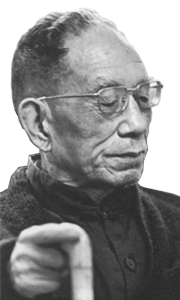
Mou Zongsan (Mou Tsung-san) (1909—1995)

Mou ZongsanMou Zongsan (Mou Tsung-san) is a sophisticated and systematic example of a modern Chinese philosopher. A Chinese nationalist, he aimed to reinvigorate traditional Chinese philosophy through an encounter with Western (and especially German) philosophy and to restore it to a position of prestige in the world. In particular, he engaged closely with Immanuel Kant’s three Critiques and attempted to show, pace Kant, that human beings possess intellectual intuition, a supra-sensible mode of knowledge that Kant reserved to God alone. He assimilated this notion of intellectual intuition to ideas found in Confucianism, Buddhism, and Daoism and attempted to expand it into a metaphysical system that would establish the objectivity of moral values and the possibility of sagehood.

Mou’s Collected Works run to thirty-three volumes and extend to history of philosophy, logic, epistemology, ontology, metaethics, philosophy of history, and political philosophy.  His corpus is an unusual hybrid in that although its main aim is to erect a metaphysical system, many of the books where Mou pursues that end consist largely of cultural criticism or histories of Confucian, Buddhist, or Daoist philosophy in which Mou explains his own opinions through exegesis of other thinkers’ in a terminology appropriated from Kant, Tiantai Buddhism, and Neo-Confucianism.

Table of Contents

  1. Biography
  2. Cultural Thought
    1. Chinese Philosophy and the Chinese Nation
    2. Development of Chinese Philosophy
    3. History of Chinese Philosophy: Confucianism, Buddhism, and Daoism
  3. Metaphysical Thought
    1. Intellectual Intuition and Things-in-Themselves
    2. Two-Level Ontology
    3. Perfect Teaching
  4. Criticisms
  5. Influence
  6. References and Further Reading

1. Biography

Mou was born in 1909, at the very end of China’s imperial era, into the family of a rural innkeeper who admired Chinese classical learning, which the young Mou came to share. At just that time, however, traditional Chinese learning was being denigrated by some of the intellectual elite, who searched frantically for something to replace it due to fears that their own tradition was dangerously impotent against modern nation-states armed with Western science, technology, bureaucracy, and finance.

In 1929, Mou enrolled in Peking (Beijing) University’s department of philosophy. He embarked on a deep study of Russell and Whitehead’s Principia Mathematica (then a subject of great interest in Chinese philosophical circles ) and also of Whitehead’s Process and Reality. However, Mou was also led by his interest in Whiteheadian process thought to read voraciously in the pre-modern literature on the Yijing (I Ching or Book of Changes), and his classical tastes made him an oddball at Peking University, which was vigorously modernist and anti-traditional.  Mou would have been a lonely figure there had he not met Xiong Shili in his junior year. Xiong was just making his name as a nationally known apologist for traditional Chinese philosophy and mentored Mou for years afterward.   The two men remained close until Mou later left the mainland. Mou graduated from Peking University in 1933 and moved around the country unhappily from one short-term teaching job to another owing to frequent workplace personality conflicts and fighting between the Chinese government and both Japanese and Communist forces. Despite these peregrinations, Mou wrote copiously on logic and epistemology and also on the Yijing.  Mou hated the Communists very boisterously and when they took over China in 1949 he moved to Taiwan and spent the next decade teaching and writing in a philosophical vein about the history and future of Chinese political thought and culture. In 1960, once again unhappy with his colleagues, Mou was invited by his friend Tang Junyi, also a student of Xiong, to leave Taiwan for academic employment in Hong Kong.  There, Mou’s work took a decisive turn and entered what he later considered its mature stage, yielding the books which established him as a key figure in modern Chinese philosophy. During the next thirty-five years he published seven major monographs (one running to three volumes), together with translations of all three of Immanuel Kant’s Critiques and many more volumes’ worth of articles, lectures, and occasional writings. Mou officially retired from the Chinese University of Hong Kong in 1974 but continued to teach and lecture in Hong Kong and Taiwan until his death in 1995.

We can divide Mou’s expansive thought into two closely related parts which we might call his “cultural” thought, about the history and destiny of Chinese culture, and his “metaphysical” thought, concerning the problems and doctrines of Chinese philosophy, which Mou thought of as the essence of Chinese culture.

2. Cultural Thought

a. Chinese Philosophy and the Chinese Nation

Like most intellectuals of his generation, Mou was a nationalist and saw his work as a way to strengthen the Chinese nation and return it to a place of greatness in the world.

Influenced by Hegel, Mou thought of the history and culture of the Chinese nation as an organic whole,, with a natural and knowable course of development. He thought that China’s political destiny depended ultimately on its philosophy, and in turn blamed China’s conquest by the Manchus in 1644, and again by the Communists in 1949, on its loss of focus on the Neo-Confucianism of the Song through Ming dynasties (960-1644)He hoped his own work would help to re-kindle China’s commitment to Confucianism and thereby help defeat Communism.

Along with many of his contemporaries, Mou was interested in why China never gave rise its own Scientific Revolution like that in the West, and also in articulating what the strengths were in China’s intellectual history whereby it outstripped the West. Mou phrased his answer to these two questions in terms of “inner sagehood” (neisheng) and “outer kingship” (waiwang). By “inner sagehood,” Mou meant the cultivation of moral conduct and outlook—at which he thought Confucianism was unequalled in the world—and he used “outer kingship” to encompass political governancealong with other ingredients in the welfare of society, such as a productive economy and scientific and technological know-how. Mou thought that China’s classical tradition was historically weak in the theory and practice of “outer kingship,” and he believed that Chinese culture would have to transform itself thoroughly by discovering in its indigenous learning the resources with which to develop traditions of science and democracy.

For the last thirty years of his life, all of Mou’s writings were part of a conversation with Immanuel Kant, whom he considered the greatest Western philosopher and the one most useful for exploring Confucian “moral metaphysics.” Throughout that half of his career, Mou’s books quoted Kant extensively (sometimes for pages at a time) and appropriated Kantian terms into the service of his reconstructed Confucianism. Scholars agree widely that Mou altered the meanings of these terms significantly when he moved them from Kant’s system into his own, but opinions vary about just how conscious Mou was that he had done so.

b. Development of Chinese Philosophy

As an apologist for Chinese philosophy, Mou was anxious to show that its genius extended to almost all areas and epochs of Chinese philosophy. To this end, He wrote extensively about the history of Chinese philosophy and highlighted the important contributions of Daoist and Buddhist philosophy, along with their harmonious interaction with Confucian philosophy in the dialectical unfolding and refinement of Chinese philosophy in each age.

Before China was united under the Qin dynasty (221-206 BCE), Mou believed, Chinese culture gave definitive form to the ancient philosophical inheritance of the late Zhou dynasty (771-221 BCE), culminating in the teachings of Confucius and Mencius. These were still epigrammatic rather systematic, but Mou thought that they already contained the essence of later Chinese philosophy in germinal form. The next great phase of development came in the Wei-Jin period (265-420 CE) with the assimilation of “Neo-Daoism” or xuanxue (literally “dark” or “mysterious learning”), from whence came the first formal articulation of the “perfect teaching” (concerning which see below). Shortly afterward, Mou taught, Chinese culture experienced its first great challenge from abroad, in the form of Buddhist philosophy. In the Sui and Tang dynasties (589-907) it was the task of Chinese philosophy to “digest” or absorb Buddhist philosophy into itself. In the process, it gave birth to indigenous Chinese schools of Buddhist philosophy (most notably Huayan and Tiantai), which Mou believed advanced beyond the Indian schools because they agreed with essential tenets of native Chinese philosophy, such as the teaching that all people are endowed with an innately sagely nature.

On Mou’s account, in the Song through Ming dynasties (960-1644) Confucianism underwent a second great phase of development and reasserted itself as the true and proper leader of Chinese culture and philosophy. However, at the end of the Ming, there occurred what Mou taught was an alien irruption into Chinese history by the Manchus, who thwarted the “natural” course of China’s cultural unfolding. In the thinking of late Ming philosophers such as Huang Zongxi (1610-1695), Gu Yanwu (1613-1682), and Wang Fuzhi (1619-1692), Mou thought that China had been poised to give rise to its own new forms of “outer kingship” which would have eventuated in an indigenous birth of science and democracy in China, enabling China to compete with the modern West. Chinese culture, however. was diverted from that healthy course of development by the intrusion of the Manchus. Mou believed that it was this diversion which made China vulnerable to the Communist takeover of the 20th century by alienating it from its own philosophical tradition.

Mou preached that the mission of modern Chinese philosophy was to achieve a mutually beneficial conciliation with Western philosophy. Inspired by the West’s example, China would appropriate science and democracy into its native tradition, and the West in turn would benefit from China’s unparalleled expertise in “inner sagehood,” typified especially by its “perfect teaching.”

However, throughout Mou’s lifetime, he remained unimpressed with the actual state of contemporary Chinese philosophy. He seldom rated any contemporary Chinese thinkers as worthy of the name “philosopher,” and he mentioned Chinese Marxist thought only rarely and only as a force entirely antipathetic to true Chinese philosophy.

c. History of Chinese Philosophy: Confucianism, Buddhism, and Daoism

In his historical writings on Confucianism, Mou is most famous for his thesis of the “three lineages” (san xi). Whereas Neo-Confucians where traditionally grouped into a “School of Principle” represented chiefly by Zhu Xi (1130-1200) and a “School of Mind” associated with Lu Xiangshan (1139-1192) and Wang Yangming (1472-1529), Mou also recognized a third lineage exemplified by lesser-known figures as Hu Hong (Hu Wufeng) (1105-1161) and Liu Jishan (Liu Zongzhou) (1578-1645).

Mou judged this third lineage to be the true representatives of Confucian orthodoxy. He criticized Zhu Xi, conventionally regarded as the authoritative synthesizer of Neo-Confucian doctrine, as a usurper who despite good intentions depicted heavenly principle (tianli) in an excessively transcendent way that was foreign to the ancient Confucian message. On Mou’s view, that message is one of paradoxical “immanent transcendence” (neizai chaoyue), in which heavenly principle and human nature are only lexically distinct from each other, not substantially separate. It was because Mou believed that the Hu-Liu lineage of Neo-Confucianism expressed this paradoxical relationship most accurately and artfully that that he ranked it the highest or “perfect” (yuan) expression of Confucian philosophy. (See “Perfect Teaching” below.)

Because Mou wanted to revalorize the whole Chinese philosophical tradition, and not just its Confucian wing, he also wrote extensively on Chinese Buddhist philosophy. He maintained that Indian Buddhist philosophy had remained limited and flawed until in migrated to Chinawhere it was leavened with what Mou saw as core principles of indigenous Chinese philosophy, such as a belief in the basic goodness of both human nature and the world. From Chinese Buddhist thought he adopted methodological ideas that he later applied to his own system. One of these was “doctrinal classification” (panjiao), a doxographic technique of reading competing philosophical systems as forming a dialectical progression of closer and closer approximations to a “perfect teaching” (yuanjiao), rather than as mutually incompatible contenders. Much as Mou discovered what he thought of as the highest expression of Confucian doctrine in the largely forgotten thinkers of the Hu-Liu lineage, he found what he thought of as their formal analog and philosophical precursor in the relatively obscure Tiantai school of Buddhism and its thesis of the identity of enlightenment and delusion.

Mou wrote far less about Daoism than Confucianism or Buddhism, but at least in principle he regarded it too as an indispensible part of the Chinese philosophical heritage. Mou focused most on the “Inner Chapters” (neipian) of the Zhuangzi, especially the “Wandering Beyond” (Xiaoyao you) and “Discussion on Smoothing Things Out”(Qi wu lun) and the writings of Wei-Jin commentators Guo Xiang (c. 252-312 CE) and Wang Bi (226-249 CE). Mou saw the Wei-Jin idea of “root and traces” (ji ben) in particular as an early forerunner of Tiantai Buddhist thinking central to its concept of the “perfect teaching.”

3. Metaphysical Thought

In his metaphysical writings, Mou was mainly interested in how moral value is able to exist and how people are able to know it. Mou hoped to show that humans can directly know moral value and indeed that such knowledge amounts to knowledge par excellence. In an inversion of one of Kant’s terms, he called this project “moral metaphysics” (daode de xingshangxue), meaning a metaphysics in which moral value is ontically primary. That is, a moral metaphysics considers that the central ontological fact is that moral value exists and is known or “intuited” by us more directly than anything else. Mou believed that Chinese philosophy alone has generated the necessary insights for constructing such a moral metaphysics, whereas Kant (who represented for Mou the summit of Western philosophy) did not understand moral knowing because, fixated on theoretical and speculative knowledge, he wrong-headedly applied the same transcendentalism that Mou found so masterful in the Critique of Pure Reason (which supposes that we know a thing not directly but only through the distorting lenses of our mental apparatus) to moral matters, where it is completely out of place.

a. Intellectual Intuition and Things-in-Themselves

For many, the most striking thing about Mou’s philosophy (and the hardest to accept) is his conviction that human beings possess “intellectual intuition” (zhi de zhijue), a direct knowledge of reality without resort to the senses and without overlaying such sensory forms and cognitive categories as time, space, number, and cause and effect.

As with most of the terms that Mou borrowed from Kant, he attached a much different meaning to ‘intellectual intuition.’   For Kant, intellectual intuition was a capacity belonging to God alone. However, Mou thought this was Kant’s greatest mistake and concluded that one of the great contributions of Chinese philosophy to the world was a unanimous belief that humans have intellectual intuition. In the context of Chinese philosophy he took ‘intellectual intuition’ as an umbrella term for the various Confucian, Buddhist, and Daoist concepts of a supra-mundane sort of knowing that, when perfected, makes its possessor a sage or a buddha.

On Mou’s analysis, though Confucian, Buddhist, and Daoist philosophers call intellectual intuition by different names and theorize it differently, they agree that it is available to everyone, that it transcends subject-object duality, and that it is higher than, and prior to, the dualistic knowledge which comes through the “sensible intuition” of seeing and hearingoften called “empirical” (jingyan) or “grasping” (zhi) knowledge in Mou’s terminology. However, Mou taught that the Confucian understanding of intellectual intuition (referred to by a variety of names such as ren, “benevolence,” or liangzhi, “innate moral knowing”) is superior to the Buddhist and Daoist conceptions because it recognizes that intellectual intuition is essentially moral and creative.

Mou thought that people regularly manifest intellectual intuition in everyday life in the form of morally correct impulses and behaviors. To use the classic Mencian example, if we see a child about to fall down a well, we immediately feel alarm. For Mou, this sudden upsurge of concern is an occurrence of intellectual intuition, spontaneous and uncaused. Furthermore, Mou endorsed what he saw as the Confucian doctrine that it is this essentially moral intellectual intuition that “creates” or “gives birth to the ten thousand things” (chuangsheng wanwu) by conferring on them moral value.

b. Two-Level Ontology

Through our capacity for intellectual intuition, Mou taught, human beings are “finite yet infinite” (youxian er wuxian). He accepted Kant’s system as a good analysis of our finite aspect, which is to say our experience as beings who are limited in space and time and also in understanding, but he also thought that in our exercise of intellectual intuition we transcend our finitude as well.

Accordingly, Mou went to great pains to explain how the world of sensible objects and the realm of noumenal objects, or objects of intellectual intuition, are related to each other in a “two-level ontology” (liangceng cunyoulun) inspired by the Chinese Buddhist text The Awakening of Faith. In this model, all of reality is said to consist of mind, but a mind which has two aspects (yixin ermen). As intellectual intuition, mind directly knows things-in-themselves, without mediation by forms and categories and without the illusion that things-in-themselves are truly separate from mind. This upper level of the two-level ontology is what Mou labels “ontology without grasping” (wuzhi cunyoulun), once again choosing a term of Buddhist inspiration. However, mind also submits itself to forms and categories in a process that Mou calls “self-negation” (ziwo kanxian). Mind at this lower level, which Mou terms the “cognitive mind” (renzhi xin), employs sensory intuition and associated cognitive processes to apprehend things as discrete objects, separate from each other and from mindhaving location in time and space, numerical identity, and causal and other relations. This lower ontological level is what Mou calls “ontology with grasping” (zhi de cunyoulun).

c. Perfect Teaching

On Mou’s view, all of the many types of Chinese philosophy he studied taught some version of this doctrine of intellectual intuition, things-in-themselves, and phenomena, and he considered it important to explain how he adjudicated among these many broadly similar strains of philosophy. To that end, he borrowed from Chinese Buddhist scholasticism the concept of a “perfect teaching” (yuanjiao) and the practice of classifying teachings (panjiao) doxographically in order to rank them from less to more “perfect” or complete.

A perfect teaching, in Mou’s sense of the term, is distinguished from a penultimate one not by its content (which is the same in either case) but by its rhetorical form. Specifically, a perfect teaching is couched in the form of a paradox (guijue). In Mou’s opinion, all good examples of Chinese philosophy acknowledge the commonsense difference between subject and object but also teach that we can transcend that difference through the exercise of intellectual intuition. But what distinguishes a perfect teaching is that it makes a show of flatly asserting, in a way supposed to surprise the listener, that subject and object are simply identical to one another, without qualification.

Mou developed this formal concept of a perfect teaching from the example offered by Tiantai Buddhist philosophyHe then applied it to the history of Confucian thoughtidentifying what he thought of as a Confucian equivalent to the Tiantai perfect teaching in the writings of Cheng Hao (1032-1085), Hu Hong, and Liu Jishan. Though Mou believed that all three families of Confucian philosophy—Confucian, Buddhist, and Daoist—had their own versions of a perfect teaching, he rated the Confucian perfect teaching more highly than the Buddhist or Daoist ones, for it gives an account of the “morally creative” character of intellectual intuition, which he thought essential. In the Confucian perfect teaching, he taught, intellectual intuition is said to “morally create” the cosmos in the sense that it gives order to chaos by making moral judgments and thereby endowing everything in existence with moral significance.

Mou claimed that the perfect teaching was a unique feature of Chinese philosophy and reckoned this a valuable contribution to world philosophy because, in his opinion, only a perfect teaching supplied an answer to what he called the problem of the “summum bonum” (yuanshan) or “coincidence of virtue and happiness” (defu yizhi), that is, the problem of how it can be assured that a person of virtue will necessarily be rewarded with happiness. He noted that in Kant’s philosophy (and, in his opinion, throughout the rest of Western philosophy too) there could be no such assurance that virtue would be crowned with happiness except to hope that God would make it so in the afterlife. By contrast, Mou was proud to say, Chinese philosophy provides for this “coincidence of virtue and happiness” without having to posit either a God or an afterlife. The argument for that assurance differed in Confucian, Buddhist, and Daoist versions of the perfect teaching, but in each case it consisted of a doctrine that intellectual intuition (equivalent to “virtue”) necessarily entails the existence of the phenomenal world (which Mou construed as the meaning of “happiness”), without being contingent on God’s intervention in this world or the next or on any condition other than the operation of intellectual intuition, which Mou considered available to all people at all times.

In arguing for the historical absence of such a solution to the problem of the perfect good anywhere outside of China, Mou did acknowledge that Epicurean and Stoic philosophers also tried to establish that virtue resulted in happiness, but he claimed that their explanations only worked by redefining either virtue or happiness in order to reduce its meaning to something analytically entailed by the other. However, some critics have argued that Mou’s alternative commits the same fault by effectively collapsing happiness into virtue.

4. Criticisms

Mou has often been accused of irrationalism due to his doctrine of the direct, supra-sensory intellectual intuition, which states that people can apprehend the deeper reality underlying the mere phenomena that are measured and described by scientific knowledge. Mou has also been ridiculed because he did not so much present positive arguments in favor of his main metaphysical beliefs as propound them as definitive facts, presumably known to him through a privileged access to sagely intuition.

Critics also frequently question the relevance of Mou’s philosophy, both to the Confucian tradition from which he took his inspiration, as well as to Chinese society. They point out that Mou’s thought (as well as that of other inheritors of Xiong Shili’s legacy in general) inhabits a far different social context than the Confucian tradition with which he identifies. With Mou and his generation, Chinese philosophy was detached from its old homes in the traditional schools of classical learning (shuyuan), the Imperial civil service, and monasteries and hermitages, and was transplanted into the new setting of the modern university, with its disciplinary divisions and limited social role. Critics point to this academicization as evidence that, despite Mou’s aspirations to kindle a massive revival of the Confucian spirit in China, his thought risks being little more than a “lost soul,” deracinated and intellectualized. The first problem with this, they claim, is that Mou reduces Confucianism to a philosophy in the modern academic sense and leaves out other important aspects of the pre-modern Confucian cultural system, such as its art, literature, and ritual and its political and career institutions. Second, they claim, because Mou’s brand of Confucianism accents metaphysics so heavily, it remains confined to departments of philosophy and powerless to exert any real influence over Chinese society.

Mou has also been criticized for his explicit essentialism. In keeping with his Hegelian tendency, he presented China as consisting essentially of Chinese culture, and even more particularly with Chinese philosophy, and he claimed in turn that this is epitomized by Confucian philosophy.  Furthermore, he presents the Confucian tradition as consisting essentially of an idiosyncratic-looking list of Confucian thinkers. Opponents complain that even if there were good reasons for Mou to enshrine his handful of favorite Confucians as the very embodiment of all of Chinese culture, this would remain Mou’s opinion and nothing more, a mere interpretation rather than the objective, factual historical insight that Mou claimed it was.

5. Influence

In Mou’s last decades, he began to be recognized together with other prominent students of Xiong Shili as a leader of what came to be called the “New Confucian” (dangdai xin rujia) movement, which aspires to revive and modernize Confucianism as a living spiritual tradition. Through his many influential protégés, Mou achieved great influence over the agenda of contemporary Chinese philosophy.

Two of his early students, Liu Shu-hsien (b. 1934)  and Tu Wei-ming (b. 1940) have been especially active in raising the profile of contemporary Confucianism in English-speaking venues, as has the Canadian-born scholar John Berthrong (b. 1946). Mou’s emphasis on Kant’s transcendental analytic gave new momentum to research on Kant and post-Kantians, particularly in the work of Mou’s student Lee Ming-huei (b. 1953), and his writings on Buddhism lie behind much of the interest in and interpretation of Tiantai philosophy among Chinese scholars. Finally, Mou functions as the main modern influence on, and point of reference for, the intense research on Confucianism among mainland Chinese philosophers today.

6. References and Further Reading

  • Angle, Stephen C. Sagehood: The Contemporary Significance of Neo-Confucian Philosophy. New York: Oxford University Press, 2009.
  • Angle, Stephen C. Contemporary Confucian Political Philosophy. Cambridge: Polity, 2012.
  • Asakura, Tomomi. “On Buddhistic Ontology: A Comparative Study of Mou Zongsan and Kyoto School Philosophy.” Philosophy East and West 61/4 (October 2011): 647-678.
  • Berthrong, John. “The Problem of Mind: Mou Tsung-san’s Critique of Chu Hsi.” Journal of Chinese Religion 10 (1982): 367-394.
  • Berthrong, John. All Under Heaven. Albany: State University of New York Press, 1994.
  • Billioud, Sébastien. “Mou Zongsan’s Problem with the Heideggerian Interpretation of Kant.” Journal of Chinese Philosophy 33/2 (June 2006): 225-247.
  • Billioud, Sébastien. Thinking through Confucian Modernity: A Study of Mou Zongsan’s Moral Metaphysics. Leiden and Boston: Brill, 2011.
  • Bresciani, Umberto. Reinventing Confucianism: The New Confucian Movement. Taipei: Taipei Ricci Institute for Chinese Studies, 2001.
  • Bunnin, Nicholas. “God’s Knowledge and Ours: Kant and Mou Zongsan on Intellectual Intuition.” Journal of Chinese Philosophy 35/4 (December 2008): 613-624.
  • Chan, N. Serina. “What is Confucian and New about the Thought of Mou Zongsan?” in New Confucianism: A Critical Examination, ed. John Makeham (New York: Palgrave Macmillan, 2003), 131-164.
  • Chan, N. Serina. The Thought of Mou Zongsan. Leiden and Boston: Brill, 2011.
  • Chan, Wing-Cheuk. “Mou Zongsan on Zen Buddhism.” Dao: A Journal of Comparative Philosophy 5/1 (2005) : 73-88.
  • Chan, Wing-Cheuk. “Mou Zongsan’s Transformation of Kant’s Philosophy.” Journal of Chinese Philosophy 33/1 (March 2006): 125-139.
  • Chan, Wing-Cheuk. “Mou Zongsan and Tang Junyi on Zhang Zai’s and Wang Fuzhi’s Philosophies of Qi : A Critical Reflection.” Dao: A Journal of Comparative Philosophy 10/1 (March 2011): 85-98.
  • Chan, Wing-Cheuk. “On Mou Zongsan’s Hermeneutic Application of Buddhism.” Journal of Chinese Philosophy 38/2 (June 2011): 174-189.
  • Chan, Wing-Cheuk and Henry C. H. Shiu. “Introduction: Mou Zongsan and Chinese Buddhism.” Journal of Chinese Philosophy 38/2 (June 2011): 169-173.
  • Clower, Jason. The Unlikely Buddhologist: Tiantai Buddhism in the New Confucianism of Mou Zongsan. Leiden and Boston: Brill, 2010.
  • Clower, Jason. “Mou Zongsan on the Five Periods of the Buddha’s Teaching. Journal of Chinese Philosophy 38/2 (June 2011): 190-205.
  • Guo Qiyong. “Mou Zongsan’s View of Interpreting Confucianism by ‘Moral Autonomy’.” Frontiers of Philosophy in China 2/3 (June 2007): 345-362.
  • Kantor, Hans-Rudolf. “Ontological Indeterminacy and Its Soteriological Relevance: An Assessment of Mou Zongsan’s (1909-1995) Interpretation of Zhiyi’s (538-597) Tiantai Buddhism.” Philosophy East and West 56/1 (January 2006): 16-68.
  • Kwan, Chun-Keung. “Mou Zongsan’s Ontological Reading of Tiantai Buddhism.” Journal of Chinese Philosophy 38/2 (June 2011): 206-222.
  • Lin, Chen-kuo. “Dwelling in Nearness to the Gods: The Hermeneutical Turn from MOU Zongsan to TU Weiming.” Dao 7 (2008): 381-392.
  • Lin, Tongqi and Zhou Qin. “The Dynamism and Tension in the Anthropocosmic Vision of Mou Zongsan.” Journal of Chinese Philosophy 22/4 (December 1995): 401-440.
  • Liu, Shu-hsien. “Mou Tsung-san (Mou Zongsan)” in Encyclopedia of Chinese Philosophy, ed. A.S. Cua. New York: Routledge, 2003.
  • Mou, Tsung-san [Mou Zongsan]. “The Immediate Successor of Wang Yang-ming: Wang Lung-hsi and his Theory of Ssu-wu.” Philosophy East and West 23/1-2 (1973): 103-120.
  • Neville, Robert C. Boston Confucianism: Portable Tradition in the Late-Modern World. Albany: State University of New York Press, 2000.
  • Stephan Schmidt. “Mou Zongsan, Hegel, and Kant: The Quest for Confucian Modernity.” Philosophy East and West 61/2 (April 2011): 260-302.
  • Shiu, Henry C.H. “Nonsubstantialism of the Awakening of Faith in Mou Zongsan.” Journal of Chinese Philosophy 38/2 (June 2011): 223-237.
  • Tang, Andres Siu-Kwong. “Mou Zongsan’s ‘Transcendental’ Interpretation of Huayan Buddhism.” Journal of Chinese Philosophy 38/2 (June 2011): 238-256.
  • Tu, Wei-ming. Centrality and Commonality: An Essay on Confucian Religiousness. Albany: State University of New York Press, 1989.
  • Tu, Xiaofei. “Dare to Compare: The Comparative Philosophy of Mou Zongsan.” Kritike 1/2 (December 2007): 24-35.
  • Zheng Jiadong. “Mou Zongsan and the Contemporary Circumstances of the Rujia.” Contemporary Chinese Thought 36/2 (Winter 2004-5): 67-88.
  • Zheng Jiadong. “Between History and Thought: Mou Zongsan and the New Confucianism That Walked Out of History.” Contemporary Chinese Thought 36/2 (Winter 2004-5): 49-66.

Author Information

Jason Clower
Email: jclower@csuchico.edu
California State University, Chico
U. S. A.

Moral Particularism

Moral particularism is the view that the moral status of an action is not in any way determined by moral principles; rather, it depends on the configuration of the morally relevant features of the action in a particular context. It can be seen as a reaction against a traditional principled conception of morality as comprising a true and coherent set of moral principles. The chief motivation for moral particularism derives from the observation that exceptions to principles are common, and exceptions to exceptions are not unusual. Moral principles, which are equipped only to deal with homogeneous cases, seem to be too crude to handle the delicate nuances in heterogeneous moral situations.

Two counterarguments against moral particularism have been popular. One is the argument from supervenience. The other is the argument from the atomism of reason. The argument from supervenience is meant to establish the existence of true absolute moral principles, whereas the argument from the atomism of reason is meant to establish the existence of true, pro tanto, moral principles. If these arguments succeed, they will jointly consolidate a principled conception of morality. This article introduces the idea of moral particularism in more detail and assesses moral particularists’ responses to the two counterarguments mentioned above.

Table of Contents

  1. Introduction
  2. Absolute Moral Principlism and the Supervenience Argument
  3. Moral Particularists’ Responses to the Supervenience Argument
  4. Argument from Atomism of Reason for Pro tanto Principlism
  5. Criticism of Argument from Atomism of Reason
  6. Concluding Remarks
  7. References and Further Reading

1. Introduction

Moral particularism, on a first approximation, is the view that the moral status of an action is not in any way determined by moral principles; rather, it depends on the configuration of the morally relevant features of the action in a particular context. To illustrate, whether killing is morally wrong is not determined by whether it violates any sort of universal moral principles, say, the moral principle against killing; rather, its moral status is determined by its morally relevant features in the particular context where it occurs. If it occurs in a normal context, it is wrong; however, if it occurs in a context where the killer kills because it is the only way to defend from a rascal’s fatal attack, it is not wrong. In this case, the moral principle against killing does not determine the moral status of the action; rather, its moral status is determined by its morally relevant features, that is, the feature of killing an aggressor and the feature of saving one’s own life, in the particular context. Now, let us call those who contend, contra moral particularists, that the moral status of an action is determined by moral principles the ‘moral principlists’. In the killing case, the moral principlists might well contend that the principle against killing is not the right sort of principle but the principle which says that ‘killing is wrong except it is done out of self-defense’ is. So still the moral principlists might contend that it is the principle that determines the moral status of the action. However, according to moral particularism, even in cases where the moral verdicts issued respectively by moral principles and particular features converge, it is still the particular features rather than universal principles that determine the moral status of an action. This is not to say that the moral particularists are right to think so; this merely illustrates the difference between the views of moral particularists and principlists. The gist of moral particularism is best summed up in the words of Terence Irwin (2000): the particulars are normatively prior to the universals.

To further illustrate the differences between moral particularism and principlism, moral particularism can be seen as a reaction against a top-down principled approach to morality. That is, it opposes the moral principlists’ idea that we can get morally right answers by applying universal moral principles to particular situations.

In more detail, in moral principlists’ conception of morality, morality is made up of a true and coherent set of moral principles. It follows from this conception that if one negates the existence of moral principles, one negates morality altogether. For without moral principles, it seems that there would be no standards against which the moral status of actions can be determined.

The above-mentioned principlists’ conception of morality has been, without a doubt, a dominant view. This can be confirmed by examining the work in normative ethics. One chief concern of normative ethics has been to formulate basic moral principles that govern the moral terrain. It is generally believed by the normative ethicists that in basic moral principles lies the ultimate source of moral truths. The normative ethicists, though arguing among themselves over what the correct basic moral principles are, all tacitly agree that a major part of normative ethics is built upon the articulation of the basic moral principles and their application to practical moral issues.

While the debate amongst normative ethicists is continuing about the correct formulation and application of the basic moral principle(s), the common principled conception of morality underlying it has not received proper attention—not until the appearance of the contemporary particularists.

Contrary to the principlists, the particularists argue that morality does not depend upon codification into a true and coherent set of moral principles. On their view, general principles fail to capture the complexity and uniqueness of particular circumstances. Exceptions to principles are common and exceptions to exceptions are not unusual (Davis 2004; Tsu 2010). In other words, there are no exceptionless principles of the sort which the principlists have in mind. The particularists believe that the moral status of an action is not determined by moral principles; instead it always relies on the particular configuration of its contextual features. In brief, moral particularists take a bottom-up approach and, as Irwin pointed out, they give the normative priorities to the particulars. That is, according to moral particularism, the moral status of an action is determined by its morally relevant features in a particular context.

More slowly, one chief motivation for moral particularism to place emphasis on the particulars comes from their observation that the whole history of moral philosophy has witnessed brilliant moral philosophers searching for true moral principles that codify the moral landscape, yet no principles have generated wide agreement. There can be many explanations for this, but one is particularly salient: there are no true moral principles to be had in the first place. Parallel situations like this are common in many corners of philosophy. Many brilliant philosophers have spent their whole life’s time analyzing concepts of probability, truth or knowledge, trying to supply non-trivial, non-circular necessary and sufficient conditions for them. As is generally acknowledged today, it is extremely difficult, if not entirely impossible, to come up with a widely accepted analysis. One plausible explanation is that no analysis of the kind is to be had in the first place. This is not to say that there cannot be alternative explanations. But until they are produced and justified, there is at least a prima facie case for doubting whether conceptual analysis can produce non-trivial, non-circular necessary and sufficient conditions for the meanings of many philosophically interesting terms. Likewise, as hardly any moral principle receives wide acceptance, there is also a prima facie case that can be made for doubting whether there are any true moral principles in the first place, until an alternative explanation of why agreement on principles is so hard to come by is produced and justified.

Adding to the untenability of the principled conception of morality, moral particularists argue, is the fact that the moral status of an action is context-sensitive in character. That is, whether an action is right or wrong depends entirely on the particular contexts where it takes place; no universal principles, which are only equipped to deal with homogeneous cases, are capable of capturing the context-sensitive character of the moral status of an action in various heterogeneous contexts. Take the action of killing for instance. A principle against killing will run into exceptions in cases of self-defense and a further qualified principle against killing except in cases of self-defense will run into exceptions again in cases of overreacting self-defense. The exceptions may well go on infinitely. This shows that, the moral particularists believe, no principles are able to handle the essentially context-sensitive character of the moral status of an action.

To forestall some possible misunderstanding, moral particularism is not just the view that the moral status of an action is not determined by moral principles of the absolute kind – the absolute moral principle against killing; rather, it is the more encompassing and more radical view that it is not determined by moral principles of the pro tanto kind either. The difference between absolute moral principles and pro tanto ones roughly lies in the fact that the former purport to determine the moral status of an action conclusively, whereas the later do not; instead, the pro tanto moral principles, on a standard construal, merely specify the contribution a morally relevant feature makes to the determination of the moral status of an action. To use an example to illustrate, the difference between an absolute principle against lying and a pro tanto principle against lying lies in the fact that according to the absolute principle, lying is wrong (period) whereas according to the pro tanto principle, lying is wrong-making. To put it differently, according to the absolute principle against lying, the fact that an action has a feature of lying conclusively determines its wrongness whereas according to the pro tanto principle against lying, the same fact merely contributes to the wrongness of the action and leaves open the possibility that it is right overall. For instance, if an action has not only a feature of lying, but also a feature of saving a life, then the wrongness the feature of lying contributes to the action may well be outweighed by the rightness the feature of saving a life contributes to the action. Overall, the action may still turn out to be right, despite its violation of the pro tanto principle against lying.

Moral particularism, as we have explained, not only opposes absolute principlism, i.e. the idea that the moral status of an action is determined by absolute principles, but also pro tanto principlism, i.e. the idea that pro tanto moral principles jointly determine the moral status of an action. As moral particularists see things, there are neither true absolute principles nor true pro tanto principles. They both are bound to run into exceptions in some cases. In what follows, we will introduce the arguments for absolute moral principlism and pro tanto principlism and moral particularists’ responses to them.

Before we move on, however, there is an important caveat to be noted about terminology. It is this. Some philosophers use ‘prima facie principles’ to mean pro tanto principles. This is largely due to W. D. Ross’s influence. Ross was perhaps the first philosopher who used ‘prima facie’ to mean ‘pro tanto’. Strictly speaking, however, there is a difference in the meanings of these two phrases, as Ross himself later recognized and apologized. The difference between ‘prima facie’ and ‘pro tanto’ principles can be put in the following way: a prima facie principle specifies a moral duty at first glance whereas a pro tanto principle specifies a moral duty sans phrase, unless it is overridden by other moral duties. To illustrate with examples, a pro tanto principle against lying means that other things being equal, we have a duty not to lie. By contrast, a prima facie principle against lying means that at first glance, we have a duty not to lie; however, as we take a closer examination of the facts of the situations, we discover that we do not in fact have such a duty, as, for example, in the case where we are playing a bluffing game, the rule of which states that lying to the other contestants is permitted.

Now, having clarified the distinction between ‘pro tanto principle’ and ‘prima facie principle’, it has to be noted, for our purposes, that pro tanto principlism is the view that the moral status of an action is determined jointly by pro tanto principles, instead of by prima facie principles we just elucidated. In fact, the prima facie principles do not in any way determine the moral status of an action, for as we have explained, they are merely indicative of its moral status (as our moral duty) at first glance.

With the above caveat in mind, we can proceed to examine the arguments for absolute moral principlism and pro tanto principlism, and moral particularists’ responses to them.

2. Absolute Moral Principlism and the Supervenience Argument

Absolute moral principlism  is the idea that there are true absolute moral principles. The most powerful argument that has been advanced in support of this idea is the supervenience argument. It was advanced collaboratively by Frank Jackson, Philip Pettit, and Michael Smith (henceforth the Canberrans, as they all worked in Canberra in Australia when they advanced the argument) in their co-authored paper “Ethical Particularism and Patterns”. Roughly, the supervenience argument takes the following form:

P1: The thesis of global supervenience is true.

P2: If the thesis of global supervenience is true, then there must be a true conditional of the form ‘(x) (Nx → Mx)’.

P3: The true conditional of the form ‘(x) (Nx → Mx)’ must be shaped.

P4: A true shaped conditional of the form ‘(x) (Nx → Mx)’ is a true absolute moral principle.

C: There are true absolute moral principles, that is absolute moral principlism is true.

The above argument is valid, but each premise needs some comment.

P1: The thesis of global supervenience is true.

The thesis of global supervenience means, according to the Canberrans, the following:

The thesis of global supervenience: Naturally identical worlds are morally identical.

To illustrate, suppose that N1 stands for the sum of natural properties of world 1 and M1 for the sum of its moral properties. According to the thesis of global supervenience, for any world that is naturally identical with world 1, that is for any world that has N1, it must have M1. The Canberrans take the global thesis to be true, for it is a dictum in the realm of ethics that there cannot be a moral difference without a natural difference. So it follows from this dictum that naturally identical worlds are morally identical.

P2: If the thesis of global supervenience is true, then there must be a true conditional of the form ‘(x) (NxMx)’.

Suppose again that N1 stands for the sum of natural properties of world 1 and M1 for the sum of its moral properties. As we have illustrated, according to the thesis of global supervenience, for any world that is naturally identical with world 1, that is for any world that has N1, it must have M1. Likewise, let N2 and M2 stand respectively for the sum of natural properties of world 2 and the sum of its moral properties. According to the thesis of global supervenience, for any world that is naturally identical with world 2, it must have M2. Such being the case, from the thesis of global supervenience we can get the following raft of conditionals:

If x has N1, then x has M1.

If x has N2, then x has M2.

For the sake of simplicity, let us focus on the moral property of rightness and use ‘M’ for it, and use ‘N’ for ‘N1 or N2 or N3…’. Now, we can simplify the above raft of conditionals as follows:

If x has N, then x has M.

Hence, we can infer from the thesis of global supervenience that there must be a true conditional of the form ‘(x) (Nx → Mx)’.

P3: The true conditional of the form ‘(x) (NxMx)’ must be shaped.

The meaning of ‘shaped’ requires some explanation. According to the Canberrans, a conditional of the form ‘(x) (Nx → Mx)’ is shaped if and only if there is some commonality in the various Ns ‘N’ refers to. Remember that ‘N’ stands for ‘N1 or N2 or N3…’. So this just means that a conditional of the form ‘(x) (Nx → Mx)’ is shaped if and only if there is some commonality amongst N1, N2, N3… Having clarified the meaning of ‘shaped’, one question that needs to be addressed here is why there must be some commonality amongst N1, N2, N3…

The Canberrans contend that there must be some commonality amongst the various Ns, for if there were not, an absurd consequence would follow. The absurd consequence is this: we are not competent with the use of moral terms. This is absurd because we are indeed competent with the use of moral terms. We condemn a cold-blooded case of murder as immoral whereas we approve of an act of self-sacrifice as virtuous. It is absurd to suggest that we are not competent with the use of moral terms. Let’s call this absurd consequence conceptual incompetence for short. So how is it the case that if there were no commonality amongst the various Ns, conceptual incompetence would follow? Or to put the question somewhat differently, why is commonality in the various Ns essential for our competence with the use of moral terms?

To answer this question, let us use an example to illustrate. According to the Canberrans, the moral term ‘M’ (or ‘right’ in our current case) applies to various actions that have Ns. These actions that have Ns can be infinite in number. In order to know that ‘M’ can be applied to these various actions that have Ns, we, as finite human beings, cannot possibly acquaint ourselves with each and all of the actions that have Ns which ‘M’ applies to. That is to say, we cannot become competent with the use of ‘M’ by acquainting ourselves with all the possible actions ‘M’ applies to. The only viable way via which we can become competent with the use of ‘M’ is when these various actions have some finite commonality we can latch on to. Once we latch on to that commonality, we become competent with the use of ‘M’. So, the fact that we are indeed competent with the use of ‘M’ shows that there must be some commonality amongst the various Ns.

P4: A true shaped conditional of the form ‘(x) (NxMx)’ is a true absolute moral principle.

This premise is by definition true, as the Canberrans contend that a true absolute moral principle is one that displays a shaped connection between the natural ways things might be and the moral ways things might be. Suppose that ‘N’ stands for the natural property of maximal utility and ‘M’ for the moral property of rightness. Then the true shaped conditional of the form ‘(x) (Nx → Mx)’ just says that an action that has maximal utility is right. This is clearly equivalent to a true absolute moral principle of utility.

C: There are true absolute moral principles, that is absolute moral principlism is true).

C follows validly from P1 to P4. If there are true absolute moral principles, this just means that absolute moral principlism is true. Besides, this also means that moral particularism, the claim that there are neither true absolute moral principles nor true pro tanto moral principles will be refuted.

3. Moral Particularists’ Responses to the Supervenience Argument

In section 2, we have examined Canberrans’ supervenience argument for moral absolute principlism, or against moral particularism. Now, in this section, we will examine moral particularists’ response to Canberrans’ supervenience argument. Much of the philosophical action has focused on P3, especially on ‘conceptual incompetence’. This is understandable, as all the other premises seem to be relatively uncontroversial. So now, without further detain, let us just cut to the chase and introduce moral particularists’ response to P3. Jonathan Dancy (1999a, 2004), a chief proponent of moral particularism, responds to the supervenience argument by taking issue with P3. He contends that the Canberrans have not provided us with very convincing reasons to believe that P3 is true. In particular, Dancy argues that the Canberrans’ claim with regard to ‘conceptual incompetence’ is far from being justified.

As a reminder, P3 is the claim that the true conditional of the form ‘(x)

(Nx → Mx)’ must be shaped. As we have explained, the meaning of a ‘shaped’

conditional boils down to this: there is some commonality in the various Ns. And the Canberrans contend that if there were no commonality in the

various Ns, then the absurd consequence of ‘conceptual incompetence’ would

result, that is the absurd consequence that we are not competent with the use of

moral terms.

Remember that the Canberrans’ reason for thinking that ‘conceptual

incompetence’ would result is this. The Canberrans argue that the only plausible way for us to learn a moral term is by latching onto a commonality that the various actions that have Ns have in common, for we, as finite beings, cannot possibly acquaint ourselves with all the various actions that have Ns which the moral term can be applied to. So if there were no commonality amongst the various actions that have Ns, then it would be impossible for us to become competent with the use of moral terms.

However, Dancy maintains that Canberrans’ line of reasoning is a non sequitur. He argues that we can become competent with the use of moral terms even if there is no commonality amongst the various actions that have Ns. For there is one theory of competence the Canberrans unduly neglected, that is, the prototype theory, which is firstly advanced by Rosch (1975). According to the prototype theory, there is no commonality amongst the various Ns the moral term ‘right’ can be applied to; we do not latch unto the commonality amongst various Ns when we learn the term ‘right’ since there is none. Instead, what we latch unto are the ‘prototypical properties’ of a right action, that is the properties that are typical of a right action.

To use an analogy to illustrate, the various things the concept ‘bird’ can be applied to really have no commonality. It is true that birds can typically fly. However, a penguin cannot fly. It is also true that birds typically have feathers. Nonetheless, some baby birds do not. So there is really no commonality all birds have in common. Does this mean that we are thus unable to learn how to use the term ‘bird’? No! For we are indeed competent with the use of the term ‘bird’. So how do we pick up the term ‘bird’ if there is really no commonality amongst the various birds? According to the prototype theory, what we pick up are the prototypical properties that are typical of a bird—for instance, its capability of flying, its having feathers, and its having wings, et cetera. With regard to the atypical cases, such as those of penguins and baby birds, we can rightly categorize them as birds because they have enough of those prototypical properties that are typical of a bird. Likewise, Dancy contends that in the moral cases, we can become competent with the use of moral terms, say, the term ‘right’, by picking up those prototypical properties that are typical of right actions. With regard to the atypical cases, we can rightly categorize them as right actions because they have enough of those prototypical properties that are typical of right actions just as we can rightly categorize penguins and baby birds as birds because they have enough of those prototypical properties that are typical of birds.

So far, we have seen Dancy’s response to the ‘conceptual incompetence’ claim that is used to support P3 in the supervenience argument. Whether Dancy’s response is successful is an issue that requires further investigation. The crux of the question lies in whether the term ‘right’ is really analogous to the term ‘bird’ with regard to the lack of commonality amongst the things they can be applied to. The use of analogy, while illuminating, does not seem to prove that the term ‘right’ is really analogous to the term ‘bird’ in that aspect. To put it somewhat differently, is there any good reason to think that the prototype theory that can be used to explain our competence with the term ‘bird’ can explain equally well our competence with the term ‘right’? Perhaps a natural response from the moral particularists would be to say that the morally right actions are multiply realizable at the natural level—even killing, stealing, and lying can be morally right in some circumstances, and if so, it seems plausible to contend that these morally right actions do not seem to have anything in common with other morally right ones such as saving a drowning kid in the pond or donating to Oxfam. This is one of the possible responses that can be made. As to exactly how plausible it is and whether there are other more plausible responses await further exploration. These issues will not be pursed here.

4. Argument from Atomism of Reason for Pro tanto Principlism

In sections 2 and 3, we have examined respectively the supervenience argument that purports to establish the truth of absolute principlism and moral particularist’s response to it. Now, remember that moral particularism does not just hold the view that absolute principlism is false, but also the view that pro tanto principlism is false. Now, if there are good arguments to show that pro tanto principlism is true, then moral particularism will be falsified.

Remember that pro tanto principlism is the claim that there are true pro tanto moral principles. Pro tanto moral principles specify a feature of an action that is either right-making or wrong-making. For instance, the pro tanto principle against lying specifies the feature of lying as a wrong-making feature whereas the pro tanto principle demanding promise-keeping specifies the feature of promise-keeping as right-making. The strongest argument that has been advanced to support pro tanto principlism is the argument from the atomism of reason. It runs as follows:

P1. The atomism of reason is true.

P2. If the atomism of reason is true, then there are true pro tanto moral

principles.

C. There are true pro tanto moral principles

The above argument is valid. But in the meantime, each premise needs some comments.

P1: The atomism of reason is true.

In its simplest form, the atomism of reason is the idea that features of an action, qua reasons, behave in an atomistic way. The atomism of reason is contrasted with holism of reason, the view that features of an action, qua reasons, behave in a holistic way. To grasp the difference between atomism and holism, it is of course necessary for us to understand what ‘atomistic way’ and ‘holistic way’ mean. According to atomism, features, qua reasons, behave in an atomistic way in the sense that their status as reasons for or against performing an action is constant, insusceptible to the change of contexts. It is as if they had an intrinsic nature that remains constant across contexts. Hence, the analogy to ‘atom’. To illustrate, according to atomism of reason, if a feature of lying is a reason against performing the action in one context, its status as a reason against remains constant; even in a context where you have to lie in order to save a life, the feature of lying still remains as a reason against performing the action. Its status as a reason against does not change, although its moral significance might well be outweighed by that of saving a life.

On the other hand, holism contends that features, qua reasons, behave in a holistic way in the sense that their status as reasons for or against might change due to the change of contexts. For instance, the fact that an action has a feature of lying might be a reason against performing it in a normal context; however, it might not be so in a context where we are playing a bluffing game. Indeed, it might even become a reason for performing the action because it makes the game more exciting and enjoyable.

In face of the challenges from the holists, there are typically three routes the atomists take to respond. First, the atomists might well bite the bullet and contend that the feature of lying is a reason against no matter what. In the context of playing a bluffing game, the atomists might well contend that the fact that bluffing has a feature of lying is still a reason against so doing; it is just that its moral significance is outweighed by that of the harmless pleasures of the participants. That is why bluffing seems overall morally permissible in that context. However, this does not mean that the status of the feature of lying as a reason has changed from a reason against to a reason for in that context.

Another response from the atomists is this. The features that change their reason status are overly simplified. The more the features get specified, the less compelling the case is that they can change their reason status. For instance, the feature of killing might change its status from a reason against in a normal context to a reason for in a context where the only possible way to defend oneself against a rapist is to kill him. However, when the feature of killing gets more specified as the feature of killing a little girl merely for one’s own pleasure, it does not seem likely that its status as a reason against can change.

A third line of response from the atomists is this. There are two sorts of features we need to distinguish in the current context: the morally thin and the morally thick. The difference between the thin and the thick, according to Crisp (2000), lies chiefly in whether they are couched in virtue terms. For instance, the features of lying and killing belong to the thin whereas the features of honesty and cruelty belong to the thick. They also differ in the way they behave. While the morally thin might change their reason status according to contexts, the morally thick don’t. For instance, while it might well be the case that the feature of lying might change its status from a reason against to a reason for, it is never the case for the feature of dishonesty. The feature of dishonesty is always a reason against. To think otherwise is to distort the meaning of ‘dishonesty’. In fact, according to Crisp, the invariant reason status of the feature of dishonesty is the best explanation for the variance of reason status of lying. In cases where lying brings about dishonesty, it is a reason against, whereas in cases where it does not, it is not a reason against. To put it more generally, the invariant reason status of the morally thick provides an illuminating explanation for why the morally thin change their reason status. So the atomists contend that it is both linguistically intuitive and explanatorily illuminating to regard the morally thick as invariant reasons. Such being the case, the atomists contend that while holism might be true of the morally thin, it is not true of the morally thick.

P2. If the atomism of reason is true, then there are true pro tanto moral principles.

The atomism of reason is the claim that features, qua reasons, behave in an atomistic way. As we have explained, this means that their reason status does not change according to contexts. If a feature of lying is a reason against in one context, it is a reason against in all contexts. If so, this just means that there is (always) a reason against lying. On the other hand, according to the pro tanto moral principle against lying, the fact that an action has a feature of lying always is a reason against performing it. So if the atomism of reason about lying is true, it follows naturally that there is a true pro tanto moral principle against lying. The same line of reasoning can be generalized to apply to other features as well.

5. Criticism of Argument from Atomism of Reason

P1 in the argument from the atomism of reason is where all the philosophical action is. In section 3, we have seen the atomists’ three possible replies to the particularists’ holism charge against P1. However, the particularists are not thus satisfied. In what follows, I will introduce respectively particularists’ further challenges to the atomists’ three replies.

First, the atomists contend that the atomism is simply true of how all features qua reasons behave. Even in cases where we are playing a bluffing game, the feature of lying is still a reason against but not a reason for. It does not thus change its reason status. Against this line of reasoning, the particularists might well contend that the atomists’ point is simply question-begging. For whether atomism is true of how all features qua reasons behave is exactly the issue disputed. The atomists’ assertion is no substitute for persuasion.

Second, the atomists contend that when the features get more and more specified, it is less and less likely that their reason status can change. For instance, while it might be possible for a feature of killing to change its reason status from a reason against to a reason for, it seems very unlikely for a more specified feature of killing, the feature of killing a little girl merely for fun, to change its reason status. In reply, the particularists might well contend that while the specified feature of killing a little girl merely for fun cannot change its moral status, it does not thus establish a pro tanto moral principle in the relevant sense. For the ‘merely for fun’ bit is a description of the agent’s motive, whereas a pro tanto principle is exclusively about the moral status of actions. When the controversial bit of the description of the feature is eliminated, it no longer seems as intuitively plausible to maintain that the feature of killing a little girl is always a reason against, for doing so might eliminate her needless suffering as a terminally ill patient and serves as a reason for. Against this line of reasoning, the atomists might well contend that the ‘merely for fun’ bit is added to the description only to prevent other principles from getting involved (for instance, the girl is not being killed as demanded by some other principle, where doing so is necessary to save a large number of girls) and that the specified feature can thus establish the truth of a pro tanto principle in the relevant sense. If the atomists were to so contend, the particularists might counter, as Dancy (2000) did, that true moral principles generated out of specified features like this are far and few between in the moral landscape. So while the atomists might have won a few battles against the particularists by producing a few true moral principles based on specified features, they certainly have not won the war. For morality, for the larger part, still cannot be codified into exceptionless moral principles and does not depend on them for its existence, the particularists might insist.

Finally, the atomists contend that atomism is true of the morally thick, the features that are couched in virtue terms, such as honesty or cruelty. In reply, the particularists might well contend that this is not necessarily the case. A spy might well be too honest whereas a platoon leader relentless in training his soldiers who are about to be sent to the battlefields might well be only cruel to be kind. In these cases, the feature of honesty might well change its reason status from a reason for to a reason against whereas the feature of cruelty might well do the reverse. In short, the morally thick, contra what the atomists claim, might well change their reason status. And calling someone ‘too honest’ or ‘cruel to be kind’ does not really run counter to our linguistic intuitions. On the other hand, with regard to the explanation of why a morally thin feature such as that of lying changes its reason status, the holists are not completely clueless as the atomists like to think. In fact, they might well appeal to the change of the context as providing an explanation. For instance, the holists might well contend that the reason why a feature of lying which is normally a reason against becomes a reason for in the context of playing a bluffing game is because of the change of the context. The atomists do not have any theoretical edge in terms of providing an explanation for why the morally thin can change their reason status.

6. Concluding Remarks

Moral particularism, as we have introduced it, is the view that the particulars are normatively prior to the universals. That is, the moral status of an action is not in any way determined by universal moral principles, but by the morally relevant features in a particular context where the action takes place. This view is motivated by the observation that universal principles, no matter whether they are absolute or pro tanto, often run into exceptions. This observation has led moral particularists to believe that the moral status of an action is context-sensitive, susceptible to the influences of various morally relevant factors in the particular circumstances. And as both absolute moral principles and pro tanto ones deal in the same sort of moral answer in all contexts they cover, moral particularists believe that they oversimplify the moral matter. The moral principles, be they absolute or pro tanto, fly in the face of the context-sensitivity of the moral status of an action. Moral particularists therefore contend that there are neither true absolute moral principles nor true pro tanto ones,

As we have seen, two major arguments against moral particularism have been advanced respectively by absolute moral principlists and pro tanto moral principlists. However, as we have also seen, they are far from being conclusive. P3 in the supervenience argument and P1 in the argument from the atomism of reason can both be disputed. Of course, this does not mean that there can never be compelling arguments against moral particularism. In fact, there are several outstanding issues remaining for moral particularism. Roughly, they all point to the fact that moral particularism has not really undermined a principled conception of morality, when the idea of a moral principle is construed in various specific ways. For instance, Holton (2002) has argued that the gist of moral particularism is entirely compatible with the existence of what he calls ‘that’s-it principle’. Ridge and McKeever (2006), on the other hand, propose to view moral principles as ‘regulative ideals’ and argue that this view of moral principles is not scathed by any particularist argument that has been advanced so far. Moreover, Väyrynen (2006) champions the notion of ‘hedged moral principles’ and argues that they might well play an indispensable role in action guidance. Finally, Robinson (2006) has urged a dispositionalist understanding of moral principles; when moral principles are so understood, Robinson contends that they are immune from the particularists’ attacks. We cannot afford to pursue the details of the above-mentioned proposals here. To determine whether they are successful or not lies beyond the scope of the current article. However, they all provide interesting topics for future research. It is fair to say that debates on moral particularism are still very lively. They cut deep into the nature of morality. This article has barely begun to scratch the surface.

7. References and Further Reading

  • Audi, Robert. (2004). The Good in the Right, New Jersey: Princeton University Press
  • Audi, Robert. (2008). “Ethical Generality and Moral Judgment”, in M. Lance, M. Ptrc, and V. Strahovnik (eds.), Challenging Moral Particularism. New York: Routledge, pp. 31-52
  • Berker, Selim. (2007). “Particular Reasons”, Ethics, vol. 118, pp. 109-139
  • Blackburn, Simon. (1992). “Through Thick and Thin”, Proceedings of The Aristotelian Society, Suppl., vol. 66, pp. 285-99
  • Crisp, Roger. (2000). “Particularizing Particularism” in Brad Hooker and Margaret Little (eds.), Moral Particularism, Oxford: Oxford University Presss, pp. 23-47
  • Cullity, Garrett. (2002). “Particularism and Moral Theory: Particularism and Presumptive Reasons”, Aristotelian Society Supplementary Volume, vol. 76, issue 1, pp. 169-190
  • Dancy, Jonathan. (1981). “On Moral Properties.”, Mind, 90, no. 359, pp. 367-85
  • Dancy, Jonathan. (1983). “Ethical particularism and Morally Relevant Properties”, Mind, vol. 92, pp. 530-547
  • Dancy, Jonathan. (1993). Moral Reasons, Oxford: Blackwell
  • Dancy, Jonathan. (1999a). “Can the Particularist Learn the Difference Between Right and Wrong”, in K. Brinkmann (ed.), The Proceedings of the Twentieth World Congress of Philosophy, vol. 1, Bowling Green, OH: Philosophy Documentation Center, pp. 59-72
  • Dancy, Jonathan. (1999b). “Defending Particularism”, Metaphilosophy, vol. 30, no. 1/2, pp. 25-32
  • Dancy, Jonathan. (2000). “Particularist’s Progress” in Brad Hooker and Margaret Little (eds.), Moral Particularism, Oxford: Oxford Press, pp. 130-156
  • Dancy, Jonathan. (2002). “What Do Reasons Do?”, The Southern Journal of Philosophy, Supplement, vol. XLI, pp. 95-113
  • Dancy, Jonathan. (2004). Ethics Without Principles, Oxford: Oxford University Press
  • Dancy, Jonathan. (2007). “Defending the Right”, Journal of Moral Philosophy, vol. 4, no. 1, pp. 85-98
  • Dancy, Jonathan. (2009). “Moral Particularism”, The Stanford Encyclopedia of Philosophy, Edward N. Zalta (ed.)
  • Davis, Darin. (2004). Rules and Vision: Particularism in Contemporary Ethics, Ph.D. Thesis, St. Louis University
  • Garfied, Jay. (2000). “Particularity and Principle”, in Brad Hooker and Margaret Little (eds.), Moral Particularism, Oxford: Oxford University Press, pp. 178-204
  • Gert, Bernard. (2004). Common Morality, New York: Oxford University Press
  • Gert, Bernard. (2005). Morality: Its Nature and Justification, Oxford: Oxford University Press
  • Gewirth, Alan. (1978). Reason and Morality, Chicago: University of Chicago Press
  • Hare, Richard. (1963). Freedom and Reason, Clarendon: Oxford University Press
  • Hare, Richard. (1981). Moral Thinking, Oxford: Oxford University Press
  • Hare, Richard. (1984). “Supervenience”, Aristotelian Society Supplementary Volume 58, pp. 1-16
  • Harman, Gilbert. (2005). “Moral Particularism and Transduction”, Philosophical Issues, vol. 15(1), pp. 44-55
  • Holton, Richard. (2002). “Principles and Particularisms”, Proceedings of the Aristotelian Society Supplementary Volume 67 (1), pp. 191-209.
  • Hooker, Brad. (2000). “Ethical Particularism and Patterns” in Brad Hooker and Margaret Little (eds.), Moral Particularism, Oxford: Oxford University Press, pp. 1-22
  • Irwin, Terence. (2000). “Ethics as an Inexact Science” in Brad Hooker and Margaret Little (eds.), Moral Particularism, Oxford: Oxford University Press
  • Jackson, Frank, Philip Pettit & Michael Smith. (2000). “Ethical Particularism and Patterns” in Brad Hooker and Margaret Little (eds.), Moral Particularism, Oxford: Oxford University Press, pp. 79-99
  • Jackson, Frank, Philip Pettit & Michael Smith. (2004). Mind, Morality, and Explanation, New York: Oxford University Press
  • Kagan, Shelly. (1988). “The Additive Fallacy”, Ethics, vol. 99, pp. 5-31
  • Kagan, Shelly. (1998). Normative Ethics, Boulder, Colorado: Westview Press
  • Kirchin, Simon. (2007). “Particularism and Default Valency”, Journal of Moral Philosophy, vol. 4 (1), pp. 16-32
  • Little, Margaret. (2000). “Moral Generalities Revisited” in Brad Hooker and Margaret Little (eds.), Moral Particularism, Oxford: Oxford University Press, pp. 276-304
  • Little, Margaret & Mark Lance. (2005a). “Particularism and Antitheory” in David Copp (ed.) The Oxford Handbook of Ethical Theory, pp. 567-595(29)
  • Little, Margaret & Mark Lance. (2005b). “Defeasibility and the Normative Grasp of Context”, Erkenntnis, vol. 61, pp. 435-455
  • Little, Margaret & Mark Lance. (2008). “From Particularism to Defeasibility in Ethics”, in M. Lance, M. Ptrc, and V. Strahovnik (eds.), Challenging Moral Particularism. New York: Routledge, pp. 53-75
  • McDowell, John. (2002). “Virtue and Reason” in Mind, Value & Reality, Massachusetts: Harvard University Press, pp. 50-73
  • McKeever, Sean & Michael Ridge. (2006). Principled Ethics: Generalism as a Regulative Ideal, Oxford: Oxford University Press
  • McKeever, Sean & Michael Ridge. (2007). “Turning on Default Reasons”, Journal of Moral Philosophy, vol. 4 (1), pp. 55-76
  • McNaughton, David. (1988). Moral Vision, Oxford: Blackwell
  • McNaughton, David. (1996). ‘An Unconnected Heap of Duties?’, The Philosophical Quarterly, Vol. 46, No. 185, pp. 433-437
  • McNaughton, David & Piers Rawling. (2000). “Unprincipled Ethics” in Brad Hooker and Margaret Little (eds.), Moral Particularism, Oxford: Oxford Press, pp. 256-275
  • Noble, C. (1989). “Normative Ethical Theories” in S. Clark and E. Simpson (eds), Anti-Theory in Ethics and Moral Conservativism, State University of New York Press, Albany, N.Y, pp. 49-64
  • Nussbaum, Martha. (1986). The Fragility of Goodness, Cambridge: Cambridge University Press
  • Nussbaum, Martha. (1990). Love’s Knowledge, N.Y.: Oxford University Press
  • Olson, Jonas & Frans Svensson. (2003). “A Particular Consequentialism: Why Moral Particularism and Consequentialism Need Not Conflict”, Utilitas 15, pp. 194-205
  • O’Neill, Onora. (1996). Towards Justice and Virtue: A Constructive Account of Practical Reasoning, Cambridge: Cambridge University Press
  • Pellegrino, Gianfranco. (2006). “Particularism and Individuation: Disappearing, Not Varing, Features”, Acta Analytica, vol. 21, no. 2, pp. 54-70
  • Raz, Joseph. (2000). “The Truth in Particularism” in Brad Hooker and Margaret Little (eds.), Moral Particularism, Oxford: Oxford University Press, pp. 48-78
  • Richardson, H. (1990). “Specifying Norms as a Way to Resolve Concrete Ethical Problems”, Philosophy and Public Affairs, vol. 19, pp. 279-310
  • Ridge, Michael & Sean McKeever. (2007). “Turning on Default Reasons”, The Journal of Moral Philosophy, vol. 4, no. 1, pp. 55-76
  • Ridge, Michael. (2008) “Moral Non-Naturalism”, The Stanford Encyclopedia of Philosophy, Edward N. Zalta (ed.),
  • Robinson, Luke. (2006). “Moral Holism, Moral Generalism and Moral Dispositionalism”, Mind, vol. 115, pp. 331-360
  • Rosch. E. (1975). “Cognitive Representation of Semantic Categories”, Journal of Experimental Psychology, vol. 104, pp. 192-233
  • Ross, W. D. (2002). The Right and The Good, Oxford: Oxford University Press
  • Shafer-Landau, Russ. (2001). “Knowing Right from Wrong”, Australasian Journal of Philosophy, vol. 79, no. 1, pp. 62-80
  • Sinnott-Armstrong, Walter. (1999). “Some Varieties of Particularism”, Metaphilosophy 30, pp. 1-12
  • Stratton-Lake, P. (ed.) (2002). Ethical Intuitionism: Re-evaluations, Oxford: Oxford University Press
  • Thomas, Alan. (2007). “Practical Reasoning and Normative Relevance”, Journal of Moral Philosophy, vol. 4, no. 1, pp. 77-84
  • Thomson, Judith Jarvis. (1990). The Realm of Rights, Cambridge, Mass.: Harvard University Press
  • Timmons, Mark. (2002). Moral Theory, USA: Rowman & Littlefield Publishers
  • Tsu, Peter Shiu-Hwa. (2008). “Book Note on Principled Ethics: Generalism as a Regulative Ideal”, Australasian Journal of Philosophy, vol. 86 (3), pp. 521-524
  • Tsu, Peter Shiu-Hwa. (2009). “How the Ceteris Paribus Principles of Morality Lie”, Public Reason, vol. 2 (1), pp. 89-94
  • Tsu, Peter Shiu-Hwa. (2010). “Can Morality Be Codified?”, Australian Journal of Professional and Applied Ethics, vol. 11, no. 1 & 2, pp. 145-154
  • Tsu, Peter Shiu-Hwa. (2011a). Defending Moral Particularism, Ph.D. Thesis, Australian National University
  • Tsu, Peter Shiu-Hwa. (2011b). “Defending Particularism from Supervenience/Resultance Attack”, Acta Analytica, vol. 24, no. 4, pp. 387-492
  • Väyrynen, Pekka. (2002). Ruling Passions: A Defense of Moral Generalism, Ph.D. Thesis, Cornell University
  • Väyrynen, Pekka. (2006). “Moral Generalism: Enjoy in Moderation”, Ethics, vol. 116, pp. 704-741
  • Williams, Bernard. (2006). Ethics and The Limits of Philosophy, Oxford: Routledge
  • Winch, Peter. (1972). “The Universalizability of Moral Judgements”, Ethics and Actions, London: Routledge & Kegan and Paul Ltd, pp. 151-170
  • Wittgenstein, Ludwig. (1963). Philosophical Investigations, tr. G. E. M. Anscombe, Basil Blackwell & Mort: Oxford

Author Information

Peter Shiu-Hwa Tsu
Email: u4079238@alumni.anu.edu.au
Taipei Medical University
Republic of China

Knowledge by Acquaintance and Knowledge by Description

Our own experiences of pain are better known to us than the bio-chemical structure of our brains. Some philosophers hold that this difference is due to different kinds of knowledge: knowledge by acquaintance and knowledge by description. I have first-hand or direct knowledge of my own experiences; whereas I have only second-hand or indirect knowledge of my brain’s being in a particular bio-chemical state. These two different kinds of knowledge indicate an essential difference in one’s awareness of certain kinds of truths. There is, however, considerable controversy among philosophers whether this distinction can consistently be applied and whether generally knowledge by acquaintance offers a stronger or better perspective on one’s knowledge than other kinds of knowledge.

Some philosophers distinguish knowledge by acquaintance from knowledge by description roughly along the following lines: knowledge by acquaintance is a unique form of knowledge where the subject has direct, unmediated, and non-inferential access to what is known whereas knowledge by description is a type of knowledge that is indirect, mediated, and inferential. There are some significant philosophical issues in spelling out how exactly to make this distinction and even whether it is possible to maintain that there is a privileged kind of knowledge by acquaintance. Nonetheless, many philosophers have put this distinction to work in issues related to epistemology and philosophy of mind.

Table of Contents

  1. The Distinction: Knowledge by Acquaintance and Knowledge by Description
  2. The Epistemology of Knowledge by Acquaintance and Knowledge by Description
    1. Bertrand Russell
    2. Recent Accounts
    3. Criticisms
    4. Replies
  3. The Philosophy of Mind and Knowledge by Acquaintance
  4. Conclusion
  5. References and Further Reading

1. The Distinction: Knowledge by Acquaintance and Knowledge by Description

The concept of acquaintance was introduced to contemporary philosophy by Bertrand Russell in his seminal article “Knowledge by Acquaintance and Knowledge by Description” (1910) and in chapter five of The Problems of Philosophy (1912) (although see Russell 1905, pp. 479-480, 492-493 for an earlier passing discussion of it). Russell explains that a person is acquainted with an object when he stands in a “direct cognitive relation to the object, i.e. when [the subject is] directly aware of the object itself” (Russell 1910, p. 108). In another place, he writes “we have acquaintance with anything of which we are directly aware, without the intermediary of any process of inference or any knowledge of truths” (Russell 1912, p. 46). To have knowledge by acquaintance, according to Russell, occurs when the subject has an immediate or unmediated awareness of some propositional truth. Knowledge by description, by contrast, is propositional knowledge that is inferential, mediated, or indirect.

The traditional account of knowledge by acquaintance is susceptible to being misunderstood or conflated with merely being directly acquainted with something (on this point see Russell 1914, p. 151). It is important to notice that there is a difference between being directly acquainted with something and having knowledge by acquaintance that something is the case. For a subject to be directly acquainted with something only requires for the subject to have unmediated access to the object of awareness.  Knowledge by acquaintance that something is the case, however, is more than being directly acquainted with something’s being the case. Knowledge by acquaintance, after all, is a kind of knowledge, which requires the subject to hold a belief under the right conditions. For a subject to be directly acquainted with something does not necessarily require the subject to hold a belief about it. Notice the difference in the following claims:

(1) S is directly acquainted with p

and

(2) S knows by direct acquaintance that p.

Propositions (1) and (2) do not mean the same thing. The truth-conditions for (1) are different than the truth-conditions for (2). In order for (1) to be true, it needs to be the case that the subject is in fact acquainted with p. For example, when p is the fact that one is experiencing a mild pain, all it takes for (1) to be true is that the subject has some unmediated access or awareness of his pain experience.  However, for (2) to be true, more is required. Some person may be directly acquainted with his mild pain experience but fail to have knowledge that he is having a pain experience, perhaps by failing to attend to this experience in such a way that he forms a propositional belief on the basis of his direct acquaintance with the pain experience. (Consider the possibility of an animal–perhaps a fish or a worm–that has the capacity to be acquainted with its pains, but lacks the capacity to form any propositional attitudes.) Thus, (1) may be a necessary condition for (2), but it would be hasty to conclude that (1) is sufficient for (2) or that (1) and (2) are equivalent. The subject needs to be aware of no propositional content about p to satisfy (1). But in order to satisfy (2), the subject needs to have a belief with propositional content about p, which is properly based on his direct acquaintance with p.

2. The Epistemology of Knowledge by Acquaintance and Knowledge by Description

The epistemological issues involving the distinction, knowledge by acquaintance and knowledge by description, have focused primarily on whether there is privileged unmediated knowledge by acquaintance. I begin with Russell’s epistemic use of the distinction, and then I will survey some contemporary accounts of knowledge by acquaintance. Finally, to round out this overview of the epistemic applications of this distinction I will highlight a couple of criticisms of classical accounts of knowledge by acquaintance and responses to them.

a. Bertrand Russell

Russell used the distinction between knowledge by acquaintance and description to articulate a foundationalist epistemology where knowledge by acquaintance is the most basic kind of knowledge and knowledge by description is inferential (Russell 1910 and 1912, ch. 5). “All our knowledge,” wrote Russell, “rests upon acquaintance for its foundation” (Russell 1912, p. 48). Knowledge by acquaintance, therefore, is a direct kind of knowledge; it is a kind of knowledge that does not depend on inference or mediation. The test Russell employs for determining what someone knows by acquaintance is based on dubitability. For this reason, Russell maintained a person cannot know by acquaintance that physical objects, like an iPod, exist; after all, even when someone is seeing an iPod, it is possible to doubt whether the iPod exists (due to the possibilities of dreaming, illusion, hallucination, and so forth). The sense data, or sensory experiences, of an iPod, however, cannot consistently be doubted by a person who is experiencing them. Thus, sense data can be known by acquaintance, whereas physical objects cannot.  Russell also believed that one could be directly acquainted with memory experiences, introspective experiences (awareness of one’s own direct acquaintances and other internal sensations), universals, and (probably) even one’s own self (see Russell 1912, ch. 5; however, for one place where he is less confident of being directly acquainted with the self, see his 1914, p. 81).

On Russell’s view one cannot know by acquaintance that physical objects exist. Consequently, knowledge by description provides the only possibility of knowing physical objects. Knowledge by description, according to Russell, is dependent on direct acquaintance in at least two ways. First, knowledge by description depends on acquaintance for its propositional content. Russell unequivocally stated, “every proposition which we can understand must be composed wholly of constituents with which we are acquainted” (Russell 1912, p. 58). Although one’s knowledge by description may concern objects that outstrip the range of one’s immediate acquaintance, the propositional content is composed of concepts with which the subject is directly acquainted.

There is a similarity between the way one can know something about particular things outside of one’s experience and the way Russell envisioned knowledge by description to allow a person to think about physical objects. Consider the belief that the tallest living man in the world exists. Someone can form this belief, even though he may have no clue who this individual is. Understanding the concepts of being the tallest, being alive, and being a man are sufficient for allowing a person to hold this belief, even though its referent may lie beyond the set of people that one has met first-hand. Likewise, Russell believed that one could form beliefs about physical objects, despite the fact that one cannot ever be directly acquainted with them. When a person holds the belief, for example, that there is a cup of coffee, he is not directly acquainted with the coffee as a physical object, but he is able to think about the physical object through descriptions with which he is directly acquainted. The descriptive content might consist of there being an object that is the cause of his experiences of blackness, bitterness, hotness, and liquidness. On Russell’s account, the subject’s acquaintance with the right concepts allows him to form beliefs about physical objects.

The second way in which knowledge by description depends on acquaintance is that knowledge by description is inferentially dependent on knowledge by acquaintance. In other words, the propositions one knows by description ultimately are inferred from one’s propositional knowledge by acquaintance. Consequently, this gives rise to a foundationalist epistemology in which all of one’s knowledge is either foundational or inferentially based on foundational knowledge. It is well-known that Russell believed one’s knowledge of the world beyond his or her own mind needed to be inferred from more basic knowledge of one’s own mental experiences (see Russell 1912, ch. 2 and Russell 1914). This raises the difficulty for Russell’s position of how to provide a plausible account of this inferential relationship between knowledge by acquaintance and knowledge by description in a way that successfully accommodates the commonsense notion that most people know that physical objects exist.

b. Recent Accounts

Since Russell, much work has been advanced in his name promoting and applying the distinction of knowledge by acquaintance and description to use in epistemology. On the one hand, there have been traditional acquaintance theorists who have more-or-less kept the original Russellian conception of knowledge by acquaintance; namely the view that one is directly acquainted with one’s own states of mind and not the extra-mental world. Brie Gertler helpfully characterizes contemporary accounts of knowledge by acquaintance as involving judgments that are (a) tied directly to their truthmakers, (b) depend only on the subject’s conscious states of mind for their justification, and (c) are more strongly justified than any empirical judgments that are not directly tied to their truthmakers and dependent only on conscious states of mind for their justification (Gertler 2012, p. 99). The traditional position on knowledge by acquaintance has been most influentially promulgated by the works of Richard Fumerton and Laurence BonJour (for other accounts related to the traditional approach see Balog 2012, Chalmers 2003, Fales 1996, Feldman 2004, Gertler 2001, Gertler 2011, Gertler 2012, Hasan forthcoming, and Pitt 2004).

Fumerton has proposed the following three conditions as necessary and sufficient for knowledge by acquaintance: (i) S is directly acquainted with the fact that p; (ii) S is directly acquainted with the thought that p; and (iii) S is directly acquainted with the correspondence that holds between the fact that p and the thought that p (Fumerton 1995, pp. 73-79). These three acquaintances parallel the requirements for a proposition’s being true (on a correspondence theory of truth): (a) the truth-maker (S is directly acquainted with the fact that p); (b) the truth-bearer (S is directly acquainted with the thought that p); and (c) the correspondence relation (S is directly acquainted with the correspondence between the fact that p and the thought that p). Given the subject’s direct acquaintance with (i), (ii), and (iii), he is directly acquainted with everything necessary to constitute being directly acquainted with a true proposition.

To the extent that BonJour provides an account of knowledge by acquaintance, it is directed exclusively to basic empirical beliefs. BonJour describes his theory of basic empirical justification as taking place when a person directly apprehends that his experience fits or satisfies the description offered by the content of his belief (BonJour 2001; BonJour 2003, especially pp. 60-76, 191-193; BonJour uses the language of “direct acquaintance” in 2001, while he prefers “direct apprehension” in 2003). It is the subject’s ability to have a direct acquaintance or apprehension of the contents of one’s own conscious experiences and how they fit or satisfy the content of one’s basic beliefs that makes knowledge by acquaintance possible. BonJour stresses, however, that fallibility can occur due to the subject’s misapprehension of one’s experience or failure to see the fit between the experience and the belief.  Despite the possibility of error, he believes that this does not undermine genuine cases when a subject does correctly apprehend the character of experience and sees its fit with one’s basic belief.

On the other hand, there are non-traditional acquaintance theorists who have modified knowledge by acquaintance in such a way that one can be acquainted with and know physical objects directly (such as Brewer 2011). Another deviation from the Russellian tradition is to maintain that knowledge by acquaintance is a different kind of knowledge than propositional knowledge (Tye 2009, pp. 95-102). On this non-propositional approach to knowledge by acquaintance, there is a sense in which one can be said to know something with which one is acquainted, even though the person does not necessarily have any propositional belief states about the thing that is said to be known by acquaintance.

c. Criticisms

Perhaps the most influential problem raised for knowledge by acquaintance is commonly called the problem of the speckled hen (due to Gilbert Ryle as reported by Chisholm 1942). The problem arises by considering the case where someone looks at a hen with exactly 48 speckles on one side. Yet, the perceiver’s experience is not adequate grounds for him to distinguish an experience of a hen with exactly 47 or 49 speckles. Indeed, even if someone were to hold the belief that one’s experience is of a hen with exactly 48 speckles, it would by most standards fail to count as knowledge because the subject could have easily formed a false belief (for example, that the hen has 47 or 49 speckles) on the basis of being acquainted with that very experience (for one way to understand this epistemic principle see “The Safety Condition for Knowledge”). In other words, typically people cannot distinguish between having a visual experience of a 47, 48, or 49 speckled hen. However, if a person is directly acquainted with these experiences and can plausibly satisfy the other conditions required for knowledge by acquaintance, then cases of this sort stand as potential counterexamples to possessing knowledge or justification through direct acquaintance. Given the indiscernibility of the contents of mental states through direct acquaintance, this raises doubts whether one’s justification based on direct acquaintance can offer some unique, privileged state of knowledge. After all, one motivation for accepting knowledge by acquaintance is that the subject’s knowledge of his own mental states may be indubitable, whereas other kinds of knowledge cannot. The problem of the speckled hen challenges the idea that one may fail to have indubitable justification through knowledge by acquaintance because for just about any putative mental state with which one is acquainted, since there may be a different mental state that is virtually indistinguishable from it. It even raises the question whether these closely related states constitute genuinely different experiences for the subject at all.

The problem of the speckled hen has continued to challenge contemporary accounts of knowledge by acquaintance (see Sosa 2003a, 2003b; Markie 2009; Poston 2010). The challenge, as Sosa puts it, is for the acquaintance theorist to “tell us which sorts of features of our states of consciousness are epistemically effective ones, the ones such that by corresponding to them specifically that our basic beliefs acquire epistemically foundational status” (Sosa 2003, pp. 277-278, similar remarks can be found in Sosa 2003b, p.121). Here the concern is that the acquaintance theorist has no principled way of explaining why one’s acquaintance with a simple mental state (for example, an experience of three black dots against a white background) is able to ground a justified belief, whereas one’s acquaintance with a complex mental state (for example, a hen with 48 speckles) fails to serve as appropriate grounds for a justified belief. The problem is for acquaintance theorists to provide a plausible account of the conditions and limits of knowledge by acquaintance that naturally explains cases like the speckled hen.

A second influential problem for knowledge by acquaintance is due to Wilfrid Sellars. Sellars (1963) famously critiqued the possibility of acquiring non-inferentially justified beliefs through some privileged, direct relation to one’s sensory experience. The problem that Sellars has raised can be put in terms of a dilemma (for a recent defense of this type of dilemma, see Williams 1999). The dilemma focuses on whether the conscious experiential states of mind are propositional or non-propositional. If, on the one hand, mental experiences are non-propositional, then it is mysterious (at best) to explain how a belief can derive any justification from a non-propositional basis. Donald Davidson expresses the core intuition behind this horn of the dilemma: “nothing can count as a reason for holding a belief except another belief” (1986, p. 126). The central claim at the crux of this side of the dilemma is that only propositional entities can stand in logical or justificatory relations to other propositional entities.

On the other side of the dilemma, if one accepts that mental experiences are propositional, then the problem for acquaintance theorists is to explain how one is justified in accepting the propositional content of experiences. Defenders of this objection stress that this horn of the dilemma pushes the problem of generating non-inferential justification back a step. If beliefs derive their justification from the propositional contents of experiences, then experiences too must derive their justification from some other appropriate source of propositional content. Contrary to the kind of foundationalism proposed by the acquaintance theorist, this horn of the dilemma essentially states that mental experiences do not constitute a non-arbitrary way to stop the regress of justification needed to arrive at a foundational bedrock for empirical knowledge or justification.

Thus, the Sellarsian dilemma appears to leave no viable alternative for the defender of direct acquaintance: (i) if experiences are non-propositional, then they cannot stand in justificatory relations to propositional beliefs; (ii) if experiences are propositional, then there must be some further basis for one to be justified in holding the propositional content of the experiences. The first option alleges that deriving justification from non-propositional content is mysterious and inexplicable. The second option alleges that granting propositional content to experiences does not stop the regress of reasons. Either way, the foundational and unique role that is supposed to be filled by knowledge by acquaintance is undermined.

d. Replies

In response to the problem of the speckled hen, Fumerton (2005) has suggested a variety of options available to the acquaintance theorist. First, it is possible that knowledge by acquaintance fails in cases like the speckled hen because the subject fails to have an acquaintance with the correspondence that holds between the character of his experience and the thought that the experience has a specific character (compare Poston 2007). Recall that on the traditional account, knowledge by acquaintance requires more than only being acquainted with the truth-maker for one’s belief, it also involves some kind of awareness of the correspondence or fit that holds between one’s thought and the experience that is the basis for one’s thought. A second proposal is based on phenomenal concepts (compare Feldman 2004). A phenomenal concept is a concept that one can immediately recognize (for example, being three-sided) as opposed to a concept that involves a process of thought to recognize (for example, being 27-sided). Restricting knowledge by acquaintance to belief-states involving phenomenal concepts can accommodate the challenge of the speckled hen by plausibly maintaining that the concept of being 48-speckled is not a phenomenal concept and thereby not a candidate for knowledge by acquaintance. Third, one can maintain that there are degrees between determinate and determinable properties with which one is acquainted (compare Fales 1996, pp. 173-180). Properties fall on a continuum between being more general to being more specific or determined. For example, a ripe tomato’s surface can be described generally as colored, more determinately as red, or even more determinately as vermilion. Given this distinction in the determinateness of properties, it is possible that one could be directly acquainted with differing degrees of determinable properties. If experiences can instantiate varying degrees of these determinable properties (and this is a matter of controversy that cannot be addressed here), then in cases like the speckled hen the acquaintance theorist may hold that the subject is not directly acquainted with the experience of a hen with 48 speckles but with the experience having a less determinate property such as the property of being many-speckled. Thus, in cases akin to the speckled hen, the subject may not be acquainted with the property of being 48-speckled, but with a less determinate property like being many-speckled.

Another proposed solution to the problem of the speckled hen follows from distinguishing between the phenomenal and epistemic appearances of an experience (Gertler 2011, pp. 103-106). The phenomenal appearance of an experience is determined by the properties that constitute the experience. The epistemic appearance of an experience is what the experience inclines the subject to believe. For example, if someone takes a white plate and holds it under a green light, the plate phenomenally appears green (that is, the property of being green partly constitutes the experience of the plate) but with sufficient knowledge of the effects of green lighting on white objects, it does not epistemically appear green (that is, the subject is not inclined to think that the plate is green). In cases like the speckled hen, then, the experience may phenomenally appear to be 48-speckled, but it may only epistemically appear to be many-speckled. The key to this solution is disambiguating the meaning of “appearance” to explain how in one sense the subject may have an appearance of a hen with 48 speckles (phenomenally) and in another sense the subject may not have an appearance of a hen with 48 speckles (epistemically).

With respect to the Sellarsian dilemma, one response takes the horn of the dilemma that states propositional beliefs derive their justification from non-propositional experiences. For instance, Fumerton (1995, pp. 74-76) proposes an account of knowledge by acquaintance (see above section 2b) where the subject is in a position to know a truth through three acquaintances. Since acquaintance by itself is not an epistemic concept in need of justification, it enables the subject to be appropriately related to the source of one’s justification without necessitating further levels of justification. Thus, in response to the challenge to explain how non-propositional experiences (such as the raw experience of searing pain) can justify propositional thoughts (such as the belief that I am experiencing pain), Fumerton maintains that justification is made possible by being directly acquainted with the relation of correspondence that holds between the non-propositional experience and the propositional thought.

BonJour offers another influential response to Sellars’s dilemma (2001, pp. 28-34; 2003, especially pp. 69-74). On BonJour’s account of basic empirical knowledge (see above section 2b), the awareness or apprehension of the justification for one’s belief is built-in or partly constitutive of the justifying non-conceptual experience. While non-conceptual experiences do not stand in certain kinds of logical relations (for example, inferring) to conceptual beliefs, there is a relation of description or fit that holds between experiences and beliefs. Since certain kinds of experiences have a built-in awareness of their contents, these experiences contain within themselves a kind of reason for thinking that the given description accurately fits. The crucial move in BonJour’s solution is to see that the built-in awareness renders the basic empirical belief justified without any further need for justification.

Staunch defenders of the Sellarsian dilemma will likely remain unimpressed with these responses. The problem, they might urge, is that these alleged solutions push the problem back a level. Those defending the dilemma will press these proposals to explain how propositional beliefs can correspond or accurately describe non-propositional experiences. In some places, Fumerton and BonJour seem to suggest that first-hand experience with our own conscious states of mind adequately demonstrate how these relations are able to hold (Fumerton 1995, p. 77; BonJour 2003, pp. 69-74).

Other friends of direct acquaintance have suggested that experiences, while being non-propositional, may have a propositional structure (or proto-propositional structure) that allows for propositional content to map onto it (Fales 1996, pp. 166-169). For example, a non-propositional experience may be constituted by presenting particulars exemplifying specific properties, which naturally provides a structure resembling statements in the subject-predicate form. Timothy McGrew contends that basic empirical beliefs can be formed by indexically referring to one’s non-propositional experience as part of what constitutes the propositional content of the belief (1995, especially pp. 89-90). By embedding the non-propositional content as a constituent part of the belief (for example, “I am being appeared to thusly”), it is possible to show how non-propositional experiences may provide a basis for forming justified propositional beliefs (for some concerns about the richness of indexically formed beliefs to serve as a foundation see Sosa 2003b, especially pp. 122-124).

3. The Philosophy of Mind and Knowledge by Acquaintance

While knowledge by acquaintance has its most immediate application to philosophical topics in epistemology, it has increasingly been applied to issues in metaphysics, especially in the philosophy of mind. In particular, knowledge by acquaintance has played a role in the knowledge argument against physicalism. Some argue that knowledge of qualia is direct and unmediated, which provides an insight into the nature of the mind that cannot be known through the physical sciences. Frank Jackson presents this argument through a compelling thought experiment about Mary (Jackson 1982; 1986). Mary is a scientist who learns all the physical truths from her exhaustive study of the completed physics. For whatever reasons, Mary has lived her entire life without experiencing any colors besides black, white, and shades of gray. One day after she has mastered all the physical truths and everything that can be deduced a priori from them, Mary leaves her black-and-white environment and sees a ripe tomato.  Intuitively, it seems that Mary learns something new with this experience; she learns this is what it’s like to have a red experience. Since Mary knew all the physical truths prior to seeing the ripe tomato and since Mary learned something new about the world after seeing the ripe tomato, the implication of the thought experiment, then, is that physicalism is false.

More recently David Chalmers has made use of knowledge by acquaintance to support property dualism in the same vein as the knowledge argument. His arguments rely in part on the notion that our direct knowledge of phenomenal conscious states justifies our beliefs about them (see Chalmers 1996, especially pp. 196-198; 2004; 2007). Among his arguments is the case from the asymmetry between one’s knowledge of consciousness and the rest of the world (Chalmers 1996, pp. 101-103). A person’s knowledge of consciousness is based on first-hand, direct experiences of it, not evidence that is external to one’s immediate access. His argument, roughly stated, is that since subjects know by acquaintance that phenomenal consciousness exists and possesses certain features, and this knowledge cannot be deduced a priori from one’s knowledge of physical truths, it follows that these features of conscious experience are not physical.

Some philosophers have attempted to defend physicalist theories of mind with the notion of knowledge by acquaintance, albeit by employing a non-traditional approach to knowledge by acquaintance (compared to the traditional approach as described in section 1 and section 2). Generally these approaches have endorsed that knowledge by acquaintance is nothing more than a subject’s being directly acquainted with a property or fact, and they have deviated from the traditional position that knowledge by acquaintance requires propositional belief (see Conee 1994 and Tye 2009). Those who use knowledge by acquaintance to defend physicalism claim that the knowledge argument only highlights two different ways of knowing the same thing. One way this case has been made is by suggesting that one can know all the propositional truths about something (for example, the city of Houston) and yet not know it directly. The difference between knowledge of phenomenal consciousness and knowledge of brain states is like the difference between knowing about Houston (by reading a very thorough visitor’s guide) and knowing Houston directly (by visiting the city). According to these views, it is because knowledge by acquaintance is a different kind of knowledge that phenomenal knowledge appears to differ from descriptive, physical knowledge about brain states. Although there is not space for a full evaluation of these views, one problem that has been raised is that knowledge by acquaintance cannot by itself account for the epistemic disparity that this solution is attempting to solve (see Nida-Rümelin 1995; Gertler 1999). In other words, the problem is that there appears to be propositional, factual content about the properties of conscious experience that these non-standard accounts of knowledge by acquaintance fail to capture.

4. Conclusion

The distinction between knowledge by acquaintance and knowledge by description has a number of important applications in philosophy. In epistemology, it underwrites a tradition from Bertrand Russell that continues to influence debates on the nature of foundationalism and the possibility of a privileged class of knowledge. In metaphysics, knowledge by acquaintance has increasingly been incorporated into arguments concerning the nature of conscious experience and the viability of physicalism. The current trend suggests that knowledge by acquaintance will continue to be refined and put to work on a variety of philosophical fronts.

5. References and Further Reading

  • Balog, K. 2012. “Acquaintance and the Mind-Body Problem.” In Simone Gozzano and Christopher Hill (eds.), New Perspectives on Type Identity: The Mental and the Physical (pp. 16-43). Cambridge: Cambridge University Press.
  • BonJour, L. 2001. “Toward a Defense of Empirical Foundationalism.” In Michael Raymond DePaul (ed.), Resurrecting Old-Fashioned Foundationalism (pp. 21-38). Lanham: Rowman and Littlefield.
  • BonJour, L. 2003. “A Version of Internalist Foundationalism.” In Laurence BonJour and Ernest Sosa (eds.), Epistemic Justification: Internalism Vs. Externalism, Foundations Vs. Virtues (pp.5-96). Malden: Blackwell.
  • Brewer, B. 2011. Perception and its Objects. Oxford: Oxford University Press.
  • Chalmers, D. 1996. The Conscious Mind. Oxford: Oxford University Press.
  • Chalmers, D. 2003. “The Content and Epistemology of Phenomenal Belief.” In Quentin Smith and Aleksandar Jokic (eds.), Consciousness: New Philosophical Perspectives (pp. 220-272). Oxford: Oxford University Press.
  • Chalmers, D. 2004. “Phenomenal Concepts and the Knowledge Argument.” In Peter Ludlow, Yujin Nagasawa, and Daniel Stoljar (eds.), There’s Something about Mary: Essays on Phenomenal Consciousness and Frank Jackson’s Knowledge Argument (pp. 269-298). Cambridge: MIT Press.
  • Chalmers, D. 2007. “Phenomenal Concepts and the Explanatory Gap.” In Torin Alter and Sven Walter (eds.), Phenomenal Concepts and Phenomenal Knowledge: New Essays on Consciousness and Physicalism (pp. 167-194). Oxford: Oxford University Press.
  • Chisholm, R. 1942. “The Problem of the Speckled Hen.” Mind 51, 368-373.
  • Conee, E. 1994. “Phenomenal Knowledge.” Australasian Journal of Philosophy 72, 136-150.
  • Davidson, D. 1986. “A Coherence Theory of Truth and Knowledge.” In Ernest Lepore (ed.), Truth and Interpretation: Perspectives on the Philosophy of Donald Davidson (pp. 423-438). Malden: Blackwell.
  • Fales, E. 1996. A Defense of the Given. Lanham: Rowman and Littlefield.
  • Feldman, R. 2004. “The Justification of Introspective Beliefs.” In Earl Conee and Richard Feldman (eds.), Evidentialism: Essays in Epistemology (pp. 199-218). Oxford: Oxford University Press.
  • Fumerton, R. 1995. Metaepistemology and Skepticism. Lanham: Rowman and Littlefield.
  • Fumerton, R. 2005. “Speckled Hens and Objections of Acquaintance.” Philosophical Perspectives 19, 121-138.
  • Gertler, B. 1999. “A Defense of the Knowledge Argument.” Philosophical Studies 93, 317-336.
  • Gertler, B. 2001. “Introspecting Phenomenal States.” Philosophy and Phenomenological Research 63, 305–328.
  • Gertler, B. 2011. Self-Knowledge. New York: Routledge.
  • Gertler, B. 2012. “Renewed Acquaintance.” In Declan Smithies and Daniel Stoljar (eds.), Introspection and Consciousness (pp. 93-128). Oxford: Oxford University Press.
  • Hasan, A. Forthcoming. “Phenomenal Conservatism, Classical Foundationalism, and Internalist Justification.” Philosophical Studies.
  • Jackson, F. 1982. “Epiphenomenal Qualia.” Philosophical Quarterly 32, 126-136.
  • Jackson, F. 1986. “What Mary Didn’t Know.” The Journal of Philosophy 83, 291-295.
  • Markie, P. 2009. “Classical Foundationalism and Speckled Hens.” Philosophy and Phenomenological Research 79, 190-206.
  • McGrew, T. 1995. The Foundations of Knowledge. Lanham: Littlefield Adams.
  • Nida-Rümelin, M. 1995. “What Mary Couldn’t Know: Belief about Phenomenal States.” In Thomas Metzinger (ed.), Conscious Experience (pp. 219-241). Exeter: Imprint Academic.
  • Pitt, D. “The Phenomenology of Cognition, or, What it is Like to Think That P?” Philosophy and Phenomenological Research 69, 1-36.
  • Poston, T. 2007. “Acquaintance and the Problem of the Speckled Hen.” Philosophical Studies 132, 331-346.
  • Poston, T. 2010. “Similarity and Acquaintance.” Philosophical Studies 147, 369-378.
  • Russell, B. 1905. “On Denoting.” Mind 14, 479-493.
  • Russell, B. 1910. “Knowledge by Acquaintance and Knowledge by Description.” Proceedings of the Aristotelian Society 11, 108-128.
  • Russell, B. 1997 [1912]. Problems of Philosophy, ed. John Perry. Oxford: Oxford University Press.
  • Russell, B. 1993 [1914]. Our Knowledge of the External World. New York: Routledge.
  • Sellars, W. 1963. Empiricism and the Philosophy of Mind. In Science, Perception, and Reality. London: Routledge and Keagan Paul.
  • Sosa, E. 2003a. “Privileged Access.” In Quentin Smith and Aleksandar Jokic (eds.), Consciousness: New Philosophical Perspectives (pp. 273-292). Oxford: Oxford University Press.
  • Sosa, E. 2003b. “Beyond Internal Foundations to External Virtues.” In Laurence BonJour and Ernest Sosa (eds.), Epistemic Justification: Internalism Vs. Exeternalism, Foundations Vs. Virtues (pp. 99-170). Malden: Blackwell.
  • Tye, M. 2009. Consciousness Revisited. Cambridge: MIT Press.
  • Williams, M. 1999 [1977]. Groundless Belief. Princeton: Princeton University Press.


Author Information

John M. DePoe
Email: jdepoe@marywood.edu
Marywood University
U. S. A.

Deconstruction

Although deconstruction has roots in Martin Heidegger’s concept of Destruktion, to deconstruct is not to destroy.  Deconstruction is always a double movement of simultaneous affirmation and undoing.  It started out as a way of reading the history of metaphysics in Heidegger and Jacques Derrida, but was soon applied to the interpretation of literary, religious, and legal texts as well as philosophical ones, and was adopted by several French feminist theorists as a way of making clearer the deep male bias embedded in the European intellectual tradition.

To deconstruct is to take a text apart along the structural “fault lines” created by the ambiguities inherent in one or more of its key concepts or themes in order to reveal the equivocations or contradictions that make the text possible.  For example, in “Plato’s Pharmacy,” Derrida deconstructs Socrates’ criticism of the written word, arguing that it not only suffers from internal inconsistencies because of the analogy Socrates himself makes between memory and writing, but also stands in stark contrast to the fact that his ideas come to us only through the written word he disparaged (D 61-171).  The double movement here is one of tracing this tension in Plato’s text, and in the traditional reading of that text, while at the same time acknowledging the fundamental ways in which our understanding of the world is dependent on Socrates’ attitude toward the written word.  Derrida points out similar contradictions in philosophical discussions of a preface (by G. W. F. Hegel, D 1-69) and a picture frame (by Immanuel Kant, TP 17-147), which are simultaneously inside and outside the respective works under consideration.

Since the distinction between what is inside the text (or painting) and what is outside can itself be deconstructed according to the same principles, deconstruction is, like Destruktion, an historicizing movement that opens texts to the conditions of their production, their con-text in a very broad sense, including not only the historical circumstances and tradition from which they arose, but also the conventions and nuances of the language in which they were written and the details of their authors’ lives.  This generates an effectively infinite complexity in texts that makes any deconstructive reading necessarily partial and preliminary.

Table of Contents

  1. Destruktion
  2. Deconstruction
    1. Early Formulations
    2. Literary Deconstruction
    3. Contentions and Confrontations
    4. Later Versions
  3. Feminist Deconstruction
  4. References and Further Readings
    1. References
    2. Additional Readings

1. Destruktion

Heidegger’s use of the word Destruktion suffers from the same problem as Edmund Husserl’s use of Intentionalität. Neither is an ordinary German word; both were borrowed from Latin almost as neologisms to express a concept their creators perceived as relatively new to the philosophical domain, only to have the words become confused with their more common cognates when translated into French or English.  The usual German word for “destruction” is “Zerstörung”, but Heidegger’s concept of Destruktion is also closely related to Abbau or dismantling.  Derrida uses the word deconstruction to capture both German terms. (EO 86-6).

In Being and Time, Heidegger says that the purpose of Destruktion is to “arrive at those primordial experiences in which we achieved our first ways of determining the nature of Being—the ways which have guided us ever since” (BT 44).  This is the double gesture referred to above, one that takes apart the European traditions and in so doing finds the basic understanding of Being beneath its surface. This goal separates Destruktion from deconstruction, not because deconstruction is purely negative, but because it has no fixed endpoint or goal.  Deconstruction is always an on-going process because the constantly shifting nature of language means that no final meaning or interpretation of a text is possible.  Subsequent ages, grounded in a different language and different ways of life, will always see something different in a text as they deconstruct it in the context of the realities with which they live.  What is meant by “the written word”, for example, has already evolved substantially since Derrida wrote “Plato’s Pharmacy” due to the explosion in electronic media.  All deconstruction can reveal are temporary and more or less adequate truths, not more primordial or deeper ones.  For Heidegger, on the other hand, the “primordial experiences” of Being revealed through Destruktion result in a single interpretation that offers a more authentic alternative to philosophy’s misunderstanding of the temporality and historicality of human existence.

Temporality and historicality are essential components of Dasein, Heidegger’s term for human existence, because it is “thrown projection”, that is, an entity necessarily oriented toward an unknown future, but always based on a past for which it is not itself fully responsible and which it can never fully know.  Time, then, is not only a category of experience (as in Kant), but the very core of our existence. As beings in a present moment are  defined in terms of a past that creates our possibilities and a future into which we project them.  On a larger scale, this temporality of Dasein (as opposed to Hegelian Spirit) is what creates history; our ability to project forward and interpret backwards not only the circumstances of our lives, but also those of the entire social world to which we belong.  For Heidegger, Destruktion of the traditions in that social world can lead us back to a past that can be re-interpreted in ways that reveal the deeper understanding of Being hidden in the earliest texts of the European tradition; it  can offer ways to project a different, more authentic future for Dasein based on the new way of seeing the past.

2. Deconstruction

a. Early Formulations

As already noted, deconstruction differs from Destruktion in that it has no fixed or expected endpoint or map, but is rather a potentially infinite process.  Although obviously a critical tool, it also lacks the sense, evident in Heidegger, that the text to be deconstructed is part of how European thought has somehow gone wrong and needs correction.  This is because deconstruction rejects both the idea that there is a fixed series of eras (ancient, medieval, modern) in European history that mark a downward path, and the idea that there is some determinate way in which that path might be reversed, by a re-interpretation of early Greek philosophy.  Rather, Derrida insists that what he deconstructs are texts that he “loves” (EO 87) and they  are vital parts of our intellectual world, with a view to revealing their underlying complexities and hidden contradictions.  He does not seek to undo Kant, for example, or interpret his writings in ways closer to Derrida’s own vision of what philosophy should be, but rather shows us the ways in which Kant both changes and continues the metaphysical tradition, as well as the ways in which Kant’s texts undo themselves along the same “fault lines” that have undermined that tradition throughout its history.

In 1967, Derrida offered this definition:

To ‘deconstruct’ philosophy, thus, would be to think—in the most faithful, interior way—the structured genealogy of philosophy’s concepts, but at the same time to determine—from a certain exterior that is unqualifiable or unnameable by philosophy—what this history has been able to dissimulate or forbid, making itself into a history by means of this. . .motivated repression (P 6).

What is outside of, or excluded from the realm dominated by the philosophical tradition, although unnamed in it, provides a vantage point and a key with which to find the flaws and lacunae that domination seeks to hide.  The opposition between the spoken and written word in Plato, the text and its introduction in Hegel, the painting and its frame in Kant belong to a series of oppositions (good/evil, mind/body, male/female, center/margin, necessary/contingent, and so forth .) that run though and in many ways structure the European philosophical tradition.  Each of these pairs is also a hierarchy meant to exclude both the non-dominant member of the pair (the body, the female, the margin, the contingent) and anything outside the opposition (the ambiguous, the borderline, the hybrid) from the philosophical realm.  These hierarchical oppositions, in turn, create the basis for political hierarchy and social domination (male/female, freeman/slave, propertied/landless, Christian/other, citizen/immigrant), power differentials that motivate the repression to which Derrida refers. This is why deconstruction denies the possibility of some pre-Socratic “primordial experience” of Being to be found through dismantling the metaphysical tradition which could then solve the problems that tradition has created, because that experience, too, would be subject to deconstruction along these same lines.

What deconstruction reveals, among other things, is that the repression that is necessary for creating a history of philosophy is in large part a repression of what philosophy itself cannot control, of what escapes the grasp of philosophy while being part of it.  The fault lines that deconstruction follows are the traces left inside philosophy by what it must define as exterior to it in order to be philosophy.  Derrida’s early work connects these fault lines to what is represented by the written word:  our inability to control or limit the meaning that might be given to our words because of the historical development of language, the ambiguity of linguistic meaning, and the ability of written text to be excerpted, reproduced and read in contexts we can neither imagine nor control (as opposed, supposedly, to the immediate and limited context of the spoken word).  This is why any text can be deconstructed (even Friedrich Nietzsche’s fragmentary message “I have forgotten my umbrella” in Spurs), but canonical texts (Plato, Kant, Hegel, later Heidegger himself) offer the richest and most productive grounds for deconstruction.  We learn more about ourselves by seeing the traces of a fear of absolute loss that motivate the Aufhebung in Hegel’s texts, than we might from finding the same anxiety in the writing of someone whose influence on European philosophy (and politics) has been less profound.

As an example of deconstruction here, however, it seems advisable to choose a text closer to Nietzsche’s umbrella, than Hegel’s phenomenology of Spirit.  The Truth in Painting takes its title from a letter in which Paul Cézanne tells Émile Bernard, “I owe you the truth in painting [la verité en peinture] and I will tell it to you.”  Derrida points out that the philosophy of language would assert that in writing this, Cézanne must have known what he meant, but in fact the sentence itself has no determinate meaning.  “The truth in painting” escapes and exceeds the boundaries philosophy wants to draw with regard to language because it has at least four meanings, none of which is reducible to any of the others:  1) the truth about truth itself to be found in or through a painting or other work of art, such as the truth Heidegger finds in Van Gogh’s painting of the shoes in “Origin of the Work of Art”; 2) the truth of the painting as painting, that is, how “true to life” it is, how well it succeeds in representing what it is meant to represent; 3) the truth about its object that can be found through the painting, such as when a portrait lays bare the character of its subject; and 4) the truth about painting in the sense of what is true in painting as a human enterprise or art form.

This ambiguity of the French sentence is compounded by the fact that Cézanne promises, not to paint the truth, but to tell or say it in language, thus linking text and painting in a complex nexus of possible meanings and realizations.  There is, and can be, no single meaning of this sentence simply because of the rather ordinary (but untranslatable) French phrase “en peinture”.  As is sometimes the case with the deconstruction of such partial and cryptic texts, Derrida’s target here is not Cézanne’s words themselves, but rather the account of truth and promises (the implicit debt in Cézanne’s “I owe you”) found in contemporary philosophy of language.  Not only does this sentence fail traditional philosophical tests for having a truth value, due to its ambiguity, it also fails to have the conditions of satisfaction, with which more recent philosophy of language hoped to replace those tests and determine whether Cézanne paid his “debt”.  By deconstructing the phrase “the truth in painting”, Derrida hopes to underscore the pragmatic reality that how language functions as a living phenomenon makes it impossible to develop purely formal criteria for identifying or cataloguing true statements.

b. Literary Deconstruction

One notable fact about the reception of deconstruction in the United States was its relatively early acceptance by departments of literature compared to departments of philosophy.  Undoubtedly , there are several reasons for this, but one may be that, as Geoffrey Hartman notes, “Deconstructive criticism does not present itself as a novel enterprise” because the ambiguity and contextuality, the interplay of the spoken and written word, that deconstruction emphasizes in philosophical texts are both more obvious and more acknowledged in literary ones.  At the same time, deconstruction, by foregrounding the fact that “Everything we thought of as spirit, or meaning separable from the letter of the text, remains within an ‘intertextual’ sphere” (DC viii), opened important channels of communication between philosophy and literary studies.

The tools of deconstruction and the sorts of truths they reveal, are similar in both spheres.  The basic strategy is still to follow the trace of a key ambiguity or blind spot through the text to illuminate hierarchical oppositions it relies on and the fault lines along which it can be undone, while still acknowledging its power and importance in European thought.  Ernest Jones’ classic psychoanalytic reading of “Hamlet”, for instance, is deconstructive in that it foregrounds the suppressed patricide in “Julius Caesar” (Shakespeare ignores the fact that Brutus was Caesar’s illegitimate son, thus implying an invariant (beloved-)father/(legitimate-)son pair), and then uses this omission as one key in tracing the Oedipal fault line in the later play.  Here deconstruction yields, not a new meaning to “Hamlet”, as one could say Derrida does in his discussion of prefaces in Hegel, but a new richness to our understanding of Shakespeare’s work.

This highlights the fact that deconstruction plays a different role in literature than in philosophy.  Deconstruction tends to be used in literary theory in arguments between and among theorists about the value of their theories, rather than about the value of the texts under discussion.  One deconstructs Kant to argue with Kant (and perhaps others), but one doesn’t deconstruct Shakespeare to argue with Shakespeare (or, as we saw above, Cézanne to argue with Cézanne).  In addition, literary deconstruction is about texts that are of a different nature than the deconstruction itself, while the deconstruction of one philosophical text results in another philosophical text.  This makes it much clearer in philosophy that deconstructive texts can themselves be, in fact must be, deconstructed.  What literary deconstruction produces, on the other hand, is not itself literature.  This doesn’t mean that literary deconstructions cannot be deconstructed, but that they are not deconstructed in the same way that they are constructed. The context in which such a deconstruction might be carried out, is quite different from the context in which the original deconstructive text was created.  Put another way, literary deconstruction assumes the possibility and reality of literature in at least some sense of the term, whereas deconstruction as a philosophical enterprise questions, at its most basic level, the possibility of philosophy itself.

c. Contentions and Confrontations

Deconstruction has always been engaged in active dialogue with other contemporary approaches to philosophical and literary texts.  The most productive of these conversations have been with those schools of thought that are closest in history and orientation to deconstruction, often sharing its roots in Heidegger’s work.  At the same time, the issues raised in those debates are often similar to those raised by more strident critics completely opposed to the deconstructive enterprise.  A brief summary of some of the most notable confrontations, across more than twenty years, offers an opportunity to consider the most powerful objections to deconstruction, from the end of the 20th century, onwards.

The 1981 conversation between deconstruction (in the person of Derrida) and hermeneutics (in the person of Hans-Georg Gadamer) raises at least two recurrent themes.  The first has already been indirectly discussed—the charge that deconstruction is a negative enterprise.  Gadamer, who speaks of the debate as one between Heidegger’s reading of Nietzsche and Derrida’s, calls deconstruction a “repudiation” of the “language of concepts” that is the legacy of European philosophy (DD 101).  As already noted, however, deconstruction is always a question and a double movement aware of its own debt to the texts it deconstructs, and so never a repudiation.  The second charge is that deconstruction does not allow for the possibility that a word can be redefined or used independently of its traditional metaphysical meaning.  Gadamer raises this point with regard to “understanding” in general, “self-understanding” and “dialectic”, asking why these terms must be considered part of metaphysics when used in the way he uses them.  This argument is weakened, however, by Gadamer’s own reference to “an older wisdom that speaks in living language”, thus affirming the continuing echo of the tradition even in the most carefully redefined or well-intentioned philosophical terms (DD 95-99).

Although directed at postmodernism, the 1990 exchange between major feminist theorists recorded in Feminist Contentions raises some of the same themes as the earlier debate, but also bears directly on the feminist reception of deconstruction in the United States. The feminists who argue here against postmodernism, and by extension against deconstruction, make the case that political action requires a stronger basis than either of these is capable of providing.  Seyla Benhabib, for instance, acknowledges that subjectivity is largely shaped by language and other symbolic structures, but insists that there must remain some sense in which “we are both author and character at once” in our own life histories.  She argues that, in order to be politically effective in the face of women’s sometimes tenuous sense of self and lack of autonomy, feminist philosophy requires a core of irreducible selfhood and agency that deconstruction would deny (FC 21-22).  As Judith Butler points out however, this line of argument precludes the possibility of any “political opposition” to the self as traditionally understood because it allows us no political way to move beyond the traditional metaphysical dualisms (author/character, authority/submission, self/other, autonomy/heteronomy, and back to, e.g.,  male/female) (FC 36).

In her response to Butler, Benhabib emphasizes another recurring theme in debates about deconstruction:  “how can one be constituted by discourse without being determined by it?”  That is, how does the deconstructive understanding of the self as opaque and internally divided provide a starting point for social and political critique (FC 110)?  We have seen, however, that for deconstruction discourse is neither monolithic nor unequivocal, which means that it cannot be fully determinative of the self, either.  The very lack of a permanent, substantial self in the usual sense that Benhabib and others criticize in deconstruction, is at the same time, what creates the possibility of agency outside and beyond the world of fixed essences and meanings envisioned by the philosophical tradition.  (A Cartesian self, Descartes himself tells us in the Meditations, is most free when it has no choice but to follow Reason.)  The complexities here can be seen in the way deconstructive texts themselves often grapple with these same questions about the possibility of personal and political agency (see below) but, as might be expected, come up with no final answer.

The 1993 confrontation between deconstruction and the neo-pragmatism of Richard Rorty raises similar points.  Rorty accuses Derrida of being a humanist in the sense of a follower of the Enlightenment, while he suggests that deconstruction itself diverts attention, at least in the United States, away from real politics (which he later defines as “a matter of pragmatic, short-term reforms and compromises”).  He embraces the deconstructive understanding of language, which he likens to Ludwig Wittgenstein’s, but denies that the consequences of a Wittgensteinian theory of language can be meaningfully applied to the natural sciences.  He argues instead for an empiricist and naturalist position in science, that he sees to be in conflict with the “transcendental” side of deconstruction, that is, its continuing concern with metaphysics and the resultant tendency to see science as a form of metaphysical materialism (DP 14-17).

In response, Derrida accepts some commonality between pragmatism and deconstruction, but defends the asking of the transcendental question and the refusal to do away with metaphysics altogether as a defense against “empiricism, positivism, and psychologism”.  He also refers to his work on the inevitability of violence in the political realm, which counters the tacit optimism in Rorty’s political views (DP 81-83).  Derrida’s argument is that the political state relies on the rule of law, and the rule of law, in turn, relies on the power to punish, that is, on violence, which is therefore the ground of the political state.  His later work on immigration also underscores the dependence of the political state on a sharp and often violent boundary between who has the full rights of  democratic citizenship (“fraternity” in the French context)–that is, the citizen, the landowner, the freeman, all always male–and who does not (aliens, peasants, slaves, women).

Philosophy in a Time of Terror (2003) is not a direct confrontation between deconstruction and Jürgen Habermas’ theory of communicative action, but illustrates the continuity of themes among those critical of deconstruction over the preceding twenty years.  In the context of 9/11, Habermas’ remarks acknowledges the structural violence that underlies the successful societies of what he terms the West. But then questions the “deconstructivist suspicion”, that the model of communication that works reasonably well in everyday situations, will no longer be adequate when we move to larger conversations between political and social groups.  He argues that insisting dialogue is “nothing but” displaced violence obscures the potential of dialogue for ending violence without creating new pretexts for it (PT 35-38).  He similarly objects to the deconstruction of the concept of tolerance as always an exercise of the power to tolerate or not, because the toleration demanded in a democracy is one between equals and thus mutual rather than paternalistic.  He also finds a certain circularity in deconstruction, since it seems to rely on the same universalism, tolerance, and so forth , it seeks to undo.

As already noted, however, this double gesture is itself the essence of deconstruction.  Derrida, for his part, points out that the “major events” that provoke the kind of communication between groups Habermas refers to are more often, if not exclusively, those that directly affect Europe and the United States and not, for instance, an equal number of deaths in Somalia or the Sudan.  What is threatened by 9/11, he goes on, is exactly a particular context of interpretation that has dominated the dialogues between “the West” and its Other, legitimating some forms of violence while disallowing others (PT 92-93).  He reasserts his reading of toleration as an exercise of paternalistic, or specifically religious, power (PT 127).  One does not ask an oppressed group to “tolerate” their oppressors; it is something asked only of those in a position to grant or deny such toleration.  He also questions the possibility of an actually existing democracy, due to the violence of power relations (PT 120), much less the possibility of a democracy in which different groups would be sufficiently equal for toleration to be genuinely mutual.

This last contestation between Habermas and Derrida, is indirect because it was in the form of separate interviews, illustrates three main points.  One, already noted, is the continuity of objections to deconstruction over an extended period of time, primarily focused around issues of the everyday vs. the transcendental (a dualism that deconstruction seeks to undermine) and the political implications of deconstruction.  The second is the lingering impression that these confrontations rely more on contradiction than on real attempts at communication, or even argument.  A method that questions everything, including itself and even the concept of method, as deconstruction does, leaves critics little concrete substance to criticize, except the circularity and the double gesture that deconstruction embraces.  At the same time, the third point to be noted is the increasing engagement of deconstruction with politics after 1989, if not directly in response to these challenges, at least in the context of their persistence.

d. Later Versions

In the 2001 interview about 9/11, Derrida makes a series of statements about the nature of deconstruction that suggest both similarities and differences from his earlier pronouncements.  He defines the deconstructive philosopher as someone “who analyzes and then draws the practical and effective consequences of the relationship between our philosophical heritage and the structure of the still dominant juridico-political system that is so clearly undergoing mutation” (PT 106).  The explicit emphasis on both politics and the pragmatic is as marked as the much more obscure references that were more common thirty years earlier.  At the same time, he emphatically repeats the double gesture of affirming his faith in and allegiance to the idea of an international law that is, like democracy, unrealizable and, again like democracy, undecidable, that is, impossible even to envision without contradiction (PT 115).  Finally, he refers back to “Plato’s Pharmacy” to suggest that the political state is, like writing for Socrates, “at once remedy and poison”, something we can live neither with, because of its inherent violence, nor without, because only the state can protect us from the violence it engenders (PT 124).

Deconstruction retains it critical edge well into the 21st century, even when directed against closely allied texts.  For instance, the 2001 address Derrida gave upon receiving the Theodor Adorno Prize turns back on Adorno himself, specifically on his privileging of the German language even as he champions globalism and a united Europe.  This deconstruction centers in the familiar manner on the untranslatably ambiguous French word fichu (n. neckerchief; adj., lost or done for).  The word appears in French in a letter to Adorno’s wife by Walter Benjamin, who uses it in describing a dream where he speaks of “changing a poem into a fichu” in the first sense (neckerchief or scarf).  This fichu is then associated in the dream with the letter “d”, which Derrida suggests might refer to a name Benjamin used in signing letters, or to his sister or his wife, both named Dora.  Derrida then goes on to point out that “dora” in Greek can mean scorched or scratched skin, hence linking it to fichu in the second sense, but also to Auschwitz and to 9/11, which was Adorno’s birthdate (PM 164-181).  In an excellent example of the deconstruction of a deconstruction, the English translator of this address inserts a footnote here to add that “dor”, meaning gift, is also part of Adorno’s given name, Theodor, “gift of the gods” (PM 203).

Clearly gender plays a central role in the deconstructive process in “Fichus”.  If the fault line or rifts in traditional philosophical texts are the result of attempts to exclude from philosophy what it cannot control, Woman (i.e., Adorno’s wife, Benjamin’s wife and sister, any woman who wears a fichu) will be one of the constant sites of deconstructive undoing.  Death also becomes of increasing importance in deconstruction, as shown in Derrida’s late works focused on the death of the father, the mother, and eventually his own.  In addition to the connection psychoanalysis makes between women and death, both these themes are revealed by deconstruction to be at the root of what the philosophical tradition has always sought to avoid.  Writing, for Socrates, can be deceptive (like a woman), or wander from the source like an illegitimate son (born to such a woman).   Socrates does not say either “woman” or “death”,  but the hatred of writing, deconstruction argues, as of all manifestations of our embodiment in Plato and the tradition he inaugurates, is fundamentally a “motivated repression” of what always exceeds philosophy, the philosopher’s body, his desires, and ultimately his death.

3. Feminist Deconstruction

The connection between deconstruction and feminist readings of the European tradition, although implicit in Derrida’s work since “Plato’s Pharmacy” (1972), was made explicit in a 1981 interview with Christie V. McDonald called “Choreographies”.  Much earlier, however, feminist theorists in France were incorporating deconstructive strategies in their work.  In their 1975 book The Newly Born Woman, for instance, Hélène Cixous and Catherine Clément underscore the series of hierarchical oppositions (good/bad, life/death, day/night, culture/nature, male/female) that provide most, if not all, of the key terms that open a text to a deconstructive reading.  The list, which carries a footnoted reference to Derrida, is not, as we have already seen, an innocent one.  In Plato the pair speech/writing is one central theme; in the ancient Greeks generally, active/passive; in religion God/man, later Christian/Jew; in René Descartes and the moderns mind/body; in colonial or racist ideology Western/Oriental, white/black.  In a further repetition of Derrida’s method, Cixous and Clément’s move is not to reverse these hierarchies, which would only create another system of power.  They seek instead to think in a third way.  This third way is called “bisexuality” here, meaning the refusal to focus on a single sexual organ in favor of undifferentiated pleasures of the flesh (NBW 84-85).  This move to rethink sexuality as part of a deconstructive strategy, drawing on psychoanalysis and anthropological texts such as Marcel Mauss’ “Essay on the Gift”, is a common theme in French feminist deconstruction, also found, for example, in the work of Luce Irigaray and Julia Kristeva (and in later texts by Derrida himself).

Given the importance of Sigmund Freud’s work to this strain of feminist deconstruction, Sarah Kofman’s 1980 book on Freud provides a detailed example of the potential power of this method for feminist thought.  One major fault line she examines is the concept of “penis envy”, a phenomenon that is supposedly central to the process that transforms bisexual creatures into women.  Kofman notes, however, that this process amounts to transforming into a woman “a little girl who has first been a little boy” because within psychoanalysis pre-Oedipal bisexuality affirms the “original predominance of masculinity (in both sexes)” (EW 111-122).  She draws extensively on Freud’s biography, as well as his texts, to make clear how he characterizes women as defined both by lack (their penis envy) and their excess (“her narcissistic self-sufficiency and her indifference” which leaves the male “emptied of this original narcissism in favor of the love object” [EW 52]), another classic deconstructive self-contradiction.  Ultimately, she argues that penis envy, Freud’s “idée fixe”, and indeed his whole account of femininity and female sexuality, “allows him to blame nature for the cultural injustice by which man subordinates woman’s sexual desires to his”.  She also notes Freud’s surprise that, given all this, women might be hostile to men or frigid (EW 208-209).

In The Man of Reason (1984) Genevieve Lloyd undertakes a feminist reading on a larger historical scale, deconstructing (although she does not use that term) major philosophical texts from Plato to Simone de Beauvoir along a fault line that would equate reason with the masculine.  The hierarchical dualism found in deconstruction (speech/writing, male/female, and so forth.)  in epistemologically-oriented English language philosophy take the form rational/irrational, knowledge/ignorance, and so forth.  Lloyd traces the ways in which these last two pairs maintained a powerfully gendered meaning as the concept of Reason itself evolved through the history of European philosophy.  After 1600, public/private and universal/particular became politically important additions to the list; in the twentieth century existentialism adds transcendence/embodiment.  Most important, Lloyd says, has been the underlying pair superior/inferior.  As we have already seen, whatever is on the masculine side of the dichotomy is assumed, simply from that fact, to have value; whatever is the feminine side, to have none.  Again, like Derrida, Cixous and Clément, Lloyd rejects a move to reverse this polarity because “ironically, it [would] occur in a space already prepared for it by the intellectual tradition it seeks to reject” (MR 105).  Perhaps more optimistic than her French counterparts, Lloyd ends with her own version of the deconstructive double gesture:  “Philosophy has defined ideals of Reason through exclusions of the feminine.  But it also contains within it the resources for critical reflection on those ideals and on its own aspirations” (MR 109).

4. References and Further Readings

a. References

  • Benhabib, Seyla, Judith Butler, Drucilla Cornell, and Nancy Fraser. Feminist Contentions: A Philosophical Exchange. New York: Routledge, 1995. (FC)
  • Bloom, Harold, Paul de Man, Jacques Derrida, Geoffrey Hartman, and J. Hillis Miller. Deconstruction and Criticism. New York: The Seabury Press,1979. (DC)
  • Borradori, Giovanna. Philosophy in a Time of Terror: Dialogues with Jürgen Harbermas and Jacques Derrida. Chicago: University of Chicago Press, 2003. (PT)
  • Cixous, Hélène, and Catherine Clément. The Newly Born Woman, Betsy Wing, trans. Minneapolis: University of Minnesota Press, 1986. (NBW)
  • Critchley, Simon, Jacques Derrida, Ernesto Laclau, and Richard Rorty. Deconstruction and Pragmatism, Chantal Mouffe, ed. New York: Routledge, 1996. (DP)
  • Derrida, Jacques. Positions, Alan Bass, trans. Chicago: University of Chicago Press, 1981. (P)
  • Derrida, Jacques. Dissemination, Barbara Johnson, trans. Chicago: University of Chicago Press, 1981. (D)
  • Derrida, Jacques. The Ear of the Other: Otobiography, Transference, Translation, Christie V. McDonald, ed., Peggy Kamuf, trans. NewYork: Schocken, 1985. (EO)
  • Derrida, Jacques. The Truth in Painting, Geoff Bennington and Ian McLeod, trans. Chicago: University of Chicago Press, 1987. (TP)
  • Derrida, Jacques, and Christie V. McDonald. “Choreographies”, in Feminist Interpretations of Jacques Derrida, Nancy J. Holland, ed. University Park, PA: Pennsylvania State University Press, 1997.
  • Derrida, Jacques. Paper Machine, Rachel Bowlby, trans. Palo Alto, CA: Stanford University Press, 2005. (PM)
  • Descartes, René. The Philosophical Words of Descartes, Volume I, Elizabeth S. Haldane and G. R. T. Ross, trans. (Cambridge, UK: Cambridge University Press, 1911).
  • Heidegger, Martin. Being and Time, John Macquarrie and Edward Robinson, trans. New York: Harper, 1962. (BT)
  • Heidegger, Martin. “The Origin of the Work of Art” in Poetry, Language, Thought, Albert Hofstadter, trans. New York: Harper, 1971.
  • Jones, Ernest. Hamlet and Oedipus. New York: Doubleday, 1954.
  • Kofman, Sarah. The Enigma of Woman: Woman in Freud’s Writings, Catherine Porter, trans. Ithaca, NY: Cornell University Press, 1985. (EW)
  • Lloyd, Genevieve. The Man of Reason: “Male” and “Female” in Western Philosophy. Minneapolis: University of Minnesota Press, 1984. (MR)
  • Michelfelder, Diane P., and Richard E. Palmer, eds. Dialogue and Deconstruction: The Gadamer-Derrida Encounter. Albany, NY: State University of New York Press, 1989. (DD)

b. Additional Readings

  • Armour, Ellen T.  Deconstruction, Feminist Theology, and the Problem of Difference. Chicago:  University of Chicago Press, 1999.
    • Excellent, but dense, example of the political use of deconstruction.
  • Bordo, Susan R.  The Flight to Objectivity:  Essays on Cartesianism & Culture.  Albany, NY:  State University of New York Press, 1987.
    • Excellent, accessible feminist deconstruction of Descartes.
  • Cornell, Drucilla.  Beyond Accommodation:  Ethical Feminism, Deconstruction, and the Law. Lanham, MD:  Rowman & Littlefield, 1999.
    • Excellent, but dense, example of the use of deconstruction in legal theory.
  • Derrida, Jacques.  Writing and Difference, Alan Bass, trans.  Chicago:  University of Chicago Press, 1978.
    • Early deconstructions of Foucault, Hegel, Husserl, and others.
  • Derrida, Jacques.  Margins – Of Philosophy, Alan Bass, trans.  Chicago:  University of Chicago Press, 1982.
    • Early deconstructions of Heidegger, Hegel, and J. L. Austin.
  • Derrida, Jacques, and Anne Dufourmantelle.  Of Hospitality, Rachel Bowlby, trans. Palo Alto, CA:  Stanford University Press, 2000.
    • Addresses issues of gender, immigration, and the political state.
  • Derrida, Jacques.  Rogues:  Two Essays on Reason, Pascale-Anne Brault and Michael Naas.  Palo Alto, CA:  Stanford University Press, 2005.
    • Excellent political and feminist late deconstruction.
  • Derrida, Jacques.  Psyche:  Inventions of the Other, Volume II, Peggy Kamuf and Elizabeth Rottenber, eds.  Stanford, CA:  Stanford University Press, 2008.
    • Includes both “Geschlecht” articles on Heidegger and gender, plus other important papers from 1998-2003.
  • Fraser, Nancy.  Unruly Practices:  Power, Discourse and Gender in Contemporary Social Theory.  Minneapolis:  University of Minnesota Press, 1989.
    • A major feminist theorist who is critical of deconstruction.
  • Kofman, Sarah.  Selected Writings, Thomas Albrecht, ed., with Georgia Albert and Elizabeth Rotten berg.   Stanford, CA:  Stanford University Press, 2007.
  • Moi, Toril, ed.  The Kristeva Reader.  New York:  Columbia University Press, 1986.
  • Sellers, Susan, ed.  The Hélène Cixous Reader.  New York:  Routledge, 1994. (CR)
  • Silverman, Hugh J., and Gary Aylesworth, eds.   The Textual Sublime:  Deconstruction and its Differences.   Albany, NY:  State University of New York Press, 1990.
    • Several interesting articles on deconstruction, including one by Paul DeMan.
  • Taylor, Mark C., ed.  Deconstruction in Context:  Literature and Philosophy.  Chicago:  University of Chicago Press, 1986.
    • Collection of philosophical writings from Kant onward that provides some of the historical context for deconstruction.
  • Whitford, Margaret, ed.  The Irigaray Reader.  Malden, MA:  Blackwell, 1991.

Author Information

Nancy J. Holland
Email: nholland@gw.hamline.edu
Hamline University
U. S. A.

The Yoga Sutras of Patanjali

The tradition of Patañjali in the oral and textual tradition of the Yoga Sūtras is accepted by traditional Vedic schools as the authoritative source on Yoga, and it retains this status in Hindu circles into the present day. In contrast to its modern Western transplanted forms, Yoga essentially consists of meditative practices culminating in attaining a state of consciousness free from all modes of active or discursive thought, and of eventually attaining a state where consciousness is unaware of any object external to itself, that is, is only aware of its own nature as consciousness unmixed with any other object. This state is not only desirable in its own right, but its attainment guarantees the practitioner freedom from every kind of material pain or suffering, and, indeed, is the primary classical means of attaining liberation from the cycle of birth and death in the Indic soteriological traditions, that is, in the theological study of salvation in India. The Yoga Sūtras were thus seen by all schools, not only as the orthodox manual for guidance in the techniques and practices of meditation, but also for the classical Indian position on the nature and function of mind and consciousness, for the mechanisms of action in the world and consequent rebirth, and for the metaphysical underpinnings and description of the attainment of mystical powers.

Table of Contents

  1. Background and Author
  2. Metaphysics
  3. Philosophy and Psychology of Mind
  4. Soteriology and Praxis
  5. Epistemology
  6. Ethics
  7. Theism
  8. References and Further Reading
    1. Primary Sources
    2. Secondary Sources

1. Background and Author

In terms of literary sources, there is evidence as early as the oldest Vedic text, the Ṛg Veda (c. 1200 – c. 1500 B.C.E.), that there were yogī-like ascetics on the margins of the Vedic world. In terms of the archaeological record, seals found in Indus Valley sites (c. 3000 – c. 1500 B.C.E.) with representations of figures seated in a clear yogic posture (the most famous figure is seated in padmāsana, lotus pose, with arms extended and resting on the knees in a classical meditative posture), suggest that, irrespective of its literary origins, Yoga has been practiced on the Indian subcontinent for well over 4000 years. However, it is in the late Vedic age, marked by the fertile speculations expressed in a genre of texts called the Upaniṣads (c. 800 – c. 600 B.C.E.), that practices that can be clearly related to classical Yoga are first articulated in literary sources.

While the Upaniṣads are especially concerned with jñāna, or understanding Brahman, the Absolute Truth, through the cultivation of knowledge, there are also several unmistakable references to a technique for realizing Brahman (in its localized aspect of ātman) called Yoga. As with the Upaniṣads in general, we do not find a systematic philosophy here, but mystico-poetic utterances, albeit profound in content (Kaṭha Upaniṣad VI.11–18; Śvetāśvatara Upaniṣad II.8–15; Maitrī Upaniṣad VI.18). The Mahābhārata Epic, which is the largest literary epic in the world, also preserves significant material representing the evolution of Yoga, indeed, the term “yoga” and “yogī occur about 900 times throughout the Epic. Usually dated somewhere between the 9th–4th centuries C.E., the Epic exhibits the transition between the origins of Yoga in the Upaniṣadic period and its expression in the systematized traditions of Yoga as represented in the classical period by Patañjali. Nestled in the middle of the Epic, the well-known Bhagavad Gītā (c. 4th century B.C.E.), devotes a good portion of its bulk to the practices of Yoga, which it considers to be “ancient” (IV.3).

This, of course, indicates that practices associated with Yoga had gained wide currency in the centuries prior to the common era, with a clearly identifiable set of basic techniques and generic practices, and we will here simply allude to the fact that scholars have long pointed out a commonality of vocabulary, and concepts between the Yoga Sūtras (YS) and Buddhist texts. All this underscores the fact that there was a cluster of numerous interconnected and cross-fertilizing variants of meditational YogaBuddhist and Jain as well as Hindu – prior to Patañjali, all drawn from a common but variegated pool of terminologies, practices and concepts (and, indeed, many strains continue to the present day). Of closer relevance to the Sūtras is the fact that the history of Yoga is inextricable from that of the Sāṁkhya tradition. Sāṁkhya provides the metaphysical infrastructure for Yoga (discussed in the section on metaphysics), and thus is indispensable to an understanding of Yoga. While both Yoga and Sāṁkhya share the same metaphysics and the common goal of liberating purua from its encapsulation, their methods differ.

Sāṁkhya occupies itself with the path of reasoning to attain liberation, specifically concerning itself with the analysis of the manifold ingredients of prakti from which the purua was to be extricated, and Yoga more with the path of meditation, focusing its attention on the nature of mind and consciousness, and the techniques of concentration in order to provide a practical method through which the purua can be isolated and extricated. Sāṁkhya seems to have been perhaps the earliest philosophical system to have taken shape in the late Vedic period, and has permeated almost all subsequent Hindu traditions; indeed the classical Yoga of Patañjali has been seen as a type of neo-Sāṁkhya, updating the old Sāṁkhya tradition to bring it into conversation with the more technical philosophical traditions that had emerged by the 3–5th centuries C.E., particularly Buddhist thought. In fact, Sāṁkhya and Yoga should not be considered different schools until a very late date: the first reference to Yoga itself as a distinct school seems to be in the writings of Śaṅkara in the 9th century C.E. Yoga and Sāṁkhya in the Upaniṣads and Epic simply refer to the two distinct paths of salvation by meditation and salvation by knowledge, respectively.

One might add, as an aside, that from the 900-odd references to Yoga in the Mahābhārata, there are only two mentions of āsana, posture, the third limb of Patañjali’s system. Neither the Upaniṣads nor the Gītā mention posture in the sense of stretching exercises and bodily poses (the term is used as “seat” rather than bodily postures), and Patañjali himself only dedicates three brief sūtras from his text to this aspect of the practice. The reconfiguring, presentation and perception of Yoga as primarily or even exclusively āsana in the sense of bodily poses, then, is essentially a modern Western phenomenon and finds no precedent in the premodern Yoga tradition. From this rich and fertile post-Vedic context, then, emerged an individual called Patañjali whose systematization of the heterogeneous practices of Yoga came to be authoritative for all subsequent practitioners and his system eventually reified into one of the six schools of classical Indian philosophy. It is important to stress here that Patañjali is not the founder or inventor of Yoga, the origins of which, as noted above, had long preceded him in primordial and mythic times.  Patañjali systematized the preexisting traditions and authored what came to be the seminal text for Yoga discipline. There was never one uniform school of Yoga, or Ur-Yoga (or of any Indic school of thought for that matter): there was a plurality of variants, and certainly different conceptualizations of meditative practices that were termed Yoga. For example, while Patañjali organizes his system into eight limbs, and the Mahābhārata, too, speaks of Yoga as having eight “qualities” (aṣṭaguṇita, XII.304.7), as early as in the Maitrī Upaniṣad of the 2nd century B.C.E., there is reference to a six-limbed Yoga (VI.18), as there is in the Viṣṇu Purāṇa (VI.7.91). Along similar lines, there are various references to the twelve yogas and seven dhāraṇās (dhāraṇā is considered the sixth of Patañjali’s limbs) found in the Epic Mahābhārata. Yoga is thus best understood as a cluster of techniques, some more and some less systematized, that pervaded the landscape of ancient India. These overlapped and were incorporated into the various traditions of the day such as the jñāna, knowledge-based traditions, providing these systems with a practical method and technique for attaining an experienced-based transformation of consciousness. Patañjali’s particular systematization of these techniques was in time to emerge as the most dominant, but by no means exclusive, version.

Indeed, internal to his own text, in his very first sūtra, atha yoga anuśāsanam, Patañjali indicates that he is continuing the teachings of Yoga (the verbal prefix anu indicates the continuation of the action denoted by the verb), and the traditional commentators certainly perceive him in this light. In point of fact, the tradition itself ascribes the actual origins of Yoga to the legendary figure Hiraṇyagarbha. Moreover, evidence that Patañjali was addressing an audience already familiar with the tenets of Yoga can be deduced from the Yoga Sūtras themselves. For example, on occasion, Patañjali will mention one member of a list of items followed by “etc.,”, thereby assuming his audience to be familiar with the remainder of the list. But, in short, because he produced the first systematized treatise on the subject, Patañjali was to become the prime or seminal figure for the Yoga tradition after his times, and was accepted as such by other schools. To all intents and purposes, his Yoga Sūtras were to become the canon for the mechanics of generic Yoga, so to speak, that other systems tinkered with, and flavored with their own theological trappings.

As with the reputed founders of the other schools of thought, very little is known about Patañjali himself. Tradition, first evidenced in the commentary of Bhoja Rāja in the 11th century C.E., considers him to be the same Patañjali who wrote the primary commentary on the famous grammar by Pāṇini, and also ascribes to him authorship of a treatise on medicine. There is an ongoing discussion amongst scholars as to whether this was likely or not, but there is not much to be gained by challenging the evidence of traditional accounts in the absence of alternative evidence to the contrary that is uncontroversial or at least adequately compelling.

Patañjali’s date can only be inferred from the content of the text itself. Unfortunately, as with most classical Sanskrit texts from the ancient period, early Sanskrit texts tend to be impossible to date with accuracy, and there are always dissenters against whatever dates become standard in academic circles. Most scholars seem to date the text shortly after the turn of the common era, (c. 1st – c. 2nd century C.E.), but it has been placed as early as several centuries before the common era. Other than the fact that the text does not postdate the 5th century C.E., the date of the Yoga Sūtras cannot be determined with exactitude.

The Sūtra writing style is that used by the philosophical schools of ancient India (thus we have Vedānta Sūtras, Nyāya Sūtras, etc.). The term “sūtra,” (from the Sanskrit root , cognate with “sew”) literally means a thread, and essentially refers to a terse and pithy philosophical statement in which the maximum amount of information is packed into the minimum amount of words. Knowledge systems were handed down orally in ancient India, and thus source material was kept minimal partly with a view to facilitating memorization. Being composed for oral transmission and memorization, the Yoga Sūtras, and sūtra traditions in general, allowed the student to “thread together” in memory the key ingredients of the more extensive body of material with which the student would become thoroughly acquainted. Thus, each sūtra served as a mnemonic device to structure the teachings and facilitate memorization, almost like a bullet point that would then be elaborated upon.

This very succinctness – the Yoga Sūtras contain about 1200 words in 195 sūtras – and the fact that the sūtras are in places cryptic, esoteric and incomprehensible in their own terms points to the fact that they served as manuals to be used in conjunction with a teacher. Therefore, it is an unrealistic (if not impossible) task to attempt to bypass commentary in the hope of retrieving some original pure, pre-commentarial set of Ur-interpretations

Knowledge systems in ancient Indian were transmitted orally, from master to disciple, with an enormous emphasis on fidelity towards the original set of Sūtras upon which the system is founded, the master unpacking the dense and truncated aphorisms to the students.  Periodically, teachers of particular prominence wrote commentaries on the primary texts of many of these knowledge systems. Some of these gained wide currency to the point that the primary text was always studied in conjunction with a commentary, particularly since texts such as the Yoga Sūtras were designed to be unpacked because they contain numerous sūtras that are incomprehensible without further elaboration. One cannot overstress, therefore, that our understanding of Patañjali’s text is completely dependent on the interpretations of later commentators: it is incomprehensible, in places, in its own terms.

In terms of the overall accuracy of the commentaries there is an a priori likelihood that the interpretations of the Sūtras were faithfully preserved and transmitted orally through the few generations from Patañjali until the first commentary by Vyāsa in the 5th Century C.E. Certainly, the commentators from Vyāsa onwards are remarkably consistent in their interpretations of the essential metaphysics of the system for over fifteen hundred years, which is in marked contrast with the radical differences in essential metaphysical understanding distinguishing commentators of the Vedānta school (a Rāmānuja or a Madhva from a Śaṅkara, for example). While the 15th century commentator Vijñānabhikṣu, for example, may not infrequently quibble with the 9th century commentator Vācaspati Miśra, the differences generally are in detail, not essential metaphysical elements. And while Vijñānabhikṣu may inject a good deal of Vedāntic concepts into the basic dualism of the Yoga system, this is generally an addition (conspicuous and identifiable) to the system rather than a reinterpretation of it. There is thus a remarkably consistent body of knowledge associated with the Yoga school for the best part of a millennium and a half, and consequently one can speak of “the traditional understanding” of the Sūtras in the premodern period without overly generalizing or essentializing.

The first extant commentary by the legendary Vyāsa, typically dated to around the 4–5th century C.E., was to attain a status almost as canonical as the primary text by Patañjali himself. Consequently, the study of the Yoga Sūtras has always been embedded in the commentary that tradition attributes to this greatest of literary figures. Practically speaking, when we speak of the philosophy of Patañjali, what we really mean (or should mean) is the understanding of Patañjali according to Vyāsa: it is Vyāsa who determined what Patañjali’s abstruse Sūtras meant, and all subsequent commentators elaborated on Vyāsa. The Vyāsa Bhāṣya (commentary) becomes inseparable from the Sūtras; an extension of it.  From one sūtra of a few words, Vyāsa might write several lines of comment without which the sūtra remains incomprehensible. Vyāsa’s commentary, the Bhāṣya, thus attains the status of canon, and is almost never questioned by any subsequent commentator. Subsequent commentators base their commentaries on unpacking Vyāsa’s Bhāṣya – rarely critiquing it, but rather expanding or elaborating upon it. It is this point of reference that produces a marked uniformity in the interpretation of the Sūtras in the pre-modern period.

The next commentary is called the Vivaraṇa, attributed to the great Vedāntin Śaṅkara in the 8th – 9th century C.E. It has remained unresolved since it was first questioned in 1927 whether the commentary on the Yoga Sūtras assigned to Śaṅkara is authentically penned by him. The next best known commentator is Vācaspati Miśra, whose commentary, the Tattvavai Śāradī, can be dated with more security to the 9th century C.E.  Vācaspati Miśra was a prolific intellectual, penning important commentaries on the Vedānta, Sāṁkhya, Nyāya and Mīmāṁsā schools in addition to his commentary on the Yoga Sūtras, and was noteworthy for his ability to present each tradition in its own terms, without displaying any overt personal predilection.

A fascinating Arabic translation of Patañjali’s Sūtras was undertaken by the famous Arab traveler and historian al-Bīrunī (973–1050 C.E.), the manuscript of which was discovered in Istanbul in the 1920’s. Roughly contemporaneous with al-Bīrunī is the 11th century King Bhoja, poet, scholar and patron of the arts, sciences and esoteric traditions, in whose commentary, called the Rājamārtaṇ∂a, there are on occasion very valuable insights to be found. In the 15th century, Vijñānabhikṣu wrote a most insightful and useful commentary after that of Vyāsa’s, the Yogavārttika. Vijñānabhikṣu was another prolific scholar, noteworthy for his attempt to harmonize Vedānta and Sāṁkhya concepts. In the 16th century C.E., another Vedāntin, Rāmānanda Sarasvatī, wrote his commentary, called Yogamaṇiprabhā, which also adds little to the previous commentaries. But there are valuable insights contained in the Bhāsvatī by Hariharānanda Āraṇya, written in Bengali, from a context nearer our own times, a standpoint exposed to Western thought, but still thoroughly grounded in tradition. While many other commentaries have been written, these are the primary commentaries written in the pre-modern era. The commentaries written in the modern period, many of which have made massive adjustments to modernity or the sensitivities of the Western market, are beyond the scope of this discussion, which limits itself to classical Yoga philosophy.

The Yoga Sūtras is divided into four padas, chapters. The first, samādhi pāda, defines Yoga as the complete cessation of all active states of mind, and outlines various stages of insight that stem from this. The chapter points to the ultimate goal of Yoga, which is content-less awareness, beyond even the most supreme stages of insight. The second, sādhana pāda, outlines the various practices, and moral and ethical observances that are preliminary requirements to serious meditative practice. The third, vibhūti pada, primarily deals with various super-normal powers that can accrue to the practitioner when the mind is in extreme states of concentration. There seems to have been a widespread culture in ancient India of engaging in Yoga-like practices but not in pursuit of the real goal of Yoga as defined by Patañjali, but rather in quest of such super-normal powers; this chapter can be read as Patañjali’s warning against being side-tracked in this way. The fourth, kaivalya pāda deals with liberation, and, amongst other things, contains Patañjali’s response to the Buddhist challenge.

2. Metaphysics

As noted, Yoga is not to be considered as a school distinct from Sāṁkhya until well after Patañjali’s time, but rather as a different approach or method towards enlightenment, although there are minor differences. Sāṁkhya provides the metaphysical or theoretical basis for the realization of purua, and Yoga the technique or practice itself.  While the Yoga tradition does not agree with the Sāṁkhya view that metaphysical analysis, that is, jñāna, knowledge, constitutes a sufficient path towards enlightenment in and of itself the metaphysical presuppositions of the Yoga system assume those of Sāṁkhya. Leaving aside the numerous variants of Sāṁkhya (the Chinese Buddhist pilgrim Hsöen Tsang’s disciple in the 7th century C.E. reports 18 schools, and the loss of the earlier material, the later khya Kārikā of Iśvarakṛṣṇa (4th–5th century C.E.), has by default become the seminal text of the tradition, just as Patañjali’s Yoga Sūtras has for the Yoga tradition.

In the generic Sāṁkhya (literally “numeration”) system, the universe of animate and inanimate entities is perceived as ultimately the product of two ontologically distinct categories; hence this system is quintessentially dvaita, or dualistic in presupposition. These two categories are prakti, or the primordial material matrix of the physical universe, and purua, the innumerable conscious selves embedded within it. As a result of the interaction between these two entities, the material universe evolves in a series of stages. The actual catalysts in this evolutionary process are the three guas, literally “strands” or “qualities,” which are inherent in prakti. These are: sattva, “lucidity;” rajas, “action;” and tamas, “inertia.” These guas are sometimes compared to the threads which underpin the existence of a rope; just as a rope is actually a combination of threads, so all manifest reality actually consists of a combination of the guas.

Given the meditative focus of the text, the guas are especially significant to Yoga in terms of their psychological manifestation; in Yoga, the mind and therefore all psychological dispositions, are prakti, and therefore also comprised of the guas – the only difference between mind and matter being that the former has a larger preponderance of sattva, and the latter of tamas. Therefore, according to the specific intermixture and proportionality of the guas, living beings exhibit different types of mindsets and psychological dispositions. Thus, when sattva is predominant in an individual, the qualities of lucidity, tranquility, wisdom, discrimination, detachment, happiness, and peacefulness manifest; when rajas is predominant, hankering, attachment, energetic endeavor, passion, power, restlessness and creative activity; and when tamas, the gua least favorable for yoga, is predominant, ignorance, delusion, disinterest, lethargy, sleep, and disinclination towards constructive activity.

The guas are continually interacting and competing with each other, one gua becoming prominent for a while and overpowering the others, only to be eventually dominated in turn by the increase of one of the other guas. They are compared to the wick, fire and oil of the lamp which, while opposed to each other in their nature, come together to produce light. Just as there are an unlimited variety of colors stemming from the intermixture of the three primary colors, different hues being simply expressions of the specific proportionality of red, yellow and blue, so the unlimited psychological dispositions of living creatures (and of physical forms) stem from the intermixture of the guas; specific states of mind being reflections of the particular proportionality of the intermixture of the three guas.

The guas not only underpin the philosophy of mind in Yoga, but the activation and interaction of these gua qualities result in the production of the entirety of physical forms that also evolve from the primordial material matrix, prakti, under the same principle. Thus the physical composition of objects like air, water, stone, fire, etc. differs because of their constitutional makeup of specific guas: air contains more of the buoyancy of sattva, stones more of the sluggishness of the tamas element, and fire, of rajas. The guas allow for the infinite plasticity of prakti and the objects of the world.

The process by which the universe evolves from prakti is usefully compared to the churning of milk: when milk receives a citric catalyst, yogurt, curds, or butter emerge. These immediate products, in turn, can be further manipulated to produce a further series of products – milk desserts, cheese, etc. Similarly, according to classical Sāṁkhya, the first evolute emerging from prakti when it is churned by the guas (sattva specifically) is buddhi, intelligence. Intelligence is characterized by the functions of judgment, discrimination, knowledge, ascertainment, will, virtue and detachment, and sattva is predominant in it. This means that in its purest state, when the potential of rajas and tamas are minimized, buddhi is primarily lucid, peaceful, happy, tranquil and discriminatory, all qualities of sattva. It is the interface between purua and all other praktic evolutes. From this vantage point, it can direct awareness out into the objects and embroilments of the world, or, in its highest potential, it can become aware of the presence of purua and consequently redirect itself towards complete realization of the true source of consciousness that pervades it.

From buddhi, ahakāra, or ego is produced (aham “I” + kāra “doing;” referred to as asmitā in this text). This is characterized by the function of self-awareness and self-identity. It is the discursive aspect that processes and appropriates external reality from the perspective of an individualized sense of self or ego – the notion of “I” and “mine” in human awareness. Ahakāra also limits the range of awareness to fit within and identify with the contours of the particular psychophysical organism within which it finds itself in any one embodiment, as opposed to another. In other words, the ahakāra of a typical, unenlightened, bug acts almost like a concave screen, which refracts consciousness to pervade and appropriate the contours of the bug. If the bug dies and becomes, say, a typical, unenlightened dog and then a typical human in subsequent lives, the ahakāra aspect of the citta adjusts to accommodate and absorb consciousness into these new environments.  Thus the bug thinks it is a bug, the dog thinks it is a dog, and the human thinks he or she is a human.

When ego in turn is “churned” by the guṇa of sattva inherent in it, manas, the mind, is produced. The mind is the seat of the emotions, of like and dislike, and is characterized by controlling the senses – filtering and processing the potentially enormous amount of data accessible to the senses. It primarily receives, sorts, categorizes and then transmits. It serves as the liaison between the activities of the senses transmitting data from the external world, and buddhi, intelligence. It therefore partakes both of internal and external functioning: internally, it is characterized by reflective synthesis, while simultaneously being a sense because it acts similar to the senses. The puruṣa, or self, is cloaked in these psychic layers prior to receiving a gross body and senses. The Yoga school, while using the terminology of (especially) buddhi, but also ahaṁkāra and manas, differs somewhat from that of Sāṁkhya in conceiving these three as interacting functions of the one citta, mind, rather than as three distinct metaphysical layers. Citta, then, as the term used by Patañjali and the commentators to refer to all three of these cognitive functions combined, is one of the most important terms in the Yoga Sūtras.

3. Philosophy and Psychology of Mind

Yoga is defined by Patañjali as “citta vtti nirodha” (YS I.2), the stilling of all states of the citta. There are five vttis, a term used frequently throughout the Yoga Sūtras to essentially refer to any sensual impression, thought, idea, or cognition, psychic activity or conscious mental state whatsoever. These five vttis are: right knowledge, error, metaphor, deep sleep and memory (YS I.5-11). They are either kliṣṭa, detrimental to the goal of Yoga, or akliṣṭa, conducive to it. The kliṣṭa vttis are those stemming from the mind when it is subject to the five kleśas, obstacles – ignorance, ego, desire, aversion, clinging to life – discussed below, and the akliṣṭa vttis are those stemming from their opposites – knowledge of the true self and freedom from desire, etc. Put simply, akliṣṭa vttis are the mental activities of a jivanmukta, a being who is liberated while still embodied.

The first of these five vttis is epistemological, pramāa, that is, the sources that constitute the production of valid knowledge of an object – the methods of attaining accurate information about reality. This is discussed in the section on epistemology, and we will simply note here that the first vtti is when the mind is in a state of right knowledge, that is, is accurately reflecting external reality (Yoga would not disagree with the basics of the Nyāya tradition as to what constitutes right knowledge, nor with the criteria that produce it). The second vtti is error, which can be produced from the same sources as knowledge, and is defined as considering something to be what it is not, a state that can be subsequently removed by true knowledge of what the nature of the thing in question is (such as the perception of two moons when in an intoxicated state).

The third type of vtti is, loosely speaking, imagination or metaphor, or, more precisely, the usage of words or expressions that do not correspond to any actual physical reality, but that are understood in common parlance. An example given in the commentaries is the statement that “the arrow stands still, stood still, will stand still.” What this actually means in the mind of the listener is that the arrow has ceased (or will cease) to move, that is, “standing still,” the absence of motion, is really an imagined state of affairs dependent on the idea of motion, but it is then projected as an actual characteristic of the arrow. A more straightforward example from English usage might be: “the sun rises and sets” or “time flies;” common usage has assigned meaning to these imaginary states of affairs, and no one bats an eyelid when such expressions are uttered. In fact, metaphors and similes, which, if dissected to their literal meanings do not correspond to actual objective reality, are normal everyday expressions and ubiquitous in human language, since language is largely figurative.

The fourth vtti is deep sleep defined as a state of mind which is based on an absence [of any content]. There is some difference between schools but (in contrast to e.g. Vedānta), the Yoga tradition views deep sleep as a type of vtti on the grounds that when one awakes, one remembers that one has either slept well, or slept restlessly, or slept in a stupor. One would not be able to do so if these impressions did not relate back to a state of mind that existed during deep sleep. This is because, in Yoga psychology, memory is the product of saskāra, and saskāra is caused by experience. Therefore, the memory of having slept well must relate to a state of mind experienced during deep sleep, which is recorded in the citta as memory (the topic of the next sūtra) and remembered upon awakening. This state of mind according to this line of reasoning must therefore pertain to a category of vtti distinct from others.

Finally, the fifth vtti is memory, defined as the retention of images of sense objects that have been experienced. Any vtti leaves its copy on the citta before fading away. Memories are generated from and thus depend on the other types of vttis. As noted earlier, every object that has ever been experienced forms a saskāra, an imprint, in the citta mind, like a sound is imprinted on a tape recorder, or an image on film. The mind forms an impression of an object through the sense organs, which is called a pratyaya. Once this pratyaya or active image of this object is no longer of active interest to the mind, it becomes an inactive, or latent, saskāra. Thus vttis, and their pratyaya content, are retained as saskāras when they fade. Memory consists of the retrieval of these saskāras; memories are the reactivation of the imprints of sense objects that one has experienced and recognized in the past that are not too covered by forgetfulness (tamas). However, it is important to note that these saskāras are not just passive imprints but vibrant latent impulses that can get activated under conducive circumstances and can exert influence on a person’s thoughts and behaviors.

The notion of the subconscious in Western psychology corresponds to other less retrievable saskāras, primarily from previous lives, which remain latent as subliminal impressions. The mind is thus a storehouse of these recorded saskāras, deposited and accumulated in the citta over countless lifetimes. Saskāras also account for such things as personality traits, habits, compulsive and addictive behaviors, etc. The stronger or more dominant a cluster of saskāras becomes, the more it activates and imposes itself upon the consciousness of the individual, demanding indulgence and perpetuating a vicious cycle that can be very hard to break (the reverse, of course, also holds true with the benevolent akliṣṭa vttis discussed below: one can become “addicted,” so to speak, to benevolent yogic activities and lifestyle by dint of constant repetition).

Any other states of mind that one might conceive of would be considered by the Yoga tradition as a subset of one of these five essential categories. Since the mind is never static but always active and changing, vttis are constantly being produced, and thus constantly absorb the consciousness of purua away from its own pure nature, channeling it out into the realm of subtle or gross prakti.

As noted above, these five categories of vttis can be either akliṣṭa, conducive (at least initially) to the ultimate goal of Yoga, or kliṣṭa, detrimental. These participial terms assume an awareness of their nominal form, kleśa; there are five kleśas: ignorance, ego, desire, aversion and clinging to life (YS II.3-9). These kleśas are deeper elements of the psyche than their surface level manifestations as vttis. In resonance with all Indic soteriological thought, the first kleśa, ignorance, is the foundation of all the other kleśas, and hence of sasāra, so when ignorance is dispelled, the other kleśas, which may exist in latent unconscious form, or in various stages of consciousness, disappear. It is defined as follows: “Ignorance is the notion which takes the self, which is joyful, pure and eternal, to be the non-self, which is painful, unclean and temporary.” The “non-self,” an-ātman, consists not only of the body, which is the locus for enjoyment; and the mind, which is an instrument through which the awareness of purua can contact the world; but also the accessories or paraphernalia of the body, whether animate (such as spouse, animals, and offspring), or inanimate (such as furniture or food).

Ego is to consider the nature of the seer and the nature of the instrumental power of seeing to be the same thing. In other words, ego is the specific aspect of ignorance which identifies the non-self – specifically the intelligence – with the true self, purua (ātman). Ego and ignorance are to some extent the same thing, but there is a difference in degree. Ignorance initially involves a not-as-yet specific notion of “I-ness,” a sense of self as being something other than purua as yet undefined, a partial identification of the real self with buddhi, the intelligence, while ego involves a more developed or complete identity between the purua self and buddhi. The difference is one of degree; ego evolves out of ignorance, and makes the misidentification of non-self with self more concrete and specific.

Moving on to the third kleśa: the hankering, desire or craving for pleasure or the means to attain pleasure by one who remembers past experiences of pleasure, is attachment, rāga. The key ingredient in this process is memory. In other words, one who has experienced pleasure in the past recollects it and hankers to repeat the experience in the present or future, or to attain the means of repeating the experience. It is this dwelling on past experiences that constitutes “attachment.” When a new means of pleasure is perceived, it is memory that infers that the new means of pleasure is the same as or similar to something that produced pleasure in the past, and therefore promises to provide the same or similar pleasure in the present or future.

The fourth kleśa can be understood in a parallel manner to the previous kleśa of attachment: the feeling of resistance, anger, frustration and resentment towards pain and its causes by one who remembers past experiences of similar pain, is aversion. The tendency of clinging-to-life is the fifth kleśa which is taken to be a synonym for the fear of death.  Just as the previous sūtras indicated that attachment or aversion to something is caused by positive or negative memories of that thing, aversion to death likewise indicates that one’s memory retains unpleasant recollections of past deaths, although these are latent or subconscious in the present life.

When under the influence of the detrimental vttis stemming from the kleśas, the mind becomes attracted or repelled by sense objects drawing its attention. In its attempt to attain that which attracts it, that is, to fulfill desires, and avoid that which repels it, avoid aversions, the mind provokes action, karma, which initiates a vicious reactive cycle. Karma, from the root k, to “do” or “make,” literally means “work,” but inherent in the Indic concept of work, or any type of activity, is the notion that every action breeds a reaction. Thus karma refers not only to an initial act, whether benevolent or malicious, but also to the reaction it produces (pleasant or unpleasant in accordance with the original act) which ripens for the actor either in this life or a future one. Hence people are born into different socio-economic situations, and pleasant or unpleasant things happen to them throughout life in accordance with their own previous actions.

This cycle of action and reaction, or sasāra, is potentially eternal and unlimited since not only does any one single act breed a reaction, but the actor must then react to this reaction causing a re-reaction, which in turn fructifies and provokes re-re-reactions, and so on ad infinitum. Since these reactions and re-reactions, etc., cannot possibly be fitted into one life, they spill over from one lifetime to the next. It is in an attempt to portray the sheer unlimited and eternal productive power of karma that Indic thinkers, both Hindu and Buddhist, use such metaphors as “the ocean” of birth and death. Thus, karma, which keeps consciousness bound to the external world and forgetful of its own nature, is generated by the vttis, and the vttis, in turn, are produced by the kleśas. There is thus a cycle of kleśas, vttis and saskāras: vttis, that is thoughts, etc. stemming form sense experience, (and their consequent actions) are recorded in the citta as saskāras, and these saskāras eventually activate consciously or subliminally, producing further vttis. These vttis then provoke action with their corresponding reactions noted above, which in turn are recorded as saskāras, and the cycle continues. Kleśas, vttis, saskāras and karma are thus all interconnected links in the chain of sasāra.

The akliṣṭa non-detrimental mental vṛttis, on the other hand, are produced by the sāttvic faculty of discrimination that seeks to control the influence of rajas and tamas and thereby the detrimental vṛttis that they produce. Through the practice of yoga, the yogī attempts to supplant all the rājasic and tāmasic saṁskāras with sāttvic ones until these, too, are restricted in the higher states of meditative concentration — the notions of detrimental and non-detrimental are from the relative perspective of saṁsāra; the detrimental (rājasic and tāmasic) vṛttis cause pain, and the non-detrimental (sāttvic) ones at least lead in the direction of liberation, even though they too must eventually be given up. But these latter do point to the possibility of acting in the world, in one’s prakṛtic body and mind, from an enlightened perspective free from ignorance. This points to the notion of the jīvanmukta: someone who is still embodied and thus functioning with a citta, but a citta that generates vṛttis that are not subject to ignorance, ego, and attachment, etc.

4. Soteriology and Praxis

We have discussed that ignorance is the cause of suffering and sasāra, and that when this is removed by discrimination, liberation is attained. The core project of the Sūtras, then, is to outline how to accomplish this. The second chapter, kriyā yoga, is dedicated to this effect, featuring the eight limbs of yoga, that is, to the means of achieving discriminative discernment. The eight limbs are: yamas, abstentions; niyamas, observances; āsana, posture; prāāyāma, breath control; pratyahāra disengagement of the senses; dharaā, concentration, dhyāna, meditation and samādhi, absorption.

The yamas are: non-violence, truthfulness; refrainment from stealing; celibacy; and renunciation of [unnecessary] possessions. The first of these, ahi, non-violence, is the yama singled out by the commentators on Patañjali for special attention, indeed, as the root of the other yamas. Patañjali’s goal is to achieve ahi and enhance it. Ahi is defined as not injuring any living creature anywhere at any time. Truth, the second yama, is defined as one’s words and thoughts being in exact correspondence to fact. “Refrainment from stealing”, the third yama, is described as not taking things belonging to others, and not even harboring the desire to do so. Celibacy is the control of the sexual organs, a definition further refined as not seeing, speaking with, embracing, or otherwise interacting with members of the opposite sex as objects of desire. Renunciation of possessions is the ability to see the problems caused by the acquisition, preservation and destruction of things, since these only provoke attachment and injury. These yamas are considered the great vow. They are not exempted by one’s class, place, time or circumstance. They are universal.

The niyamas, observances, are: cleanliness, contentment, austerity, study [of scripture], and devotion to God. Cleanliness is external and internal; the former pertains to the body, and the latter to purifying the mind of all contamination (jealousy, pride, vanity, hatred and attachment.) “Contentment,” santoa, the second niyama, manifests as disinterest in accumulating more than one’s immediate needs of life. “Austerity,” tapas, is the ability to tolerate the urge to eat and drink, as well as the urge for the dualities of life – hot and cold, etc., to avoid useless talk, and to perform fasts. “Study,” svādhyāya, refers to reading sacred scriptures whose subject matter is liberation, and also includes the repetition of the om syllable. The last item on Patañjali’s list, “devotion to God,” śvara-praidhāna, includes offering all one’s activities to śvara, the “original teacher,” (YS I.26), without desire for the fruit. This last niyama will be discussed further in the section on theism.

With regards to the third limb of Yoga, the term “āsana” is hardly found in the older texts, except on occasion in the sense of a “seat.” Although the entirety of Yoga is typically understood and presented as āsana, physical posture, in the popular representations of the term in the West, it is actually only the third limb of Yoga, not an end or goal unto itself. Indeed, given that he dedicated 20 sūtras to the yamas and niyamas, Patañjali has relatively little to say about āsana, leaving us with only three sūtras to the topic consisting of a total of nine words – less than 1% of the text.

Vyāsa, the main commentator, knew of a range of āsanas in the 5th century C.E. (listing 12 followed by “etc.”, suggesting a well known tradition of variants). Nonetheless, essentially, posture is a limb of the actual goal of Yoga to the extent that it allows the meditator to sit “firmly,” sthira, and “comfortably,” sukha, for meditation. Indeed, as noted, āsana in fact literally means “seat.” The point is that yogic postures are useful only to the extent to which they facilitate fixing the mind completely by training the body not to be a source of distraction. Prāāyāma, breath control, consists of the regulation of the incoming and outgoing breaths. It is defined as the external, internal and restrained movements [of breath], which are drawn out and subtle in accordance to place, time and number. Pratyāhāra, the fifth limb, is defined as withdrawal from sense objects.

This process of consecutive stages of internalization seen in these first five limbs, then, continues throughout the remaining three limbs. The fifth limb, dhāraā, concentration, involves fixing the mind on one place. Although Patañjali allows that any object can be used as the support of the mind in dhāraā, theistic meditation comes highly recommended (see section on Theism). The seventh limb, meditation, is the one-pointedness of the mind on one image. More specifically, it consists of the continuous flow of the same thought or image of the object of meditation, without being distracted by any other thought. When the image of the object of meditation “flows” uninterrupted in the mind, that is to say when the mind can focus exclusively on that object without any other distraction, the seventh limb of Yoga, dhyāna, has been achieved. The sixth and seventh limbs of Yoga, as well as the eighth, are not different practices as is the case with the previous five limbs, but a continuation and deepening of the same practice.


Samādhi, the final limb, is when that same dhyāna shines forth as the object alone and the mind is devoid of its own reflective nature. When the mind is so fully absorbed in the object of meditation that it loses all notions of itself as a self-conscious, reflective mind, one has reached the state of samādhi. In this state, the mind is no longer aware of itself as meditating on something external to itself; all distinctions between the yogī as the subjective meditator, the act of meditation, and the object of meditation have disappeared. Like a pure crystal which, when placed next to a red flower, appears to completely lose its own character by reflecting the form and color of the flower exclusively, the yogī is no longer self-aware, and is conscious only of the object of meditation, and it is in this level of intensity that samādhi differs from dhyāna. There is thus a progression of concentrative absorption on the object of meditation from dhāraa, through dhyāna, to samādhi, the state of consciousness ensuing when all thought has, in fact, been stilled. This is the final goal of Yoga.

There are four stages of saprajñāta samādhi, all of which have an ālabana, “a support”. This means that the consciousness of the purua is still flowing through the praktic citta to connect with or be supported by an object of meditational focus (albeit in progressively more subtle ways). In this state, the mind is fixed on one pratyaya, image, or undeviating vtti, that of the object of concentration, and resists all change into other states. The object of concentration, whatever it might be, is the ālabana, that is, the unwavering image the object produces on the concentrated mind.

The first level of saprajñāta samādhi, vitarka samādhi, is taken to be contemplation on a gross physical object, that is to say, meditating on an object which one experiences as a manifestation or construct of the gross physical or material atomic elements. It is thus the first level of experiencing an object in samādhi.

This first stage is further refined by Patañjali, and subdivided into two subdivisions: sa– “with” vitarka, and nir– “without” vitarka. When the yogī uses an object such as, say, a cow, as the meditational support, or object of concentration (ālabana), but the yogī’s awareness of this object is conflated with the word for and the concept of a cow, this absorption is known as savitarka samādhi (samāpatti), “absorption with physical awareness.” In other words, the yogī’s experience of the object is still subtly tinged with awareness of what the object is called, and with the memory or idea corresponding to that object. Direct experience of the object in its own right and on its own ground of being is tainted by the imposition of conceptual thought upon it.

When, in contrast, the object stands out in its own right without being conflated with the conventional terminologies of language that might refer to it, or with any idea or meaning it might generate, nirvitarka samādhi has been attained. This non-conceptual, or, perhaps more accurately, super-conceptual stage occurs when the yogī’s citta has been purged of any memory awareness of what the object is and what it is called. In other words, no saskāric imprints pertaining to “cow” are activated on any subconscious or intuitive level whatsoever. In this state there is no recognition of what the object of meditation is, or what its name or function are; recognition is colored exclusively by the object of focus itself without any discursive analysis of the object’s place in the greater scheme of things and without the normal instinctive impulsion to identify it. Moreover, the mind has also given up its own nature of being an organ of knowledge. In other words, awareness is not even aware of the mind as being an instrument channeling awareness onto an object. In a sense, all “knowledge” of the object as conventionally understood has been suspended, and the mind has completely transformed itself into the object, free from any discursive identification or self-awareness. The object can now shine forth in its own right as an object with its own inherent existence, free from labels, categorizations or situatedness in the grand scheme of things. We can note that the object has in effect become the yogi’s entire universe, since awareness is focused on it exclusively and is thus unaware of anything else, even the discursive process itself.

Keeping the metaphysics of Sāṁkhya in mind, we know that the five gross elements which constitute gross physical objects evolve from elements that are more subtle still. That is to say, they are actually evolutes from the tanmātras, the five subtle elements. The second level of samādhi concentration, vicāra samādhi, involves absorption into this more subtle aspect of the object of meditation, that is to say, perceiving the object as actually consisting of these more subtle ingredients. In fact, the subtle substructure of external reality can refer to any of the evolutes from prakti, as the tanmātras themselves evolve from ahakāra which, in turn, evolves from buddhi. Thus, the latter can also be considered sūkma, subtle. As a new archer first aims at large objects, and then progressively smaller ones, so the neophyte yogī first experiences the gross nature of the object in meditation, and then its progressively more subtle nature. Thus, instead of experiencing the object as comprised of compact quantum masses, the bhūtādi gross elements, as in the first state of vitarka, in vicāra, the yogī experiences them as vibratory, radiant potential, subtle energy, (a sublevel of reality normally imperceptible to the senses).

Vicāra samādhi, like vitarka, is also subdivided into two subdivisions of sa– “with,” and nir– “without.” When the intensity of focus on the object of meditation deepens such that the yogī penetrates its gross externalization and experiences the object as consisting of subtle elements, the tanmātras, but subtle elements circumscribed as existing in time and space, then the ensuing concentrative state of awareness is known as savicāra. In other words, in savicāra meditation, an object is perceived as consisting of subtle elements, but the object is still experienced as existing in the present time, rather than in the past or future, and is still bounded by space, that is, it is taking up some distinct physical space in the presence of the meditator rather than being situated anywhere else. Briefly put, at this stage, the yogī still has some level of awareness of space and time.

When, on the other hand, the yogī can focus on the object unconditioned by such dimensionality; in other words when he or she cannot just focus on the subtle nature of an object, but transcends space and time and perceives that these subtle essences pervade and underpin all things at all times, then the yogī has attained the state of nirvicāra. In this state, the yogī is no longer aware of dimensionality and temporality – the here and now. The object is no longer a distinct object taking up extension in a portion of space different from other spatial objects and existing in the present, rather than any other time, because the yogī experiences the subtle elements of the object as underpinning all objects at all times. In other words, the form of the object dissolves as it were under the power of the yogī’s focus, and the yogī now is simply experiencing vibrant subtle energies pervading all reality everywhere and eternally.

There is no consensus amongst the commentators as to the exact nature of the last two stages of samādhi, ānanda and asmitā, underscoring the fact that such states are experiential and do not lend themselves to scholastic categorization and analysis. The version that surfaces most commonly utilizes the three components of knowledge identified in Hindu philosophical discourse to demarcate the differences between these four stages of samādhi. In any act of knowledge, there is the “knower,” or subject of knowledge; the instruments of knowledge (mind and senses, etc.); and the object of knowledge. These are termed “ghit,” “grahaa,” and “grāhya” respectively (literally: the “grasper,” the “instrument of grasping,” and “that which is grasped”). In the first two stages of samādhi outlined above, vitarka and vicāra, the object upon which the mind is fixed, whether perceived as its grosser outer form or subtler inner constituents, is an external one and therefore considered grāhya (“that which is grasped”). Now, in the third stage, ānanda samādhi, the yogī transfers awareness from the objects of the senses, grāhya, to the organs of the senses themselves, grahaa (the instruments of grasping), or more precisely, the powers (śakti) behind the sensual abilities of seeing, touching, smelling, tasting and hearing, (rather than the gross physical organs of eye, ear, nose, etc.). The citta now becomes aware of the mechanisms of cognition, the instruments of the senses. It becomes aware of the internal organ through which external objects are “grasped,” rather than the external objects themselves, whether experienced in their gross or subtle constitutions.

Since, in Sāṁkhya, the grahaa includes the internal organ, manas, buddhi and ahakāra, the support of the mind in ānanda samādhī is the citta itself, specifically in its aspect as ahakāra. Thus, in this third stage, awareness becomes aware of the citta itself in its capacity of acquiring knowledge, as an ‘instrument’ which ‘grasps’ the objects of the senses.  In other words, the mind focuses on its own cognizing nature. Since the gua of sattva predominates in ahakāra and buddhi, and sattva is the source of bliss, Patañjali calls this stage ānanda samādhi, the “blissful absorption.”

Finally, by involuting awareness further still and penetrating the internal organ of meditation to its still more essential nature, one transcends even the instruments of knowledge and arrives at buddhi, to the closest praktic coverings, to the purua itself. Relentless in the pursuit of true and ultimate knowledge, at this point the yogī attains the fourth and final stage of saprajñāta samādhi. Having penetrated the constituents of the external object of meditation through its gross and subtle elements, consecutively in the first two stages of samādhi, and having withdrawn itself from external cognition and into a state of contemplating the powers behind the very organs of cognition in the third, awareness penetrates the citta further still, absorbing itself in the citta’s feature of buddhi, the grahit, “the grasper,” the closest praktic covering to the purua itself.

One final step now remains where this ultimate uncoupling of purua from all connection with prakti and all involvement with the citta occurs. This is asaprajñāta samādhi, samādhi without support. This all results in a total of six stages of saprajñāta samādhi, before the final stage of asaprajñāta samādhi. Therefore, including the latter, there will be a total of seven stages of samādhi explicitly expressed by Patañjali in his system.

As we have seen, the four states of saprajñāta all involved the citta in various ways. Asaprajñāta is beyond the mind. It is therefore beyond thought and word. To underscore this, perhaps, Patañjali has used the simple pronoun anya, “the other,” rather than a descriptive term, thereby pointing to asaprajñāta as a state which transcends all descriptive categories and nomenclatures. The commentators present asaprajñāta samādhi, samādhi “without support,” as being the state where the awareness of purua is no longer aware of any external entity at all, including the citta, since the latter has dissolved itself. This state corresponds with nirbīja, without seed” (I.51). In this final and ultimate state, the supreme goal of Yoga, the mind is not supported by any active thought. The vttis of the mind exist simply as potential, and the saskāras, the subconscious imprints that trigger thoughts, memories and karma, are also latent. Since the mind is now empty of all thoughts, the awareness of purua now no longer has any object whatsoever to be aware of, and thus, for the first time, can only become self-aware (loosely speaking). The final goal of Yoga has been attained.

Another way of considering this is that awareness is eternal, it cannot ever cease being aware. That being the case, the self’s only options are of what it is aware of: it can be object aware, or (again, loosely speaking) subject aware – that is, aware of entities or objects other than itself, or exclusively aware of itself as awareness with no reference to any other entity. After myriad births being aware of the unlimited varieties of prakṛtic objects, puruṣa has now come to the point of self-realization – realizing itself as distinct from not just objects of thought, but the very faculty and process of thought itself, the citta and its vṛttis. When there are no objects to detain its awareness other than its own self, the svarupa of YS I.3, this is asaṁprajñāta samādhi.

5. Epistemology

The Yoga school accepts three sources of receiving knowledge, pramāa, as valid (YS I.7), in accordance with the Sāṁkhya tradition. The first is sense perception, pratyāka, placed first on the list of pramāas because the other pramāas are dependent on it. Vyāsa defines sense perception as being the state or condition of the mind, vtti, which apprehends both the specific (viśea) and generic (sāmānya) nature of an external object discussed further below. This apprehension is accomplished by the citta encountering a sense object through the senses and forming an impression of this object, a vtti. More specifically, the tāmasic nature of sense objects imprint themselves upon the mind, and are then illuminated in the mind by the mind’s sāttvic nature. Due to pervading the mind, the purua, or self, then becomes conscious of this mental impression, as if it were taking place within itself, indistinguishable from itself. In actual fact, the impression is imprinted on the citta, mind, which is pervaded by consciousness but external to it.

The second pramāa, source of receiving valid knowledge, is anumāna, inference (logic), defined as the assumption that an object of a particular category shares the same qualities as other objects in the same category – qualities which are not shared by objects in different categories. Yoga accepts Nyāya principles here.

Finally, agama, “verbal testimony,” the third source of valid knowledge accepted by Patañjali, is the relaying of accurate information through the medium of words by a “trustworthy” person who has perceived or inferred the existence of an object, to someone who has not. “Trustworthy” is someone whose statements cannot be contradicted, has sense organs appropriately working in a suitable external environment, and is trustworthy and compassionate and free from defects such as illusion, laziness, deceit, dull-wittedness and so forth. The words of such a reliable authority enter the ear and produce an image, vtti, in the mind of the hearer that corresponds to the vtti experienced by the trustworthy person. The person receiving the information in this manner has neither personally experienced nor inferred the existence of the object of knowledge, but valid knowledge of the object is nonetheless achieved, which distinguishes this source of knowledge from the two discussed previously.

Returning to the most important episteme, perception, one must note that there are different types of pratyaka: the commentary on the khya Kārikā, the Yuktidīpikā, speaks of yogic perception as well as sensual perception (38.2). Indeed, several schools make a distinction between aparapratyaka, conventional perception, and parapratyaka, supernormal perception, or, as the khya Sūtras put it, external perception, bahya-pratyaka, and internal perception abahya pratyaka (I.90). The perception of interest to Yoga is the latter, that of a supernormal nature. But even the startling claims of omniscience that one encounters in the text are relevant only as signposts of experiences that the yogī will encounter on the path of Yoga, not as articles of faith.

Returning to the term viśea, particularity” or specificity,” the term is best understood in contrast to “sāmānya,” which refers to the general category of an object. Let us consider a “cow,” or the standard item used to exemplify a generic object in philosophical commentarial discourse, a “pot.”  The word “cow” refers to a generic category of bovine creature with udders and horns, who give milk and go “moo”; and “pot” to a roundish container usually made of clay (in India) that holds liquids or other substances. Although there are millions of cows in the world, and each and every one is distinct, individual and unique in some way, the term “cow” does not particularize or distinguish one cow from another. It is a general term that refers to an entire category of creatures. Likewise with the term “pot.” The term sāmānya, then refers to the genus, species or general category of something; terms like “cow” and “pot,” indeed all words in human speech, refer to objects only in terms of their generic characteristics. Viśea, by contrast is what particularizes ultimate entities from each other, and ultimately one atom from another (the delimiting feature an atom has that makes it a unique specific individual, distinct from any other atom).

According to Yoga, these three forms of knowledge as conventionally accepted are all limited because they cannot provide information about “particulars” or specifics. Verbal testimony is dependent on words, and words, like “cow,” can only point to the cow as a member of a general class of things – so when we say something like “there is a cow in the field,” we are only really giving information about the cow as a member of a species, and not about particulars: we are not conveying precise information about the specifics of the particular individual cow in question.

Along exactly the same lines, inference, also, only deals with generalities (and is, in fact, dependent on perception in the first place).  As for empirical sense perception, it is true, say the commentators, that when we look at a particular cow or pot, we might be able to pick up on some characteristic that distinguishes the particular cow or pot in front of us from other cows and pots – perhaps this cow has odd skin color or the pot an odd shape. But conventional sense perception, says Vyāsa, cannot provide us information about the precisely specific or subtle nature of an object – its atomic composition for example, nor about distant or hidden objects beyond the range of the senses.

Only through the clear, unobstructed insight of samādhi can one fully grasp the viśea, particularity, of an object, its subtle substructure of distinct atoms and subtle essences. Patañjali claims that the yogī can tell the difference between two identical items, since, although they appear identical to normal perception, the atoms comprising them are different, and it is these that the yogī can perceive. We must keep in mind that the yogic tradition claims one can actually perceive these essences through the undeviatingly concentrated focus of mind in the higher stages of samādhi, not merely theorize their existence. This perception, then, is actually a form of pratyaka, but not that of conventional sense perception. As noted earlier, the Yuktidīpikā commentary on Sāṁkhya points out that yogic pratyaka transcends normal sense-based perception. It is parapratyaka, “higher,” supreme, supernormal, perception.

Additionally, since the citta is by nature luminous, once the influences of rajas and tamas have been removed, there is nothing to obstruct its natural luminosity, and it can pass beyond the limitations inherent in finite objects due to the tamas preponderant in physical things. The ingredients of the mind itself are the same as those underpinning the object in external reality, the three guṇas; we must keep in mind here that the gross and subtle elements are nothing other than tamas-dominant evolutes from sattva-dominant buddhi and ahaṁkāra. Thus when fully sāttvic, the mind can transcend its own kleśa limitations (II.2ff) and merge into the common substratum of all things. This corresponds to such states as savicāra described in the section on samādhi, when the yogī’s awareness perceives that the subtle nature of the object of meditation as well as the meditating mind itself actually pervades all objects and thus all reality. So, once the obstructing qualities of rajas and tamas have been removed, then the pure luminosity of consciousness passes beyond the limitations of all boundaries and finite objects. In other words, the commentators claim that in the higher stages of samādhi, the yogī becomes essentially omniscient since awareness is no longer limited to the body or dimensionality but can radiate out infinitely and permeate the subtle substratum in the form of buddhi, ahaṁkāra, the tanmātra, etc. (as well as the specific conglomeration of atoms that emerge from these tanmātras), underpinning all objects. It can thus perceive the viśeṣa, particularity, that is, the specific atomic composition, of any particular object. As an aside, this ability reflects the metaphysics of the supernormal mystic powers inherent in the Yoga tradition, a discussion of which occupies almost a quarter of the text (but which are beyond the scope of this entry).

6. Ethics

Patañjali outlines a practice essential for enhancing sattva and lucidity, the prerequisite for attaining steadiness in the mind. We have established by now that the path and attainments of Yoga are nothing other than the maximization of the gua of sattva. Central to the Yoga tradition, then, are the ethical and other practices indispensable to this objective. Verse I.33 states that as a result of cultivating an attitude of “friendship” with those who find themselves in a “situation of happiness,” one of “compassion” towards those in “distress,” one of “joy” towards “pious” selves, and one of “equanimity” or indifference towards the “impious,” sattva is generated. Consequently, the mind becomes lucid – clarity being the nature of sattva. Once clear, one-pointed concentration, or steadiness, which is the goal of meditational Yoga, can be achieved by the mind.

From an ethical point of view, by being a well-wisher towards those who are happy, as well as those who are virtuous, the contamination of envy is removed. By compassion towards those miserable, that is, by wishing to remove someone’s miseries as if they were one’s own, the contamination of the desire to inflict harm on others is removed. By equanimity towards the impious, the contamination of intolerance is removed. By thus removing these traits of envy, desire to inflict harm, and intolerance, which are characteristics of rajas and tamas, the sattva natural to the mind can manifest. In the ensuing state of lucidity, the inclination towards seeking higher truths by controlling the vttis, in other words towards cultivating a focused state of mind by the practice of yoga, spontaneously arises, because the inclination for enlightenment is natural to the pure sāttvic mind.

A further set of ethical practices indispensable for increasing the sattva component of the mind are the five yamas, observances (literally “restraints”) of chapter II: non-violence, truthfulness; refrainment from stealing; celibacy and renunciation of [unnecessary] possessions. From these, ahi, non-violence, is the yama singled out by the commentators for special attention, and therefore leads the list and thus, the entire eight limbs of Yoga (it seems important to note that the yamas themselves lead the list of the eight limbs suggesting that one’s yogic accomplishment remains limited until the yamas are internalized and put into practice) (YS II.30).

Vyāsa accordingly takes ahi as the root of the other yamas. He defines it as not injuring any living creature anywhere at any time. Just as the footprints of an elephant covers the footprints of all other creatures, so does ahi cover all the other yamas – one continues to undertake more and more vows and austerities for the sole purpose of purifying ahi.

Vyāsa defines “truth,” the second yama, as one’s words and thoughts being in exact correspondence to fact, that is, to whatever is known through the three processes of knowledge accepted by the Yoga school. Speech is for the transfer of one’s knowledge to others, and should not be deceitful, misleading or devoid of value. It should be for the benefit of all creatures, and not for their harm. However, underscoring the centrality of ahi – truth must never result in violence. In other words, if there is ever a conflict between the yamas – if observing one yama results in the compromise of another – then ahi must always be respected first.

“Refrainment from stealing,” the third yama, is described as not taking things belonging to others, and not even harboring the desire to do so.  Vyāsa defines “celibacy” as the control of the sexual organs, and this is further refined by Vācaspati Miśra as not seeing, speaking with, embracing, or otherwise interacting with members of the opposite sex as objects of desire. In short, self-realization cannot be attained if one is sexually absorbed because this indicates that one is still seeking fulfillment on the sensual level, and thus misidentifying with the non-self.

Vyāsa defines “renunciation of possessions” as the ability to see the problems caused by the acquisition, preservation and destruction of things, since these only provoke attachment and injury. These yamas are considered the great vow; they are not exempted by one’s class, place, time or circumstance. They are universal in all aspects of life’s affairs and social interactions. Without them rajas and tamas cannot be curtailed, and the sattva essential to the higher stages of Yoga is unattainable.

7. Theism

Patañjali in YS I.23 states that the goal of Yoga can be attained by the grace of God, śvara-prāidhānād vā. The theistic, or śvaravāda element in Indic thought stretches back at least to the late Vedic period. Of the six “schools” of traditional thought that stem from this period, five – Nyāya, Vaiśeṣika, Vedānta, Yoga and Sāṁkhya – were, or became, theistic. Sāṁkhya, although often represented as nontheistic, was, in point of fact, widely theistic in its early expressions, and continued to retain widespread theistic variants outside of the later classical philosophical school associated with Ῑśvarakṛṣṇa, as evidenced in the Purāṇas and Bhagavad Gītā. Reflecting Patañjali’s undogmatic and nonsectarian sophistication, although śvara-praidhāna, “devotion to God” may not be the exclusive or mandatory way to attain realization of the self (given the particle vā “or” in I.23) it is clearly favored by him. The term “śvara” occurs in three distinct contexts in the Yoga Sūtras. The first, beginning with I.23, is in the context of how to attain the ultimate goal of Yoga, namely, the cessation of all thought, saprajñāta samādhi and realization of purua. Patañjali presents dedication to śvara as one such option. But it is important to note the word va, “or,” in this sūtra, indicating that Patañjali presents devotion to śvara, the Lord, as an optional means of attaining samādhi, rather than an obligatory one.

In the ensuing discussion, Patañjali states that:

the Lord is a special self because he is untouched by the deposits of saskāras, karma and its fructification, and the obstacles to the practice of yoga, the kleśas of nescience, ego, attachment, aversion and the will-to-live. He is omniscient, and also the teacher of the ancients, because he is not limited by Time.

Given the primary context of the Sūtras, namely fixing the mind on an object, two sūtras, I.27–28, specify how śvara is to be meditated upon: “his designation is the mystical syllable “om,” and its repetition, japa, and the contemplation of its meaning should be performed.” This points to the ubiquitous and most prominent form of Hindu meditation from the classical period to the present day: mantra recitation (japa). As a result of this devotional type of meditation, “comes the realization of the inner consciousness and freedom from all obstacles.”

The second context in which Patañjali refers to śvara is in the first sūtra in chapter II, where kriyā yoga, the path of action, is described as consisting of austerity, study and devotion to the Lord. By performing such kriyā yoga, samādhi is attained and the obstacles (the kleśas of II.3), are weakened. Finally, śvara surfaces again in a third context in the second chapter, II.32, where the niyamas are listed. The niyamas, which are the second limb of the eight-limbed path of Yoga, consist of cleanliness, contentment, austerity, study and, as in the other two contexts, śvarapraidhāna, devotion to śvara (thus, the three ingredients of kriyā yoga are all niyamas). The various benefits associated with following the yamas and niyamas, ethics and morals, are noted in the ensuing sūtras of the chapter, and II.45 states that the benefit from the niyama of devotion to God is the attainment of samādhi. This is the final reference to śvara in the text, but it is significant, because all the boons mentioned as accruing from the other yamas and niyamas (there are ten in all) represent praktic, or material, attainments – vitality, knowledge of past lives, detachment, etc., etc.  It is only from śvarapraidhāna, the last item on the list of yamas and niyamas, that the ultimate goal of Yoga, samādhi, is achieved. These then are the gleanings that can be extracted from Patañjali’s characteristically frugal sūtras.

From these we can conclude that Patañjali is definitely promoting a degree of theistic practice in the Yoga Sūtras. Although in the first context, śvarapraidhāna, devotional surrender to God, is optional as a means of attaining samādhi, Patañjali does direct six sūtras to śvara, which is not insignificant given the frugality of his sūtras. This devotional surrender is not optional in the second context, kriyā yoga. Since it is likewise not optional in the third context as a niyama, which is a prerequisite to meditational yoga, Patañjali seems to be requiring that all aspiring yogīs be devotionally oriented in the preparatory stages to the higher goals of Yoga and, while in the higher, more meditational stages of practice they may shift their meditational focus of concentration to other objects – even, ultimately, to any object of their pleasing (I.39) – they would best be advised to retain śvara as object thereafter, since this “special purua” can bestow perfection of samādhi which other objects cannot (II.45).

Patañjali also states that śvara is represented by the mystical syllable “om.” Om has been understood as a sonal incarnation of Brahman (which is the most common term used for the Absolute Truth in the Upaniads), since the late Vedic period. A scholastic such as Patañjali would most certainly have been well schooled in the Upaniṣads (especially given his own mandate of the prerequisite of study for success in yoga, II.1 & 44), which, as an orthodox thinker, he would have accepted as śruti, divine revelation. Even though he never refers to Brahman in the Sūtras, here again we must wonder whether along with all the śvara theologies of his time he is quite consciously equating the Upaniṣadic Brahman with this personal śvara, by means of this common denominator of om.

It is through the sound om that the yogi is to fix the mind on Ῑśvara. After all, since Ῑśvara, as a type of puruṣa, is beyond prakṛti, and therefore beyond conceptualization or any type of vṛtti, how is one to fix one’s mind upon him – the prakṛtic mind cannot perceive that which is finer than itself? Patañjali here provides the means: through the recitation of the syllable in which Ῑśvara manifests. Such recitation is called japa (an old Vedic term common in the old Brāhmaṇa texts, where it referred to the soft recitation of Vedic mantras by the priest.) By constantly repeating om and contemplating its meaning, artha, namely Ῑśvara, the mind of the yogī becomes one-pointed – the goal of all yoga practice. Repeating the sound om and “contemplating its meaning,” namely, that it is the sound representation of Ῑśvara, the object of the yogī’s surrender, when coupled with Patañjali’s usage of the word praṇidhāna, surrender, in I.23, points to chanting the mantra in a devotional mood. This is quintessential Hindu theistic meditation, the most prominent form of Hindu Yoga evidenced from antiquity to the present day.

8. References and Further Reading

a. Primary Sources

  • Aranya, Swami Hariharananda. 1984. Yoga Philosophy of Patanjali [with the commentary of Vyasa]. Albany: State University of New York Press.
  • Ballantyne, James Robert. 1852. The Aphorisms of the Yoga Philosophy of Patañjali with Illustrative Extracts from the Commentary By Bhoja Raja. Allahabad: Presbyterian Mission Press.
  • Hariharānanda, Mukerji. 1963. Yoga Philosophy of Patañjali. Calcutta: Calcutta University (reprint, New York: SUNY, 1977).
  • Kumar Shiv & Bhargava, D.N. 1980. Yultidipika. Delhi: Eastern Book Linkers.
  • Manikar, T.G.1972. Samkhya Karika of Isvarakrsna with Gaudabhasya. Poona: Oriental Book Agency.
  • Rukmani, T.S.1981. Yogavārttika of Vijñānabhikßu. 4 vols. Delhi: Munshiram Manoharlal.
  • Sharma, Har Dutt. 1933. The Samkhya Karika [with the commentary of Gaudapada]. Poona: Oriental Book Agency.
  • Sharma, Har Dutt. 1934 The Tattva Kaumudi. Poona: Oriental Book Agency.
  • Woods, James Haughton. 1912. The Yoga System of Patañjali [with the commentary of Vacaspati]. Delhi: Motilal Banarsidass, (reprint, 1998).

b. Secondary Sources

  • Alter, Joseph. 2004. Yoga in Modern India: The Body between Science and Philosophy. Princeton: Princeton University Press.
  • Bhattacharya, Ram Shankar. 1985. An Introduction to the Yoga Sütra. Delhi: Bharatiya Vidya Prakasansa.
  • Bronkhurst, Johannes. 1993. The Two Traditions of Meditation in Ancient India. Delhi: Motilal Banarsidass.
  • Brockington, John, “Epic Yoga” Journal of Vaishnava Studies 14.1. Fall (2005): 123-138.
  • Bryant, Edwin. 2009. The Yoga Sutras: A New Edition, Translation, and Commentary. New York: North Point Press.
  • Chapple, Christopher. 2003. Reconciling Yogas. Albany: State University of New York.
  • Dasgupta, S. 1922. A History of Indian Philosophy Motilal Banarsidass.
  • Dasgupta, S. Hindu Mysticism. 1927. Chicago: The Open Court Publishing Company.
  • De Michelis, Elizabeth. 2004. History of Modern Yoga: Patanjali and Western Esotericism. New York and London: Continuum.
  • Eliade, Mircea. 1958. Yoga: Immortality and Freedom. Translated by Willard R. Trask. London: Kegan Paul.
  • Feuerstein, Georg. 1989. The Yoga-Sutra of Patañjali: A New Translation and Commentary. Rochester, VT: Inner Traditions.
  • Feuerstein, Georg. 1996. The Philosophy of Classical Yoga. Rochester, VT: Inner Traditions.
  • Feuerstein, Georg. 2001. The Yoga Tradition: Its History, Literature, Philosophy, and Practice. Prescott, AZ: Hohm Press.
  • Feuerstein, Georg. 2003. The Deeper Dimension of Yoga: Theory and Practice. Boston: Shambhala.
  • Hopkins, E.W. 1901 “Yoga Technique in the Great Epic” Journal of the American Oriental Society. Vol 22: 333-379.
  • Larson, Gerald James Classical Sākhya. 1979. Delhi: Motilal Benarsidass.
  • Larson, Gerald James. 1999. “Classical Yoga as Neo- Sāṁkhya: a Chapter in the History of Indian Philosophy” Asiatische Studien Études Asiatiques. LII.3: 723-732.
  • Larson, Gerald James and Bhattacharya. 2008. Yoga: India’s philosophy of Meditation. Encyclopedia of Indian Philosophies. Volume XII. Delhi: Motilal Banarsidass.
  • Singleton, Mark. 2010. Yoga Body: The Origins of Modern Posture Practice. Oxford and New York: Oxford University Press.
  • Yamashita Koichi. 1994. Pātañjala Yoga Philosophy with Reference to Buddhism. Calcutta: Firma KLM.
  • Whicher, Ian. 1998. The Integrity of the Yoga Darśana. New York: SUNY.


Author Information

Edwin Bryant
Email: edbryant@rci.rutgers.edu
Rutgers University
U. S. A.

Cornelius Castoriadis (1922—1997)

Cornelius Castoriadis was an important intellectual figure in France for many decades, beginning in the late-1940s. Trained in philosophy, Castoriadis also worked as a practicing economist and psychologist while authoring over twenty major works and numerous articles spanning many traditional philosophical subjects, including politics, economics, psychology, anthropology, and ontology. His oeuvre can be understood broadly as a reflection on the concept of creativity and its implications in various fields. Perhaps most importantly he warned of the dangerous political and ethical consequences of a contemporary world that has lost sight of autonomy, i.e. of the need to set limits or laws for oneself.

Influenced by his understanding and criticism of traditional philosophical figures such as the Ancient Greeks, German Idealists, Marx, and Heidegger, Castoriadis was also influenced by thinkers as diverse as Sigmund Freud, Max Weber, Maurice Merleau-Ponty, and Georg Cantor. He engaged in dynamic intellectual relationships with his fellow members of Socialisme ou Barbarie (including Claude Lefort and Jean-François Lyotard, among others) and later in life with leading figures in mathematics, biology, and other fields. He is remembered largely for his initial support for and subsequent break from Marxism, for his call for Western thought to embrace the reality of creativity, and finally for his defense of an ethics and politics based on “lucid” deliberation and social and individual autonomy. For Castoriadis the central question of philosophy and the source of philosophy’s importance is its capacity to break through society’s closure and ask what the relevant questions for humans ought to be.

Table of Contents

  1. Beginnings
    1. Youth in Greece and Arrival in France
    2. The Concept of Self-Management in the Early Writings
  2. The Break From Marxism
  3. Theoretical Developments
    1. The Creative Imagination
      1. Philosophical Background: Aristotle
      2. Philosophical Background: Kant
      3. Philosophical Background: Post-Kantian Philosophy
      4. Creation ex Nihilo
    2. Related Theoretical Concepts
      1. The Monad and the Social-Historical
      2. The Living Being and Its Proper World
      3. Magmas and Ensembles
  4. The Project of Autonomy
    1. Heteronomy and Autonomy
    2. Democracy in Ancient Greece
    3. Public, Private, and Agora
  5. References and Further Reading
    1. Book-Length Collections of Castoriadis’s Work in English
    2. Secondary Readings (French and English)

1. Beginnings

a. Youth in Greece and Arrival in France

Cornelius Castoriadis was born to an ethnically Greek family living in Constantinople (Istanbul) in 1922. The year was one of the most tumultuous in modern Greek history. Following the First World War, lands granted to Greece at the expense of the Ottoman Empire by the victorious Entente powers were being claimed militarily by Turkish nationalists. As the defeat of the Greek army in the formerly Ottoman territories seemed imminent, Castoriadis’s father relocated the family to Athens, the home of Castoriadis’s mother, when Cornelius was a few months old. As a result, Castoriadis spent his youth in Athens where he discovered philosophy at the age of twelve or thirteen. He engaged in communist youth activities while in high school and later studied economics, political science, and law while resisting the Axis occupation of Greece during Second World War. His Trotskyist opposition group distanced itself from the pro-Stalinist opposition. During this time Castoriadis published his first academic writings on Max Weber’s methodology and led seminars on philosophers including Kant and Hegel. In 1945 he won and accepted a scholarship to write a philosophy dissertation at the Sorbonne in Paris, thus starting a wholly new stage in his life.

In Paris Castoriadis planned to write his dissertation on the impossibility of a closed, rationalist philosophical system. This plan took second stage, however, to his critical-political activities. He became active in the French branch of the Trotskyist party though he quickly criticized the group’s failure to take a stronger stance against Stalin. By 1947 Castoriadis developed his own criticism of the Soviets who, he argued, had only created a new brand of exploitation in Russia, i.e. bureaucratic exploitation (Castoriadis Reader 3). Discovering he shared similar views with recent acquaintance Claude Lefort, the two began to distance themselves altogether from the Trotskyist goal of party rule.

Castoriadis began two major vocations in 1948. First, he and Lefort co-founded the journal and political group Socialisme ou Barbarie (Socialism or Barbarism). They focused on criticizing both Soviet bureaucracy and capitalism and on developing ideas for other possible organizations of society. The group’s founding statement expressed an interest in a non-dogmatic yet still Marxist social critique. On the one hand, the traditional questions Marx raised about workers and social organization would remain important, while on the other hand any commitment to specific Marxist positions would remain conditional. Despite internal dissent and membership changes, the group remained partially intact from 1948 to 1966 with a peak involvement of a few dozen members and approximately 1,000 copies produced per issue of the group’s journal. Castoriadis’s leadership and writings helped establish him as an important figure in the political-intellectual field in Paris.

Second, in 1948 Castoriadis began working as an economist with the international Organization for European Economic Cooperation (OEEC). He would remain there until 1970, analyzing the short- and medium-term economic status of developed nations. His work with OEEC not only allowed him an income and the possibility of remaining in France until his eventual nationalization, but it also permitted him great insights into the economies of capitalist countries and into the functioning of a major bureaucratic organization. Following his employment with OEEC, Castoriadis worked during the 1970s as a psychoanalyst. He finally received an academic position at the École des Hautes Études en Sciences Sociales (EHESS) in Paris in 1979. He remained with EHESS until his death following heart surgery in 1997.

b. The Concept of Self-Management in the Early Writings

Reflecting on the Socialisme ou Barbarie group, Castoriadis considered one of his and the journal’s most important contributions to be the concept of workers’ self-management (Castoriadis Reader 1-17). While in his later writings the concept would develop into a theory of autonomy standing independently of the Marxist framework, during the journal years the theory of self-management served as a modification of or an alternative to Marx’s theory of class struggle.

In 1955’s “On the Content of Socialism” (Castoriadis Reader 40-105) Castoriadis, writing under a pseudonym in order to protect himself from deportation as an alien, defined the central conflict of society not in terms of the classical dichotomy between owners and workers but in terms of a conflict between directors and executants. (Notably, this distinction coincides with Aristotle’s definitions of master and slave in the Politics and with philosopher Simone Weil’s economic analysis from as early as 1933). Contemporary society, he argued, is split between a stratum of managers who direct workers, and a stratum of workers obedient to managers. Workers pass real-world information up to the managers; but they must then carry out the often nonsensical orders that are passed back down. For Castoriadis, in both Western and so-called “communist” countries (i.e. countries Castoriadis would have said embodied only a semblance of communism) managers are often uninformed about subordinate tasks, know little about interrelated fields of work, and nevertheless they still direct the immediate production process. Such a managerial apparatus, argued Castoriadis, leads to inefficiency, waste, and unnecessary conflict between aloof managers and servile workers.

The domination of society by the managerial apparatus can only be surpassed, argued Castoriadis, when workers take responsibility for organizing themselves. Workers must assume effective management of their own work situation in “full knowledge of the relevant facts.” This emphasis on the importance of knowledge implies that individuals should work cooperatively. They should form workers councils consisting of conditionally elected members. Those members, in a strict reversal of the bureaucratic managerial model, should convene frequently not in order to make decisions for workers but in order to express the decisions of the workers. They should then convey important information back to the workers for the purpose of helping workers make their own decisions. In this way, the workers’ council is not a managerial stratum. Rather, it helps convey information to workers for their purposes. While Castoriadis did support a centralized institution, or assembly of councils, capable of making rapid decisions when needed, such decisions, he argued, would be at all times reversible by the workers and their councils.

In the end, Castoriadis contrasted self-management with individualistic, negative libertarian, or anarchic ideals, i.e. the ideals idolized in capitalist countries. Such countries reject the role of workers councils but they then become heavily bureaucratized anyway. Castoriadis also contrasted self-management with the explicitly centralized, exploitative bureaucracies of the so-called communist countries. In both cases what currently blocks the emergence of self-management is the division between directors and executants. While some specialization of labor will always be necessary, what is damaging today is specifically the dominance of a class that is devoted only to the management of other people’s work.

2. The Break From Marxism

Like many anti-totalitarian leftists, Castoriadis initially tried to divorce the bad features of twentieth-century communism from the “true meaning” of Marxism. However, by the mid- to late-1950s he came to argue that a profound critique of existing communist countries also requires a critique of Marx’s philosophy. Capitalism, Marxism, and the Soviet experiment were all based in a common set of presuppositions.

Castoriadis’s analysis of the institutional structure of the Soviet Union, collected later in La Société Bureaucratique (Bureaucratic Society), suggested that the Soviet Union is dominated by a militaristic, bureaucratic institution that Castoriadis called total bureaucratic capitalism (TBC). This name implies that the principle of the social order in the USSR is truly an analogue—albeit a more centralized analogue—of the Western capitalist order, which Castoriadis called fragmented bureaucratic capitalism (FBC) (Castoriadis Reader 218-238). Castoriadis then argued that both TBC and FBC were rooted in a common “social imaginary.”

This social imaginary, common to TBC and FBC, was expressed as a desire for rational mastery over self and nature. Both capitalist thought and Marx assumed that capital has enormous, even total power over humanity. This assumption led to an excessive desire on both sides to control its supposed force. For this reason Marx’s followers aimed to create a totalitarian bureaucratic system that could theoretically gain “mastery over the master” (World in Fragments 32-43). Yet, according to Castoriadis’s analysis, the exploitation found in Western society was not solved by this system of control; it was instead rendered more total and crushing. The managerial, bureaucratic class became a unified, oppressive force in itself, pursuing its own interests against the people. Hence, Castoriadis concluded that the eventual efforts of the communist countries to gain rational mastery were not truly separable from Marx’s own, earlier philosophy. That philosophy itself had emerged from the common social imaginary that FBC and TBC share, namely the desire to gain total control of nature and history through controlling capital.

Castoriadis also developed more specific criticisms of Marx’s economic assumptions. Indeed, as early as 1959’s “Modern Capitalism and Revolution” (Political and Social Writings II 226-315) he attacked Marx’s method of treating workers as though they were cogs in the machine of capitalism. Marx, he argued, failed to consider the importance of the unplanned, contingent actions of the proletariat, actions powerful enough to save a company from mismanagement or to lead it into disaster. In other words, Marx’s analysis of capitalism was too deterministic. The creative decisions of workers are not strictly subject to capital’s laws. Rather, workers sustain or destroy capitalism itself through their own actions. As such, workers’ actions—singularly and collectively—can lead to changes in the very laws of the system.

As a result, Castoriadis found that Marx’s view of history was based in flawed assumptions. The actions of workers cannot be sufficiently explained by supposed laws of historical dialectic. Workers themselves could determine the law of history rather than being merely determined by history’s law. As such, the classical theory of capitalism’s inevitable collapse into socialism and then communism could not be sustained. While Castoriadis agreed with Marx (and praised Marx’s far-reaching analysis) that the history of capitalism is ridden with crises and so-called contradictions, he disagreed with Marx’s deduction of future historical developments from out of those events. The outcome of a capitalist crisis is in truth determined by how individuals and society take up those crises, not by any necessary, internal self-development of capitalism “itself.”

From out of this engagement with Marx, Castoriadis began to develop his own view of how autonomous society could arise. Autonomous society, he argued, is a creation of the singular individual and the collectivity. It cannot be sufficiently deduced or developed from tendencies, potentialities, impossibilities, or necessities contained within the current system. Whereas Marx interpreted the workers’ struggles for autonomy as part of the rational self-development of capitalism itself, Castoriadis, by contrast, emphasized the real contingency of the historical successes of democratic-emancipatory struggles. These struggles had preceded capitalism, were subdued within capitalism and the modern era of rational mastery, and are still present but also largely subdued in the contemporary age of FBC and TBC (World in Fragments 32-43). Castoriadis’s break with Marx is therefore his break with the desire to gain mastery over the supposedly all-powerful forces controlling humanity and history.

3. Theoretical Developments

Between the end of Socialisme ou Barbarie in 1966 and the publication of L’institution imaginaire de la société (The Imaginary Institution of Society) in 1975 the tenor and explicit subject matter of Castoriadis’s work changed noticeably. For the remainder of his life he engaged with a broader variety of disciplines, including psychoanalysis, biology, sociology, ecology, and mathematics. His specific views in each field were almost always linked to his general theory of the creative imagination—operating at both singular and collective levels—and to its implications for each discipline. Philosophy’s role, he argued, is to break through the closure of any instituted social imaginary in order to make possible a deliberative attitude about what humans ought actively to institute, i.e. about the very goals, ends, and capacities of society and individuals themselves. In this sense, Castoriadis’ ontology of creation makes possible his ethics and politics of autonomy (Section 4). In developing his theoretical concepts, Castoriadis never worked in a vacuum, as he contributed to several intellectual groups during this time, including the École Freudienne de Paris led by Jacques Lacan, the journal Textures (primarily philosophical), and the journal Libre (primarily political) with Claude Lefort.

a. The Creative Imagination

While the first division of L’institution imaginaire de la société offered a modified version of Castoriadis’ critique of Marx, the second division contained his full-scale theory of the creative imagination. He argued there that the imagination is not primarily a capacity to create visual images. Rather, it is the singular or collective capacity to create forms, i.e. the capacity to create the presentation or self-presentation of being itself. The theory of the creative imagination developed over many years through essays conversant with the Western intellectual tradition. In this section I will present his views as a dialogue with the figures to whom Castoriadis acknowledged a debt.

i. Philosophical Background: Aristotle

In 1978’s “The Discovery of the Imagination” (World in Fragments 213-245) Castoriadis distinguished what he called the radical imagination from the “traditional” view of the imagination. Aristotle’s traditional view, depicted in De Anima, treated the imagination as a faculty generating an image that accompanies sensations but typically distorts them. Since sensations themselves are always true according to Aristotle, the extra imaginary capacity (primarily serving to reproduce what the senses provided, to recombine past sensations into new images, or to supplement sensation confusingly) was treated mainly as an obfuscator of truth. Castoriadis argued that philosophy usually considered this account of imagination to reveal its basic power. Regardless of whether they attacked or praised it, philosophers tended to treat the imagination in this way as something that creates a kind of fantastical non-reality.

Despite this picture of the imagination as “negative,” Castoriadis argued that hidden deeper within the philosophical tradition was a discovery of a primary imagination that is not simply negative. Indeed, in De Anima 3.7-3.9 Aristotle argued that the primary imagination is a “condition for all thought.” For Castoriadis, this claim implies that there can be no grasp of reality without the primary imagination. It should be interpreted, Castoriadis argued, as a capacity for the very presentation of reality as such, a presentation required for any further understanding. In this way, the primary imagination precedes any re-presentation of reality.

Even so, Aristotle remained an ambiguous figure for Castoriadis. He had raised difficult problems for any account of imagination as strictly negative or re-presentational; but he also failed to draw out the full consequences of his discovery of the primary imagination. Most of his writings and most of traditional philosophy portray the imagination as mainly reproductive, negative, or obfuscatory.

ii. Philosophical Background: Kant

According to Castoriadis, Immanuel Kant rediscovered the importance of the imagination and gave philosophy a new awareness of its role (World in Fragments 246-272). In Critique of Pure Reason, Kant had allowed that the imagination is the capacity to present an object even without the presence of that object in sensible intuition. As such, he freed the imagination from the traditional role of merely following or accompanying the senses in an a posteriori function. For Kant, the imagination was already involved in the initial presentation of whatever may appear to the senses.

Like Aristotle, however, Kant was an ambiguous figure for Castoriadis. While Kant was aware of the imagination’s creativity and its vital role in presenting whatever can appear, he was also too quick to re-subordinate the imagination to the task of offering presentations that remain within the a priori, necessary, and stable structures (i.e. the categories and pure forms of intuition) inherent in the knowing mind. For example, while Kant allowed the imagination a role in a priori mathematical construction in intuition, he allowed that it works in this way only within the framework of the pre-established forms of intuitions themselves (that is, within the pre-set structures of space and of time). In short, the imagination remained bound to functioning in a pre-established field in Kant’s theoretical work (Castoriadis Reader 319-337). The same tendency, argued Castoriadis, found expression in Kant’s later work on the imagination in the Critique of Judgment (Philosophy, Politics, Autonomy 81-123).

Nevertheless, Castoriadis in some sense followed the Kantian view that an unknown X, other than the knowing subject, can “occasion” imaginary presentations. Castoriadis preferred, however, to invoke Fichte’s term Anstoß (shock) for the “encounter” with whatever occasions imaginary activity. With this shock, the imagination goes into operation generates a presentation for itself. It thereby brings something “other” into a relation with itself, forming the presentation of the other as what it is. While Fichte had suggested that the imagination in some sense gives itself this shock, Castoriadis denied that the question of the internality or externality of the shock was decidable. Thus he maintained that the imagination forms either itself or another something into a presentation by “leaning on” (Freud’s term is anaclisis) what is formable in whatever it forms. Something in what the imagination forms thus lends itself to formation by the imagination. While there can be no account of the nature of this formability without the imagination’s actual formation of the formable X, Castoriadis argued that his fact does not prove that there is nothing formable in itself, i.e. that there is nothing at all apart from the imagination’s activity.

Finally, Castoriadis took his Kant-inspired account even further. He argued that the imagination can in some cases create a presentation of reality by starting without any shock whatsoever. The imagination can create a presentation or form of reality without any conditioning shock (Castoriadis Reader 323-6). Thus, while there are inevitably some shocks for any psyche, the shock is not a necessary condition for the operation of the imagination.

Castoriadis argued that Kant had implicitly recognized the creativity of the imagination. Kant, however, tried hard to chain down the imagination to stable structures of thought and intuition. But Kant’s efforts in this direction merely indicated that he was deeply aware of a creativity that is not necessarily stable or bound to an a priori rule of operation. He recognized the primary imagination. Hence Kant, like Aristotle, is an ambiguous friend for Castoriadis.

iii. Philosophical Background: Post-Kantian Philosophy

Castoriadis’s response to Kant’s philosophy, at least in its negative aspects, is not entirely dissimilar to the responses given by post-Kantians such as the German Idealists, Nietzsche, and Heidegger. However, it differs in that it does not involve the monism implicit or explicit in modern idealism (Hegel) and materialism (Nietzsche, Marx). Indeed, perhaps more than any other thinker since Kant, and in opposition to the monistic tendencies of most of the post-Kantians, Castoriadis embraced the inevitability of the encounter with an “other.” There is no such thing as a singular substance existing radically alone; for each substance interacts with others. While Castoriadis’s views do at times overlap with the phenomenological tradition, his theory of radical creativity puts him at odds with the Heideggerian tradition. Castoriadis also diverged from the twentieth century “turn to language” in analytic philosophy (though he did develop a theory of signification in The Imaginary Institution of Society). More broadly, in contrast to prevalent cultural relativism of the twentieth century West, he instead expressed an absolute support for the project of moral and political autonomy (Section 4).

What is perhaps most vital for understanding Castoriadis’s creative imagination—what makes his project unique in contemporary philosophy—is that his analysis of creativity is not supposed to entail, by itself, a normative claim. Castoriadis does not assign a positive value to creativity as such. In fact, Castoriadis explicitly rejected the positive valuation of “the new for the sake of the new” (Post-Script on Insignificance 93-107). The endless search for the next thing or the newest idea in contemporary thought leads to a lack of understanding of the already established norms, and therefore to an unconscious redeployment of those norms. Even so, the radical creativity of the imagination does, in a different way, lead to value-theoretic considerations and, in particular, to a kind of politics. While value cannot be derived from being or creation, the very fact that being is creation leads to another question: What ought we create (or re-create), institute (or perpetuate), or set for ourselves as a project? How can we provide limits and institutions for ourselves so that we may effectively achieve and call into question what we understand to be good? As such, Castoriadis’s radical imagination might be said to “clear the way” for his politics and ethics (Section 4).

iv. Creation ex Nihilo

As the above dialogue with the philosophical tradition has already suggested, Castoriadis argued that being is creation. He described creation as an emergence of newness that, whether deliberate or unconscious, is itself not sufficiently determined by preceding historical conditions. He thus described creation as ex nihilo, or as stemming from nothing. Even so, he also insisted that creation is neither in nihilo nor cum nihilo (Castoriadis Reader 321, 404). In other words, while creation must be understood to emerge out of nothing, this creation always emerges within a set of historical or natural conditions. However, these conditions are not sufficient to account for the being of the new creation. Thus, even if there were (per impossible) a complete and exhaustive account of the conditions contextualizing any occasion of creation, neither the existence nor the specificity of the new creation could be fully understood as derived from those conditions. For example, we miss the radical, historical newness of the Greek social creation of “democracy” if we attempt to explain it simply in terms of what already existed in Athens at the time. The creation of democracy broke through the conditioning constraints of the existing social state of affairs. In this sense, Greek democracy was radically new.

Castoriadis repeatedly contrasted ex nihilo creation with production or deduction of consequences. First, production entails that a set of elements or materials is given, which givens are then molded or modified into a new product. Even notions of self-differentiation are really just notions of productivity in this sense, for they envision the new creation (call it X-prime) as emerging from the original X merely as a self-modification of that original X. Thus, the new “product” is treated not as an original itself but rather as a modified “version” of an original. This is not what Castoriadis means by a new creation. Second, in the case of deduction, he argued that a deductive theory of newness would mean only that there is some new conclusion that follows sufficiently from a set of factors as a result of there being a determinate rule or law of the deduction process itself (laws of inference, and so forth). Yet such deduction does not create or reveal something new qua new; rather, it involves an inference from premises to something different that is supposed to already exist because its existence follows from the premises. Thus, he argued, both production and deduction are beholden to theories of “difference” that really only explain the new as a derivative, a modified sameness, or an already-existing thing. Castoriadis contrasted these concepts sharply with creation ex nihilo.

Importantly, Castoriadis’s notion of creation is not equivalent to the epistemic notion of unpredictability, as he clarified in 1983’s “Time and Creation” (World in Fragments 374-401). A continuous emergence of something out of something else can still be fully unpredictable. Unpredictability might, for example, mean simply that not all of the relevant producers, factors, or laws of inference are known or knowable: An unpredictable event or phenomenon could still be determined by unknown factors. Unpredictability could be a function of the limitations of knowledge. Thus unpredictability is not equivalent to creation. While Castoriadis agreed that knowers are not, as far as we know, omniscient, he argued that with each creation there emerges something ontologically new, something that is not merely seemingly new “for us” due to some subjective lack of knowledge. Separating radical creation from the merely epistemic notion of unpredictability, Castoriadis defends the notion that creation brings about something genuinely new.

Further, Castoriadis argued that creation does not prevent deterministic accounts from, so to speak, sticking. Creation cannot be simply opposed to determinism; rather creation only excludes the idea that there could be a total inclusion of the various strata of beings (and creations) within “a single ultimate and elementary level” of determination (World in Fragments 393). Thus, Castoriadis did not deny that creations lend themselves to being understood in terms of continuous difference (production, deduction) or determination. Rather, a stratum of explicable difference always emerges as a result of the relationship of a creation to those conditions in and with (but not from) which it occurs. For example, while Greek democracy was a radically new social creation in history, this creation also at once re-instituted many of the conditions with and in which it emerged. Thus, resultant continuities and (mere) differences are evident between Greek democracy and the world existing prior to its emergence. This stratum of continuity and (mere) difference is somewhat explicable in terms of what is producible or deducible from already existing conditions or elements; but democracy is also something wholly original, something lacking complete continuity with what precedes.

Finally, Castoriadis’s terminology of the ex nihilo should not be confused with the theological sense of creation ex nihilo. Theological creation, he argued, is usually treated as “production” by God according to ideas or pre-existing potentialities, such as the nature or mind of God (Fenêtre sur le Chaos 160-164). A God who looks to ideas that always exist, whether those ideas are God’s own (Augustine) or eternal models not identical to god (Plato), is not thought of as genuinely creative in Castoriadis’s sense. Further, theology usually says the world’s creation is a completed affair. It might play itself out in interesting ways; but this “playing out” does not include the possibility of any radical newness. Thus, traditional solutions to the theodicy problem—whether they involve a God who continually creates the world according to general laws (Malebranche) or a God who creates pre-packaged monads (Leibniz)—always posit that God has a plan established in advance when he creates the world “once and for all.” At its most extreme point, therefore, theological creation is in fact coincident with the most radical necessitarianism (Spinoza). They both deny the radically new. Thus, Castoriadis joked that “spiritualists are the worst materialists” (Fenêtre sur le Chaos 161).

b. Related Theoretical Concepts

i. The Monad and the Social-Historical

In addition to the influence of philosophers, Castoriadis’s account of the imagination was most deeply influenced by his reading of Freud and his engagement with psychoanalysis. This interest became more marked during the years following the end of Socialisme ou Barbarie. At that time he became involved with the L’Ecole Freudienne de Paris (EFP) of Jacques Lacan and was also married for a time to psychoanalyst Piera Aulagnier.

In his interpretation of Freud, Castoriadis focused on the concept of Vorstellungen (representations), especially in the writings from 1915 (World in Fragments 253). He believed Freud’s search for the origins of representations led him closer to the idea of the primary imagination (Section 3.a.1) than did his explorations of the more famous concept of Phantasie (imagination). Castoriadis argued that Freud’s investigations led (implicitly but not explicitly) to the conclusion that for the human psyche there is no strictly mechanical apparatus converting bodily drives into psychical representations. In Castoriadis’s view Vorstellungen are created originally and cannot be accounted for strictly in terms of physical drives or states. Rather, there is an irreducible source of representations, which Castoriadis came to call the monad or the “monadic pole of the psyche.”

Castoriadis’s invocation of the term monad stems, first of all, from the Greek term for unity or aloneness. The term was most famously re-employed by Leibniz to describe the simple, invisible, and sole kind of metaphysical constituent of reality. Leibniz argued that nothing enters or leaves a monad, and yet monads have seemingly interactive experiences due to their pre-established coordination, created by God (i.e. the best possible world). For Leibniz, each monad reflects the state of the other monads and harmonizes with them while remaining independent. Invoking Leibniz’s metaphysics, Castoriadis retained the term but gave it a different sense and value. The monad, for Castoriadis, is not the sole kind of metaphysical constituent but neither is it unreal; rather, the monad is that aspect of the psyche that is incapable of accepting that it itself is not the sole kind of metaphysical constituent. As such, no monad actually remains entirely immanent to itself. All monads are inevitably fractured when the psyche encounters a radical otherness. Following the fragmentation the remnants of the monad desire to recover themselves into a now-impossible state of total aloneness. This “monadical” desire for aloneness has two effects. On the one hand, the monad’s desire for total self-enclosure leads the psyche to disregard the non-psychical sources of human function. The psyche begins to hate and despise the body, sometimes detrimentally. On the other hand, the monad’s desire for unity is not simply a negative thing since it leads the psyche to find unique ways to individuate itself. This individuation often occurs through the psyche’s adoption of social norms and identities. Adoption of norms or identities is not necessarily a bad thing, especially insofar as it can bring a certain measure of stability to the psyche. Castoriadis’s main point was rather that while the monadic pole of the psyche always tends toward radical aloneness, the broader psyche—of which the monad is only an aspect—is in fact capable of socialization, of adopting shared identities, and of having productive relations to others. The monadic pole, however, always fights against subsumption into social or physical norms or identities.

Ultimately Castoriadis felt a need to account for the monadic aspect of the psyche due to his experiences as an analyst interacting with patients. The monad, he suggests, is a necessary hypothesis we must posit if we are to describe the observable history of the patient subsequent to his or her fragmentation (Figures of the Thinkable 168). What follows fragmentation is a phase of life in which the psyche creates itself in relation to a specific social-historical situation and the collective conditions it faces. These collective conditions, or institutions, essentially “fabricate” the individual from out of the psyche as the psyche adopts them into its own identity.

For this reason Castoriadis’s psychoanalytic work leads directly into his political philosophy. For in the same way that psychical creativity as such is broader than, and precedes, the social-historical individuation of the psyche, so too is there a ground of any social formation. This ground, irreducible to individual psychic creativity, Castoriadis calls the anonymous collective. This trans-individual creativity yields as its effects the imaginary formations falling into our typical, narrower categories of “culture” or “society.” A psyche always forms itself through these instituted social offerings; but the social instituting power itself is what accounts in the first place for this instituted state of affairs. The instituted can always be rewritten by the instituting power, and thus a truly autonomous society explicitly acknowledges this instituting power and seeks lucidly to share in it (Section 4).

In this sense, Castoriadis insisted that various strata of creativity—for example, the psyche and the anonymous collective—are irreducible to each other and yet they are importantly interactive. He thus understood that psychoanalysis has a broader social role than is typically believed. In particular it can help the psyche break consciously and lucidly with the monadical desire for total self-enclosure. Castoriadis felt this task could help bring about a world where the singular psyche and the collectivity begin to acknowledge the duty to share in the deliberative activities of distinctively autonomous self-creation (Section 4).

ii. The Living Being and Its Proper World

In addition to his reflection on social and individual human creativity, Castoriadis’s view of “being as creation” led him to develop theories about non-human living beings. In “The State of the Subject Today” (World in Fragments 137-171) he considered in turn the living being, the psyche, the social individual, and finally human society, arguing that each is a distinct but interactive “stratum” of being. While a living being (for example, a human) is conditioned by its interaction with and dependency on other living beings such as cells, nevertheless no stratum of living beings (such as humanity) is reducible to any other stratum. Human life cannot be conceived accurately as merely an “expression” of cell life, for example. Each stratum involves a unique, original kind of living being, or “being for itself,” which leans on but is by no means determined by the other strata with which it interacts.

Beginning at the cellular level then, Castoriadis described the living being as creative of its own proper world as it leans on other beings and worlds which lend themselves. Castoriadis suggested, for example, that an individual dog is a participant in the species dog, in the sense that this dog creates for itself a world in common with other dogs. Nevertheless, while the “proper worlds” of the cells of this dog (or of other beings in its environment) are a condition of this dog and of this dog’s creation of a proper world shared with other dogs, these cells are not something out of which this dog sufficiently emerges or with which this dog’s life is always entirely consistent. Dog cells do not determine the proper world of a dog although they are conditions leaned upon by this dog as it creates its own proper world. While dog-life thus depends on cell-life, the stratum of life proper to dogs is a creation of dogs as they live with their conditioning cells. And, of course, cell life is also creative of a proper world for itself, i.e. a world only partially analogical with the life of the dog. As a result, each stratum of life is unique yet interactive.

On this level, Castoriadis conversed with Chilean biologist and proponent of the theory of autopoiesis Francisco Varela (for example, see “Life and Creation” in Post-Script on Insignificance). For Varela, and also for Humberto Maturana, auto-creation means that each living being creates for itself a world of closure. The living being is essentially dependent upon the living beings which condition it. Higher beings are expressions of the potentialities inherent in the lower constituents. Castoriadis followed Varela with respect to the self-creation of the living being and its proper world, arguing that nothing enters into the proper world of a living being without being transformed by it. However, for Castoriadis, auto-creation did not have to entail a kind of organizational closure. Some living beings are both radically creative of new, irreducible strata of life and merely lean on others for their creations; they are not simply expressions of those other strata. The creativity of a dog, for example, is thus irreducible to being the expression of the constituents of itself (e.g. cells) or the expression of its environment. Even the most basic stratum of natural life (which Castoriadis called the “first natural stratum”) is merely a condition for the emergence of other living beings; it is not something that decides, determines, or produces what those other strata are.

Thus, Castoriadis did not treat the creativity of the living being as simply a larger or smaller scale version of other living beings. The human creation of a proper world, for example, creatively breaks out of a closure relative to its supporting conditions (internal or environmental) and breaks continuity even with itself at times. Humans create a new stratum of being irreducible to the others. We are always intra- and inter-active with other strata; but the human psyche creates in ways that are not contained potentially in anterior states of other living beings or in its inherited conditions. Humans create a new, common, distinct stratum of life. Thus, Castoriadis argued from a biological standpoint that it is quite possible to affirm truly that “everything is interactive.” Yet he insisted that we cannot for that reason “simply say that everything interacts with everything […]” (Post-Script on Insignificance 67). All of what is proper to the human world interacts with some other strata, but only some of what is proper to the human world shares something in common with all other strata.

iii. Magmas and Ensembles

Castoriadis’s project has many aspects that allow it to be interpreted as a “theory of being” in the traditional sense. He developed two important theoretical concepts that underpin much of his ontological work beginning in the 1970s: magmas and ensembles. The former term was Castoriadis’s preferred name for indeterminate, or mixed, being. The latter, the French term for “sets,” is his term for determinate being (where being refers to either the singular or plural).

Castoriadis faced his greatest difficulties in describing magmas since he argued magmas exist and yet they are not comprehensible by traditional ontology because traditional ontology thinks that true being is strictly determinate. Traditional ontology says that what is indeterminate (Greek apeiron) is a more or less deficient being or a kind of non-being. That is, indeterminate being is at best conceived as existing only insofar as it is related to determinate being (Greek peras). Castoriadis’s task was to envision indeterminate being without thinking of it as merely existing relative to, or as a negation of, determinate being. As such, Castoriadis made a very cautious effort to “define” magmas (although he did not consider his task to be possible in this definitional form) in a way that did not define them as deficient modes of determinate being. In the 1983 text, “The Logic of Magmas and the Question of Autonomy” (Castoriadis Reader 290-318), he suggested several propositions:

M1: If M is a magma, one can mark, in M, an indefinite number of ensembles.

M2: If M is a magma, one can mark, in M, magmas other than M.

M3: If M is a magma, M cannot be partitioned into magmas.

M4: If M is a magma, every decomposition of M into ensembles leaves a magma as residue.

M5: What is not a magma is an ensemble or is nothing.

Here the central problem in thinking about magmas is the way that they appear as a great nexus wherein any magma is inseparable from any other magma. Magmas are thus something like mixtures of beings that involve no totally separate or discrete elements. Even so, other magmas, different from any particular magma that is being researched, can be “indicated” as existing within the magma being researched. For this reason, magmas are also not simply one sole entity. Yet they have no parts and always resist being confined to sets. In short, magmas are inherently indeterminate; while they are determinable in some ways, they are never wholly determinate.

As for his account of ensembles, or determinate being, Castoriadis argued that all traditional ontology—including Platonic forms, Aristotelian substance, Kantian categories, the Hegelian absolute, for example—assumes that being is essentially determinate. Such an ontology is, in Castoriadis’s terms, an ensemblist-identitarian, or ensidic, ontology. These ontologies always rely on certain operators of thinking, including traditional logical and mathematical principles such as the principle of identity, non-contradiction, the excluded third, and so forth. They assume that being consists of entirely discrete or separate elements neatly conforming to these principles. Ensidic thought therefore cannot grasp the notion that there would be anything genuinely other than determinate being.

As an example of ensidic thought, Castoriadis referred to set theory and its development. Cantor’s naïve set theory described a set as “any collection into a whole M of definite and separate objects m of our intuition or our thought.” He thus expressed explicitly what all later (non-naive or axiomatic) versions of set theory would maintain implicitly: the assumption that being is wholly determinate or consists of wholly determinate elements. When Cantor’s original set theory was shown to lead to paradoxes (such as Russell’s paradox), later axiomatic set theory did not call into question Cantor’s core pre-assumption that all being is determinate. Instead, it attempted to salvage Cantor’s determinacy assumption by wagering on being’s “conformability” to the determinacy assumption, all while searching for better ways to make that assumption consistent. Axiomatic set theory thus unquestioningly accepted Cantor’s original presupposition, even as it attempted to salvage set theory through axiomatics. Thus, set theory is a paradigmatic case of ensidic thought. Yet it is not unique in its assumption that being must be determinate. Everyday language, for example, already implicitly posits the separation and distinctness of beings. Set-theoretical ontology just re-confirms this bias of everyday language when it presumes that all being is determinate.

The problem with the assumption that all being must be determinate, or ensidic, Castoriadis argued, is not that there is in truth no stratum of determinate being whatsoever. Rather, there is such a stratum of wholly determinate being. The problem is that while this stratum is a condition for the emergence of other beings, it is merely a condition and not the sole constitutive principle of the other strata of being. The assumption that all being must be determinate leads ensidic logic to present some stratum of being (the first natural stratum of sheer determinacy) as if it were solely constitutive of each and every stratum of being (or each and every being). As such, a wholly ensidic ontology wrongly assumes that this de facto condition of determinacy is itself universally constitutive in principle of all possible beings. It falsely assumes that other strata simply conform to the ensidic strata (or stratum) of being. In reality, ensidic thought itself posits this stratum of being as primary, without the attendant awareness that this hypothesis is a hypothesis. Thus, traditional ontology, like everyday language, gravely mistakes the ensidic stratum itself for what being must be.

4. The Project of Autonomy

For Castoriadis, the psyche of each human is inevitably fragmented and cannot remain in a strictly monadic state. Further, as the ground of social-historical constellations of meaning, the creativity of the anonymous collective—i.e. the social instituting power—is irreducible to individual psychic creativity (Section 3.b.i). Thus, the question of genuine politics arises necessarily for humans because humans must create themselves as they exist in relation to others and in relation to society’s institutions (which often mediate relations with others). Therefore, the question of true political action is intimately linked to the question of which institutions we shall institute, internalize, and lean on in our creations. Hence, we must engage in lucid deliberation about what is good for humans and about which institutions help us achieve the good. This lucid deliberation separates genuine politics from demagoguery or cynical politics.

Importantly, genuine deliberation does not merely concern the means to achieving a goal we assume we already know (as Aristotle had supposed in Ethics that our goal of “happiness” is a given and we only need to deliberate about the means to happiness). Rather, we must deliberate about the ends themselves as well as the means. As such, political existence can never arrive at a total, final conclusion. Since no set model of action is given to us (for example, politics cannot be modeled on what is natural or ecological, in accordance with evolution, and so forth), genuine politics cannot assume that any given condition or state of life determines which laws it should lay down for itself and which practices it should support or sanction. Rather, for Castoriadis, genuine politics is a way of life in which humans give the laws to themselves as they constantly re-engage in deliberation about what is good. In short, genuine politics coincides with the question, and the ability of individuals and society to pose the question, What is a good society? Societies and individuals who can genuinely pose this question are capable of autonomy, transcending the closure of the traditions and social conditioning in which they emerge. This capacity for autonomy depends not only on the individuals and society who actually give limits and laws to themselves, but also on those institutions on which individuals and society lean when creating those laws.

a. Heteronomy and Autonomy

In 1989’s “Done and To Be Done,” (Castoriadis Reader 361-417) Castoriadis restated some of the political arguments he had developed since his tenure with Socialisme ou Barbarie. He argued that the problem of traditions covering over the reality of creation (Section 3) is not merely a theoretical error; it also immediately coincides with closure in political and moral reality. All societies are self-creative and yet most, he argued, are utterly incapable of calling into question their own established norms. In such societies, the instituted situation immediately coincides without remainder with what is good and valid in the minds of the people. Such a society, which does not or cannot question its own norms or considers its norms to be given by God, gods, nature, history, ancestors, and so forth, is heteronomous in opposition to autonomous societies.

Castoriadis argued that heteronomy results when nature, essence, or existence are understood to produce the law for the creative living being, for individuals, or for society. On the one hand, Castoriadis’s definition of heteronomy was not limited to, nor did it target, religious beliefs in any special sense. Castoriadis’s examples were at times examples of religious beliefs and at other times examples of closed, but not necessarily religious, societies. In this way, the distinction cuts across any supposed divide between sacred and secular, such that even the most seemingly enlightened and anti-religious materialism could be a dominant instituted imaginary in a largely heteronomous society. In such a society, humans are continuously regenerated in a systematic state of closure. The necessary condition for the project of autonomy is, thus, the breaking of such instituted radical closure, i.e. the rupture of heteronomy.

On the other hand, what is essential for Castoriadis’s positive account of autonomy is that there is no law of nature that is pre-set for the human. That is, there is no substance or rule determining what a human qua human must be or can be. However, this is not to say that the human is nothing at all: The creativity of the human means that humans “cannot not posit norms” (Castoriadis Reader 375). As such, humans can always pose and repose the question of norms and of what they are to be; we can always in principle break away from a heteronomous condition. The radical creativity of the psyche and collectivity is never obliterated by a society or a set of social institutions, even if autonomy is de facto absent. Nevertheless, it is possible for heteronomous societies and individuals to largely cover over this creativity of the human, to institute norms that cannot, in a de facto sense, be called into question.

As a result, Castoriadis did not identify creation (or self-creation) with the moral and political project of autonomy. Rather, even heteronomous societies create themselves and are self-constituting. Autonomy exists only when we create “the institutions which, by being internalized by individuals, must facilitate their accession to their individual autonomy and their effective participation in all forms of explicit power existing in society” (Castoriadis Reader 405). Autonomy thus means not only that tradition can be questioned—i.e. that the question of the good can be posed—but also that we continue to make it de facto possible for ourselves to continue to ask, What is good? The latter requires that we establish institutional supports for autonomy.

For Castoriadis there is therefore an exigency to embrace autonomy in a sense not limited to the liberal ideal of non-coercive, negative freedom wherein coercion as such is depicted as evil (albeit, a necessary evil). Castoriadis argued that the object of genuine politics is to build a people who are capable of positive self-limitation. This self-limitation is not limited to weak suggestiveness; rather, autonomy “can be more than and different from mere exhortation if it is embodied in the creation of free and responsible individuals” (Castoriadis Reader 405). Castoriadis argued, against the liberal ideal, that the elimination of coercion cannot be a sufficient political goal, even if it is often a good thing. Rather, autonomous societies go beyond the negative-liberty project of un-limiting people. Autonomous communities create ways of explicitly, lucidly, and deliberately limiting themselves by establishing institutions through which individuals form their own laws for themselves and will therefore be formed as critical, self-critical, and autonomous. Only such institutions can make autonomy “effective” in a de facto way.

Finally, in defining what he meant by “effective” autonomy, Castoriadis distinguished his view of autonomy from Kant’s. In the Kantian perspective, he argued, the possibility of autonomy involves the possibility of acting freely in accordance with the universal law, itself established once and for all, apart from the influence of any other heteronomous incentives. Castoriadis argued that Kantianism treats autonomy itself as a goal or as something that we want simply for itself. Echoing Hegel, Castoriadis argued that Kantian autonomy ends up as a purely formal issue or a desire for autonomy for itself alone. Castoriadis, like Kant, did not deny the importance of the pursuit of autonomy for itself, with the full knowledge that the law of one’s action is not given from elsewhere. However, he added that we do not desire autonomy only for itself but also in order to be able to make, to do, and to institute. The formal, Kantian autonomy must also be made factual. “The task of philosophy,” he argued, “is not only to raise the question quid juris; that is just the beginning. Its task is to elucidate how right becomes fact and fact right—which is the condition for its existence, and is itself one of the first manifestations thereof” (Castoriadis Reader 404). As such, effective autonomy means that the will for autonomy itself as an “end” must also be a will for the de facto “means” to autonomy, namely the will to establish the institutions on which autonomy leans.

b. Democracy in Ancient Greece

In 1983’s “The Greek Polis and the Creation of Democracy” (Philosophy, Politics, Autonomy 81-123) Castoriadis argued that institutions of autonomy have appeared twice in history: in Athens in the fifth century B.C.E. and in Western Europe during the Enlightenment. Neither example serves as a model for emulation today in institutions. If we recall that the existence of autonomous institutions is never a sufficient condition for autonomy, we realize that there can be no question of treating historical cases as models to emulate. Rather, what makes these cases important, for Castoriadis, is that they are examples where, within societies that have instituted a strict closure, the closure is nevertheless ruptured, opened, and the people reflectively and deliberatively institute a radically new nomos, or law, for themselves.

Societies, argued Castoriadis, tend to institute strict closure: “In nearly all of the cultures that we know of, it is not merely that what is valid for each one is its institutions and its own tradition, but, in addition, for each, the others are not valid” (Post-Script on Insignificance 93). However, Castoriadis argued that Greece—in grasping that other societies do not mirror a nature found everywhere, but are radically creative of their own, unique institutions—also thereby grasped themselves as self-creative of their own institutions. The Greeks broke with their own established social closure and instituted “lucid self-legislation.” The Greek discovery of social self-creation (i.e. the social instituting power) led to the partial realization (institution) of autonomy precisely because they both effectively imagined their potential universality with others as an end (formal autonomy) and yet also established some particular institutions as supports for autonomy’s effective realization. Even so, the Greek creation remained partial and its institutions were limited and narrow (for example, they excluded women). Castoriadis’s point was that the potential universality of their creation (radical criticism and self-criticism), which they understood to be their own creation, coincided with the democratic institutions established as supports for rendering autonomy effective. In the end, the Greeks inaugurated a tradition of radical criticism that is, for Castoriadis, always something with which autonomy—and philosophy—begins.

c. Public, Private, and Agora

Castoriadis did not shy from suggesting some specific institutional characteristics that autonomous societies embrace. While he cautioned that there can be no a priori or final decision about what autonomous society should be, he proposed in “Done and To Be Done” (Castoriadis Reader 361-417) a classical, three-pronged institutional arrangement of society’s strata. These strata are:

ekklésia—the public/public

oikos—the private/private

agora—the public/private

In defining these terms, Castoriadis insisted that the first necessary condition of an autonomous society is the rendering open of the public/public sphere, or ekklésia. The task is to make self-institution by individuals and society explicit through the public consideration of the works and projects that commit the collectivity and the individual. The ekklésia is not a sphere of bureaucratic management of individuals by social architects; quite the opposite, it entails the establishment of institutions for public knowledge production and lawmaking, thus making possible an intellectual space for individuals to know and question laws in an informed way. Such considerations that affect individuals cannot, however, be left to the private/private or the public/private spheres; they must be undertaken by the collectivity together in public. There seems to be no requirement that the ekklésia occupy what we commonly call a physical place; rather, the site for knowing, deliberating about, and questioning the law is any space that “belongs to all (ta koina).” What is important is that the ekklésia involves the collectivity in a public deliberation about the goals and means of society and individuals.

Second, Castoriadis argued that an autonomous society will render the private/private sphere, or oikos, inviolable and independent of the other spheres. Individuals, families, and homes create themselves with institutions. That is, private life, as it creates itself, leans on an instituted fabric of society, a fabric the very continuation of which must be the subject of deliberation in the ekklésia. This fabric includes the institutions for education, basic criminal law, and other society-wide conditions. Bureaucratic communism or socialism, insofar as they destroy individual personality and private life, are to be abolished through the ekklésia’s efforts to support the independence and distinctness of the private/private sphere.

Third, Castoriadis defended the independence of the public/private, mixed sphere, i.e. the agora. His defense of the term the Greeks used for their marketplace has nothing to do with any defense of so-called free enterprise (i.e. merely negative liberty to exploit workers). Rather, the agora is where individuals (and not a particular set of individuals, as was the case in Athens, where citizen males alone participated) can group themselves in relation to others for purposes that are not explicitly questions pertaining to the public/public sphere. The independence of the agora as a mixed sphere would eliminate the possibility of forced collectivization of goods or the need for the abolition of money forms, which are still useful in the agoric sphere. The agoric sphere provides a kind of buffer between the tyrannies of the wholly public or wholly private set of interests, thus supporting the ongoing institution of autonomy as a whole.

For Castoriadis, each of the three institutional strata should be treated as a proper sphere of its own. They should not be collapsed into one sphere. “Autonomous society,” he wrote, “can only be composed of autonomous individuals” (World in Fragments 416). The preservation of each stratum is vital. Yet, on the one hand, the statist and bureaucratic societies of the twentieth century, despite their intentions of establishing a genuine public sphere, constantly collapsed the potential universality of the public/public sphere into a massive, all-inclusive private/private stratum, i.e. into a manipulative, bureaucratic society. On the other hand, the Western liberal democracies were more properly oligarchic, totalitarian-capitalist societies that happen to exist in a somewhat more fragmented and less total form than their statist counterparts. They too tend to collapse the public/public into private, bureaucratic, capitalist corporations. They thereby generate people who do not know the law and therefore cannot question it or effectively institute new laws. Thus, autonomy—while always in principle possible for us—is nevertheless factually foreclosed across most of the world, even to this day.

5. References and Further Reading

a. Book-Length Collections of Castoriadis’s Work in English

  • Castoriadis, Cornelius. A Society Adrift: Interviews and Debates, 1974–1997. Trans. Helen Arnold. New York: Fordham University Press, 2010.
    • This text contains full articles of a largely political tenor as well as occasional writings and interviews.
  • Castoriadis, Cornelius. Crossroads in the Labyrinth. Trans. Martin H. Ryle and Kate Soper. Cambridge: Cambridge University Press, 1984.
    • This text contains several important essays; however, it includes only a few of the essays to be found in the six-volume French title.
  • Castoriadis, Cornelius. Figures of the Thinkable. Trans. Helen Arnold. Stanford, CA: Stanford University Press, 2007.
    • This text contains a variety of important articles, including important theoretical pieces, such as “Remarks on Space and Number.”
  • Castoriadis, Cornelius. On Plato’s Statesman. Trans. David Ames Curtis. Stanford, CA: Stanford University Press, 2002.
    • Castoriadis provides a close and critical reading of the Plato dialogue while engaging with other Greek thinkers and sources. (Also, these lectures are only part of a larger collection of Castoriadis’s course materials, which are slowly being published in French).
  • Castoriadis, Cornelius. Philosophy, Politics, Autonomy. Essays in Political Philosophy. Trans. and Ed. David Ames Curtis. Oxford: Oxford University Press, 1991.
    • This text is the best single collection of Castoriadis’s political works.
  • Castoriadis, Cornelius. Political and Social Writings, Volume 1: 1946–1955. From the Critique of Bureaucracy to the Positive Content of Socialism. Trans. and Ed. David Ames Curtis. Minneapolis, MN: University of Minnesota Press, 1988.
    • These volumes collect many of Castoriadis’s political writings, from occasional pieces to the full-scale, multi-part articles from Socialisme ou Barbarie.
  • Castoriadis, Cornelius. Political and Social Writings, Volume 2: 1955–1960. From the Workers’ Struggle against Bureaucracy to Revolution in the Age of Modern Capitalism. Trans. and Ed. David Ames Curtis. Minneapolis, MN: University of Minnesota Press, 1988.
    • This text contains “Modern Capitalism and Revolution,” and, along with Vol. 3, tracks the break with Marxism.
  • Castoriadis, Cornelius. Political and Social Writings, Volume 3: 1961–1979. Recommencing the Revolution: From Socialism to the Autonomous Society. Trans. and Ed. David Ames Curtis. Minneapolis, MN: University of Minnesota Press, 1993.
    • This text, along with Vol. 2, tracks Castoriadis during his break with Marxism.
  • Castoriadis, Cornelius. Post-Script on Insignificance: Dialogues with Cornelius Castoriadis. Trans. Gabriel Rockhill and John V. Garner. New York: Continuum Press, 2011.
    • This text contains dialogues with Octavio Paz, Alain Connes, Francisco Varela, and others. A helpful introduction by Rockhill clarifies many concepts and offers criticism of some of Castoriadis’s historiographical assumptions.
  • Castoriadis, Cornelius. The Castoriadis Reader. Trans. and Ed. David Ames Curtis. New York: Blackwell Publishing, 1997.
    • This text is the most comprehensive single collection of Castoriadis’s work.
  • Castoriadis, Cornelius. The Imaginary Institution of Society. Trans. Kathleen Blamey. Cambridge: MIT Press, 1987.
    • This text is Castoriadis’s most famous single work and the second half contains Castoriadis’s most sustained single piece of writing.
  • Castoriadis, Cornelius. World in Fragments. Writings on Politics, Society, Psychoanalysis, and the Imagination. Trans. David Ames Curtis. Stanford, CA: Stanford University Press, 1997.
    • This text contains a helpful introduction by Curtis focusing on Castoriadis’s engagement with the history of science. It is the most comprehensive collection other than the Castoriadis Reader.

b. Secondary Readings (French and English)

  • Adams, S. Castoriadis’s Ontology: Being and Creation. New York: Fordham University Press, 2011.
    • In addition to this full-scale study of Castoriadis that situates his work in the context of continental philosophy and twentieth-century social thought, Adams has published several strong articles, focusing especially on Castoriadis’s notion of physis and trans-human creativity.
  • Bachofen, B., Elbaz, S., and Poirier, N. Ed. Cornelius Castoriadis: Réinventer l’autonomie. Paris: Éditions du Sandre, 2008.
    • This French-language text contains essays by several thinkers, including Edgar Morin, that focus on autonomy and ontology.
  • Bernstein, J. Recovering the Ethical Life: Jürgen Habermas and the Future of Critical Theory. London: Psychology Press, 1995.
    • Bernstein’s text includes a thoughtful chapter on Habermas’ criticism of Castoriadis.
  • Busino, G. Ed. Autonomie et Autotransformation de la Société. La Philosophie Militante de Cornelius Castoriadis. Geneva: Droz, 1989.
    • This text is a multilingual collection of essays on Castoriadis.
  • Callinicos, A. Trotskyism. Minneapolis: University of Minnesota Press, 1990.
    • In one chapter Callinicos argues that Castoriadis initiates volunteerism in order to save revolutionary possibilities.
  • Elliott, A. Critical Visions: New Directions in Social Theory. Oxford: Rowman & Littlefield Publishers, Inc., 2003.
    • Elliott’s work, this text and several others, contains frequent references to Castoriadis.
  • Habermas, J. The Philosophical Discourse of Modernity: Twelve Lectures. Trans. Thomas McCarthy. Oxford and Cambridge: Polity and Blackwell Press, 1987.
    • Habermas makes a normative critique, challenging Castoriadis’s ability to value one imaginary over another. He also famously charges that Castoriadis posits a kind of self-producing social demiurge.
  • Honneth, A. “Rescuing the Revolution with an Ontology: On Cornelius Castoriadis’s Theory of Society” Thesis Eleven. Trans. Gary Robinson, Vol. 14. 1986. 62-78.
    • Honneth more or less follows Habermas’ criticism.
  • Joas, H. “Institutionalization as a Creative Process: The Sociological Importance of Cornelius Castoriadis’ss Political Philosophy,” Pragmatism and Social Theory. Trans. Raymond Meyer. Chicago and London: University of Chicago Press, 1993. 154-171.
    • This article provides a helpful review of Castoriadis’s work on language and articulation.
  • Kalyvas, A. “The Politics of Autonomy and the Challenge of Deliberation: Castoriadis contra Habermas.” Thesis Eleven. Vol. 64. Feb. 2001. 1-19.
    • Kalyvas defends Castoriadis against Habermas-style criticism.
  • Kavoulakos, K. “The Relationship of Realism and Utopianism in the Theories of Democracy of Jurgen Habermas and Cornelius Castoriadis.” Society and Nature. Vol. 6. Aug. 1994. 69-97.
    • Kavoulakos has published several essays on Castoriadis’s work.
  • Klooger, J., Castoriadis: Psyche, Society, Autonomy, Boston: Brill, 2009.
    • Klooger provides a critical, informed, and thoughtful review of all aspects of Castoriadis’s work, focusing on the later material, including the implications of Castoriadis’s work for physics and ontology. Especially helpful is his critical discussion of Castoriadis’s too-relativistic comments on physics, which, he argues, make it seem as if Newtonian mechanics corresponds to a stratum of being that it describes better than relativity does.
  • Klymis, S. and Van Eynde, L. L’Imaginaire selon Castoriadis. Thèmes et Enjeux. Brussels: Facultés Universitaire Sain-Louis et Bruxelles, 2006.
    • This text is a collection of essays in French on a variety of themes in Castoriadis’s work.
  • Leibowitz, M. Beyond Capital. New York: St. Martin’s Press, 1992.
    • This text contains a full-scale defense of Marx, as opposed to Castoriadis-style objections, by suggesting that Capital is one side of a larger dialectical picture: Marx intended to write a companion work from the standpoint of workers, rather than merely from the perspective of capitalists.
  • Poirier, N. L’ontologie Politique de Castoriadis: Création et Institution. Paris: Éditions Payot et Rivage, 2011.
    • Poirier interrogates Castoriadis’s theory of democratic institutions with a view to their openness to creativity. The work also contains helpful discussions of Castoriadis in relation to Marx’s view of praxis and Lefort’s critique of totalitarianism.
  • Rorty, R. “Unger, Castoriadis, and the Romance of a National Future” Critique and Construction: A Symposium on Roberto Unger’s Politics. Eds. Robin W. Lovin and Michael J. Perry. Cambridge: Cambridge University Press, 1990. 29-45.
    • Rorty positively assesses the break with Marxism and briefly defends Castoriadis contra Habermas.
  • Stavrakakis, Y. The Lacanian Left: Psychoanalysis, Theory, Politics. Albany: SUNY Press, 2007.
    • Stavrakakis reads Castoriadis from a Lacanian perspective and attempts to mediate their differences.
  • Thesis Eleven. “Cornelius Castoriadis” Special Issue. Vol. 49. May 1997.
    • This issue of the Australian journal contains several helpful assessments of Castoriadis’s work by a variety of thinkers.

Author Information

John V. Garner
Email: jgarner@westga.edu
The University of West Georgia
U. S. A.