
Locke: Ethics

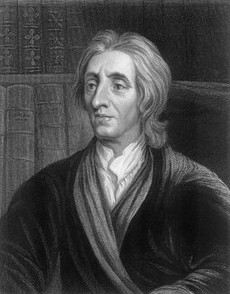
LockeThe major writings of John Locke (1632–1704) are among the most important texts for understanding some of the central currents in epistemology, metaphysics, politics, religion, and pedagogy in the late 17th and early 18th century in Western Europe. His magnum opus, An Essay Concerning Human Understanding (1689) is the undeniable starting point for the study of empiricism in the early modern period. Locke’s best-known political text, Two Treatises of Government (1693) criticizes the political system according to which kings rule by divine right (First Treatise) and lays the foundation for modern liberalism (Second Treatise). His Letter Concerning Toleration (1689) argues that much civil unrest is borne of the state trying to prevent the practice of different religions. In this text, Locke suggests that the proper domain of government does not include deciding which religious path the people ought to take for salvation—in short, it is an argument for the separation of church and state. Some Thoughts Concerning Education (1693) is a very influential text in early modern Europe that outlines the best way to rear children. It suggests that the virtue of a person is directly related to the habits of body and the habits of mind instilled in them by their educators.

Although these texts enjoy a status of “must-reads,” Locke’s views on ethics or moral philosophy have nowhere near the same high status. The reason for this is, in large part, that Locke never wrote a text devoted to the topic. This omission is surprising given that several of his friends entreated him to set down his thoughts about ethics. They saw that the scattered remarks that Locke makes about morality here and there throughout his works were, at times, quite provocative and in need of further development and defense. But, for reasons unknown to us, Locke never indulged his friends with a more systematic moral philosophy. It is thus up to his readers to stitch together his fragmented remarks about happiness, moral laws, freedom, and virtue in order to see what kind of moral philosophy is woven through the texts and to determine whether it is a coherent position.

Table of Contents

  1. Introduction
  2. The Good
    1. Pleasure and Pain
    2. Happiness
  3. The Law of Nature
    1. Existence
    2. Content
    3. Authority
    4. Reconciling the Law with Happiness
  4. Power, Freedom, and Suspending Desire
    1. Passive and Active Powers
    2. The Will
    3. Freedom
    4. Judgment
  5. Living the Moral Life
  6. References and Further Reading
    1. Primary Sources
    2. Secondary Sources: Books
    3. Secondary Sources: Articles

1. Introduction

While Locke did not write a treatise devoted to a discussion of ethics, there are strands of discussion of morality that weave through many, if not most, of his works. One such strand is evident near the end of his An Essay Concerning Human Understanding (hereafter: Essay) where he states that one of the most important aspects of improving our knowledge is to recognize the kinds of things that we can truly know. With this recognition, he says, we are able to finely-tune the focus of our enquiries for optimal results. And, he concludes, given the natural capacities of human beings, “Morality is the proper Science, and Business of Mankind in general” because human beings are both “concerned” and “fitted to search out their Summum Bonum [highest good]” (Essay, Book IV, chapter xii, section 11; hereafter: Essay, IV.xii.11). This claim indicates that Locke takes the investigation of morality to be of utmost importance and gives us good reason to think that Locke’s analysis of the workings of human understanding in general is intimately connected to discovering how the science proper to humankind is to be practiced. The content of the knowledge of ethics includes information about what we, as rational and voluntary agents, ought to do in order to obtain an end, in particular, the end of happiness. It is the science, Locke says, of using the powers that we have as human beings in order to act in such a way that we obtain things that are good and useful for us. As he says: ethics is “the seeking out those Rules, and Measures of humane Actions, which lead to Happiness, and the Means to practice them” (Essay, IV.xxi.3). So, there are several elements in the landscape of Locke’s ethics: happiness or the highest good as the end of human action; the rules that govern human action; the powers that command human action; and the ways and means by which the rules are practiced. While Locke lays out this conception of ethics in the Essay, not all aspects of his definition are explored in detail in that text. So, in order to get the full picture of how he understands each element of his description of ethics, we must often look to several different texts where they receive a fuller treatment. This means that Locke himself does not explain how these elements fit together leaving his overarching theory somewhat of a puzzle for future commentators to contemplate. But, by mining different texts in this way, we can piece together the details of an ethical theory that, while not always obviously coherent, presents a depth and complexity that, at minimum, confirms that this is a puzzle worth trying to solve.

2. The Good

a. Pleasure and Pain

The thread of moral discussion that weaves most consistently throughout the Essay is the subject of happiness. True happiness, on Locke’s account, is associated with the good, which in turn is associated with pleasure. Pleasure, in its turn, is taken by Locke to be the sole motive for human action. This means that the moral theory that is most directly endorsed in the Essay is hedonism.

On Locke’s view, ideas come to us by two means: sensation and reflection. This view is the cornerstone of his empiricism. According to this theory, there is no such thing as innate ideas or ideas that are inborn in the human mind. All ideas come to us by experience. Locke describes sensation as the “great source” of all our ideas and as wholly dependent on the contact between our sensory organs and the external world. The other source of ideas, reflection or “internal sense,” is dependent on the mind’s reflecting on its own operations, in particular the “satisfaction or uneasiness arising from any thought” (Essay, II.i.4). What’s more, Locke states that pleasure and pain are joined to almost all of our ideas both of sensation and of reflection (Essay, II.vii.2). This means that our mental content is organized, at least in one way, by ideas that are associated with pleasure and ideas that are associated with pain. That our ideas are associated with pains and pleasures seems compatible with our phenomenal experience: the contact between the sense organ of touch and a hot stove will result in an idea of the hot stove annexed by the idea of pain, or the act of remembering a romantic first kiss brings with it the idea of pleasure. And, Locke adds, it makes sense to join our ideas to the ideas of pleasure and pain because if our ideas were not joined with either pleasure of pain, we would have no reason to prefer the doing of one action over another, or the consideration of one idea over another. If this were our situation, we would have no reason to act—either physically or mentally (Essay, II.vii.3). That pleasure and pain are given this motivational role in action entails that Locke endorses hedonism: the pursuit of pleasure and the avoidance of pain are the sole motives for action.

Locke notes that among all the ideas that we receive by sensation and reflection, pleasure and pain are very important. And, he notes that the things that we describe as evil are no more than the things that are annexed to the idea of pain, and the things that we describe as good are no more than the things that are annexed to the idea of pleasure. In other words, the presence of good or evil is nothing other than the way a particular idea relates to us—either pleasurably or painfully. This means that on Locke’s view, good is just the category of things that tend to cause or increase pleasure or decrease pain in us, and evil is just the category of things that tend to cause or increase pain or decrease pleasure in us (Essay, II.xx.2). Now, we might think that, morally speaking, this way of defining good and evil gets Locke into trouble. Consider the following scenario. Smith enjoys breaking her promises. In other words, failing to honor her word brings her pleasure. According to the view just described, it seems that breaking promises, at least for Smith, is a good. For, if good and evil are defined as nothing more than pleasure and pain, it seems that if something gives Smith pleasure, it is impossible to deny that it is a good. This would be an unwelcome effect of Locke’s view, for it would indicate that his system leads directly to a kind of moral relativism. If promise breaking is pleasurable for Smith and promise keeping is pleasurable for her friend Jones and pleasure is the sign of the good, then it seems that the good is relative and there is no sense in which we can say that Jones is right about what is good and Smith is wrong. Locke blocks this kind of consequence for his view by introducing a distinction between “happiness” and “true happiness.” This indicates that while all things that bring us pleasure are linked to happiness, there is also a category of pleasure-bringing things that are linked to true happiness. It is the pursuit of the members of this special category of pleasurable things that is, for Locke, emblematic of the correct use of our intellectual powers.

b. Happiness

Locke is very clear—we all constantly desire happiness. All of our actions, on his view, are oriented towards securing happiness. Uneasiness, Locke’s technical term for being in a state of pain and desirous of some absent good, is the motive that moves us to act in the way that is expected to relieve the pain of desire and secure the state of happiness (Essay, II.xxi.36). But, while Locke equates pleasure with good, he is careful to distinguish the happiness that is acquired as a result of the satisfaction of any particular desire and the true happiness that is the result of the satisfaction of a particular kind of desire. Drawing this distinction allows Locke to hold that the pursuit of a certain sets of pleasures or goods is more worthy than the pursuit of others.

The pursuit of true happiness, according to Locke, is equated with “the highest perfection of intellectual nature” (Essay, II.xxi.51). And, indeed, Locke takes our pursuit of this true happiness to be the thing to which the vast majority of our efforts should be oriented. To do this, he says that we need to try to match our desires to “the true instrinsick good” that is really within things. Notice here that Locke is implying that there is distinction to be drawn between the “true intrinsic good” of a thing and, it seems, the good that we unreflectively take to be within a certain thing. The idea here is that attentively considering a particular thing will allow us to see its true value as opposed to the superficial value we assign to a thing based on our immediate reaction to it. We can think, for example, of a bitter tasting medicine. A face-value assessment of the medicine will lead us to evaluate that the thing is to be avoided. However, more information and contemplation of it will lead us to see that the true worth of the medicine is, in fact, high and so it should be evaluated as a good to be pursued. And, Locke states, if we contemplate a thing long enough, and see clearly the measure of its true worth; we can change our desire and uneasiness for it in proportion to that worth (Essay, II.xxi.53). But how are we to understand Locke’s suggestion that there is a true, intrinsic good in things? So far, all he has said about the good is that it is tracked by pleasure. We begin to get an answer to this question when Locke acknowledges the obvious fact that different people derive pleasure and pain from different things. While he reiterates that happiness is no more than the possession of those things that give the most pleasure and the absence of those things that cause the most pain, and that the objects in these two categories can vary widely among people, he adds the following provocative statement:

 If therefore Men in this Life only have hope; if in this Life they can only enjoy, ’tis not strange, nor unreasonable, that they should seek their Happiness by avoiding all things, that disease them here, and by pursuing all that delight them; wherein it will be no wonder to find variety and difference. For if there be no Prospect beyond the Grave, the inference is certainly right, Let us eat and drink, let us enjoy what we delight in, for tomorrow we shall die [Isa, 22:13; I Cor. 15:32]. (Essay, II.xxi.55)

Here, Locke suggests that pursuing and avoiding the particular things that give us pleasure or pain would be a perfectly acceptable way to live were there “no prospect beyond the grave.” It seems that what Locke means is that if there were no judgment day, which is to say that if our actions were not ultimately judged by God, there would be no reason to do otherwise than to blindly follow our pleasures and flee our pains. Now, given this suggestion, the question, then, is how to distinguish between the things that are pleasurable but that will not help our case on judgment day, and those that will. Locke provides a clue for how to do such a thing when he says that the will is typically determined by those things that are judged to be good by the understanding. However, in many cases we use “wrong measures of good and evil” and end by judging unworthy things to be good. He who makes such a mistake errs because “[t]he eternal Law and Nature of things must not be alter’d to comply with his ill order’d choice” (Essay, II.xxi.56). In other words, there is an ordered way to choose which things to pursue—the things that are in accordance with the eternal law and nature of things—and an ill-ordered way, in accordance with our own palates. This indicates that Locke takes there to be a fixed law that determines which things are worthy of our pursuit, and which are not. This means that Locke takes there to be an important distinction between the good, understood as all objects that are connected to pleasure and the moral good, understood as objects connected to pleasure which are also in conformity with a law. Though the distinctions between good and moral good, and between evil and moral evil are not discussed in any great detail by Locke, he does states that moral good and evil is nothing other than the “Conformity or Disagreement of our voluntary Actions to some Law.” Locke states punishments and rewards are bestowed on us for our following or failure to follow this law by “the Will and Power of the Law-maker” (Essay, II.xxviii.5). So, Locke affirms that moral good and evil are closely tied to the observance or violation of some law, and that the lawmaker has the power to reward or punish those who adhere to or stray from the law.

3. The Law of Nature

a. Existence

In the Essay, the concepts of laws and lawmakers do not receive much treatment beyond Locke’s affirmation that God has decreed laws and that there are rewards and punishments associated with the respect or violation of these laws (Essay, I.iii.6; I.iii.12; II.xxi.70; II.xxviii.6). The two most important questions concerning the role of laws in a system of ethics remain unanswered in the Essay: (1) how do we determine the content of the law? This is the epistemological question. And (2) what kind of authority does the law have to obligate? This is the moral question. Locke spends much time considering these questions in a series of nine essays written some thirty years before the Essay, which are known under the collected title Essays on the Law of Nature (hereafter: Law).

The first essay in the series treats the question of whether there is a “rule of morals, or law of nature given to us.” The answer is unequivocally “yes” (Law, Essay I, page 109; hereafter: Law, I: 109). The reason for this positive answer, in short, is because God exists. Locke appeals to a kind of teleological argument to support the claim of God’s existence, saying that given the organization of the universe, including the organized way in which animal and vegetable bodies propagate, there must be a governing principle that is responsible for the patterns we see on earth. And, if we extend this principle to the existence of human life, Locke claims that it is reasonable to believe that there is a pattern or a law that governs behavior. This law is to be understood as moral good or virtue and, Locke states, it is the decree of God’s will and is discernable by “the light of nature.” Because the law tells us what is and is not in conformity with “rational nature,” it has the status of commanding or prohibiting certain behaviors (Law, I: 111; see also Essay, IV.xix.16). Because all human beings possess, by nature, the faculty of reason, all human beings, at least in principle, can discover the natural law.

Locke offers five reasons for thinking that such a natural law exists. He begins by noting that it is evident that there is some disagreement among people about the content of the law. However, far from thinking that such disagreement casts doubt on the existence of the law, he takes the presence of disagreement about the law as evidence that such a true and objective law exists. Disagreements about the content of the law confirm that everyone is in agreement about the fundamental character of the law—that there are things that are by their nature good or evil—but just disagree about how to interpret the law (Law, I: 115). The existence of the law is further reinforced by the fact that we often pass judgment on our own actions, by way of our conscience, leading to feelings of guilt or pride. Because it is not possible, according to Locke, to pronounce a judgment without the existence of a law, the act of conscience demonstrates that such a natural law exists. Third, again appealing to a kind of teleological argument, Locke states that we see that laws govern all manner of natural operations and that it makes sense that human beings would also be governed by laws that are in accordance with their nature (Law, I: 117). Fourth, Locke states that without the natural law, society would not be able to run the way that it does. He suggests that the force of civil law is grounded on the natural law. In other words, without the natural law, positive law would have no moral authority. Elsewhere, Locke underlines this point by saying that given that the law of nature is the eternal rule for all men, the rules made by legislators must conform to this law (The Two Treatises of Government, Treatise II, section 135, hereafter: Government, II.35). Finally, on Locke’s view, there would be no virtue or vice, no reward or punishment, no guilt, if there were no natural law (Law, I: 119). Without the natural law, there would be no bounds on human action. This means that we would be motivated only to do what seems pleasurable and there would be no sense in which anyone could be considered virtuous or vicious. The existence of the natural law, then, allows us to be sensitive to the fact that there are certain pleasures that are more in line with what is objectively right. Indeed, Locke also gestures towards, but does not elaborate on, this kind of thought in the Essay. He suggests that the studious man, who takes all his pleasures from reading and learning will eventually be unable to ignore his desires for food and drink. Likewise, the “Epicure,” whose only interest is in the sensory pleasures of food and drink, will eventually turn his attention to study when shame or the desire to “recommend himself to his Mistress” will raise his uneasiness for knowledge (Essay, II.xxi.43).

So, Locke has given us five reasons to accept the existence of the law of nature that grounds virtuous and vicious behavior. We turn now to how he thinks we come to know the content of the law.

b. Content

Locke suggests that there are two ways to determine the content of the law of nature: by the light of nature and by sense experience.

Locke is careful to note that by “light of nature” he does not mean something like an “inward light” that is “implanted in man” and like a compass constantly leads human beings towards virtue. Rather, this light is to be understood as a kind of metaphor that indicates that truth can be attained by each of us individually by nothing more than the exercise of reason and the intellectual faculties (Law, II: 123). Locke uses a comparison to precious metal mining to make this point clear. He acknowledges that some might say that his explanation of the discovery of the content of the law by the light of nature entails that everyone should always be in possession of the knowledge of this content. But, he notes, this is to take the light of nature as something that is stamped on the hearts on human beings, which is a mistake (see Law, III, 137-145). While the depths of the earth might contain veins of gold and silver, Locke says, this does not mean that everyone living on the stretch of land above those veins is rich (Law, II: 135). Work must be done to dig out the precious metals in order to benefit from their value. Similarly, proper use must be made of the faculties we have in order to benefit from the certainty provided by the light of nature. Locke notes that we can come to know the law of nature, in a way, by tradition, which is to say by the testimony and instruction of other people. But it is a mistake to follow the law for any reason other than that we recognize its universal binding force. This can only be done by our own intellectual investigation (Law, II: 129).

But what, exactly, is the light of nature? Locke acknowledges that it is difficult to answer this question—it is not something stamped on the heart or mind, nor is it something that is exclusively learned by tradition or testimony. The only option left for describing it, then, is that it is something acquired or experienced by sense experience or by reason. And, indeed, Locke suggests that when these two faculties, reason and sensation, work together, nothing can remain obscure to the mind. Sensation provides the mind with ideas and reason guides the faculty of sensation and arranges “together the images of things derived from sense-perception, thence forming others [ideas] and composing new ones” (Law, IV: 147). Locke emphasizes that reason ought to be taken to mean “the discursive faculty of the mind, which advances from things known to thinks unknown,” using as its foundation the data provided by sense experience (Law, IV: 149).

When directly addressing the question of how the combination of reason and sense experience allow us to know the content of the law of nature, Locke states that two important truths must be acknowledged because they are “presupposed in the knowledge of any and every law” (Law, IV: 151). First, we must understand that there is a lawmaker who decreed the law, and that the lawmaker is rightly obeyed as a superior power (a discussion of this point is also found in Government, I.81). Second, we must understand that the lawmaker wishes those to whom the law is decreed to follow the law. Let us take each of these in turn.

Sense experience allows us to know that a lawmaker exists. To demonstrate this, Locke appeals, once again, to a kind of teleological argument: by our senses we come to know the objects external world and, importantly, the regularities with which they move and change. We also see that we human beings are part of the movements and changes of the external world. Reason, then, contemplates these regularities and orders of change and motion and naturally comes to inquire about their origin. The conclusion of such an inquiry, states Locke, is that a powerful and wise creator exists. This conclusion follows from two observations: (1) that beasts and inanimate things cannot be the cause of the existence of human beings because they are clearly less perfect than human beings, and something less perfect cannot bring more perfect things into existence, and 2) that we ourselves cannot be the cause of our own existence because if we possessed the power to create ourselves, we would also have the power to give ourselves eternal life. Because it is obviously the case that we do not have eternal life, Locke concludes that we cannot be the origin of our own existence. So, Locke says, there must be a powerful agent, God, who is the origin of our existence (Law, IV: 153). The senses provide the data from the external world, and reason contemplates the data and concludes that a creator of the observed objects and phenomena must exist. Once the existence of a creator is determined, Locke thinks that we can also see that the creator has “a just and inevitable command over us and at His pleasure can raise us up or throw us down, and make us by the same commanding power happy or miserable” (Law, IV: 155). This commanding power, on Locke’s view, indicates that we are necessarily subject to the decrees of God’s will. (A similar line of discussion is found in Locke’s The Reasonableness of Christianity, 144–46.)

As for the second truth, that the lawmaker, God, wishes us to follow the laws decreed, Locke states that once we see that there is a creator of all things and that an order obtains among them, we see that the creator is both powerful and wise. It follows from these evident attributes that God would not create something without a purpose. Moreover, we notice that our minds and bodies seem well equipped for action, which suggests, “God intends man to do something.” And, the “something” that we are made to do, according to Locke, is the same purpose shared by all created things—the glorification of God (Law, IV: 157). In the case of rational beings, Locke states that given our nature, our function is to use sense experience and reason in order to discover, contemplate, and praise God’s creation; to create a society with other people and to work to maintain and preserve both oneself and the community. And this, in fact, is the content of the law of nature—to preserve one’s own being and to work to maintain and preserve the beings of the other people in our community. This injunction to preserve oneself and to preserve one’s neighbors is also endorsed and stressed throughout Locke’s discussions of political power and freedom (see Government, I.86, 88, 120; II.6, 25, 128).

c. Authority

Once we have knowledge of the content of the law of nature, we must determine from where it derives its authority. In other words, we must ask why we are bound to follow the law once we are aware of its content. Locke begins this discussion by reiterating that the law of nature “is the care and preservation of oneself.” Given this law, he states that virtue should not be understood as a duty but rather the “convenience” of human beings. In this sense, the good is nothing more than what is useful. Further, he adds, the observance of this law is not so much an obligation but rather “a privilege and an advantage, to which we are led by expediency” (Law, VI: 181). This indicates that Locke thinks that actions that are in conformity with the law are useful and practical. In other words, it is in our best interest to follow the law. While this characterization of why we in fact follow the law is compelling, there is nevertheless still an inquiry to be made into why we ought to follow the law.

Locke begins his treatment of this question by stating that no one can oblige us to do anything unless the one who obliges has some superior right and power over us. The obligation that is generated between such a superior power and those who are subject to it results in two kinds of duties: (1) the duty to pay obedience to the command of the superior power. Because our faculties are suited to discover the existence of the divine lawmaker, Locke takes it to be impossible to avoid this discovery, barring some damage or impediment to our faculties. This duty is ultimately grounded in God’s will as the force by which we were created (Law, VI: 183). (2) The duty to suffer punishment as a result of the failure to honor the first duty—obedience. Now, it might seem odd that it would be necessary to postulate that punishment results from the failure to respect a law the content of which is only that we must take care of ourselves. In other words, how could anyone express so little interest in taking care of himself or herself that the fear of punishment is needed to motivate the actions necessary for such care? It is worth quoting Locke’s answer in full:

[A] liability to punishment, which arises from a failure to pay dutiful obedience, so that those who refuse to be led by reason and to own that in the matter of morals and right conduct they are subject to a superior authority may recognize that they are constrained by force and punishment to be submissive to that authority and feel the strength of Him whose will they refuse to follow. And so the force of this obligation seems to be grounded in the authority of a lawmaker, so that power compels those who cannot be moved by warnings. (Law, VI: 183)

So, even though the existence, content, and authority of the law of nature are known in virtue of the faculties possessed by all rational creatures—sense experience and reason—Locke recognizes that there are people who “refuse to be led by reason.” Because these people do not see the binding force of the law by their faculties alone, they need some other impetus to motivate their behavior. But, Locke thinks very ill of those who are in need of this other impetus. He says the these features of the law of nature can be discovered by anyone who is diligent about directing their mind to them, and can be concealed from no one “unless he loves blindness and darkness and casts off nature in order that he may avoid his duty” (Law, VI: 189, see also Government, II.6).

d. Reconciling the Law with Happiness

The main lines of Locke’s natural law theory are as follows: there is a moral law that is (1) discoverable by the combined work of reason and sense experience, and (2) binding on human beings in virtue of being decreed by God. Now, in §1 above, we saw that Locke thinks that all human beings are naturally oriented to the pursuit of happiness. This is because we are motivated to pursue things if they promise pleasure and to avoid things if they promise pain. It has seemed to many commentators that these two discussions of moral principles are in tension with each other. On the view described in Law, Locke straightforwardly appeals to reason and our ability to understand the nature of God’s attributes to ground our obligation to follow the law of nature. In other words, what is lawful ought to be followed because God wills it and what is unlawful ought to be rejected because it is not willed by God. Because we can straightforwardly see that God is the law-giver and that we are by nature subordinate to Him, we ought to follow the law. By contrast, in the discussion of happiness and pleasure in the Essay, Locke explains that good and evil reduce to what is pleasurable and what is painful. While he does also indicate that the special categories of good and evil—moral good and moral evil—are no more than the conformity or disagreement between our actions and a law, he immediately adds that such conformity or disagreement is followed by rewards or punishments that flow from the lawmaker’s will. From this discussion, then, it is difficult to see whether Locke holds that it is the reward and punishment that binds human beings to act in accordance with the law, or if it is the fact that the law is willed by God.

One way to approach this problem is to suggest that Locke changed his mind. Because of the thirty-year gap between Law and the Essay, we might be tempted to think that the more rationalist picture, where the law and its authority are based on reason, was the young Locke’s view when he wrote Law. This view, the story would go, was replaced by Locke’s more considered and mature view, hedonism. But this approach must be resisted because both theories are present in early and late works. The role of pleasure and pain with respect to morality is present not only in the Essay, but is invoked in Law (passage quoted at the end of §2c), and many other various minor essays written in the years between Law and Essay (for example, ‘Morality’ (c.1677–78) in Political Essays, 267–69). Likewise, the role of the authority of God’s will is retained after Law, again evident in various minor essays (for example, ‘Virtue B’ (1681) in Political Essays, 287-88), Government II.6), Locke’s correspondence (for example, to James Tyrrell, 4 August 1690, Correspondence, Vol.4, letter n.1309) and even in the Essay itself (II.xxviii.8). An answer to how we might reconcile these two positions is suggested when we consider the texts where appeals to both theories are found side-by-side in certain passages.

In his essay Of Ethick in General (c. 1686–88) Locke affirms the hedonist view that happiness and misery consist only in pleasure and pain, and that we all naturally seek happiness. But in the very next paragraph, he states that there is an important difference between moral and natural good and evil—the pleasure and pain that are consequences of virtuous and vicious behavior are grounded in the divine will. Locke notes that drinking to excess leads to pain in the form of headache or nausea. This is an example of a natural evil. By contrast, transgressing a law would not have any painful consequences if the law were not decreed by a superior lawmaker. He adds that it is impossible to motivate the actions of rational agents without the promise of pain or pleasure (Of Ethick in General, §8). From these considerations, Locke suggests that the proper foundation of morality, a foundation that will entail an obligation to moral principles, needs two things. First, we need the proof of a law, which presupposes the existence of a lawmaker who is superior to those to whom the law is decreed. The lawmaker has the right to ordain the law and the power to reward and punish. Second, it must be shown that the content of the law is discoverable to humankind (Of Ethick in General, §12). In this text it seems that Locke suggests that both the force and authority of the divine decree and the promise of reward and punishment are necessary for the proper foundation of an obligating moral law.

A similar line of argument is found in the Essay. There, Locke asserts that in order to judge moral success or failure, we need a rule by which to measure and judge action. Further, each rule of this sort has an “enforcement of Good and Evil.” This is because, according to Locke, “where-ever we suppose a Law, suppose also some Reward or Punishment annexed to that Law” (Essay, II.xxviii.6). Locke states that some promise of pleasure or pain is necessary in order to determine the will to pursue or avoid certain actions. Indeed, he puts the point even more strongly, saying that it would be in vain for the intelligent being who decrees the rule of law to so decree without entailing reward or punishment for the obedient or the unfaithful (see also Government, II.7). It seems, then, that reason discovers the fact that a divine law exists and that it derives from the divine will and, as such, is binding. We might think, as Stephen Darwall suggests in The British Moralists and the Internal Ought, that if reason is that which discovers our obligation to the law, the role for reward and punishment is to motivate our obedience to the law. While this succeeds in making room for both the rationalist and hedonist strains in Locke’s view, some other texts seem to indicate that by reason alone we ought to be motivated to follow moral laws.

One striking instance of this kind of suggestion is found in the third book of the Essay where Locke boldly states that “Morality is capable of Demonstration” in the same way as mathematics (Essay, III.xi.16). He explains that once we understand the existence and nature of God as a supreme being who is infinite in power, goodness, and wisdom and on whom we depend, and our own nature “as understanding, rational Beings,” we should be able to see that these two things together provide the foundation of both our duty and the appropriate rules of action. On Locke’s view, with focused attention the measures of right and wrong will become as clear to us as the propositions of mathematics (Essay, IV.iii.18). He gives two examples of such certain moral principles to make the point: (1) “Where there is no Property, there is no Injustice” and (2) “No Government allows absolute Liberty.” He explains that property implies a right to something and injustice is the violation of a right to something. So, if we clearly see the intensional definition of each term, we see that (1) is necessarily true. Similarly, government indicates the establishment of a society based on certain rules, and absolute liberty is the freedom from any and all rules. Again, if we understand the definitions of the two terms in the proposition, it becomes obvious that (2) is necessarily true. And, Locke states, following this logic, 1 and 2 are as certain as the proposition that “a Triangle has three Angles equal to two right ones” (Essay, IV.iii.18). If moral principles have the same status as mathematical principles, it is difficult to see why we would need further inducement to use these principles to guide our behavior. While there is no clear answer to this question, Locke does provide a way to understand the role of reward and punishment in our obligation to moral principles despite the fact that it seems that they ought to obligate by reason alone.

Early in the Essay, over the course of giving arguments against the existence of innate ideas, Locke addresses the possibility of innate moral principles. He begins by saying that for any proposed moral rule human beings can, with good reason, demand justification. This precludes the possibility of innate moral principles because, if they were innate, they would be self-evident and thus would not be candidates for justification. Next, Locke notes that despite the fact that there are no innate moral principles, there are certain principles that are undeniable, for example, that “men should keep their Compacts.” However, when asked why people follow this rule, different answers are given. A “Hobbist” will say that it is because the public requires it, and the “Leviathan” will punish those who disobey the law. A “Heathen” philosopher will say that it is because following such a law is a virtue, which is the highest perfection for human beings. But a Christian philosopher, the category to which Locke belongs, will say that it is because “God, who has the Power of eternal Life and Death, requires it of us” (Essay, I.iii.5). Locke builds on this statement in the following section when he notes that while the existence of God and the truth of our obedience to Him is made manifest by the light of reason, it is possible that there are people who accept the truth of moral principles, and follow them, without knowing or accepting the “true ground of Morality; which can only be the Will and Law of God” (Essay, I.iii.6). Here Locke is suggesting that we can accept a true moral law as binding and follow it as such, but for the wrong reasons. This means that while the Hobbist, the Heathen, and the Christian might all take the same law of keeping one’s compacts to be obligating, only the Christian does it for the right reason—that God’s will requires our obedience to that law. Indeed, Locke states that if we receive truths by revelation they too must be subject to reason, for to follow truths based on revelation alone is insufficient (see Essay, IV.xviii).

Now, to determine the role of pain and pleasure in this story, we turn to Locke’s discussion of the role of pain and pleasure in general. He says that God has joined pains and pleasures to our interaction with many things in our environment in order to alert us to things that are harmful or helpful to the preservation of our bodies (Essay, II.vii.4). But, beyond this, Locke notes that there is another reason that God has joined pleasure and pain to almost all our thoughts and sensations: so that we experience imperfections and dissatisfactions. He states that the kinds of pleasures that we experience in connection to finite things are ephemeral and not representative of complete happiness. This dissatisfaction coupled with the natural drive to obtain happiness opens the possibility of our being led to seek our pleasure in God, where we anticipate a more stable and, perhaps, permanent happiness. Appreciating this reason why pleasure and pain are annexed to most of our ideas will, according to Locke, lead the way to the ultimate aim of the enquiry in human understanding—the knowledge and veneration of God (Essay, II.vii.5–6). So, Locke seems to be suggesting here that pain and pleasure prompt us to find out about God, in whom complete and eternal happiness is possible. This search, in turn, leads us to knowledge of God, which will include the knowledge that He ought to be obeyed in virtue of His decrees alone. Pleasure and pain, reward and punishment, on this interpretation, are the means by which we are led to know God’s nature, which, once known, motivates obedience to His laws. This mechanism supports Locke’s claim that real happiness is to be found in the perfection of our intellectual nature—in embarking on the search for knowledge of God, we embark on the intellectual journey that will lead to the kind of knowledge that brings permanent pleasure. This at least suggests that the knowledge of God has the happy double-effect of leading to both more stable happiness and the understanding that God is to be obeyed in virtue of His divine will alone.

But given that all human beings experience pain and pleasure, Locke needs to explain how it is that certain people are virtuous, having followed the experience of dissatisfaction to arrive at the knowledge of God, and other people are vicious, who seek pleasure and avoid pain for no reason other than their own hedonic sensations.

4. Power, Freedom, and Suspending Desire

a. Passive and Active Powers

In any discussion of ethics, it is important not only to determine what, exactly, counts as virtuous and vicious behavior, but also the extent to which we are in control of our actions. This is important because we want to be able to adequately connect behavior to agents in order to attribute praise or blame, reward or punishment to an agent, we need to be able to see the way in which she is the causal source of her own actions. Locke addresses this issue in one of the longest chapters of the Essay—“Of Power.” In this chapter, Locke describes how he understands the nature of power, the human will, freedom and its connection to happiness, and, finally, the reasons why many (or even most) people do not exercise their freedom in the right kind of way and are unhappy as a result. It is worth noting here that this chapter of the Essay underwent major revisions throughout the five editions of the Essay and in particular between the first and second edition. The present discussion is based on the fourth edition of the Essay (but see the “References and Further Reading” below for articles that discuss the relevance of the changes throughout all five editions).

Locke states that we come to have the idea of “power” by observing the fact that things change over time. Finite objects are changed as a result of interactions with other finite objects (for example fire melts gold) and we notice that our own ideas change either as a result of external stimulus (for example the noise of a jackhammer interrupts the contemplation of a logic problem) or as a result of our own desires (for example hunger interrupts the contemplation of a logic problem). The idea of power always includes some kind of relation to action or change. The passive side of power entails the ability to be changed and the active side of power entails the ability to make change. Our observation of almost all sensible things furnishes us with the idea of passive power. This is because sensible things appear to be in almost constant flux—they are changed by their interaction with other sensible things, with heat, cold, rain, and time. And, Locke adds, such observations give us no fewer instances of the idea of active power, for “whatever Change is observed, the Mind must collect a Power somewhere, able to make that Change” (Essay, II.xxi.4). However, when it comes to active powers, Locke states that the clearest and most distinct idea of active power comes to us from the observation of the operations of our own minds. He elaborates by stating that there are two kinds of activities with which we are familiar: thinking and motion. When we consider body in general, Locke states that it is obvious that we receive no idea of thinking, which only comes from a contemplation of the operations of our own minds. But neither does body provide the idea of the beginning of motion, only of the continuation or transfer of motion. The idea of the beginning of motion, which is the idea associated with the active power of motion, only comes to us when we reflect “on what passes in our selves, where we find by Experience, that barely by willing it, barely by a thought of the Mind, we can move the parts of our Bodies, which were before at rest” (Essay, II.xxi.4). So, it seems, the operation of our minds, in particular the connection between one kind of thought, willing, and a change in either the content of our minds or the orientation of our bodies, provides us with the idea of an active power.

b. The Will

The power to stop, start, or continue an action of the mind or of the body is what Locke calls the will. When the power of the will is exercised, a volition (or willing) occurs. Any action (or forbearance of action) that follows volition is considered voluntary. The power of the will is coupled with the power of the understanding. This latter power is defined as the power of perceiving ideas and their agreement or disagreement with one another. The understanding, then, provides ideas to the mind and the will, depending on the content of these ideas, prefers certain courses of action to others. Locke explains that the will directs action according to its preference—and here we must understand “preference” in the most general sense of inclination, partiality, or taste. In short, the will is attracted to actions that promise the procurement of pleasing things and/or the distancing from displeasing things. The technical term that Locke uses to describe that which determines the will is uneasiness. He elaborates, stating that the reason why any action is continued is “the present satisfaction in it” and the reason why any action is taken to move to a new state is dissatisfaction (Essay, II.xxi.29). Indeed, Locke affirms that uneasiness, at bottom, is really no more than desire, where the mind is disturbed by a “want of some absent good” (Essay, II.xxi.31). So, any pain or discomfort of the mind or body is a motive for the will to command a change of state so as to move from unease to ease. Locke notes that it is a common fact of life that we often experience multiple uneasinesses at one time, all pressing on us and demanding relief. But, he says, when we ask the question of what determines the will at any one moment, the answer is the most pressing uneasiness (Essay, II.xxi.31). Imagine a situation where you are simultaneously experiencing discomfort as a result of hunger and the anxiety of being under-prepared for tomorrow’s philosophy exam. On Locke’s view the most intense or the most pressing of these uneasinesses will determine your will to command the action that will relieve it. This means that no matter how much you want to stay at the library to study, if hunger comes to be the more pressing than the desire to pass the exam, hunger will determine the will to act, commanding the action that will result in the procurement of food.

While Locke states that the most pressing uneasiness determines the will, he adds that it does so “for the most part, but not always.” This is because he takes the mind to have the power to “suspend the execution and satisfaction of any of its desires” (Essay, II.xxi.47). While a desire is suspended, Locke says, our mind, being temporarily freed from the discomfort of the want for the thing desired, has the opportunity to consider the relative worth of that thing. The idea here is that with appropriate deliberation about the value of the desired thing we will come to see which things are really worth pursuing and which are better left alone. And, Locke states, the conclusion at which we arrive after this intellectual endeavor of consideration and examination will indicate what, exactly, we take to be part of our happiness. And, in turn, by a mechanism that Locke does not describe in any detail, our uneasiness and desire for that thing will change to reflect whether we concluded that the thing does, indeed, play a role in our happiness or not (Essay, II.xxi.56). The problem is that there is no clear explanation for how, exactly, the power to suspend works. Despite this, Locke nowhere indicates that suspension is an action of the mind that is determined by anything other than volition of the will. We know that Locke takes all acts of the will to be determined by uneasiness. So, suspending our desires must be the result of uneasiness for something. Investigating how Locke understands human freedom and judgment will allow us to see what, exactly, we are uneasy for when we are determined to suspend our desires.

c. Freedom

When the nature of the human will is under discussion, we often want to know the extent of this faculty’s freedom. The reason why this question is important is because we want to see how autonomously the will can act. Typically, the question takes the form of: is the will free? Locke unequivocally denies that the will is free, implying, in fact, that it is a category mistake to ask the question at all. This is because, on his view, both the will and freedom are powers of agents, and it is a mistake to think that one power (the will) can have as a property a second power (freedom) (Essay, II.xxi.20). Instead, Locke thinks that the right question to pose is whether the agent is free. He defines freedom in the following way:

[T]he Idea of Liberty, is the Idea of a Power in any Agent to do or forbear any particular Action, according to the determination or thought of the mind, whereby either of them is preferr’d to the other; where either of them is not in the Power of the Agent to be produced by him according to his Volition here he is not a Liberty, that Agent is under Necessity. (Essay, II.xxi.8)

So, Locke considers that an agent is free in acting when her action is connected to her volition in the right kind of way. That is, when her action (or forbearance of action) follows from her volition, she is free. And, her volition is determined by the “thought of the mind” that indicates which action is preferred.

Notice here that Locke takes an agent to be free in acting when she acts according to her preference—this means that her actions are determined by her preference. This plainly shows that Locke does not endorse a kind of freedom of indifference, according to which the will can choose to command an action other than the thing most preferred at a given moment. This is the kind of freedom most often associated with indeterminism. Freedom, then, for Locke, is no more than the ability to execute the action that is taken to result in the most pleasure at a given moment. The problem with this way of defining freedom is that it seems unable to account for the kinds of actions we typically take to be emblematic of virtuous or vicious behavior. This is because we tend to think that the power of freedom is a power that allows us to avoid vicious actions, perhaps especially those that are pleasurable, in order to pursue a righteous path instead. For instance, on the traditional Christian picture, when we wonder about why God would allow Adam to sin, the response given is that Adam was created as a free being. While God could have created beings that, like automata, unfailingly followed the good and the true, He saw that it was all things considered better to create beings that were free to choose their own actions. This decision was made despite the fact that God foresaw the sinful use to which this freedom would be put. This traditional view explains Adam’s sin in the following way: Adam knew that it was God’s commandment that he was not to eat of the tree of knowledge. Adam also knew that following God’s commandment was the right thing to do. So, in the moment where he was tempted to eat the fruit of the tree of knowledge, he knew it was the wrong thing to do, but did it anyway. This is because, the story goes, and in that moment he was free to decide whether to follow the commandment or to give in to temptation. Of his own free choice, Adam decided to follow temptation. This means that in the moment of original sin, both following God’s commandment and eating the fruit were live options for Adam, and he chose the fruit of his own agency.

Now, on Locke’s system, a different explanation obtains. Given his definition of freedom, it is difficult, at least prima facie, to see how Adam could be blamed for choosing the fruit over the commandment. For, according to Locke, an agent acts freely when her actions are determined by her volitions. So, if Adam’s greatest uneasiness was for the fruit, and the act of eating the fruit was the result of his will commanding such action based on his preference, then he acted freely. But, on this understanding of freedom, it is difficult to see how, exactly, Adam can be morally blamed for eating the fruit. The question now becomes: is Adam to be blamed for anticipating more pleasure from the consumption of the fruit than from following God’s command? In other words, was it possible for Adam to alter the intensity of his desire for the fruit? It seems that on Locke’s view, the answer must be connected to one of the powers he takes human beings to possess—the power to suspend desires. And, in certain passages of the Essay, Locke implies that suspending desires and freedom are linked, suggesting that while agents are acting freely whenever their volitions and actions are linked in the right kind of way, there is, perhaps, a proper use of the power to act freely.

d. Judgment

Locke asserts that the “highest perfection of intellectual nature” is the “pursuit of true and solid happiness.” He adds that taking care not to mistake imaginary happiness for real happiness is “the necessary foundation of our liberty.” And, he writes that the more closely we are focused on the pursuit of true happiness, which is our greatest good, the less our wills are determined to command actions to pursue lesser goods that are not representative of the true good (Essay, II.xxi.51). In other words, the more we are determined by true happiness, the more we will to suspend our desires for lesser things. This suggests that Locke takes there to be a right way to use our power of freedom. Locke indicates that there are instances where it is impossible to resist a particular desire—when a violent passion strikes, for instance. He also states, however, that aside from these kinds of violent passions, we are always able to suspend our desire for any thing in order to give ourselves the time and the emotional distance from the thing desired in which to consider the worth of thing relative to our general goal: true happiness. True happiness, or real bliss, on Locke’s view, is to be found in the pursuit of things that are true intrinsic goods, which promise “exquisite and endless Happiness” in the next life (Essay, II.xxi.70). In other words, true good is something like the Beatific Vision.

Now, Locke admits that it is a common experience to be carried by our wills towards things that we know do not play a role in our overall and true happiness. However, while he allows that the pursuit of things that promise pleasure, even if only a temporary pleasure, represents the action of a free agent, he also says that it is possible for us to be “at Liberty in respect of willing” when we choose “a remote Good as an end to be pursued” (Essay, II.xxi.56). The central thing to note here is that Locke is drawing a distinction between immediate and remote goods. The difference between these two kinds of goods is temporal. For instance, acting to obtain the pleasure of intoxication is to pursue an immediate good while acting to obtain the pleasure of health is to pursue a remote good. So, we can suppose here that Locke is suggesting that forgoing immediate goods and privileging remote goods is characteristic of the right use of liberty (but see Rickless for an alternative interpretation). If this is so, it is certainly not a difficult suggestion to accept. Indeed, it is fairly straightforwardly clear that many immediate pleasures do not, in the end, contribute to overall and long-lasting happiness.

The question now, and it is a question that Locke himself poses, is “How Men come often to prefer the worse to the better; and to chase that, which, by their own Confession, has made them miserable” (Essay, II.xxi.56). Locke gives two answers. First, bad luck can account for people not pursuing their true happiness. For instance, someone who is afflicted with an illness, injury, or tragedy is consumed by her pain and is thus unable to adequately focus on remote pleasures. Quoting Locke’s second answer “Other uneasinesses arise from our desire of absent good; which desires always bear proportion to, and depend on the judgment we make, and the relish we have of any absent good; in both which we are apt to be variously misled, and that by our own fault” (Essay, II.xxi.57).

Here Locke states that our own faulty judgment is to blame for our preferring the worse to the better. This is because, on his view, the uneasiness we have for any given object is directly proportional to the judgments we make about the merit of the things to which we are attracted. So, if we are most uneasy for immediate pleasures, it is our own fault because we have judged these things to be best for us. In this way, Locke makes room in his system for praiseworthiness and blameworthiness with respect to our desires: absent illness, injury, or tragedy, we ourselves are responsible for endorsing, through judgment, our uneasinesses. He continues, stating that the major reason why we often misjudge the value of things for our true happiness is that our current state fools us into thinking that we are, in fact, truly happy. Because it is difficult for us to consider the state of true, eternal happiness, we tend to think that in those moments when we enjoy pleasure and feel no uneasiness, we are truly happy. But such thoughts are mistaken on his view. Indeed, as Locke says, the greatest reason why so few people are moved to pursue the greatest, remote good is that most people are convinced that they can be truly happy without it.

The cause of our mistaken judgments is the fact that it is very difficult for us to compare present and immediate pleasures and pains with future or remote pleasures and pains. In fact, Locke likens this difficulty to the trouble we typically experience in correctly estimating the size of distant objects. When objects are close to us, it is easy to determine their size. When they are far away, it is much more difficult. Likewise, he says, for pleasures and pains. He notes that if every sip of alcohol were accompanied by headache and nausea, no one would ever drink. But, “the fallacy of a little difference in time” provides the space for us to mistakenly judge that the alcohol contributes to our true happiness (Essay, II.xxi.63). We experience this difficulty of judging remote pleasures and pains due to the “weak and narrow Constitution of our Minds” (Essay, II.xxi.64). The condition of our minds makes it easy for us to think that there could be no greater good than the relief of being unburdened of a present pain. In order to correct this problem and convince a man to judge that his greatest good is to be found in a remote thing, Locke says that all we must do is convince him that “Virtue and Religion are necessary to his Happiness” (Essay, II.xxi.60). Locke explains that a “due consideration will do it in most cases; and practice, application, and custom in most” (Essay, II.xxi.69). The suggestion is that contemplation and deliberation alone may be sufficient to correct our problem of considering all immediate pleasures and pains to be greater than any future ones. And, if that does not work, practice and habit can also correct this problem. By practice and exposure, we can, according to Locke, change the agreeableness or disagreeableness of things. It seems, then, that the power to suspend desire must be the power to reject immediate pleasures in favor of the pursuit of remote or future pleasures. However, it seems that in order to suspend in this way, we must already have judged that these immediate pleasures are not representative of the true good. For, without this kind of prior judgment, it seems that we would not be in a position to suspend in the way that is required. This is because absent the prior judgment, there would be no reason for the uneasiness we felt for the perceived good to not determine the will. The question to resolve now is how to get ourselves into a position where we are uneasy for the remote, true good and can suspend our desires for immediate pleasures. In other words, we must determine how we can come to seriously judge immediate pleasures to not have a part in our true happiness.

5. Living the Moral Life

In order to behave in a way that will lead us to the greatest and truest happiness, we must come to judge the remote and future good, the “unspeakable,” “infinite,” and “eternal” joys of heaven to be our greatest and thus most pleasurable good (Essay, II.xxi.37–38). But, on Locke’s view, our actions are always determined by the thing we are most uneasy about at any given moment. So, it seems, we need to cultivate the uneasiness for the infinite joys of heaven. But if, as Locke suggests, the human condition is such that our minds, in their weak and narrow states, judge immediate pleasures to be representative of the greatest good, it is difficult to see how, exactly, we can circumvent this weakened state in order to suspend our more terrestrial desires and thus have the space to correctly judge which things will lead to our true happiness. While in the Essay Locke does not say as much as we might like on this topic, elsewhere in his writings we can get a sense for how he might respond to this question.

In 1684, Locke was asked by his friend Edward Clarke, for advice about raising and educating his children. In 1693, Locke’s musings on this topic were published as Some Thoughts Concerning Education (hereafter: Education). This text provides insight into the importance that Locke places on the connection between the pursuit of true happiness and early childhood education in general. Locke begins his discussion by noting that happiness is crucially dependent on the existence of both a sound mind and a sound body. He adds that it sometimes happens that by a great stroke of luck, someone is born whose constitution is so strong that they do not need help from others to direct their minds towards the things that will make them happy. But this is an extraordinarily rare occurrence. Indeed, Locke notes: “I think I may say, that, of all the men we meet with, nine parts of ten are what they are, good or evil, useful or not, by their education” (Education, §1). It is the education we receive as young children, on Locke’s view, that determines how adept we are at targeting the right objects in order to secure our happiness. He observes that the minds of young children are easily distracted by all kinds of sensory stimuli and notes that the first step to developing a mind that is focused on the right kind of things is to ensure that the body is healthy. Indeed, the objective in physical health is to get the body in the perfect state to be able to obey and carry out the mind’s commands. The more difficult part of this equation is training the mind to “be disposed to consent to nothing, but what may be suitable to the dignity and excellency of a rational creature” (Education, §31). And Locke goes further still, stating that the foundation of all virtue is to be placed in the ability of a human being to “deny himself his own desires, cross his own inclinations, and purely follow what reason directs as best, though the appetite lean the other way” (Education, §33). The way to do this, he says, is to resist immediately present pleasures and pains and to wait to act until reason has determined the value of the desirable things in one’s environment.

Locke states that we must recognize the difference between “natural wants” and “wants of fancy.” The former are the kinds of desires that must be obeyed and that no amount of reasoning will allow us to give up. The latter, however, are created. Locke states that parents and teachers must ensure that children develop the habit of resisting any kind of created fancy, thus keeping the mind free from desires for things that do not lead to true happiness (Education, §107). If parents and teachers are successful in blocking the development of “wants of fancy,” Locke thinks that the children who benefit from this success will become adults who will be “allowed greater liberty” because they will be more closely connected to the dictates of reason and not the dictates of passion (Education, §108). So, in order to live the moral life and listen to reason over passions, it seems that we need to have had the benefit of conscientious care-givers in our infancy and youth (see also Government, II.63). This raises the difficulty of how to connect an individual’s moral successes or failures with the individual herself. For, if she had the bad moral luck of unthinking or careless parents and teachers, it seems difficult to see how she could be blamed for failing to follow a virtuous path.

One way of approaching this difficulty is to recall that Locke takes the content of law of nature, the moral law decreed by God, to be the preservation both of ourselves and of the other people in our communities in order to glorify God (Law, IV). The dictate to help to preserve the other people in our community shifts some of the moral burden from the individual onto the community. This means that it is every individual’s responsibility to do all they can, all things considered, to preserve themselves and to ensure, to the best of their ability, that the children in their communities are raised to avoid developing wants of fancy. In this way, children will develop the habit of suspending their desires for terrestrial pleasures and focusing their efforts on attaining the true happiness that results from acting to secure remote goods.

6. References and Further Reading

a. Primary Sources

  • An Essay Concerning Human Understanding. Edited by Peter H. Nidditch. Oxford: Clarendon Press, 1975.
    • This is the critical edition of Locke’s Essay. The body of the text is based on the fourth edition of the Essay and all the changes from the first edition through the fifth (1689, 1694, 1695, 1700, 1706) are indicated in the footnotes. The text also includes a comprehensive forward by Nidditch. Note that Locke’s orthography, grammar, and style are often quite different from the way that academic English is written today. In the citations from this text in particular, all emphases, capitalization, and odd spelling are original to Locke.
  • Essays on the Laws of Nature. Edited and translated by W. von Leyden. Oxford: Clarendon Press, 1954.
    • This edition includes both the original Latin and the English translation of the essays. It also includes Locke’s valedictory speech as censor of moral philosophy at Christ Church and some other shorter pieces of writing. Von Leyden’s introduction provides a very detailed discussion of the sources of Locke’s arguments in these essays, the arguments themselves, and the relations these arguments bear to other of Locke’s writings. It is worth noting here that on von Leyden’s interpretation, it is not possible to render Locke’s discussion of natural law consistent with his endorsement of a hedonistic motivational system in later works.
  • Political Essays. Edited by Mark Goldie. Cambridge: Cambridge University Press, 1997.
    • This collection includes major writings on politics and government, including Essays on the Laws of Nature, Of Ethick in General, and An Essay on Toleration, in addition to many other minor essays.
  • The Correspondence of John Locke, in Eight Volumes. Edited by E.S. De Beer. Oxford: Clarendon Press, 1976–89.
    • A complete database of Locke’s correspondence including notes about his correspondents, notes about events and proper names mentioned in letters, as well as signposts for what was going on in Locke’s life at the time he was writing. The first volume of the collection includes an exhaustive introduction to Locke’s life, work, and contacts in the academic and social world; an explanation of how Locke’s letters were preserved; a discussion of previous publications of Locke’s correspondence and how they relate to this collection; and information about transcription practices, including details about editorial grammar decision and dating of the letters.
  • The Works of John Locke, in Nine Volumes, 12th edition. London: Rivington, 1824.
    • This collection includes most of Locke’s longer texts, some shorter texts and a selection of letters. Among other things, the collection contains: Essay (vols.1 and 2), his correspondence with Stillingfleet (vol.3), Two Treatises of Government (vol.4), Letters on Toleration (vol.5), The Reasonableness of Christianity (vol.6), notes on St. Paul’s Epistles (vol.7), Some Thoughts Concerning Education and A Discourse of Miracles (vol.8), and a selection of letters (vol.9).

b. Secondary Sources: Books

  • Aaron, Richard I. John Locke. Oxford: Oxford University Press, 1971.
    • This is a comprehensive study of Locke’s life and works and includes fifteen very nice pages on Locke’s moral philosophy. Importantly, Aaron concludes that Locke fails to provide his readers  with a science of morals and, in fact, that Locke’s disparate comments about ethics and moral principles cannot be reconciled.
  • Colman, John. John Locke’s Moral Philosophy. Edinburgh: Edinburgh University Press, 1983.
    • In this study, Colman addresses the major themes and problems of Locke’s moral theory including the connection between law and obligation, and the connection between moral principles and    demonstrability.
  • Darwall, Stephen. The British Moralists and the Internal ‘Ought’: 1640–1740. Cambridge: Cambridge University Press, 1995.
    • This is a deep and broad study of moral philosophy from the mid 17th to the mid 18th century. Locke is one among several central figures under discussion. The reader greatly benefits from Darwall’s careful discussions of the theoretical connections between Locke and his contemporaries and his influences on the topics of natural law, autonomy, motivation, duty, and freedom.
  • Lolordo, Antonia. Locke’s Moral Man. Oxford: Oxford University Press, 2012.
    • In this study, Lolordo draws on different parts of the Essay in order to see Locke’s theory of agency. She argues in favor of the interpretation according to which there are two senses of freedom in Locke’s view, one of which is properly used to attain the goal proper to a moral agent. Of particular interest is her discussion that links Locke’s comments about personal identity to moral agency and her claim that, for Locke, metaphysics is unnecessary for ethics.
  • Mabbot, J.D. John Locke. London: Macmillan Press, 1973.
    • This is a study of Locke’s philosophical system that focuses on knowledge acquisition, logic and language, ethics and theology, and political theory. In his discussion of ethics and theology, Mabbot traces Locke’s discussions of moral principles, their demonstrability, and their binding force through The Two Treatises of GovernmentThe Essays on the Laws of Nature, and An Essay Concerning Human Understanding.
  • Schouls, Peter A. Reasoned Freedom: John Locke and Enlightenment. Ithaca: Cornell University Press, 1992.
    • This is a defense of the view that Locke was a great influence on enlightenment thought, in particular in the domains of reason and freedom. Schouls also points out what he takes to be       many inconsistencies across and sometimes within Locke’s texts.
  • Yaffe, Gideon. Liberty Worth the Name: Locke on Free Agency. New Jersey: Princeton University Press, 2000.
    • This is a book-length study of Locke’s view of human freedom. The content includes careful analysis of the chapter ‘Of Power’ of the Essay in addition to comments about how this chapter is connected to Locke’s discussion of personal identity. Yaffe defends an interpretation according to which Locke’s view contains two definitions of freedom, only one of which is “worth the name”—the kind of freedom that allows the pursuit of true good.

c. Secondary Sources: Articles

  • Chappell, Vere. “Locke on the Intellectual Basis of Sin.” Journal of the History of Philosophy 32 (1994): 197–207.
  • Chappell, Vere. “Locke on the Liberty of the Will.” In Locke’s Philosophy: Content and Context. Edited by G.A.J. Rogers, 101–21. Oxford: Oxford University Press, 1994.
  • Chappell, Vere. “Power in Locke’s Essay.” In The Cambridge Companion to Locke’s “An Essay Concerning Human Understanding.” Edited by Lex Newman, 130–56. Cambridge: Cambridge University Press, 2007.
    • In these articles, Chappell advances the interpretation that changes made in the fifth edition of the Essay indicate that Locke changed his view about human freedom.
  • Darwall, Stephen. “The Foundations of Morality,” In The Cambridge Companion to Early Modern Philosophy. Edited by Donald Rutherford, 221–49.
    • This paper canvasses the main themes explored by and influences on early modern moral theories, including Locke’s.
  • Glauser, Richard. “Thinking and Willing in Locke’s Theory of Human Freedom,” Dialogue 42 (2003): 695–724.
    • Glauser argues that Locke’s view remains consistent across the changes made in the various editions of the Essay.
  • Magri, Tito. “Locke, Suspension of Desire, and the Remote Good,” British Journal for the History of Philosophy 8 (2000): 55–70.
    • Magri argues that Locke’s view changes over the course of the different editions of the Essay, in particular that he moves from having an “internalist” view of motivation to having an “externalist” view of motivation. Magri casts doubt on the consistency of Locke’s position.
  • Mathewson, Mark D. “John Locke and the Problems of Moral Knowledge,” Pacific Philosophical Quarterly 87 (2006): 509–26.
    • Mathewson argues that Locke’s comments about the nature of moral ideas leads to moral subjectivity and relativism.
  • Rickless, Samuel. “Locke on Active Power, Freedom, and Moral Agency,” Locke Studies 13 (2013): 31–51.
  • Rickless, Samuel. “Locke on the Freedom to Will.”  Locke Newsletter 31 (2000): 43–68.
    • In these papers, Rickless argues that Locke holds one and only one definition of freedom: the ability to act according to our volitions. According to Rickless, Locke holds the same definition of freedom as Hobbes. The 2013 paper is a direct argument against the interpretation advanced by Lolordo in Locke’s Moral Man.
  • Schneewind, J.B. “Locke’s Moral Philosophy,” The Cambridge Companion to Locke. Edited by Vere Chappell. Cambridge: Cambridge University Press, 1994.
    • Schneewind is one commentator who thinks that Locke’s moral philosophy ends up in a contradiction between the natural law view and hedonism.
  • Walsh, Julie. “Locke and the Power to Suspend Desire,” Locke Studies, 14 (2014).
    • Walsh argues that Locke’s view remains consistent and coherent across the various editions of the Essay and emphasizes the role played by suspension and judgment in attaining true happiness.


Author Information

Julie Walsh
Email: julie.walsh@wellesley.edu
Wellesley College
U. S. A.
Truthmaker Theory

Truthmaker theory is the branch of metaphysics that explores the relationships between what is true and what exists. Discussions of truthmakers and truthmaking typically start with the idea that truth depends on being, and not vice versa. For example, if the sentence ‘Kangaroos live in Australia’ is true, then there are kangaroos living in Australia. And if there are kangaroos living in Australia, then the sentence ‘Kangaroos live in Australia’ is true. But we can ask whether the sentence is true because of the way the world is, or whether the world is the way it is because the sentence is true. Truthmaker theorists make the former claim that the sentence is true because of what exists in the world; it is not the case that the world is the way it is because of which sentences are true. Truthmaker theorists use this fundamental idea as a starting point for clarifying the nature of truth and its relationship to ontology, and to advance various views in metaphysics concerning the nature of the past and future, counterfactual conditionals, modality, and many others. Because truthmaker theorists end up with differing views concerning all these matters, what ultimately unites them is not any single thesis but rather a commitment to thinking that the idea of truthmaking is a useful one for pursuing metaphysical inquiry. Others might conceive of ‘truthmaker theory’ more strictly (such as by requiring a commitment to all truths having truthmakers, or all truthmakers being of a particular ontological variety), though defining the enterprise in this way will inevitably fail to capture all those earnestly pursuing investigation into truthmaking.

Philosophical discussion of truthmakers falls into two broad categories. First, there are ‘internal’ debates about the nature of truthmaker theory itself. For instance, there are open questions as to which truths have truthmakers: do all truths have truthmakers, or just some proper subset of truths (such as the positive truths or synthetic truths)? There are questions as to the nature of the truthmaking relation: is it a necessary relation or a contingent one? Is it a kind of supervenience, dependence, or something else? And it is an open question as to what sorts of objects serve as truthmakers: perhaps there are states of affairs, tropes, or counterparts that serve as truthmakers, or perhaps none of these. There is also frequent debate as to whether truthmaker theory constitutes a theory of truth (similar to, in particular, the correspondence theory of truth), or whether it is an entirely separate philosophical enterprise, one concerned more with metaphysics rather than semantics.

There are also ‘external’ truthmaking discussions that apply basic ideas about truthmaking to longstanding metaphysical topics. The hope is that truthmaker theory can bring new insights and argumentative resources to bear on traditional metaphysical inquiries. For example, truthmaker theorists investigate whether presentism—the view that only the present exists—can satisfy the obligations of truthmaker theory. Truthmaker theory has also been wielded against metaphysical views such as behaviorism and phenomenalism, and it has made contributions to the metaphysics of modality.

Table of Contents

  1. History of Truthmaker Theory
  2. The Truthmaking Relation
  3. Maximalism and Non-Maximalism
  4. Kinds of Truthmakers
  5. Truthmaking Principles
  6. Truthmaking and Truth
  7. Truthmaking and the Past
  8. Truthmaking and Modality
  9. Objections to Truthmaker Theory
  10. References and Further Reading

1. History of Truthmaker Theory

Perhaps the first occurrence of a basic truthmaking idea is found in Aristotle’s Categories. There Aristotle points out that if a certain man exists, then a statement that that man exists is true, and vice versa. But it seems that there is a difference in priority between these two states of affairs. The statement is true because the man exists; it is not the case that the man exists because the statement is true. Aristotle is, in effect, raising a ‘Euthyphro’ question, drawing on Plato’s famous dialogue. Is the statement true because of the way the world is, or is the world the way it is because of which statements are true? Aristotle chose the former answer, and set the stage for discussions of truthmakers far down the road.

The idea of a truthmaker did not play a significant role in philosophy until the rise of logical atomism in the work of Bertrand Russell and Ludwig Wittgenstein. In the Philosophy of Logical Atomism, Russell takes it to be a truism that there are facts, and says that facts are the sort of thing that make propositions true or false. The project of logical atomism is then to determine what sorts of facts are ontologically required in order to make true all the different kinds of propositions. The most basic kind of fact for Russell is the atomic fact, which consists of no more than the possession of a quality by a particular object (or of the holding of a relation between multiple objects). Sentences like ‘X is green’ and ‘X is heavier than Y’, if true, are made true by atomic facts. More complex sentences like ‘X is green and is heavier than Y’ do not call for more complex, ‘molecular’ facts. Instead, the same atomic facts from before can explain the truth of conjunctive sentences. Particularly worrisome are negative truths, such as ‘X is not red’. Russell believed that there need to be negative facts to account for negative truths. In advocating for the existence of negative facts, Russell claims to have ‘nearly produced a riot’ when he suggested the idea at a seminar at Harvard (1985: 74). The idea that reality contains entities that are fundamentally negative in nature has long struck many philosophers as puzzling and metaphysically unacceptable, and there has been continuing controversy over what, if anything, makes negative truths true.

The next major advance in truthmaker theory came from the work of the Australian philosopher David Armstrong. Armstrong—who credits fellow philosopher Charlie Martin with inspiring him on the topic—has long advocated the use of truthmakers in metaphysics. Armstrong cites two paradigm examples of how truthmakers can be put to work in philosophy. First, there is the case of behaviorism, as defended by Gilbert Ryle (1949). Ryle’s philosophy of mind relies heavily on dispositions; Ryle thought that claims involving mental terms could be analyzed into subjunctive conditionals involving dispositions. What it is for Ryle to believe that he is a philosopher is that if he were to be asked what his profession was, he would reply ‘philosopher’. While this counterfactual may be true, the truthmaker theorist asks: but what is it that makes it true? The behaviorist faces a challenge of either accepting this counterfactual as a brute truth, a truth with no further explanation, or admitting that it is made true by some sort of mental state, thus abandoning the supposed ontological economy of behaviorism.

Similarly, Armstrong argues that the phenomenalism of philosophers such as Berkeley and Mill faces a parallel difficulty. According to phenomenalism, all that exists are sensory impressions. But might it not be true that there is a rock on the dark side of the moon that no one has ever observed? The phenomenalist accounts for this idea by claiming that if you were to go to that part of the moon, you would have a rock-like sensory impression. But again: what makes that counterfactual true? The anti-phenomenalist will say that the counterfactual is true because it is made true (at least in part) by the rock itself. The phenomenalist, limited by an ontology of actual sense impressions, is hard-pressed to find a plausible answer to the truthmaker theorist’s question.

In the wake of Armstrong’s (and others’) writings, truthmaker theory became a lively corner of contemporary metaphysics.

2. The Truthmaking Relation

A key concern of truthmaker theory is giving an account of the truthmaking relation. When some object X is a truthmaker for some truth Y, what is the nature of the relationship that X and Y stand in?

One universally agreed upon fact about the truthmaking relation is that it is not a one-one relation. That is, in principle an object can be a truthmaker for multiple truths, and any given truth can have multiple truthmakers. For example, Socrates is frequently thought to be a truthmaker not only for ‘Socrates exists’, but also for ‘Socrates is human’ and ‘There are humans’. For it is impossible that Socrates—who is essentially human—could exist and yet any of those sentences be false (at least given some familiar assumptions about essences). Similarly, ‘There are humans’ is made true by many things—anything that is essentially human, in fact. Hence, it can be misleading to ask what the truthmaker for some truth is, since it is not necessary that truths have only one, unique truthmaker.

So what exactly is the nature of the relation? To ask this question is to probe what sort of analysis, if any, can be given of the truthmaking relation. Many truthmaker theorists have argued that the truthmaking relation, at the least, requires metaphysical necessitation. Some object X necessitates the truth of Y if and only if it is metaphysically impossible for X to exist, and yet Y not be true. In the language of possible worlds, X necessitates Y if and only if every possible world in which X exists is a world in which Y is true. Necessitation is thought to be a necessary component of the truthmaking relation because it shows that the truthmaker’s existence is a sufficient condition on the truth in question. If X’s existence were not enough to guarantee Y’s truth, then X would not yet adequately explain or account for the truth of Y. Something else, in addition to X, would be needed to properly account for Y’s truth.

Not all theorists have agreed that necessitation is necessary for truthmaking. Hugh Mellor (2003), for instance, at one point argued that truthmakers need not necessitate the truths that they make true. Mellor relied on the controversial case of general truths, such as ‘All gold spheres are less than a mile in diameter’. Suppose there are three such spheres, A, B, and C. Then there are three states of affairs (Mellor calls them ‘facta’): A’s being less than a mile in diameter, B’s being less than a mile in diameter, and C’s being less than a mile in diameter. For Mellor, the truthmaker for the general truth is no more than the sum of the three states of affairs. But these three states of affairs do not necessitate the truth of ‘All gold spheres are less than a mile in diameter’, since it is possible that that very sum could exist, and yet the sentence be false. That is a case where, for example, A, B, and C all exist with diameters less than a mile, but a fourth gold sphere D exists whose diameter is greater than a mile. Mellor reasons that the sum of the three states of affairs is the truthmaker for ‘All gold spheres are less than a mile in diameter’, and thus concludes that truthmaking does not require necessitation. (Furthermore, on his view, the truthmaking relation is contingent in the sense that whether X is a truthmaker for Y can vary from world to world. Those who accept necessitation would reject this consequence.) Other theorists argue that truthmaking does require necessitation, and so the sum is not a truthmaker for the sentence; something else (such as one of the totality states of affairs discussed below) is needed to provide a truthmaker, or perhaps it has no truthmaker at all (according to advocates of the supervenience accounts discussed below).

It is more common for philosophers to challenge the sufficiency of the necessitation condition, rather than its necessity. The concern that necessitation is not enough derives in large part from the fact that all objects necessitate the truth of all necessary truths. This is the problem of trivial truthmakers for necessary truths. For example, Socrates necessitates ‘2 + 2 = 4’, for it is metaphysically impossible for Socrates to exist and yet ‘2 + 2 = 4’ be false. Similarly, if God exists, and exists necessarily, then a torn, dog-eared copy of Lolita rotting away in some landfill necessitates the truth of ‘God exists’. If it is impossible for that sentence to be false, then it is impossible for that sentence to be false should that rotting copy of Lolita exist. But—according to this line of thought—Socrates is not a truthmaker for ‘2 + 2 = 4’, and the copy of Lolita is not a truthmaker for ‘God exists’. Truthmaking requires more than just necessitation.

Theories divide as to what exactly else is required of the truthmaking relation. Trenton Merricks (2007) has argued that truthmaking requires ‘aboutness’, in that X is a truthmaker for Y only if Y is about X. Mathematical claims are not about Socrates, and so Socrates cannot make them true. ‘God exists’ is about God, so only God is a candidate truthmaker for it. Those who accept Merricks’s proposal thereby avoid the problem of trivial truthmakers for necessary truths.

E. J. Lowe (2007) conceives of truthmaking as depending upon the essences of propositions. X is a truthmaker for Y only if it is part of the essence of Y that it be true should an object like X exist. This amendment solves the problem of trivial truthmakers because it is no part of the essence of the proposition expressed by ‘God exists’ that it be true should the copy of Lolita exist. The essence of the proposition that God exists has nothing to do with the rotting copy of Lolita, just as the proposition that two and two are four has nothing to do with Socrates. Lowe criticizes his own view on the grounds that it implies that propositions can be related to things that do not exist. For example, Batman could have been a truthmaker for ‘There are humans’, since the nature of the proposition that there are humans is such that it is true if things like Batman existed. So according to Lowe’s account, the proposition’s essence appears to stand in a relation to a non-existent entity, which is concerning for anyone who takes relations to entail the existence of their relata.

Regardless of how the problem of trivial truthmakers is solved, theorists seem to be agreed that the truthmaking relation, however ultimately analyzed, needs to be treated as a hyperintensional relation. That is, as a matter of necessity, a particular object could exist and a particular claim could be true in all the same possible worlds without that object being a truthmaker for the claim. Hence, truthmaking is a relation that is more discriminating than modal relations such as necessitation. Truthmaking is thus more like a dependence relation, or a grounding relation, than relations like necessitation or supervenience. Sometimes it is said that truthmaking is an ‘in virtue of’ relation: X is a truthmaker for Y because Y is true ‘in virtue’ of the existence of X (for example, Rodriguez-Pereyra 2006c). X is somehow ontologically responsible for the truth of Y, and no merely intensional relation is thought to capture this deeper connection between a truth and its truthmaker.

Some theorists accept that truthmaking is a kind of ‘in virtue of’ relation, but deny that it can be further analyzed. This is the view of, for example, Gonzalo Rodriguez-Pereyra (2006c), who holds that the truthmaking relation is a primitive notion that resists analysis.

In addition to the project of analyzing the components of the truthmaking relation (or admitting that such an analysis cannot be offered), there is also a question of what the structural and logical features of the relation are. One issue concerns the nature of the kinds of relata that the relation takes. The relation is typically understood to hold between a truth and a truthmaker. In this sense it is usually ‘cross-categorial’ in that it obtains between very different kinds of things, items from different categories. The truth that Socrates exists is made true by Socrates: here we have a case where the truthmaking relation obtains between a person and a truthbearer.

For many truthmaker theorists, there is no restriction on the kind of object that can be a truthmaker. To be a truthmaker, something just needs to appropriately account for the truth of some truthbearer. On this view, truthmakers are just whatever sorts of things are ontologically available. Other views impose restrictions. For example, one might argue that only facts or state of affairs are properly thought of as truthmakers. On this view, Socrates could not be a truthmaker for ‘Socrates exists’ because Socrates himself is not a fact or state of affairs. (At best he is a sort of abstraction from various states of affairs or facts.) There must be some other entity, such as the fact that Socrates exists, or a state of affairs composed by Socrates and an existence property, that makes the sentence true. Other views would find this perspective ontologically inflating: we do not need, in addition to Socrates, some further state of affairs that requires a property of existence in order to give an ontological account of the truth of ‘Socrates exists’. Finally, some have thought that only certain entities deserve to be thought of as truthmakers, such as fundamental entities (for example, Cameron 2008). On this view, X is a truthmaker for Y only if X is a fundamental entity.

As for the other side of the truthmaking relation, theorists disagree as to what sorts of objects are the bearers of truth. More restrictive views maintain that there is only one sort of truthbearer, or that there is only one primary kind of truthbearer, compared to which all other truthbearers are derivative. For example, a common view is that some sentence or belief bears truth only in virtue of expressing a true proposition, where propositions are the primary bearers of truth and falsity. More liberal views are happy to concede that there are a variety of truthbearers, and that they can all stand in the truthmaking relation. It is not clear that substantive questions about truthmaker theory turn on one’s background views about truthbearers, but it is wise to be sensitive to the ways in which truthmaking considerations might be affected by issues concerning truthbearers. For example, one could argue that while Socrates is a sufficient truthmaker for the proposition that Socrates exists (for it is impossible for Socrates to exist and yet that proposition be false), he is not a sufficient truthmaker for the sentence ‘Socrates exists’ because it is possible for Socrates to exist and yet the sentence be false, should the sentence have turned out to have a different meaning. For example, it is possible that ‘Socrates exists’ could have meant something else—such as that Socrates is Persian—and so it is possible that Socrates could have existed and that sentence be false. On this reading, then, one might take the truthmaker for the (uninterpreted) sentence to be more involved than the truthmaker for the proposition that sentence contingently expresses. What makes ‘Socrates exists’ true is Socrates plus whatever it is that makes it true that ‘Socrates exists’ means that Socrates exists.

Finally, consider some of the logical features of the truthmaking relation. In particular, there is the issue of how truthmaking stands with respect to reflexivity, symmetry, and transitivity. A relation is reflexive when every object that stands in the relation stands in the relation to itself. This would mean that every truth is its own truthmaker. The cross-categorial nature of truthmaking prohibits this possibility. Because not all truthmakers are truthbearers, the truthmaking relation is not reflexive.

Many theorists argue that truthmaking is irreflexive, in that there is no instance of something standing in the truthmaking relation to itself. (Hence, irreflexivity is stronger than the view that truthmaking is non-reflexive, which means that not every truth is its own truthmaker.) The general thought here is that truthmaking is a kind of dependence relation, and nothing can depend upon itself. But there are plausible counterexamples to irreflexivity. For example, the proposition that there are propositions appears to be a case of self-truthmaking. Because that proposition exists, it is true. One might respond by saying that the relation in this case actually holds between the existence of the proposition and the truth of the proposition, and so not between one and the same thing. This response, however, requires a substantial rethinking of the nature of the truthmaking relation (such that it no longer holds between truthmakers and truthbearers), and the apparent reification of properties like truth and existence.

Similar remarks apply to symmetry. A symmetric relation is one where if X bears it to Y, Y bears it to X. The cross-categorial nature of truthmaking again shows that the truthmaking relation is not in general symmetric. Not all truthmakers are truthbearers. But because some truthbearers can be truthmakers, the possibility for symmetry arises, in which case the relation is just non-symmetric. (Again, some will resist by suggesting that truthmaking, as a kind of dependence, must be anti-symmetric: if X depends on Y, Y does not depend on X.) In fact, any case of reflexive truthmaking will provide a case of symmetric truthmaking.

Finally consider transitivity: if X stands in R to Y, and Y stands in R to Z, then X stands in R to Z. Transitivity fails for obvious reasons. Socrates is a truthmaker for the proposition that Socrates exists, and the proposition that Socrates exists is a truthmaker for the proposition that there are propositions. But Socrates is no truthmaker for the proposition that there are propositions. Truthmaking is not transitive in general, but there could be individual instances of it (drawing on the same cases of reflexivity and symmetry).

3. Maximalism and Non-Maximalism

Another central question any truthmaker theorist must address concerns which truths have truthmakers. Perhaps all truths have truthmakers, or perhaps just some proper subset of the truths have truthmakers. Truthmaker maximalism is the thesis that all truths have truthmakers. Truthmaker non-maximalism maintains that there are truthmaker gaps: truths that have no truthmaker.

There have not been many arguments for maximalism. Its defenders frequently claim that the view is on its own quite intuitive and plausible. Resisting maximalism, according to such advocates, threatens to court the view that truths can ‘float free’ of reality. A truth without a truthmaker, on this view, is a brute truth, a truth for which there can be no explanation. Such truths, if they exist, are thought by maximalists to be metaphysically mysterious. Others have argued for maximalism by conceiving of having a truthmaker as being somehow essential to being true. If what it is to be true is to have a truthmaker, then something cannot be true without having a truthmaker. (The relationship between truth and truthmaking is further discussed in section 5.)

One motivation for non-maximalism is the existence of plausible counterexamples to the thesis that all truths have truthmakers. Consider negative existential truths, such as ‘There are no merlions’. On the face of it, the sentence is true not because some kind of thing exists; it is true because nothing of a different kind exists. A truthmaker for the negative existential would have to be some sort of entity whose existence excluded the existence of merlions, and explained their non-existence. But there is nothing in the world among the ‘positive’ entities that can guarantee that there are no merlions. Take, for example, the set of all the actually existing animals. Taken together, their existence does not guarantee the absence of merlions. For that set of animals could exist and yet it still be true that there are, in addition, merlions. It is only if we somehow combine the existence of those animals together with the fact that those animals are all the animals that we can find a suitable truthmaker for the negative existential.

Armstrong introduced a ‘totaling’ relation in response to these difficulties. For example, there is a state of affairs composed of the sum of all the animals standing in the totaling relation to the property of being an animal. This state of affairs fixes which animals exist, and so excludes the existence of any merlions. Armstrong generalizes this approach when he argues for the existence of what he calls the ‘totality state of affairs’. This is a second-order state of affairs that is composed of the sum of all the first-order state of affairs standing in the totaling relation to the property of being a first-order state of affairs. The existence of this second-order state of affairs thereby guarantees that the first-order states of affairs that partially compose it are all the first-order states of affairs there are. This single totality state of affairs can be a truthmaker for all negative existentials (and every other truth besides).

Like Russell’s negative facts, totality states of affairs are thought by many to be entities that are not fully ‘positive’. Their existence seems to concern what is not in addition to what is, and this is thought to be metaphysically suspicious. One way of putting the worry is that they are entities whose existence bears on the existence of things that are fully distinct from them. Ordinarily, one object’s existence does not bear on the existence of other objects that are separate from it. The existence of the Statue of Liberty neither entails nor excludes the existence of the Eiffel Tower. Neither does their existence exclude the existence of other potential landmarks that happen not to exist (such as a replica of the Statue of Liberty in Victoria Harbour). Totality states of affairs are different. The totality of animals excludes the existence of merlions, though merlions are entirely distinct from totalities of animals. For this reason, some philosophers have sought to develop non-maximalist approaches to truthmaker theory.

One prominent way of defending non-maximalism is to defend alternate principles that attempt to capture the dependence of truth upon being, but without admitting that all truths have truthmakers. One such principle is the thesis that truth supervenes on being, and it has been defended in both strong and weak versions. The strong version, defended by John Bigelow (1988), is the principle that if some proposition P is true at some world W1 but not world W2, then there must exist some entity at W1 that does not exist at W2, or some entity that exists at W2 but not W1. This principle captures the idea that what is true cannot vary from possible world to possible world unless there is some corresponding difference in the ontology of those worlds. Truth thus depends on being, although some truths escape having truthmakers. To see why, suppose that ‘There are merlions’ is false at W1 but true at W2. The principle implies that something must exist in one of these worlds but not the other. In this case, there is a merlion that exists at W2 but does not exist at W1. Although the negative existential ‘There are no merlions’ is true at W1, it has no truthmaker in that world. Nevertheless, its truth depends on the ontology of the world in the sense that, had it been false, there would have been something in the world’s ontology (namely, a merlion) that it does not currently have.

David Lewis (2001) has defended a weaker supervenience principle. For Lewis, if some proposition P is true at some world W1 but not world W2, then either there must exist some entity at only one of the worlds, or some group of things must stand in some fundamental relation at one of the worlds but not the other. Like the strong supervenience principle, this weaker principle allows one to accept negative existentials as truthmaker gaps, but also allows one to treat contingent predications as truthmaker gaps. For example, suppose that while W1 and W2 contain all the same objects, they differ with respect to the properties those objects have. For example, suppose some object O is blue in W1, but red in W2. Because ‘O is blue’ is true in W1 but false in W2, the strong supervenience principle requires that there be some entity that exists in one of the worlds but not the other. But ex hypothesi the two worlds have the same ontology. The advocate of strong supervenience (alongside the maximalist) requires something like a blueness trope or state of affairs (that is, O’s being blue) to exist in W1 but not W2. The contingent predication still needs a truthmaker. The advocate of weak supervenience, by contrast, does not require the contingent predication to have a truthmaker. While there is no entity that guarantees the truth of ‘O is blue’ in W1, its truth nevertheless depends on being in the sense that had it been false, there must be some difference in what exists, or in what properties those things have and what relations they stand in. The worlds where ‘O is blue’ is false are worlds where either O does not exist, or has different properties, such as being red.

Maximalism, strong supervenience, and weak supervenience are all attempts to capture the basic intuition behind truthmaker theory, and avoid the commitment to there being truths that ‘float free’ of reality. Some philosophers, however, have admitted that there are truths that do not depend on being at all, in any sense. Roy Sorensen (2001), for example, has argued that the puzzling truthteller sentence ‘This very sentence is true’ has a determinate truth value, but that it can never be known. Unlike the paradoxical liar sentence (‘This very sentence is false’), the truthteller is consistent: it can be true or false without contradiction. Sorensen argues that the truthteller is what we might call a deep truthmaker gap. Its truth does not depend on being in any sense, whereas shallow truthmaker gaps like contingent predications and negative existentials (if indeed they are truthmaker gaps) still in some sense depend on being. Sorensen argues that the truthteller’s status as a deep truthmaker gap explains why its truth value is unknowable: because we usually come to know truths by way of some kind of connection to their truthmakers, the fact that the truthteller (or its negation) lacks a truthmaker explains why we do not know its truth value.

Other forms of non-maximalism include the thesis that only ‘positive’ truths have truthmakers (however the positive/negative distinction may be articulated), that only synthetic truths have truthmakers, and that only contingent truths have truthmakers. It is incumbent upon theorists adopting such views that they explain why negative, analytic, or necessary truths are best thought of as not requiring truthmakers when accounting for their truth.

Finally, consider the following argument against maximalism, which does not turn at all on the plausibility of the various sorts of ontological truthmaking posits. Consider the sentence ‘This very sentence has no truthmaker’. This sentence is provably true (see Milne 2005). To see why, first suppose it is false. In that case, it has a truthmaker, in which case it is true: contradiction. So it must be true after all. Therefore, it has no truthmaker, since that is what it says about itself. It is a truthmaker gap. Here, simple reasoning leads to the view that there is at least one truth without a truthmaker. Many maximalists reject this argument (sometimes by assimilating it to the liar paradox), but nevertheless it remains to be seen where the reasoning goes wrong (see, for example, Rodriguez-Pereyra 2006a).

4. Kinds of Truthmakers

Truthmaker theorists are motivated by ontological questions: we can make progress on figuring out what exists by pursuing questions about what truthmakers there are. Considerations about truthmaking have thus led to different views about what exactly is included in the world’s ontology. These considerations often go hand in hand with the ancient metaphysical debate between realists and nominalists in discussions over the nature and existence of universals.

In his logical atomism, Russell just accepted as a truism the existence of facts, which are the sorts of things that make propositions true. Armstrong accepts the existence of similar objects, but he calls them ‘states of affairs’. A state of affairs is a complex object composed (in a non-mereological way) by a particular together with a universal. To offer a simplified example, suppose there is a universal of being a philosopher. Socrates instantiates this universal, and so in addition to the existence of Socrates and the universal, there is a third thing—we might call it ‘Socrates’s being a philosopher’—that is a kind of fusion of the other two.

Armstrong offers a truthmaking argument for the existence of states of affairs. It is true that Socrates is a philosopher. But Socrates does not make this claim true. Because the claim is a contingent predication, it is possible that Socrates could have existed and yet not been a philosopher. So Socrates does not necessitate the truth of ‘Socrates is a philosopher’, and so is not a truthmaker for the sentence. Nor does the universal being a philosopher necessitate ‘Socrates is a philosopher’, for it might have existed without Socrates being a philosopher. (Something else could have instantiated the universal.) Furthermore, not even the mereological sum of Socrates together with being a philosopher necessitates ‘Socrates is a philosopher’. For a world in which Socrates exists but is not a philosopher, though someone else is, is a world where the mereological sum exists but the sentence is false. On this basis, Armstrong argues that there must be something else, a state of affairs, that is a fusion of the particular and the property. Every world where the state of affairs composed by Socrates and being a philosopher is a world where ‘Socrates is a philosopher’ is true. On this basis, Armstrong defends the existence of states of affairs in the name of offering a satisfying truthmaker theory for contingent predications.

Similarly, Armstrong argues that we also need totality states of affairs in order to find truthmakers for negative and general truths. All the first-order states of affairs that exist are not enough to guarantee that there are no unicorns, or that all spheres of gold are less than a mile in diameter. So Armstrong posits the existence of a totaling relation, and second-order states of affairs partially composed by it. Again we see truthmaking considerations driving an ontological argument for the existence of entities that we might not ordinarily posit.

Not all truthmaker theorists accept Armstrong’s pro-universals and pro-states of affairs approach to truthmaker theory. Others have defended nominalist positions that reject the existence of universals, and so maintain the thesis that reality is exhausted by the particular. One popular ‘moderate’ form of nominalism is the view that there are tropes, which are individual, particularized property instances. Whereas the realist maintains that there is one unified thing, the universal of being a philosopher that is commonly instantiated by both Plato and Aristotle, the trope nominalist argues that there are two different ‘being a philosopher’ tropes: the trope associated with Plato is a distinct existence from the trope associated with Aristotle. Tropes, at least if thought of as essentially tied to their bearers, can serve as truthmakers for contingent predications. If Socrates’s being a philosopher trope exists, it must be true that Socrates is a philosopher. That trope, whose identity is bound up with Socrates, cannot in any sense be ‘transferred’ to Aristotle or anyone else. So tropes are sufficient necessitators for contingent predications. For those who find tropes ontologically advantageous over universals and states of affairs, this is a compelling argument. (It remains to be seen, however, whether trope theorists can provide truthmakers for negative and general truths, and so whether they must also, in the end, posit the existence of states of affairs.)

Another nominalist-friendly approach to truthmakers comes from David Lewis (2003), who uses counterpart theory to resist the above arguments for states of affairs and tropes. On Lewis’s view, an object exists in only one possible world, but has counterparts in different possible worlds. But there are multiple ways of thinking about objects, and so multiple ways of identifying an object’s counterparts. For example, we can use the name ‘Socrates qua philosopher’ to identify a series of counterparts to Socrates, all of whom are philosophers. Similarly, ‘Socrates qua Greek’ identifies Socrates in a way such that all his counterparts are Greek. Lewis next maintains that objects under counterpart relations can be truthmakers for contingent predications: every possible world in which Socrates qua philosopher exists is a world in which Socrates (or his counterpart) is a philosopher. So Lewis provides necessitating truthmakers for contingent predications without admitting the existence of tropes or states of affairs.

The previous arguments presuppose that contingent predications and/or negative and general truths require truthmakers. If they do, then truthmaker theorists are led to positing the existence of objects such as universals, tropes, states of affairs, and counterparts. A competing perspective, however, derives from a refusal to assume maximalist truthmaking principles, and so avoids such arguments. This alternative approach does not assume from the beginning that contingent predications and/or negative and general truths require truthmakers, and so is not ready to concede that we need an ontology of counterparts, tropes, or states of affairs. Instead of defending the existence of such entities, these truthmaker theorists defend the truth of non-maximalist truthmaker principles (as discussed in section 3). For example, advocates of the strong supervenience principle—that any difference in truth between two possible worlds requires a difference in ontology between the two worlds—believe that negative and general truths do not require truthmakers, and so, for example, Armstrong’s argument for totality states of affairs is unsuccessful. Similarly, advocates of the weak supervenience principle—that any difference in truths between two possible worlds requires either a difference in ontology or a difference in what fundamental relations objects stand in—argue that contingent predications do not require truthmakers, and so the arguments above do not succeed in showing that such posits exist.

5. Truthmaking Principles

Some very general and controversial principles concerning truthmaker theory have been canvassed above, such as maximalism, strong and weak supervenience, and principles concerning whether the truthmaking relation is irreflexive (or merely non-reflexive), asymmetric (or merely non-symmetric), or anti-transitive (or merely non-transitive). Other disputed truthmaking principles concern how truthmakers relate to one another, and what other logical principles apply in the theory of truthmaking.

One such principle in truthmaker theory is the entailment principle: if X is a truthmaker for Y, then X is a truthmaker for anything entailed by Y. For example, suppose that the state of affairs of Socrates’s being a philosopher exists, and is a truthmaker for ‘Socrates is a philosopher’. Because ‘Socrates is a philosopher’ entails ‘Something is a philosopher’, the entailment principle holds that the state of affairs of Socrates’s being a philosopher is also a truthmaker for ‘Something is a philosopher’. Furthermore, any other state of affairs involving the universal being a philosopher will also be a truthmaker for ‘Something is a philosopher’, since the truthmaking relation is not one-one.

While seemingly quite plausible, the entailment principle runs into an immediate difficulty: the problem of trivial truthmakers for necessary truths. ‘Socrates is a philosopher’ also entails ‘2 + 2 =4’, at least when entailment is thought of on the model of necessary truth preservation. Every world where ‘Socrates is a philosopher’ is true is a world where ‘2 + 2 = 4’ is true. But, presumably, the state of affairs of Socrates’s being a philosopher is not a truthmaker for ‘2 + 2 =4’, though the entailment principle suggests otherwise. In response, truthmaker theorists find ways to restrict the entailment principle, or offer alternate understandings of the kind of entailment in question. Generally speaking, truthmaker theorists attempt to articulate a hyperintensional account of entailment that is more modally discriminating than standard entailment. For example, one might think that some sort of relevance notion of entailment is at stake (for example, Restall 1996); the hope is to develop a conception of entailment that maintains that while ‘Socrates is a philosopher’ entails ‘Someone is a philosopher’, it does not entail ‘2 + 2 =4’.

Another plausible truthmaking principle—and one entailed by the entailment principle—is the conjunction principle. According to this principle, any truthmaker for a conjunction is also a truthmaker for the individual conjuncts. The conjunction principle follows from the entailment principle simply because conjuncts are entailed by the conjunctions they compose. While plausible, the principle has been doubted (for example, Rodriguez-Pereyra 2006c). The principle might seem appealing so long as we think of the truthmaking relation as tracking entailment relations. But recall that the truthmaking relation is not just a necessitation or entailment relation. As an ‘in virtue of’ relation, there is more to being a truthmaker than just being a necessitator. Take, for example, the conjunctive truth ‘Socrates exists and Aristotle exists’. A plausible truthmaker for this conjunction is the mereological sum composed by Socrates and Aristotle. If that sum exists, the conjunction has to be true. But is that mereological sum a truthmaker for the individual conjuncts? Put another way: is ‘Socrates exists’ true in virtue of the existence of the mereological sum Socrates + Aristotle? One might say: no, ‘Socrates exists’ is true in virtue of the existence of Socrates, period. The mereological sum, while a genuine necessitator of the truth of ‘Socrates exists’, is not the entity responsible for the sentence’s truth. The truthmaker for the conjunction, in effect, has ‘extraneous’ parts that are irrelevant to the truth of some of its conjuncts. Since truthmaking is thought of as a hyperintensional relation such that mere necessitation is not sufficient for truthmaking, there is room to doubt that Socrates + Aristotle is a genuine truthmaker for ‘Socrates exists’. Other philosophers who defend the conjunction principle may simply accept the sum as an adequate, albeit non-‘minimal’ truthmaker for the conjunct. (That is, the truthmaker has a proper part that is also a truthmaker.) After all, a truth may have multiple truthmakers on the standard view.

A similar candidate truthmaking principle is the disjunction principle: any truthmaker for a disjunction is a truthmaker for at least one of the disjuncts. For example, if Socrates is a truthmaker for ‘Socrates exists or Cthulhu exists’, then he is a truthmaker either for ‘Socrates exists’ or ‘Cthulhu exists’. The principle seems innocuous enough, until one considers necessary disjunctions of the form ‘p or it is not the case that p’. If one accepts the basic entailment principle, then any object whatsoever is a truthmaker for every claim of the form ‘p or it is not the case that p’. By the disjunction principle, any object whatsoever is therefore a truthmaker of either ‘p’ or ‘it is not the case that p’, depending upon which one is the true disjunct. As a result, every object is a truthmaker for every truth. This unfortunate result has led many to rethink the plausibility of the entailment and disjunction principles. (This problem may well be circumvented if a ‘relevance’ style amendment to the entailment principle is offered.)

A similar, but less controversial truthmaking principle about disjunction would be that any object that is a truthmaker for some truth is also a truthmaker for any disjunction that includes that truth as a disjunct. So since Socrates is a truthmaker for ‘Socrates exists’, he is also a truthmaker for ‘Socrates exists or Caesar sank in the Rubicon’. This sort of principle has been at work since the beginning of truthmaker theory; Russell (1985) relied on it when arguing that we need not posit a realm of disjunctive facts to make disjunctive propositions true. Atomic facts on their own suffice to serve as truthmakers for disjunctions.

6. Truthmaking and Truth

This section is a halfway house in the transition away from the internal concerns of truthmaker theory, and toward its external connections with other domains of philosophy, for it is controversial whether or not the theory of truth is a distinct domain from the theory of truthmakers. This section explores the relationship between the theory of truth and the theory of truthmakers, and surveys the possible attitudes one might take about their relationship to one another.

The history of truthmaker theory is inextricably linked with the correspondence theory. The metaphysical ambitions of Russell’s logical atomism are a natural extension of the correspondence theory of truth that he was beginning to accept around the same time period. Nowadays truthmaker theory is sometimes thought of as a modified, contemporary update of correspondence theory. It is no great mystery why. According to correspondence theories of truth, a proposition is true if and only if it stands in the correspondence relation to some worldly entity. (Oftentimes these entities are thought to be facts.) According to truthmaker theory, it seems that propositions are true if and only if they have a truthmaker; that is, a proposition is true just in case it stands in the truthmaking relation to some worldly entity, its truthmaker. If one identifies the truthmaking relation with the correspondence relation, and the set of truthmakers (facts or not) with the set of corresponding objects, then it certainly appears that truthmaker theory provides a correspondence-style theory of truth.

Notice that the above perspective presupposes maximalism. The only possible way of finding a theory of truth (let alone a correspondence theory of truth) inside truthmaker theory is to first commit to the thesis that every truth has a truthmaker. Any truthmaker gap would be an exception to anyone trying to explain the nature of truth by way of truthmakers. So the fact that maximalism is an optional requirement of truthmaker theory shows that taking truthmaker theory to be a theory of truth is also optional at best.

Even granting maximalism, anyone who seeks to define truth in terms of truthmakers still faces a crucial challenge. The truthmaking relation is itself typically understood in terms of truth. Truthmakers are objects that necessitate the truth of certain propositions, and not their other features. The accounts of the truthmaking relation canvassed in section 2 all presuppose the notion of truth. The essential dependence account, for example, holds that X is a truthmaker for Y only if Y is essentially such that it is true if X exists. Unless truthmaking can somehow be analyzed without further resort to truth, it cannot, on pain of circularity, be put to work in defining truth. Truth, it seems, is prior to truthmaking. Truthmaker theory presupposes the notion of truth, and so is not fit to serve as a theory of truth itself.

If truthmaker theory presupposes the notion of truth, does it presuppose any particular conception of truth? Again, many might think that truthmaker theory presupposes a correspondence theory of truth, or some similar substantive theory of truth. Several philosophers have also argued that truthmaker theory is incompatible with deflationary theories of truth (for example, Vision 2005). According to deflationary theories, truth is not a substantive property of propositions, in virtue of which they are true. The proposition that snow is white is not true in virtue of its having some property, or standing in a particular relation (for example, correspondence) to some object (or fact). Rather, the deflationist maintains, there is nothing more to the truth of the proposition that snow is white other than snow being white.

Accordingly, some might see deflationary theories of truth as containing an implicit rejection of truthmaker theory. As a result, truthmaker theory is incompatible with deflationary theories, and must presuppose some substantive theory of truth. (If not correspondence, there are coherence theories, pragmatic theories, epistemic theories, and others.) But it is not at all clear that anything in truthmaker theory conflicts with deflationary theories of truth. The latter tend to consist of axioms such as ‘The proposition that snow is white is true if and only if snow is white’ and ‘The proposition that Socrates is a philosopher is true if and only if Socrates is a philosopher’. These biconditionals themselves do not conflict with anything in truthmaker theory (or, typically, with any other theory of truth, either). Deflationists also maintain, in addition, that these axioms exhaust all there is to be said about the nature of truth. (It is this negative claim that substantive theories of truth must reject.) But truthmaker theorists need not be offering the claims of their theories as in any way revealing the nature of truth itself. To say that the truthmaker for the proposition that Socrates is a philosopher is a particular trope, state of affairs, or Socrates under a counterpart relation is not to say anything about the nature of truth itself. Rather, it is a claim about the particular ontological grounds needed for a particular claim about Socrates. In principle, truthmaker theorists and deflationists have nothing that they must disagree about.

7. Truthmaking and the Past

A longstanding metaphysical question concerns the reality of the past. Everyone can agree that entities in the present exist. But what about the objects that do not currently exist but someday will? And what about objects that used to exist but exist no longer? Presentism is the view that reality is exhausted by the present; the only things that exist are entities in the present. Eternalism, by contrast, is the view that there is no time limit on what exists: entities from the past are just as real as presently existing entities, which are just as real as future entities.

The existence of non-present entities is a highly contentious issue in philosophy. What is less controversial is the fact that there are, presently, truths about entities from the past. Presentists and eternalists disagree as to whether Socrates, a past entity, exists. But they agree that ‘Socrates existed’ is true. (What is more contentious is whether or not there are, right now, truths about the future. Parallel problems arise for those who think that there are truths about the future, but do not believe in the existence of purely future entities.) Eternalists face no difficulty in accounting for how such claims can be true. Socrates is the truthmaker for ‘Socrates existed’ in just the way that the Eiffel Tower is the truthmaker for ‘The Eiffel Tower exists’. Socrates and the Eiffel Tower are equally real, from the eternalist’s metaphysical point of view. One is located entirely in the past, and the other is located (but not entirely) in the present. But the present is not metaphysically privileged, so entities from the past and future are freely available to eternalists to serve as truthmakers.

Presentism, by contrast, faces a challenge from truthmaker theory. Given that there are truths about the past, but nothing (fully) from the past that exists, presentists are at pains when accounting for what, if anything, there is that can make those truths about the past true. Presentists have two available options: First, they can deny that truths about the past have truthmakers. Second, they can attempt to show that there are sufficient ontological resources in the present to ground the truths about the past.

Consider first the strategy of denying that truths about the past have truthmakers. This is a form of non-maximalism that limits truthmakers to truths about the present. Recall from section 3 that there are two distinct ways of conceiving of truthmaker gaps, that is, truths without truthmakers. There are deep truthmaker gaps, which are truths that do not depend in any way whatsoever upon what exists. Deep truthmaker gaps violate the principle that truth supervenes upon being: a deep truthmaker gap could be true in one world, but false in another, without there being any other difference between the two worlds. Shallow truthmaker gaps, by contrast, do not have truthmakers, but their truth is nonetheless ontologically accountable (by way, perhaps, of their adherence to one of the supervenience principles).

It appears that presentists cannot take advantage of the supervenience principles that have been defended by truthmaker theorists, and so appear to be forced into the view that if truths about the past are truthmaker gaps, they are deep truthmaker gaps. To see why, consider two presentist universes. These worlds are metaphysically indiscernible at the present moment: all the same things exist, and stand in the same fundamental relations. But they have different histories. In one of the universes, at some point some radioactive atom A decayed within its half-life, while a neighboring atom B did not. In the other universe, B decayed within its half-life, that is, within the predicted time it would take for half of a group of B-like atoms to radioactively decay, while A did not. So in the first universe, ‘A decayed within its half-life’ is true, while it is false in the second universe. But this difference has made no later difference in the histories of these universes, and so now, at present, the two universes are indiscernible. Yet something is true in one of them but not the other. So supervenience has been violated: they are discernible with respect to truth, but indiscernible with respect to being. Hence, presentists cannot defend a non-maximalist perspective on truths about the past without conceding that those truths are deep truthmaker gaps. But deep truthmaker gaps are highly unattractive—they make the truths in question brute, inexplicable truths. Given that eternalists have an easy, straightforward account of truthmakers for truths about the past, presentists face a serious objection. Presentists might respond by claiming that the supervenience principles need to be appropriately modified, such that truth supervenes on not just present being, but past being as well. But this response requires that present truths stand in relations to past entities, which is impossible for presentists who do not believe in past entities. If there are no past entities, there are no past entities for present truths to supervene upon.

The second strategy for presentism is to deny that there are no presently available truthmakers for truths about the past. On this kind of account, the burden is on the presentist to offer an ontological account of what present entities are available that can provide grounds for truths about the past. An eclectic menagerie of entities has been posited by presentists over the years to serve as truthmakers. Some have suggested that the world—the present world—has a variety of ‘tensed properties’ (for example, Bigelow 1996). For example, while echidnas make true ‘There are echidnas’, the world’s having the property there having been dinosaurs makes true ‘There were dinosaurs’. Others have posited a realm of ‘tensed facts’ (for example, Tallant 2009). A tensed fact is a sui generis entity posited solely to provide a truthmaker for past truths. So the truthmaker for ‘There were dinosaurs’ is on this view just an entity of some sort that we call ‘the fact that there were dinosaurs’. Still others have suggested that, for example, God’s memory of there being dinosaurs is a truthmaker for ‘There were dinosaurs’ (for example, Rhoda 2009).

Anyone can posit an entity to be a truthmaker. Such posits constitute a genuine solution to the truthmaking challenge to presentism only if those entities are the right sorts of entities to be truthmakers, and only if they are entities whose existence is plausible and can be independently motivated (lest they remain ad hoc posits). After all, the eternalist stands ready with plausible, independently motivated truthmakers. Hence, presentists do not need to just offer some account of truthmakers for past truths; they need to provide an equally good account.

Tensed facts fail both sorts of challenges. Consider Socrates’s last moments, as the hemlock spread through his blood. During those moments, ‘Socrates exists’ was true, and made true by Socrates. A few moments later, ‘Socrates existed’ is true, and made true by a tensed fact that has just sprung into existence. That two truths so similar should be made true by such drastically different entities should be fairly disquieting. Socrates seems to be the perfect sort of thing to explain why ‘Socrates exists’ is true. After all, the sentence is about Socrates, a human being, and so a human being seems fit to provide the grounds for its truth. ‘Socrates existed’ is also about a human being, but now the supposed truthmaker is some sort of sui generis entity, something that is certainly composed in no way by a human being. There is no independent reason to believe in tensed facts; they are put forward as truthmakers for truths about the past by brute force, since it is unclear what they are apart from their stipulated role of being truthmakers for truths about the past.

Tensed property views face a similar sort of objection. ‘Socrates exists’ is true at some moment in virtue of Socrates. ‘Socrates existed’ is true the next moment, but in virtue of the world’s having some tensed property. Why, one might wonder, is not ‘Socrates exists’ true, when it is true, in virtue of the world having the tensed property presently containing Socrates? If such properties are not motivated to account for the present, it is unclear why we should posit them to account for the past.

In general, any strategy using presently existing entities to make true truths about the past will face a common explanatory problem (Sanson and Caplan 2010). Why are truths about the past true in virtue of things in the present? After all, truths about the past seem to be about the past, and so it is unclear how anything not from the past could be an adequate explanation of why they are true. Truthmakers are not mere necessitators; they have to give the right sort of grounds for their truths. God’s memory of there being Socrates certainly necessitates the truth of ‘Socrates existed’. But it is fair to claim that ‘Socrates existed’ is not true in virtue of God’s having a particular memory. (To deny this seems to accept some form of divine idealism.) So God’s memories aren’t the right kind of thing to make true ‘Socrates existed’. (To the view’s credit, the existence of God’s memories can at least be motivated independently—for anyone motivated to believe in God. The view is obviously a non-starter for naturalistic metaphysics.)

8. Truthmaking and Modality

Another traditionally problematic domain of truths are the modal claims: claims involving possibility and necessity, as well as related kinds of claims such as counterfactuals. For example, there are claims about mere possibilities, that is, possibilities that do not obtain, but could have. There are also necessary and impossible truths, and truths that those truths are necessary or impossible. Since such claims appear to concern a realm beyond the actual world, the grounds for their truth have long intrigued metaphysicians.

Though defended independently of his views about truthmaking, David Lewis’s modal realism can be put to work as a theory of truthmakers for some modal truths. According to Lewis, there exists, in addition to the actual world, infinitely many other concrete worlds. These other possible worlds are just as real as the actual world; the actual world bears no special metaphysical significance. While objects exist only in one possible world, they have counterparts in other worlds. An object’s counterparts are the entities in other possible worlds that are highly similar to the object (where similarity is explicated contextually). These counterparts can serve as truthmakers for modal truths concerning the actual world. For example, Socrates could have been a sophist. What makes that true, Lewis could maintain, is one of Socrates’s sophistic counterparts. Because there exists a counterpart of Socrates that is a sophist, ‘Socrates could have been a sophist’ is true in the actual world. At the same time, this view might face a relevance objection: the truth in question is a claim about Socrates, so how could it be made true by some individual existing in a separate, causally isolated possible world?

Armstrong hopes for a more austere account of the truthmakers for truths of mere possibility. To do this, he defends the principle that any truthmaker for a contingent truth is also a truthmaker for the truth that that truth is contingent. So, if some object X is a truthmaker for some contingent proposition that p, then X is a truthmaker for the truth that it is contingent that p. And if it is contingent that p, it follows that it is possible that it is not the case that p. X will therefore provide a truthmaker for the truth of mere possibility (assuming the truth of the right sort of entailment principle). For example, Socrates might not have been a philosopher, even though he was. Suppose the truthmaker for ‘Socrates is a philosopher’ is the state of affairs of Socrates’s being a philosopher. In that case, Socrates’s being a philosopher also makes it true that it is contingent that Socrates is a philosopher. By the entailment principle, Socrates’s being a philosopher is also a truthmaker for the claim that it is possible that Socrates is not a philosopher. In this way, Armstrong defends an account of truthmakers for truths of mere possibilities that does not employ resources above and beyond the ordinary truthmakers needed to grounds truths solely about the actual world.

As for necessary truths (and claims that such truths are necessary), most truthmaker theorists are agreed that not just any old entity will do, since mere necessitation is not sufficient for truthmaking. If it is true that God exists, and necessarily so, then presumably God is the truthmaker for such claims, not every object whatsoever. What is more contentious is what it is that makes mathematical statements true. Platonists might defend their view on the basis that numbers, understood Platonically, are necessary for giving an account of truthmakers for mathematical truths (for example, Baron 2013). Others might hope for a non-Platonic basis for mathematical truthmakers. Since it is agreed that truthmakers need to be ‘about’ or relevant to their corresponding truths, non-Platonists face the challenge of explaining how their purported truthmakers ground the truth of claims that at least appear to concern Platonic entities.

There are many more modal cases to keep truthmaker theorists busy. There are truths of natural necessity (for example, that all copper conducts electricity), conceptual truths (for example, that all bachelors are male), and logical truths (for example, that someone is human only if someone is human). All pose unique challenges for truthmaker theory.

9. Objections to Truthmaker Theory

Many philosophers are unmoved by truthmaker theory. A common thread running between the various objections that have been raised is that truthmaker theory lacks the sufficient motivation that would be necessary to justify its ontological posits. Truthmaker theory traditionally defends the existence of ontologically controversial entities (such as states of affairs or tropes), and so such posits should figure into theories only when they have some indispensable theoretical role to play. And many are convinced that no such role exists.

One line of objection maintains that truthmaker principles that are weaker than maximalism are not worthy of the name, and that the ontological posits required for maximalism are unacceptable. So no form of truthmaker theory is tenable. (See, for example, Dodd 2002 and Merricks 2007.) Such objections rely on conceptions of truthmaker theory that are substantially narrower than what is actually found in the literature; non-maximalists will be unmoved by such supposed refutations. It is up to truthmaker theorists, not their opponents, to decide who counts as a truthmaker theorist.

Another common style of objection is to claim that the intuitions behind truthmaker theory can be saved far more economically by ontologically innocuous principles (for example, Hornsby 2005). As a result, the key but controversial principles supporting truthmaker theory (and the ontological results they produce) are unmotivated, and so should be rejected. The objection runs as follows. As above, a central motivating thought behind truthmaker theory is that truth depends on reality. Maximalists account for this intuition by way of requiring that every truth be made true by some entity, in virtue of which that truth is true. Non-maximalists might look to the strong or weak supervenience principles to explain how what is true is not independent from what exists and how those things are arranged. But other philosophers find these principles to be overreactions to the idea that truth depends on being. For these philosophers, that idea is best cashed out by pointing to the instances of the following schema:

The proposition that p is true because p.

For instance, the proposition that Socrates is a philosopher is true because Socrates is a philosopher. According to the objection, this ‘because principle’ suffices to explain how the truth of the proposition that Socrates is a philosopher depends upon reality. After all, this maneuver seems to capture the asymmetry between truth and reality. For instances of the reverse schema are false:

p because the proposition that p is true.

It is not the case that Socrates is a philosopher because the proposition that Socrates is a philosopher is true. Hence, there is no need to entertain the existence of a state of affairs or trope, and no need to posit general claims about the supervenience of truth on being.

The most natural response for truthmaker theorists to make is that the above ‘because principles’ remain silent on the questions of interest to truthmaker theorists. Advocates of the objection claim that such principles express the appropriate dependency between truth and reality. But there is no mention of reality anywhere in the principles. Consider what is being expressed by the ‘because principles’. They appear to apply a relation—the ‘because’ relation—between two sentences, or perhaps two propositions. The first sentence applies truth to a proposition; the second is just the use of a sentence that expresses that proposition. The ‘because principle’ cannot be expressing a relation involving entities such as facts or states of affairs, since the objector does not believe in the need for an ontology of those kinds of things. In fact, one can endorse a ‘because principle’ without taking any metaphysical or ontological stand about anything. The sentence ‘Socrates is a philosopher’ is completely silent on what exists. The sentence itself does not tell you what its ontological commitments are; one must bring to the sentence a theory of ontological commitment or truthmaking in order to determine what its metaphysical implications are. Presumably, advocates of the ‘because principles’ think that the used sentence following ‘because’ somehow involves reality. In so doing, they betray the fact that they are reading ontological implications already into the sentence. They are bringing, in other words, an implicit theory of truthmaking to the table.

Consider again the sorts of suspicious counterfactual conditionals that motivated truthmaker theory in the first place. The counterfactual ‘If I were to go to the quad I would have a tree-like sensory impression’ appears to be true, and true in virtue of the existence of a real, live tree in the quadrangle courtyard. That is the view that puts pressure on ontologies limited to actual sensory impressions: they have no available truthmakers for such counterfactuals, and so must take such claims to be primitive, brute truths. The objector to truthmaker theory points out that the proposition that if I were to go to the quad I would have a tree-like sensory impression is true because if I were to go to the quad I would have a tree-like sensory impression. That is true, but beside the point. It does not explain the need for something to exist in order for something to be true. We’re left wondering why I would have a tree-like sensory impression if I were to go to the quad. All the ‘because principle’ does (at least on the readings available to the objector) is cite a relation that obtains between two sentences or propositions; but truthmaker theorists are after a relation between truth and reality.

10. References and Further Reading

  • Armstrong, D. M. 2004. Truth and Truthmakers. Cambridge: Cambridge University Press.
    • A systematic account of truthmaker theory by one of its most established proponents.
  • Baron, Sam. 2013. A truthmaker indispensability argument. Synthese 190: 2413-2427.
    • Argues for mathematical Platonism on the basis of certain truthmaking considerations.
  • Beebee, Helen and Julian Dodd. 2005. Truthmakers: The Contemporary Debate. Oxford: Clarendon Press.
    • An anthology of various essays both critical and supportive of truthmaker theory.
  • Bigelow, John. 1988. The Reality of Numbers: A Physicalist’s Philosophy of Mathematics. Oxford: Clarendon Press.
    • Defends the strong supervenience principle, offering a non-maximalist approach to truthmaker theory.
  • Bigelow, John. 1996. Presentism and properties. Philosophical Perspectives 10: 35-52.
    • Discusses the relationship between truthmaker theory and presentism; defends the view that truths about the past have truthmakers in the present.
  • Cameron, Ross P. 2008. Truthmakers and ontological commitment: or how to deal with complex objects and mathematical ontology without getting into trouble. Philosophical Studies 140: 1-18.
    • Defends a view that requires truthmakers to be fundamental entities.
  • Caplan, Ben and David Sanson. 2011. Presentism and truthmaking. Philosophy Compass 6: 196-208.
    • Provides an accessible introduction to presentism and truthmaker theory.
  • Dodd, Julian. 2002. Is truth supervenient on being? Proceedings of the Aristotelian Society (New Series) 102: 69-85.
    • Argues that truthmaker theory is unmotivated.
  • Hornsby, Jennifer. 2005. Truth without truthmaking entities. In Truthmakers: The Contemporary Debate, eds. Helen Beebee and Julian Dodd, 33-47. Oxford: Clarendon Press.
    • Argues that the intuitions behind truthmaking can be captured without resort to contentious ontological posits.
  • Lewis, David. 2001. Truthmaking and difference-making. Noûs 35: 602-615.
    • Provides an important critical perspective on maximalist truthmaker theory that relies on defending the weak supervenience principle.
  • Lewis, David. 2003. Things qua truthmakers. In Real Metaphysics: Essays in Honour of D. H. Mellor, eds. Hallvard Lillehammer and Gonzalo Rodriguez-Pereyra, 25-42. London: Routledge.
    • Provides a nominalist-friendly account of truthmaker theory that employs counterpart theory.
  • Lowe, E. J. 2009. An essentialist approach to truth-making. In Truth and Truth-Making, eds. E. J. Lowe and A. Rami, 201-216. Stocksfield: Acumen.
    • Defends the view that the truthmaking relation is a kind of essential dependence.
  • Lowe, E. J. and A. Rami, eds. 2009. Truth and Truth-Making. Stocksfield: Acumen.
    • An anthology of papers on truthmaker theory, including several on this list, that provides an introduction to core issues in truthmaker theory.
  • MacBride, Fraser. 2014. Truthmakers. In The Stanford Encyclopedia of Philosophy (Spring 2014 Edition), ed. Edward N. Zalta.
    • Provides a detailed overview of several main theoretical concerns within truthmaker theory.
  • Mellor, D. H. 2003. Real metaphysics: replies. In Real Metaphysics: Essays in Honour of D. H. Mellor, eds. Hallvard Lillehammer and Gonzalo Rodriguez-Pereyra, 212-238. London: Routledge.
    • Offers an argument that the truthmaking relation does not require necessitation.
  • Merricks, Trenton. 2007. Truth and Ontology. Oxford: Clarendon Press.
    • Offers a sustained and ultimately negative critical evaluation of truthmaker theory.
  • Milne, Peter. 2005. Not every truth has a truthmaker. Analysis 65: 221-224.
    • Raises a potential paradox for maximalism.
  • Molnar, George. 2000. Truthmakers for negative truths. Australasian Journal of Philosophy 78: 72-86.
    • Introduces and discusses the problem of negative truths for truthmaker theory.
  • Mulligan, Kevin, Peter Simons and Barry Smith. 1984. Truth-makers. Philosophy and Phenomenological Research 44: 287-321.
    • Offers a non-maximalist approach to truthmaker theory without resorting to states of affairs that begins by finding truthmakers for atomic facts.
  • Restall, Greg. 1996. Truthmakers, entailment and necessity. Australasian Journal of Philosophy 74: 331-340.
    • Discusses problems (such as that related to the disjunction principle) with treating the truthmaking relation merely as a relation of necessitation.
  • Rhoda, Alan R. 2009. Presentism, truthmakers, and God. Pacific Philosophical Quarterly 90: 41-62.
    • Posits the existence of God’s memories as providing presentist-friendly truthmakers for truths about the past.
  • Rodriguez-Pereyra, Gonzalo. 2006a. Truthmaker Maximalism defended. Analysis 66: 260-264.
    • Defends truthmaker maximalism against Milne’s argument on the grounds that it begs the question.
  • Rodriguez-Pereyra, Gonzalo. 2006b. Truthmakers. Philosophy Compass 1: 186-200.
    • Provides a highly accessible introduction to central issues in truthmaker theory.
  • Rodriguez-Pereyra, Gonzalo. 2006c. Truthmaking, entailment, and the conjunction thesis. Mind (New Series) 115: 957-982.
    • Argues against certain core principles discussed in the truthmaking literature.
  • Russell, Bertrand. 1985. The Philosophy of Logical Atomism. ed. David Pears. La Salle, IL: Open Court.
    • An early work that makes use of truthmaking ideas that gave rise to and inspired future contemporary work on truthmakers.
  • Ryle, Gilbert. 1949. The Concept of Mind. Chicago: University of Chicago Press.
    • Presents Ryle’s behaviorism that becomes a later target of truthmaker theory.
  • Sanson, David and Ben Caplan. 2010. The way things were. Philosophy and Phenomenological Research 81: 24-39.
    • Argues against various defenses of truthmakers for presentism on the ground that such posits are insufficiently explanatory.
  • Sorensen, Roy. 2001. Vagueness and Contradiction. Oxford: Clarendon Press.
    • In the last chapter of this book Sorensen argues that the truthtelling sentence ‘This very sentence is true’ is a deep truthmaker gap: a truth without a truthmaker that depends in no way upon reality.
  • Tallant, Jonathan. 2009. Presentism and truth-making. Erkenntnis 71: 407-416.
    • Discusses various strategies for presentist truthmaking.
  • Vision, Gerald. 2005. Deflationary truthmaking. European Journal of Philosophy 13: 364-380.
    • Discusses the relationship between truthmaker theory and the deflationary theory of truth, and finds the two projects difficult to combine.


Author Information

Jamin Asay
Email: asay@hku.hk
University of Hong Kong
Hong Kong

Pejorative Language

Some words can hurt. Slurs, insults, and swears can be highly offensive and derogatory. Some theorists hold that the derogatory capacity of a pejorative word or phrase is best explained by the content it expresses. In opposition to content theories, deflationism denies that there is any specifically derogatory content expressed by pejoratives.

As noun phrases, ‘insult’ and ‘slur’ refer to symbolic vehicles designed by convention to derogate targeted individuals or groups. When used as verb phrases, ‘insult’ and ‘slur’ refer to actions performed by agents (Anderson and Lepore 2013b). Insulting or slurring someone does not require the use of language. Many different kinds of paralinguistic behavior could be used to insult(verb) or slur(verb) a targeted individual. Slamming a door in an interlocutor’s face is one way to insult them. Another way would be to sneer at them. Arguably, one could slur a Jewish person by performing a “Nazi salute” gesture in their presence. This article focuses on the linguistic meaning(s) that pejorative words encode as symbolic vehicles designed by convention to derogate (or harm) their targets.

Furthermore, it is important to delineate the differences between slurring and insulting. The latter is a matter of causing someone to be offended, where offense is a subjective psychological state (Hom 2012, p 397). Slurring, contrastly, does not require offending a target or eliciting any reaction whatsoever. For instance, the word ‘nigger’, used pejoratively at a Ku Klux Klan rally, derogates African Americans even if none are around to be offended by its use.

Table of Contents

  1. Desiderata
    1. Practical Features
    2. Descriptive Features
    3. Embedded Uses
    4. Expressive Autonomy
    5. Appropriation
  2. Content Theories
    1. Pejorative Content as Fregean Coloring
    2. Expressivism
    3. Slurs and Truth-Value Gaps
    4. A Gestural Theory
    5. A Perspectival Theory
    6. Implicature Theories
    7. A Presupposition Theory
    8. Inferentialism
    9. Combinatorial Externalism
  3. A Deflationary Theory
  4. Broader Applications
  5. References and Further Reading

1. Desiderata

This section  focuses on five central features of pejoratives: practical features, descriptive featuresembedded usesexpressive autonomy and appropriation. An explanation of these features is among the desiderata for an adequate theory of pejoratives.

a. Practical Features

There is a family of related practical features exhibited by pejoratives. First, pejoratives have the striking power to influence and motivate listeners. Insults and slurs can be used as tools for promoting destructive ways of thinking about their targets. Calling someone ‘loser’, for example, is a way of soliciting listeners to view them as undesirable, damaged, inferior, and so forth. Racial slurs have the function of propagating racism in a speech community. ‘Nigger’, for example, has the function of normalizing hateful attitudes and harmful discriminatory practices toward various “non-white” groups. Speakers have used the term to derogate African Americans, Black Africans, East Indians, Arabs, and Polynesians (among others). This is not to suggest that the derogation accomplished by means of pejoratives is always highly destructive. In some circumstances, insults like ‘asshole’ can be used to facilitate mild teasing between friends.

Second, some pejoratives tend to make listeners feel sullied. In some cases, merely overhearing a slur is sufficient for making a non-prejudiced listener feel complicit in a speaker’s slurring performance (Camp 2013) (Croom 2011). Third, different pejoratives vary in their levels of intensity (Saka 2007, p 148). For instance, ‘nigger’ is much more derogatory toward Blacks than ‘honky’ is toward Whites. Even different slurs for a particular group can vary in their derogatory intensity (for example, ‘nigger’ is more derogatory than ‘negro’). Further, pejoratives exhibit derogatory variation across time. While ‘negro’ was once used as a neutral classifying term, it is now highly offensive (Hom 2010, p 166). A successful theory of pejoratives will need to account for their various practical features.

b. Descriptive Features

Gibbard (2003) suggests that the notion of a thick ethical concept, due to Williams (1985), can shed light on the meaning of slurs. In comparison with thin ethical concepts (such as right and wrongjust and unjust), thick ethical concepts contain both evaluative and descriptive content. Paradigm examples include cruelcowardly and unchaste. For Williams, terms that express thick ethical concepts not only play a role in prescribing and motivating action; they also purport to describe how things are. To say that a person is cruel, for example, is to say that they bring about suffering, and they are morally wrong for doing so. (For more on the distinction between thick and thin moral terms, see Metaethics.) According to Gibbard,

[r]acial epithets may sometimes work this way: where the local population stems from different far parts of the world, classification by ancestry can be factual and descriptive, but, alas, the terms people use for this are often denigrating. Nonracists can recognize things people say as truths objectionably couched. (2003, p 300)

Although Gibbard’s claim that slurring statements express truths that are “objectionably couched” is controversial, it does seem that slurs classify their respective targets. A speaker who calls an Italian person ‘spic’ does not merely say something offensive and derogatory – said speaker simulateneously makes a factual error in classifying his target incorrectly. Similarly, the insult ‘moron’ appears to both ascribe a low level of intelligence to its targets and evaluate them negatively for it. Additionally, as the following example illustrates, some swear words seem to contain descriptive content:

(1) A:        Tom fucked Jerry for the first time last week.

B:         No, they fucked for the second time last week; the first was two months ago.

Also, consider the following example (Hom 2010, p 170):

(2)        Random fucking is risky behavior.

There appears to be genuine disagreement between A and B in (1) and someone who asserts (2) has surely made a claim capable of being true or false. A successful theory of pejoratives should explain, or explain away, apparent descriptive, truth-conditional features.

c. Embedded Uses

Potts (2007) observes that most pejoratives appear to exhibit nondisplaceability: the use of a pejorative is derogatory even as an embedded term in a larger construction. An indirect report or a conditional sentence are often vehicles of nondisplacibility; direct quotations, however, are excluded. Consider, for example, that Sue has uttered (3) and another speaker attempts to report on her utterance with (4):

(3)        That asshole Steve is on time today.

(4)        Sue said that that asshole Steve is on time today.

As long as the occurrence of ‘asshole’ is not read as implicitly metalinguistic—with a change in intonation or an accompanying gesture indicating that the speaker wishes to distance herself from any negative feelings toward Steve—listeners will interpret the speaker of (4) as making a disparaging remark about Steve, even if the speaker is merely attempting to report on Sue’s utterance.

Like the insult ‘asshole’, the gendered slur ‘bitch’ appears to scope out of indirect reports. Suppose Eric utters (5) and someone tries to report on his utterance with (6):

(5)        A bitch ran for President of the United States in 2008.

(6)        Eric said that a bitch ran for President of the United States in 2008.

It would be difficult to use (6) to give a neutral (non-sexist) report of Eric’s offensive claim. Unless a metalinguistic reading is available for the occurrence of ‘bitch’, anyone who utters (6) in an attempt to report on Eric’s utterance of (5) risks making an offensive claim about women (Anderson and Lepore 2013a, p 29).

Potts claims that one way in which pejoratives are nondisplaceable is that they always tell us about the current utterance situation (2007, p 169-71).  Consider

(7)        That bastard Kresge was late for work yesterday (#But he’s no bastard today, because he was on time)

Despite the fact that ‘bastard’ is within the scope of a tense operator in (7), it would be implausible to read the speaker as claiming that she disliked Kresge only in the past, as the defective parenthetical (indicated by the hash sign) illustrates.

However, not all pejoratives behave the same way when embedded. Consider (8)-(11):

(8)        If Steve doesn’t finish his report by the end of the week, he’s fucked (but I suspect he’ll finish on time.)

(9)        Suppose our new employee, Steve, is a bastard (On the other hand, maybe he’ll be nice)

(10)      Steve is not a bastard (I think he’s a good guy).

(11)      Steve used to be a real fucker in law school (but I like him much better now).

A speaker who utters (8)-(11) need not be said to have made a disparaging claim about Steve. This is because the occurrences of ‘fucked’, ‘bastard’, and ‘fucker’ in (8)-(11) appear to be “narrow-scoping” (Hom 2012, p.387). Thus, at least some embedded uses of pejoratives seem not to commit the speaker to an offensive claim (compare the non-defective parentheticals in these cases with the defective one in (7)).

Slurring words, however, appear to behave differently. As (12) and (13) illustrate, slurs are just as offensive and derogatory when uttered as part of a supposition or embedded in a conditional sentence as when they are used in predicative assertions:

(12)      If the guys standing at the end of my driveway are spics, I’ll tell them to leave (#Fortunately, there is no such thing as a spic, since no one is inferior for being Hispanic)

(13)      Suppose the next job applicant is a nigger. (#Of course that won’t happen, since no one is inferior for being Black.)

Notice the defectiveness of the parentheticals as attempts to cancel the derogatoriness of the preceding sentences.  In general, slurs appear to take wide scope relative to all truth-conditional operators, including negation. Consider the following explicit attempt to reject a racist claim:

(14)      It is not the case that Ben is a kike; he is not Jewish!

(14) fails to undermine the derogatoriness of the slur ‘kike’. Seemingly, the trouble is that it only disavows a derogatory way of thinking about Ben, and so it cannot be used to reject a racist attitude toward Jews in general (Camp 2013). Further, as Saka (2007, p 122) observes, even Tarskian disquotational sentences containing slurs appear to express hostility:

(15)      “Nietzsche was a kraut” is true iff Nietzsche was a kraut.

A successful theory of pejoratives must explain the behavior of embedded pejorative words and phrases, and more specifically, must account for the fact that slurring words and insulting words appear to behave differently within the scope of truth-conditional and intensional operators. A successful theory must also resolve the apparent tension between the putative descriptive features of slurs, and their behavior under embedding.

d. Expressive Autonomy

The expressive power of a pejorative term is autonomous to the extent that it is independent of the attitudes of particular speakers who use the term. Slurring words appear to exhibit derogatory autonomy– their derogatory capacity is independent of the attitudes of speakers who use them (Hom 2008, p426). For instance, a racist who intends to express affection toward Italians by asserting, ‘I love wops; they are my favorite people on Earth’, has still used the slur in a patently offensive manner (Anderson and Lepore 2013a, p33). Likewise, a competent speaker who knows that ‘kike’ is a term of abuse for Jews could not stipulate a non-derogatory meaning by uttering, “What’s wrong with saying that kikes are smart? By ‘kike’, I just mean Jews, and Jews are smart, aren’t they?” (Saka 2007, p 148).

e. Appropriation

Some pejoratives are used systematically to accomplish aims other than those for which they were designed. Appropriation refers to the various systematic ways in which agents repurpose pejorative language.  For certain slurs, the target group takes over the term to transform its meaning to lessen or to eliminate its derogatory force. This is one variety of appropriation known as linguistic reclamation(Brontsema 2004). The term ‘queer’ is a paradigm case. Although ‘queer’ once derogated those who engaged in sexually abnormal behavior, the term ‘queer’ now contains little to no derogatory force as a result of homosexual women and men appropriating the term. Now, non-prejudiced speakers can use the term ‘queer’ in a various contexts. For instance, phrases such as ‘queer studies program’ and ‘queer theory’ do not derogate homosexuals. In contrast, the slur ‘nigger’ -often marked by an alternative spelling ‘nigga’- has been appropriated more exclusively by the target group, and is often used as a means of expressing camaraderie between group members (Saka 2007, p145). Barring a few rare exceptions, targeted speakers can use the term to refer to one another in a non-denigrating way. Appropriated uses of ‘nigger’ are common in comedic performances and satire. The use of ‘nigger’ in a comedy bit designed to mock and criticize racism need not commit the speaker to racist attitudes (Richard 2008, p.12).

Insults are also subject to appropriation. In some contexts, an insult can be used to express something more jocular or affectionate than hateful, such as in the phrase: ‘George is the most lovable bastard I know’. A successful theory of these phenomena need to account for their various appropriated uses.

2. Content Theories

According to content theories, pejorative words are derogatory in virtue of the content they express. This section contains an overview and discussion of several content theories and their merits, followed by standard criticisms.

a. Pejorative Content as Fregean Coloring

For Gottlob Frege, two aspects to the meaning of a term are its reference and its sense. The reference is what the term denotes, while the sense provides instructions for picking out the reference. (For more on this distinction see Gottlob Frege: Language.) Additionally, Frege posited an expressive realm of meaning separate from sense and reference. For Frege, a word’s färbung (often translated as ‘coloring’ or ‘shading’) is constituted by the negative or positive psychological states associated with it that play no role in determining the truth-value of utterances that include it. The terms ‘dog’ and ‘cur’, for example, share the same sense and reference, but the latter has a negative coloring – something like disgust or contempt for the targeted canine (Frege 1892, p.240). Likewise for the neutral term ‘English’ and the slur ‘Limey’, which was once applied exclusively to English sailors, but now targets English people generally:

(16)      Mary is English.

(17)      Mary is a Limey.

For Frege, both (16) and (17) are true just in case Mary is English. However, for most speakers, ‘English’ is neutral in coloring, while ‘Limey’ is associated with negative feelings for English people.

Although the Fregean approach accounts for the descriptive features of pejoratives as well as the behavior of slurs when embedded, most contemporary theorists reject it (see, for example, Hom (2008)). For Frege, “coloring and shading are not objective, and must be evoked by each hearer or reader” (1897, p 155). On his view, a pejorative term’s coloring is not conventional (in any sense of the term); rather, coloring consists only in subjective (non-conventional) associations speakers have with the term. Dummett (1981) diagnoses the problem with positing an essentially subjective realm of meaning: the meaning of a linguistic sign or symbol cannot be in principle subjective, since it is what speakers conveyto listeners. Given the subjective nature of coloring, Fregeans are committed to holding that the derogatory power of slurs is due to subjective associations held by speakers and listeners. As a result, Fregeans will have difficulty accounting for expressive autonomy (Hom 2008, p 421). For instance, Fregeans will have trouble explaining why ‘nigger’ can be just as derogatory in the mouth of a racist as it is when uttered by a non-racist. In reply, Fregeans might offer a dispositional theory of coloring. Consider an analogy with a dispositional theory of color, according to which a thing is yellow, for example, if it disposes normal agents in appropriate conditions to have a qualitative experience of yellow. Similarly, Fregeans might hold that a slur has a negative coloring to the extent that uttering or hearing S disposes speakers and listeners to have derogatory attitudes toward the target. This approach could generalize to other pejorative terms. Consider Frege’s example of ‘cur’. On the revised version of the theory, ‘cur’ has a negative coloring to the extent that competent listeners who hear the term predicated of a dog are disposed to think of the targeted canine as flea-ridden, mangy, and dangerous. Such an account might be promising, but much more would need to be said about how hearing the word disposes listeners to think in derogatory ways. As it stands, the Fregean view does little to explain how pejoratives can be so rhetorically powerful.

b. Expressivism

Another main theory of pejoratives is a descendent of the metaethical view known as expressivism. According to the version of expressivism developed by Ayer (1936), moral and aesthetic statements do not express propositions capable of being true or false, and merely serve to express and endorse the speaker’s own moral sentiments. For Ayer, an assertion of ‘Stealing is wrong’ does not express a truth-evaluable proposition; rather, it merely expresses the speaker’s disapproval of stealing. (For more on expressivism, see Non-Cognitivism in Ethics.)

One might extend Ayer’s expressivism to cover pejoratives. On this view, derogatory statements containing pejoratives do not express propositions capable of being true or false – they merely express a non-cognitive attitude, such as disapproval, of the target group. An expressivist theory of pejoratives is well suited to explain the behavior of slurs under embedding. However, it will have difficulty accounting for their descriptive features. As noted above, a speaker who calls an Italian person ‘spic’ has seemingly made a classificatory error. If slurs lack descriptive content, and merely serve to express non-cognitive attitudes, then it is unclear how they could classify their targets.

Saka (2007) offers an alternative, hybrid expressivist theory of slurs, according to which slurs contain both expressive and descriptive content (see also Kaplan (2004)). Saka denies that there is a single belief or proposition expressed by slurring statements such as ‘Nietzsche was a kraut’. Rather, such statements express an attitude complex, which includes (i) the pure belief that Nietzsche was German, and (ii) a cognitive-affective state toward Germans (Saka 2007, p 143). Saka’s hybrid theory could plausibly account for the descriptive, truth-conditional features of pejoratives.

However, it is not clear that either the pure expressivist theory of pejoratives or Saka’s hybrid theory can extend to all pejoratives. According to a standard objection to metaethical expressivism, the so-called Frege-Geach problem, one can utter a sentence containing a moral predicate (such as ‘good’, ‘evil’, ‘right’, and ‘wrong’) as the antecedent or consequent of a conditional sentence without making a moral judgment. Expressivists about moral terms are unable to account for the sameness of content in both asserted and non-asserted contexts, so the objection goes. For example, as Geach (1965) observed, the following is a valid argument:

(18)      If tormenting the cat is wrong, then getting your brother to do it is wrong.

(19)      Tormenting the cat is wrong.

(20)      Therefore, getting your brother to do it is wrong.

If, as the metaethical expressivist claims, ‘wrong’ merely expresses a speaker’s approval, then it is a mystery how the term ‘wrong’ could carry the same content in (19) and when embedded in the antecedent of the conditional sentence in (18), given that (19) expresses a moral judgment while (18) does not. Hom (2010) argues that expressivist theories of swears face a similar challenge. Consider the following argument:

(21)      If George fucked up his presentation, he will be fired.

(22)      George fucked up his presentation.

(23)      Therefore, he will be fired.

In order for this argument to be valid, the pejorative term ‘fucked’ must have the same semantic content in (21) and (22), despite the fact that (21) does not express a negative attitude about George, while (22) does. It is difficult to see how the pure expressivist theory could account for this. Although Saka’s hybrid theory has the potential to explain the preservation of content between (21) and (22), his view will have difficulty accounting for the fact that (21) expresses no negative attitude about George.

Additionally, one might worry that the non-cognitive attitudes posited by expressivism are too underspecified to account for derogatory variation (‘kraut’ is less derogatory than ‘nigger’ is, and so forth). Do all pejoratives express something like ‘contempt’ or ‘hostility’ or do the negative attitudes differ for each term? Saka claims that derogatory variation among slurs is due to the historical circumstances that led to their introduction and sustain their derogatory power (Saka 2007, p148). But the appeal to historical context here is illicit if the derogatoriness of slurs is to be explained by an attitude complex expressed by speakers who use the term. After appealing to external institutions to explain the derogatory features of slurs, it appears that the posited attitude complex has no remaining explanatory work.

Finally, expressivists need to do more to explain how the expression of negative attitudes relates to the practical features of slurs. In particular, they need to specify a notion of expression that makes it clear how the expression of hostility (or contempt, and so forth) toward a target could motivate listeners to feel similarly.

c. Slurs and Truth-Value Gaps

Richard (2008) holds that slurs express derogatory attitudes toward their targets, but unlike Saka he claims that slurs lack truth-conditional content. Richard is not a pure expressivist, since he does not take the derogatory content of slurs to be a negative affective state. He denies that slurring speech is false by claiming that to apply the term ‘false’ to an utterance is to claim that the speaker made an error that can be corrected by judicious use of negation. Nevertheless, examples like “My neighbor isn’t a chink; she’s Japanese,” suggest that it cannot. Richard also denies that derogatory statements containing slurs can be true. He acknowledges that predicating a slur of someone entails classifying him or her as a member of a particular group, but he denies that correct classification suffices for truth. For instance, Richard holds that the anti-Semite can correctly classify a person as Jewish by calling them ‘kike’, but when a speaker slurs a Jewish person with ‘kike’, they have not simply classified them as Jewish nor have they merely expressed an affective state (like hatred or contempt) – they have misrepresented the target as being despicable for being Jewish. According to Richard, we cannot endorse the classification as true without also endorsing the representation as accurate. On his view, whatever truth belongs to a classification is truth it inherited from the thought expressed in making it, and the thought expressed by the anti-Semite who uses the slur ‘kike’ is the mistaken thought that Jews are despicable for being Jewish (Richard 2008, p. 24).

Although Richard’s view could potentially make sense of the behavior of slurs under embedding, he does not offer a positive theory of how slurs represent their targets. He might hold that the relevant sort of representation is imagistic. Perhaps hearing a slur puts an unflattering image of the target group in the minds of listeners. In any event, Richard offers no help here. Instead, he is interested only in establishing that there are numerous statements – among them, derogatory statements containing slurs – that have a determinate content, yet are not truth-apt. Others include applications of vague predicates to borderline cases and statements that give rise to liar paradoxes. As it stands, nothing in Richard’s view helps us see how misrepresenting a target by means of calling them a pejorative word has the power to motivate listeners to think derogatory thoughts about them. Thus, Richard’s view leaves the practical features of slurs unexplained.

Further, there are reasons to be doubtful of Richard’s claim that slurs always misrepresent their targets. While this claim seems plausible in the case of racial slurs, it is not obviously true of all slurring words. Consider ‘fascist’, which is a slur for officials in an authoritarian political system. On Richard’s view, to call Mussolini and Hitler fascists is to represent them as contemptible for their political affiliation. Presumably, this would not be to misrepresent them. Richard might agree, and respond that the concept of truth is not what we should use when evaluating a slurring performance as accurate or inaccurate. In that case, Richard still owes a positive account of how such words can accurately represent their targets. Absent these details, it is difficult to evaluate Richard’s claims.

d. A Gestural Theory

Hornsby (2001) offers a theory of the derogatory content of slurs, but her view could be extended to cover other pejoratives:

It is as if someone who used, say, the word ‘nigger’ had made a particular gesture while uttering the word’s neutral counterpart. An aspect of the word’s meaning is to be thought of as if it were communicated by means of this (posited) gesture. The gesture is made, ineludibly, in the course of speaking, and is thus to be explicated…in illocutionary terms. (p 140)

According to Hornsby, the gestural content of a slur cannot be captured in terms of a proposition or thought. Rather, “the commitments incurred by someone who makes the gesture are commitments to targeted emotional attitudes” (2001, p140).  Hornsby’s gestural theory has the potential to account for slurs’ expressive autonomy and their offensiveness when embedded. Unfortunately, Hornsby’s central thesis is unclear. On one interpretation, she holds that a speaker who uses a slur actually performs a pejorative gesture in the course of uttering it, although the gesture itself is elliptical. On another interpretation, she is claiming only that using a slur is analogous to performing a derogatory gesture. For either interpretation, there is a lacunae in Hornsby’s theory. If the first interpretation is what Hornsby intends, she owes an account of what the posited gestures are supposed to be. Perhaps she thinks that to call an African American ‘nigger’ is to perform an elliptical “throat slash” in their direction (Hom 2008, p418). Or maybe uttering ‘nigger’ amounts to giving targets “the finger”. If this is what Hornsby intends, she owes an account of how it is possible to perform an elided gesture. On the other hand, if Hornsby is merely claiming that derogatory uses of slurs are analogous to pejorative gestures, she needs to specify how tight the analogy is.

e. A Perspectival Theory

Camp (2013) offers a perspectival theory of slurs. On her view, slurs are so rhetorically powerful because they signal allegiance to a perspective, which is an integrated, intuitive way of thinking about the target group (p335). For Camp, a speaker who slurs some group G non-defeasibly signals his affiliation with a way of thinking and feeling about Gs as a whole (p340). The perspectival account offers an explanation for why slurs produce a feeling of complicity in their hearers, that is, why non-racist listeners tend to feel implicated in a speaker’s slurring performance. Camp describes two kinds of complicity. First, there is cognitive complicity:

The nature of semantic understanding, along with the fact that perspectives are intuitive cognitive structures only partially under conscious control, means that simply hearing a slur activates an associated perspective in the mind of a linguistically and culturally competent hearer. This in turn affects the hearer’s own intuitive patterns of thought: she now thinks about G’s in general, about the specific G (if any) being discussed, and indeed about anyone affiliated with Gs in the slurs’ light, however little she wants to. (p343)

Second, there is social complicity: the fact that there exists a word designed by convention to express the speaker’s perspective indicates that the perspective is widespread in the hearer’s culture, and being reminded of this may be painful for non-prejudiced listeners (Camp 2013, p344; see also Saka 2007, p 142).  Camp’s theory also has the potential to explain linguistic reclamation. When a slur is taken over by its target group and its pejorative meaning is transformed; the derogatory perspective it once signaled becomes detached and the term comes to signal allegiance to a neutral (or positive) perspective on the target.

One might take issue with Camp’s claim that complicity is due to speakers signaling the presence of racist attitudes. In general, merely signaling one’s own perspective is insufficient for generating complicity. For instance, one might signal one’s libertarian political perspective by placing a ‘Ron Paul’ bumper sticker on one’s car, yet this behavior is not likely to make observers feel complicit in the expression of a libertarian perspective. Even signaling one’s racist attitudes need not lead others to feel complicit. For instance, one might overtly signal a racist perspective by refusing to sit next to members of a certain race on a bus or by crossing the street whenever a member of a certain race is walking toward them; however, in most cases, this sort of behavior is not likely to activate a derogatory perspective in observers or make observers feel complicit. Thus, the fact that slurs signal a derogatory perspective, if it is a fact, does not explain why slurs tend to make listeners feel complicit in the expression of a derogatory attitude.

f. Implicature Theories

In some cases, what a speaker means is not exhausted by what she literally says. Grice (1989) distinguishes what a speaker literally says with her words from what she implies or suggests with them. Grice posited two kinds of implicature: conversational and conventional. When a speaker communicates something by means of conversational implicature, she violates (or makes as if to violate) a conversational norm, such as provide as much information as is required given the aim of the conversation. The hearer, working on the assumption that the speaker is being cooperative, attempts to derive the implicatum (that is, what the speaker meant, but did not literally say) based on the words used by the speaker and what conversational norm she has (apparently) violated. Suppose that Professor has written a letter of recommendation for her philosophy student, X, that reads, “Mr. X’s command of English is excellent, and his attendance at tutorials has been regular” (Grice 1989, p 33). The reader, recognizing that A does not wish to opt out, will observe that she has apparently violated the maxim of quantity: seemingly, she has not provided enough information about X’s philosophical abilities for the reader to make an assessment. The most reasonable explanation for A’s behavior is that she thinks X is a rather bad student, but is reluctant to explicitly say so, since doing so would entail saying something impolite or violating some other norm. According to Grice, sometimes the conventional meaning of a term determines what is implied by usage of the word, in addition to determining what is said by it. If a sentence s conventionally implies that Q, then it is possible to find another sentence s*, which is truth-conditionally equivalent to s, yet does not imply that Q. Consider the sentences ‘Alexis is rich and kind’ and ‘Alexis is rich, but kind’. For Grice, these two sentences have the same literal truth-conditions (they are true just in case Alexis is both rich and kind), but only the latter implies that there is a contrast between being rich and kind (in virtue of the conventional meaning of ‘but’). (For more on Grice’s theory of implicature, see Philosophy of Language.)

One might apply Grice’s theory of implicature to pejoratives. A theory that understands pejorative content as conversationally implicated content has little chance of succeeding. First, it seems that the pejorative meaning of a slur needn’t be worked out by the listener in the way that a conversational implicature must be (Saka 2007, p136). Second, conversational implicata are supposed to be cancellable, but the derogatory content of a slur is not (Hom 2008, p434). According to Grice, for any putative conversational implicatureP, it will always be possible to explicitly cancel P by adding something like ‘but not P’ or ‘I do not mean to imply that P’. And it is clear that the derogatory contents of slurs are not explicitly cancellable, as the following defective example illustrates: ‘That house is full of kikes, but I don’t mean to disparage Jewish people’.

Stenner (1981), Whiting (2007, 2013) and Williamson (2009) have argued that the derogatory content of some pejorative words and phrases is best understood in terms of conventional implicature. According to a conventional implicature account of slurs (hereafter, the ‘CI account’), slurs and their neutral counterparts have the same literal meaning, but slurs conventionally imply something negative that their neutral counterparts do not. For instance, ‘Franz was German’ and ‘Franz was a Boche’ are the same at the level of what is said – they have the same literal truth-conditions, that is, they are both true just in case Franz was German. But ‘Franz was a Boche’ conventionally implies the false and derogatory propositionthat Franz was cruel and despicable because he was German. One virtue of the CI account is that it explains the descriptive features of pejoratives as well as expressive autonomy.

One objection to the CI account is that it is controversial whether there is any such thing as conventional implicature. Bach (1999) argues that putative cases of conventional implicature are actually part of what is said by an utterance. Bach devised the indirect quotation (IQ) test for conventionally implicated content. Suppose that speaker A has uttered (24), and speaker B has reported on A’s utterance with (25):

(24)      She is wise, but short.

(25)      A said that she is wise and short.

According to Bach, since B has left out important information in her indirect report, namely information about the purported contrast between being wise and short, that information must have been part of what was said, as opposed to what was implied, by A’s utterance. Hom (2008) uses Bach’s IQ test to undermine the CI account of slurs. Suppose A uttered (26) and reported on A’s utterance with (27):

(26)      Bill is a spic.

(27)      A said that Bill is Hispanic.

According to Hom, since B has misreported A, the derogatory content of the slur must be part of what is said, and so the CI account fails. Notice, however, that Hom’s use of Bach’s test does not show that the derogatoriness of slurs must be part of their literal semantic content, since “what is said” could refer to pragmatically enriched content (see, for example, Bach (1994)).  A more serious objection is that even if Griceans are correct in holding that an utterance of ‘Italians are wops’ carries a negative implicature about Italians, more would need to be said in order to explain how implying something negative about Italians could bring about complicity in listeners, and motivate listeners to discriminate against Italians. Consider a paradigm case of conventional implicature: a speaker who asserts ‘but Q’ commits herself to a contrast between P and Q by virtue of the conventional meaning of ‘but’. However, there is no reason to think that bystanders would automatically feel complicit in the speaker’s claim. Yet listeners often find themselves feeling complicit in the expression of a negative attitude just by overhearing a slur. Even if terms like ‘but’ are capable of triggering a kind of complicity, it is surely not the robust sort of complicity triggered by slurs. Potts (2007) offers a non-propositional version of the CI account. Potts understands pejorative content in terms of expressive indices, which model a speaker’s negative (or positive) attitudes in a conversational context. He offers the following schema for an expressive index:

<a I b>

where and b are individuals, and I is an interval that represents a’s positive or negative feelings for in the conversational context. The more narrow the interval, the more intense the feeling. If I = [-1, 1], then ais essentially indifferent toward b. If I = [0.8, 1], then a has a highly positive attitude toward b. If I = [-0.5, 0], then a has negative feelings for b. For Potts, the conventionally implicated content of a pejorative is a function that alters the expressive index of a conversational context. So, for example, if Bill calls George a ‘spic’, the expressive index might shift from <Bill [-1, 1] George>, where Bill is indifferent to George, to <Bill [-0.5, 0] George>, where Bill has negative feelings toward George. Potts’s theory could potentially account for complicity. He might argue that a feeling of complicity results from taking part in a conversation whose expressive index has been lowered due to the use of a slur. One problem with Potts’s theory is that expressive indices are supposed to measure psychological states of conversation participants, and these can depend on a variety of idiosyncratic features of the participants – their background beliefs, values, and so forth. This makes it difficult to see how the expressive content of pejoratives could be objective and speaker-independent (Hom 2010, p180).

Additionally, Potts’s numerical modeling of attitudes seems too coarse-grained to explain the differences between slurs and other pejoratives. One could shift the expressive index of a conversation by using an insult like ‘asshole’ or even by using non-pejorative language. For instance, Bill might lower the expressive index in a conversation about his colleague, George, by pointing out that George is late for work and that he’s not dressed appropriately for the office. Bill could also lower the index by uttering, ‘Here comes George!’ in a contemptuous tone of voice. If Potts is correct, the pejorative content of slurs like ‘nigger’, ‘chink’, and ‘spic’ should be understood in terms of expressive indices. However, in that case, Potts will have difficulty explaining the distinctively racist nature of these words, which derogate individuals qua members of particular racial groups.

g. A Presupposition Theory

In the philosophical literature, to presuppose a proposition P is to take P for granted in a way that contrasts with asserting that P (Soames 1989, p.553). According to one widely accepted theory, presupposed content is best understood in terms of attitudes and background beliefs of speakers. According to Robert Stalnaker’s theory of pragmatic presupposition, each conversation is governed by a conversational record, which includes the common ground, that is, the background assumptions mutually accepted by participants for the purposes of the conversation. The pragmatic presuppositions of an utterance are the requirements it places on sets of common background assumptions built up among conversational participants (Soames 1989, p.556). Mutually accepted background assumptions are subject to change over the course of a conversation. Lewis (1979) observes that information can be added to (or removed from) the conversational record when necessary in order to forestall presupposition failure and make what is said conversationally acceptable. For instance, if a speaker says, ‘Avery broke the copy machine’ in the course of a conversation, and it was not already mutually understood by the speaker and her listeners that a copy machine was damaged, then it will be assumed for the purposes of the conversation that some salient copy machine was broken. Schlenker (2007) argues that pejorative content is best understood in terms of presupposition. Consider how the presupposition theory covers slurs. Suppose (28) is asked in a conversation:

(28)      Was there a honky on the subway today?

According to Schlenker, if none of the conversation participants dissent, a derogatory proposition (or set of such propositions) – for example, that Caucasians are despicable for being Caucasianthat the speaker and the audience are willing to treat Caucasians as despicable – is incorporated into common ground.

There are several problems with the presupposition theory of pejoratives. First, as Potts (2007), Hom (2010), and Anderson and Lepore (2013a) observe, presuppositions can be cancelled when sentences that trigger them are embedded in an indirect report, but the derogatoriness of embedded slurs cannot be cancelled. Compare (29) with (30):

(29)      Frank believes that John stopped smoking, but John has never smoked.

(30)      #Eric said that a nigger is in the white house, but Blacks are not inferior for being Black.

Ordinarily, an assertion of ‘John stopped smoking’ presupposes that John previously smoked. When embedded in an indirect report, however, the presupposition can be cancelled, as (29) illustrates. In contrast, (30) appears to convey something highly offensive, which cannot be cancelled by the right conjunct. If the presupposition account were correct, we would expect (30) to be inoffensive and non-derogatory. Also, as Richard (2008) has observed, derogation with slurs needn’t be a rational, cooperative effort between speakers. According to Richard,

[a] pretty good rule of thumb is that someone who is using these words is insulting and being hostile to their targets. But there is a rather large gap between doing that and putting something on the conversational record. If I yell ‘Smuck!’ at someone who cuts me off…[a]m I entitled to assume, if you don’t say ‘He’s not a smuck’, that you assume that the person in question is a smuck, or are hostile towards him? Surely not. (2008, pp.21-2)

h. Inferentialism

Inferentialism is the thesis that knowing the meaning of a statement is a matter of knowing the conditions under which one is justified in making the statement; and the consequences of accepting it, which include both the inferential powers of the statement and anything that counts as acting on the truth of the statement (Dummett 1981, p 453). In this view, one knows the meaning of the term ‘valid’, for example, if one knows the criteria for applying ‘valid’ to arguments, and one understanding the consequences of such an application, namely that an argument’s validity provides a basis for accepting its conclusion so long as one accepts its premises.

Dummett (1981) offers an inferentialist account of slurs (see also Tirrell (1999) and Brandom (2000)). Dummett posits two inference rules for slurs: an introduction rule and an elimination rule. The introduction rule gives sufficient conditions for applying the slur to someone and the elimination rule specifies what one commits oneself to by doing so. Consider the slur ‘boche’, which was once commonly applied to people of German origin:

The condition for applying the term to someone is that he is of German nationality; the consequences of its application are that he is barbarous and more prone to cruelty than other Europeans. We should envisage the connections in both directions as sufficiently tight as to be involved in the very meaning of the word: neither could be severed without altering its meaning (454).

Williamson (2009) formalizes Dummett’s inference rules for ‘boche’ as follows:

Boche introduction:

x is a German

Therefore, x is a boche

Boche elimination:

x is a boche

Therefore, x is cruel

Brandom (2000) endorses the inferentialist account of slurs, and notes a sense in which slurs are unsayable for non-prejudiced speakers. On his view, once one uses a term like ‘boche’, one commits oneself to the thought that Germans are cruel because of being German. The only recourse for non-xenophobic speakers, Brandom concludes, is to refuse to employ the concept, since it embodies an inference one does not endorse. The inferentialist theory is well suited to explain the descriptive features of slurs as well as expressive autonomy. The theory also accounts for why a slur is derogatory toward an entire group of individuals, even when a speaker intends only to derogate a single person in a particular context with the term.

However, there are numerous objections to the inferentialist’s treatment of slurs. First, Hornsby (2001) questions whether it is possible to spell out for every slur the consequences to which its users are committed. Further, as Williamson (2009) observes, a speaker might grow up in a community where only the pejorative word for a group is used. For instance, someone may only know Germans as people who are ‘boche’ without knowing the term ‘Germans’. In that case, the speaker could be competent with ‘boche’ (she could know that it is a xenophobic term of abuse) without knowing the word ‘German’. Thus, knowing the ‘boche-introduction’ rule is not necessary for competency with the slur.

i. Combinatorial Externalism

Hom (2008) offers a theory of the semantic content of slurs. According to Hom, the derogatory content of a pejorative term is wholly constituted by its literal meaning. Hom makes use of the semantic externalist framework first developed by Putnam (1975) and Kripke (1980). Semantic externalism holds that the internal state of the particular speaker of a word does not fully determine the word’s meaning, which is instead determined, at least partly, by external social practices of the linguistic community to which the word actively belongs. For more on semantic externalism, see Internalism and Externalism in the Philosophy of Mind and Language. According to Putnam (1975), one can competently use terms like ‘elm’ and ‘beech’ without understanding the complex biological properties of each kind of tree, as long as one stands in the right sort of causal relation to the social institutions that determine their meaning. Similarly, according to Hom, the meaning of a slur is determined by a social institution of racism that is constituted by a racist ideology and a set of harmful discriminatory practices. Hom offers the following formal schema for the semantic content of slurs:

Ought to be subject to p*1 + … + p*n because of being d*1 + … + d*nall because of being NPC*,

where p*1 + … + p*are prescriptions for harmful discriminatory treatment derived from a set of racist practices, d*1 + … + d*are negative properties derived from a racist ideology, and NPC* is the semantic value of the slur’s neutral counterpart (Hom 2008, p.431). Hom calls his view Combinatorial Externalism (CE). On this view, ‘chink’ expresses the following complex, socially constructed property as part of its literal meaning: ought to be subject to higher college admissions standardsexcluded from managerial positions…, because of being slanty-eyed, devious…, all because of being Chinese.

According to Hom, one motivation for CE is that it accounts for the common intuition that slurs have empty extensions. A non-racist might say ‘There are no chinks; there are only Chinese.’ Given that no one ought to be subject to discriminatory practices because of their race, CE predicts that all racial slurs have null extensions. Hom’s semantic analysis also accounts for expressive autonomy, since the social institutions that determine the meanings of slurs are independent of the attitudes of particular speakers. Finally, CE accounts for non-derogatory, appropriated uses of slurs by in-group members. For Hom, when a targeted group appropriates a slur, they create a new supporting social institution for the term which imbues the term with a new (non-pejorative) semantic content.

Hom (2012) extends CE to cover swears. Consider Hom’s analysis of ‘John fucked Mary’:

to say that John fucked Mary is to say (something like) that they each ought to be scorned, ought to go to hell, ought to be treated as less desirable (if female), ought to be treated as more desirable (if male), ought to be treated as damaged (if female), …, for being sinful, unchaste, lustful, impure, … because of having sexual intercourse with each other. (Hom 2012, p 395)

In speech communities wherein ideologies support progressive ideas about sex and reject the meaning of the term, the term will come to have a different semantic content  because the above prescriptions will no longer be a part of the semantic content of ‘fucked’.

CE faces several objections. First, the behavior of embedded slurs poses a problem for CE (see Richard (2008), Jeshion (2013) and Whiting (2013)). According to Hom (2012), derogation requires the actual predication of a slur to a targeted individual. Notice that a speaker who utters (31) has not literally assigned negative properties to anyone or prescribed negative practices for anyone, yet the utterance appears to be highly offensive and derogatory:

(31)      If there are any spics among the job applicants, do not hire them.

If Hom is correct, non-prejudiced speakers should be able to endorse utterances like (31), since they would be true, given their false antecedents (Richard 2008, p17). In response, Hom (2012) suggests that wide-scoping intuitions about pejoratives can be explained by what they conversationally imply. (31)  indicates that the speaker thinks that some Hispanic individuals are inferior and ought to be excluded from employment opportunities. However, if this is correct, there should be contexts where the speaker can felicitously follow up her utterance with ‘not that I mean to imply that Hispanic people are inferior or that they should be discriminated against’, since conversational implicata are cancellable. But the use of the slur in (31) seems non-defeasibly racist and derogatory. As Jeshion (2013) observes, following the utterance up with ‘but I don’t mean to imply anything derogatory’ does not get the speaker off the hook.

Finally, Jeshion (2013) objects that CE’s account of the semantic content of slurs has it backwards. She argues that ideologies and social practices must antedate slurs, and this is a problem because the use of a slur for a particular group often plays a role in the creation and development of such institutions and practices. If so, a social institution could not be the source of a slur’s pejorative content.

3. A Deflationary Theory

Anderson and Lepore (2013a, 2013b) deny that the characteristic features of slurs are due to the contents they express. Their proposal is simply that “slurs are prohibited words; as such, their uses are offensive to whomever these prohibitions matter” (2013a, p.21). Anderson and Lepore note that quotation does not always eliminate the offensiveness of pejoratives (see also Saka 1998, p.122). An utterance of (32), for example, would be offensive despite the quotational use of the slur it contains:

(32)      ‘Nigger’ is a term for blacks.

Anderson and Lepore argue that content theorists will have difficulty accounting for the widespread practice of avoiding the word ‘nigger’ completely (using the locution ‘the N-word’ in place of quoting the term).

Deflationism accounts for the behavior of embedded slurs. However, it faces several objections. First, the theory offers little by way of an explanation of the practical features of slurs. (Croom 2011) Pointing out that slurs are prohibited words does not help us understand how they are such effective vehicles for spreading prejudice. Additionally, Whiting (2013) observes that it is possible for there to be slurs in the absence of taboos or social prohibitions. In a society in which the vast majority of speakers are prejudiced toward a particular racial group, and the targeted group members have internalized racist attitudes, it may be that no one objects to the use of slurs or finds them offensive, yet slurs might still be derogatory. Thus, social prohibitions cannot be all there is to the derogatoriness of slurs.

Finally, by defining slurs as merely prohibited words, Anderson and Lepore rule out a priori the possibility of slurs that are appropriate and morally permissible. One example might be ‘fascist’, which targets individuals based on political affiliation; using this slur to denigrate an authoritarian dictator need not (and perhaps should not) be prohibited.

4. Broader Applications

Since the 1980s, philosophical work on pejoratives has focused primarily on two questions: what (if anything) do pejoratives mean, and how is derogation by means of pejoratives accomplished? Researchers working on these questions would do well to familiarize themselves with empirical literature on pejoratives (for empirical studies on the behavioral and psychological effects of overhearing slurs, see Kirkland and others. 1987, Carnaghi and Maass 2007, and Gadon and Johnson 2009).

Work on slurs in the philosophy of language and linguistics has implications for debates in other disciplines. For instance, in answering the question of whether there should be legal restrictions on hate speech (which may involve the use of slurs), we will need to get clear on how hate speech harms its targets (Hornsby 2001). Legal theorists interested in these issues will want to pay careful attention to the literature discussed in this article. (For a discussion of whether laws against hate speech are justified, see Waldron 2012.)

5. References and Further Reading

  • Anderson, L. and E. Lepore 2013a, “Slurring Words,” Nous 47.1, 25-48
    • [Offers a deflationary theory of slurs]
  • Anderson, L. and E. Lepore 2013b, “What Did you Call Me? Slurs as Prohibited Words: Setting Things Up,” Analytic Philosophy 54.3, 350-363.
    • [Responds to objections to the deflationary theory defended in their 2013a]
  • Ayer, A. J. 1936, Language, Truth and Logic, Dover, New York.
    • [Defends an expressivist theory of moral and aesthetic terms]
  • Bach, K. 1994, “Conversational Impliciture,” Mind and Language 9.2, 124-162.
    •  [Argues that Grice’s distinction between what a speaker literally says and what she implies is not exhaustive, and posits a third, intermediate category]
  • Bach, K. 1999, “The Myth of Conventional Implicature,” Linguistics and Philosophy 22.4, 327-366.
    • [Argues that what is commonly held to be conventionally implicated content is actually part of what is said]
  • Brandom, R. 2000, Articulating Reasons: An Introduction to Inferentialism, Harvard University Press,      Cambridge, MA.
    • [Defends an inferentialist theory of slurs]
  • Brontsema, R. 2004, “A Queer Revolution: Reconceptualizing the Debate over Linguistic   Reclamation,” Colorado Research in Linguistics 17.1, 1-17.
    • [Gives an overview of the notion of linguistic appropriation as it applies to slurs]
  • Camp, E. 2013, “Slurring Perspectives,” Analytic Philosophy 54.3, 330-349.
    • [Defends a perspectival theory of slurs]
  • Carnaghi, A. and A. Maass 2007, “In-Group and Out-Group Perspectives in the Use of Derogatory Group Labels: Gay versus Fag,” Journal of Language and Social Psychology 26.2, 142-156.
    • [A study that measures the effects of slurs on targeted individuals compared with non-targets]
  • Croom, A.M. 2011, “Slurs,” Language Sciences 33, 343-358.     
    • [Offers a stereotype theory of slurs]
  • Dummett, M. 1981, Frege: Philosophy of Language 2nd ed., Harvard University Press, Cambridge, MA.
    • [Defends an inferentialist theory of slurs]
  • Frege, G. 1892, “On Sinn and Bedeutung,” in M. Beany (ed.) 1997, The Frege Reader Blackwell, Malden, MA, 151-171.
    • [A classic paper in which Frege defends his theory of sense and reference]
  • Frege, G. 1897, “Logic,” in M. Beany (ed.) The Frege Reader, Blackwell, Malden, MA, 227-250.
    • [Frege explicates his notion of “coloring”]
  • Gadon, O. and C. Johnson 2009, “The Effect of a Derogatory Professional Label: Evaluations of a “Shrink”,” Journal of Applied Social Psychology 39.3, 634-55.
    • [Empirical study on the effects of overhearing a psychologist referred to as a ‘shrink’]
  • Geach, P. 1965, “Assertion,” Philosophical Review 69, 449-465.
    • [Poses the famous Frege-Geach problem]
  • Gibbard, A. 2003, “Reasons Thick and Thin: A Possibility Proof,’ Journal of Philosophy 100.6,  288-304.
    • [Argues that slurs are like thick evaluative terms in that they express both descriptive and evaluative content]
  • Grice, P. 1989, Studies in the Way of Words, Harvard University Press, Cambridge, MA.
    • [A collection of papers on various topics in the philosophy of language]
  • Hom, C. 2008, “The Semantics of Racial Epithets,” Journal of Philosophy 105, 416-440.
    • [Defends a truth-conditional, semantic theory of slurs]
  • Hom, C. 2010, “Pejoratives,” Philosophy Compass 5.2, 164-185.
    • [Gives a general overview of various theories of pejoratives]
  • Hom, C. 2012, “A Puzzle about Pejoratives,” Philosophical Studies 159.3, 383-405.
    • [Extends the semantic theory of slurs developed in his (2008) to swear words]
  • Hornsby, J. 2001, “Meaning and Uselessness: How to Think About Derogatory Words,” Midwest Studies in Philosophy 25, 128-141.
    • [Defends a gestural theory of slurs]
  • Jeshion, R. 2013, “Slurs and Stereotypes,” Analytic Philosophy 54.3, 314-329.
    • [Raises objections to the theories of slurs developed by Hom (2008) and Camp (2013)]
  • Kaplan, D. 2004, “The Meaning of Ouch and Oops” (unpublished transcription of the Howison  Lecture in Philosophy at U.C. Berkeley)
    • [Defends a broadly expressivist theory of pejoratives]
  • Kirkland, S., J. Greenberg, and T. Pyszczynski 1987, “Further Evidence of the Deleterious Effects of Overheard Ethnic Labels: Derogation Beyond the Target,”   Personality and Social Psychology  Bulletin 13.2, 216-227.
    • [Empirical study on how overhearing the slur ‘nigger’ affects evaluations of those targeted by the slur]
  • Kripke, S. 1980, Naming and Necessity, Harvard University Press, Cambridge, MA.
    • [Gives a defense of semantic externalism]
  • Lewis, D. 1979, “Scorekeeping in a Language Game,” Journal of Philosophical Logic 8, 339-359.
    • [Offers a theory of conversational kinematics]
  • Neale, S. 1999, “Colouring and Composition,” in R. Stainton and K. Murasugi (eds.) Philosophy and Linguistics, Westview press, Boulder, CO, 35-82.
    • [Explicates Frege’s notion of coloring]
  • Potts, C. 2007, “The Expressive Dimension,” Theoretical Linguistics 33.2, 255-268.
    • [Offers a non-propositional version of the conventional implicature theory of slurs]
  • Putnam, H. 1975, “The Meaning of Meaning,” in Mind, Language and Reality: Philosophical Papers Volume 2, C.U.P., Cambridge: Cambridge, 215-271.
    • [Offers a defense of semantic externalism]
  • Richard, M. 2008, When Truth Gives Out, Harvard University Press, Cambridge, MA.
    • [Argues that utterances containing derogatory uses of slurs are not truth-apt]
  • Saka, P. 1998, “Quotation and the Use-Mention Distinction” Mind 107, 113-136.
    • [Notes that quotation does not entirely eliminate the offensiveness of swear words]
  • Saka, P. 2007, How to Think About Meaning, Springer, Berlin.
    • [Defends a hybrid expressivist theory of slurs]
  • Schlenker, P. 2007, “Expressive Presuppositions,” Theoretical Linguistics 33.2, 237-245.
    • [Defends a presupposition theory of pejoratives]
  • Soames, S. 1989, “Presupposition,” in M. Gabbay and F. Guenthner (eds.) Handbook of Philosophical Logic, Kulwer, Dordrecht, 553-616.
    • [Explicates the notion of linguistic presupposition]
  • Stenner, A.J. 1981, “A Note on Logical Truth and Non-Sexist Semantics,” in M. Vetterling-Braggin (ed.) Sexist Language: A Modern Philosophical Analysis, Littlefield, Adams and Co, New York, 299-306.
    • [Defends a conventional implicature theory of slurs]
  • Tirrell, L. 1999, “Derogatory Terms,” in C. Hendriks and K. Oliver (eds.) Language and Liberation:   Feminism, Philosophy and Language, SUNY Press, Albany, NY, 41-79.
    • [Defends an inferentialist theory of slurs]
  • Waldron, J. 2012, The Harm in Hate Speech, Harvard University Press, Cambridge, MA.
    • [Makes the case for legal restrictions on hate speech]
  • Whiting, D. 2007, “Inferentialism, Representationalism and Derogatory Words,” International Journal of Philosophical Studies 15.2, 191-205.
    • [Offers a conventional implicature theory of slurs]
  • Whiting, D. 2013, “It’s Not What You Said, It’s the Way You Said It: Slurs and Conventional Implicature,” Analytic Philosophy 54.3, 364-377.
    • [Responds to objections to the conventional implicature theory by Hom (2008) and others]
  • Williams, B. 1985, Ethics and the Limits of Philosophy, Harvard University Press, Cambridge, MA.
    • [Explicates the notion of a thick evaluative term]
  • Williamson, T. 2009, “Reference, Inference and the Semantics of Pejoratives,” in J. Almog and P. Leonardi (eds.) The Philosophy of David Kaplan, Oxford University Press, Oxford, 137-158.
    • [Raises objections to the inferentialist theory of slurs; defends a conventional implicature theory.]


Author Information

Ralph DiFranco
Email: ralph.difranco@uconn.edu
University of Connecticut
U. S. A.

Continental Rationalism

Continental rationalism is a retrospective category used to group together certain philosophers working in continental Europe in the 17th and 18th centuries, in particular, Descartes, Spinoza, and Leibniz, especially as they can be regarded in contrast with representatives of “British empiricism,” most notably, Locke, Berkeley, and Hume. Whereas the British empiricists held that all knowledge has its origin in, and is limited by, experience, the Continental rationalists thought that knowledge has its foundation in the scrutiny and orderly deployment of ideas and principles proper to the mind itself. The rationalists did not spurn experience as is sometimes mistakenly alleged; they were thoroughly immersed in the rapid developments of the new science, and in some cases led those developments. They held, however, that experience alone, while useful in practical matters, provides an inadequate foundation for genuine knowledge.

The fact that “Continental rationalism” and “British empiricism” are retrospectively applied terms does not mean that the distinction that they signify is anachronistic. Leibniz’s New Essays on Human Understanding, for instance, outlines stark contrasts between his own way of thinking and that of Locke, which track many features of the rationalist/empiricist distinction as it tends to be applied in retrospect. There was no rationalist creed or manifesto to which Descartes, Spinoza, and Leibniz all subscribed (nor, for that matter, was there an empiricist one). Nevertheless, with due caution, it is possible to use the “Continental rationalism” category (and its empiricist counterpart) to highlight significant points of convergence in the philosophies of Descartes, Spinoza, and Leibniz, inter alia. These include: (1) a doctrine of innate ideas; (2) the application of mathematical method to philosophy; and (3) the use of a priori principles in the construction of substance-based metaphysical systems.

Table of Contents

  1. Origin and History of the Term “Rationalism”
  2. Innate Ideas
    1. Descartes
    2. Spinoza
    3. Leibniz
    4. Malebranche
  3. Mathematical Method
    1. Descartes
    2. Spinoza
    3. Leibniz
  4. A Priori Principles
    1. Intelligibility and the Cartesian Circle
    2. Substance Metaphysics
      1. Descartes
      2. Spinoza
      3. Leibniz
  5. Continental Rationalism, Experience, and Experiment
    1. Descartes
    2. Spinoza
    3. Leibniz
  6. References and Further Reading
    1. Primary Sources
    2. Secondary Sources

1. Origin and History of the Term “Rationalism”

According to the Historisches Worterbuch der Philosophie, the word “rationaliste” appears in 16th century France, as early as 1539, in opposition to “empirique.” In his New Organon, first published in 1620 (in Latin), Francis Bacon juxtaposes rationalism and empiricism in memorable terms:

Those who have treated of the sciences have been either empiricists [Empirici] or dogmatists [Dogmatici]. Empiricists [Empirici], like ants, simply accumulate and use; Rationalists [Rationales], like spiders, spin webs from themselves; the way of the bee is in between: it takes material from the flowers of the garden and the field; but it has the ability to convert and digest them. (The New Organon, p. 79; Spedding, 1, 201)

Bacon’s association of rationalists with dogmatists in this passage foreshadows Kant’s use of the term “dogmatisch” in reference, especially, to the Wolffian brand of rationalist philosophy prevalent in 18th century Germany. Nevertheless, Bacon’s use of “rationales” does not refer to “Continental rationalism,” which developed only after the New Organon, but rather to the Scholastic philosophy that dominated the medieval period. Moreover, while Bacon is, in retrospect, often considered the father of modern empiricism, the above-quoted passage shows him no friendlier to the empirici than to the rationales. Thus, Bacon’s juxtaposition of rationalism and empiricism should not be confused with the distinction as it develops over the course of the 17th and 18th centuries, although his imagery is certainly suggestive.

The distinction appears in an influential form as the backdrop to Kant’s critical philosophy (which is often loosely understood as a kind of synthesis of certain aspects of Continental rationalism and British empiricism) at the end of the 18th century. However, it was not until the time of Hegel in the first half of the 19th century that the terms “rationalism” and “empiricism” were applied to separating the figures of the 17th and 18th centuries into contrasting epistemological camps in the fashion with which we are familiar today. In his Lectures on the History of Philosophy, Hegel describes an opposition between “a priori thought,” on the one hand, according to which “the determinations which should be valid for thought should be taken from thought itself,” and, on the other hand, “the determination that we must begin and end and think, etc., from experience.” He describes this as the opposition between “Rationalismus and “Empirismus” (Werke 20, 121).

2. Innate Ideas

Perhaps the best recognized and most commonly made distinction between rationalists and empiricists concerns the question of the source of ideas. Whereas rationalists tend to think (with some exceptions discussed below) that some ideas, at least, such as the idea of God, are innate, empiricists hold that all ideas come from experience. Although the rationalists tend to be remembered for their positive doctrine concerning innate ideas, their assertions are matched by a rejection of the notion that all ideas can be accounted for on the basis of experience alone. In some Continental rationalists, especially in Spinoza, the negative doctrine is more apparent than the positive. The distinction is worth bearing in mind, in order to avoid the very false impression that the rationalists held to innate ideas because the empiricist alternative had not come along yet. (In general, the British empiricists came after the rationalists.) The Aristotelian doctrine, nihil in intellectu nisi prius in sensu (nothing in the intellect unless first in the senses), had been dominant for centuries, and it was in reaction against this that the rationalists revived in modified form the contrasting Platonic doctrine of innate ideas.

a. Descartes

Descartes distinguishes between three kinds of ideas: adventitious (adventitiae), factitious (factae), and innate (innatae). As an example of an adventitious idea, Descartes gives the common idea of the sun (yellow, bright, round) as it is perceived through the senses. As an example of a factitious idea, Descartes cites the idea of the sun constructed via astronomical reasoning (vast, gaseous body). According to Descartes, all ideas which represent “true, immutable, and eternal essences” are innate. Innate ideas, for Descartes, include the idea of God, the mind, and mathematical truths, such as the fact that it pertains to the nature of a triangle that its three angles equal two right angles.

By conceiving some ideas as innate, Descartes does not mean that children are born with fully actualized conceptions of, for example, triangles and their properties. This is a common misconception of the rationalist doctrine of innate ideas. Descartes strives to correct it in Comments on a Certain Broadsheet, where he compares the innateness of ideas in the mind to the tendency which some babies are born with to contract certain diseases: “it is not so much that the babies of such families suffer from these diseases in their mother’s womb, but simply that they are born with a certain ‘faculty’ or tendency to contract them” (CSM I, 304). In other words, innate ideas exist in the mind potentially, as tendencies; they are then actualized by means of active thought under certain circumstances, such as seeing a triangular figure.

At various points, Descartes defends his doctrine of innate ideas against philosophers (Hobbes, Gassendi, and Regius, inter alia) who hold that all ideas enter the mind through the senses, and that there are no ideas apart from images. Descartes is relatively consistent on his reasons for thinking that some ideas, at least, must be innate. His principal line of argument proceeds by showing that there are certain ideas, for example, the idea of a triangle, that cannot be either adventitious or factitious; since ideas are either adventitious, factitious, or innate, by process of elimination, such ideas must be innate.

Take Descartes’ favorite example of the idea of a triangle. The argument that the idea of a triangle cannot be adventitious proceeds roughly as follows. A triangle is composed of straight lines. However, straight lines never enter our mind via the senses, since when we examine straight lines under a magnifying lens, they turn out to be wavy or irregular in some way. Since we cannot derive the idea of straight lines from the senses, we cannot derive the idea of a true triangle, which is made up of straight lines, through the senses. Sometimes Descartes makes the point in slightly different terms by insisting that there is “no similarity” between the corporeal motions of the sense organs and the ideas formed in the mind on the occasion of those motions (CSM I, 304; CSMK III, 187). One such dissimilarity, which is particularly striking, is the contrast between the particularity of all corporeal motions and the universality that pure ideas can attain when conjoined to form necessary truths. Descartes makes this point in clear terms to Regius:

I would like our author to tell me what the corporeal motion is that is capable of forming some common notion to the effect that ‘things which are equal to a third thing are equal to each other,’ or any other he cares to take. For all such motions are particular, whereas the common notions are universal and bear no affinity with, or relation to, the motions. (CSM I, 304-5)

Next, Descartes has to show that the idea of a triangle is not factitious. This is where the doctrine of “true and immutable natures” comes in. For Descartes, if, for example, the idea that the three angles of a triangle are equal to two right angles were his own invention, it would be mutable, like the idea of a gold mountain, which can be changed at whim into the idea of a silver mountain. Instead, when Descartes thinks about his idea of a triangle, he is able to discover eternal properties of it that are not mutable in this way; hence, they are not invented (CSMK III, 184).

Since, therefore, the triangle can be neither adventitious nor factitious, it must be innate; that is to say, the mind has an innate tendency or power to form this idea from its own purely intellectual resources when prompted to do so.

Descartes’ insistence that there is no similarity between the corporeal motions of our sense organs and the ideas formed in the mind on the occasion of those motions raises a difficulty for understanding how any ideas could be adventitious. Since none of our ideas have any similarity to the corporeal motions of the sense organs – even the idea of motion itself – it seems that no ideas can in fact have their origin in a source external to the mind. The reason that we have an idea of heat in the presence of fire, for instance, is not, then, because the idea is somehow transmitted by the fire. Rather, Descartes thinks that God designed us in such a way that we form the idea of heat on the occasion of certain corporeal motions in our sense organs (and we form other sensory ideas on the occasion of other corporeal motions). Thus, there is a sense in which, for Descartes, all ideas are innate, and his tripartite division between kinds of ideas becomes difficult to maintain.

b. Spinoza

Per his so-called doctrine of “parallelism,” Spinoza conceives the mind and the body as one and the same thing, conceived under different attributes (to wit, thought and extension). (See Benedict de Spinoza: Metaphysics.) As a result, Spinoza denies that there is any causal interaction between mind and body, and so Spinoza denies that any ideas are caused by bodily change. Just as bodies can be affected only by other bodies, so ideas can be affected only by other ideas. This does not mean, however, that all ideas are innate for Spinoza, as they very clearly are for Leibniz (see below). Just as the body can be conceived to be affected by external objects conceived under the attribute of extension (that is, as bodies), so the mind can (as it were, in parallel) be conceived to be affected by the same objects conceived under the attribute of thought (that is, as ideas). Ideas gained in this way, from encounters with external objects (conceived as ideas) constitutes knowledge of the first kind, or “imagination,” for Spinoza, and all such ideas are “inadequate,” or in other words, confused and lacking order for the intellect. “Adequate ideas,” on the other hand, which can be formed via Spinoza’s second and third kinds of knowledge (reason and intuitive knowledge, respectively), and which are clear and distinct and have order for the intellect, are not gained through chance encounters with external objects; rather, adequate ideas can be explained in terms of resources intrinsic to the mind. (For more on Spinoza’s three kinds of knowledge and the distinction between adequate and inadequate ideas, see Benedict de Spinoza: Epistemology.)

The mind, for Spinoza, just by virtue of having ideas, which is its essence, has ideas of what Spinoza calls “common notions,” or in other words, those things which are “equally in the part and in the whole.” Examples of common notions include motion and rest, extension, and indeed God. Take extension for example. To think of any body – however small or however large – is to have a perfectly complete idea of extension. So, insofar as the mind has any idea of body (and, for Spinoza, the human mind is the idea of the human body, and so always has ideas of body), it has a perfectly adequate idea of extension. The same can be said for motion and rest. The same can also be said for God, except that God is not equally in the part and in the whole of extension only, but of all things. Spinoza treats these common notions as principles of reasoning. Anything that can be deduced on their basis is also adequate.

It is not clear if Spinoza’s common notions should be considered innate ideas. Spinoza speaks of active and passive ideas, and adequate and inadequate ideas. He associates the former with the intellect and the latter with the imagination, but “innate idea” is not an explicit category in Spinoza’s theory of ideas as it is in Descartes’ and also Leibniz’s. Common notions are not “in” the mind independent of the mind’s relation with its object (the body); nevertheless, since it is the mind’s nature to be the idea of the body, it is part of the mind’s nature to have common notions. Commentators differ over the question of whether Spinoza had a positive doctrine of innate ideas; it is clear, however, that he denied that all ideas come about through encounters with external objects; moreover, he believed that those ideas which do come about through encounters with external objects are of an inferior epistemic value than those produced through the mind’s own intrinsic resources; this is enough to put him in the rationalist camp on the question of the origin of ideas.

c. Leibniz

Of the three great rationalists, Leibniz propounded the most thoroughgoing doctrine of innate ideas. For Leibniz, all ideas are strictly speaking innate. In a general and relatively straightforward sense, this viewpoint is a direct consequence of Leibniz’s conception of individual substance. According to Leibniz, “each substance is a world apart, independent of everything outside of itself except for God. Thus all our phenomena, that is to say, all the things that can ever happen to us, are only the results of our own being” (L, 312); or, in Leibniz’s famous phrase from the Monadology, “monads have no windows,” meaning there is no way for sensory data to enter monads from the outside. In this more general sense, then, to give an explanation for Leibniz’s doctrine of innate ideas would be to explain his conception of individual substance and the arguments and considerations which motivate it. (See Section 4, b, iii, below for a discussion of Leibniz’s conception of substance; see also Gottfried Leibniz: Metaphysics.) This would be to circumvent the issues and questions which are typically at the heart of the debate over the existence of innate ideas, which concern the extent to which certain kinds of perceptions, ideas, and propositions can be accounted for on the basis of experience. Although Leibniz’s more general reasons for embracing innate ideas stem from his unique brand of substance metaphysics, Leibniz does enter into the debate over innate ideas, as it were, addressing the more specific questions regarding the source of given kinds of ideas, most notably in his dialogic engagement with Locke’s philosophy, New Essays on Human Understanding.

Due to Leibniz’s conception of individual substance, nothing actually comes from a sensory experience, where a sensory experience is understood to involve direct concourse with things outside of the mind. However, Leibniz does have a means for distinguishing between sensations and purely intellectual thoughts within the framework of his substance metaphysics. For Leibniz, although each monad or individual substance “expresses” (or represents) the entire universe from its own unique point of view, it does so with a greater or lesser degree of clarity and distinctness. Bare monads, such as comprise minerals and vegetation, express the rest of the world only in the most confused fashion. Rational minds, by contrast, have a much greater proportion of clear and distinct perceptions, and so express more of the world clearly and distinctly than do bare monads. When an individual substance attains a more perfect expression of the world (in the sense that it attains a less confused expression of the world), it is said to act; when its expression becomes more confused, it is said to be acted upon. Using this distinction, Leibniz is able to reconcile the terms of his philosophy with everyday conceptions. Although, strictly speaking, no monad is acted upon by any other, nor acts upon any other directly, it is possible to speak this way, just as, Leibniz says, Copernicans can still speak of the motion of the sun for everyday purposes, while understanding that the sun does not in fact move. It is in this sense that Leibniz enters into the debate concerning the origin of our ideas.

Leibniz distinguishes between “ideas” (idées) and “thoughts” (pensées) (or, sometimes, “notions” (notions) or “concepts” (conceptus)). Ideas exist in the soul whether we actually perceive them or are aware of them or not. It is these “ideas” that Leibniz contends are innate. “Thoughts,” by contrast is Leibniz’s designation for ideas which we actually form or conceive at any given time. In this sense, “thoughts” can be formed on the basis of a sensory experience (with the above caveats regarding the meaning a sensory experience can have in Leibniz’s thought) or on the basis of an internal experience, or a reflection. Leibniz alternatively characterizes our “ideas” as “aptitudes,” “preformations,” and as “dispositions” to represent something when the occasion for thinking of it arises. On multiple occasions, Leibniz uses the metaphor of the veins present in marble to illustrate his understanding of innate ideas. Just as the veins dispose the sculptor to shape the marble in certain ways, so do our ideas dispose us to have certain thoughts on the occasion of certain experiences.

Leibniz rejects the view that the mind cannot have ideas without being aware that it has them. (See Gottfried Leibniz: Philosophy of Mind.) Much of the disagreement between Locke and Leibniz on the question of innate ideas turns on this point, since Locke (at least as Leibniz represents him in the New Essays) is not able to make any sense out of the notion that the mind can have ideas without being aware of them. Much of Leibniz’s defense of his innate ideas doctrine takes the form of replying to Locke’s charge that it is absurd to hold that the mind could think (that is, have ideas) without being aware of it.

Leibniz marshals several considerations in support of his view that the mind is not always aware of its ideas. The fact that we can store many more ideas in our understanding than we can be aware of at any given time is one. Leibniz also points to the phenomenology of attention; we do not attend to everything in our perceptual field at any given time; rather we focus on certain things at the expense of others. To convey a sense of what it might be like for the mind to have perceptions and ideas in a dreamless sleep, Leibniz asks the reader to imagine subtracting our attention from perceptual experience; since we can distinguish between what is attended to and what is not, subtracting attention does not eliminate perception altogether.

While such considerations suggest the possibility of innate ideas, they do not in and of themselves prove that innate ideas are necessary to explain the full scope of human cognition. The empiricist tends to think that if innate ideas are not necessary to explain cognition, then they should be abandoned as gratuitous metaphysical constructs. Leibniz does have arguments designed to show that innate ideas are needed for a full account of human cognition.

In the first place, Leibniz recalls favorably the famous scenario from Plato’s Meno where Socrates teaches a slave boy to grasp abstract mathematical truths merely by asking questions. The anecdote is supposed to indicate that mathematical truths can be generated by the mind alone, in the absence of particular sensory experiences, if only the mind is prompted to discover what it contains within itself. Concerning mathematics and geometry, Leibniz remarks: “one could construct these sciences in one’s study and even with one’s eyes closed, without learning from sight or even from touch any of the needed truths” (NE, 77). So, on these grounds, Leibniz contends that without innate ideas, we could not explain the sorts of cognitive capacities exhibited in the mathematical sciences.

A second argument concerns our capacity to grasp certain necessary or eternal truths. Leibniz says that necessary truths can be suggested, justified, and confirmed by experience, but that they can be proved only by the understanding alone (NE, 80). Leibniz does not explain this point further, but he seems to have in mind the point later made by both Hume and Kant (to different ends), that experience on its own can never account for the kind of certainty that we find in mathematical and metaphysical truths. For Leibniz, if it can be granted that we can be certain of propositions in mathematics and metaphysics – and Leibniz thinks this must be granted – recourse must be had to principles innate to the mind in order to explain our ability to be certain of such things.

d. Malebranche

It is worth noting briefly the position of Nicolas Malebranche on innate ideas, since Malebranche is often considered among the rationalists, yet he denied the doctrine of innate ideas. Malebranche’s reasons for rejecting innate ideas were anything but empiricist in nature, however. His leading objection stems from the infinity of ideas that the mind is able to form independently of the senses; as an example, Malebranche cites the infinite number of triangles of which the mind could in principle, albeit not in practice, form ideas. Unlike Descartes and Leibniz, who view innate ideas as tendencies or dispositions to form certain thoughts under certain circumstances, Malebranche understands them as fully formed entities that would have to exist somehow in the mind were they to exist there innately. Given this conception, Malebranche finds it unlikely that God would have created “so many things along with the mind of man” (The Search After Truth, p. 227). Since God already contains the ideas of all things within Himself, Malebranche thinks that it would be much more economical if God were simply to reveal to us the ideas of things that already exist in him rather than placing an infinity of ideas in each human mind. Malebranche’s tenet that “we see all things in God” thus follows upon the principle that God always acts in the simplest ways. Malebranche finds further support for this doctrine from the fact that it places human minds in a position of complete dependence on God. Thus, if Malebranche’s rejection of innate ideas distinguishes him from other rationalists, it does so not from an empiricist standpoint, but rather because of the extent to which his position on ideas is theologically motivated.

3. Mathematical Method

In one sense, what it means to be a rationalist is to model philosophy on mathematics, and, in particular, geometry. This means that the rationalist begins with definitions and intuitively self-evident axioms and proceeds thence to deduce a philosophical system of knowledge that is both certain and complete. This at least is the goal and (with some qualifications to be explored below) the claim. In no work of rationalist philosophy is this procedure more apparent than in Spinoza’s Ethics, laid out famously in the geometrical manner (more geometrico). Nevertheless, Descartes’ main works (and those of Leibniz as well), although not as overtly more geometrico as Spinoza’s Ethics, are also modelled after geometry, and it is Descartes’ celebrated methodological program that first introduces mathematics as a model for philosophy.

a. Descartes

Perhaps Descartes’ clearest and most well-known statement of mathematics’ role as paradigm appears in the Discourse on the Method:

Those long chains of very simple and easy reasonings, which geometers customarily use to arrive at their most difficult demonstrations, had given me occasion to suppose that all the things which can fall under human knowledge are interconnected in the same way. (CSM I, 120)

However, Descartes’ promotion of mathematics as a model for philosophy dates back to his early, unfinished work, Rules for the Direction of the Mind. It is in this work that Descartes first outlines his standards for certainty that have since come to be so closely associated with him and with the rationalist enterprise more generally.

In Rule 2, Descartes declares that henceforth only what is certain should be valued and counted as knowledge. This means the rejection of all merely probable reasoning, which Descartes associates with the philosophy of the Schools. Descartes admits that according to this criterion, only arithmetic and geometry thus far count as knowledge. But Descartes does not conclude that only in these disciplines is it possible to attain knowledge. According to Descartes, the reason that certainty has eluded philosophers has as much to do with the disdain that philosophers have for the simplest truths as it does with the subject matter. Admittedly, the objects of arithmetic and geometry are especially pure and simple, or, as Descartes will later say, “clear and distinct.” Nevertheless, certainty can be attained in philosophy as well, provided the right method is followed.

Descartes distinguishes between two ways of achieving knowledge: “through experience and through deduction […] [W]e must note that while our experiences of things are often deceptive, the deduction or pure inference of one thing from another can never be performed wrongly by an intellect which is in the least degree rational […]” (CSM I, 12). This is a clear statement of Descartes’ methodological rationalism. Building up knowledge through accumulated experience can only ever lead to the sort of probable knowledge that Descartes finds lacking. “Pure inference,” by contrast,” can never go astray, at least when it is conducted by right reason. Of course, the truth value of a deductive chain is only as good as the first truths, or axioms, whose truth the deductions preserve. It is for this reason that Descartes’ method relies on intuition as well as deduction. Intuition provides the first principles of a deductive system, for Descartes. Intuition differs from deduction insofar as it is not discursive. Intuition grasps its object in an immediate way. In its broadest outlines, Descartes’ method is just the use of intuition and deduction in the orderly attainment and preservation of certainty.

In subsequent Rules, Descartes goes on to elaborate a more specific methodological program, which involves reducing complicated matters step by step to simpler, intuitively graspable truths, and then using those simple truths as principles from which to deduce knowledge of more complicated matters. It is generally accepted by scholars that this more specific methodological program reappears in a more iconic form in the Discourse on the Method as the four rules for gaining knowledge outlined in Part 2. There is some doubt as to the extent to which this more specific methodological program actually plays any role in Descartes’ mature philosophy as it is expressed in the Meditations and Principles (see Garber 2001, chapter 2). There can be no doubt, however, that the broader methodological guidelines outlined above were a permanent feature of Descartes’ thought.

In response to a request to cast his Meditations in the geometrical style (that is, in the style of Euclid’s Elements), Descartes distinguishes between two aspects of the geometrical style: order and method, explaining:

The order consists simply in this. The items which are put forward first must be known entirely without the aid of what comes later; and the remaining items must be arranged in such a way that their demonstration depends solely on what has gone before. I did try to follow this order very carefully in my Meditations […] (CSM II, 110)

Elsewhere, Descartes contrasts this order, which he calls the “order of reasons,” with another order, which he associates with scholasticism, and which he calls the “order of subject-matter” (see CSMK III, 163). What Descartes understands as “geometrical order” or the “order of reasons” is just the procedure of starting with what is most simple, and proceeding in a step-wise, deliberate fashion to deduce consequences from there. Descartes’ order is governed by what can be clearly and distinctly intuited, and by what can be clearly and distinctly inferred from such self-evident intuitions (rather than by a concern for organizing the discussion into neat topical categories per the order of subject-matter)

As for method, Descartes distinguishes between analysis and synthesis. For Descartes, analysis and synthesis represent different methods of demonstrating a conclusion or set of conclusions. Analysis exhibits the path by which the conclusion comes to be grasped. As such, it can be thought of as the order of discovery or order of knowledge. Synthesis, by contrast, wherein conclusions are deduced from a series of definitions, postulates, and axioms, as in Euclid’s Elements, for instance, follows not the order in which things are discovered, but rather the order that things bear to one another in reality. As such, it can be thought of as the order of being. God, for example, is prior to the human mind in the order of being (since God created the human mind), and so in the synthetic mode of demonstration the existence of God is demonstrated before the existence of the human mind. However, knowledge of one’s own mind precedes knowledge of God, at least in Descartes’ philosophy, and so in the analytic mode of demonstration the cogito is demonstrated before the existence of God. Descartes’ preference is for analysis, because he thinks that it is superior in helping the reader to discover the things for herself, and so in bringing about the intellectual conversion which it is the Meditations’ goal to effectuate in the minds of its readers. According to Descartes, while synthesis, in laying out demonstrations systematically, is useful in preempting dissent, it is inferior in engaging the mind of the reader.

Two primary distinctions can be made in summarizing Descartes’ methodology: (1) the distinction between the order of reasons and the order of subject-matter; and (2) the analysis/synthesis distinction. With respect to the first distinction, the great Continental rationalists are united. All adhere to the order of reasons, as we have described it above, rather than the order of subject-matter. Even though the rationalists disagree about how exactly to interpret the content of the order of reasons, their common commitment to following an order of reasons is a hallmark of their rationalism. Although there are points of convergence with respect to the second, analysis/synthesis distinction, there are also clear points of divergence, and this distinction can be useful in highlighting the range of approaches the rationalists adopt to mathematical methodology.

b. Spinoza

Of the great Continental rationalists, Spinoza is the most closely associated with mathematical method due to the striking presentation of his magnum opus, the Ethics, (as well as his presentation of Descartes’ Principles), in geometrical fashion. The fact that Spinoza is the only major rationalist to present his main work more geometrico might create the impression that he is the only philosopher to employ mathematical method in constructing and elaborating his philosophical system. This impression is mistaken, since both Descartes and Leibniz also apply mathematical method to philosophy. Nevertheless, there are differences between Spinoza’s employment of mathematical method and that of Descartes (and Leibniz). The most striking, of course, is the form of Spinoza’s Ethics. Each part begins with a series of definitions, axioms, and postulates and proceeds thence to deduce propositions, the demonstrations of which refer back to the definitions, axioms, postulates and previously demonstrated propositions on which they depend. Of course, this is just the method of presenting findings that Descartes in the Second Replies dubbed “synthesis.” For Descartes, analysis and synthesis differ only in pedagogical respects: whereas analysis is better for helping the reader discover the truth for herself, synthesis is better in compelling agreement.

There is some evidence that Spinoza’s motivations for employing synthesis were in part pedagogical. In Lodewijk Meyer’s preface to Spinoza’s Principles of Cartesian Philosophy, Meyer uses Descartes’ Second Replies distinction between analysis and synthesis to explain the motivation for the work. Meyer criticizes Descartes’ followers for being too uncritical in their enthusiasm for Descartes’ thought, and attributes this in part to the relative opacity of Descartes’ analytic mode of presentation. Thus, for Meyer, the motivation for presenting Descartes’ Principles in the synthetic manner is to make the proofs more transparent, and thereby leave less excuse for blind acceptance of Descartes’ conclusions. It is not clear to what extent Meyer’s explanation of the mode of presentation of Spinoza’s Principles of Cartesian Philosophy applies to Spinoza’s Ethics. In the first place, although Spinoza approved the preface, he did not author it himself. Secondly, while such an explanation seems especially suited to a work in which Spinoza’s chief goal was to present another philosopher’s thought in a different form, there is no reason to assume that it applies to the presentation of Spinoza’s own philosophy. Scholars have differed on how to interpret the geometrical form of Spinoza’s Ethics. However, it is generally accepted that Spinoza’s use of synthesis does not merely represent a pedagogical preference. There is reason to think that Spinoza’s methodology differs from that of Descartes in a somewhat deeper way.

There is another version of the analysis/synthesis distinction besides Descartes’ that was also influential in the 17th century, that is, Hobbes’ version of the distinction. Although there is little direct evidence that Spinoza was influenced by Hobbes’ version of the distinction, some scholars have claimed a connection, and, in any case, it is useful to view Spinoza’s methodology in light of the Hobbesian alternative.

Synthesis and analysis are not modes of demonstrating findings that have already been made, for Hobbes, as they are for Descartes, but rather complementary means of generating findings; in particular, they are forms of causal reasoning. For Hobbes, analysis is reasoning from effects to causes; synthesis is reasoning in the other direction, from causes to effects. For example, by analysis, we infer that geometrical objects are constructed via the motions of points and lines and surfaces. Once motion has been established as the principle of geometry, it is then possible, via synthesis, to construct the possible effects of motion, and thereby, to make new discoveries in geometry. According to the Hobbesian schema, then, synthesis is not merely a mode of presenting truths, but a means of generating and discovering truths. (For Hobbes’ method, see The English Works of Thomas Hobbes of Malmesbury, vol. 1, ch. 6.) There is reason to think that synthesis had this kind of significance for Spinoza, as well – as a means of discovery, not merely presentation. Spinoza’s methodology, and, in particular, his theory of definitions, bear this out

Spinoza’s method begins with reflection on the nature of a “given true idea.” The “given true idea” serves as a standard by which the mind learns the distinction between true and false ideas, and also between the intellect and the imagination, and how to direct itself properly in the discovery of true ideas. The correct formulation of definitions emerges as the most important factor in directing the mind properly in the discovery of true ideas. To illustrate his conception of a good definition, Spinoza contrasts two definitions of a circle. On one definition, a circle is a figure in which all the lines from the center to the circumference are equal. On another, a circle is the figure described by the rotation of a line around one of its ends, which is fixed. For Spinoza, the second definition is superior. Whereas the first definition gives only a property of the circle, the second provides the cause from which all of the properties can be deduced. Hence, what makes a definition a good definition, for Spinoza, is its capacity to serve as a basis for the discovery of truths about the thing. The circle, of course, is just an example. For Spinoza, the method is perfected when it arrives at a true idea of the first cause of all things, that is, God. Only the method is perfected with a true idea of God, however, not the philosophy. The philosophy itself begins with a true idea of God, since the philosophy consists in deducing the consequences from a true idea of God. With this in mind, the definition of God is of paramount importance. In correspondence, Spinoza compares contrasting definitions of God, explaining that he chose the one which expresses the efficient cause from which all of the properties of God can be deduced.

In this light, it becomes clear that the geometrical presentation of Spinoza’s philosophy is not merely a pedagogic preference. The definitions that appear at the outset of the five parts of the Ethics do not serve merely to make explicit what might otherwise have remained only implicit in Descartes’ analytic mode of presentation. Rather, key definitions, such as the definition of God, are principles that underwrite the development of the system. As a result, Hobbes’ conception of the analysis/synthesis distinction throws an important light on Spinoza’s procedure. There is a movement of analysis in arriving at the causal definition of God from the preliminary “given true idea.” Then there is a movement of synthesis in deducing consequences from that causal definition. Of course, Descartes’ analysis/synthesis distinction still applies, since, after all, Spinoza’s system is presented in the synthetic manner in the Ethics. But the geometrical style of presentation is not merely a pedagogical device in Spinoza’s case. It is also a clue to the nature of his system.

c. Leibniz

Leibniz is openly critical of Descartes’ distinction between analysis and synthesis, writing, “Those who think that the analytic presentation consists in revealing the origin of a discovery, the synthetic in keeping it concealed, are in error” (L, 233). This comment is aimed at Descartes’ formulation of the distinction in the Second Replies. Leibniz is explicit about his adherence to the viewpoint that seems to be implied by Spinoza’s methodology: synthesis is itself a means of discovering truth no less than analysis, not merely a mode of presentation. Leibniz’s understanding of analysis and synthesis is closer to the Hobbesian conception, which views analysis and synthesis as different directions of causal reasoning: from effects to causes (analysis) and from causes to effects (synthesis). Leibniz formulates the distinction in his own terms as follows:

Synthesis is achieved when we begin from principles and run through truths in good order, thus discovering certain progressions and setting up tables, or sometimes general formulas, in which the answers to emerging questions can later be discovered. Analysis goes back to the principles in order to solve the given problems only […] (L, 232)

Leibniz thus conceives synthesis and analysis in relation to principles.

Leibniz lays great stress on the importance of establishing the possibility of ideas, that is to say, establishing that ideas do not involve contradiction, and this applies a fortiori to first principles. For Leibniz, the Cartesian criterion of clear and distinct perception does not suffice for establishing the possibility of an idea. Leibniz is critical, in particular, of Descartes’ ontological argument on the grounds that Descartes neglects to demonstrate the possibility of the idea of a most perfect being on which the argument depends. It is possible to mistakenly assume that an idea is possible, when in reality it is contradictory. Leibniz gives the example of a wheel turning at the fastest possible rate. It might at first seem that this idea is legitimate, but if a spoke of the wheel were extended beyond the rim, the end of the spoke would move faster than a nail in the rim itself, revealing a contradiction in the original notion.

For Leibniz, there are two ways of establishing the possibility of an idea: by experience (a posteriori) and by reducing concepts via analysis down to a relation of identity (a priori). Leibniz credits mathematicians and geometers with pushing the practice of demonstrating what would otherwise normally be taken for granted the furthest. For example, in Meditations on Knowledge, Truth, and Ideas, Leibniz writes, “That brilliant genius Pascal agrees entirely with these principles when he says, in his famous dissertation on the geometrical spirit […] that it is the task of the geometer to define all terms though ever so little obscure and to prove all truths though little doubtful” (L, 294). Leibniz credits his own doctrine of the possibility of ideas with clarifying exactly what it means for something to be beyond doubt and obscurity.

Leibniz describes the result of the reduction of concepts to identity variously as follows: when the thing is resolved into simple primitive notions understood in themselves (L, 231); “when every ingredient that enters into a distinct concept is itself known distinctly”; “when analysis is carried through to the end” (L, 292). Since, for Leibniz, all true ideas can be reduced to simple identities, it is, in principle, possible to derive all truths via a movement of synthesis from such simple identities in the way that mathematicians produce systems of knowledge on the basis of their basic definitions and axioms. This kind of a priori knowledge of the world is restricted to God, however. According to Leibniz, it is only possible for our finite minds to have this kind of knowledge – which Leibniz calls “intuitive” or “adequate” – in the case of things which do not depend on experience, or what Leibniz also calls “truths of reason,” which include abstract logical and metaphysical truths, and mathematical propositions. In the case of “truths of fact,” by contrast, with the exception of immediately graspable facts of experience, such as, “I think,” and “Various things are thought by me,” we are restricted to formulating hypotheses to explain the phenomena of sensory experience, and such knowledge of the world can, for us, only ever achieve the status of hypothesis, though our hypothetical knowledge can be continually improved and refined. (See Section 5, c, below for a discussion of hypotheses in Leibniz.)

Leibniz is in line with his rationalist predecessors in emphasizing the importance of proper order in philosophizing. Leibniz’s emphasis on establishing the possibility of ideas prior to using them in demonstrating propositions could be understood as a refinement of the geometrical order that Descartes established over against the order of subject-matter. Leibniz emphasizes order in another connection vis-à-vis Locke. As Leibniz makes clear in his New Essays, one of the clearest points of disagreement between him and Locke is on the question of innate ideas. In preliminary comments that Leibniz drew up upon first reading Locke’s Essay, and which he sent to Locke via Burnett, Leibniz makes the following point regarding philosophical order:

Concerning the question whether there are ideas and truths born with us, I do not find it absolutely necessary for the beginnings, nor for the practice of the art of thinking, to answer it; whether they all come to us from outside, or they come from within us, we will reason correctly provided that we keep in mind what I said above, and that we proceed with order and without prejudice. The question of the origin of our ideas and of our maxims is not preliminary in philosophy, and it is necessary to have made great progress in order to resolve it. (Philosophische Schriften, vol. 5, pp. 15-16)

Leibniz’s allusion to what he “said above” refers to remarks regarding the establishment of the possibility of ideas via experience and the principle of identity. This passage makes it clear that, from Leibniz’s point of view, the order in which Locke philosophizes is quite misguided, since Locke begins with a question that should only be addressed after “great progress” has already been made, particularly with respect to the criteria for distinguishing between true and false ideas, and for establishing legitimate philosophical principles. Empiricists generally put much less emphasis on the order of philosophizing, since they do not aim to reason from first principles grasped a priori.

4. A Priori Principles

A fundamental tenet of rationalism – perhaps the fundamental tenet – is that the world is intelligible. The intelligibility tenet means that everything that happens in the world happens in an orderly, lawful, rational manner, and that the mind, in principle, if not always in practice, is able to reproduce the interconnections of things in thought provided that it adheres to certain rules of right reasoning. The intelligibility of the world is sometimes couched in terms of a denial of brute facts, where a “brute fact” is something that “just is the case,” that is, something that obtains without any reason or explanation (even in principle). Many of the a priori principles associated with rationalism can be understood either as versions or implications of the principle of intelligibility. As such, the principle of intelligibility functions as a basic principle of rationalism. It appears under various guises in the great rationalist systems and is used to generate contrasting philosophical systems. Indeed, one of the chief criticisms of rationalism is the fact that its principles can consistently be used to generate contradictory conclusions and systems of thought. The clearest and best known statement of the intelligibility of the world is Leibniz’s principle of sufficient reason. Some scholars have recently emphasized this principle as the key to understanding rationalism (see Della Rocca 2008, chapter 1).

The intelligibility principle raises some classic philosophical problems. Chief among these is a problem of question-begging or circularity. The task of proving that the world is intelligible seems to have to rely on some of the very principles of reasoning in question. In the 17th century, discussion of this fundamental problem centered around the so-called “Cartesian circle.” The problem is still debated by scholars of 17th century thought today. The viability of the rationalist enterprise seems to depend, at least in part, on a satisfactory answer to this problem.

a. Intelligibility and the Cartesian Circle

The most important rational principle in Descartes’ philosophy, the principle which does a great deal of the work in generating its details, is the principle according to which whatever is clearly and distinctly perceived to be true is true. This principle means that if we can form any clear and distinct ideas, then we will be able to trust that they accurately represent their objects, and give us certain knowledge of reality. Descartes’ clear and distinct ideas doctrine is central to his conception of the world’s intelligibility, and indeed, it is central to the rationalists’ conception of the world’s intelligibility more broadly. Although Spinoza and Leibniz both work to refine understanding of what it is to have clear and distinct ideas, they both subscribe to the view that the mind, when directed properly, is able to accurately represent certain basic features of reality, such as the nature of substance.

For Descartes, it cannot be taken for granted from the outset that what we clearly and distinctly perceive to be true is in fact true. It is possible to entertain the doubt that an all-powerful deceiving being fashioned the mind so that it is deceived even in those things it perceives clearly and distinctly. Nevertheless, it is only possible to entertain this doubt when we are not having clear and distinct perceptions. When we are perceiving things clearly and distinctly, their truth is undeniable. Moreover, we can use our capacity for clear and distinct perceptions to demonstrate that the mind was not fashioned by an all-powerful deceiving being, but rather by an all-powerful benevolent being who would not fashion us so as to be deceived even when using our minds properly. Having proved the existence of an all-powerful benevolent being qua creator of our minds, we can no longer entertain any doubts regarding our clear and distinct ideas even when we are not presently engaged in clear and distinct perceptions.

Descartes’ legitimation of clear and distinct perception via his proof of a benevolent God raises notorious interpretive challenges. Scholars disagree about how to resolve the problem of the “Cartesian circle.” However, there is general consensus that Descartes’ procedure is not, in fact, guilty of vicious, logical circularity. In order for Descartes’ procedure to avoid circularity, it is generally agreed that in some sense clear and distinct ideas need already to be legitimate before the proof of God’s existence. It is only in another sense that God’s existence legitimates their truth. Scholars disagree on how exactly to understand those different senses, but they generally agree that there is some sense at least in which clear and distinct ideas are self-legitimating, or, otherwise, not in need of legitimation.

That some ideas provide a basic standard of truth is a fundamental tenet of rationalism, and undergirds all the other rationalist principles at work in the construction of rationalist systems of philosophy. For the rationalists, if it cannot be taken for granted in at least some sense from the outset that the mind is capable of discerning the difference between truth and falsehood, then one never gets beyond skepticism.

b. Substance Metaphysics

The Continental rationalists deploy the principle of intelligibility and subordinate rational principles derived from it in generating much of the content of their respective philosophical systems. In no aspect of their systems is the application of rational principles to the generation of philosophical content more evident and more clearly illustrative of contrasting interpretations of these principles than in that for which the Continental rationalists are arguably best known: substance metaphysics.

i. Descartes

Descartes deploys his clear and distinct ideas doctrine in justifying his most well-known metaphysical position: substance dualism. The first step in Descartes’ demonstration of mind-body dualism, or, in his terminology, of a “real” distinction (that is, a distinction between two substances) between mind and body is to show that while it is possible to doubt that one has a body, it is not possible to doubt that one is thinking. As Descartes makes clear in the Principles of Philosophy, one of the chief upshots of his famous cogito argument is the discovery of the distinction between a thinking thing and a corporeal thing. The impossibility of doubting one’s existence is not the impossibility of doubting that one is a human being with a body with arms and legs and a head. It is the impossibility of doubting, rather, that one doubts, perceives, dreams, imagines, understands, wills, denies, and other modalities that Descartes attributes to the thinking thing. It is possible to think of oneself as a thing that thinks, and to recognize that it is impossible to doubt that one thinks, while continuing to doubt that one has a body with arms and legs and a head. So, the cogito drives a preliminary wedge between mind and body.

At this stage of the argument, however, Descartes has simply established that it is possible to conceive of himself as a thinking thing without conceiving of himself as a corporeal thing. It remains possible that, in fact, the thinking thing is identical with a corporeal thing, in other words, that thought is somehow something a body can do; Descartes has yet to establish that the epistemological distinction between his knowledge of his mind and his knowledge of body that results from the hyperbolic doubt translates to a metaphysical or ontological distinction between mind and body. The move from the epistemological distinction to the ontological distinction proceeds via the doctrine of clear and distinct ideas. Having established that whatever he clearly and distinctly perceives is true, Descartes is in a position to affirm the real distinction between mind and body.

In this life, it is never possible to clearly and distinctly perceive a mind actually separate from a body, at least in the case of finite, created minds, because minds and bodies are intimately unified in the composite human being. So Descartes cannot base his proof for the real distinction of mind and body on the clear and distinct perception that mind and body are in fact independently existing things. Rather, Descartes’ argument is based on the joint claims that (1) it is possible to have a clear and distinct idea of thought apart from extension and vice versa; and (2) whatever we can clearly and distinctly understand is capable of being created by God exactly as we clearly and distinctly understand it. Thus, the fact that we can clearly and distinctly understand thought apart from extension and vice versa entails that thinking things and extended things are “really” distinct (in the sense that they are distinct substances separable by God).

The foregoing argument relies on certain background assumptions which it is now necessary to explain, in particular, Descartes’ conception of substance. In the Principles, Descartes defines substance as “a thing which exists in such a way as to depend on no other thing for its existence” (CSM I, 210). Properly speaking, only God can be understood to depend on no other thing, and so only God is a substance in the absolute sense. Nevertheless, Descartes allows that, in a relative sense, created things can count as substances too. A created thing is a substance if the only thing it relies upon for its existence is “the ordinary concurrence of God” (ibid.). Only mind and body qualify as substances in this secondary sense. Everything else is a modification or property of minds and bodies. A second point is that, for Descartes, we do not have a direct knowledge of substance; rather, we come to know substance by virtue of its attributes. Thought and extension are the attributes or properties in virtue of which we come to know thinking and corporeal substance, or “mind” and “body.” This point relies on the application of a key rational principle, to wit, nothingness has no properties. For Descartes, there cannot simply be the properties of thinking and extension without these properties having something in which to inhere. Thinking and extension are not just any properties; Descartes calls them “principal attributes” because they constitute the nature of their respective substances. Other, non-essential properties, cannot be understood without the principal attribute, but the principal attribute can be understood without any of the non-essential properties. For example, motion cannot be understood without extension, but extension can be understood without motion.

Descartes’ conception of mind and body as distinct substances includes some interesting corollaries which result from a characteristic application of rational principles and account for some characteristic doctrinal differences between Descartes and empiricist philosophers. One consequence of Descartes’ conception of the mind as a substance whose principal attribute is thought is that the mind must always be thinking. Since, for Descartes, thinking is something of which the thinker is necessarily aware, Descartes’ commitment to thought as an essential, and therefore, inseparable, property of the mind raises some awkward difficulties. Arnauld, for example, raises one such difficulty in his Objections to Descartes’ Meditations: presumably there is much going on in the mind of an infant in its mother’s womb of which the infant is not aware. In response to this objection, and also in response to another obvious problem, that is, that of dreamless sleep, Descartes insists on a distinction between being aware of or conscious of our thoughts at the time we are thinking them, and remembering them afterwards (CSMK III, 357). The infant is, in fact, aware of its thinking in the mother’s womb, but it is aware only of very confused sensory thoughts of pain and pleasure and heat (not, as Descartes points out, metaphysical matters (CSMK III, 189)) which it does not remember afterwards. Similarly, the mind is always thinking even in the most “dreamless sleep,” it is just that the mind often immediately forgets much of what it had been aware.

Descartes’ commitment to embracing the implications – however counter-intuitive – of his substance-attribute metaphysics, puts him at odds with, for instance, Locke, who mocks the Cartesian doctrine of the always-thinking soul in his An Essay Concerning Human Understanding. For Locke, the question whether the soul is always thinking or not must be decided by experience and not, as Locke says, merely by “hypothesis” (An Essay Concerning Human Understanding, Book II, Chapter 1). The evidence of dreamless sleep makes it obvious, for Locke, that the soul is not always thinking. Because Locke ties personal identity to memory, if the soul were to think while asleep without knowing it, the sleeping man and the waking man would be two different persons.

Descartes’ commitment to the always-thinking mind is a consequence of his commitment to a more basic rational principle. In establishing his conception of thinking substance, Descartes reasons from the attribute of thinking to the substance of thinking on the grounds that nothing has no properties. In this case, he reasons in the other direction, from the substance of thinking, that is, the mind, to the property of thinking on the converse grounds that something must have properties, and the properties it must have are the properties that make it what it is; in the case of the mind, that property is thought. (Leibniz found a way to maintain the integrity of the rational principle without contradicting experience: admit that thinking need not be conscious. This way the mind can still think in a dreamless sleep, and so avoid being without any properties, without any problem about the recollection of awareness.)

Another consequence of Descartes’ substance metaphysics concerns corporeal substance. For Descartes, we do not know corporeal substance directly, but rather through a grasp of its principal attribute, extension. Extension qua property requires a substance in which to inhere because of the rational principle, nothing has no properties. This rational principle leads to another characteristic Cartesian position regarding the material world: the denial of a vacuum. Descartes denies that space can be empty or void. Space has the property of being extended in length, breadth, and depth, and such properties require a substance in which to inhere. Thus, nothing, that is, a void or vacuum, is not able to have such properties because of the rational principle, nothing has no properties. This means that all space is filled with substance, even if it is imperceptible. Once again, Descartes answers a debated philosophical question on the basis of a rational principle.

ii. Spinoza

If Descartes is known for his dualism, Spinoza, of course, is known for monism – the doctrine that there is only one substance. Spinoza’s argument for substance monism (laid out in the first fifteen propositions of the Ethics) has no essential basis in sensory experience; it proceeds through rational argumentation and the deployment of rational principles; although Spinoza provides one a posteriori argument for God’s existence, he makes clear that he presents it only because it is easier to grasp than the a priori arguments, and not because it is in any way necessary.

The crucial step in the argument for substance monism comes in Ethics 1p5: “In Nature there cannot be two or more substances of the same nature or attribute.” It is at this proposition that Descartes (and Leibniz, and many others) would part ways with Spinoza. The most striking and controversial implication of this proposition, at least from a Cartesian perspective, is that human minds cannot qualify as substances, since human minds all share the same nature or attribute, that is, thought. In Spinoza’s philosophy, human minds are actually themselves properties – Spinoza calls them “modes” – of a more basic, infinite substance.

The argument for 1p5 works as follows. If there were two or more distinct substances, there would have to be some way to distinguish between them. There are two possible distinctions to be made: either by a difference in their affections or by a difference in their attributes. For Spinoza, a substance is something which exists in itself and can be conceived through itself; an attribute is “what the intellect perceives of a substance, as constituting its essence” (Ethics 1d4). Spinoza’s conception of attributes is a matter of longstanding scholarly debate, but for present purposes, we can think of it along Cartesian lines. For Descartes, substance is always grasped through a principal property, which is the nature or essence of the substance. Spinoza agrees that an attribute is that through which the mind conceives the nature or essence of substance. With this in mind, if a distinction between two substances were to be made on the basis of a difference in attributes, then there would not be two substances of the same attribute as the proposition indicates. This means that if there were two substances of the same attribute, it would be necessary to distinguish between them on the basis of a difference in modes or affections.

Spinoza conceives of an affection or mode as something which exists in another and needs to be conceived through another. Given this conception of affections, it is impossible, for Spinoza, to distinguish between two substances on the basis of a difference in affections. Doing so would be somewhat akin to affirming that there are two apples on the basis of a difference between two colors, when one apple can quite possibly have a red part and a green part. As color differences do not per se determine differences between apples, in a similar way, modal differences cannot determine a difference between substances – you could just be dealing with one substance bearing multiple different affections. It is notable that in 1p5, Spinoza uses virtually the same substance-attribute schema as Descartes to deny a fundamental feature of Descartes’ system.

Having established 1p5, the next major step in Spinoza’s argument for substance monism is to establish the necessary existence and infinity of substance. For Spinoza, if things have nothing in common with each other, one cannot be the cause of the other. This thesis depends upon assumptions that lie at the heart of Spinoza’s rationalism. Something that has nothing in common with another thing cannot be the cause of the other thing because things that have nothing in common with one another cannot be understood through one another (Ethics 1a5). But, for Spinoza, effects should be able to be understood through causes. Indeed, what it is to understand something, for Spinoza, is to understand its cause. The order of knowledge, provided that the knowledge is genuine, or, as Spinoza says, “adequate,” must map onto the order of being, and vice versa. Thus, Spinoza’s claim that if things have nothing in common with one another, one cannot be the cause of the other, is an expression of Spinoza’s fundamental, rationalist commitment to the intelligibility of the world. Given this assumption, and given the fact that no two substances have anything in common with one another, since no two substances share the same nature or attribute, it follows that if a substance is to exist, it must exist as causa sui (self-caused); in other words, it must pertain to the essence of substance to exist. Moreover, Spinoza thinks that since there is nothing that has anything in common with a given substance, there is therefore nothing to limit the nature of a given substance, and so every substance will necessarily be infinite. This assertion depends on another deep-seated assumption of Spinoza’s philosophy: nothing limits itself, but everything by virtue of its very nature affirms its own nature and existence as much as possible.

At this stage, Spinoza has argued that substances of a single attribute exist necessarily and are necessarily infinite. The last major stage of the argument for substance monism is the transition from multiple substances of a single attribute to only one substance of infinite attributes. Scholars have expressed varying degrees of satisfaction with the lucidity of this transition. It seems to work as follows. It is possible to attribute many attributes to one substance. The more reality or being each thing has, the more attributes belong to it. Therefore, an absolutely infinite being is a being that consists of infinite attributes. Spinoza calls an absolutely infinite being or substance consisting of infinite attributes “God.” Spinoza gives four distinct arguments for God’s existence in Ethics 1p11. The first is commonly interpreted as Spinoza’s version of an ontological argument. It refers back to 1p7 where Spinoza proved that it pertains to the essence of substance to exist. The second argument is relevant to present purposes, since it turns on Spinoza’s version of the principle of sufficient reason: “For each thing there must be assigned a cause, or reason, both for its existence and for its nonexistence” (Ethics 1p11dem). But there can be no reason for God’s nonexistence for the same reasons that all substances are necessarily infinite: there is nothing outside of God that is able to limit Him, and nothing limits itself. Once again, Spinoza’s argument rests upon his assumption that things by nature affirm their own existence. The third argument is a posteriori, and the fourth pivots like the second on the assumption that things by nature affirm their own existence.

Having proven that a being consisting of infinite attributes exists, Spinoza’s argument for substance monism is nearly complete. It remains only to point out that no substance besides God can exist, because if it did, it would have to share at least one of God’s infinite attributes, which, by 1p5, is impossible. Everything that exists, then, is either an attribute or an affection of God.

iii. Leibniz

Leibniz’s universe consists of an infinity of monads or simple substances, and God. For Leibniz, the universe must be composed of monads or simple substances. His justification for this claim is relatively straightforward. There must be simples, because there are compounds, and compounds are just collections of simples. To be simple, for Leibniz, means to be without parts, and thus to be indivisible. For Leibniz, the simples or monads are the “true atoms of nature” (L, 643). However, “material atoms are contrary to reason” (L, 456). Manifold a priori considerations lead Leibniz to reject material atoms. In the first place, the notion of a material atom is contradictory in Leibniz’s view. Matter is extended, and that which is extended is divisible into parts. The very notion of an atom, however, is the notion of something indivisible, lacking parts.

From a different perspective, Leibniz’s dynamical investigations provide another argument against material atoms. Absolute rigidity is included in the notion of a material atom, since any elasticity in the atom could only be accounted for on the basis of parts within the atom shifting their position with respect to each other, which is contrary to the notion of a partless atom. According to Leibniz’s analysis of impact, however, absolute rigidity is shown not to make sense. Consider the rebound of one atom as a result of its collision with another. If the atoms were absolutely rigid, the change in motion resulting from the collision would have to happen instantaneously, or, as Leibniz says, “through a leap or in a moment” (L, 446). The atom would change from initial motion to rest to rebounded motion without passing through any intermediary degrees of motion. Since the body must pass through all the intermediary degrees of motion in transitioning from one state of motion to another, it must not be absolutely rigid, but rather elastic; the analysis of the parts of the body must, in correlation with the degree of motion, proceed to infinity. Leibniz’s dynamical argument against material atoms turns on what he calls the law of continuity, an a priori principle according to which “no change occurs through a leap.”

The true unities, or true atoms of nature, therefore, cannot be material; they must be spiritual or metaphysical substances akin to souls. Since Leibniz’s spiritual substances, or monads, are absolutely simple, without parts, they admit neither of dissolution nor composition. Moreover, there can be no interaction between monads, monads cannot receive impressions or undergo alterations by means of being affected from the outside, since, in Leibniz’s famous phrase from the Monadology, monads “have no windows” (L, 643). Monads must, however, have qualities, otherwise there would be no way to explain the changes we see in things and the diversity of nature. Indeed, following from Leibniz’s principle of the identity of indiscernibles, no two monads can be exactly alike, since each monad stands in a unique relation to the rest, and, for Leibniz, each monad’s relation to the rest is a distinctive feature of its nature. The way in which, for Leibniz, monads can have qualities while remaining simple, or in other words, the only way there can be multitude in simplicity is if monads are characterized and distinguished by means of their perceptions. Leibniz’s universe, in summary, consists in monads, simple spiritual substances, characterized and distinguished from one another by a unique series of perceptions determined by each monad’s unique relationship vis-à-vis the others.

Of the great rationalists, Leibniz is the most explicit about the principles of reasoning that govern his thought. Leibniz singles out two, in particular, as the most fundamental rational principles of his philosophy: the principle of contradiction and the principle of sufficient reason. According to the principle of contradiction, whatever involves a contradiction is false. According to the principle of sufficient reason, there is no fact or true proposition “without there being a sufficient reason for its being so and not otherwise” (L, 646). Corresponding to these two principles of reasoning are two kinds of truths: truths of reasoning and truths of fact. For Leibniz, truths of reasoning are necessary, and their opposite is impossible. Truths of fact, by contrast, are contingent, and their opposite is possible. Truths of reasoning are by most commentators associated with the principle of contradiction because they can be reduced via analysis to a relation between two primitive ideas, whose identity is intuitively evident. Thus, it is possible to grasp why it is impossible for truths of reasoning to be otherwise. However, this kind of resolution is only possible in the case of abstract propositions, such as the propositions of mathematics (see Section 3, c, above). Contingent truths, or truths of fact, by contrast, such as “Caesar crossed the Rubicon,” to use the example Leibniz gives in the Discourse on Metaphysics, are infinitely complicated. Although, for Leibniz, every predicate is contained in its subject, to reduce the relationship between Caesar’s “notion” and his action of crossing the Rubicon would require an infinite analysis impossible for finite minds. “Caesar crossed the Rubicon” is a contingent proposition, because there is another possible world in which Caesar did not cross the Rubicon. To understand the reason for Caesar’s crossing, then, entails understanding why this world exists rather than any other possible world. It is for this reason that contingent truths are associated with the principle of sufficient reason. Although the opposite of truths of fact is possible, there is nevertheless a sufficient reason why the fact is so and not otherwise, even though this reason cannot be known by finite minds.

Truths of fact, then, need to be explained; there must be a sufficient reason for them. However, according to Leibniz, “a sufficient reason for existence cannot be found merely in any one individual thing or even in the whole aggregate and series of things” (L, 486). That is to say, the sufficient reason for any given contingent fact cannot be found within the world of which it is a part. The sufficient reason must explain why this world exists rather than another possible world, and this reason must lie outside the world itself. For Leibniz, the ultimate reason for things must be contained in a necessary substance that creates the world, that is, God. But if the existence of God is to ground the series of contingent facts that make up the world, there must be a sufficient reason why God created this world rather than any of the other infinite possible worlds contained in his understanding. As a perfect being, God would only have chosen to bring this world into existence rather than any other because it is the best of all possible worlds. God’s choice, therefore, is governed by the principle of fitness, or what Leibniz also calls the “principle of the best” (L, 647). The best world, according to Leibniz, is the one which maximizes perfection; and the most perfect world is the one which balances the greatest possible variety with the greatest possible order. God achieves maximal perfection in the world through what Leibniz calls “the pre-established harmony.” Although the world is made up of an infinity of monads with no direct interaction with one another, God harmonizes the perceptions of each monad with the perceptions of every other monad, such that each monad represents a unique perspective on the rest of the universe according to its position vis-à-vis the others.

According to Leibniz’s philosophy, in the case of all true propositions, the predicate is contained in the subject. This is often known as the “predicate-in-notion principle. The relationship between predicate and subject can only be reduced to an identity relation in the case of truths of reason, whereas in the case of truths of fact, the reduction requires an infinite analysis. Nevertheless, in both cases, it is possible in principle (which is to say, for an infinite intellect) to know everything that will ever happen to an individual substance, and even everything that will happen in the world of an individual substance on the basis of an examination of the individual substance’s notion, since each substance is an expression of the entire world. Leibniz’s predicate-in-notion principle therefore unifies both of his two great principles of reasoning – the principle of contradiction and the principle of sufficient reason – since the relation between predicate and subject is either such that it is impossible for it to be otherwise or such that there is a sufficient reason why it is as it is and not otherwise. Moreover, it represents a particularly robust expression of the principle of intelligibility at the very heart of Leibniz’s system. There is a reason why everything is as it is, whether that reason is subject to finite or only to infinite analysis.

(See also: 17th Century Theories of Substance.)

5. Continental Rationalism, Experience, and Experiment

Rationalism is often criticized for placing too much confidence in the ability of reason alone to know the world. The extent to which one finds this criticism justified depends largely on one’s view of reason. For Hume, for instance, knowledge of the world of “matters of fact” is gained exclusively through experience; reason is merely a faculty for comparing ideas gained through experience; it is thus parasitic upon experience, and has no claim whatsoever to grasp anything about the world itself, let alone any special claim. For Kant, reason is a mental faculty with an inherent tendency to transgress the bounds of possible experience in an effort to grasp the metaphysical foundations of the phenomenal realm. Since knowledge of the world is limited to objects of possible experience, for Kant, reason, with its delusions of grasping reality beyond those limits, must be subject to critique.

Sometimes rationalism is charged with neglecting or undervaluing experience, and with embarrassingly having no means of accounting for the tremendous success of the experimental sciences. While the criticism of the confidence placed in reason may be defensible given a certain conception of reason (which may or may not itself be ultimately defensible), the latter charge of neglecting experience is not; more often than not it is the product of a false caricature of rationalism

Descartes and Leibniz were the leading mathematicians of their day, and stood at the forefront of science. While Spinoza distinguished himself more as a political thinker, and as an interpreter of scripture (albeit a notorious one) than as a mathematician, Spinoza too performed experiments, kept abreast of the leading science of the day, and was renowned as an expert craftsman of lenses. Far from neglecting experience, the great rationalists had, in general, a sophisticated understanding of the role of experience and, indeed, of experiment, in the acquisition and development of knowledge. The fact that the rationalists held that experience and experiment cannot serve as foundations for knowledge, but must be fitted within, and interpreted in light of, a rational epistemic framework, should not be confused with a neglect of experience and experiment.

a. Descartes

One of the stated purposes of Descartes’ Meditations, and, in particular, the hyperbolic doubts with which it commences, is to reveal to the mind of the reader the limitations of its reliance on the senses, which Descartes regards as an inadequate foundation for knowledge. By leading the mind away from the senses, which often deceive, and which yield only confused ideas, Descartes prepares the reader to discover the clear and distinct perceptions of the pure intellect, which provide a proper foundation for genuine knowledge. Nevertheless, empirical observations and experimentation clearly had an important role to play in Descartes’ natural philosophy, as evidenced by his own private empirical and experimental research, especially in optics and anatomy, and by his explicit statements in several writings on the role and importance of observation and experiment.

In Part 6 of the Discourse on the Method, Descartes makes an open plea for assistance – both financial and otherwise – in making systematic empirical observations and conducting experiments. Also in Discourse Part 6, Descartes lays out his program for developing knowledge of nature. It begins with the discovery of “certain seeds of truth” implanted naturally in our souls (CSM I, 144). From them, Descartes seeks to derive the first principles and causes of everything. Descartes’ Meditations illustrates these first stages of the program. By “seeds of truth” Descartes has in mind certain intuitions, including the ideas of thinking, and extension, and, in particular, of God. On the basis of clearly and distinctly perceiving the distinction between what belongs properly to extension (figure, position, motion) and what does not (colors, sounds, smells, and so forth), Descartes discovers the principles of physics, including the laws of motion. From these principles, it is possible to deduce many particular ways in which the details of the world might be, only a small fraction of which represent the way the world actually is. It is as a result of the distance, as it were, between physical principles and laws of nature, on one hand, and the particular details of the world, on the other, that, for Descartes, observations and experiments become necessary.

Descartes is ambivalent about the relationship between physical principles and particulars, and about the role that observation and experiment play in mediating this relationship. On the one hand, Descartes expresses commitment to the ideal of a science deduced with certainty from intuitively grasped first principles. Because of the great variety of mutually incompatible consequences that can be derived from physical principles, observation and experiment are required even in the ideal deductive science to discriminate between actual consequences and merely possible ones. According to the ideal of deductive science, however, observation and experiment should be used only to facilitate the deduction of effects from first causes, and not as a basis for an inference to possible explanations of natural phenomena, as Descartes makes clear at one point his Principles of Philosophy (CSM I, 249). If the explanations were only possible, or hypothetical, the science could not lay claim to certainty per the deductive ideal, but merely to probability.

On the other hand, Descartes states explicitly at another point in the Principles of Philosophy that the explanations provided of such phenomena as the motion of celestial bodies and the nature of the earth’s elements should be regarded merely as hypotheses arrived at on the basis of a posteriori reasoning (CSM I, 255); while Descartes says that such hypotheses must agree with observation and facilitate predictions, they need not in fact reflect the actual causes of phenomena. Descartes appears to concede, albeit reluctantly, that when it comes to explaining particular phenomena, hypothetical explanations and moral certainty (that is, mere probability) are all that can be hoped for.

Scholars have offered a range of explanations for the inconsistency in Descartes’ writings on the question of the relation between first principles and particulars. It has been suggested that the inconsistency within the Principles of Philosophy reflects different stages of its composition (see Garber 1978). However the inconsistency might be explained, it is clear that Descartes did not take it for granted that the ideal of a deductive science of nature could be realized. Moreover, whether or not Descartes ultimately believed the ideal of deductive science was realizable, he was unambiguous on the importance of observation and experiment in bridging the distance between physical principles and particular phenomena. (For further discussion, see René Descartes: Scientific Method.)

b. Spinoza

The one work that Spinoza published under his own name in his lifetime was his geometrical reworking of Descartes’ Principles of Philosophy. In Spinoza’s presentation of the opening sections of Part 3 of Descartes’ Principles, Spinoza puts a strong emphasis on the hypothetical nature of the explanations of natural phenomena in Part 3. Given the hesitance and ambivalence with which Descartes concedes the hypothetical nature of his explanations in his Principles, Spinoza’s unequivocal insistence on hypotheses is striking. Elsewhere Spinoza endorses hypotheses more directly. In the Treatise on the Emendation of the Intellect, Spinoza describes forming the concept of a sphere by affirming the rotation of a semicircle in thought. He points out that this idea is a true idea of a sphere even if no sphere has ever been produced this way in nature (The Collected Works of Spinoza, Vol. 1, p. 32). Spinoza’s view of hypotheses relates to his conception of good definitions (see Section 3, b, above). If the cause through which one conceives something allows for the deduction of all possible effects, then the cause is an adequate one, and there is no need to fear a false hypothesis. Spinoza appears to differ from Descartes in thinking that the formation of hypotheses, if done properly, is consistent with deductive certainty, and not tantamount to mere probability or moral certainty.

Again in the Treatise on the Emendation of the Intellect, Spinoza speaks in Baconian fashion of identifying “aids” that can assist in the use of the senses and in conducting orderly experiments. Unfortunately, Spinoza’s comments regarding “aids” are very unclear. This is perhaps explained by the fact that they appear in a work that Spinoza never finished. Nevertheless, it does seem clear that although Spinoza, like Descartes, emphasized the importance of discovering proper principles from which to deduce knowledge of everything else, he was no less aware than Descartes of the need to proceed via observation and experiment in descending from such principles to particulars. At the same time, given his analysis of the inadequacy of sensory images, the collection of empirical data must be governed by rules and rational guidelines the details of which it does not seem that Spinoza ever worked out.

A valuable perspective on Spinoza’s attitude toward experimentation is provided by Letter 6, which Spinoza wrote to Oldenburg with comments on Robert Boyle’s experimental research. Among other matters, at issue is Boyle’s “redintegration” (or reconstitution) of niter (potassium nitrate). By heating niter with a burning coal, Boyle separated the niter into a “fixed” part and a volatile part; he then proceeded to distill the volatile part, and recombine it with the fixed part, thereby redintegrating the niter. Boyle’s aim was to show that the nature of niter is not determined by a Scholastic “substantial form,” but rather by the composition of parts, whose secondary qualities (color, taste, smell, and so forth) are determined by primary qualities (size, position, motion, and so forth). While taking no issue with Boyle’s attempt to undermine the Scholastic analysis of physical natures, Spinoza criticized Boyle’s interpretation of the experiment, arguing that the fixed niter was merely an impurity left over, and that there was no difference between the niter and the volatile part other than a difference of state.

Two things stand out from Spinoza’s comments on Boyle. On the one hand, Spinoza exhibits a degree of impatience with Boyle’s experiments, charging some of them with superfluity on the grounds either that what they show is evident on the basis of reason alone, or that previous philosophers have already sufficiently demonstrated them experimentally. In addition, Spinoza’s own interpretation of Boyle’s experiment is primarily based in a rather speculative, Cartesian account of the mechanical constitution of niter (as Boyle himself points out in response to Spinoza). On the other hand, Spinoza appears eager to show his own fluency with experimental practice, describing no fewer than three different experiments of his own invention to support his interpretation of the redintegration. What Spinoza is critical of is not so much Boyle’s use of experiment per se as his relative neglect of relevant rational considerations. For instance, Spinoza at one point criticizes Boyle for trying to show that secondary qualities depend on primary qualities on experimental grounds. Spinoza thought the proposition needed to be demonstrated on rational grounds.  While Spinoza acknowledges the importance and necessity of observation and experiment, his emphasis and focus is on the rational framework needed for making sense of experimental findings, without which the results are confused and misleading.

c. Leibniz

In principle, Leibniz thinks it is not impossible to discover the interior constitution of bodies a priori on the basis of a knowledge of God and the “principle of the best” according to which He creates the world. Leibniz sometimes remarks that angels could explain to us the intelligible causes through which all things come about, but he seems conflicted over whether such understanding is actually possible for human beings. Leibniz seems to think that while the a priori pathway should be pursued in this life by the brightest minds in any case, its perfection will only be possible in the afterlife. The obstacle to an a priori conception of things is the complexity of sensible effects. In this life, then, knowledge of nature cannot be purely a priori, but depends on observation and experimentation in conjunction with reason

Apart from perception, we have clear and distinct ideas only of magnitude, figure, motion, and other such quantifiable attributes (primary qualities). The goal of all empirical research must be to resolve phenomena (including secondary qualities) into such distinctly perceived, quantifiable notions. For example, heat is explained in terms of some particular motion of air or some other fluid. Only in this way can the epistemic ideal be achieved of understanding how phenomena follow from their causes in the same way that we know how the hammer stroke after a period of time follows from the workings of a clock (L, 173). To this end, experiments must be carried out to indicate possible relationships between secondary qualities and primary qualities, and to provide a basis for the formulation of hypotheses to explain the phenomena.

Nevertheless, there is an inherent limitation to this procedure. Leibniz explains that if there were people who had no direct experience of heat, for instance, even if someone were to explain to them the precise mechanical cause of heat, they would still not be able to know the sensation of heat, because they would still not distinctly grasp the connection between bodily motion and perception (L, 285). Leibniz seems to think that human beings will never be able to bridge the explanatory gap between sensations and mechanical causes. There will always be an irreducibly confused aspect of sensible ideas, even if they can be associated with a high degree of sophistication with distinctly perceivable, quantifiable notions. However, this limitation does not mean, for Leibniz, that there is any futility in human efforts to understand the world scientifically. In the first place, experimental knowledge of the composition of things is tremendously useful in practice, even if the composition is not distinctly perceived in all its parts. As Leibniz points out, the architect who uses stones to erect a cathedral need not possess a distinct knowledge of the bits of earth interposed between the stones (L, 175). Secondly, even if our understanding of the causes of sensible effects must remain forever hypothetical, the hypotheses themselves can be more or less refined, and it is proper experimentation that assists in their refinement.

6. References and Further Reading

When citing the works of Descartes, the three volume English translation by Cottingham, Stoothoff, Murdoch, and Kenny was used. For the original language, the edition by Adam and Tannery was consulted.

When citing Spinoza’s Ethics, the translation by Curley in A Spinoza Reader was used. The following system of abbreviation was used when citing passages from the Ethics: the first number designates the part of the Ethics (1-5); then, “p” is for proposition, “d” for definition, “a” for axiom, “dem” for demonstration, “c” for corollary, and “s” for scholium. So, 1p17s refers to the scholium of the seventeenth proposition of the first part of the Ethics. For the original language, the edition by Gebhardt was consulted.

For the original language in Leibniz, the edition by Gerhardt was consulted.

a. Primary Sources

  • Bacon, Francis. The Works of Francis Bacon. 7 Volumes. Edited by J. Spedding, R. L. Ellis, and D.D. Heath. London: Longmans, 1857-70. Cited above as Spedding, volume, page.
  • Bacon, Francis. The New Organon. Edited by Lisa Jardine and Michael Silverthorne. Cambridge, UK: Cambridge University Press, 2000.
  • Descartes, René. Oeuvres de Descartes. 12 Volumes. Edited by C. Adam and P. Tannery. Paris: J. Vrin, 1964-76.
  • Descartes, René. The Philosophical Writings of Descartes. 3 vols. Vols. 1 and 2 translated by John Cottingham, Robert Stoothoff, and Dugald Murdoch. Vol. 3 translated by John Cottingham, Robert Stoothoff, Dugald Murdoch, and Anthony Kenny. Cambridge, UK: Cambridge University Press, 1984-91. Cited above as CSM or CSMK, volume, page.
  • Hegel, G.W.F. Werke in zwanzig BändenVorlesungen über die Geschichte der Philosophie: Werke XX. Edited by Eva Moldenhauer and Karl Markus Michel. Frankfurt am Main: Suhrkamp Verlag, 1986. Cited as Werke, volume, page.
  • Hobbes, Thomas. The English Works of Thomas Hobbes of Malmesbury, Volume 1. London: John Bohn, 1839.
  • Leibniz, G.W. Philosophische Schriften. 7 Volumes. Edited by C.I. Gerhardt. Berlin, 1875-90.
  • Leibniz, G.W. Philosophical Papers and Letters. Second Edition. Translated and edited by Leroy E. Loemker. Dordrecht: Kluwer, 1989. Cited above as L, page.
  • Leibniz, G.W. New Essays on Human Understanding. Translated and edited by Peter Remnant and Jonathan Bennett. Cambridge, UK: Cambridge University Press, 1996. Cited above as NE, page.
  • Locke, John. An Essay Concerning Human Understanding. Edited by Peter H. Nidditch. Oxford, UK: Oxford University Press, 1979.
  • Malebranche, Nicholas. The Search after Truth. Translated and edited by Thomas M. Lennon and Paul J. Olscamp. Cambridge, UK: Cambridge University Press, 1997.
  • Spinoza, Benedict de. Spinoza Opera. 4 Volumes. Edited by C. Gebhardt. Heidelberg: Carl Winter, 1925.
  • Spinoza, Benedict de. The Collected Works of Spinoza. Vol. 1. Edited and translated by Edwin Curley. Princeton, NJ: Princeton University Press, 1985.
  • Spinoza, Benedict de. A Spinoza Reader: The Ethics and Other Works. Edited and translated by Edwin Curley. Princeton, NJ: Princeton University Press, 1994.
  • Spinoza, Benedict de. Spinoza: Complete Works. Translated by Samuel Shirley and edited by Michael L. Morgan. Indianapolis, IN: Hackett, 2002.

b. Secondary Sources

  • Ayers, Michael (ed.). Rationalism, Platonism and God. Oxford, UK: Oxford University Press, 2007.
  • Biasutti, Franco. “Reason and Experience in Leibniz and Spinoza” in Studia Spinozana, Volume 6, Spinoza and Leibniz (1990): 45-71.
  • Cottingham, John. The Rationalists. Oxford, UK: Oxford University Press, 1988.
  • Della Rocca, Michael. Spinoza. London: Routledge, 2008.
  • Fraenkel, Carlos; Perinetti, Dario; Smith, Justin E.H. (eds.). The Rationalists: Between Tradition and Innovation. Dordrecht: Springer, 2011.
  • Gabbey, Alan. “Spinoza’s natural science and methodology” in The Cambridge Companion to Spinoza, edited by Don Garrett. Cambridge, UK: Cambridge University Press, 1996.
  • Garber, Daniel. “Science and Certainty in Descartes” in Descartes: Critical and Interpretive Essays, edited by Michael Hooker. Baltimore, MD: The Johns Hopkins University Press, 1978.
  • Garber, Daniel. Descartes Embodied: Reading Cartesian Philosophy through Cartesian Science. Cambridge, UK: Cambridge University Press, 2001.
  • Huenemann, Charlie. Understanding Rationalism. Durham, UK: Acumen Publishing, 2008.
  • Leduc, Christian. “Leibniz and Sensible Qualities” in British Journal for the History of Philosophy. 18(5), 2010: 797-819.
  • Nelson, Alan (ed.). A Companion to Rationalism. Oxford, UK: Blackwell, 2005.
  • Pereboom, Derk (ed.). The Rationalists: Critical Essays on Descartes, Spinoza, and Leibniz. Rowman & Littlefield, 1999.
  • Phemister, Pauline. The Rationalists: Descartes, Spinoza, and Leibniz. Polity, 2006.
  • Wilson, Margaret Dauler. Ideas and Mechanism: Essays on Early Modern Philosophy. Princeton, NJ: Princeton University Press, 1999.


Author Information

Matthew Homan
Email: matthew.homan@cnu.edu
Christopher Newport University
U. S. A.

Knowledge Norms

Epistemology has seen a surge of interest in the idea that knowledge provides a normative constraint or rule governing certain actions or mental states. Such interest is generated in part by noticing that fundamentally epistemic notions, such as belief, evidence, and justification, figure prominently not only in theorizing about knowledge, but also in our everyday evaluations of each others’ actions, reasoning, and doxastic commitments. The three most prominent proposals to emerge from the epistemology literature have been that knowledge is the norm of assertion, the norm of action, and the norm of belief, though we shall consider other proposals as well.

‘Norm’ here is often, but not always, understood as a rule which is intimately related to the action/mental state type in question, such that this relationship is a constitutive one: the action or mental state is constituted (in part) by its relationship to the rule. Typically such views argue for a norm of permission such that knowledge is required, as a necessary condition, for permissibly acting or being in the relevant mental state: in schematic form, one must: X only if one knows a relevantly specified proposition. Some philosophers also endorse a sufficiency condition as well, so that knowledge is necessary and sufficient for (epistemic) permission to X, such that one must: X if and only if one knows a relevantly specific proposition. Such views put knowledge to work in elucidating normative concepts, practical rationality, and conceptual priorities in epistemology, mind, and decision theory. This article outlines the growing literature on these topics.

Table of Contents

  1. Knowledge Norm of Assertion
    1. Problem Sentences: Moore’s Paradox
    2. Conversational Patterns
    3. Rivals and Objections
    4. Sufficiency
  2. Knowledge Norm of Action
    1. Knowledge and Practical Reasoning
    2. Knowledge and Reasons
    3. Sufficiency and Pragmatic Encroachment
  3. Knowledge Norm of Belief
    1. The Belief-Assertion Parallel
    2. Knowledge Disagreement Norm
  4. References and Further Reading

1. Knowledge Norm of Assertion

Assertion is the speech act we use to make claims about the way things are: in English, asserting is the default speech act for uttering a sentence in the indicative or declarative mood, such as when one tells someone, “John is in his office” (for an overview of assertion, including ways of characterizing it that do not make essential appeal to epistemic norms, see MacFarlane 2011).  The recent literature on the norms of assertion has concentrated on whether there is a rule governing the speech act of assertion which specifies a necessary condition for making the speech act permissible on that occasion; section 1.D below briefly discusses the idea of a sufficient condition for permissible assertion. The view has its roots in the work of philosophers who argued that when one asserts, claims, or declares that p (which are to be distinguished from simply uttering “p”) one somehow thereby represents oneself as knowing that p, even though p itself may not refer to the speaker’s knowledge at all (see Moore 1962: 277; Moore 1993: 211; Black 1952; and Unger 1975: 251ff.). The idea that when one asserts that p one represents oneself as knowing that p—call this position ‘RK’—enabled an explanation of certain problem sentences and conversational patterns.

a. Problem Sentences: Moore’s Paradox

G.E. Moore noted the paradoxical nature of asserted conjunctions where one affirms a proposition but also denies that one believes it or that one knows it. Conjunctions such as (1) and (2), he said, sound “absurd” (Moore 1942: 542-43; 1962: 277):

(1)   Dogs bark, but I don’t believe that they do.

(2)   Dogs bark, but I don’t know that they do.

The order of the conjuncts does not matter to their absurdity, as (3) and (4) make clear (Moore 1993: 207):

(3)   I don’t believe that dogs bark, but they do.

(4)   I don’t know that [whether] dogs bark, but they do.

What captured Moore’s interest about such asserted sentences is that they could be true and yet it seems incoherent to state that truth: “It is a paradox that it should be perfectly absurd to utter assertively words of which the meaning is something which may quite well be true—is not a contradiction” (Moore 1993:  209). Moore’s own diagnosis of their absurdity appeals to something like RK, namely that “by asserting p positively, you imply, though you don’t assert, that you know that p” (1962: 277). So in asserting one of (1) – (4), one asserts, in one conjunct, a proposition and thereby also represents oneself as knowing it; but one also denies, in the other conjunct, that one knows it (or believes it, entailed by knowing it), thus generating a contradiction between what one claims (that one doesn’t know) and what one represents as being the case (that one does know).

b. Conversational Patterns

Peter Unger (1975) pointed to certain conversational patterns which seem to support RK, because RK well-explains them. One of these concerns the common use of the question “How do you know?” in response to someone’s assertion: such a question may be used to elicit clarification about why one is flat-out asserting, but importantly, it also may be used to challenge someone’s assertion. What is more, it is rare that this question is condemned as out of line in response to an assertion. Such questions are appropriate even though an asserter has said nothing at all about knowing what she’s asserted, and an asserter cannot acceptably answer such questions by claiming that she never claimed that she knew it. And an asserter who concedes with “I don’t know,” or modifies her original assertion by moving to “I believe p” or “I think p” or “Probably p” will normally be taken to be retreating from her original outright assertion that p: she has instead replaced her claim with a weaker one. RK explains all these points (Unger 1975: 263-64; cf. also Slote 1979).

Timothy Williamson (1996; 2000, Ch. 11), provides a fuller defense of the view, and pointed to further conversational patterns explained by RK. Williamson’s account replaces RK with the Knowledge Norm of Assertion, sometimes called the ‘Knowledge Account of Assertion’, which says that

(KNA) One must: assert that p only if one knows that p

KNA can be thought of “as giving the condition on which a speaker has the authority to make an assertion. Thus asserting p without knowing p is doing something without having the authority to do it, like giving someone a command without having the authority to do so” (2000: 257). Williamson thinks of KNA as constitutive of the speech act of assertion, conceived of by analogy with the rules of a game: just as the rules of chess are essential to it in that they constitute what the game is and what it is to play chess, so Williamson thinks of the speech act of assertion as constituted by its relation to KNA. In this sense, mastering the speech act of assertion involves implicitly grasping this norm and the practice which it governs (2000: 241); indeed, the speech act plausibly functions to express one’s knowledge (Turri 2011).  If this is correct, KNA would explain RK, a descriptive fact about what speakers who assert represent about themselves: for it is in virtue of engaging in a practice whose norm we all implicitly grasp that one would represent oneself as conforming to that norm. (For helpful discussion of Williamson’s approach to constitutivity, see Turri 2014a; for an account on which the KNA is derived from a more fundamental norm of intellectual flourishing, see Brogaard 2014.)

Williamson notes that in addition to the “How do you know?” question which can be used to implicitly challenge one’s authority to assert, the stronger challenge question “Do you know that?” explicitly challenges one’s authority, and the dismissal “You don’t know that!” rejects one’s authority. KNA explains this range of aggressiveness (Williamson 2000: 253; 2009: 344). Turri (2010) further points out that there is an asymmetry between the acceptability of certain kinds of prompts to assertion:

(5) Do you know whether p?

(6) Is p?

are typically interchangeable as prompts to an assertion, and the flat-out assertion “p” serves to answer each equally well; but certain stronger questions, such as “Are you certain that p?” typically cannot be used, as can (5) and (6), as an initial prompt for assertion, whereas weaker prompts such as “Do you think that p?” or “Do you have any idea whether p?” seem to request something weaker than a flat-out assertion (perhaps a hedged assertion or a prediction), are thereby not interchangeable with (5) and (6). Related to this data is that a standard response when one feels not well-positioned to assert, in reply to a prompt like (6), is to answer “I don’t know.” The appropriateness of the “I don’t know” response is telling given that the query was about p, not about whether one knows that p. Thus KNA seems confirmed by these data.

In addition to prompts and challenges, and our responses to them, there is data from lottery assertions (Williamson 2000: 246-252, Hawthorne 2004: 21-23). Many people find it somehow inappropriate for people to flat-out assert of a particular lottery ticket (before the draw has been announced) that it will lose, even though given a large enough lottery its losing is overwhelmingly probable. Many also find it plausible that one does not know that such a ticket will lose. KNA proponents aim to explain the first point in terms of the second: the reason it is inappropriate for one to make such lottery assertions, absent special knowledge about the lottery being rigged, is that one does not know that the ticket will lose.

Benton (2011) and Blaauw (2012) also point to peculiar facts about the parenthetical positioning of “I know” in assertive sentences, which seem well-explained by KNA. Notice that “I believe” (or “I think,” or “probably”) can occur in assertive constructions to hedge one’s assertion, and syntactically they can occur in prefaced or utterance-initial position (7), parenthetical position (8), or utterance-final parenthetical position (9), with each sounding as good as the other:

            (7) I believe that John is in his office.

            (8) John is, I believe, in his office.

            (9) John is in his office, I believe.

Yet with “I know,” (10) sounds perfectly in order, but (11) and (12), while coherent, can seem oddly redundant:

            (10) I know that John is in his office.

            (11) ?  John is, I know, in his office.

            (12) ?  John is in his office, I know.

KNA is able to explain why: if flat-out assertions express one’s knowledge, or represent one as knowing, it will be expressively redundant to add to it that one knows (where (10) is not redundant because it seems to be the amplified claim that: one knows that John’s in his office). However this explanatory argument from KNA of such data has been critiqued as incomplete or inadequate (see McKinnon & Turri 2013, McGlynn 2014).

Finally, knowledge seems to be connected to assertion in parallel with its connection to showing someone how to do something: in the same way that knowing that p seems to be required for permissibly asserting that p, knowing how to X seems to be required for permissibly showing someone how to X.  In this sense, knowing is the pedagogical norm of showing, for structurally parallel considerations to the linguistic data discussed above (Moorean conjunctions, challenges, prompts, etc.) is available for pedagogical contexts (Buckwalter & Turri 2014).

In short, KNA claims to offer the best explanation of these data from Moorean conjunctions, challenges, prompts, responses to prompts, lottery assertions, parenthetical positioning, and pedagogical norms.

c. Rivals and Objections

Though KNA has been widely defended, its opponents offer substantial criticism and suggest rival accounts requiring other epistemic or alethic conditions: most rival norms of assertion appeal to justified or reasonable or well-supported belief, or that it be reasonable or credible for one to believe, or that one’s assertion be true.

Williamson (2000: 244-249) considered a Truth Norm to be the most significant rival to KNA. Because knowledge is factive, the KNA requires its assertions to be true; but according to the Truth Norm, one must assert that p only if p is true (a further norm requiring evidence for p would be derivable from the requirement of truth), and thus is less demanding than the KNA. Weiner (2005) argues for a Truth Norm by noting that cases of prediction and retrodiction seem to be counterexamples to KNA, that is, they are assertions which seem intuitively acceptable even though the propositions affirmed are not known. Weiner further argues that the Truth Norm can rely on Gricean pragmatic resources to explain the data from lotteries and Moorean conjunctions, for the Truth Norm on its own does not predict the inappropriateness of such assertions. While Weiner (2005) and Whiting (2013) argue for truth as necessary and sufficient for the epistemic propriety of assertion, Littlejohn (2012) and Turri (2013b) argue (compatibly with the KNA) that truth is necessary for epistemically proper assertion; Littlejohn’s defense of factivity focuses on the requirement that assertions about what a subject ought to do would have to satisfy the truth requirement to be properly asserted, whereas Turri’s draws on experimental investigation of people’s judgments of false assertions. For criticisms of Weiner’s Truth Norm, see Pelling (2011) and Benton (2012). A related norm is that proposed by Maitra and Weatherson (2010): they argue that a certain class of statements, namely those concerned with what is “the thing for one to do,” form an important exception to the KNA. Their rival norm, the Action Rule, says “Assert that p only if acting as if p is true is the thing for you to do” (2010: 114). They argue that their Action Rule collapses into the Truth Norm for propositions concerning what one should do (“if an agent should do X, then that agent is in a position to say that they should do X,” 2010: 100), though it does not do so for other propositions.

Douven (2006) argues for a Rational Credibility Norm, and Lackey (2007) argues for a Reasonable-to-Believe Norm; for related norms, see also McKinnon’s (2013) Supportive Reasons Norm. These views roughly hold  that to be epistemically acceptable, an assertion that p need not be known, but must be credible or reasonable for the speaker to believe, even if it is not actually believed by the speaker. Douven’s approach argues that his norm is as adequate as the KNA in explaining most of the linguistic data canvassed above, but that his Rational Credibility norm is a priori simpler than, and so preferable to, the KNA (cf. Douven 2009 which updates some of his arguments). Lackey’s influential discussion argues for this view by suggesting that cases of selfless assertion are intuitively acceptable. Selfless assertions involve cases in which an asserter possesses knowledge-worthy evidence, appreciates the strength of that evidence, yet for non-epistemic reasons fails to believe that p (and asserts that p anyway). Thus on Lackey’s particular account, the speaker need not even believe what is asserted (for criticism of Lackey’s view, see Turri 2014b). Because these norms sanction lottery assertions and Moorean assertions, Douven and Lackey both attempt to explain away the impropriety attending to such assertions.

Kvanvig (2009, 2011a) argues for a Justified Belief Norm; somewhat related is Neta’s (2009) Justified-Belief-that-One-Knows Norm. These norms require, for permissible assertion, a justified belief of some kind, either that the asserter justifiably believe what is asserted, perhaps even knowledge-level justification; or that the asserter hold the higher order justified belief that she knows what she’s asserted (the latter of which will, on many views, itself require that she justifiably believe the asserted proposition). These norms do not actually require an assertion to be true, and thus their proponents have to explain the apparent defect in a false assertion, even if one is largely absolved from blame given that that one was justified in believing what was asserted (for discussion see Williamson 2009: 345). Similarly, Coffman (2014) argues for a Would-Be Knowledge Norm, which is stronger than a justified belief norm in that it requires not only knowledge-level justification, but also that the belief not be Gettiered. This norm also, however, does not require truth, for one might have a false belief which (given one’s knowledge-level justification) would be knowledge if only it were true.

Another rival approach is a context-sensitive norm of assertion which accepts that an epistemic norm governs assertion, but claims that its content can vary according to context. There are different ways of formulating such an account. On Gerken’s (2012) view, the epistemic norm of a central type of assertion is an internalist norm of “Discursive Justification,” according to which an asserter must be able to articulate reasons for her belief in the proposition asserted. This approach is context-sensitive in that what counts as adequate reason-giving will vary according to context (for other norms of assertion that impose primarily ‘down stream’ requirements on the speaker, see also Rescorla 2009 and MacFarlane 2009: 90ff.).

Goldberg (2009, 2011) initially applied the KNA to issues in the epistemology of testimony. More recently, Goldberg (2015) formulates and defends a context-sensitive norm on which knowledge is often required for permissible assertion—perhaps knowledge is even the default value—but in other contexts justification or reasonable belief might be enough, and in still other contexts, perhaps something even stronger than knowledge is required (certainty, perhaps). Goldberg draws on Grice’s (1989) maxim of quality, according to which assertions are governed by the first supermaxim and its two submaxims:

Quality: Try to make your contribution one that is true.

    1. Do not say that which you believe to be false.
    2. Do not say that for which you lack adequate evidence. (1989, 27)

Grice’s quality maxim, invoking as it does the notion of ‘adequate’ evidence, would seem to be just such a context-sensitive norm (though see Benton 2014a, for reasons to doubt this). Goldberg’s hypothesis is that there is Mutually-Manifest Epistemic Norm of Assertion (MMENA), which is comprised of a norm (ENA), and the context-sensitive mechanism (RMBS) which fixes the epistemic condition required by ENA:

ENA   S must: assert p, only if S satisfies epistemic condition E with respect to p, i.e., only if S has the relevant warranting authority regarding p.

RMBS  When it comes to a particular assertion that p, the relevant warranting authority regarding p depends in part on what it would be reasonable for all parties to believe is mutually believed among them (regarding such things as the participants’ interests and informational needs, and the prospects for high-quality information in the domain in question) (Goldberg, 2015, Chap. 12)

McKinnon’s (2013) Supportive Reasons Norm is designed to be similarly context-sensitive, and on a natural reading, Lackey’s Reasonable-to-Believe Norm can be understood this way as well; Stone (2007: 100-101) also prefers, but does not develop, a kind of context-sensitive norm opposed to the KNA. Such rival norms have the intuitive benefit of explaining a great range of conversational contexts in which we seem to assert acceptably; however with this flexibility comes the burden of having to provide plausible explanations of the data, considered in sections I.A and I.B above, which invoke knowledge.

Note however that opting for a context-sensitive norm need not mean that one eschews the KNA. DeRose (2002; 2009 Chap. 3) accepts a version of KNA, but regards “know(s)” as semantically context-sensitive. Thus the standard for the truth of “knowledge” ascriptions at a context sets the standard for permissible assertion: for a given speaker S in a conversational context C, the truth conditions for “S knows that p” at C are the assertibility conditions for S to assert that p in C. On this view, knowledge remains the norm of assertion. Relatedly, Schaffer (2008) argues for a contextualist version of KNA which he claims supports contrastivism about knowledge.

Many of the rival norms to KNA are motivated in part by the idea that KNA is just too strong an epistemic requirement on assertion: many KNA opponents find it implausible to think that one has done anything wrong by asserting what one doesn’t know, so long as one’s assertion, or one’s decision to assert p, is supported in the relevant way by adequate evidence or reasons for p (see McGlynn 2014 for a thorough discussion). Some of these objections to KNA come from appeals to intuitions about cases, in particular, cases in which one asserts with strong grounds or evidence, but one is in a Gettier situation, or what one asserts is unluckily false. In general, such cases appeal to what are judged to be blameless assertion (for concerns about relying on such judgments of blame, see Turri & Blouw 2014). Some proponents of KNA respond that in such cases one asserts reasonably if one reasonably took oneself to know, even though on KNA, one still asserts impermissibly: its being reasonable is what excuses one for having violated the norm, and the plausibility of calling it an ‘excuse’ suggests that a norm was violated (Williamson 2000: 256; DeRose 2009: 93-95, Sutton 2007: 80, Hawthorne & Stanley 2008: 573, 586); but this excuse maneuver has been heavily criticized for multiplying senses of propriety or for being too general (Lackey 2007, Gerken 2011, Kvanvig 2011a). See also Littlejohn 2012 and 2014 for extensive discussion of the notion of excuse, as related to these norms.

Other opponents of the KNA are particularly motivated to preserve the acceptability of our assertive practices within special contexts which are nevertheless familiar and ones in which it seems that we do assert, such as the philosophy seminar room (see Goldberg, 2015). Still others rely on intuitions about cases and a desire to give a normative role to the hearer of an assertion (see Pelling’s 2013b “knowledge provision” account). Some express skepticism at the very idea of there being a constitutive epistemic norm of assertion in Williamson’s sense, preferring instead the idea that more general norms of cooperation and rationality (perhaps those given by Grice) will suffice to explain any normativity in our practice of saying and asserting (e.g. Cappelen 2011; see Benton, 2014a, and Montgomery 2014 for discussion). Maitra (2011) in particular presents a challenge to Williamson’s way of formulating the notion of constitutive rules on analogy with the rules of a game. Yet the general idea that a constitutive epistemic norm can individuate speech acts has been deployed for other speech acts on the assertive spectrum: Turri (2013) thereby individuates the stronger speech act of guaranteeing, and Benton & Turri (2014) individuate the speech act of prediction.

The final rival to the KNA considered here is a Certainty Norm (Stanley 2008), on which to assert that p one must be (subjectively) certain that p. This norm is motivated in part by the idea that the Moorean conjunction schemas

(13)  p but I’m not certain that p

(14)  p but it is not certain that p

strike many to be just as problematic as the knowledge and belief conjunctions (1)-(4) considered above; a Certainty Norm could explain them, and if certainty is required for knowledge, it could also explain (1)-(4). However, the Certainty Norm inherits the ‘too strong’ objection with which many charge KNA, and as noted above, certainty does not figure in both prompts and challenges to assertions (Turri 2010). Also, it is unclear how the Certainty Norm will handle the truth desideratum insofar as conversational participants generally seem to care about truth, and not just a speaker’s confidence, in assertion.

d. Sufficiency

Even if KNA can seem to impose an overly demanding condition on the propriety of assertion, on first pass it might seem that knowledge at least provides a sufficient condition on epistemically permissible assertion. After all, this idea goes, even if some epistemic/alethic standard weaker than knowledge is necessary for permissible assertion, nevertheless surely having knowledge is sufficient.  Most of the rivals to KNA ought to agree that when one knows, one thereby arguably meets the less stringent standards of: truth, it being reasonable/credible to believe, being justified in believing, and (if the contextually set standards for certainty do not easily come apart from those of knowledge) being certain enough to assert. Thus some of KNA’s defenders (cf. Hawthorne 2004: 23 n. 58, and 87; DeRose 2009: 93), and many of its opponents, could be tempted to endorse a sufficiency direction of the knowledge norm, such as the following: 

(KNA-S)  One is properly epistemically positioned to assert that p if one knows that p.

(As shall be seen below in section 2.c, similar sufficiency principles, tying knowledge to action, undergird pragmatic encroachment views of knowledge.)

But Lackey (2011, 2013) has argued that in fact, KNA-S is false (compare Pelling 2013a for another argument). She appeals to cases of what she calls isolated second-hand knowledge to show that in some settings, particularly those involving experts, asserting even though one knows is epistemically deficient. Consider a case in which an oncologist has referred her patient for lab tests, which arrive back on her day off. She must meet with the patient to provide the diagnosis, if any, and is only able to confer briefly with the oncologist from the lab about what the diagnosis is (that he has pancreatic cancer). The doctor can learn from her colleague’s testimony that her patient has pancreatic cancer, but this knowledge is isolated (she knows no other facts about the test results or the diagnosis), and entirely second-hand (via testimony with the lab oncologist). Given her epistemic situation, Lackey argues, it is intuitively (epistemically) impermissible for the doctor to assert to her patient that he has pancreatic cancer, even though she knows this. More generally, for experts asserting as experts, it seems that asserting with merely isolated second-hand knowledge is (epistemically) improper, because experts ought to engage their expertise first-hand, or ought to have more than isolated knowledge gained entirely through expert testimony. Thus Lackey argues that KNA-S is false. (See Carter & Gordon 2011 for an appeal to the idea that understanding is needed. For a challenge to Lackey’s cases, see Benton 2014b; for her reply, see Lackey 2014.)

2. Knowledge Norm of Action

Knowledge seems intimately connected to our reasons for, and our evaluations of, action. Recently many philosophers have endorsed normative connections between knowledge and action, and have deployed principles according to which knowledge is either necessary, sufficient, or both necessary and sufficient for appropriate action. Some of these discussions are focused on action as the result of practical reasoning, or on the connection between knowledge and reasons, or on knowledge as a sufficient epistemic position for acting on a proposition. We will consider these in turn.

a. Knowledge and Practical Reasoning

Some philosophers have noticed intuitive connections between knowledge, assertion, and practical reasoning (see Fantl & McGrath 2002; Hawthorne 2004, esp. 21-32, and Ch. 4; Stanley 2005; and Hawthorne & Stanley 2008).  Many thus argue that knowledge plays an important normative role in practical reasoning: when one faces a decision over whether to act that depends on the truth of some proposition, then acting without knowing that proposition can seem epistemically suspect and deserving of criticism. We often invoke knowledge when justifying someone’s decision to act, and we often cite their lack of knowledge when censuring others for acting on inadequate grounds; knowledge figures in our appraisals of blame, negligence, and in conditional orders wherein one is commanded to X just in case one knows a specified condition to obtain.

These facts support the idea that one ought only to use known propositions as premises in one’s practical deliberations. For example, if you opt against purchasing very affordable health insurance, on the grounds that you are plenty healthy, you may be criticized by your loved ones precisely because you do not know that you will not soon fall gravely ill. To take another example: suppose that you spent a dollar on a lottery ticket in a 10,000 ticket lottery with a $5,000 prize, and you are deliberating about whether to sell your ticket. Suppose you reason as follows:

The ticket is a loser.

So if I keep the ticket, I will get nothing.

But if I sell the ticket, I will get a penny.

So I should sell the ticket. (Hawthorne 2004: 29, 85)

Such reasoning should strike us as unacceptable and a plausible reason for why is that the first premise isn’t known. Similarly, suppose that someone offered to sell you their ticket in the same lottery for a cent: if you decline on the basis that you know their ticket will lose, that may also strike us as the wrong basis for declining, for it seems (to many) that you don’t know the ticket will lose. Indeed, if you do know the first premise, standard decision theory validates the reasoning; this suggests that only one’s beliefs which amount to knowledge should figure in to shaping one’s decision table (cf. Weatherson 2012).

These kinds of considerations suggest the following necessary direction norm, Action-Knowledge Principle (AKP), which gives a necessary condition on appropriately treating a proposition as a reason for acting:

(AKP)  Treat the proposition that p as a reason for acting only if you know that p (Hawthorne & Stanley 2008: 578)

AKP plausibly lies behind our epistemic evaluations of actions, and also provides a nice diagnosis of some comparative intuitions about low stakes vs. high stakes cases (e.g. Stanley 2005, 9-10).

A parallel debate concerns the idea that there is a common epistemic norm—say, knowledge, or perhaps epistemic ‘warrant,’ or justification—which provides a necessary condition on both appropriate assertion in particular and appropriate action/practical reasoning more generally: see Brown 2011 and 2012, Montminy 2013, Gerken 2013. As we will see in the next section, a structurally similar question concerns whether a common epistemic norm governs practical reason as well as theoretical reason (that is, on what one can appropriately take as a reason for believing).

Some important criticisms of AKP are the following. First, as with the KNA above, it doesn’t license acting on p when one holds a justified belief that p; indeed, one might be Gettiered with respect to p (see Brown 2008, Neta 2009). Acting on p in such cases seems to many to be entirely appropriate, and thus these are counterexamples to AKP. As with the KNA, the reply (Hawthorne & Stanley 2008: 573-74, 586) is that such subjects are blameless for making an excusable mistake, and the need for an excuse is explained by AKP.

Second, it has been objected that AKP doesn’t license acting on subjective probabilities of a proposition, and thus that it can seem in conflict with Bayesian decision theory. Sometimes one is only in a position to treat propositions that are probable for one as reasons for acting; Cresto (2010) argues that when probabilistic talk is interpreted in subjectivist terms, AKP can be violated even though it seems as though one has done nothing wrong. On standard Bayesian decision theory, one plugs one’s probabilities, along with one’s values for possible outcomes, into one’s decision table to discern the act which maximizes expected utility.  If you assign 0.7 probability to (have 0.7 credence in) the proposition that it will rain, and on that basis choose to carry an umbrella on your walk, have you violated AKP? Perhaps not, for if you know that you assign 0.7 probability to it raining, and use this knowledge as your reason for acting, then you do not violate AKP: the proposition that you treat as your reason for so acting is that rain is 0.7 probable (Hawthorne & Stanley 2008: 580-583). Arguably, one’s credences are not always luminous to one, and thus there is still a role for knowledge (and thus AKP) to play. Weatherson (2012) argues that the role for knowledge in decision theory is that it sets the standard for what gets on to one’s decision table; moreover, it might be that one’s credences can constitute knowledge (Moss 2013), and if so there is room for AKP to govern actions based on them. But still, it might be implausible to suppose that every such case of appropriately acting on a probability involves your knowing what your credence is: though your credence in it may be 0.7 on this occasion, this may not be transparent to you. It may be sufficient for you to act on the more coarse-grained probability that it’s more likely than not that it will rain, even if you do not form the belief that it is more likely than not that will rain. On this way of looking at things, the objection remains. For important constructive work adjudicating these issues and proposing some ways in which a knowledge norm for practical reasoning and Bayesian decision theory are compatible, see Weisberg (2013).

b. Knowledge and Reasons

We standardly cite reasons as propositions which ought to make a difference to someone’s decision to act one way or another. Such normative reasons are reasons there are for a particular agent to believe, feel, or act a certain way. (Such reasons are distinguishable from both explanatory reasons—reasons why an agent believed or felt or acted—and from motivating reasons—reasons for which an agent acted in a particular way.)  Normative reasons can be either possessed by an agent or not possessed by an agent: if Iris is at the bar and there is petrol in the glass in front of her, then there is a reason for her not to drink the liquid in her glass, but it will not be a reason Iris possesses unless she is aware that there is petrol in the glass.

A natural way to approach the connection between knowledge and action is by noting that possessing a reason for some action arguably depends on knowing a proposition, and that lacking knowledge can rob one of possessing the relevant reason (see Hyman 1999, Unger 1975, Ch. 5, Alvarez 2010, and Littlejohn 2014). If Iris knows that there is petrol in the glass, then that is a reason she possesses to refrain from drinking it; but if she does not know it, then she does not possess that reason to refrain, even though there is a reason for her to refrain. There being petrol in the glass can only be a reason Iris possesses if she knows it.

This view connects naturally with the above discussion of the normative relation between knowledge and action: where one treats a proposition as one’s reason for action, and then acts for that reason, one only acts properly when one knows that proposition. This is because, on the view being considered, one cannot possess p as a reason to ϕ unless one knows that p. Of course, one’s motivating reason for ϕ-ing might be a falsehood: one might falsely believe that q and thereby take q as one’s reason for ϕ-ing, and one’s belief that q explains why one ϕ’d. On the view being considered then, one cannot in that circumstance have had q as a reason, for one cannot (because q is false) know that q. That is, the reasons one takes to be one’s reasons can come apart from the reasons one in fact possesses. If this is correct, it has consequences for how to understand the normative concept of justification. In particular, knowledge figures importantly in understanding what reasons justify one in believing or in acting, such that the mark of justification is not an internalist or subjectivist notion of rationality but instead an externalist or objectivist notion explicable in terms of facts or knowledge of facts. See Littlejohn (2014) for more.

Some philosophers question the claim, crucial to the above line of reasoning, that one can possess p as a reason, or properly treat p as a reason for acting, only if p is true (and known). Comesaña and McGrath (2014) call this “factualism about reasons-had,” and against it they argue that one can have false reasons (see also Schroeder 2008, Fantl & McGrath 2009: 100-104, and Dancy 2014, among others).  The case for the possibility of having false reasons is built primarily upon two ideas. First, it seems to them that ascribing a reason to someone for their action can be done even if that reason is (or entails) a false proposition. That is, they claim that one could acceptably say of someone that “The reason she turned down the job was that she had another job offer,” even if she did not have another job offer and the speaker knows this. Second, when someone acts on a mistaken belief, there is pressure to claim that she acted for the same reason as she would’ve had her belief in fact been true. On this way of looking at things, there must be the same psychological state that rationalizes Iris’s taking and drinking from the glass with petrol in it as would (counterfactually) rationalize Iris’s taking and drinking from a glass with gin and tonic in it; in other words, such views take what it is that rationalizes to be what it is that provides ones with reasons, both motivating and normative: one has the same normative reasons in both the good and bad cases. Such views are at odds with the standard semantics about schemas such as “S’s reason for X-ing was/is that p” or “The reason S had for X-ing was that p”, which entail that p and so are factive; see Comesaña and McGrath (2014) for ways of handling these semantic issues.

As noted in the last section, there is a parallel question about whether the epistemic norm governing practical reason is the same as that governing theoretical reason. Hawthorne & Stanley’s AKP is a knowledge norm on practical reason, but they also note the analogous principle regarding reasons for belief:

(TKP) Treat the proposition that p as a reason for believing q only if one knows that p. (2008, 577)

Littlejohn (2014) notes a compelling argument that AKP is true just in case TKP, and that more generally, whatever epistemic status norms practical reason must also norm theoretical reason. The argument for it goes thus. Suppose (for reductio) that in fact, the norm for theoretical reason were less epistemically demanding than that for practical reason: for concreteness, suppose that one could treat p as a reason for believing that q only if one were justified in believing that p, but that knowledge still governed practical reason along the lines suggested by AKP.  In that case, if you justifiably believe that this liquid is gin, and you knew that you ought (if you can) to make another round of drinks for your guests, you could take your justified belief that it is gin as your reason for believing that: you can make them another round of drinks. But AKP says that you may treat that latter proposition (that you can make them another round of drinks) as a reason only if you know it; and let’s suppose you don’t know it, because in fact it’s not gin but petrol. In this situation, though it’s proper for you to treat your justified belief as a reason to form another belief, AKP says that you cannot properly treat this new belief as a reason for acting, namely making another round of drinks. If the epistemic norms diverged in this way, they would “demand that you were akratic,” and this seems absurd (Littlejohn 2014: 135-136). Things go similarly if the divergence goes the other way, namely if the norm of theoretical reason were more demanding than the norm of action: together these would permit situations in which one can act on a proposition (say, because one justifiably believes it), but not use it as a premise from which to deduce, and form beliefs in, other propositions. Thus there is a case for the unity thesis that a single epistemic status governs both practical and theoretical reasoning, even if it is not knowledge; for arguments that it is something weaker than knowledge, like justification or warrant, see Gerken (2011).

c. Sufficiency and Pragmatic Encroachment

Though Fantl & McGrath question the necessary direction principles AKP, they and others do endorse and defend sufficiency direction principles on which knowledge of a proposition is sufficient to rationalize acting on that proposition. Hawthorne & Stanley (2008, 578) defend a biconditional principle which adds to AKP a sufficiency direction, given a choice one faces which depends on a particular proposition. Where a choice between options X1… Xn is “p-dependent” just in case the most preferable of X1… Xn conditional on the proposition that p is not the same as the most preferable of X1… Xn conditional on the proposition that not-p, the Reason-Knowledge Principle (RKP) says:

(RKP) Where one’s choice is p-dependent, it is appropriate to treat the proposition that p as a reason for acting just in case one knows that p.

RKP gives necessary and sufficient conditions for appropriately treating a proposition as a reason for acting. Similarly Fantl & McGrath (2002, 2009, 2012) defend at length a variety of sufficiency conditions tying knowledge to action:

(Action) If you know that p, then if the question of whether p is relevant to the question of what to do, it is proper for you to act on p.

(Preference) If you know that p, then you are rational to prefer as if p.

(Inquiry) If you know that p, then you are proper not to inquire further into whether p.

(KJ)         If you know that p, then p is warranted enough to justify you in ϕ-ing, for any ϕ.

On the face of them, these principles can seem exactly right: for example, it might seem obvious that if one knows a proposition, then one is in good enough position to act upon it. But these principles admit of modus tollens as well: if it is not proper for one to act on p, or rational to prefer as if p, or proper to close off inquiry regarding p, or where p is not warranted to enough for one to act, for any action one considers undertaking, then one does not know that p. These principles bear out the intuitive judgments of many about such cases: to the extent that one’s epistemic position in some p seems inadequate when facing a decision that depends on that p, to that same extent we tend to be inclined to deny that one knows that p. That is, in cases where the practical stakes for one make it irrational for one to act on a proposition, such principles entail that one does not know that proposition (even though in other contexts where one faces no such decision, where one has the same evidence or is in the same “epistemic” position, one might know that proposition). Thus such views endorse “pragmatic encroachment” in epistemology (also known as “subject-sensitive invariantism” in Hawthorne 2004: Ch. 4, Brown 2008, and DeRose 2009), for practical considerations can seem to encroach on whether one knows. See Neta 2009 and Kvanvig 2011b for some criticisms, and Fantl & McGrath 2012 for arguments that pragmatic encroachment isn’t only about knowledge.

3. Knowledge Norm of Belief

a. The Belief-Assertion Parallel

Some philosophers (going back to at least Frege, Peirce, and Ramsey) find plausible the idea that belief or judgment amount to a kind of “inner assertion” where (full) belief is the inner analogue to outward (flat-out) assertion. For those inclined to this view who also accept the Knowledge Norm of Assertion, there is a motivation to accept a parallel Knowledge Norm of Belief. Williamson gestures at this idea thus:

It is plausible, nevertheless, that occurrently believing p stands to asserting p as the inner stands to the outer. If so, the knowledge rule for assertion corresponds to the norm that one should believe p only if one knows p. Given that norm, it is not reasonable to believe p when one knows that one does not know p. (2000, 255-56)

Adler (2002: 276ff.) calls this idea the “Belief-Assertion Parallel,” and offers a range of considerations suggesting that belief and assertion are on a par in this way.

Note however, that this Parallel is likewise intuitive should one prefer some kind of evidential or justification norm, rather than a knowledge norm, on both assertion and on belief. If, epistemically speaking, one shouldn’t assert to others that p without some sufficient evidence or justification for p, then one shouldn’t (epistemically speaking) believe that p without some similar sufficient evidence or justification for p; and in reverse, if (epistemically speaking) one shouldn’t believe that p without some sufficient evidence or justification for p, then one shouldn’t (epistemically speaking) assert to others that p without some similar sufficient evidence or justification for p. Thus to the extent that one finds the epistemic standard for assertion to be similar, if not identical, to the epistemic standard for belief, to that extent the Belief-Assertion Parallel will seem intuitive. Only if one takes the standard for one to be higher than the standard for the other will one be motivated to reject the Belief-Assertion Parallel. (For in-depth discussion, see Goldberg 2015, Chs. 6 and 7.)

Though Williamson does not formulate it explicitly, taking a cue from his KNA schema would provide us with a similar formulation for a Knowledge Norm of Belief, which gives a necessary condition for the propriety of belief:

(KNB) One must: believe p only if one knows p.

(Compare Sutton 2005, 2007; for clarification of how best to understand a norm like KNB, see Jackson 2012.) In addition to the inner/outer parallel noted above, Williamson also provides a different consideration in favor of KNB, one that invokes teleological considerations concerning the “aim” of belief:

If believing p is, roughly, treating p as if one knew p, then knowing is in that sense central to believing. Knowledge sets the standard of appropriateness for belief. That does not imply that all cases of knowing are paradigmatic cases of believing, for one might know p while in a sense treating p as if one did not know p—that is, while treating p in ways untypical of those in which subjects treat what they know. Nevertheless, as a crude generalization, the further one is from knowing p, the less appropriate it is to believe p. Knowing is in that sense the best kind of believing. Mere believing is a kind of botched knowing. In short, belief aims at knowledge (not just truth). (Williamson 2000, 47)

Notice that the KNB provides an elegant and unified account of Moore’s Paradox at the level of belief, a desideratum of many approaches to theorizing about Moore’s Paradox (e.g. Sorenson 1988): these authors note that while the sentences (1)-(4), uttered assertively, are absurd, it also seems absurd to believe (the propositions of) any of their conjuncts together. Huemer (2007) argues explicitly for the idea that theorizing about Moorean conjunctions in this way should lead us to accept both KNA and KNB.

Sosa (2010/2011, Chap. 3: 41-53) provides an interesting argument for another version of the Belief-Assertion Parallel, which arrives at norms similar to KNA and KNB, but he does so by explicit appeal to teleological considerations about the aim of belief. Sosa argues for what he calls the Affirmative Conception of Belief (2011: 41; cf. Sosa 2014):

Consider a concept of affirming that p, defined as: concerning the proposition that p, either (a) asserting it publicly, or (b) assenting to it privately.

With this Affirmative Conception in hand, he then applies considerations from the propriety of means-end action in general to the action of assertion as a special case, using the terminology of his virtue-theoretic epistemology (cf. Sosa 2007):

If one asserts that p as means thereby to assert that p with truth, this essentially involves the relevant means-end belief. I mean the belief that asserting that p is a means to thereby assert that p with truth. And this belief is equivalent to the belief that p. Accordingly, if that means-end belief needs to amount to knowledge in order for the means-end action to be apt, then in order for a sincere assertion that p to be apt, the agent must know that p. In this way, knowledge is a norm of assertion. If an assertion (in one’s own person) that p is not to fall short epistemically it must be sincere, and a sincere assertion that p will be apt only if the subject knows that p. This is, moreover, not just a norm in the sense that the subject does better in his assertion that p provided he knows that p. Rather, if his assertion is not apt, it then fails to meet minimum standards of performance normativity. Any performance (with an aim) that is inapt is thereby flawed. … Knowledge is said to be necessary for proper assertion … If knowledge is the norm of assertion, it is plausibly also the norm of affirmation, whether the affirming be private or public. (2011: 48)

Sosa goes on to develop an intriguing argument for the “equivalence” of the knowledge norm of assertion and the value-of-knowledge thesis (2011: 49-52). For a related view tying the norms of belief and assertion to a virtue-theoretic account, see Wright (2014).

Instructive here is Bach’s combination of views (Bach & Harnisch 1979, Bach 2008). Bach holds a Belief Norm of Assertion, on which the only norm fundamental to assertion is that assertions must be sincere (one must outright believe what one flat-out asserts), but he also holds a Knowledge Norm of Belief much like KNB (2008: 77). Because Bach accepts the KNB, he gets a derived version of the KNA: for one must believe only what one knows, but given his Belief Norm of Assertion, one must assert only what one believes; thus one must assert only what one knows, if one is believing as one ought. This combination of views is one which accepts KNB, accepts (the derivative) KNA, but which denies the Belief-Assertion Parallel at the level of what norms are constitutive of assertion and of belief.

An objection to the KNB, similar in spirit to objections to KNA considered above, is that many find it implausible to hold that one is doing epistemically poorly, or doing anything epistemically impermissible, by believing many propositions which we nevertheless do not know, and which we furthermore properly take ourselves not to know. For some important criticisms of KNB, stemming from arguments that there is nothing epistemically problematic or improper about lottery propositions, see McGlynn (2013, 2014). Relatedly, while most find it incoherent or irrational to believe the Moorean conjunction form (1) considered above, many find it unproblematic to believe some conjunctions of the form (2), namely believing a proposition and also believing that one does not know that proposition. Those who object to KNB on these grounds tend to deny a parallel between the epistemic standard for belief and the epistemic standard for knowledge. Couched in evidential terminology, many epistemologists intuitively think of belief in terms of an evidence-threshold model, according to which the evidential threshold which one must meet in order permissibly belief some proposition is lower than the evidential threshold for knowledge: more evidence is required to know than to (permissibly) believe.

b. Knowledge Disagreement Norm

In a spirit related to considerations stemming from endorsement of the KNB, Hawthorne & Srinivasan (2013) argue for a Knowledge Norm of Disagreement. In the growing literature on the epistemology of disagreement, debate ensues over what one should do in the face of disagreement about some proposition, particularly when those disagreeing with one are regarded as one’s intellectual or evidential peers. Typically such cases of peer disagreement are formulated such that you have formed a belief or a judgment on (or assigned a credence to) some proposition p, and have done so on the basis of some evidence: perhaps it is a judgment about which of two horses won a very close race, and the evidence is visual; or perhaps it is a judgment about what you and your friend each owe from calculating your share of a restaurant bill which you are splitting, in which case the evidence is intellectual and inferential. Many philosophers writing on such cases of disagreement are “conciliationists” of one sort or another, that is, they endorse the idea that in some such disagreements, one does something improper or irrational if one does not either suspend judgment on p, or reduce one’s credence in p. Opposed to conciliationists are “dogmatists” who advocate the idea that in face of such disagreements, it is sometimes appropriate or rational for one to hold steadfast or “stick to one’s guns” by retaining one’s belief or one’s credence.  (See essays in Feldman & Warfield 2010, and Christensen & Lackey 2013 for more.)

Hawthorne & Srinivasan (2013: 11-12), drawing on a knowledge-centric epistemology which takes knowledge to be the central goal of our epistemic activity, articulate a position which is in some ways a middle ground between these two views. They argue for the following Knowledge Disagreement Norm:

(KDN)  In a case of disagreement about whether p, where S believes that p and H believes that not-p:

(i) S ought to trust H and believe that not-p iff were S to trust H, this would result in S’s knowing not-p

(ii) S ought to dismiss H and continue to believe that p iff were S to stick to her guns this would result in S’s knowing p, and

(iii) in all other cases, S ought to suspend judgment about whether p.

KDN’s ‘ought’ clauses are motivated by a ranking of actions according to their counterfactual outcomes: according to KDN’s clause (i), one should be ‘conciliatory’ in the face of disagreement just in case trusting one’s disagreeing interlocutor would result in one gaining knowledge, whereas according to clause (ii), one should be ‘dogmatic’ in the face of disagreement just in case would lead to retaining one’s knowledge. Finally, in cases where neither party knows whether the proposition under dispute is true, each should suspend judgment.

Notice that KDN, formulated in the terminology of knowledge and outright belief, is neutral on the matter of how to respond when the ‘disagreement’ concerns divergences in credences toward a proposition: its clause (iii) is capable of accommodating many different approaches here. Further, KDN is fully general in that it does not hold only for cases of peer disagreement: its clauses (i) and (ii) are designed to capture the appropriateness of occasions in which someone defers to an expert or someone in a better evidential position, and thereby can come to know by trusting them. If it is plausible to suppose that becoming apprised of peer disagreement can defeat one’s knowledge, then such cases may be subsumed to clause (iii) (2013: 13-14, 21ff). Finally, KDN has the merit that, if followed, knowledge will tend to be maximized for all parties to a disagreement: if we disagree, but by trusting you, I can come to know what you believe, I ought to do so.

It may be objected that KDN is not easily followed, precisely because knowledge is a non-luminous condition, that is, one is not always in a position to know when one knows; and this is particularly pressing in the case of disagreement, for it is clear that (at least) one of the disagreeing parties doesn’t know, and it can be utterly unclear to most such disputants which one (if any) knows. This objection, and similar objections that are occasionally pressed against the norms of assertion and practical reasoning covered in earlier sections, seems to assume that norms must be perfectly operationalizable, that is, they must be such that one is always in a position to know whether one is complying with them (Williamson 2008). On this idea, a norm N, which requires that one X in circumstances C, will be perfectly operationalizable just in case S can know she is in C, and is thus in a position to reason that, given that she is in C, and could X by A-ing, and that N says she ought to X in C, that S ought to A. But it is a substantive question whether norms are or must be perfectly operationalizable; and given that many such conditions of epistemological interest are arguably non-luminous (see Williamson 2000: Ch. 4), one might reconsider the worth of that assumption. For more discussion of this issue and how it relates to the hypological categories of praise and blame, see Hawthorne & Srinivasan (2013: 15-21).

4. References and Further Reading

  • Adler, Jonathan. 2002. Belief’s Own Ethics. Cambridge: MIT Press.
  • Alvarez, Maria. 2010.  Kinds of Reasons. Oxford University Press.
  • Bach, Kent, and R. Michael Harnish. 1979. Linguistic Communication and Speech Acts. Cambridge: MIT Press.
  • Bach, Kent. 2008. “Applying Pragmatics to Epistemology.” Philosophical Issues 18: 68-88.
  • Benton, Matthew A. 2011. “Two More for the Knowledge Account of Assertion.” Analysis 71: 684-687.
  • ­­­­­Benton, Matthew A. 2012. “Assertion, Knowledge, and Predictions.” Analysis 72: 102-105.
  • Benton, Matthew A. 2014a. “Gricean Quality.” Noûs.
  • Benton, Matthew A. 2014b. “Expert Opinion and Second-Hand Knowledge.” Philosophy and Phenomenological Research.
  • Benton, Matthew A. and John Turri. 2014. “Iffy Predictions and Proper Expectations.” Synthese 191: 1857-1866.
  • Blaauw, Martijn. 2012. “Reinforcing the Knowledge Account of Assertion.” Analysis 72: 105-108.
  • Black, Max. 1952. “Saying and Disbelieving.” Analysis 13: 25–33.
  • Brogaard, Berit. 2014. “Intellectual Flourishing as the Fundamental Epistemic Norm.” In Clayton Littlejohn and John Turri (eds.), Epistemic Norms: New Essays on Action, Assertion, and Belief. Oxford: Oxford University Press.
  • Brown, Jessica. 2008. “Subject-Sensitive Invariantism and the Knowledge Norm for Practical Reasoning.” Noûs 42: 167-189.
  • Brown, Jessica. 2010. “Knowledge and Assertion.” Philosophy and Phenomenological Research 81: 549-566.
  • Brown, Jessica. 2011. “Fallibilism and the Knowledge Norm for Assertion and Practical Reasoning.” In Jessica Brown and Herman Cappelen (eds.), Assertion: New Philosophical Essays. Oxford: Oxford University Press.
  • Brown, Jessica. 2012. “Assertion and Practical Reasoning: Common or Divergent Epistemic Standards?” Philosophy and Phenomenological Research 84: 123-157.
  • Buckwalter, Wesley and John Turri. 2014. “Telling, Showing, and Knowing: A Unified Theory of Pedagogical Norms.” Analysis 74: 16-20.
  • Cappelen, Herman. 2011. “Against Assertion.” In Jessica Brown and Herman Cappelen (eds.), Assertion: New Philosophical Essays. Oxford: Oxford University Press.
  • Carter, J. Adam and Emma Gordon. 2011. “Norms of Assertion: The Quantity and Quality of Epistemic Support.” Philosophia 39: 615-635.
  • Christensen, David and Jennifer Lackey (eds.). 2013. The Epistemology of Disagreement: New Essays. Oxford: Oxford University Press.
  • Coffman, E.J. 2014. “Lenient Accounts of Warranted Assertability.” In Clayton Littlejohn and John Turri (eds.), Epistemic Norms: New Essays on Action, Assertion, and Belief. Oxford: Oxford University Press.
  • Comesaña, Juan and Matthew McGrath. 2014. “Having False Reasons.” In Clayton Littlejohn and John Turri (eds.), Epistemic Norms: Assertion, Action, and Belief. Oxford: Oxford University Press.
  • Cresto, Eleonora. 2010. “On Reasons and Epistemic Rationality.” Journal of Philosophy 107: 326-330.
  • Dancy, Jonathan. 2014. “On Knowing One’s Reason.” In Clayton Littlejohn and John Turri (eds.), Epistemic Norms: Assertion, Action, and Belief. Oxford: Oxford University Press.
  • DeRose, Keith. 2002. “Assertion, Knowledge, and Context.” Philosophical Review 111: 167-203.
  • DeRose, Keith. 2009. The Case for Contextualism. Oxford: Oxford University Press.
  • Douven, Igor. 2006. “Assertion, Knowledge, and Rational Credibility.” Philosophical Review 115: 449-485.
  • Douven, Igor. 2009. “Assertion, Moore, and Bayes.” Philosophical Studies 144: 361-375.
  • Fantl, Jeremy and Matthew McGrath. 2002. “Evidence, Pragmatics, and Justification.” Philosophical Review 111: 67-94.
  • Fantl, Jeremy and Matthew McGrath. 2009. Knowledge in an Uncertain World. Oxford: Oxford University Press.
  • Fantl, Jeremy and Matthew McGrath. 2012. “Pragmatic Encroachment: It’s Not Just about Knowledge.” Episteme 9: 27-42.
  • Feldman, Richard and Ted Warfield (eds.). 2010. Disagreement. Oxford: Oxford University Press.
  • Gerken, Mikkel. 2011. “Warrant and Action.” Synthese 178: 529-547.
  • Gerken, Mikkel. 2012. “Discursive Justification and Skepticism.” Synthese 189: 373-394.
  • Gerken, Mikkel. 2013. “Same, Same but Different: The Epistemic Norms of Assertion, Action, and Practical Reasoning.” Philosophical Studies 168: 725-744.
  • Goldberg, Sanford C. 2009. “The Knowledge Account of Assertion and the Nature of Testimonial Knowledge.” In Patrick Greenough and Duncan Pritchard (eds.). Williamson on Knowledge. Oxford: Oxford University Press.
  • Goldberg, Sanford C. 2011. “Putting the Norm of Assertion to Work: The Case of Testimony.” In Jessica Brown and Herman Cappelen (eds.), Assertion: New Philosophical Essays. Oxford: Oxford University Press.
  • Goldberg, Sanford C. 2015. Assertion: The Philosophical Significance of a Speech Act. Oxford: Oxford University Press.
  • Grice, Paul. 1989. Studies in the Way of Words. Cambridge: Harvard University Press.
  • Hawthorne, John. 2004. Knowledge and Lotteries. Oxford: Oxford University Press.
  • ­­Hawthorne, John and Jason Stanley. 2008. “Knowledge and Action.” Journal of Philosophy 105: 571-590.
  • Hawthorne, John and Amia Srinivasan. 2013. “Disagreement Without Transparency: Some Bleak Thoughts.” In David Christensen and Jennifer Lackey (eds.), The Epistemology of Disagreement: New Essays. Oxford: Oxford University Press.
  • Huemer, Michael. 2007. “Moore’s Paradox and the Norm of Belief.” In Susana Nuccetelli and Gary Seay (eds.), Themes from G.E. Moore: New Essays in Epistemology and Ethics. Oxford: Clarendon Press.
  • Hyman, John. 1999. “How Knowledge Works.” Philosophical Quarterly 49: 433-451.
  • Jackson, Alexander. 2012. “Two Ways to Put Knowledge First.” Australasian Journal of Philosophy 90: 353-369.
  • Kvanvig, Jonathan L. 2009. “Assertions, Knowledge, and Lotteries.” In Patrick Greenough and Duncan Pritchard (eds.), Williamson on Knowledge. Oxford: Oxford University Press.
  • Kvanvig, Jonathan L. 2011a. “Norms of Assertion.” In Jessica Brown and Herman Cappelen (eds.), Assertion: New Philosophical Essays. Oxford: Oxford University Press.
  • Kvanvig, Jonathan L. 2011b. “Against Pragmatic Encroachment.” Logos & Episteme 2: 77-85.
  • Lackey, Jennifer. 2007. “Norms of Assertion.” Noûs 41: 594-626.
  • Lackey, Jennifer. 2011. “Assertion and Isolated Second-Hand Knowledge.” In Jessica Brown and Herman Cappelen (eds.), Assertion: New Philosophical Essays. Oxford: Oxford University Press.
  • Lackey, Jennifer. 2013. “Deficient Testimonial Knowledge.” In Tim Henning and David P. Schweikard (eds.), Knowledge, Virtue, and Action: Putting Epistemic Virtues to Work. New York: Routledge.
  • Lackey, Jennifer. 2014. “Assertion and Expertise.” Philosophy and Phenomenological Research.
  • Littlejohn, Clayton. 2012.  Justification and the Truth-Connection.  Cambridge University Press.
  • Littlejohn, Clayton. 2013. “The Russellian Retreat.” Proceedings of the Aristotelian Society 113: 293-320.
  • Littlejohn, Clayton. 2014. “The Unity of Reason.” In Clayton Littlejohn and John Turri (eds.), Epistemic Norms: Assertion, Action, and Belief. Oxford: Oxford University Press.
  • MacFarlane, John. 2011. “What is Assertion?” In In Jessica Brown and Herman Cappelen (eds.), Assertion: New Philosophical Essays. Oxford: Oxford University Press.
  • Maitra, Ishani. 2011. “Assertion, Norms, and Games.” In Jessica Brown and Herman Cappelen (eds.), Assertion: New Philosophical Essays. Oxford: Oxford University Press.
  • Maitra, Ishani and Brian Weatherson. 2010. “Assertion, Knowledge, and Action.” Philosophical Studies 149: 99-118.
  • McGlynn, Aidan. 2013. “Believing Things Unknown.” Noûs 47: 385-407.
  • McGlynn, Aidan. 2014. Knowledge First?  Basingstoke: Palgrave-Macmillan.
  • McKinnon, Rachel. 2013. “The Supportive Reasons Norm of Assertion.” American Philosophical Quarterly 50: 121-135.
  • McKinnon, Rachel and John Turri. 2013. “Irksome Assertions.” Philosophical Studies 166: 123-128.
  • Montgomery, Brian. 2014. “In Defense of Assertion.” Philosophical Studies. [published online Early View]
  • Montminy, Martin. 2013. “Why Assertion and Practical Reasoning Must Be Governed by the Same Epistemic Norm.” Pacific Philosophical Quarterly 94: 57-68.
  • Moore, G.E. 1942. “A Reply to My Critics.” In Paul Arthur Schilpp (ed.), The Philosophy of G.E. Moore, The Library of Living Philosophers. La Salle: Open Court Press. 3rd edn.: 1968.
  • Moore, G.E. 1962. Commonplace Book: 1919–1953. London: George Allen & Unwin.
  • Moore, G.E. 1993. “Moore’s Paradox.” In Thomas Baldwin (ed.), G.E. Moore: Selected Writings, 207–212. London: Routledge.
  • Moss, Sarah. 2013. “Epistemology Formalized.” Philosophical Review 122: 1-43.
  • Neta, Ram. 2009. “Treating Something as a Reason For Action.” Noûs 43: 684-699.
  • Pelling, Charlie. 2011. “A Self-Referential Paradox for the Truth Account of Assertion.” Analysis 71: 688.
  • Pelling, Charlie. 2013a. “Paradox and the Knowledge Account of Assertion.” Erkenntnis 78: 977-978.
  • Pelling, Charlie. 2013b. “Assertion and the Provision of Knowledge.” Philosophical Quarterly 63: 293-312.
  • Rescorla, Michael. 2009. “Assertion and its Constitutive Norms.” Philosophy & Phenomenological Research 79: 98-130.
  • Schaffer, Jonathan. 2008. “Knowledge in the Image of Assertion.” Philosophical Issues 18: 1-19.
  • Schroeder, Mark. 2008. “Having Reasons.” Philosophical Studies 139: 57-71.
  • Slote, Michael. 1979. “Assertion and Belief.” In Jonathan Dancy (ed.), Papers on Language and Logic. Keele University Library, pp. 177-90. Repr. in Slote, Selected Essays. New York: Oxford University Press, 2010.
  • Sorensen, Roy. 1988. Blindspots. New York: Oxford University Press.
  • Sosa, Ernest. 2007. A Virtue Epistemology: Apt Belief and Reflective Knowledge, volume 1. Oxford: Clarendon Press.
  • ­­­Sosa, Ernest. 2010. “Value Matters in Epistemology.” Journal of Philosophy 107: 167-190.
  • Sosa, Ernest. 2011. Knowing Full Well. Princeton: Princeton University Press.
  • Sosa, Ernest. 2014. “Epistemic Agency and Judgment.” In Clayton Littlejohn and John Turri (eds.), Epistemic Norms: Assertion, Action, and Belief. Oxford: Oxford University Press.
  • Stanley, Jason. 2005. Knowledge and Practical Interests. Oxford: Oxford University Press.
  • Stanley, Jason. 2008. “Knowledge and Certainty.” Philosophical Issues 18: 35-57.
  • Stone, Jim. 2007. “Contextualism and Warranted Assertion.” Pacific Philosophical Quarterly 88: 92-113.
  • Sutton, Jonathan. 2005. “Stick to What You Know.” Noûs 39: 359-396.
  • Sutton, Jonathan. 2007. Without Justification. Cambridge: MIT Press.
  • Turri, John. 2010. “Prompting Challenges.” Analysis 70: 456-462.
  • Turri, John. 2011. “The Express Knowledge Account of Assertion.” Australasian Journal of Philosophy 89: 37-45.
  • Turri, John. 2013a. “Knowledge Guaranteed.” Noûs 47: 602-612.
  • Turri, John. 2013b. “The Test of Truth: An Experimental Investigation of the Norm of Assertion.” Cognition 129: 279-291.
  • Turri, John. 2014a. “Knowledge and Suberogatory Assertion.” Philosophical Studies 167: 557-567.
  • Turri, John. 2014b. “You Gotta Believe.” In Clayton Littlejohn and John Turri (eds.), Epistemic Norms: Assertion, Action, and Belief. Oxford: Oxford University Press.
  • Turri, John and Peter Blouw. 2014. “Excuse Validation: A Study in Rule-Breaking.” Philosophical Studies.
  • Unger, Peter. 1975. Ignorance: The Case for Skepticism. Oxford: Clarendon Press. Reissued 2002.
  • Weatherson, Brian. 2012. “Knowledge, Bets, and Interests.” In Jessica Brown and Mikkel Gerken (eds.), Knowledge Ascriptions. Oxford: Oxford University Press.
  • Weiner, Matthew. 2005. “Must We Know What We Say?” Philosophical Review 114: 227-251.
  • Weisberg, Jonathan. 2013. “Knowledge in Action.” Philosophers’ Imprint 13: 1-23.
  • Whiting, Daniel. 2013. “Stick to the Facts: On the Norms of Assertion.” Erkenntnis 78: 847-867.
  • Williamson, Timothy. 1996. “Knowing and Asserting.” Philosophical Review 105: 489-523.
  • Williamson, Timothy. 2000. Knowledge and its Limits. Oxford: Oxford University Press.
  • Williamson, Timothy. 2008. “Why Epistemology Cannot be Operationalized.” In Quentin Smith (ed.), Epistemology: New Philosophical Essays. Oxford: Oxford University Press.
  • Williamson, Timothy. 2009. “Replies to Critics.” In Patrick Greenough and Duncan Pritchard (eds.). Williamson on Knowledge. Oxford: Oxford University Press.
  • Wright, Sarah. 2014. “The Dual-Aspect Norms of Belief and Assertion: A Virtue Approach to Epistemic Norms.” In Clayton Littlejohn and John Turri (eds.), Epistemic Norms: Assertion, Action, and Belief. Oxford: Oxford University Press.


Author Information

Matthew A. Benton
Email: matthew.benton@philosophy.ox.ac.uk
University of Oxford
United Kingdom

Legal Validity

Legal validity governs the enforceability of law, and the standard of legal validity enhances or restricts the ability of the political ruler to enforce his will through legal coercion. Western law adopts three competing standards of legal validity. Each standard emphasizes a different dimension of law (Berman 1988, p. 779), and each has its own school of jurisprudence.

Legal positivism emphasizes law’s political dimension. Legal positivism recognizes political rulers as the only source of valid law and adopts the will of the political ruler as its validity standard. Leading legal positivists include Jeremy Bentham, John Austin, and H.L.A. Hart.

Natural law theory emphasizes law’s moral dimension. Natural law theory recognizes universal moral principles as the primary source of valid law. These moral principles provide a standard of legal validity that imposes moral limits on the ruler’s coercive powers. Leading natural law theorists include Aristotle, Cicero, Justinian, and Thomas Aquinas.

The historicist school emphasizes law’s historical dimension. The historicist school recognizes legal custom as the primary source of valid law. Legal custom provides a standard of legal validity that imposes customary limits on the political ruler’s coercive powers. Leading historicists include Sir Edward Coke, John Selden, Sir Matthew Hale, and Sir William Blackstone.

Legal positivism recognizes positive law as the only real law and rejects law’s moral and historical dimensions as sources of valid laws. Natural law theory and the historicist school, on the other hand, often integrate law’s three dimensions. They recognize each dimension as a potential source of valid law but emphasize a particular dimension through their validity standard. Blackstone’s unique jurisprudence adopts two validity standards, one from law’s historical dimension, and one from law’s moral dimension.

Standards of legal validity are historically cyclical. A society typically adopts a standard of legal validity based on moral principles, custom, or both. This validity standard restricts the ruler’s ability to enforce his will through legal coercion. Then, intellectual challenges to moral principles and legal custom minimize their esteem. A new validity standard is adopted based on the will of the political ruler. Abuses of coercive powers by political rulers eventually stimulate renewed restrictions on those powers. The society adopts a revived standard of legal validity based on moral principles, custom, or both. The revived validity standard will typically endure until the memory of abuse fades, when the cycle begins again.

This cycle began with Hesiod in 700 B. C. E. and continued into the 21st Century. In common law jurisprudence, judicial acceptance of Hart’s legal positivism eroded Blackstone’s validity standards based on moral principles and custom. In civil law jurisprudence, Soviet and Nazi abuses of positivist legal systems revived validity standards based on moral principles. This essay describes the cycle of legal validity in Western law and proposes a fresh approach to legal validity to break this cycle.

Table of Contents

  1. The Sophists
  2. Plato
  3. Aristotle
  4. Cicero
  5. Justinian’s Corpus Juris Civilis
  6. Aquinas
  7. Blackstone
  8. Bentham
  9. Austin
  10. Hart
  11. Radbruch
  12. Positivism in American Jurisprudence
  13. A Fresh Approach
  14. References and Further Reading

1. The Sophists

The first standard of legal validity in the Western legal tradition appears in Hesiod’s religious poem Works and Days, circa 700 B. C. E. Hesiod presents an archetypal jurisprudence that integrates law’s three dimensions. Dikê, the goddess of human justice, personifies law’s moral dimension. Dikê’s father Zeus personifies law’s political dimension. Dikê’s mother Thetis, the Titan embodiment of custom and social order, personifies law’s historical dimension.

Justice “sets the laws straight with righteousness” and distinguishes men from beasts. Divinely decreed moral principles establish the validity standard for human law and customs, and conforming laws and customs establish the nomoi (law). Just men obey the nomoi, and obedience brings peace and prosperity. Disobedience brings punishment to the individual and his city through famine, plague, infertility, and military disaster.

The Sophists, wandering teachers of the fifth century B. C. E., challenged Greek conventions in religion, morality, and political conduct. They rejected Hesiod’s moral dimension by rejecting the existence of divine lawgivers and universal moral principles. They rejected Hesiod’s historical dimension by denying any normative authority to custom. Might was right, and law functioned only in the political dimension as the will of the strongest.

The Sophist Protagoras of Abdera (b. circa 481 B. C. E.), rejected law’s moral dimension. As an agnostic, Protagoras rejected the divine lawgiver. As a moral relativist, Protagoras rejected the existence of universal moral principles. Unlike later Sophists, however, Protagoras accepted the validity of custom in law’s historical dimension.

Protagoras based his moral relativism on the argument that a shared factual knowledge of the world is impossible. The foundation of Protagoras’ relativism is the “man-measure” of the Aletheia (Truth). “Man is the measure of all things, of those that are that they are, of those that are not that they are not.”

Sense perception forms the basis of all knowledge, Protagoras believed, and every sense impression that a person receives is securely true. The data of sense perception, however, are private, subjective states. The wind is truly warm to the man who perceives it as warm, but the same wind is truly cold to the man who perceives it as cold. Perceived objects therefore have contradictory properties and there are no public facts.

Protagoras maintained that all knowledge claims are thus equally true. Furthermore, their truth endures regardless of conflicting claims. Protagoras therefore claimed “it is equally possible to affirm and deny anything of anything.” (Aristotle, Metaphysics, 1007b).

Protagoras extended his doctrine that all knowledge claims are equally true to claim that all virtue claims are equally true. Virtue claims are relative to the claimant because virtue is only another form of knowledge. (Plato, Protagoras, 323a-328d). There are no universal moral principles, and law’s moral dimension does not exist.

Although Protagoras rejected law’s moral dimension, he embraced law’s historical dimension. Although all knowledge and virtue claims are equally true, Protagoras argued they are not all equally sound. Only the ignorant equated truth with soundness. One set of thoughts can therefore be “better than another, but not in any way truer.” The same is true of laws. All laws are equally true, but not all laws are equally sound.

Protagoras accepted a duty to obey the law. Since no moral or legal code is truer than any other, no individual should assert his moral or legal judgments over those advanced by the state. Society is required to preserve humanity. The perpetuation of society, in turn, requires respect for law and custom. Men should obey the state’s laws and customs so long as they function soundly. (Plato, Protagoras, 322d; Theaetetus, 167b).

The Sophist Callicles (b. circa 484 B. C. E.), rejected law’s historical dimension and denied any duty to obey the law. Using “nature” to mean the antithesis of mind, Callicles argued that nature’s normative authority (phusis) supersedes the normative authority of man’s laws and customs (nomoi). Man’s laws and customs violate “nature’s own law” and “natural justice.” Nature’s law, not man’s, should govern our actions.

Callicles said that what men call “right” merely expresses what men believe to be to their advantage. Legal conventions in democracies wrongfully elevate the weak over the strong. The majority of weaker folk frame the laws for their advantage to prevent the stronger from gaining advantage over them. The true nature of right is established by nature, not men, and nature’s law establishes right in the strong. Natural justice provides that the better and wiser man should rule over and have more than the inferior. Might, therefore, makes right. All animals and races of man recognize right as the sovereignty and advantage of the stronger over the weaker. (Plato, Gorgias, 483b-d, 490a).

The Sophist Thrasymachus (b. circa 459 B. C. E.) argued for disobeying laws and customs. Defining justice as obedience to the laws, Thrasymachus argues that justice is nothing but the advantage of the stronger. Obedience furthers the advantage of others and reduces the obedient to a form of slavery. Only disobedience to law profits a man and leads to his advantage. Injustice is therefore “a stronger, freer, and more masterful thing than justice.” (Plato, Republic, 338c-344c).

Solon’s constitution created an archetypal positivist legal system in Athens in 594 B. C. E. Solon reposed political and judicial authority in the heliastic courts. The courts enforced undefined laws with no standard of legal validity other than the unrestrained will of the jurors. Pericles’ introduction of payments for jurors in 451 B. C. E. enthroned Athens’ poorest and least educated class as dikasts in the heliastic courts. The Athenian courts became infamous for injustice and gullibility. Xenophon writes that Athenian courts often acted on emotion to put innocent men to death and acquit wrongdoers. (Xenophon 1990, pp.41-42). Eighty dikasts who found Socrates innocent voted for his death.

Athenian ostracism (ostrakismos) permitted the conviction, exile, and execution of any Athenian without charges, hearing, or defense. Originally intended for removing tyrants, Plutarch records that ostracism quickly became a way of pacifying jealousy of the eminent. Ostracism breathed out malice in exile and death. Every one was liable to it whose reputation, birth, or eloquence rose above the common level. (Plutarch 1914, pp. 2, 230, 233).

Athens ostracized its greatest heroes from envy of their honors. Athens ostracized Aristides, the hero of the Battle of Marathon, in 483 B. C. E. Athens ostracized Themistocles, savior of Athens at the Battle of Salamis, in 471 B. C. E. Both men were exiled for ten years without charges or a hearing.

Lack of procedural safeguards encouraged frivolous public prosecutions (graphai) and impeachments (eisangeliai), giving free reign to Athens’ gullible and imprudent dikasts. Frivolous political prosecutions destroyed Athens’ leadership, spawning bloody regime changes and military disasters. The frivolous prosecution of Pericles in 443 B. C. E. precipitated the Peloponnesian War with Sparta. The frivolous prosecution of Alcibiades in 415 B. C. E. caused Athens’ ablest general to switch sides and lead Sparta against Athens.

The greatest ignominy involves the Arginusae generals in 404 B. C. E. Six Athenian naval commanders won a great naval victory against Sparta at Arginusae. A violent storm prevented their recovering the dead and shipwrecked. The generals were nevertheless impeached and executed for failing to do so. Deprived of her best generals, Athens lost the war the next year in a devastating naval defeat at Aegospotami.

Political prosecutions wreaked political havoc as well. Five regime changes rocked Athens between 411 B. C. E. and 403 B. C. E. These regimes included the reign of terror by the Thirty Tyrants in 404 B. C. E.

Athenian positivism criminalized thought and expression in frivolous prosecutions against philosophers. Anaxagoras circa 430 B. C. E., Protagoras circa 415 B. C. E., and Socrates in 399 B. C. E. were all convicted on manufactured charges of impiety (asebeia). Impiety was undefined by Athenian law. Every juror defined it anew in every case as he pleased.

Athens often regretted its decisions. Socrates’ lead accuser Anytus was stoned for his role in Socrates’ death. Athens honored Socrates with a bronze statue by Lysippus. Athens thus gained “the indelible reproach of decreeing to the same citizens the hemlock on one day and statues on the next.” (Hamilton 2010, p. 289).

2. Plato

Plato described Socrates as the bravest, wisest, and most upright man of his time. Plato planned a career in politics but “withdrew in disgust” after observing how Athenian courts “corrupted the written laws and customs.” (Plato, Letter VII, 325a-c). Plato reacted to Socrates’ death by repudiating the Sophists, reviving law’s moral and historical dimensions, and formulating a natural law standard of legal validity based on principles of universal justice.

Plato begins his revival of law’s historical dimension by emphasizing the autonomy of law, which he considered the most important aspect of government. Autonomous laws wield supremacy over political rulers. Political rulers are subject to the same laws as other citizens, and they may not alter the laws to suit their will.

Plato wrote that the preservation or ruin of a community depends on the autonomy of laws more than anything else. Respecting law’s autonomy preserves the entire community. Disregarding it brings destruction. Autonomy is so important that “the man who is most perfect in obedience to established law” should receive the highest post in government. The second most obedient man should receive the second highest post, and so on for all the posts. (Plato, Laws, 715c-d.)

Plato begins his revival of law’s moral dimension by persuasively refuting Protagoras’ moral relativism in the Theaetetus. Protagoras claimed that all sense perceptions are equally true. Since knowledge is perception, all knowledge claims are equally true. Since moral claims are a species of knowledge claims, all moral claims are equally true. Therefore, no one set of moral principles has authority to guide the laws.

Plato offers eleven objections to Protagoras’ arguments in the Theaetetus. Three are recounted here. First, Plato denies that knowledge is perception. If knowledge were perception, we would understand anyone speaking to us in a foreign tongue. This is clearly not the case. Second, remembered knowledge refutes Protagoras’ claim that knowledge is perception. Remembered knowledge involves no perception, but it is knowledge nonetheless.

Third, moral relativism is self-refuting. Assume, as Protagoras claims, that “all beliefs are true.” Assume also that another man exists who believes that “not all beliefs are true.” If Protagoras is correct, then the second man’s belief must be true. Protagoras’ belief that “all beliefs are true” is thus refuted. (Plato, Theaetetus, 160e-177b).

Plato continues his revival of law’s moral and historical dimensions in the Crito. The Crito considers whether a duty exists to obey the law. Socrates’ friend Crito argues for Socrates to escape and avoid his unjust execution.

Socrates replies that the soul is more precious than the body. Good actions benefit our souls, but wrong actions mutilate them. The important thing is not living, but living well. This means living honorably. Socrates utilizes three principles in determining whether to escape. First, circumstances never justify wrong action. Second, one should not injure others, even when they injure you. Third, one “ought to honor one’s agreements, provided they are right.” (Plato, Crito, 47e-49e).

Plato defines law’s moral dimension through these principles. Justinian’s Corpus Juris Civilis defines its moral dimension by these same principles in the sixth century. (Justinian, Digest, 1.1.10). Blackstone’s Commentaries does the same in the eighteenth century. (Blackstone 1828, p. 27).

Plato next refutes Thrasymachus’ claim in the Republic that disobeying the law “is a stronger, freer, and more masterful thing” than obeying the law. In the Crito’s “Speech of the Laws,” the Laws present two arguments for obedience. The first is the “argument from agreement.” Socrates has undertaken to live his life in obedience to Athens’ laws. Athens did not force Socrates to live in its precincts. Socrates was free to leave at any time. By choosing to stay in Athens with full knowledge of how the laws functioned, Socrates promised obedience to the laws.

The Laws’ orders are “in the form of proposals, not savage commands.” Socrates can either obey the Laws or persuade (the personification of) the Law that they are at fault. If Socrates escapes without persuading the personification of the Laws that they were at fault, he would dishonor his agreement to obey the laws. Dishonoring a just agreement violates the ethic of “living well” and damages the soul.

The Laws’ second argument is the “argument from injury.” Disobedience destroys both the Laws and the city, which cannot exist if legal judgments are ignored. Socrates concludes that “both in war and in the law courts and everywhere else you must do whatever your city and your country command, or else persuade them in accordance with universal justice” that they are at fault.

The Laws’ second argument implies a natural law standard of validity based on principles of universal justice. The Laws insist they operate as “proposals, not savage commands.” Socrates’ duty to obey the Laws is contingent on the Laws’ compliance with principles of universal justice. By implication, there is no duty to obey the Laws if they violate principles of universal justice. (Plato, Crito, 51e-52d).

3. Aristotle

Aristotle designs his legal philosophy to avoid the catastrophes described in his Athenian Constitution. Aristotle accepts the necessity of law’s political dimension because laws cannot enforce themselves. Nevertheless, the Athenian legal history proves the political dimension is not sufficient to preserve a society or achieve its happiness.

Human nature demands more than political power from law. Law must accomplish justice and foster virtue. Justice is required to prevent revolution, and virtue is required for human happiness. Man separated from justice is “the worst of animals,” and man without virtue “is the most unholy and the most savage of animals.” (Aristotle, Politics 1253a).

Aristotle writes in the Politics that securing justice is the state’s most important function. Justice is more essential to the state than providing the necessities of life. Governments must be founded on justice to endure. Governments that rule unjustly and give unequal treatment to similarly placed subjects provoke revolutions. Justice maintained, however, forms a bond between the members of society that preserves the state. (Aristotle, Politics 1328b, 1332b, 1253a).

Aristotle’s Nicomachean Ethics defines justice as lawfulness concerned with the common advantage and happiness of the political community. Aristotle distinguishes between legal justice (to nomikon dikaion) and natural justice (physikon dikaion). Legal justice involves positive laws and custom enacted by man, such as conventional measures for grain and wine. These “are just not by nature but by human enactment” and “are not everywhere the same.”Aristotle secures legal justice by granting autonomy to law and by utilizing custom to encourage obedience. (Aristotle, Nicomachean Ethics, 1134b-1135a).

Natural justice, on the other hand, involves principles of natural law that originate in nature. Such principles do not arise in the minds of men “by people’s thinking this or that.” Natural law principles apply with equal force everywhere, just as fire burns both in Greece and in Persia. Aristotle secures natural justice by adopting natural law precepts as the standard of legal validity. Positive laws that violate natural law precepts are nullified. (Aristotle, Nicomachean Ethics, 1134b).

Aristotle secures legal justice by restricting the will of the political ruler through autonomous laws. The Politics teaches that unrestrained power produces tyranny, even in democracies. Aristotle considers whether societies function best under the “rule of men” or the “rule of law.” He concludes that laws, when good, should be supreme. Political rulers should merely complement the law by acting as its guardians and ministers. They should only regulate those matters on which the laws are unable to speak with precision owing to the difficulty of any general principle embracing all particulars. (Aristotle, Politics, 1282b).

Aristotle gives four reasons for emphasizing law’s autonomy over the will of the political ruler. First, law frees the state from the desires and passions that afflict political rulers. “The law is reason unaffected by desire. Desire … is a wild beast, and passion perverts the minds of rulers, even when they are the best of men.” (Aristotle, Politics, 1287a). Second, tyranny results when political rulers exercise autonomy over law, even in democracies. Third, the orderly rotation of political offices requires autonomous laws. Equality, liberty, justice, and expediency mandate that every mature citizen participates in governing the state. Fourth, the orderly rotation of political offices preserves the state by assuring evenhanded administration by magistrates.

Aristotle utilizes law’s historical dimension to secure legal justice through custom. Aristotle uses the term nomos for law, and nomos includes custom and convention as components of the social norm. Aristotle writes in the Politics that legal custom is itself a form of justice. Custom and convention maintain social stability by encouraging obedience to the law. The law has no power to command obedience except that of habit, which can only be given by time. Aristotle urges caution in changing the law because changes enfeeble the power of the law. If the advantage of a change is small, it is wiser to leave errors in the law. The citizens usually lose more by the habit of disobedience than they gain by changing the law. (Aristotle, Politics, 1255a, 1269a).

Aristotle utilizes law’s moral dimension to secure natural justice in two ways. The first is by nullifying positive laws that subvert natural law precepts. Aristotle formulates a natural law standard of legal validity. Aristotle’s Rhetoric describes natural law as an unwritten law, based on nature, and common to all people. “There is in nature a common principle of the just and unjust that all people in some way divine.” (Aristotle, Rhetoric, 1373b).

Natural law provides immutable and universal standards of justice. Natural law constitutes a separate body of binding law that exceeds positive law in authority. Human actions should complete nature rather than subvert it, and natural law nullifies positive laws that subvert natural law precepts. (Aristotle, Rhetoric, 1373b).

Like Plato, Aristotle argues that the universal standards of natural law justify disobeying positive laws. Aristotle’s Rhetoric provides two examples invalidating positive law for violating natural law precepts. The first is the case of Sophocles’ Antigone, where Antigone disobeys Creon’s order and provides funeral rites to her brother Polyneices. The second is Aristotle’s guide to jury nullification of written law by appealing to higher principles of natural law. (Aristotle, Rhetoric, 1373b, 1375a-b).

Aristotle never explains why natural law wields supremacy over positive law. The supremacy of natural law is consistent, however, with Aristotle’s view in the Physics that the ultimate causes of nature are divine. (Aristotle, Physics, 198b-199b).

The second way that Aristotle secures natural justice is by fostering virtue. Aristotle believed that human happiness depended on virtue more than liberty. The government is thus responsible for producing a virtuous state, and this is best accomplished through law. Although virtue encompasses more than mere conformity to law, virtue will only develop and flourish in a state that supports the legal enforcement of virtue. The state must provide moral education through its laws to make its citizens just and good. Failing to do so undermines the state’s political system and harms its citizens. (Aristotle, Nicomachean Ethics, 1179b; Politics, 1280b, 1310a, 1337a).

4. Cicero

Marcus Tullius Cicero (106-43 B. C. E.) was a politician, philosopher, orator, and attorney. Cicero’s De Legibus (The Laws), De Officis (On Duties), and De Re Publica (The Republic) greatly influence the natural law tradition. Cicero esteemed Plato and Aristotle. Although not a Stoic, Cicero adopted Stoicism’s divine Nature as the source of natural law precepts that dictate legal validity. The histories of Herodotus, Thucydides, Xenophon, and Polybius persuaded Cicero that natural law imposes justice on human events.

Cicero’s signature contribution to jurisprudence is his explication of Nature as divine lawgiver. Law and justice originate in Nature as a divinely ordained set of universal moral principles. Cicero describes Nature as the omnipotent ruler of the universe, the omnipresent observer of every individual’s intentions and actions, and the common master of all people. Belief in divine Nature stabilizes society, encourages obedience to law, and leads to individual virtue. (Cicero, De Legibus, 2.15-16).

Law’s moral dimension dominates Cicero’s jurisprudence. Cicero defines natural law as perfect reason in commanding and prohibiting. These principles are the sole source of justice and provide the sole standard of legal validity. “True law is right reason in agreement with Nature.” (Cicero, De Re Publica, 3.33).

The precepts of natural law are eternal and immutable. They apply universally at all places, at all times, and to all people. Natural law summons to duty by its commands, and averts from wrongdoing by its prohibitions. Nature serves as the enforcing judge of natural law precepts, and Nature’s punishment for violating natural law precepts is inescapable. (Cicero, De Re Publica, 3.33).

Natural law provides the naturae norma, the standard of legal validity for positive law and custom. The naturae norma provides the only means for separating good provisions from bad. Justice entails that laws and customs comply with the naturae norma and preserve the peace, happiness, and safety of the state and its citizens. Positive laws and customs that fail to do so are not regarded as laws at all. (Cicero, De Legibus, 1.44, 2.11-2.14).

Regarding Cicero’s political dimension of law, the magistrate’s limited role is to govern and to issue orders that are just and advantageous in keeping with the laws. Although the magistrate has some control of the people, the laws are fully in control of the magistrate. An official is the speaking law, and the law is a nonspeaking official. (Cicero, De Legibus, 3.2).

Political rulers cannot alter, repeal, or abolish natural law precepts. Furthermore, political rulers have no role in interpreting or explaining natural law precepts. Every man can discern the precepts of natural law for himself through reason. (Cicero, De Re Publica, 3.33).

Political rulers must issue just commands as measured by natural law precepts. Individuals are protected against unjust coercion. Although rulers may use sanctions to enforce legitimate commands, every affected subject has the right to appeal to the people before enforcement of any sanction. Furthermore, no ruler can issue commands concerning single individuals. Any significant sanction against an individual, such as execution or loss of citizenship, is reserved to the highest assembly of the people. As a further protection, all laws must be officially recorded by the censors. (Cicero, De Re Publica, 2.53-2.54; De Legibus, 3.10-3.47).

Like Aristotle, Cicero requires that magistrates be subject to the power of others. Successive terms are forbidden, and ten years must pass before the magistrate becomes eligible for the same office. Every magistrate leaving office must submit an account of his official acts to the censors. Misconduct is subject to prosecution. No magistrate may give or receive any gifts while seeking or holding office, or after the conclusion of his term. (Cicero, De Legibus, 3.9-3.11).

Regarding Cicero’s historical dimension of law, Cicero agrees with Aristotle that custom maintains social stability by encouraging obedience to law. Custom can even achieve immortality for the commonwealth. The commonwealth will be eternal if citizens conduct their lives in accordance with ancestral laws and customs. (Cicero, De Re Publica, 3.41).

5. Justinian’s Corpus Juris Civilis

The Corpus Juris Civilis (Body of Civil Law) codified Roman law pursuant to the decree of Justinian I. Completed in A.D. 535, the four works of the Corpus became the sole legal authorities in the empire. The Institutes was a law school text. The Codex contained statutes dating from A.D. 76. The Digest contained commentaries by leading jurists, and the New Laws was supplemented as new laws became necessary.

The Corpus is the direct ancestor of modtern Wester civil law systems. Its influence on canon law is seen in the medieval maim Ecclesia vivit lege romana (the Church lives on Roman law). Common law jurisprudence never accepted the Corpus as binding authority. Nevertheless, its twelfth century revival profoundly influenced the formation of common law jurisprudence through the works of the father of the common law, Henry de Bracton (C. E. 1210 – C. E. 1268).

The Corpus divides law into public law involving state interests and private law governing individuals. Private law is a mixture of natural law, the law of nations, and municipal law. The Corpus establishes a clear hierarchy among law’s three dimensions. The moral dimension occupies the highest position and provides the standard of legal validity. The historical dimension of legal custom occupies the second position, and the political dimension of Roman municipal law occupies the lowest position.

The Corpus’ moral dimension resides in two bodies of law, natural law and the law of nations. Like Cicero, the Corpus originates natural law in a divine lawgiver. “The laws of nature, which are observed by all nations alike, are established by divine providence.” The precepts of natural law are universal, eternal, and immutable. (Justinian, Institutes, 1.2.11; Digest, 1.3.2).

Natural law governs all land, air, and sea creatures, including man. “The law of nature is that which she has taught all animals; a law not peculiar to the human race, but shared by all living creatures.” The Corpus extends natural law to “all living creatures” to repudiate the Sophist arguments that law is merely a human convention with no basis in nature, justice does not exist, and there is no duty to obey law. The Corpus‘ rebuttal focuses on the highly socialized behavior of such animal species as ants, bees, and birds. Although animals cannot legislate or form social conventions, they nevertheless follow norms of behavior. These norms affirm the existence of natural law. (Justinian, Institutes, 1.1.3, 2.1.11).

The Institutes and the Digest state three precepts of natural law: “Honeste vivere, alterum non laedere, suum cuique tribuere.” Live honorably, injure no one, and give every man his due. (Justinian, Institutes, 1.1.3; Digest, 1.1.10). These precepts track the Crito’s admonishments to live well, harm no one, and honor agreements so long as they are honorable. (Plato, Crito, 47e-49e). Blackstone’s Commentaries adopts these exact precepts. (Blackstone 1828, p. 27).

The law of nations is the portion of natural law that governs relations between human beings. (Justinian, Digest, 1.4). Its rules are “prescribed by natural reason for all men” and “observed by all peoples alike.” The law of nations is the source of duties to God, one’s parents, and one’s country. It recognizes human rights to life, liberty, and self-defense, and its recognition of property rights enables contracts and commerce between peoples.

The precepts of natural law provide the standard for legal validity. This standard voids any right or duty violating natural law precepts. The Institutes provides illustrative examples: Contracts created for immoral purposes, such as carrying out a homicide or a sacrilege, are not enforceable. (Justinian, Institutes, 3.19.24). Immorality invalidates wrongful profits. Anyone profiting from wrongful dominion over another’s property must disgorge those profits.(Justinian, Digest, 5.3.52).

Immorality invalidates agency relationships. Agents are not obliged to carry out immoral instructions from their principals. If they do, they are not entitled to indemnity from their principals for any liability the agents incur. (Justinian, Institutes, 3.26.7). Immorality even invalidates bequests and legacies if the bequest is contingent upon immoral conduct.(Justinian, Institutes, 2.20.36).  

The Corpus’ historical dimension provides custom as a source of enforceable law. The Corpus defines legal custom as the tacit consent of a people established by long-continued habit. Since custom evidences the consent of the people, it is a higher source of law than positive or statutory law.Statutory provisions, if customarily ignored, are treated like repealed legislation. (Justinian, Digest, 1.1.3).

Legal custom establishes the autonomy of law over political rulers. Custom binds judges. A judge’s first duty is “to not judge contrary to statutes, the imperial laws, and custom.” Legal custom even controls statutory interpretation. “Custom is the best interpreter of statutes.” (Justinian, Institutes, 4.17; Digest, 1.1.37).

The Corpus’ political dimension resides in its six categories of Roman municipal law, the “statutes, plebiscites, senatusconsults, enactments of the Emperors, edicts of the magistrates, and answers of those learned in the law.” In contrast to natural law and the law of nations, Roman municipal law was unique to Rome. Its provisions were also “subject to frequent change, either by the tacit consent of the people, or by the subsequent enactment of another statute.” (Justinian, Institutes, 1.2.3, 1.2.11).

6. Aquinas

Thomas AquinasSumma Theologica recognizes all three dimensions of law as potential sources of valid law. The moral dimension wields supremacy, however, through a rigid standard of legal validity. Human laws that fail this standard are not merely unenforceable; they are “perversions of law,” “acts of violence,” and “no law at all.” (Aquinas, Summa Theologica, quest. 94 art. 4; quest. 95 art. 2).

Common law jurisprudence has never accepted Aquinas’ natural law theory. It differs in important ways from Blackstone’s natural law theory. Thomism nevertheless influenced the philosophical method taught in Roman Catholic institutions. Martin Luther King Jr. invoked Aquinas’ natural law theory in the Birmingham jail to justify civil disobedience, and Aquinas’ theory motivates contemporary opponents of abortion and euthanasia.

Question 97 establishes both God and man as lawgivers. Divine and natural law come from the rational will of God. Human law comes from the will of man, regulated by reason. (Aquinas, Summa, quest. 97 art. 3).

Question 90 defines four existence conditions for law. The first condition is that law is an ordinance of reason, that law is created by a being with reason to achieve a goal. The second condition is that the law has the common good as its goal and that laws must distribute their burdens equitably and proportionately among their subjects. The third condition is a lawgiver who has care of the community because unless the lawgiver holds sufficient power to coerce obedience, the law cannot induce its subjects to virtue. The fourth condition is publication, which is required for law to have the binding force to compel obedience. Each condition is necessary for law, and together they are sufficient. Failing any condition renders a purported law an act of violence. (Aquinas, Summa, quest. 96 art. 1-4).

Question 91 divides law into four types. Eternal law is the set of timeless truths that govern the movement and behavior of all things in the universe, including human beings. Divine law is the word of God revealed to man to guide him to his supernatural end. God reveals divine law to operate because human reason is inadequate to discover its precepts. Natural law is that portion of the eternal law that governs the behavior of human beings. Natural law is derived from eternal law, and its precepts are discovered by reason. Human law is any law of human authorship. Man creates human law in order to implement the precepts of natural law. (Aquinas, Summa, quest. 91 art. 1-4).

Question 94 presents Aquinas’ theory of natural law. God writes natural law in the hearts of men, and man discerns the natural law using practical reason. Four natural inclinations enable man to discern the precepts of natural law. The first is an inclination to seek after good. The second is an inclination to preserve one’s own according to one’s nature. Man shares these first two inclinations with all substances. The third is an inclination to reproduce, raise, and educate one’s offspring. Man shares this inclination with animals. The fourth is an inclination “to know the truth about God and to live in society.” This inclination is unique to man. (Aquinas, Summa, quest. 94 art. 2).

Aquinas divides natural law into “first principles” and “secondary principles.” First principles are unchanging. They are always known by all human beings and they are binding on all human beings. They are mutually consistent, and conflict between them is impossible. They cannot be “blotted out from men’s hearts.” (Aquinas, Summa, quest. 94 art. 6).

The first principles of natural law contain four precepts, each reflecting one of man’s natural inclinations. The first precept is to pursue good and avoid evil. The second is to preserve life and ward off its obstacles. The third is to reproduce, raise, and educate one’s offspring. The fourth is to pursue knowledge and to live together in society. (Aquinas, Summa, quest. 94 art. 2).

Secondary principles of natural law differ significantly from first principles. Secondary principles are subject to change, albeit rarely and for special causes. They are not always known by all persons and they are not always binding. These differences result from practical reason’s susceptibility to perversion by passion, evil habits, and evil dispositions. Lastly, secondary principles can be blotted out from men’s hearts through “evil persuasions,” errors in “speculative matters,” vicious customs,” and “corrupt habits.” (Aquinas, Summa, quest. 94 art. 6).

Secondary principles form three categories. The first involves secondary principles that are always known by all persons and are always binding, such as “do not murder or slay the innocent.” The second category involves principles that are always binding but not always known, such as “do not steal.” Julius Caesar reports in the Gallic Wars, for example, that the Germans did not know it was wrong to steal. The third category involves principles that are not always binding, such as “goods entrusted to another should be restored.” Although usually binding, this principle does not bind the return of another’s weapons to be used against one’s country. (Aquinas, Summa, quest. 94 art. 4).

Questions 95 through 97 discuss human law. Human law exists because the great variety of human affairs prevents the first principles of natural law from being applied to all men in the same way. Human reason derives human law from natural law precepts for particular matters, and this process creates a diversity of positive law among different peoples. The “force” accorded to human law depends on the method by which it is derived from natural law. (Aquinas, Summa, quest. 95 art. 2).

Aquinas specifies two methods. The first method involves taking a “conclusion” from a premise of natural law. As in science, reason draws specific conclusions of human law by demonstration from natural law principles. Reason demonstrates the human law conclusion that “one must not kill” from the natural law principle that “one should do harm to no man.” Human laws derived by this method have some force of natural law. (Aquinas, Summa, quest. 95 art. 2).

The second method for deriving human law involves making a “determination” from generalities of natural law. As in the arts, details are derived from general forms. A carpenter begins with the general form of a house in his mind, but he must determine the details of its construction as he builds it. Reason determines that murderers should be imprisoned for twenty years from the natural law principle that evildoers should be punished. Unlike conclusions of human law, determinations have no force of natural law. (Aquinas, Summa, quest. 95 art. 2).

Question 96 provides a narrow scope for human law. Human laws should not repress all the vices forbidden by natural law. Since most people are incapable of abstaining from all vices, human law should only prohibit those vices whose suppression is essential for preserving society. Human laws should prohibit murder and theft but remain silent as to lesser vices. (Aquinas, Summa, quest. 96 art. 2).

The Summa provides a fully developed standard of legal validity. Question 96 provides that human laws must be just. Justice requires that human laws accomplish both divine good and human good as described below. Unjust laws are not merely unenforceable; they are perversions of law and acts of violence, and they are powerless to bind the conscience. They are, in fact, not laws at all. (Aquinas, Summa, quest. 96 art. 4).

Human laws accomplish divine good by satisfying the requirements of natural law and divine law. Purported laws that conflict with divine good, natural law or divine law should always be disobeyed. (Aquinas, Summa, quest. 96 art. 4).

Human laws accomplish human good if and only if they meet three conditions. First, the end of the law must be the common good. Second, the human lawgiver must not exceed his power in establishing the law. Third, the burdens of the law must be shared equitably and proportionately by all members of society. Failure to meet any of these conditions renders the purported law unjust. (Aquinas, Summa, quest. 96 art. 4).

Purported laws that conflict with human good are unjust and may usually be disobeyed. If the purported law fails to meet one of the standards for human good, it may be disobeyed. An exception arises, however, if disobedience results in “greater harm” or creates a scandal. The unjust human law should then be obeyed, even though it is not truly a law. (Aquinas, Summa, quest. 96 art. 4).

Critics often charge that Aquinas’ claim that “an unjust law is no law at all” is incoherent. This criticism seemingly disregards Aquinas’ definition of law in Question 95. Laws have “just so much of the nature of law” as they are derived from natural law. Natural law is always just. To be considered law “at all,” therefore, human laws must be just. A purported law that is unjust is not truly a law. (Aquinas, Summa, quest. 95 art. 2).

7. Blackstone

Sir William Blackstone’s Commentaries on the Laws of England is the standard statement of common law jurisprudence. Blackstone imposes two standards of legal validity, one based on custom and the other on natural law. Purported laws that fail these standards are not merely “bad law,” they are “not law.” (Blackstone 1838, p. 47).

Law’s historical dimension provides the validity standard based on custom and serves as the primary source of human law. The historical dimension also emphasizes the autonomy of custom over the will of political rulers. Law’s moral dimension provides the validity standard based on natural law. The moral dimension also establishes natural rights as limits on the will of the political ruler and protects these rights through due process. The political dimension provides only a limited source of law, and the historical and moral dimensions severely restrict the political ruler’s ability to enforce his will through legal coercion.

Law’s historical dimension dominates Blackstone’s jurisprudence. Custom is “the first ground and chief corner stone” of common law. Custom includes rules of law, such as the rule of primogeniture, which says the oldest male descendant inherits the entire estate. Custom also includes legal principles in the forms of maxims, such as “the king can do no wrong,” “no man is bound to accuse himself,” and “no man ought to benefit from his own wrong.” Law’s historical dimension is so strong in common law that approved statutes were strictly construed and interpreted whenever possible to comply with pre-existing custom. (Blackstone 1838, pp. 46, 50).

Blackstone divides customary law into three types. The first type, “general customs,” applies to the entire kingdom. The second type, “particular customs,” only apply to limited regions or specialized groups like merchants. For illustration, the “general custom” of inheritance for England is primogeniture where the eldest son inherits all. Nevertheless, the “particular custom” of gavelkind permits shared inheritance in Kent. The third type, “peculiar laws,” includes Roman civil law and Catholic canon law. These laws have no authority in England except as the people have consented to their provisions through customary observance. (Blackstone 1838, pp. 45-57).

The validity standard for custom includes seven requirements. First, the custom must “have been used so long, that the memory of man runs not to the contrary.” Proof of any time when the custom did not exist voids the custom. Second, the custom must enjoy continuous observance, interruption voids the custom. Third, the custom must enjoy peaceable observance. Custom depends upon consent, and disputed customs lack consent. Fourth, customs must be “reasonable” and must not create unnecessary hardships.Fifth, the custom must be certain. A custom that the worthiest son inherits is void because no certain standard for worthiness exists. Sixth, compliance must be mandatory. Optional customs have no coercive force. Lastly, customs must be consistent. Inconsistent customs lack mutual consent. (Blackstone 1838, pp. 53-55).

Law’s moral dimension provides a standard of legal validity based on natural law. Blackstone’s natural law founds justice on the eternal and immutable laws of good and evil to which the creator himself conforms. God is a being of infinite power, infinite wisdom, and infinite goodness. Although God endows man with reason and free will, man is still “entirely dependent” on God. Man is subject to God’s law, and God’s law is natural law. Natural law is binding over the entire globe, in all countries, and at all times. No human laws are of any validity if they conflict with natural law, and valid human laws derive all their force and authority from natural law.

Natural law precepts are discernible by reason as far as they are necessary for the conduct of human actions. Unlike Aquinas, however, Blackstone regards human reason as “frail, imperfect, and blind” since man’s fall. To overcome these defects of human reason, God reveals the precepts of natural law through direct revelation in scripture. The validity of human law depends on the two foundations of natural law and revealed law. Human laws contradicting their precepts are void.

Natural law permits acts that promote true happiness and prohibits acts that destroy it. Natural law derives from the precept “that man should pursue his own true and substantial happiness.” God created human nature so that man obtains happiness by pursuing justice. Injustice brings unhappiness.

Substantively, natural law consists of eternal immutable laws of good and evil. Blackstone adopts three precepts of natural law from Justinian’s Institutes. “Such, among others, are these principles: that we should live honestly, should hurt nobody, and should render to every one his due; to which three general precepts Justinian has reduced the whole doctrine of law.” (Blackstone 1838, pp. 27-28).

Blackstone divides jurisprudence into natural law and positive law. Positive law provisions contrary to natural law are invalid. Individuals are furthermore bound to disobey them, such as laws requiring murder. Nevertheless, natural law does not determine every legal issue. Natural law is indifferent, for example, as to whether positive law permits the export of wool. On most issues, man is at liberty to adopt positive laws that benefit society. (Blackstone 1838, pp. 28-29).

Blackstone divides rights into two types, absolute rights and relative rights. The “immutable laws of nature” vest absolute rights in individuals. Individuals enjoy absolute rights in the state of nature, prior to the formation of society. (Blackstone 1838, pp. 88, 94).

Blackstone names three absolute rights: personal security, personal liberty, and private property. The absolute right of personal security consists of the legal enjoyment of life, limb, body, health, and reputation. The absolute right of personal liberty consists of the free power of movement without imprisonment or restraint unless by due course of law. The absolute right of property consists of the free use and disposal of lawful acquisitions, without injury or illegal diminution. (Blackstone 1838, pp 93-100).

Relative rights, in contrast to absolute rights, exist only in society. Relative rights protect and maintain inviolate the three absolute rights of personal security, personal liberty, and private property. Unlike absolute rights, which are few and simple, relative rights are more numerous and more complicated. Such rights include due process protections as well as “Blackstone’s ratio,” which says it is better that ten guilty persons escape than one innocent party suffers. (Blackstone 1838, pp. 89, 102).

Law’s political dimension is severely delimited in Blackstone’s jurisprudence. Society is formed for the protection of individuals. In addition to the validity standards discussed above, Blackstone’s historical dimension dictates a near absolute standard of legal autonomy. Law wields supremacy over the will of political rulers, whether they are kings or judges. (Blackstone 1838, p. 32).

Regarding the autonomy of law over kings, the most important maxim in English history is “the law makes the king; the king does not make the law.” This maxim dates from Henry de Bracton’s 1235 treatise The Laws and Customs of the Kingdom of England. “The king must not be under man but under God and under the law, because the law makes the king … there is no king where the will and not the law has dominion.” (De Bracton 1968, p. 33).

Regarding the autonomy of law over judges, Blackstone’s “declaratory theory” prohibits judges from making new law. Judges may only find and declare existing law; they may never make law. Judge-made law unites the power to make and enforce law in one body, and this invites tyranny. The judge should determine the law according to the known laws and customs of the land, not his own private judgment. Judges are not appointed to pronounce new laws. (Blackstone 1838, p. 46, 105).

Nevertheless, since all law is subject to the standard of reason, judges may set aside common law precedents that are contrary to reason as “manifestly absurd or unjust.” Setting unreasonable precedents aside does not create new law. Instead, it vindicates the law from misrepresentation. Unreasonable rules of common law, by definition, are not law. Such precedents are not set aside because they are bad law, but because they are not law. (Blackstone 1838, pp. 46-47).

In applying statutory law, however, the judge may never exercise his discretion to set aside the will of Parliament. The only authority that can declare an act of Parliament void is Parliament itself. The judge must “interpret and obey” its mandates. Judges may never act as miniature legislatures. “In a democracy,” writes Blackstone, “the right of making laws resides in the people at large.” (Blackstone 1838, pp. 27, 33). 

8. Bentham

Legal positivism rejects law’s moral and historical dimensions as sources of law or standards of legal validity. H. L. A. Hart is the most important figure in the positivist tradition that begins with Jeremy Bentham and John Austin. Bentham was sixteen when he attended a series of private lectures by Blackstone on the common law. These lectures were later published as Blackstone’s Commentaries.

The young Bentham listened with rebel ears. Bentham’s anonymous Fragment on Government describes Blackstone’s natural law theory as “theological grimgribber” and an “excursion into the land of fancy.” Bentham describes Blackstone as “the dupe of every prejudice,” “the accomplice of every chicanery,” “the abettor of every abuse,” and “a treasury of vulgar errors.” (Bentham 1977, 10).

Bentham’s legal theory has two distinctive features. The first is Bentham’s exclusion of law’s historical dimension. Bentham’s “imperative” theory of law defines law as (1) the assemblage of signs of a sovereign’s volition, (2) directing the conduct of persons under his power, (3) accompanied by an “expectation” in such persons, that (4) motivates obedience. The sovereign’s will provides its own validity standard. Custom is excluded and the ruler wields autonomy over law. (Bentham 1970, p. 1).

Bentham’s second distinctive feature is his exclusion of law’s moral dimension. Law for Bentham has no necessary conceptual connection with morality. Bentham abandons Blackstone’s immutable standards of right and wrong for physical sensations of pleasure and pain: “Nature has placed mankind under the governance of two sovereign masters, pain and pleasure. It is for them alone to point out what we ought to do.” (Bentham 1907, p. 1).

Bentham’s Anarchical Fallacies argues that natural laws and natural rights are imaginary. “Natural rights is simple nonsense: natural and imprescriptable rights, nonsense upon stilts.” Positive law is the only real law. Only positive law can create real rights, and positive law requires the existence of a sovereign. There can be no rights outside the existence of a sovereign command, and no rights can exist prior to the formation of a government. In sum, the will of the sovereign provides its own standard of legal validity, unrestrained by morality, custom, or the autonomy of law. (Bentham 1843, pp. 501-05).

9. Austin

John Austin‘s The Province of Jurisprudence Determined defines law’s political dimension as the sole source of law and legal validity. Like Bentham’s “imperative” theory, Austin’s “command” theory of law establishes the political ruler’s will as its own standard of legal validity. The sovereign can coerce his will through law without restraint by moral principles, custom, or the autonomy of law.

Austin’s “command” theory defines law as (a) commands, (b) backed by threat of sanctions, (c) from a sovereign, (d) to whom people have a habit of obedience. A common criticism of Austin’s theory is that the command of a gun-wielding highwayman arguably satisfies Austin’s definition of law.

The “command” theory rejects law’s historical dimension. Legal customs and principles play no part in law. Law wields no autonomy over the political ruler’s will, including the will of judges. In contrast to Blackstone, Austin encourages judges to legislate from the bench. Society cannot function unless judges are free to make new law to correct the negligence and incapacity of legislatures. (Austin 2000, p. 191, 225-31).

Austin’s “command” theory rejects law’s moral dimension as well. Austin labels Blackstone’s natural law validity standard “stark nonsense.” God’s law is uncertain, and Blackstone’s natural law standard preaches anarchy. Austin writes that “the existence of law is one thing; its merit and demerit another. Whether it be or be not is one enquiry; whether it be or be not conformable to an assumed standard, is a different enquiry. A law, which actually exists, is a law, though we happen to dislike it.” (Austin 2000, p. 184).

10. Hart

Hart’s 1957 lecture “Positivism and the Separation of Law and Morals” emphasizes three doctrines asserted by Bentham and Austin. The first, which Hart retains, is an emphasis on “the meaning of the distinctive vocabulary of the law.” The second doctrine, which Hart retains, is the separation of law and morals. Hart holds law “as it is” distinct from law “as it ought to be.” This distinction rejects moral standards as the test for legal validity. (Hart 1958, pp. 594, 601).

The third doctrine, which Hart rejects, is Austin’s command theory of law. Hart rejects Austin’s theory for four reasons. First, Austin fails to recognize that laws generally apply to those who enact them. Second, Austin does not account for laws granting public powers, such as the power to legislate or adjudicate, or for laws granting private powers to create or modify legal relations. Third, Austin fails to account for laws that originate, not from a sovereign, but out of common custom. Fourth, Austin fails to account for the continuity of legislative authority characteristic of a modern legal system. (Hart 1994, p. 70).

Hart replaces Austin’s “command” theory with a model of law as the union of primary and secondary social rules. A primary rule is a rule that imposes an obligation or a duty. “[P]rimary rules are concerned with the actions that individuals must or must not do,” such as restrictions on “violence, theft, and deception.” A rule imposes an obligation or duty when the demand for conformity is insistent and the social pressure brought to bear upon those who deviate from the rule is great. (Hart 1994, pp. 91, 94).

In order for a system of primary rules to function effectively, Hart states that secondary rules may also be necessary to provide an authoritative statement of all the primary rules. In contrast to primary rules, which impose obligations and duties, secondary rules confer powers to introduce, to change, or to modify a primary rule. These powers may be public or private.  (Hart 1994, pp. 96-97).

There are three types of secondary rules. The first type is the rule of change. This rule allows legislators to make changes in the primary rules if the primary rules are defective or inadequate. The second type is the rule of adjudication. This rule enables courts to resolve disputes regarding the interpretation and application of primary rules. The third type of secondary rule is the rule of recognition. The rule of recognition provides “a rule for conclusive identification of the primary rules of obligation.” It also provides Hart’s criterion for legal validity. A rule of law is legally valid if it conforms to the requirements of the rule of recognition. (Hart 1994, pp. 95-98, 103-05).

Hart next turns from defining the validity criteria for individual laws to defining the validity criteria for entire legal systems. System validity is determined by the attitudes of citizens and public officials toward obedience to legal rules. Hart describes two contrasting attitudes, the “external” and “internal” points of view.

The external point of view is the view of a person who feels no obligation to follow the law. He has no sense that it is right to follow the law or wrong not to do so. He rejects law as the standard of conduct for himself or others. The internal point of view, on the other hand, is the view of a person who feels obligated to follow the law. He follows the law because he thinks it is right to do so and wrong not to do so. He feels that he ought, must, and should follow the law. (Hart 1994, pp. 56-57).

The validity of a legal system depends on only two conditions. First, private citizens must generally obey the primary rules of obligation. It is sufficient that citizens take an external point of view toward primary rules. Second, public officials must adopt the rule of recognition specifying the criteria for legal validity as their “public standard of official behavior.” It is a minimum, necessary condition that officials take the internal point of view toward secondary rules. (Hart 1994, pp. 116-17).

Hart’s standard of legal validity functions solely in law’s political dimension. The will of the political rulers determines the validity of law by their adoption of a rule of recognition. The will of the political rulers determines the validity of the legal system as well. The only necessary condition for a valid legal system is the political rulers’ adoption of the internal point of view.

Hart excludes the historical dimension from his standard of legal validity. Hart omits, for example, two of the historical dimension’s traditional restraints on the will of the political ruler. The first, emphasized since Aristotle, is the autonomy of law over political rulers. Instead, Hart’s political rulers wield autonomy over law by controlling the standard of legal validity. Hart also grants judges autonomy over law by rejecting Blackstone’s declaratory theory that judges find but do not make law. If the judge determines the meaning of a legal rule to be “indeterminate or incomplete,” the judge “must exercise his discretion and make law for the case instead of merely applying already pre-existing settled law.”

The second historical restraint, emphasized by Locke and Blackstone, is the validity requirement of consent by the governed. Consent is irrelevant to Hart’s legal validity. It is sufficient that each member of the population obeys Hart’s primary rules “from any motive whatsoever.” “Any motive,” as Hart’s critics point out, includes terror and force.

Hart also excludes law’s moral dimension from his standard of legal validity. Hart accepts “morally iniquitous” laws as legally valid. “There are no necessary conceptual connections between the content of law and morality; and hence morally iniquitous provisions may be valid as legal rules or principles. One aspect of this form of the separation of law from morality is that there can be legal rights and duties which have no moral justification or force whatever.” (Hart 1994, p. 268).

11. Radbruch

Gustav Radbruch utilizes legal history to support a validity standard invoking law’s moral dimension. Radbruch, once Germany’s leading positivist, argues that the positivist separation of law and morality facilitated Hitler’s atrocities through legal means. Radbruch argues that German positivism rendered “jurists and the people alike defenseless against arbitrary, cruel, or criminal laws, however extreme they might be. In the end, the positivistic theory equates law with power; there is law only where there is power.” (Radbruch 2006b, p. 13). Positivism, in other words, operates only in law’s political dimension.

Radbruch blames the positivistic legal thinking that held sway over German jurists for rendering impotent every possible defence against the abuses of National Socialist legislation. Radbruch warns, “We must arm ourselves against the recurrence of an outlaw state like Hitler’s by fundamentally overcoming positivism.” Radbruch’s solution is a standard of legal validity invoking law’s moral dimension. (Radbruch 2006a, p. 8).

This validity standard, known as “Radbruch’s Formula,” has been applied by German courts. In cases where the discrepancy between justice and statutory law becomes “unbearable,” the statute is held void ab initio in the interest of justice. “Radbruch’s Formula” holds such statutes void ab initio because they are not truly laws.

Radbruch explains: “Where there is not even an attempt at justice, where equality, the core of justice, is deliberately betrayed in the issuance of positive law, then the statute is not merely ‘flawed law’, it lacks completely the very nature of law. For law, including positive law, cannot be otherwise defined than as a system and an institution whose very meaning is to serve justice. Measured by this standard, whole portions of National Socialist law never attained the dignity of valid law.” (Radbruch 2006a, p. 7). Radbruch thus joins Cicero, Aquinas, and Blackstone in concluding that unjust laws are not laws at all.

12. Positivism in American Jurisprudence

Hart’s separation of law from morality stimulated significant criticism in the United States. Lon Fuller’s The Morality of Law argues that law is subject to an internal morality consisting of eight principles. Laws must be enforced, for example, in a manner consistent with their wording. Legal systems that violate these principles cannot achieve social order. They destroy any moral obligation to obey the law. (Fuller 1964, pp. 33-40).

Ronald Dworkin’s “The Model of Rules” argues that Hart’s model of law is incomplete. Courts often decide difficult cases according to legal principles that provide moral justifications for case outcomes. One example is the common law maxim that no man should profit from his own wrongful conduct. These legal principles are outside Hart’s definition of primary and secondary rules. (Dworkin 1967, pp. 23-24).

Hart’s legal positivism nevertheless exerts significant influence in American jurisprudence. Four factors enhance Hart’s influence. The first occurred in 1871 when Dean Christopher Langdell of Harvard Law School dropped Blackstone’s Commentaries from Harvard’s legal curriculum. Blackstone’s jurisprudence lost influence as other schools followed.

The second enhancing factor is the erosion of law’s moral dimension. Oliver Wendell Holmes, Jr. is a leading figure in this process. Holmes advocated for law without values and identified himself as a skeptic. Holmes defines truth as the majority vote of any nation that is more powerful than all the others. Holmes equates a jurist searching for validity criteria in natural law to the poor devil who must get drunk to satisfy his demand for the superlative. (Holmes 1918, p. 40).

Holmes’ “Path of the Law” presents an early form of positivism. Holmes argues for the separation of law and morality. Holmes supports banishing every word of moral significance from the law. He rejects every ethical obligation in contract law. Holmes advocates a “bad man” perspective that looks at law as a bad man who feels no obligation to obey it. This is an early statement of Hart’s “external point of view.” (Holmes 1997, pp. 991-997).

The third factor enhancing Hart’s influence is the erosion of law’s historical dimension. Dean Roscoe Pound of Harvard Law School illustrates its erosion. Pound’s “Mechanical Jurisprudence” advocates abandoning custom as a source of any law. Pound urged replacing the common law system based on custom with a civil code system based on statutes. (Pound 1908, 605-23).

The fourth factor enhancing Hart’s influence is the natural desire of judges to “make” new law. Blackstone’s “declaratory theory” forbids judge-made law, but Hart’s “penumbra doctrine” considers it an ordinary and necessary judicial function. One striking example of Hart’s influence is Griswold v. Connecticut, 281 U.S. 479 (1965). Griswold applies a penumbra analysis to imply a Constitutional right of privacy while admitting no such right appears in the language of the Constitution. The Supreme Court decided Roe v. Wade, 410 U.S. 113 (1973) based on Griswold’s implied right of privacy. The increased willingness of judges to legislate from the bench in 20th and 21st Century American courts is Hart’s most significant and controversial legacy in American jurisprudence.

13. A Fresh Approach

Augustine‘s City of God observes that kingdoms without justice are but great bands of robbers. Robbers become rulers, not by the removal of greed, but by the addition of impunity. (Augustine 1998, p.147-48). Validity standards are the primary means by which societies deny impunity to unjust rulers. Legal validity governs the enforceability of law, and the standard of legal validity controls the ruler’s ability to enforce his will through legal coercion.

Standards of legal validity are historically cyclical, and the cycle continued in the United States during the 21st Century. American law initially embraced Blackstone’s dual validity standards based on moral principles and legal custom. Centuries of challengers have eroded those standards. Bentham, Austin, Holmes, and Hart eroded Blackstone’s moral standard by advocating the separation of law from morality. Pound eroded Blackstone’s customary standard by advocating the abandonment of common law. Legal educators dropped Blackstone from their curriculum.

These challengers eroded Blackstone’s validity standards, but they did not supplant them. A validity schism divided American jurisprudence. There was no generally accepted validity standard in American law. Academic theorists and legal educators favored Hart for his analytical clarity. Liberal judges favored Hart for increasing their power to make new law. Practitioners and conservative judges favored Blackstone for his emphasis on consent of the governed, autonomy of law, predictability of law, and morally just decisions.

Two irreconcilable bodies of precedent  emerge, one formulated by traditional judges who limit themselves to finding existing law, the other by positivist judges who make new law. As judges increasingly make new law, courts become unpredictable, ex post facto rulings increase, and laws are unevenly applied. Unelected federal judges set aside democratic resolutions of political questions and decide policy issues without public input. Justices devise or limit Constitutional rights according to personal preference to achieve their desired case outcome.

Despite fifty years of debate, the opposing camps remain estranged. Each side utilizes methods its opponent will never accept. Blackstone, for example, formulates his moral precepts in terms of divine law and human reason. This formulation is unpersuasive for two reasons. First, there is no general agreement regarding the terms of divine law, and many reject its very existence. Second, Blackstone adopts inconsistent views of human reason. On one hand, human reason is too “frail, imperfect, and blind” to generate just human laws. On the other hand, human reason is sufficient to generate the precepts of natural law from revelations of divine law.

Legal positivism is unpersuasive as well, insisting on a narrow philosophical method to formulate its standard of legal validity. Hart emphasizes “a purely analytical study of legal concepts, a study of the meaning of the distinctive vocabulary of the law.” (Hart 1958, p. 601). He describes all law as consisting of only two types of rules. Hart’s simplistic model of law is inadequate for three reasons.

First, Hart’s analysis excludes law’s historical and social contexts. Hart restricts his analysis to law’s linguistic context. Law is more than linguistics. It encompasses the entirety of the great variety of human affairs. Hart’s exclusion of these indispensible contexts commits the “analytical fallacy” described by John Dewey in “Context and Thought” (Dewey 1985, pp. 5-7).

Second, Hart’s standard of legal validity ignores the content of law. Hart only considers the pedigree of the law’s creation. Hart consequently accepts the validity of “morally iniquitous laws” whose content possesses “no moral justification or force whatsoever.” (Hart 1994, p. 268).

Hart ignores the grave consequences of enforcing “morally iniquitous” laws. For example, Hart validates legal systems if two conditions are met. First, citizens may take an external point of view toward primary rules. Obedience “from any motive whatsoever” is sufficient, permitting coercion through terror. Second, officials must take an internal point of view toward secondary rules. Objectively considered, the legal systems utilized by Stalin and Hitler satisfy both conditions.

Third, Hart’s model of law as rules is incomplete. Something important is missing from a legal philosophy that validates the Soviet and Nazi legal systems. That missing element is justice, and justice is a moral concept. As Ronald Dworkin explains, courts usually decide difficult cases according to legal principles that provide moral justifications for case outcomes. Hart’s model of rules excludes these principles. (Dworkin 1967, pp. 23-24).

Hart showed how to separate law from morality, but history showed why societies should not do so. Critics contend that a fresh approach is needed.

Neither Blackstone nor Hart assign legal history a significant role in formulating their validity standards. No major jurist since Cicero has done so. Nevertheless, a historical formulation of legal validity can avoid the problems described above. Unlike Blackstone, legal history does not require belief in a divine lawgiver, and unlike Hart, legal history does not ignore the content of law.

Legal history provides a long record of legal experimentation. A scientific approach identifies three principles that recur in just and stable legal systems. Legal systems without these principles repeatedly become arbitrary, unjust, and unstable.

The first principle is the principle of reason, which addresses the validity of law’s content. The principle of reason recognizes that every subject is a rational creature with a free will. To be stable, the legal system must treat its subjects as ends in themselves, and not as a mere means to another end. The legal system must also permit rational individuals to orient their own behavior in order to achieve a society based on ordered liberty. Procedural due process protects against the punishment of the innocent and the tyranny of the majority. Substantive due process enables laws to provide dependable guideposts to individuals in orienting their behavior.

The second principle is the principle of consent, which addresses the validity of law’s creation. This principle provides that the legitimacy of law derives from the consent of those subject to its power. Common law custom, the doctrine of stare decisis, and legislation sanctioned by the subjects’ legitimate representatives are all evidence of consent.

The third principle is the principle of autonomy, which addresses both the content and the creation of law. Laws must wield supremacy over political rulers. The ruler must be under the same laws as his subjects, and the laws must not be subject to arbitrary change to reflect the ruler’s will. To paraphrase de Bracton, the law must make the king. The king must not make the law. To paraphrase Aristotle, rightly constituted laws must be the final sovereign.

These principles operate in law’s moral and historical dimensions to restrain the ruler’s ability to enforce his will through legal coercion. Legal systems become unjust and unstable in the absence of such restraints. They project the power of the political ruler, but they are not valid legal systems. The history of the Western legal tradition is the history of revolutions against such systems. (Berman 1983).

14. References and Further Reading

  • Aquinas, Thomas. Treatise on Law (Summa Theologica, Questions 90-07). Ed. Ralph McInerny. Washington: Regnery, 1996. Print.
  • Aristotle. The Athenian Constitution. Trans. Sir Frederic G. Kenyon. Seaside, OR: Merchant, 2009. Print.
  • Aristotlte. Ethica Nichomachea. Trans. W.D. Ross. New York: Oxford UP, 2009. Print.
  • Aristotlte. Metaphysics. Trans. Joe Sachs. Santa Fe: Green Lion, 2002. Print.
  • Aristotlte. Physics. Trans. Robin Waterfield. Ed. David Bostock. Oxford: Oxford UP, 1996. Print.
  • Aristotlte. The Politics of Aristotle. Trans. Ernest Barker. Oxford: Oxford UP, 1946. Print.
  • Aristotlte. Rhetoric. Ed. W.D. Ross. Trans. W. Rhys Roberts. New York: Cosimo, 2010. Print.
  • Augustine. The City of God against the Pagans. Trans. R.W. Dyson. Cambridge: Cambridge UP, 1998. Print.
  • Austin, John. The Province of Jurisprudence Determined. Amherst, NY: Prometheus, 2000. Print.
  • Bentham, Jeremy. “Anarchical Fallacies; Being an Examination of the Declarations of Rights Issued During the French Revolution.” The Works of Jeremy Bentham. 11 vols. Edinburgh: William Tait, 1838-43. Print.
  • Bentham, Jeremy. A Comment on the Commentaries and A Fragment on Government. Ed. J.H. Burns and H.L.A. Hart. London: Athlone, 1977. Print.
  • Bentham, Jeremy. An Introduction to the Principles of Morals and Legislation. Oxford: Clarendon, 1907. Print.
  • Bentham, Jeremy. Of Laws in General. Ed. H.L.A. Hart. London: Athlone, 1970. Print.
  • Berman, Harold J. Law and Revolution: The Formation of the Western Legal Tradition. Cambridge: Harvard UP, 1983. Print.
  • Berman, Harold J. “Toward an Integrative Jurisprudence: Politics, Morality, History.” 76 (4) California Law Review (1988): 779-801. Print.
  • Blackstone, Sir William. Commentaries on the Laws of England. Vol. 1. New York: W.E. Dean, 1838. Print.
  • Cicero, De Officis (On Duties). Ed. M.T. Griffin and E.M. Atkins. Cambridge: Cambridge UP, 1991. Print.
  • Cicero, De Re Publica (On the Republic) and De Legibus (On the Laws). Trans. C.W. Keyes. Ed. Jeffrey Henderson. Bury St. Edmonds, UK: St. Edmondsbury, 2000. Print.
  • De Bracton, Henry. De Legibus et Consuetudinibus Angliae (On the Laws and Customs of England). Ed. George E. Woodbine. Trans. Samuel E. Thorne. 4 vols. Cambridge: Harvard UP, 1968. Print.
  • Dewey, John. “Context and Thought.” The Later Works of John Dewey. Ed. Jo Ann Boydston. Vol. 6. Carbondale, IL: S. Illinois UP, 1985. Print.
  • Dworkin, Ronald. “The Model of Rules.” U. Chi. L. Rev. 35 (1) (1967): 14-46. Print.
  • Fuller, Lon L. The Morality of Law. New Haven: Yale UP, 1964. Print.
  • Hamilton, Alexander, John Jay, and James Madison. “Federalist No. 63.” The Federalist Papers. Ed. Ernest O’Dell. Sundown, TX: CreateSpace, 2010. Print.
  • Hart, H. L. A. The Concept of Law. 2nd ed. Oxford: Clarendon, 1994. Print.
  • Hart, H. L. A. “Positivism and the Separation of Law and Morals.” Harv. L Rev. 71 (4) (1958): 593–629. Print.
  • Hesiod. Theogony, Works and Days, Shield. Trans. Apostolos N. Athanassakis. 2nd ed. Baltimore: Johns Hopkins Press, 2004. Print.
  • Holmes, Oliver Wendell, Jr. “Natural Law.” Harv. L. Rev. 32 (1) (1918): 40-44. Print.
  • Holmes, Oliver Wendell, Jr. “The Path of the Law.” Harv. L. Rev. 110 (5) (1997): 991-1009. Print.
  • Justinian. Corpus Juris Civilis, The Civil Law. Trans. S.P. Scott. 17 vols. Cincinnati: Central Trust, 1932. Print.
  • Plato. Crito. The Collected Dialogues of Plato, including the Letters. Trans. Lane Cooper. Ed. Edith Hamilton and Huntington Cairns. Princeton: Princeton UP, 1961. Print.
  • Plato. Protagoras. The Collected Dialogues of Plato, including the Letters. Trans. Lane Cooper. Ed. Edith Hamilton and Huntington Cairns. Princeton: Princeton UP, 1961. Print.
  • Plato. Gorgias. The Collected Dialogues of Plato, including the Letters. Trans. Lane Cooper. Ed. Edith Hamilton and Huntington Cairns. Princeton: Princeton UP, 1961. Print.
  • Plato. “Letter VII.” The Collected Dialogues of Plato, including the Letters. Trans. Lane Cooper. Ed. Edith Hamilton and Huntington Cairns. Princeton: Princeton UP, 1961. Print.
  • Plato. Laws. The Collected Dialogues of Plato, including the Letters. Trans. Lane Cooper. Ed. Edith Hamilton and Huntington Cairns. Princeton: Princeton UP, 1961. Print.
  • Plato. Theaetetus. The Collected Dialogues of Plato, including the Letters. Trans. Lane Cooper. Ed. Edith Hamilton and Huntington Cairns. Princeton: Princeton UP, 1961. Print.
  • Plato. The Republic. The Collected Dialogues of Plato, including the Letters. Trans. Lane Cooper. Ed. Edith Hamilton and Huntington Cairns. Princeton: Princeton UP, 1961. Print.
  • Plutarch. “Themistocles.” Plutarch’s Lives. Trans. Bernadotte Perrin. Cambridge: Harvard UP, 1914. Print.
  • Pound, Roscoe. “Mechanical Jurisprudence.” Colum. L. Rev. 8 (3) (1908): 605-623. Print.
  • Radbruch, Gustav. “Five Minutes of Legal Philosophy.” Trans. Bonnie Litschewski Paulson and Stanley L. Paulson. Oxford J. Legal Stud. 26 (1) (2006b): 13-15. Print.
  • Radbruch, Gustav. “Statutory Lawlessness and Supra-Statutory Law.” Trans. Bonnie Litschewski Paulson and Stanley L. Paulson. Oxford J. Legal Stud. 26 (1) (2006a): 1-11. Print.
  • Xenophon. Socrates’ Defence. Ed. Robin Waterfield. Trans. Hugh Tredennick and Robin Waterfield. New York: Penguin, 1990. Print.


Author Information

John O. Tyler, Jr.
Email: jtyler@hbu.edu
Houston Baptist University
U. S. A.

Socrates (469—399 B.C.E.)

SocratesSocrates is one of the few individuals whom one could say has so-shaped the cultural and intellectual development of the world that, without him, history would be profoundly different.  He is best known for his association with the Socratic method of question and answer, his claim that he was ignorant (or aware of his own absence of knowledge), and his claim that the unexamined life is not worth living, for human beings. He was the inspiration for Plato, the thinker widely held to be the founder of the Western philosophical tradition.  Plato in turn served as the teacher of Aristotle, thus establishing the famous triad of ancient philosophers: Socrates, Plato, and Aristotle.  Unlike other philosophers of his time and ours, Socrates never wrote anything down but was committed to living simply and to interrogating the everyday views and popular opinions of those in his home city of Athens.  At the age of 70, he was put to death at the hands of his fellow citizens on charges of impiety and corruption of the youth.  His trial, along with the social and political context in which occurred, has warranted as much treatment from historians and classicists as his arguments and methods have from philosophers.

This article gives an overview of Socrates: who he was, what he thought, and his purported method.  It is both historical and philosophical.  At the same time, it contains reflections on the difficult nature of knowing anything about a person who never committed any of his ideas to the written word.  Much of what is known about Socrates comes to us from Plato, although Socrates appears in the works of other ancient writers as well as those who follow Plato in the history of philosophy.  This article recognizes that finding the original Socrates may be impossible, but it attempts to achieve a close approximation.

Table of Contents

  1. Biography: Who was Socrates?
    1. The Historical Socrates
      1. Birth and Early Life
      2. Later Life and Trial
        1. The Peloponnesian War and the Threat to Democracy
        2. Greek Religion and Socrates’ Impiety
    2. The Socratic Problem: the Philosophical Socrates
      1. Origin of the Socratic Problem
      2. Aristophanes
      3. Xenophon
      4. Plato
      5. Aristotle
  2. Content: What does Socrates Think?
    1. Presocratic Philosophy and the Sophists
    2. Socratic Themes in Plato’s Apology
      1. Socratic Ignorance
      2. Priority of the Care of the Soul
      3. The Unexamined Life
    3. Other Socratic Positions and Arguments
      1. Unity of Virtue; All Virtue is Knowledge
      2. No One Errs Knowingly/No One Errs Willingly
      3. All Desire is for the Good
      4. It is Better to Suffer an Injustice Than to Commit One
      5. Eudaimonism
      6. Ruling is An Expertise
    4. Socrates the Ironist
  3. Method: How Did Socrates Do Philosophy?
    1. The Elenchus: Socrates the Refuter
      1. Topic
      2. Purpose
    2. Maieutic: Socrates the Midwife
    3. Dialectic: Socrates the Constructer
  4. Legacy: How Have Other Philosophers Understood Socrates?
    1. Hellenistic Philosophy
      1. The Cynics
      2. The Stoics
      3. The Skeptics
      4. The Epicureans
      5. The Peripatetics
    2. Modern Philosophy
      1. Hegel
      2. Kierkegaard
      3. Nietzsche
      4. Heidegger
      5. Gadamer
  5. References and Further Reading

1. Biography: Who was Socrates?

a. The Historical Socrates

i. Birth and Early Life

Socrates was born in Athens in the year 469 B.C.E. to Sophroniscus, a stonemason, and Phaenarete, a midwife.  His family was not extremely poor, but they were by no means wealthy, and Socrates could not claim that he was of noble birth like Plato.  He grew up in the political deme or district of Alopece, and when he turned 18, began to perform the typical political duties required of Athenian males.  These included compulsory military service and membership in the Assembly, the governing body responsible for determining military strategy and legislation.

In a culture that worshipped male beauty, Socrates had the misfortune of being born incredibly ugly.  Many of our ancient sources attest to his rather awkward physical appearance, and Plato more than once makes reference to it (Theaetetus 143e, Symposium, 215a-c; also Xenophon Symposium 4.19, 5.5-7 and Aristophanes Clouds 362).  Socrates was exophthalmic, meaning that his eyes bulged out of his head and were not straight but focused sideways.  He had a snub nose, which made him resemble a pig, and many sources depict him with a potbelly.  Socrates did little to help his odd appearance, frequently wearing the same cloak and sandals throughout both the day and the evening.  Plato’s Symposium (174a) offers us one of the few accounts of his caring for his appearance.

As a young man Socrates was given an education appropriate for a person of his station.  By the middle of the 5th century B.C.E., all Athenian males were taught to read and write. Sophroniscus, however, also took pains to give his son an advanced cultural education in poetry, music, and athletics.  In both Plato and Xenophon, we find a Socrates that is well versed in poetry, talented at music, and quite at-home in the gymnasium.  In accordance with Athenian custom, his father also taught him a trade, though Socrates did not labor at it on a daily basis.  Rather, he spent his days in the agora (the Athenian marketplace), asking questions of those who would speak with him.  While he was poor, he quickly acquired a following of rich young aristocrats—one of whom was Plato—who particularly enjoyed hearing him interrogate those that were purported to be the wisest and most influential men in the city.

Socrates was married to Xanthippe, and according to some sources, had a second wife.  Most suggest that he first married Xanthippe, and that she gave birth to his first son, Lamprocles.  He is alleged to have married his second wife, Myrto, without dowry, and she gave birth to his other two sons, Sophroniscus and Menexenus.  Various accounts attribute Sophroniscus to Xanthippe, while others even suggest that Socrates was married to both women simultaneously because of a shortage of males in Athens at the time.  In accordance with Athenian custom, Socrates was open about his physical attraction to young men, though he always subordinated his physical desire for them to his desire that they improve the condition of their souls.

Socrates fought valiantly during his time in the Athenian military.  Just before the Peloponnesian War with Sparta began in 431 B.C.E, he helped the Athenians win the battle of Potidaea (432 B.C.E.), after which he saved the life of Alcibiades, the famous Athenian general.  He also fought as one of 7,000 hoplites aside 20,000 troops at the battle of Delium (424 B.C.E.) and once more at the battle of Amphipolis (422 B.C.E.).  Both battles were defeats for Athens.

Despite his continued service to his city, many members of Athenian society perceived Socrates to be a threat to their democracy, and it is this suspicion that largely contributed to his conviction in court.  It is therefore imperative to understand the historical context in which his trial was set.

ii. Later Life and Trial

1. The Peloponnesian War and the Threat to Democracy

Between 431—404 B.C.E. Athens fought one of its bloodiest and most protracted conflicts with neighboring Sparta, the war that we now know as the Peloponnesian War.  Aside from the fact that Socrates fought in the conflict, it is important for an account of his life and trial because many of those with whom Socrates spent his time became either sympathetic to the Spartan cause at the very least or traitors to Athens at worst.  This is particularly the case with those from the more aristocratic Athenian families, who tended to favor the rigid and restricted hierarchy of power in Sparta instead of the more widespread democratic distribution of power and free speech to all citizens that obtained in Athens.  Plato more than once places in the mouth of his character Socrates praise for Sparta (Protagoras 342b, Crito 53a; cf. Republic 544c in which most people think the Spartan constitution is the best).  The political regime of the Republic is marked by a small group of ruling elites that preside over the citizens of the ideal city.

There are a number of important historical moments throughout the war leading up to Socrates’ trial that figure in the perception of him as a traitor.  Seven years after the battle of Amphipolis, the Athenian navy was set to invade the island of Sicily, when a number of statues in the city called “herms”, dedicated to the god Hermes, protector of travelers, were destroyed.  Dubbed the ‘Mutilation of the Herms’ (415 B.C.E.), this event engendered not only a fear of those who might seek to undermine the democracy, but those who did not respect the gods.  In conjunction with these crimes, Athens witnessed the profanation of the Eleusinian mysteries, religious rituals that were to be conducted only in the presence of priests but that were in this case performed in private homes without official sanction or recognition of any kind.  Amongst those accused and persecuted on suspicion of involvement in the crimes were a number of Socrates’ associates, including Alcibiades, who was recalled from his position leading the expedition in Sicily.  Rather than face prosecution for the crime, Alcibiades escaped and sought asylum in Sparta.

Though Alcibiades was not the only of Socrates’ associates implicated in the sacrilegious crimes (Charmides and Critias were suspected as well), he is arguably the most important.  Socrates had by many counts been in love with Alcibiades and Plato depicts him pursuing or speaking of his love for him in many dialogues (Symposium 213c-d, Protagoras 309a, Gorgias 481d, Alcibiades I 103a-104c, 131e-132a).  Alcibiades is typically portrayed as a wandering soul (Alcibiades I 117c-d), not committed to any one consistent way of life or definition of justice.  Instead, he was a kind of cameleon-like flatterer that could change and mold himself in order to please crowds and win political favor (Gorgias 482a).  In 411 B.C.E., a group of citizens opposed to the Athenian democracy led a coup against the government in hopes of establishing an oligarchy.  Though the democrats put down the coup later that year and recalled Alcibiades to lead the Athenian fleet in the Hellespont, he aided the oligarchs by securing for them an alliance with the Persian satraps.  Alcibiades therefore did not just aid the Spartan cause but allied himself with Persian interests as well.  His association with the two principal enemies of Athens reflected poorly on Socrates, and Xenophon tells us that Socrates’ repeated association with and love for Alcibiades was instrumental in the suspicion that he was a Spartan apologist.

Sparta finally defeated Athens in 404 B.C.E., just five years before Socrates’ trial and execution.  Instead of a democracy, they installed as rulers a small group of Athenians who were loyal to Spartan interests.  Known as “The Thirty” or sometimes as the “Thirty Tyrants”, they were led by Critias, a known associate of Socrates and a member of his circle.  Critias’ nephew Charmides, about whom we have a Platonic dialogue of the same name, was also a member.  Though Critias put forth a law prohibiting Socrates from conducting discussions with young men under the age of 30, Socrates’ earlier association with him—as well as his willingness to remain in Athens and endure the rule of the Thirty rather than flee—further contributed to the growing suspicion that Socrates was opposed to the democratic ideals of his city.

The Thirty ruled tyrannically—executing a number of wealthy Athenians as well as confiscating their property, arbitrarily arresting those with democratic sympathies, and exiling many others—until they were overthrown in 403 B.C.E. by a group of democratic exiles returning to the city.  Both Critias and Charmides were killed and, after a Spartan-sponsored peace accord, the democracy was restored.  The democrats proclaimed a general amnesty in the city and thereby prevented politically motivated legal prosecutions aimed at redressing the terrible losses incurred during the reign of the Thirty.  Their hope was to maintain unity during the reestablishment of their democracy.

One of Socrates’ main accusers, Anytus, was one of the democratic exiles that returned to the city to assist in the overthrow of the Thirty.  Plato’s Meno, set in the year 402 B.C.E., imagines a conversation between Socrates and Anytus in which the latter argues that any citizen of Athens can teach virtue, an especially democratic view insofar as it assumes knowledge of how to live well is not the restricted domain of the esoteric elite or privileged few.  In the discussion, Socrates argues that if one wants to know about virtue, one should consult an expert on virtue (Meno 91b-94e).  The political turmoil of the city, rebuilding itself as a democracy after nearly thirty years of destruction and bloodshed, constituted a context in which many citizens were especially fearful of threats to their democracy that came not from the outside, but from within their own city.

While many of his fellow citizens found considerable evidence against Socrates, there was also historical evidence in addition to his military service for the case that he was not just a passive but an active supporter of the democracy.  For one thing, just as he had associates that were known oligarchs, he also had associates that were supporters of the democracy, including the metic family of Cephalus and Socrates’ friend Chaerephon, the man who reported that the oracle at Delphi had proclaimed that no man was wiser than Socrates.  Additionally, when he was ordered by the Thirty to help retrieve the democratic general Leon from the island of Salamis for execution, he refused to do so.  His refusal could be understood not as the defiance of a legitimately established government but rather his allegiance to the ideals of due process that were in effect under the previously instituted democracy.  Indeed, in Plato’s Crito, Socrates refuses to escape from prison on the grounds that he lived his whole life with an implied agreement with the laws of the democracy (Crito 50a-54d).  Notwithstanding these facts, there was profound suspicion that Socrates was a threat to the democracy in the years after the end of the Peloponnesian War.  But because of the amnesty, Anytus and his fellow accusers Meletus and Lycon were prevented from bringing suit against Socrates on political grounds.  They opted instead for religious grounds.

2. Greek Religion and Socrates’ Impiety

Because of the amnesty the charges made against Socrates were framed in religious terms.  As recounted by Diogenes Laertius (1.5.40), the charges were stated as follows: “Socrates does criminal wrong by not recognizing the gods that the city recognizes, and furthermore by introducing new divinities; and he also does criminal wrong by corrupting the youth” (other accounts: Xenophon Memorabilia I.I.1 and Apology 11-12, Plato, Apology 24b and Euthyphro 2c-3b).  Many people understood the charge about corrupting the youth to signify that Socrates taught his subversive views to others, a claim that he adamantly denies in his defense speech by claiming that he has no wisdom to teach (Plato, Apology 20c) and that he cannot be held responsible for the actions of those that heard him speak (Plato, Apology 33a-c).

It is now customary to refer to the principal written accusation on the deposition submitted to the Athenian court as an accusation of impiety, or unholiness.  Rituals, ceremonies, and sacrifices that were officially sanctioned by the city and its officials marked ancient Greek religion.  The sacred was woven into the everyday experience of citizens who demonstrated their piety by correctly observing their ancestral traditions.  Interpretation of the gods at their temples was the exclusive domain of priests appointed and recognized by the city.  The boundary and separation between the religious and the secular that we find in many countries today therefore did not obtain in Athens.  A religious crime was consequently an offense not just against the gods, but also against the city itself.

Socrates and his contemporaries lived in a polytheistic society, a society in which the gods did not create the world but were themselves created.  Socrates would have been brought up with the stories of the gods recounted in Hesiod and Homer, in which the gods were not omniscient, omnibenevolent, or eternal, but rather power-hungry super-creatures that regularly intervened in the affairs of human beings.  One thinks for example of Aphrodite saving Paris from death at the hands of Menelaus (Homer, Iliad 3.369-382) or Zeus sending Apollo to rescue the corpse of Sarpedon after his death in battle (Homer, Iliad 16.667-684).  Human beings were to fear the gods, sacrifice to them, and honor them with festivals and prayers.

Socrates instead seemed to have a conception of the divine as always benevolent, truthful, authoritative, and wise.  For him, divinity always operated in accordance with the standards of rationality.  This conception of divinity, however, dispenses with the traditional conception of prayer and sacrifice as motivated by hopes for material payoff.  Socrates’ theory of the divine seemed to make the most important rituals and sacrifices in the city entirely useless, for if the gods are all good, they will benefit human beings regardless of whether or not human beings make offerings to them.  Jurors at his trial might have thought that, without the expectation of material reward or protection from the gods, Socrates was disconnecting religion from its practical roots and its connection with the civic identity of the city.

While Socrates was critical of blind acceptance of the gods and the myths we find in Hesiod and Homer, this in itself was not unheard of in Athens at the time.  Solon, Xenophanes, Heraclitus, and Euripides had all spoken against the capriciousness and excesses of the gods without incurring penalty.  It is possible to make the case that Socrates’ jurors might not have indicted him solely on questioning the gods or even of interrogating the true meaning of piety.  Indeed, there was no legal definition of piety in Athens at the time, and jurors were therefore in a similar situation to the one in which we find Socrates in Plato’s Euthyphro, that is, in need of an inquiry into what the nature of piety truly is.  What seems to have concerned the jurors was not only Socrates’ challenge to the traditional interpretation of the gods of the city, but his seeming allegiance to an entirely novel divine being, unfamiliar to anyone in the city.

This new divine being is what is known as Socrates’ daimon.  Though it has become customary to think of a daimon as a spirit or quasi-divinity (for example, Symposium 202e-203a), in ancient Greek religion it was not solely a specific class of divine being but rather a mode of activity, a force that drives a person when no particular divine agent can be named (Burkett, 180).  Socrates claimed to have heard a sign or voice from his days as a child that accompanied him and forbid him to pursue certain courses of action (Plato, Apology 31c-d, 40a-b, Euthydemus 272e-273a, Euthyphro 3b, Phaedrus 242b, Theages 128-131a, Theaetetus 150c-151b, Rep 496c; Xenophon, Apology 12, Memorabilia 1.1.3-5).  Xenophon adds that the sign also issued positive commands (Memorablia 1.1.4, 4.3.12, 4.8.1, Apology 12).  This sign was accessible only to Socrates, private and internal to his own mind.  Whether Socrates received moral knowledge of any sort from the sign is a matter of scholarly debate, but beyond doubt is the strangeness of Socrates’ insistence that he took private instructions from a deity that was unlicensed by the city.  For all the jurors knew, the deity could have been hostile to Athenian interests.  Socrates’ daimon was therefore extremely influential in his indictment on the charge of worshipping new gods unknown to the city (Plato, Euthyphro 3b, Xenophon, Memorabilia I.1.2).

Whereas in Plato’s Apology Socrates makes no attempt to reconcile his divine sign with traditional views of piety, Xenophon’s Socrates argues that just as there are those who rely on birdcalls and receive guidance from voices, so he too is influenced by his daimon.  However, Socrates had no officially sanctioned religious role in the city.  As such, his attempt to assimilate himself to a seer or necromancer appointed by the city to interpret divine signs actually may have undermined his innocence, rather than help to establish it.  His insistence that he had direct, personal access to the divine made him appear guilty to enough jurors that he was sentenced to death.

b. The Socratic Problem: the Philosophical Socrates

The Socratic problem is the problem faced by historians of philosophy when attempting to reconstruct the ideas of the original Socrates as distinct from his literary representations.  While we know many of the historical details of Socrates’ life and the circumstances surrounding his trial, Socrates’ identity as a philosopher is much more difficult to establish.  Because he wrote nothing, what we know of his ideas and methods comes to us mainly from his contemporaries and disciples.

There were a number of Socrates’ followers who wrote conversations in which he appears.  These works are what are known as the logoi sokratikoi, or Socratic accounts.  Aside from Plato and Xenophon, most of these dialogues have not survived.  What we know of them comes to us from other sources.  For example, very little survives from the dialogues of Antisthenes, whom Xenophon reports as one of Socrates’ leading disciples.  Indeed, from polemics written by the rhetor Isocrates, some scholars have concluded that he was the most prominent Socratic in Athens for the first decade following Socrates’ death.  Diogenes Laertius (6.10-13) attributes to Antisthenes a number of views that we recognize as Socratic, including that virtue is sufficient for happiness, the wise man is self-sufficient, only the virtuous are noble, the virtuous are friends, and good things are morally fine and bad things are base.

Aeschines of Sphettus wrote seven dialogues, all of which have been lost.  It is possible for us to reconstruct the plots of two of them: the Alcibiades—in which Socrates shames Alcibiades into admitting he needs Socrates’ help to be virtuous—and the Aspasia—in which Socrates recommends the famous wife of Pericles as a teacher for the son of Callias.  Aeschines’ dialogues focus on Socrates’ ability to help his interlocutor acquire self-knowledge and better himself.

Phaedo of Elis wrote two dialogues.  His central use of Socrates is to show that philosophy can improve anyone regardless of his social class or natural talents.  Euclides of Megara wrote six dialogues, about which we know only their titles.  Diogenes Laertius reports that he held that the good is one, that insight and prudence are different names for the good, and that what is opposed to the good does not exist.  All three are Socratic themes.  Lastly, Aristippus of Cyrene wrote no Socratic dialogues but is alleged to have written a work entitled To Socrates.

The two Socratics on whom most of our philosophical understanding of Socrates depends are Plato and Xenophon.  Scholars also rely on the works of the comic playwright Aristophanes and Plato’s most famous student, Aristotle.

i. Origin of the Socratic Problem

The Socratic problem first became pronounced in the early 19th century with the influential work of Friedrich Schleiermacher.  Until this point, scholars had largely turned to Xenophon to identify what the historical Socrates thought.  Schleiermacher argued that Xenophon was not a philosopher but rather a simple citizen-soldier, and that his Socrates was so dull and philosophically uninteresting that, reading Xenophon alone, it would be difficult to understand the reputation accorded Socrates by so many of his contemporaries and nearly all the schools of philosophy that followed him.  The better portrait of Socrates, Schleiermacher claimed, comes to us from Plato.

Though many scholars have since jettisoned Xenophon as a legitimate source for representing the philosophical views of the historical Socrates, they remain divided over the reliability of the other three sources.  For one thing, Aristophanes was a comic playwright, and therefore took considerable poetic license when scripting his characters.  Aristotle, born 15 years after Socrates’ death, hears about Socrates primarily from Plato. Plato himself wrote dialogues or philosophical dramas, and thus cannot be understood to be presenting his readers with exact replicas or transcriptions of conversations that Socrates actually had.  Furthermore, many scholars think that Plato’s so-called middle and late dialogues do not present the views of the historical Socrates.

We therefore see the difficult nature of the Socratic problem: because we don’t seem to have any consistently reliable sources, finding the true Socrates or the original Socrates proves to be an impossible task.  What we are left with, instead, is a composite picture assembled from various literary and philosophical components that give us what we might think of as Socratic themes or motifs.

ii. Aristophanes

Born in 450 B.C.E., Aristophanes wrote a number of comic plays intended to satirize and caricature many of his fellow Athenians.  His Clouds (423 B.C.E.) was so instrumental in parodying Socrates and painting him as a dangerous intellectual capable of corrupting the entire city that Socrates felt compelled in his trial defense to allude to the bad reputation he acquired as a result of the play (Plato, Apology 18a-b, 19c).  Aristophanes was much closer in age to Socrates than Plato and Xenophon, and as such is the only one of our sources exposed to Socrates in his younger years.

In the play, Socrates is the head of a phrontistêrion, a school of learning where students are taught the nature of the heavens and how to win court cases.  Socrates appears in a swing high above the stage, purportedly to better study the heavens.  His patron deities, the clouds, represent his interest in meteorology and may also symbolize the lofty nature of reasoning that may take either side of an argument.  The main plot of the play centers on an indebted man called Strepsiades, whose son Phidippides ends up in the school to learn how to help his father avoid paying off his debts.  By the end of the play, Phidippides has beaten his father, arguing that it is perfectly reasonable to do so on the grounds that, just as it is acceptable for a father to spank his son for his own good, so it is acceptable for a son to hit a father for his own good.  In addition to the theme that Socrates corrupts the youth, we therefore also find in the Clouds the origin of the rumor that Socrates makes the stronger argument the weaker and the weaker argument the stronger.  Indeed, the play features a personification of the Stronger Argument—which represents traditional education and values—attacked by the Weaker Argument—which advocates a life of pleasure.

While the Clouds is Aristophanes’ most famous and comprehensive attack on Socrates, Socrates appears in other of his comedies as well.  In the Birds (414 B.C.E.), Aristophanes coins a Greek verb based on Socrates’ name to insinuate that Socrates was truly a Spartan sympathizer (1280-83).  Young men who were found “Socratizing” were expressing their admiration of Sparta and its customs.  And in the Frogs (405), the Chorus claims that it is not refined to keep company with Socrates, who ignores the poets and wastes time with ‘frivolous words’ and ‘pompous word-scraping’ (1491-1499).

Aristophanes’ Socrates is a kind of variegated caricature of trends and new ideas emerging in Athens that he believed were threatening to the city.  We find a number of such themes prevalent in Presocratic philosophy and the teachings of the Sophists, including those about natural science, mathematics, social science, ethics, political philosophy, and the art of words.  Amongst other things, Aristophanes was troubled by the displacement of the divine through scientific explanations of the world and the undermining of traditional morality and custom by explanations of cultural life that appealed to nature instead of the gods.  Additionally, he was reticent about teaching skill in disputation, for fear that a clever speaker could just as easily argue for the truth as argue against it.  These issues constitute what is sometimes called the “new learning” developing in 5th century B.C.E. Athens, for which the Aristophanic Socrates is the iconic symbol.

iii. Xenophon

Born in the same decade as Plato (425 B.C.E.), Xenophon lived in the political deme of Erchia.  Though he knew Socrates he would not have had as much contact with him as Plato did.  He was not present in the courtroom on the day of Socrates’ trial, but rather heard an account of it later on from Hermogenes, a member of Socrates’ circle.  His depiction of Socrates is found principally in four works: Apology—in which Socrates gives a defense of his life before his jurors—Memorabilia—in which Xenophon himself explicates the charges against Socrates and tries to defend him—Symposium—a conversation between Socrates and his friends at a drinking party—and Oeconomicus—a Socratic discourse on estate management.  Socrates also appears in Xenophon’s Hellenica and Anabasis.

Xenophon’s reputation as a source on the life and ideas of Socrates is one on which scholars do not always agree.  Largely thought to be a significant source of information about Socrates before the 19th century, for most of the 20th century Xenophon’s ability to depict Socrates as a philosopher was largely called into question.  Following Schleiermacher, many argued that Xenophon himself was either a bad philosopher who did not understand Socrates, or not a philosopher at all, more concerned with practical, everyday matters like economics.  However, recent scholarship has sought to challenge this interpretation, arguing that it assumes an understanding of philosophy as an exclusively speculative and critical endeavor that does not attend to the ancient conception of philosophy as a comprehensive way of life.

While Plato will likely always remain the principal source on Socrates and Socratic themes, Xenophon’s Socrates is distinct in philosophically interesting ways.  He emphasizes the values of self-mastery (enkrateia), endurance of physical pain (karteria), and self-sufficiency (autarkeia).  For Xenophon’s Socrates, self-mastery or moderation is the foundation of virtue (Memorabilia, 1.5.4).  Whereas in Plato’s Apology the oracle tells Chaerephon that no one is wiser than Socrates, in Xenophon’s Apology Socrates claims that the oracle told Chaerephon that “no man was more free than I, more just, and more moderate” (Xenophon, Apology, 14).

Part of Socrates’ freedom consists in his freedom from want, precisely because he has mastered himself.  As opposed to Plato’s Socrates, Xenophon’s Socrates is not poor, not because he has much, but because he needs little.  Oeconomicus 11.3 for instance shows Socrates displeased with those who think him poor.  One can be rich even with very little on the condition that one has limited his needs, for wealth is just the excess of what one has over what one requires.  Socrates is rich because what he has is sufficient for what he needs (Memorabilia 1.2.1, 1.3.5, 4.2.38-9).

We also find Xenophon attributing to Socrates a proof of the existence of God.  The argument holds that human beings are the product of an intelligent design, and we therefore should conclude that there is a God who is the maker (dēmiourgos) or designer of all things (Memorabilia 1.4.2-7).  God creates a systematically ordered universe and governs it in the way our minds govern our bodies (Memorabilia 1.4.1-19, 4.3.1-18).  While Plato’s Timaeus tells the story of a dēmiourgos creating the world, it is Timaeus, not Socrates, who tells the story.  Indeed, Socrates speaks only sparingly at the beginning of the dialogue, and most scholars do not count as Socratic the cosmological arguments therein.

iv. Plato

Plato was Socrates’ most famous disciple, and the majority of what most people know about Socrates is known about Plato’s Socrates.  Plato was born to one of the wealthiest and politically influential families in Athens in 427 B.C.E., the son of Ariston and Perictione. His brothers were Glaucon and Adeimantus, who are Socrates’ principal interlocutors for the majority of the Republic.  Though Socrates is not present in every Platonic dialogue, he is in the majority of them, often acting as the main interlocutor who drives the conversation.

The attempt to extract Socratic views from Plato’s texts is itself a notoriously difficult problem, bound up with questions about the order in which Plato composed his dialogues, one’s methodological approach to reading them, and whether or not Socrates, or anyone else for that matter, speaks for Plato.  Readers interested in the details of this debate should consult “Plato.”  Generally speaking, the predominant view of Plato’s Socrates in the English-speaking world from the middle to the end of the 20th century was simply that he was Plato’s mouthpiece.  In other words, anything Socrates says in the dialogues is what Plato thought at the time he wrote the dialogue.  This view, put forth by the famous Plato scholar Gregory Vlastos, has been challenged in recent years, with some scholars arguing that Plato has no mouthpiece in the dialogues (see Cooper xxi-xxiii).  While we can attribute to Plato certain doctrines that are consistent throughout his corpus, there is no reason to think that Socrates, or any other speaker, always and consistently espouses these doctrines.

The main interpretive obstacle for those seeking the views of Socrates from Plato is the question of the order of the dialogues.  Thrasyllus, the 1st century (C.E.) Platonist who was the first to arrange the dialogues according to a specific paradigm, organized the dialogues into nine tetralogies, or groups of four, on the basis of the order in which he believed they should be read.  Another approach, customary for most scholars by the late 20th century, groups the dialogues into three categories on the basis of the order in which Plato composed them.  Plato begins his career, so the narrative goes, representing his teacher Socrates in typically short conversations about ethics, virtue, and the best human life.  These are “early” dialogues.  Only subsequently does Plato develop his own philosophical views—the most famous of which is the doctrine of the Forms or Ideas—that Socrates defends.  These “middle” dialogues put forth positive doctrines that are generally thought to be Platonic and not Socratic. Finally, towards the end of his life, Plato composes dialogues in which Socrates typically either hardly features at all or is altogether absent.  These are the “late” dialogues.

There are a number of complications with this interpretive thesis, and many of them focus on the portrayal of Socrates.  Though the Gorgias is an early dialogue, Socrates concludes the dialogue with a myth that some scholars attribute to a Pythagorean influence on Plato that he would not have had during Socrates’ lifetime.  Though the Parmenides is a middle dialogue, the younger Socrates speaks only at the beginning before Parmenides alone speaks for the remainder of the dialogue.  While the Philebus is a late dialogue, Socrates is the main speaker.  Some scholars identify the Meno as an early dialogue because Socrates refutes Meno’s attempts to articulate the nature of virtue.  Others, focusing on Socrates’ use of the theory of recollection and the method of hypothesis, argue that it is a middle dialogue.  Finally, while Plato’s most famous work the Republic is a middle dialogue, some scholars make a distinction within the Republic itself.  The first book, they argue, is Socratic, because in it we find Socrates refuting Thrasymachus’ definition of justice while maintaining that he knows nothing about justice.  The rest of the dialogue they claim, with its emphasis on the division of the soul and the metaphysics of the Forms, is Platonic.

To discern a consistent Socrates in Plato is therefore a difficult task.  Instead of speaking about chronology of composition, contemporary scholars searching for views that are likely to have been associated with the historical Socrates generally focus on a group of dialogues that are united by topical similarity.  These “Socratic dialogues” feature Socrates as the principal speaker, challenging his interlocutor to elaborate on and critically examine his own views while typically not putting forth substantive claims of his own.  These dialogues—including those that some scholars think are not written by Plato and those that most scholars agree are not written by Plato but that Thrasyllus included in his collection—are as follows: Euthyphro, Apology, Crito, Alcibiades I, Alcibiades II, Hipparchus, Rival Lovers, Theages, Charmides, Laches, Lysis, Euthydemus, Protagoras, Gorgias, Meno, Greater Hippias, Lesser Hippias, Ion, Menexenus, Clitophon, Minos.  Some of the more famous positions Socrates defends in these dialogues are covered in the content section.

v. Aristotle

Aristotle was born in 384 B.C.E., 15 years after the death of Socrates.  At the age of eighteen, he went to study at Plato’s Academy, and remained there for twenty years.  Afterwards, he traveled throughout Asia and was invited by Phillip II of Macedon to tutor his son Alexander, known to history as Alexander the Great.  While Aristotle would never have had the chance to meet Socrates, we have in his writings an account of both Socrates’ method and the topics about which he had conversations.  Given the likelihood that Aristotle heard about Socrates from Plato and those at his Academy, it is not surprising that most of what he says about Socrates follows the depiction of him in the Platonic dialogues.

Aristotle related four concrete points about Socrates.  The first is that Socrates asked questions without supplying an answer of his own, because he claimed to know nothing (De Elenchis Sophisticus 1836b6-8).  The picture of Socrates here is consistent with that of Plato’s Apology.  Second, Aristotle claims that Socrates never asked questions about nature, but concerned himself only with ethical questions.  Aristotle thus attributes to the historical Socrates both the method and topics we find in Plato’s Socratic dialogues.

Third, Aristotle claims that Socrates is the first to have employed epagōgē, a word typically rendered in English as “induction.”  This translation, however, is misleading, lest we impute to Socrates a preference for inductive reasoning as opposed to deductive reasoning.  The term better indicates that Socrates was fond or arguing via the use of analogy.  For instance, just as a doctor does not practice medicine for himself but for the best interest of his patient, so the ruler in the city takes no account of his own personal profit, but is rather interested in caring for his citizens (Republic 342d-e).

The fourth and final claim Aristotle makes about Socrates itself has two parts.  First, Socrates was the first to ask the question, ti esti: what is it?  For example, if someone were to suggest to Socrates that our children should grow up to be courageous, he would ask, what is courage?  That is, what is the universal definition or nature that holds for all examples of courage?  Second, as distinguished from Plato, Socrates did not separate universals from their particular instantiations.  For Plato, the noetic object, the knowable thing, is the separate universal, not the particular.  Socrates simply asked the “what is it” question (on this and the previous two points, see Metaphysics I.6.987a29-b14; cf. b22-24, b27-33, and see XIII.4.1078b12-34).

2. Content: What does Socrates Think?

Given the nature of these sources, the task of recounting what Socrates thought is not an easy one.  Nonetheless, reading Plato’s Apology, it is possible to articulate a number of what scholars today typically associate with Socrates.  Plato the author has his Socrates claim that Plato was present in the courtroom for Socrates’ defense (Apology 34a), and while this cannot mean that Plato records the defense as a word for word transcription, it is the closest thing we have to an account of what Socrates actually said at a concrete point in his life.

a. Presocratic Philosophy and the Sophists

Socrates opens his defense speech by defending himself against his older accusers (Apology 18a), claiming they have poisoned the minds of his jurors since they were all young men.  Amongst these accusers was Aristophanes.  In addition to the claim that Socrates makes the worse argument into the stronger, there is a rumor that Socrates idles the day away talking about things in the sky and below the earth.  His reply is that he never discusses such topics (Apology 18a-c).  Socrates is distinguishing himself here not just from the sophists and their alleged ability to invert the strength of arguments, but from those we have now come to call the Presocratic philosophers.

The Presocratics were not just those who came before Socrates, for there are some Presocratic philosophers who were his contemporaries.  The term is sometimes used to suggest that, while Socrates cared about ethics, the Presocratic philosophers did not.  This is misleading, for we have evidence that a number of Presocratics explored ethical issues.  The term is best used to refer to the group of thinkers whom Socrates did not influence and whose fundamental uniting characteristic was that they sought to explain the world in terms of its own inherent principles.  The 6th cn. Milesian Thales, for instance, believed that the fundamental principle of all things was water.  Anaximander believed the principle was the indefinite (apeiron), and for Anaxamines it was air.  Later in Plato’s Apology (26d-e), Socrates rhetorically asks whether Meletus thinks he is prosecuting Anaxagoras, the 5th cn. thinker who argued that the universe was originally a mixture of elements that have since been set in motion by Nous, or Mind.  Socrates suggests that he does not engage in the same sort of cosmological inquiries that were the main focus of many Presocratics.

The other group against which Socrates compares himself is the Sophists, learned men who travelled from city to city offering to teach the youth for a fee.  While he claims he thinks it an admirable thing to teach as Gorgias, Prodicus, or Hippias claim they can (Apology 20a), he argues that he himself does not have knowledge of human excellence or virtue (Apology 20b-c).  Though Socrates inquires after the nature of virtue, he does not claim to know it, and certainly does not ask to be paid for his conversations.

b. Socratic Themes in Plato’s Apology

i. Socratic Ignorance

Plato’s Socrates moves next to explain the reason he has acquired the reputation he has and why so many citizens dislike him.  The oracle at Delphi told Socrates’ friend Chaerephon, “no one is wiser than Socrates” (Apology 21a).  Socrates explains that he was not aware of any wisdom he had, and so set out to find someone who had wisdom in order to demonstrate that the oracle was mistaken.  He first went to the politicians but found them lacking wisdom.  He next visited the poets and found that, though they spoke in beautiful verses, they did so through divine inspiration, not because they had wisdom of any kind.  Finally, Socrates found that the craftsmen had knowledge of their own craft, but that they subsequently believed themselves to know much more than they actually did.  Socrates concluded that he was better off than his fellow citizens because, while they thought they knew something and did not, he was aware of his own ignorance.  The god who speaks through the oracle, he says, is truly wise, whereas human wisdom is worth little or nothing (Apology 23a).

This awareness of one’s own absence of knowledge is what is known as Socratic ignorance, and it is arguably the thing for which Socrates is most famous.  Socratic ignorance is sometimes called simple ignorance, to be distinguished from the double ignorance of the citizens with whom Socrates spoke.  Simple ignorance is being aware of one’s own ignorance, whereas double ignorance is not being aware of one’s ignorance while thinking that one knows.  In showing many influential figures in Athens that they did not know what they thought they did, Socrates came to be despised in many circles.

It is worth nothing that Socrates does not claim here that he knows nothing.  He claims that he is aware of his ignorance and that whatever it is that he does know is worthless.  Socrates has a number of strong convictions about what makes for an ethical life, though he cannot articulate precisely why these convictions are true.  He believes for instance that it is never just to harm anyone, whether friend or enemy, but he does not, at least in Book I of the Republic, offer a systematic account of the nature of justice that could demonstrate why this is true.  Because of his insistence on repeated inquiry, Socrates has refined his convictions such that he can both hold particular views about justice while maintaining that he does not know the complete nature of justice.

We can see this contrast quite clearly in Socrates’ cross-examination of his accuser Meletus.  Because he is charged with corrupting the youth, Socrates inquires after who it is that helps the youth (Apology, 24d-25a).  In the same way that we take a horse to a horse trainer to improve it, Socrates wants to know the person to whom we take a young person to educate him and improve him.  Meletus’ silence condemns him: he has never bothered to reflect on such matters, and therefore is unaware of his ignorance about matters that are the foundation of his own accusation (Apology 25b-c).  Whether or not Socrates—or Plato for that matter—actually thinks it is possible to achieve expertise in virtue is a subject on which scholars disagree.

ii. Priority of the Care of the Soul

Throughout his defense speech (Apology 20a-b, 24c-25c, 31b, 32d, 36c, 39d) Socrates repeatedly stresses that a human being must care for his soul more than anything else (see also Crito 46c-47d, Euthyphro 13b-c, Gorgias 520a4ff).  Socrates found that his fellow citizens cared more for wealth, reputation, and their bodies while neglecting their souls (Apology 29d-30b).  He believed that his mission from the god was to examine his fellow citizens and persuade them that the most important good for a human being was the health of the soul. Wealth, he insisted, does not bring about human excellence or virtue, but virtue makes wealth and everything else good for human beings (Apology 30b).

Socrates believes that his mission of caring for souls extends to the entirety of the city of Athens.  He argues that the god gave him to the city as a gift and that his mission is to help improve the city.  He thus attempts to show that he is not guilty of impiety precisely because everything he does is in response to the oracle and at the service of the god.  Socrates characterizes himself as a gadfly and the city as a sluggish horse in need of stirring up (Apology 30e).  Without philosophical inquiry, the democracy becomes stagnant and complacent, in danger of harming itself and others.  Just as the gadfly is an irritant to the horse but rouses it to action, so Socrates supposes that his purpose is to agitate those around him so that they begin to examine themselves.  One might compare this claim with Socrates’ assertion in the Gorgias that, while his contemporaries aim at gratification, he practices the true political craft because he aims at what is best (521d-e).  Such comments, in addition to the historical evidence that we have, are Socrates’ strongest defense that he is not only not a burden to the democracy but a great asset to it.

iii. The Unexamined Life

After the jury has convicted Socrates and sentenced him to death, he makes one of the most famous proclamations in the history of philosophy.  He tells the jury that he could never keep silent, because “the unexamined life is not worth living for human beings” (Apology 38a).  We find here Socrates’ insistence that we are all called to reflect upon what we believe, account for what we know and do not know, and generally speaking to seek out, live in accordance with, and defend those views that make for a well lived and meaningful life.

Some scholars call attention to Socrates’ emphasis on human nature here, and argue that the call to live examined lives follows from our nature as human beings.  We are naturally directed by pleasure and pain.  We are drawn to power, wealth and reputation, the sorts of values to which Athenians were drawn as well.  Socrates’ call to live examined lives is not necessarily an insistence to reject all such motivations and inclinations but rather an injunction to appraise their true worth for the human soul.  The purpose of the examined life is to reflect upon our everyday motivations and values and to subsequently inquire into what real worth, if any, they have.  If they have no value or indeed are even harmful, it is upon us to pursue those things that are truly valuable.

One can see in reading the Apology that Socrates examines the lives of his jurors during his own trial.  By asserting the primacy of the examined life after he has been convicted and sentenced to death, Socrates, the prosecuted, becomes the prosecutor, surreptitiously accusing those who convicted him of not living a life that respects their own humanity.  He tells them that by killing him they will not escape examining their lives.  To escape giving an account of one’s life is neither possible nor good, Socrates claims, but it is best to prepare oneself to be as good as possible (Apology 39d-e).

We find here a conception of a well-lived life that differs from one that would likely be supported by many contemporary philosophers.  Today, most philosophers would argue that we must live ethical lives (though what this means is of course a matter of debate) but that it is not necessary for everyone to engage in the sort of discussions Socrates had every day, nor must one do so in order to be considered a good person.  A good person, we might say, lives a good life insofar as he does what is just, but he does not necessarily need to be consistently engaged in debates about the nature of justice or the purpose of the state.  No doubt Socrates would disagree, not just because the law might be unjust or the state might do too much or too little, but because, insofar as we are human beings, self-examination is always beneficial to us.

c. Other Socratic Positions and Arguments

In addition to the themes one finds in the Apology, the following are a number of other positions in the Platonic corpus that are typically considered Socratic.

i. Unity of Virtue; All Virtue is Knowledge

In the Protagoras (329b-333b) Socrates argues for the view that all of the virtues—justice, wisdom, courage, piety, and so forth—are one.  He provides a number of arguments for this thesis.  For example, while it is typical to think that one can be wise without being temperate, Socrates rejects this possibility on the grounds that wisdom and temperance both have the same opposite: folly.  Were they truly distinct, they would each have their own opposites.  As it stands, the identity of their opposites indicates that one cannot possess wisdom without temperance and vice versa.

This thesis is sometimes paired with another Socratic, view, that is, that virtue is a form of knowledge (Meno 87e-89a; cf. Euthydemus 278d-282a).  Things like beauty, strength, and health benefit human beings, but can also harm them if they are not accompanied by knowledge or wisdom.  If virtue is to be beneficial it must be knowledge, since all the qualities of the soul are in themselves neither beneficial not harmful, but are only beneficial when accompanied by wisdom and harmful when accompanied by folly.

ii. No One Errs Knowingly/No One Errs Willingly

Socrates famously declares that no one errs or makes mistakes knowingly (Protagoras 352c, 358b-b).  Here we find an example of Socrates’ intellectualism.  When a person does what is wrong, their failure to do what is right is an intellectual error, or due to their own ignorance about what is right.  If the person knew what was right, he would have done it.  Hence, it is not possible for someone simultaneously to know what is right and to do what is wrong.  If someone does what is wrong, they do so because they do not know what is right, and if they claim they have known what was right at the time when they committed the wrong, they are mistaken, for had they truly known what was right, they would have done it.

Socrates therefore denies the possibility of akrasia, or weakness of the will.  No one errs willingly (Protagoras 345c4-e6).  While it might seem that Socrates is equivocating between knowingly and willingly, a look at Gorgias 466a-468e helps clarify his thesis.  Tyrants and orators, Socrates tells Polus, have the least power of any member of the city because they do not do what they want.  What they do is not good or beneficial even though human beings only want what is good or beneficial.  The tyrant’s will, corrupted by ignorance, is in such a state that what follows from it will necessarily harm him.  Conversely, the will that is purified by knowledge is in such a state that what follows from it will necessarily be beneficial.

iii. All Desire is for the Good

One of the premises of the argument just mentioned is that human beings only desire the good.  When a person does something for the sake of something else, it is always the thing for the sake of which he is acting that he wants.  All bad things or intermediate things are done not for themselves but for the sake of something else that is good.  When a tyrant puts someone to death, for instance, he does this because he thinks it is beneficial in some way.  Hence his action is directed towards the good because this is what he truly wants (Gorgias 467c-468b).

A similar version of this argument is in the Meno, 77b-78b.  Those that desire bad things do not know that they are truly bad; otherwise, they would not desire them.  They do not naturally desire what is bad but rather desire those things that they believe to be good but that are in fact bad.  They desire good things even though they lack knowledge of what is actually good.

iv. It is Better to Suffer an Injustice Than to Commit One

Socrates infuriates Polus with the argument that it is better to suffer an injustice than commit one (Gorgias 475a-d).  Polus agrees that it is more shameful to commit an injustice, but maintains it is not worse.  The worst thing, in his view, is to suffer injustice.  Socrates argues that, if something is more shameful, it surpasses in either badness or pain or both.  Since committing an injustice is not more painful than suffering one, committing an injustice cannot surpass in pain or both pain and badness.  Committing an injustice surpasses suffering an injustice in badness; differently stated, committing an injustice is worse than suffering one.  Therefore, given the choice between the two, we should choose to suffer rather than commit an injustice.

This argument must be understood in terms of the Socratic emphasis on the care of the soul.  Committing an injustice corrupts one’s soul, and therefore committing injustice is the worst thing a person can do to himself (cf. Crito 47d-48a, Republic I 353d-354a).  If one commits injustice, Socrates goes so far as to claim that it is better to seek punishment than avoid it on the grounds that the punishment will purge or purify the soul of its corruption (Gorgias 476d-478e).

v. Eudaimonism

The Greek word for happiness is eudaimonia, which signifies not merely feeling a certain way but being a certain way.  A different way of translating eudaimonia is well-being.  Many scholars believe that Socrates holds two related but not equivalent principles regarding eudaimonia: first, that it is rationally required that a person make his own happiness the foundational consideration for his actions, and second, that each person does in fact pursue happiness as the foundational consideration for his actions.  In relation to Socrates’ emphasis on virtue, it is not entirely clear what that means.  Virtue could be identical to happiness—in which case there is no difference between the two and if I am virtuous I am by definition happy—virtue could be a part of happiness—in which case if I am virtuous I will be happy although I could be made happier by the addition of other goods—or virtue could be instrumental for happiness—in which case if I am virtuous I might be happy (and I couldn’t be happy without virtue), but there is no guarantee that I will be happy.

There are a number of passages in the Apology that seem to indicate that the greatest good for a human being is having philosophical conversation (36b-d, 37e-38a, 40e-41c). Meno 87c-89a suggests that knowledge of the good guides the soul toward happiness (cf. Euthydemus 278e-282a).  And at Gorgias 507a-c Socrates suggests that the virtuous person, acting in accordance with wisdom, attains happiness (cf. Gorgias 478c-e: the happiest person has no badness in his soul).

vi. Ruling is An Expertise

Socrates is committed to the theme that ruling is a kind of craft or art (technē).  As such, it requires knowledge.  Just as a doctor brings about a desired result for his patient—health, for instance—so the ruler should bring about some desired result in his subject (Republic 341c-d, 342c).  Medicine, insofar as it has the best interest of its patient in mind, never seeks to benefit the practitioner.  Similarly, the ruler’s job is to act not for his own benefit but for the benefit of the citizens of the political community.  This is not to say that there might not be some contingent benefit that accrues to the practitioner; the doctor, for instance, might earn a fine salary.  But this benefit is not intrinsic to the expertise of medicine as such.  One could easily conceive of a doctor that makes very little money.  One cannot, however, conceive of a doctor that does not act on behalf of his patient.  Analogously, ruling is always for the sake of the ruled citizen, and justice, contra the famous claim from Thrasymachus, is not whatever is in the interest of the ruling power (Republic 338c-339a).

d. Socrates the Ironist

The suspicion that Socrates is an ironist can mean a number of things: on the one hand, it can indicate that Socrates is saying something with the intent to convey the opposite meaning.  Some readers for instance, including a number in the ancient world, understood Socrates’ avowal of ignorance in precisely this way.  Many have interpreted Socrates’ praise of Euthyphro, in which he claims that he can learn from him and will become his pupil, as an example of this sort of irony (Euthyphro 5a-b).  On the other hand, the Greek word eirōneia was understood to carry with it a sense of subterfuge, rendering the sense of the word something like masking with the intent to deceive.

Additionally, there are a number of related questions about Socrates’ irony.   Is the interlocutor supposed to be aware of the irony, or is he ignorant of it?  Is it the job of the reader to discern the irony?  Is the purpose of irony rhetorical, intended to maintain Socrates’ position as the director of the conversation, or pedagogical, meant to encourage the interlocutor to learn something?  Could it be both?

Scholars disagree on the sense in which we ought to call Socrates ironic.  When Socrates asks Callicles to tell him what he means by the stronger and to go easy on him so that he might learn better, Callicles claims he is being ironic (Gorgias 489e).  Thrasymachus accuses Socrates of being ironic insofar as he pretends he does not have an account of justice, when he is actually hiding what he truly thinks (Republic 337a).  And though the Symposium is generally not thought to be a “Socratic” dialogue, we there find Alcibiades accusing Socrates of being ironic insofar as he acts like he is interested in him but then deny his advances (Symposium 216e, 218d).  It is not clear which kind of irony is at work with these examples.

Aristotle defines irony as an attempt at self-deprecation (Nicomachean Ethics 4.7, 1127b23-26).  He argues that self-deprecation is the opposite of boastfulness, and people that engage in this sort of irony do so to avoid pompousness and make their characters more attractive.  Above all, such people disclaim things that bring reputation.  On this reading, Socrates was prone to understatement.

There are some thinkers for whom Socratic irony is not just restricted to what Socrates says.  The 19th century Danish philosopher Søren Kierkegaard held the view that Socrates himself, his character, is ironic.  The 20th century philosopher Leo Strauss defined irony as the noble dissimulation of one’s worth.  On this reading, Socrates’ irony consisted in his refusal to display his superiority in front of his inferiors so that his message would be understood only by the privileged few.  As such, Socratic irony is intended to conceal Socrates’ true message.

3. Method: How Did Socrates Do Philosophy?

As famous as the Socratic themes are, the Socratic method is equally famous.  Socrates conducted his philosophical activity by means of question an answer, and we typically associate with him a method called the elenchus.  At the same time, Plato’s Socrates calls himself a midwife—who has no ideas of his own but helps give birth to the ideas of others—and proceeds dialectically—defined either as asking questions, embracing the practice of collection and division, or proceeding from hypotheses to first principles.

a. The Elenchus: Socrates the Refuter

A typical Socratic elenchus is a cross-examination of a particular position, proposition, or definition, in which Socrates tests what his interlocutor says and refutes it.  There is, however, great debate amongst scholars regarding not only what is being refuted but also whether or not the elenchus can prove anything.  There are questions, in other words, about the topic of the elenchus and its purpose or goal.

i. Topic

Socrates typically begins his elenchus with the question, “what is it”?  What is piety, he asks Euthyphro.  Euthyphro appears to give five separate definitions of piety: piety is proceeding against whomever does injustice (5d-6e), piety is what is loved by the gods (6e-7a), piety is what is loved by all the gods (9e), the godly and the pious is the part of the just that is concerned with the care of the gods (12e), and piety is the knowledge of sacrificing and praying (13d-14a).  For some commentators, what Socrates is searching for here is a definition.  Other commentators argue that Socrates is searching for more than just the definition of piety but seeks a comprehensive account of the nature of piety.  Whatever the case, Socrates refutes the answer given to him in response to the ‘what is it’ question.

Another reading of the Socratic elenchus is that Socrates is not just concerned with the reply of the interlocutor but is concerned with the interlocutor himself.  According to this view, Socrates is as much concerned with the truth or falsity of propositions as he is with the refinement of the interlocutor’s way of life.  Socrates is concerned with both epistemological and moral advances for the interlocutor and himself.  It is not propositions or replies alone that are refuted, for Socrates does not conceive of them dwelling in isolation from those that hold them.  Thus conceived, the elenchus refutes the person holding a particular view, not just the view.  For instance, Socrates shames Thrasymachus when he shows him that he cannot maintain his view that justice is ignorance and injustice is wisdom (Republic I 350d).  The elenchus demonstrates that Thrasymachus cannot consistently maintain all his claims about the nature of justice.  This view is consistent with a view we find in Plato’s late dialogue called the Sophist, in which the Visitor from Elea, not Socrates, claims that the soul will not get any advantage from learning that it is offered to it until someone shames it by refuting it (230b-d).

ii. Purpose

In terms of goal, there are two common interpretations of the elenchus.  Both have been developed by scholars in response to what Gregory Vlastos called the problem of the Socratic elenchus.  The problem is how Socrates can claim that position W is false, when the only thing he has established is its inconsistency with other premises whose truth he has not tried to establish in the elenchus.

The first response is what is called the constructivist position.  A constructivist argues that the elenchus establishes the truth or falsity of individual answers.  The elenchus on this interpretation can and does have positive results.  Vlastos himself argued that Socrates not only established the inconsistency of the interlocutor’s beliefs by showing their inconsistency, but that Socrates’ own moral beliefs were always consistent, able to withstand the test of the elenchus.  Socrates could therefore pick out a faulty premise in his elenctic exchange with an interlocutor, and sought to replace the interlocutor’s false beliefs with his own.

The second response is called the non-constructivist position.  This position claims that Socrates does not think the elenchus can establish the truth or falsity of individual answers.  The non-constructivist argues that all the elenchus can show is the inconsistency of W with the premises X, Y, and Z.  It cannot establish that ~W is the case, or, for that matter, replace any of the premises with another, for this would require a separate argument.  The elenchus establishes the falsity of the conjunction of W, X, Y, and Z, but not the truth or falsity of any of those premises individually.  The purpose of the elenchus on this interpretation is to show the interlocutor that he is confused, and, according to some scholars, to use that confusion as a stepping stone on the way to establishing a more consistent, well-formed set of beliefs.

b. Maieutic: Socrates the Midwife

In Plato’s Theaetetus Socrates identifies himself as a midwife (150b-151b).  While the dialogue is not generally considered Socratic, it is elenctic insofar as it tests and refutes Theaetetus’ definitions of knowledge.  It also ends without a conclusive answer to its question, a characteristic it shares with a number of Socratic dialogues.

Socrates tells Theaetetus that his mother Phaenarete was a midwife (149a) and that he himself is an intellectual midwife.  Whereas the craft of midwifery (150b-151d) brings on labor pains or relieves them in order to help a woman deliver a child, Socrates does not watch over the body but over the soul, and helps his interlocutor give birth to an idea.  He then applies the elenchus to test whether or not the intellectual offspring is a phantom or a fertile truth.  Socrates stresses that both he and actual midwives are barren, and cannot give birth to their own offspring.  In spite of his own emptiness of ideas, Socrates claims to be skilled at bringing forth the ideas of others and examining them.

c. Dialectic: Socrates the Constructer

The method of dialectic is thought to be more Platonic than Socratic, though one can understand why many have associated it with Socrates himself.  For one thing, the Greek dialegesthai ordinarily means simply “to converse” or “to discuss.”  Hence when Socrates is distinguishing this sort of discussion from rhetorical exposition in the Gorgias, the contrast seems to indicate his preference for short questions and answers as opposed to longer speeches (447b-c, 448d-449c).

There are two other definitions of dialectic in the Platonic corpus.  First, in the Republic, Socrates distinguishes between dianoetic thinking, which makes use of the senses and assumes hypotheses, and dialectical thinking, which does not use the senses and goes beyond hypotheses to first principles (Republic VII 510c-511c, 531d-535a).  Second, in the Phaedrus, Sophist, Statesman, and Philebus, dialectic is defined as a method of collection and division.  One collects things that are scattered into one kind and also divides each kind according to its species (Phaedrus 265d-266c).

Some scholars view the elenchus and dialectic as fundamentally different methods with different goals, while others view them as consistent and reconcilable.  Some even view them as two parts of one argument procedure, in which the elenchus refutes and dialectic constructs.

4. Legacy: How Have Other Philosophers Understood Socrates?

Nearly every school of philosophy in antiquity had something positive to say about Socrates, and most of them drew their inspiration from him.  Socrates also appears in the works of many famous modern philosophers.  Immanuel Kant, the 18th century German philosopher best known for the categorical imperative, hailed Socrates, amongst other ancient philosophers, as someone who didn’t just speculate but who lived philosophically.  One of the more famous quotes about Socrates is from John Stuart Mill, the 19th century utilitarian philosopher who claimed that it is better to be a human being dissatisfied than a pig satisfied; better to be Socrates dissatisfied than a fool satisfied.  The following is but a brief survey of Socrates as he is treated in philosophical thinking that emerges after the death of Aristotle in 322 B.C.E.

a. Hellenistic Philosophy

i. The Cynics

The Cynics greatly admired Socrates, and traced their philosophical lineage back to him.  One of the first representatives of the Socratic legacy was the Cynic Diogenes of Sinope.  No genuine writings of Diogenes have survived and most of our evidence about him is anecdotal.  Nevertheless, scholars attribute a number of doctrines to him.  He sought to undermine convention as a foundation for ethical values and replace it with nature.  He understood the essence of human being to be rational, and defined happiness as freedom and self-mastery, an objective readily accessible to those who trained the body and mind.

ii. The Stoics

There is a biographical story according to which Zeno, the founder of the Stoic school and not the Zeno of Zeno’s Paradoxes, became interested in philosophy by reading and inquiring about Socrates.  The Stoics took themselves to be authentically Socratic, especially in defending the unqualified restriction of ethical goodness to ethical excellence, the conception of ethical excellence as a kind of knowledge, a life not requiring any bodily or external advantage nor ruined by any bodily disadvantage, and the necessity and sufficiency of ethical excellence for complete happiness.

Zeno is known for his characterization of the human good as a smooth flow of life.  Stoics were therefore attracted to the Socratic elenchus because it could expose inconsistencies—both social and psychological—that disrupted one’s life.  In the absence of justification for a specific action or belief, one would not be in harmony with oneself, and therefore would not live well.  On the other hand, if one held a position that survived cross-examination, such a position would be consistent and coherent.  The Socratic elenchus was thus not just an important social and psychological test, but also an epistemological one.  The Stoics held that knowledge was a coherent set of psychological attitudes, and therefore a person holding attitudes that could withstand the elenchus could be said to have knowledge.  Those with inconsistent or incoherent psychological commitments were thought to be ignorant.

Socrates also figures in Roman Stoicism, particularly in the works of Seneca and Epictetus.  Both men admired Socrates’ strength of character.  Seneca praises Socrates for his ability to remain consistent unto himself in the face of the threat posed by the Thirty Tyrants, and also highlights the Socratic focus on caring for oneself instead of fleeing oneself and seeking fulfillment by external means.  Epictetus, when offering advice about holding to one’s own moral laws as inviolable maxims, claims, “though you are not yet a Socrates, you ought, however, to live as one desirous of becoming a Socrates” (Enchiridion 50).

One aspect of Socrates to which Epictetus was particularly attracted was the elenchus.  Though his understanding of the process is in some ways different from Socrates’, throughout his Discourses Epictetus repeatedly stresses the importance of recognition of one’s ignorance (2.17.1) and awareness of one’s own impotence regarding essentials (2.11.1).  He characterizes Socrates as divinely appointed to hold the elenctic position (3.21.19) and associates this role with Socrates’ protreptic expertise (2.26.4-7).  Epictetus encouraged his followers to practice the elenchus on themselves, and claims that Socrates did precisely this on account of his concern with self-examination (2.1.32-3).

iii. The Skeptics

Broadly speaking, skepticism is the view that we ought to be either suspicious of claims to epistemological truth or at least withhold judgment from affirming absolute claims to knowledge.  Amongst Pyrrhonian skeptics, Socrates appears at times like a dogmatist and at other times like a skeptic or inquirer.  On the one hand, Sextus Empiricus lists Socrates as a thinker who accepts the existence of god (Against the Physicists, I.9.64) and then recounts the cosmological argument that Xenophon attributes to Socrates (Against the Physicists, I.9.92-4).  On the other hand, in arguing that human being is impossible to conceive, Sextus Empiricus cites Socrates as unsure whether or not he is a human being or something else (Outlines of Pyrrhonism 2.22).  Socrates is also said to have remained in doubt about this question (Against the Professors 7.264).

Academic skeptics grounded their position that nothing can be known in Socrates’ admission of ignorance in the Apology (Cicero, On the Orator 3.67, Academics 1.44).  Arcesilaus, the first head of the Academy to take it toward a skeptical turn, picked up from Socrates the procedure of arguing, first asking others to give their positions and then refuting them (Cicero, On Ends 2.2, On the Orator 3.67, On the Nature of the Gods 1.11).  While the Academy would eventually move away from skepticism, Cicero, speaking on behalf of the Academy of Philo, makes the claim that Socrates should be understood as endorsing the claim that nothing, other than one’s own ignorance, could be known (Academics 2.74).

iv. The Epicurean

The Epicureans were one of the few schools that criticized Socrates, though many scholars think that this was in part because of their animus toward their Stoic counterparts, who admired him.  In general, Socrates is depicted in Epicurean writings as a sophist, rhetorician, and skeptic who ignored natural science for the sake of ethical inquiries that concluded without answers.  Colotes criticizes Socrates’ statement in the Phaedrus (230a) that he does not know himself (Plutarch, Against Colotes 21 1119b), and Philodemus attacks Socrates’ argument in the Protagoras (319d) that virtue cannot be taught (Rhetoric I 261, 8ff).

The Epicureans wrote a number of books against several of Plato’s Socratic dialogues, including the Lysis, Euthydemus, and Gorgias.  In the Gorgias we find Socrates suspicious of the view that pleasure is intrinsically worthy and his insistence that pleasure is not the equivalent of the good (Gorgias 495b-499b).  In defining pleasure as freedom from disturbance (ataraxia) and defining this sort of pleasure as the sole good for human beings, the Epicureans shared little with the unbridled hedonism Socrates criticizes Callicles for embracing.  Indeed, in the Letter to Menoeceus, Epicurus explicitly argues against pursuing this sort of pleasure (131-132).  Nonetheless, the Epicureans did equate pleasure with the good, and the view that pleasure is not the equivalent of the good could not have endeared Socrates to their sentiment.

Another reason for the Epicurean refusal to praise Socrates or make him a cornerstone of their tradition was his perceived irony.  According to Cicero, Epicurus was opposed to Socrates’ representing himself as ignorant while simultaneously praising others like Protagoras, Hippias, Prodicus, and Gorgias (Rhetoric, Vol. II, Brutus 292).  This irony for the Epicureans was pedagogically pointless: if Socrates had something to say, he should have said it instead of hiding it.

v. The Peripatetics

Aristotle’s followers, the Peripatetics, either said little about Socrates or were pointedly vicious in their attacks.  Amongst other things, the Peripatetics accused Socrates of being a bigamist, a charge that appears to have gained so much traction that the Stoic Panaetius wrote a refutation of it (Plutarch, Aristides 335c-d).  The general peripatetic criticism of Socrates, similar in one way to the Epicureans, was that he concentrated solely on ethics, and that this was an unacceptable ideal for the philosophical life.

b. Modern Philosophy

i. Hegel

In Socrates, Hegel found what he called the great historic turning point (Philosophy of History, 448).  With Socrates, Hegel claims, two opposed rights came into collision: the individual consciousness and the universal law of the state.  Prior to Socrates, morality for the ancients was present but it was not present Socratically.  That is, the good was present as a universal, without its having had the form of the conviction of the individual in his consciousness (407).  Morality was present as an immediate absolute, directing the lives of citizens without their having reflected upon it and deliberated about it for themselves.  The law of the state, Hegel claims, had authority as the law of the gods, and thus had a universal validity that was recognized by all (408).

In Hegel’s view the coming of Socrates signals a shift in the relationship between the individual and morality.  The immediate now had to justify itself to the individual consciousness.  Hegel thus not only ascribes to Socrates the habit of asking questions about what one should do but also about the actions that the state has prescribed.  With Socrates, consciousness is turned back within itself and demands that the law should establish itself before consciousness, internal to it, not merely outside it (408-410).   Hegel attributes to Socrates a reflective questioning that is skeptical, which moves the individual away from unreflective obedience and into reflective inquiry about the ethical standards of one’s community.

Generally, Hegel finds in Socrates a skepticism that renders ordinary or immediate knowledge confused and insecure, in need of reflective certainty which only consciousness can bring (370).  Though he attributes to the sophists the same general skeptical comportment, in Socrates Hegel locates human subjectivity at a higher level.  With Socrates and onward we have the world raising itself to the level of conscious thought and becoming object for thought.  The question as to what Nature is gives way to the question about what Truth is, and the question about the relationship of self-conscious thought to real essence becomes the predominant philosophical issue (450-1).

ii. Kierkegaard

Kierkegaard’s most well recognized views on Socrates are from his dissertation, The Concept of Irony With Continual Reference to Socrates.  There, he argues that Socrates is not the ethical figure that the history of philosophy has thought him to be, but rather an ironist in all that he does.  Socrates does not just speak ironically but is ironic.  Indeed, while most people have found Aristophanes’ portrayal of Socrates an obvious exaggeration and caricature, Kierkegaard goes so far as to claim that he came very close to the truth in his depiction of Socrates.  He rejects Hegel’s picture of Socrates ushering in a new era of philosophical reflection and instead argues that the limits of Socratic irony testified to the need for religious faith.  As opposed to the Hegelian view that Socratic irony was an instrument in the service of the development of self-consciousness, Kierkegaard claims that irony was Socrates’ position or comportment, and that he did not have any more than this to give.

Later in his writing career Kierkegaard comes to think that he has neglected Socrates’ significance as an ethical and religious figure.  In his final essay entitled My Task, Kierkegaard claims that his mission is a Socratic one; that is, in his task to reinvigorate a Christianity that remained the cultural norm but had, in Kierkegaard’s eyes, nearly ceased altogether to be practiced authentically, Kierkegaard conceives of himself as a kind of Christian Socrates, rousing Christians from their complacency to a conception of Christian faith as the highest, most passionate expression of individual subjectivity.  Kierkegaard therefore sees himself as a sort of Christian gadfly.  The Socratic call to become aware of one’s own ignorance finds its parallel in the Kierkegaardian call to recognize one’s own failing to truly live as a Christian.  The Socratic claim to ignorance—while Socrates is closer to knowledge than his contemporaries—is replaced by the Kierkegaard’s claim that he is not a Christian—though certainly more so than his own contemporaries.

iii. Nietzsche

Nietzsche’s most famous account of Socrates is his scathing portrayal in The Birth of Tragedy, in which Socrates and rational thinking lead to the emergence of an age of decadence in Athens.  The delicate balance in Greek culture between the Apollonian—order, calmness, self-control, restraint—and the Dionysian—chaos, revelry, self-forgetfulness, indulgence— initially represented on stage in the tragedies of Aeschylus and Sophocles, gave way to the rationalism of Euripides.  Euripides, Nietzsche argues, was only a mask for the newborn demon called Socrates (section 12).  Tragedy—and Greek culture more generally—was corrupted by “aesthetic Socratism”, whose supreme law, Nietzsche argues, was that ‘to be beautiful everything must be intelligible’.  Whereas the former sort of tragedy absorbed the spectator in the activities and sufferings of its chief characters, the emergence of Socrates heralded the onset of a new kind of tragedy in which this identification is obstructed by the spectators having to figure out the meaning and presuppositions of the characters’ suffering.

Nietzsche continues his attack on Socrates later in his career in Twilight of the Idols.  Socrates here represents the lowest class of people (section 3), and his irony consists in his being an exaggeration at the same time as he conceals himself (4).  He is the inventor of dialectic (5) which he wields mercilessly because, being an ugly plebeian, he had no other means of expressing himself (6) and therefore employed question and answer to render his opponent powerless (7).  Socrates turned dialectic into a new kind of contest (8), and because his instincts had turned against each other and were in anarchy (9), he established the rule of reason as a counter-tyrant in order not to perish (10).  Socrates’ decadence here consists in his having to fight his instincts (11).  He was thus profoundly anti-life, so much so that he wanted to die (12).

Nonetheless, while Nietzsche accuses Socrates of decadence, he nevertheless recognizes him as a powerful individual, which perhaps accounts for why we at times find in Nietzsche a hesitant admiration of Socrates.  He calls Socrates one of the very greatest instinctive forces (The Birth of Tragedy, section 13), labels him as a “free spirit” (Human, All Too Human I, 433) praises him as the first “philosopher of life” in his 17th lecture on the Preplatonics, and anoints him a ‘virtuoso of life’ in his notebooks from 1875.  Additionally, contra Twilight of the Idols, in Thus Spoke Zarathustra, Nietzsche speaks of a death in which one’s virtue still shines, and some commentators have seen in this a celebration of the way in which Socrates died.

iv. Heidegger

Heidegger finds in Socrates a kinship with his own view that the truth of philosophy lies in a certain way of seeing things, and thus is identical with a particular kind of method.  He attributes to Socrates the view that the truth of some subject matter shows itself not in some definition that is the object or end of a process of inquiry, but in the very process of inquiry itself.  Heidegger characterizes the Socratic method as a kind of productive negation: by refuting that which stands in front of it—in Socrates’ case, an interlocutor’s definition—it discloses the positive in the very process of questioning.  Socrates is not interested in articulating propositions about piety but rather concerned with persisting in a questioning relation to it that preserves its irreducible sameness.  Behind multiple examples of pious action is Piety, and yet Piety is not something that can be spoken of.  It is that which discloses itself through the process of silent interrogation.

It is precisely in his emphasis on silence that Heidegger diverges from Socrates.  Where Socrates insisted on the give and take of question and answer, Heideggerian questioning is not necessarily an inquiry into the views of others but rather an openness to the truth that one maintains without the need to speak.  To remain in dialogue with a given phenomenon is not the same thing as conversing about it, and true dialogue is always silent.

v. Gadamer

As Heidegger’s student, Gadamer shares his fundamental view that truth and method cannot be divorced in philosophy.  At the same time, his hermeneutics leads him to argue for the importance of dialectic as conversation.  Gadamer claims that whereas philosophical dialectic presents the whole truth by superceding all its partial propositions, hermeneutics too has the task of revealing a totality of meaning in all its relations.  The distinguishing characteristic of Gadamer’s hermeneutical dialectic is that it recognizes radical finitude: we are always already in an open-ended dialogical situation.  Conversation with the interlocutor is thus not a distraction that leads us away from seeing the truth but rather is the site of truth.  It is for this reason that Gadamer claims Plato communicated his philosophy only in dialogues: it was more than just homage to Socrates, but was a reflection of his view that the word find its confirmation in another and in the agreement of another.

Gadamer also sees in the Socratic method an ethical way of being.  That is, he does not just think that Socrates converses about ethics but that repeated Socratic conversation is itself indicative of an ethical comportment.  On this account, Socrates knows the good not because he can give some final definition of it but rather because of his readiness to give an account of it.  The problem of not living an examined life is not that we might live without knowing what is ethical, but because without asking questions as Socrates does, we will not be ethical.

5. References and Further Reading

  • Ahbel-Rappe, Sara, and Rachana Kamtekar (eds.), A Companion to Socrates (Oxford: Blackwell, 2006).
  • Arrowsmith, William, Lattimore, Richmond, and Parker, Douglass (trans.), Four Plays by Aristophanes: The Clouds, The Birds, Lysistrata, The Frogs (New York: Meridian, 1994).
  • Barnes, Jonathan, Complete Works of Aristotle vols. 1 & 2  (Princeton: Princeton University Press, 1984).
  • Benson, Hugh H. (ed.), Essays on the Philosophy of Socrates (New York: Oxford University Press, 1992).
  • Brickhouse, Thomas C. & Smith, Nicholas D., Plato’s Socrates (Oxford: Oxford University Press, 1994).
  • Burkert, Walter, Greek Religion (Cambridge: Harvard University Press, 1985).
  • Cooper, John M., Plato: Collected Works (Princeton: Princeton University Press, 1997).
  • Guthrie, W.K.C., Socrates (Cambridge: Cambridge University Press, 1971).
  • Kahn, Charles H., Plato and the Socratic Dialogue (Cambridge: Cambridge University Press, 1996).
  • Kraut, Richard (ed.), The Cambridge Companion to Plato (Cambridge: Cambridge University Press, 1992).
  • Morrison, Donald R., The Cambridge Companion to Socrates (Cambridge: Cambridge University Press, 2012).
  • Rudebusch, George, Socrates (Malden, MA: Wiley-Blackwell, 2009).
  • Santas, Gerasimos, Socrates: Philosophy in Plato’s Early Dialogues (London: Routledge & Kegan Paul, 1979).
  • Taylor, C.C.W, 1998, Socrates (Oxford: Oxford University Press, 1998).
  • Vlastos, Gregory, Socrates, Ironist and Moral Philosopher (Cambridge: Cambridge University Press, 1991).
  • Xenophon: Memorabilia. Oeconomicus. Symposium. Apologia. (Loeb Classical Library, Cambridge: Harvard University Press, 1923).


Author Information

James M. Ambury
Email: jamesambury@kings.edu
King’s College
U. S. A.

John Locke (1632—1704)

LockeJohn Locke was among the most famous philosophers and political theorists of the 17th century.  He is often regarded as the founder of a school of thought known as British Empiricism, and he made foundational contributions to modern theories of limited, liberal government. He also was influential in the areas of theology, religious toleration, and educational theory. In his most important work, the Essay Concerning Human Understanding, Locke set out to offer an analysis of the human mind and its acquisition of knowledge. He offered an empiricist theory according to which we acquire ideas through our experience of the world. The mind is then able to examine, compare, and combine these ideas in numerous different ways. Knowledge consists of a special kind of relationship between different ideas. Locke’s emphasis on the philosophical examination of the human mind as a preliminary to the philosophical investigation of the world and its contents represented a new approach to philosophy, one which quickly gained a number of converts, especially in Great Britain. In addition to this broader project, the Essay contains a series of more focused discussions on important, and widely divergent, philosophical themes. In politics, Locke is best known as a proponent of limited government. He uses a theory of natural rights to argue that governments have obligations to their citizens, have only limited powers over their citizens, and can ultimately be overthrown by citizens under certain circumstances. He also provided powerful arguments in favor of religious toleration. This article attempts to give a broad overview of all key areas of Locke’s thought.

Table of Contents

  1. Life and Works
  2. The Main Project of the Essay
    1. Ideas
    2. The Critique of Nativism
    3. Idea Acquisition
    4. Language
    5. The Account of Knowledge
  3. Special Topics in the Essay
    1. Primary and Secondary Qualities
    2. Mechanism
    3. Volition and Agency
    4. Personhood and Personal Identity
    5. Real and Nominal Essences
    6. Religious Epistemology
  4. Political Philosophy
    1. The Two Treatises
    2. Property
    3. Toleration
  5. Theology
  6. Education
  7. Locke’s Influence
  8. References and Further Reading
    1. Locke’s Works
    2. Recommended Reading

1. Life and Works

John Locke was born in 1632 in Wrington, a small village in southwestern England. His father, also named John, was a legal clerk and served with the Parliamentary forces in the English Civil War. His family was well-to-do, but not of particularly high social or economic standing. Locke spent his childhood in the West Country and as a teenager was sent to Westminster School in London.

Locke was successful at Westminster and earned a place at Christ Church, Oxford. He was to remain in Oxford from 1652 until 1667. Although he had little appreciation for the traditional scholastic philosophy he learned there, Locke was successful as a student and after completing his undergraduate degree he held a series of administrative and academic posts in the college. Some of Locke’s duties included instruction of undergraduates. One of his earliest substantive works, the Essays on the Law of Nature, was developed in the course of his teaching duties. Much of Locke’s intellectual effort and energy during his time at Oxford, especially during his later years there, was devoted to the study of medicine and natural philosophy (what we would now call science). Locke read widely in these fields, participated in various experiments, and became acquainted with Robert Boyle and many other notable natural philosophers. He also undertook the normal course of education and training to become a physician.

Locke left Oxford for London in 1667 where he became attached to the family of Anthony Ashley Cooper (then Lord Ashley, later the Earl of Shaftesbury). Locke may have played a number of roles in the household, mostly likely serving as tutor to Ashley’s son. In London, Locke continued to pursue his interests in medicine and natural philosophy. He formed a close working relationship with Thomas Sydenham, who later became one the most famous physicians of the age. He made a number of contacts within the newly formed Royal Society and became a member in 1668. He also acted as the personal physician to Lord Ashley. Indeed, on one occasion Locke participated in a very delicate surgical operation which Ashley credited with saving his life. Ashley was one of the most prominent English politicians at the time. Through his patronage Locke was able to hold a series of governmental posts. Most of his work related to policies in England’s American and Caribbean colonies. Most importantly, this was the period in Locke’s life when he began the project which would culminate in his most famous work, the Essay Concerning Human Understanding. The two earliest drafts of that work date from 1671. He was to continue work on this project intermittentlyfor nearly twenty years.

Locke travelled in France for several years starting in 1675. When he returned to England it was only to be for a few years. The political scene had changed greatly while Locke was away. Shaftesbury (as Ashley was now known) was out of favor and Locke’s association with him had become a liability. It was around this time that Locke composed his most famous political work, the Two Treatises Concerning Government. Although the Two Treatises would not be published until 1689 they show that he had already solidified his views on the nature and proper form of government. Following Shaftesbury’s death Locke fled to the Netherlands to escape political persecution. While there Locke travelled a great deal (sometimes for his own safety) and worked on two projects. First, he continued work on the Essay. Second, he wrote a work entitled Epistola de Tolerantia, which was published anonymously in 1689. Locke’s experiences in England, France, and the Netherlands convinced him that governments should be much more tolerant of religious diversity than was common at the time.

Following the Glorious Revolution of 1688-1689 Locke was able to return to England. He published both the Essay and the Two Treatises (the second anonymously) shortly after his return. He initially stayed in London but soon moved to the home of Francis and Damaris Masham in the small village of Oates, Essex. Damaris Masham, who was the daughter of a notable philosopher named Ralph Cudworth, had become acquainted with Locke several years before. The two formed a very close friendship which lasted until Locke’s death. During this period Locke kept busy working on politics, toleration, philosophy, economics, and educational theory.

Locke engaged in a number of controversies during his life, including a notable one with Jonas Proast over toleration. But Locke’s most famous and philosophically important controversy was with Edward Stillingfleet, the Bishop of Worcester. Stillingfleet, in addition to being a powerful political and theological figure, was an astute and forceful critic. The two men debated a number of the positions in the Essay in a series of published letters.

In his later years Locke devoted much of his attention to theology. His major work in this field was The Reasonableness of Christianity, published (again anonymously) in 1695. This work was controversial because Locke argued that many beliefs traditionally believed to be mandatory for Christians were unnecessary. Locke argued for a highly ecumenical form of Christianity. Closer to the time of his death Locke wrote a work on the Pauline Epistles. The work was unfinished, but published posthumously. A short work on miracles also dates from this time and was published posthumously.

Locke suffered from health problems for most of his adult life. In particular, he had respiratory ailments which were exacerbated by his visits to London where the air quality was very poor. His health took a turn for the worse in 1704 and he became increasingly debilitated. He died on 28 October 1704 while Damaris Masham was reading him the Psalms. He was buried at High Laver, near Oates. He wrote his own epitaph which was both humble and forthright.

2. The Main Project of the Essay

According to Locke’s own account the motivation for writing the Essay came to him while debating an unrelated topic with friends. He reports that they were able to make little headway on this topic and that they very quickly met with a number of confusions and difficulties. Locke realized that to make progress on this topic it was first necessary to examine something more fundamental: the human understanding. It was “necessary to examine our own Abilities, and see, what Objects our Understandings were, or were not fitted to deal with.” (Epistle, 7).

Locke’s insight was that before we can analyze the world and our access to it we have to know something about ourselves. We need to know how we acquire knowledge. We also need to know which areas of inquiry we are well suited to and which are epistemically closed to us, that is, which areas are such that we could not know them even in principle. We further need to know what knowledge consists in.  In keeping with these questions, at the very outset of the Essay Locke writes that it is his “Purpose to enquire into the Original, Certainty, and Extent of humane Knowledge; together, with the Grounds and Degrees of Belief, Opinion, and Assent.” (1.1.2, 42). Locke thinks that it is only once we understand our cognitive capabilities that we can suitably direct our researches into the world. This may have been what Locke had in mind when he claimed that part of his ambition in the Essay was to be an “Under-Laborer” who cleared the ground and laid the foundations for the work of famous scientists like Robert Boyle and Isaac Newton.

The Essay is divided into four books with each book contributing to Locke’s overall goal of examining the human mind with respect to its contents and operations. In Book I Locke rules out one possible origin of our knowledge. He argues that our knowledge cannot have been innate. This sets up Book II in which Locke argues that all of our ideas come from experience. In this book he seeks to give an account of how even ideas like God, infinity, and space could have been acquired through our perceptual access to the world and our mental operations. Book III is something of a digression as Locke turns his attention to language and the role it plays in our theorizing. Locke’s main goal here is cautionary, he thinks language is often an obstacle to understanding and he offers some recommendations to avoid confusion. Finally, Book IV discusses knowledge, belief, and opinion. Locke argues that knowledge consists of special kinds of relations between ideas and that we should regulate our beliefs accordingly.

a. Ideas

The first chapter of the Essay contains an apology for the frequent use of the word “idea” in the book. According to Locke, ideas are the fundamental units of mental content and so play an integral role in his explanation of the human mind and his account of our knowledge. Locke was not the first philosopher to give ideas a central role; Descartes, for example, had relied heavily on them in explaining the human mind. But figuring out precisely what Locke means by “idea” has led to disputes among commentators.

One place to begin is with Locke’s own definition. He claims that by “idea” he means “whatsoever is the Object of the Understanding when a Man thinks…whatever is meant by Phantasm, Notion, Species, or whatever it is, which the Mind can be employ’d about in thinking.” (1.1.8, 47). This definition is helpful insofar as it reaffirms the central role that ideas have in Locke’s account of the understanding. Ideas are the sole entities upon which our minds work. Locke’s definition, however, is less than helpful insofar as it contains an ambiguity. On one reading, ideas are mental objects. The thought is that when an agent perceives an external world object like an apple there is some thing in her mind which represents that apple. So when an agent considers an apple what she is really doing is thinking about the idea of that apple. On a different reading, ideas are mental actions. The thought here is that when an agent perceives an apple she is really perceiving the apple in a direct, unmediated way. The idea is the mental act of making perceptual contact with the external world object. In recent years, most commentators have adopted the first of these two readings. But this debate will be important in the discussion of knowledge below.

b. The Critique of Nativism

The first of the Essay’s four books is devoted to a critique of nativism, the doctrine that some ideas are innate in the human mind, rather than received in experience. It is unclear precisely who Locke’s targets in this book are, though Locke does cite Herbert of Cherbury and other likely candidates include René Descartes, the Cambridge Platonists, and a number of lesser known Anglican theologians. Finding specific targets, however, might not be that important given that much of what Locke seeks to do in Book I is motivate and make plausible the alternative account of idea acquisition that he offers in Book II.

The nativist view which Locke attacks in Book I holds that human beings have mental content which is innate in the mind. This means that there are certain ideas (units of mental content) which were neither acquired via experience nor constructed by the mind out of ideas received in experience. The most popular version of this position holds that there are certain ideas which God planted in all minds at the moment of their creation.

Locke attacks both the view that we have any innate principles (for example, the whole is greater than the part, do unto others as you would have done unto you, etc.) as well as the view that there are any innate singular ideas (for example, God, identity, substance,  and so forth). The main thrust of Locke’s argument lies in pointing out that none of the mental content alleged to be innate is universally shared by all humans. He notes that children and the mentally disabled, for example, do not have in their minds an allegedly innate complex thought like “equals taken from equals leave equals”. He also uses evidence from travel literature to point out that many non-Europeans deny what were taken to be innate moral maxims and that some groups even lack the idea of a God. Locke takes the fact that not all humans have these ideas as evidence that they were not implanted by God in humans minds, and that they are therefore acquired rather than innate.

There is one misunderstanding which it is important to avoid when considering Locke’s anti-nativism. The misunderstanding is, in part, suggested by Locke’s claim that the mind is like a tabula rasa (a blank slate) prior to sense experience. This makes it sound as though the mind is nothing prior to the advent of ideas. In fact, Locke’s position is much more nuanced. He makes it clear that the mind has any number of inherent capacities, predispositions, and inclinations prior to receiving any ideas from sensation. His anti-nativist point is just that none of these is triggered or exercised until the mind receives ideas from sensation. 

c. Idea Acquisition

In Book II Locke offers his alternative theory of how the human mind comes to be furnished with the ideas it has. Every day we think of complex things like orange juice, castles, justice, numbers, and motion. Locke’s claim is that the ultimate origin of all of these ideas lies in experience: “Experience: In that, all our Knowledge is founded; and from that it ultimately derives itself. Our Observation employ’d either about external, sensible Objects; or about the internal Operations of our Minds, perceived and reflected on by ourselves, is that, which supplies our Understandings with all the material of thinking. These two are the Fountains of Knowledge, from whence all the Ideas we have, or can naturally have, do spring.” (2.1.2, 104).

In the above passage Locke allows for two distinct types of experience. Outer experience, or sensation, provides us with ideas from the traditional five senses. Sight gives us ideas of colors, hearing gives us ideas of sounds, and so on. Thus, my idea of a particular shade of green is a product of seeing a fern. And my idea of a particular tone is the product of my being in the vicinity of a piano while it was being played. Inner experience, or reflection, is slightly more complicated. Locke thinks that the human mind is incredibly active; it is constantly performing what he calls operations. For example, I often remember past birthday parties, imagine that I was on vacation, desire a slice of pizza, or doubt that England will win the World Cup. Locke believes that we are able to notice or experience our mind performing these actions and when we do we receive ideas of reflection. These are ideas such as memory, imagination, desire, doubt, judgment, and choice.

Locke’s view is that experience (sensation and reflection) issues us with simple ideas. These are the minimal units of mental content; each simple idea is “in itself uncompounded, [and] contains in it nothing but one uniform Appearance, or Conception in the mind, and is not distinguishable into different Ideas.” (2.2.1, 119). But many of my ideas are not simple ideas. My idea of a glass of orange juice or my idea of the New York subway system, for example, could not be classed a simple ideas. Locke calls ideas like these complex ideas. His view is that complex ideas are the product of combining our simple ideas together in various ways. For example, my complex idea of a glass of orange juice consists of various simple ideas (the color orange, the feeling of coolness, a certain sweet taste, a certain acidic taste, and so forth) combined together into one object. Thus, Locke believes our ideas are compositional. Simple ideas combine to form complex ideas. And these complex ideas can be combined to form even more complex ideas.

We are now in a position to understand the character of Locke’s empiricism. He is committed to the view that all of our ideas, everything we can possibly think of, can be broken down into simple ideas received in experience. The bulk of Book II is devoted to making this empiricism plausible. Locke does this both by undertaking an examination of the various abilities that the human mind has (memory, abstraction, volition, and so forth) and by offering an account of how even abstruse ideas like space, infinity, God, and causation could be constructed using only the simple ideas received in experience.

Our complex ideas are classified into three different groups: substances, modes, and relations. Ideas of substances are ideas of things which are thought to exist independently. Ordinary objects like desks, sheep, and mountains fall into this group. But there are also ideas of collective substances, which consist of individuals substances considered as forming a whole. A group of individual buildings might be considered a town. And a group of individual men and women might be considered together as an army. In addition to describing the way we think about individual substances, Locke also has an interesting discussion of substance-in-general. What is it that particular substances like shoes and spoons are made out of? We could suggest that they are made out of leather and metal. But the question could be repeated, what are leather and metal made of? We might respond that they are made of matter. But even here, Locke thinks we can ask what matter is made of. What gives rise to the properties of matter? Locke claims that we don’t have a very clear idea here. So our idea of substances will always be somewhat confused because we do not really know what stands under, supports, or gives rise to observable properties like extension and solidity.

Ideas of modes are ideas of things which are dependent on substances in some way. In general, this taxonomic category can be somewhat tricky. It does not seem to have a clear parallel in contemporary metaphysics, and it is sometimes thought to be a mere catch-all category for things which are neither substances nor relations. But it is helpful to think of modes as being like features of substances; modes are “such complex Ideas, which however compounded, contain not in them the supposition of subsisting by themselves, but are considered as Dependences on, or Affections of Substances.” (2.12.4, 165). Modes come in two types: simple and mixed. Simple modes are constructed by combining a large number of a single type of simple ideas together. For example, Locke believes there is a simple idea of unity. Our complex idea of the number seven, for example, is a simple mode and is constructed by concatenating seven simple ideas of unity together. Locke uses this category to explain how we think about a number of topics relating to number, space, time, pleasure and pain, and cognition. Mixed modes, on the other hand, involve combining together simple ideas of more than one kind. A great many ideas fall into this category. But the most important ones are moral ideas. Our ideas of theft, murder, promising, duty, and the like all count as mixed modes.

Ideas of relations are ideas that involve more than one substance. My idea of a husband, for example, is more than the idea of an individual man. It also must include the idea of another substance, namely the idea of that man’s spouse. Locke is keen to point out that much more of our thought involves relations than we might previously have thought. For example, when I think about Elizabeth II as the Queen of England my thinking actually involves relations, because I cannot truly think of Elizabeth as a queen without conceiving of her as having a certain relationship of sovereignty to some subjects (individual substances like David Beckham and J.K. Rowling). Locke then goes on to explore the role that relations have in our thinking about causation, space, time, morality, and (very famously) identity.

Throughout his discussion of the different kinds of complex ideas Locke is keen to emphasize that all of our ideas can ultimately be broken down into simple ideas received in sensation and reflection. Put differently, Locke is keenly aware that the success of his empiricist theory of mind depends on its ability to account for all the contents of our minds. Whether or not Locke is successful is a matter of dispute. On some occasions the analysis he gives of how a very complex idea could be constructed using only simple ideas is vague and requires the reader to fill in some gaps. And commentators have also suggested that some of the simple ideas Locke invokes, for example the simple ideas of power and unity, do not seem to be obvious components of our phenomenological experience.

Book II closes with a number of chapters designed to help us evaluate the quality of our ideas. Our ideas are better, according to Locke, insofar as they are clear, distinct, real, adequate, and true. Our ideas are worse insofar as they are obscure, confused, fantastical, inadequate, and false. Clarity and obscurity are explained via an analogy to vision. Clear ideas, like clear images, are crisp and fresh, not faded or diminished in the way that obscure ideas (or images) are. Distinction and confusion have to do with the individuation of ideas. Ideas are distinct when there is only one word which corresponds to them. Confused ideas are ones to which more than one word can correctly apply or ones that lack a clear and consistent correlation to one particular word. To use one of Locke’s examples, an idea of a leopard as a beast with spots would be confused. It is not distinct because the word “lynx” could apply to that idea just as easily as the word “leopard.” Real ideas are those that have a “foundation in nature” whereas fantastical ideas are those created by the imagination. For example, our idea of a horse would be a real idea and our idea of a unicorn would be fantastical. Adequacy and inadequacy have to do with how well ideas match the patterns according to which they were made. Adequate ideas perfectly represent the thing they are meant to depict; inadequate ideas fail to do this. Ideas are true when the mind understands them in a way that is correct according to linguistic practices and the way the world is structured. They are false when the mind misunderstands them along these lines.

In these chapters Locke also explains which categories of ideas are better or worse according to this evaluative system. Simple ideas do very well. Because objects directly produce them in the mind they tend to be clear, distinct, and so forth. Ideas of modes and relations also tend to do very well, but for a different reason. Locke thinks that the archetypes of these ideas are in the mind rather than in the world. As such, it is easy for these ideas to be good because the mind has a clear sense of what the ideas should be like as it constructs them. By contrast, ideas of substances tend to fare very poorly. The archetypes for these ideas are external world objects. Because our perceptual access to these objects is limited in a number of ways and because these objects are so intricate, ideas of substances tend to be confused, inadequate, false, and so forth.

d. Language

Book III of the Essay is concerned with language. Locke admits that this topic is something of a digression. He did not originally plan for language to take up an entire book of the Essay. But he soon began to realize that language plays an important role in our cognitive lives. Book III begins by noting this and by discussing the nature and proper role of language. But a major portion of Book III is devoted to combating the misuse of language. Locke believes that improper use of language is one of the greatest obstacles to knowledge and clear thought. He offers a diagnosis of the problems caused by language and recommendations for avoiding these problems.

Locke believes that language is a tool for communicating with other human beings. Specifically, Locke thinks that we want to communicate about our ideas, the contents of our minds. From here it is a short step to the view that: “Words in their primary or immediate Signification, stand for nothing, but the Ideas in the Mind of him that uses them.” (3.2.2, 405). When an agent utters the word “gold” she is referring to her idea of a shiny, yellowish, malleable substance of great value. When she utters the word “carrot” she is referring to her idea of a long, skinny, orange vegetable which grows underground. Locke is, of course, aware that the names we choose for these ideas are arbitrary and merely a matter of social convention.

Although the primary use of words is to refer to ideas in the mind of the speaker, Locke also allows that words make what he calls “secret reference” to two other things. First, humans also want their words to refer to the corresponding ideas in the minds of other humans. When Smith says “carrot” within earshot of Jones her hope is that Jones also has an idea of the long, skinny vegetable and that saying “carrot” will bring that idea into Jones’ mind. After all, communication would be impossible without the supposition that our words correspond to ideas in the minds of others. Second, humans suppose that their words stand for objects in the world. When Smith says “carrot” she wants to refer to more than just her idea, she also wants to refer to the long skinny objects themselves. But Locke is suspicious of these two other ways of understanding signification. He thinks the latter one, in particular, is illegitimate.

After discussing these basic features of language and reference Locke goes on to discuss specific cases of the relationship between ideas and words: words used for simple ideas, words used for modes, words used for substances, the way in which a single word can refer to a multiplicity of ideas, and so forth. There is also an interesting chapter on “particles.” These are words which do not refer to an idea but instead refer to a certain connection which holds between ideas. For example, if I say “Secretariat is brown” the word “Secretariat” refers to my idea of a certain racehorse, and “brown” refers to my idea of a certain color, but the word “is” does something different. That word is a particle and indicates that I am expressing something about the relationship between my ideas of Secretariat and brown and suggesting that they are connected in a certain way. Other particles includes words like “and”, “but”, “hence”, and so forth.

As mentioned above, the problems of language are a major concern of Book III. Locke thinks that language can lead to confusion and misunderstanding for a number of reasons. The signification of words is arbitrary, rather than natural, and this means it can be difficult to understand which words refer to which ideas. Many of our words stand for ideas which are complex, hard to acquire, or both. So many people will struggle to use those words appropriately. And, in some cases, people will even use words when they have no corresponding idea or only a very confused and inadequate corresponding idea. Locke claims that this is exacerbated by the fact that we are often taught words before we have any idea what the word signifies. A child, for example, might be taught the word “government” at a young age, but it will take her years to form a clear idea of what governments are and how they operate. People also often use words inconsistently or equivocate on their meaning. Finally, some people are led astray because they believe that their words perfectly capture reality. Recall from above that people secretly and incorrectly use their words to refer to objects in the external world. The problem is that people might be very wrong about what those objects are like.

Locke thinks that a result of all this is that people are seriously misusing language and that many debates and discussions in important fields like science, politics, and philosophy are confused or consist of merely verbal disputes. Locke provides a number of examples of language causing problems: Cartesians using “body” and “extension” interchangeably, even though the two ideas are distinct; physiologists who agree on all the facts yet have a long dispute because they have different understandings of the word “liquor”; Scholastic philosophers using the term “prime matter” when they are unable to actually frame an idea of such a thing, and so forth.

The remedies that Locke recommends for fixing these problems created by language are somewhat predictable. But Locke is quick to point out that while they sound like easy fixes they are actually quite difficult to implement. The first and most important step is to only use words when we have clear ideas attached to them. (Again, this sounds easy, but many of us might actually struggle to come up with a clear idea corresponding to even everyday terms like “glory” or “fascist”.) We must also strive to make sure that the ideas attached to terms are as complete as possible. We must strive to ensure that we use words consistently and do not equivocate; every time we utter a word we should use it to signify one and the same idea. Finally, we should communicate our definitions of words to others.

e. The Account of Knowledge

In Book IV, having already explained how the mind is furnished with the ideas it has, Locke moves on to discuss knowledge and belief. A good place to start is with a quote from the beginning of Book IV: “Knowledge then seems to me to be nothing but the perception of the connexion and agreement, or disagreement and repugnancy of any of our Ideas. Where this Perception is, there is Knowledge, and where it is not, there, though we may fancy, guess, or believe, yet we always come short of Knowledge.” (4.2.2, 525). Locke spends the first part of Book IV clarifying and exploring this conception of knowledge. The second part focuses on how we should apportion belief in cases where we lack knowledge.

What does Locke mean by the “connection and agreement” and the “disagreement and repugnancy” of our ideas? Some examples might help. Bring to mind your idea of white and your idea of black. Locke thinks that upon doing this you will immediately perceive that they are different, they “disagree”. It is when you perceive this disagreement that you know the fact that white is not black. Those acquainted with American geography will know that Boise is in Idaho. On Locke’s account of knowledge, this means that they are able to perceive a certain connection that obtains between their idea of Idaho and their idea of Boise. Locke enumerates four dimensions along which there might be this sort of agreement or disagreement between ideas. First, we can perceive when two ideas are identical or non-identical. For example, knowing that sweetness is not bitterness consists in perceiving that the idea of sweetness is not identical to the idea of bitterness. Second, we can perceive relations that obtain between ideas. For example, knowing that 7 is greater than 3 consists in perceiving that there is a size relation of bigger and smaller between the two ideas. Third, we can perceive when our idea of a certain feature accompanies our idea of a certain thing. If I know that ice is cold this is because I perceive that my idea of cold always accompanies my idea of ice. Fourthly, we can perceive when existence agrees with any idea. I can have knowledge of this fourth kind when, for example, I perform the cogito and recognize the special relation between my idea of myself and my idea of existence. Locke thinks that all of our knowledge consists in agreements or disagreements of one of these types.

After detailing the types of relations between ideas which constitute knowledge Locke continues on to discuss three “degrees” of knowledge in 4.2. These degrees seem to consist in different ways of knowing something. The first degree Locke calls intuitive knowledge. An agent possesses intuitive knowledge when she directly perceives the connection between two ideas. This is the best kind of knowledge, as Locke says “Such kind of Truths, the Mind perceives at the first sight of the Ideas together, by bare Intuition, without the intervention of any other Idea; and this kind of knowledge is the clearest, and most certain, that humane Frailty is capable of.” (4.2.1, 531). The second degree of knowledge is called demonstrative. Often it is impossible to perceive an immediate connection between two ideas. For example, most of us are unable to tell that the three interior angles of a triangle are equal to two right angles simply by looking at them. But most of us, with the assistance of a mathematics teacher, can be made to see that they are equal by means of a geometric proof or demonstration. This is the model for demonstrative knowledge. Even if one is unable to directly perceive a relation between idea-X and idea-Y one might perceive a relation indirectly by means of idea-A and idea-B. This will be possible if the agent has intuitive knowledge of a connection between X and A, between A and B, and then between B and Y. Demonstrative knowledge consists, therefore, in a string of relations each of which is known intuitively.

The third degree of knowledge is called sensitive knowledge and has been the source of considerable debate and confusion among Locke commentators. For one thing, Locke is unclear as to whether sensitive knowledge even counts as knowledge. He writes that intuitive and demonstrative knowledge are, properly speaking, the only forms of knowledge, but that “There is, indeed, another Perception of the Mind…which going beyond bare probability, and yet not reaching perfectly to either of the foregoing degrees of certainty, passes under the name of Knowledge.” (4.2.14, 537). Sensitive knowledge has to do with the relationship between our ideas and the objects in the external world that produce them. Locke claims that we can be certain that when we perceive something, an orange, for example, there is an object in the external world which is responsible for these sensations. Part of Locke’s claim is that there is a serious qualitative difference between biting into an orange and remembering biting into an orange. There is something in the phenomenological experience of the former which assures us of a corresponding object in the external world.

Locke spends a fair amount of time in Book IV responding to worries that he is a skeptic or that his account of knowledge, with its emphasis on ideas, fails to be responsive to the external world. The general worry for Locke is fairly simple. By claiming that ideas are the only things humans have epistemic access to, and by claiming that knowledge relates only to our ideas, Locke seems to rule out the claim that we can ever know about the external world. Lockean agents are trapped behind a “veil of ideas.” Thus we cannot have any assurance that our ideas provide us with reliable information about the external world. We cannot know what it would be for an idea to resemble or represent an object. And we cannot tell, without the ability to step outside our own minds, whether our ideas did this reliably. This criticism has historically been thought to endanger Locke’s entire project. Gilbert Ryle’s memorable assessment is that “nearly every youthful student of philosophy both can and does in his second essay refute Locke’s entire Theory of Knowledge.” Recent scholarship has been much more charitable to Locke. But the central problem is still a pressing one.

Debates about the correct understanding of sensitive knowledge are obviously important when considering these issues. At first blush, the relation involved in sensitive knowledge seems to be a relation between an idea and a physical object in the world. But, if this reading is correct, then it becomes difficult to understand the many passages in which Locke insists that knowledge is a relation that holds only between ideas. Also relevant are debates about how to correctly understand Lockean ideas. Recall from above that although many understand ideas as mental objects, some understand them as mental acts. While most of the text seems to favor the first interpretation, it seems that the second interpretation has a significant advantage when responding to these skeptical worries. The reason is that the connection between ideas and external world objects is built right into the definition of an idea. An idea just is a perception of an external world object.

However the debates discussed in the previous paragraph are resolved, there is a consensus among commentators that Locke believes the scope of human understanding is very narrow. Humans are not capable of very much knowledge. Locke discusses this is 4.3, a chapter entitled “Extent of Humane Knowledge.” The fact that our knowledge is so limited should come as no surprise. We have already discussed the ways in which our ideas of substances are problematic. And we have just seen that we have no real understanding of the connection between our ideas and the objects that produce them.

The good news, however, is that while our knowledge might not be very extensive, it is sufficient for our needs. Locke’s memorable nautical metaphor holds that: “’Tis of great use to the Sailor to know the length of his Line, though he cannot with it fathom all the depths of the Ocean. ‘Tis well he knows, that it is long enough to reach the bottom, at such Places, as are necessary to direct his Voyage, and caution him against running upon Shoales, that may ruin him. Our Business here is not to know all things, but those which concern our Conduct.” (1.1.6, 46). Locke thinks we have enough knowledge to live comfortable lives on Earth, to realize that there is a God, to understand morality and behave appropriately, and to gain salvation. Our knowledge of morality, in particular, is very good. Locke even suggests that we might develop a demonstrable system of morality similar to Euclid’s demonstrable system of geometry. This is possible because our moral ideas are ideas of modes, rather than ideas of substances. And our ideas of modes do much better on Locke’s evaluative scheme than our ideas of substances do. Finally, while the limits to our knowledge might be disappointing, Locke notes that recognizing these limits is important and useful insofar as it will help us to better organize our intellectual inquiry. We will be saved from investigating questions which we could never know the answers to and can focus our efforts on areas where progress is possible.

One benefit of Locke’s somewhat bleak assessment of the scope of our knowledge was that it caused him to focus on an area which was underappreciated by many of his contemporaries. This was the arena of judgment or opinion, belief states which fall short of knowledge. Given that we have so little knowledge (that we can be certain of so little) the realm of probability becomes very important. Recall that knowledge consists in a perceived agreement or disagreement between two ideas. Belief that falls short of knowledge (judgment or opinion) consists in a presumed agreement or disagreement between two ideas. Consider an example: I am not entirely sure who the Prime Minister of Canada is, but I am somewhat confident it is Stephen Harper. Locke’s claim is that in judging that the Canadian PM is Stephen Harper I am acting as though a relation holds between the two ideas. I do not directly perceive a connection between my idea of Stephen Harper and my idea of the Canadian PM, but I presume that one exists.

After offering this account of what judgment is, Locke offers an analysis of how and why we form the opinions we do and offers some recommendations for forming our opinions responsibly. This includes a diagnosis of the errors people make in judging, a discussion of the different degrees of assent, and an interesting discussion of the epistemic value of testimony.

3. Special Topics in the Essay

As discussed above, the main project of the Essay is an examination of the human understanding and an analysis of knowledge. But the Essay is a rather expansive work and contains discussion of many other topics of philosophical interest. Some of these will be discussed below. A word of warning, however, is required before proceeding. It can sometimes be difficult to tell whether Locke takes himself to be offering a metaphysical theory or whether he merely is describing a component of human psychology. For example, we might question whether his account of personal identity is meant to give necessary and sufficient conditions for a metaphysical account of personhood or whether it is merely designed to tell us what sorts of identity attributions we do and should make and why. We may further question whether, when discussing primary and secondary qualities, Locke is offering a theory about how perception really works or whether this discussion is a mere digression used to illustrate a point about the nature of our ideas. So while many of these topics have received a great deal of attention, their precise relationship to the main project of the Essay can be difficult to locate.

a. Primary and Secondary Qualities

Book 2, Chapter 8 of the Essay contains an extended discussion of the distinction between primary and secondary qualities. Locke was hardly original in making this distinction. By the time the Essay was published, it had been made by many others and was even somewhat commonplace. That said, Locke’s formulation of the distinction and his analysis of the related issues has been tremendously influential and has provided the framework for much of the subsequent discussion on the topic.

Locke defines a quality as a power that a body has to produce ideas in us. So a simple object like a baked potato which can produce ideas of brownness, heat, ovular shape, solidity, and determinate size must have a series of corresponding qualities. There must be something in the potato which gives us the idea of brown, something in the potato which gives us the idea of ovular shape, and so on. The primary/secondary quality distinction claims that some of these qualities are very different from others.

Locke motivates the distinction between two types of qualities by discussing how a body could produce an idea in us. The theory of perception endorsed by Locke is highly mechanical. All perception occurs as a result of motion and collision. If I smell the baked potato, there must be small material particles which are flying off of the potato and bumping into nerves in my nose, the motion in the nose-nerves causes a chain reaction along my nervous system until eventually there is some motion in my brain and I experience the idea of a certain smell. If I see the baked potato, there must be small material particles flying off the potato and bumping into my retina. That bumping causes a similar chain reaction which ends in my experience of a certain roundish shape.

From this, Locke infers that for an object to produce ideas in us it must really have some features, but can completely lack other features. This mechanical theory of perception requires that objects producing ideas in us have shape, extension, mobility, and solidity. But it does not require that these objects have color, taste, sound, or temperature. So the primary qualities are qualities actually possessed by bodies. These are features that a body cannot be without. The secondary qualities, by contrast, are not really had by bodies. They are just ways of talking about the ideas that can be produced in us by bodies in virtue of their primary qualities. So when we claim that the baked potato is solid, this means that solidity is one of its fundamental features. But when I claim that it smells a certain earthy kind of way, this just means that its fundamental features are capable of producing the idea of the earthy smell in my mind.

These claims lead to Locke’s claims about resemblance: “From whence I think it is easie to draw this Observation, That the Ideas of primary Qualities of Bodies, are Resemblances of them, and their Patterns do really exist in the Bodies themselves; but the Ideas, produced in us by these Secondary Qualities, have no resemblance of them at all.” (2.8.14, 137). Insofar as my idea of the potato is of something solid, extended, mobile, and possessing a certain shape my idea accurately captures something about the real nature of the potato. But insofar as my idea of the potato is of something with a particular smell, temperature, and taste my ideas do not accurately capture mind-independent facts about the potato.

b. Mechanism

Around the time of the Essay the mechanical philosophy was emerging as the predominant theory about the physical world. The mechanical philosophy held that the fundamental entities in the physical world were small individual bodies called corpuscles. Each corpuscle was solid, extended, and had a certain shape. These corpuscles could combine together to form ordinary objects like rocks, tables, and plants. The mechanical philosophy argued that all features of bodies and all natural phenomena could be explained by appeal to these corpuscles and their basic properties (in particular, size, shape, and motion).

Locke was exposed to the mechanical philosophy while at Oxford and became acquainted with the writings of its most prominent advocates. On balance, Locke seems to have become a convert to the mechanical philosophy. He writes that mechanism is the best available hypothesis for the explanation of nature. We have already seen some of the explanatory work done by mechanism in the Essay. The distinction between primary and secondary qualities was a hallmark of the mechanical philosophy and neatly dovetailed with mechanist accounts of perception. Locke reaffirms his commitment to this account of perception at a number of other points in the Essay. And when discussing material objects Locke is very often happy to allow that they are composed of material corpuscles. What is peculiar, however, is that while the Essay does seem to have a number of passages in which Locke supports mechanical explanations and speaks highly of mechanism, it also contains some highly critical remarks about mechanism and discussions of the limits of the mechanical philosophy.

Locke’s critiques of mechanism can be divided into two strands. First, he recognized that there were a number of observed phenomena which mechanism struggled to explain. Mechanism did offer neat explanations of some observed phenomena. For example, the fact that objects could be seen but not smelled through glass could be explained by positing that the corpuscles which interacted with our retinas were smaller than the ones which interacted with our nostrils. So the sight corpuscles could pass through the spaces between the glass corpuscles, but the smell corpuscles would be turned away. But other phenomena were harder to explain. Magnetism and various chemical and biological processes (like fermentation) were less susceptible to these sorts of explanations. And universal gravitation, which Locke took Newton to have proved the existence of in the Principia, was particularly hard to explain. Locke suggests that God may have “superadded” various non-mechanical powers to material bodies and that this could account for gravitation. (Indeed, at several points he even suggests that God may have superadded the power of thought to matter and that humans might be purely material beings.)

Locke’s second set of critiques pertain to theoretical problems in the mechanical philosophy. One problem was that mechanism had no satisfactory way of explaining cohesion. Why do corpuscles sometimes stick together? If things like tables and chairs are just collections of small corpuscles then they should be very easy to break apart, the same way I can easily separate one group of marbles from another. Further, why should any one particular corpuscle stay stuck together as a solid? What accounts for its cohesion? Again, mechanism seems hard-pressed to offer an answer. Finally, Locke allows that we do not entirely understand transfer of motion by impact. When one corpuscle collides with another we actually do not have a very satisfying explanation for why the second moves away under the force of the impact.

Locke presses these critiques with some skill and in a serious manner. Still, ultimately he is guardedly optimistic about mechanism. This somewhat mixed attitude on Locke’s part has led commentators to debate questions about his exact attitude toward the mechanical philosophy and his motivations for discussing it.

c. Volition and Agency

In Book 2, Chapter 21 of the Essay Locke explores the topic of the will. One of the things which separates people from rocks and billiard balls is our ability to make decisions and control our actions. We feel that we are free in certain respects and that we have the power to choose certain thoughts and actions. Locke calls this power the will. But there are tricky questions about what this power consists in and about what it takes to freely (or voluntarily) choose something. 2.21 contains a delicate and sustained discussion of these tricky questions.

Locke first begins with questions of freedom and then proceeds to a discussion of the will. On Locke’s analysis, we are free to do those things which we both will to do and are physically capable of doing. For example, if I wish to jump into a lake and have no physical maladies which prevent it, then I am free to jump into the lake. By contrast, if I do not wish to jump into the lake, but a friend pushes me in, I did not act freely when I entered the water. Or, if I wish to jump into the lake, but have a spinal injury and cannot move my body, then I do not act freely when I stay on the shore. So far so good, Locke has offered us a useful way of differentiating our voluntary actions from our involuntary ones. But there is still a pressing question about freedom and the will: that of whether the will is itself free. When I am deciding whether or not to jump into the water, is the will determined by outside factors to choose one or the other? Or can it, so to speak, make up its own mind and choose either option?

Locke’s initial position in the chapter is that the will is determined. But in later sections he offers a qualification of sorts. In normal circumstances, the will is determined by what Locke calls uneasiness: “What is it that determines the Will in regard to our Actions? … some (and for the most part the most pressing) uneasiness a Man is at present under. That is that which successively determines the Will, and sets us upon those Actions, we perform.” (2.21.31, 250-1). The uneasiness is caused by the absence of something that is perceived as good. The perception of the thing as good gives rise to a desire for that thing. Suppose I choose to eat a slice of pizza. Locke would say I must have made this choice because the absence of the pizza was troubling me somehow (I was feeling hunger pains, or longing for something savory) and this discomfort gave rise to a desire for food. That desire in turn determined my will to choose to eat pizza.

Locke’s qualification to this account of the will being determined by uneasiness has to do with what he calls suspension. Beginning with the second edition of the Essay, Locke began to argue that the most pressing desire for the most part determines the will, but not always: “For the mind having in most cases, as is evident in Experience, a power to suspend the execution and satisfaction of any of its desires, and so all, one after another, is at liberty to consider the objects of them; examine them on all sides, and weigh them with others.” (2.21.47, 263). So even if, at this moment, my desire for pizza is the strongest desire, Locke thinks I can pause before I decide to eat the pizza and consider the decision. I can consider other items in my desire set: my desire to lose weight, or to leave the pizza for my friend, or to keep a vegan diet. Careful consideration of these other possibilities might have the effect of changing my desire set. If I really focus on how important it is to stay fit and healthy by eating nutritious foods then my desire to leave the pizza might become stronger than my desire to eat it and my will may be determined to choose to not eat the pizza. But of course we can always ask whether a person has a choice whether or not to suspend judgment or whether the suspension of judgment is itself determined by the mind’s strongest desire. On this point Locke is somewhat vague. While most interpreters think our desires determine when judgment is suspended, some others disagree and argue that suspension of judgment offers Lockean agents a robust form of free will.

d. Personhood and Personal Identity

Locke was one of the first philosophers to give serious attention to the question of personal identity. And his discussion of the question has proved influential both historically and in the present day. The discussion occurs in the midst of Locke’ larger discussion of the identity conditions for various entities in Book II, Chapter 27. At heart, the question is simple, what makes me the same person as the person who did certain things in the past and that will do certain things in the future? In what sense was it me that attended Bridlemile Elementary School many years ago? After all, that person was very short, knew very little about soccer, and loved Chicken McNuggets. I, on the other hand, am average height, know tons of soccer trivia, and get rather queasy at the thought of eating chicken, especially in nugget form. Nevertheless, it is true that I am identical to the boy who attended Bridlemile.

In Locke’s time, the topic of personal identity was important for religious reasons. Christian doctrine held that there was an afterlife in which virtuous people would be rewarded in heaven and sinful people would be punished in hell. This scheme provided motivation for individuals to behave morally. But, for this to work, it was important that the person who is rewarded or punished is the same person as the one who lived virtuously or lived sinfully. And this had to be true even though the person being rewarded or punished had died, had somehow continued to exist in an afterlife, and had somehow managed to be reunited with a body. So it was important to get the issue of personal identity right.

Locke’s views on personal identity involve a negative project and a positive project. The negative project involves arguing against the view that personal identity consists in or requires the continued existence of a particular substance. And the positive project involves defending the view that personal identity consists in continuity of consciousness. We can begin with this positive view. Locke defines a person as “a thinking intelligent Being, that has reason and reflection, and can consider itself as itself, the same thinking thing in different times and places; which it does only by that consciousness, which is inseparable from thinking, and as it seems to me essential to it.” (2.27.9, 335).  Locke suggests here that part of what makes a person the same through time is their ability to recognize past experiences as belonging to them. For me, part of what differentiates one little boy who attended Bridlemile Elementary from all the other children who went there is my realization that I share in his consciousness. Put differently, my access to his lived experience at Bridlemile is very different from my access to the lived experiences of others there: it is first-personal and immediate. I recognize his experiences there as part of a string of experiences that make up my life and join up to my current self and current experiences in a unified way. That is what makes him the same person as me.

Locke believes that this account of personal identity as continuity of consciousness obviates the need for an account of personal identity given in terms of substances. A traditional view held that there was a metaphysical entity, the soul, which guaranteed personal identity through time; wherever there was the same soul, the same person would be there as well. Locke offers a number of thought experiments to cast doubt on this belief and show that his account is superior. For example, if a soul was wiped clean of all its previous experiences and given new ones (as might be the case if reincarnation were true), the same soul would not justify the claim that all of those who had had it were the same person. Or, we could imagine two souls who had their conscious experiences completely swapped. In this case, we would want to say that the person went with the conscious experiences and did not remain with the soul.

Locke’s account of personal identity seems to be a deliberate attempt to move away from some of the metaphysical alternatives and to offer an account which would be acceptable to individuals from a number of different theological backgrounds. Of course, a number of serious challenges have been raised for Locke’s account.. Most of these focus on the crucial role seemingly played by memory. And the precise details of Locke’s positive proposal in 2.27 have been hard to pin down. Nevertheless, many contemporary philosophers believe that there is an important kernel of truth in Locke’s analysis.

e. Real and Nominal Essences

Locke’s distinction between the real essence of a substance and the nominal essence of a substance is one of the most fascinating components of the Essay. Scholastic philosophers had held that the main goal of metaphysics and science was to learn about the essences of things: the key metaphysical components of things which explained all of their interesting features. Locke thought this project was misguided. That sort of knowledge, knowledge of the real essences of beings, was unavailable to human beings. This led Locke to suggest an alternative way to understand and investigate nature; he recommends focusing on the nominal essences of things.

When Locke introduces the term real essence he uses it to refer to the “real constitution of any Thing, which is the foundation of all those Properties, that are combined in, and are constantly found to co-exist with [an object]” (3.6.6, 442). For the Scholastics this real essence would be an object’s substantial form. For proponents of the mechanical philosophy it would be the number and arrangement of the material corpuscles which composed the body. Locke sometimes endorses this latter understanding of real essence. But he insists that these real essences are entirely unknown and undiscoverable by us. The nominal essences, by contrast, are known and are the best way we have to understand individual substances. Nominal essences are just collections of all the observed features an individual thing has. So the nominal essence of a piece of gold would include the ideas of yellowness, a certain weight, malleability, dissolvability in certain chemicals, and so on.

Locke offers us a helpful analogy to illustrate the difference between real and nominal essences. He suggests that our position with respect to ordinary objects is like the position of someone looking at a very complicated clock. The gears, wheels, weights, and pendulum that produce the motions of the hands on the clock face (the clock’s real essence) are unknown to the person. They are hidden behind the casing. He or she can only know about the observable features like the clock’s shape, the movement of the hands, and the chiming of the hours (the clock’s nominal essence). Similarly, when I look at an object like a dandelion, I am only able to observe its nominal essence (the yellow color, the bitter smell, and so forth). I have no clear idea what produces these features of the dandelion or how they are produced.

Locke’s views on real and nominal essences have important consequences for his views about the division of objects into groups and sorts. Why do we consider some things to be zebras and other things to be rabbits? Locke’s view is that we group according to nominal essence, not according to (unknown) real essence. But this has the consequence that our groupings might fail to adequately reflect whatever real distinctions there might be in nature. So Locke is not a realist about species or types. Instead, he is a conventionalist. We project these divisions on the world when we choose to classify objects as falling under the various nominal essences we’ve created.

f. Religious Epistemology

The epistemology of religion (claims about our understanding of God and our duties with respect to him) were tremendously contentious during Locke’s lifetime. The English Civil War, fought during Locke’s youth, was in large part a disagreement over the right way to understand the Christian religion and the requirements of religious faith. Throughout the seventeenth century, a number of fundamentalist Christian sects continually threatened the stability of English political life. And the status of Catholic and Jewish people in England was a vexed one.

So the stakes were very high when, in 4.18, Locke discussed the nature of faith and reason and their respective domains. He defines reason as an attempt to discover certainty or probability through the use of our natural faculties in the investigation of the world. Faith, by contrast, is certainty or probability attained through a communication believed to have come, originally, from God. So when Smith eats a potato chip and comes to believe it is salty, she believes this according to reason. But when Smith believes that Joshua made the sun stand still in the sky because she read it in the Bible (which she takes to be divine revelation), she believes according to faith.

Although it initially sounds as though Locke has carved out quite separate roles for faith and reason, it must be noted that these definitions make faith subordinate to reason in a subtle way. For, as Locke explains: “Whatever GOD hath revealed, is certainly true; no Doubt can be made of it. This is the proper Object of Faith: But whether it be a divine Revelation, or no, Reason must judge; which can never permit the Mind to reject a greater Evidence to embrace what is less evident, nor allow it to entertain Probability in opposition to Knowledge and Certainty.” (4.18.10, 695). First, Locke thinks that if any proposition, even one which purports to be divinely revealed, clashes with the clear evidence of reason then it should not be believed. So, even if it seems like God is telling us that 1+1=3, Locke claims we should go on believing that 1+1=2 and we should deny that the 1+1=3 revelation was genuine. Second, Locke thinks that to determine whether or not something is divinely revealed we have to exercise our reason. How can we tell whether the Bible contains God’s direct revelation conveyed through the inspired Biblical authors or whether it is instead the work of mere humans? Only reason can help us settle that question. Locke thinks that those who ignore the importance of reason in determining what is and is not a matter of faith are guilty of “enthusiasm.” And in a chapter added to later editions of the Essay Locke sternly warns his readers against the serious dangers posed by this intellectual vice.

In all of this Locke emerges as a strong moderate. He himself was deeply religious and took religious faith to be important. But he also felt that there were serious limits to what could be justified through appeals to faith. The issues discussed in this section will be very important below where Locke’s views on the importance of religious toleration are discussed.

4. Political Philosophy

Locke lived during a very eventful time in English politics. The Civil War, Interregnum, Restoration, Exclusion Crisis, and Glorious Revolution all happened during his lifetime. For much of his life Locke held administrative positions in government and paid very careful attention to contemporary debates in political theory. So it is perhaps unsurprising that he wrote a number of works on political issues. In this field, Locke is best known for his arguments in favor of religious toleration and limited government. Today these ideas are commonplace and widely accepted. But in Locke’s time they were highly innovative, even radical.

a. The Two Treatises

Locke’s Two Treatises of Government were published in 1689. It was originally thought that they were intended to defend the Glorious Revolution and William’s seizure of the throne. We now know, however, that they were in fact composed much earlier. Nonetheless, they do lay out a view of government amenable to many of William’s supporters.

The First Treatise is now of primarily historical interest. It takes the form of a detailed critique of a work called Patriacha by Robert Filmer. Filmer had argued, in a rather unsophisticated way, in favor of divine right monarchy. On his view, the power of kings ultimately originated in the dominion which God gave to Adam and which had passed down in an unbroken chain through the ages. Locke disputes this picture on a number of historical grounds. Perhaps more importantly, Locke also distinguishes between a number of different types of dominion or governing power which Filmer had run together.

After clearing some ground in the First Treatise, Locke offers a positive view of the nature of government in the much better known Second Treatise. Part of Locke’s strategy in this work was to offer a different account of the origins of government. While Filmer had suggested that humans had always been subject to political power, Locke argues for the opposite. According to him, humans were initially in a state of nature. The state of nature was apolitical in the sense that there were no governments and each individual retained all of his or her natural rights. People possessed these natural rights (including the right to attempt to preserve one’s life, to seize unclaimed valuables, and so forth) because they were given by God to all of his people.

The state of nature was inherently unstable. Individuals would be under constant threat of physical harm. And they would be unable to pursue any goals that required stability and widespread cooperation with other humans. Locke’s claim is that government arose in this context. Individuals, seeing the benefits which could be gained, decided to relinquish some of their rights to a central authority while retaining other rights. This took the form of a contract. In agreement for relinquishing certain rights, individuals would receive protection from physical harm, security for their possessions, and the ability to interact and cooperate with other humans in a stable environment.

So, according to this view, governments were instituted by the citizens of those governments. This has a number of very important consequences. On this view, rulers have an obligation to be responsive to the needs and desires of these citizens. Further, in establishing a government the citizens had relinquished some, but not all of their original rights. So no ruler could claim absolute power over all elements of a citizen’s life. This carved out important room for certain individual rights or liberties. Finally, and perhaps most importantly, a government which failed to adequately protect the rights and interests of its citizens or a government which attempted to overstep its authority would be failing to perform the task for which it was created. As such, the citizens would be entitled to revolt and replace the existing government with one which would suitably carry out the duties of ensuring peace and civil order while respecting individual rights.

So Locke was able to use the account of natural rights and a government created through contract to accomplish a number of important tasks. He could use it to show why individuals retain certain rights even when they are subject to a government. He could use it to show why despotic governments which attempted to unduly infringe on the rights of their citizens were bad. And he could use it to show that citizens had a right to revolt in instances where governments failed in certain ways. These are powerful ideas which remain important even today.

For more. see the article Political Philosophy.

b. Property

Locke’s Second Treatise on government contains an influential account of the nature of private property. According to Locke, God gave humans the world and its contents to have in common. The world was to provide humans with what was necessary for the continuation and enjoyment of life. But Locke also believed it was possible for individuals to appropriate individual parts of the world and justly hold them for their own exclusive use. Put differently, Locke believed that we have a right to acquire private property.

Locke’s claim is that we acquire property by mixing our labor with some natural resource. For example, if I discover some grapes growing on a vine, through my labor in picking and collecting these grapes I acquire an ownership right over them. If I find an empty field and then use my labor to plow the field then plant and raise crops, I will be the proper owner of those crops. If I chop down trees in an unclaimed forest and use the wood to fashion a table, then that table will be mine. Locke places two important limitations on the way in which property can be acquired by mixing one’s labor with natural resources. First, there is what has come to be known as the Waste Proviso. One must not take so much property that some of it goes to waste. I should not appropriate gallons and gallons of grapes if I am only able to eat a few and the rest end up rotting. If the goods of the Earth were given to us by God, it would be inappropriate to allow some of this gift to go to waste. Second, there is the Enough-And-As-Good Proviso. This says that in appropriating resources I am required to leave enough and as good for others to appropriate. If the world was left to us in common by God, it would be wrong of me to appropriate more than my fair share and fail to leave sufficient resources for others.

After currency is introduced and after governments are established the nature of property obviously changes a great deal. Using metal, which can be made into coins and which does not perish the way foodstuffs and other goods do, individuals are able to accumulate much more wealth than would be possible otherwise. So the proviso concerning waste seems to drop away. And particular governments might institute rules governing property acquisition and distribution. Locke was aware of this and devoted a great deal of thought to the nature of property and the proper distribution of property within a commonwealth. His writings on economics, monetary policy, charity, and social welfare systems are evidence of this. But Locke’s views on property inside of a commonwealth have received far less attention than his views on the original acquisition of property in the state of nature.

c. Toleration

Locke had been systematically thinking about issues relating to religious toleration since his early years in London and even though he only published his Epistola de Tolerantia (A Letter Concerning Toleration) in 1689 he had finished writing it several years before. The question of whether or not a state should attempt to prescribe one particular religion within the state, what means states might use to do so, and what the correct attitude should be toward those who resist conversion to the official state religion had been central to European politics ever since the Protestant Reformation. Locke’s time in England, France, and the Netherlands had given him experiences of three very different approaches to these questions. These experiences had convinced him that, for the most part, individuals should be allowed to practice their religion without interference from the state. Indeed, part of the impetus for the publication of Locke’s Letter Concerning Toleration came from Louis XIV’s revocation of the Edict of Nantes, which took away the already limited rights of Protestants in France and exposed them to state persecution.

It is possible to see Locke’s arguments in favor of toleration as relating both to the epistemological views of the Essay and the political views of the Two Treatises. Relating to Locke’s epistemological views, recall from above that Locke thought the scope of human knowledge was extremely restricted. We might not be particularly good at determining what the correct religion is. There is no reason to think that those holding political power will be any better at discovering the true religion than anyone else, so they should not attempt to enforce their views on others. Instead, each individual should be allowed to pursue true beliefs as best as they are able. Little harm results from allowing others to have their own religious beliefs.  Indeed, it might be beneficial to allow a plurality of beliefs because one group might end up with the correct beliefs and win others over to their side.

Relating to Locke’s political views, as expressed in the Two Treatises, Locke endorses toleration on the grounds that the enforcement of religious conformity is outside the proper scope of government. People consent to governments for the purpose of establishing social order and the rule of law. Governments should refrain from enforcing religious conformity because doing so is unnecessary and irrelevant for these ends. Indeed, attempting to enforce conformity may positively harm these ends as it will likely lead to resistance from members of prohibited religions. Locke also suggests that governments should tolerate the religious beliefs of individual citizens because enforcing religious belief is actually impossible. Acceptance of a certain religion is an inward act, a function of one’s beliefs. But governments are designed to control people’s actions. So governments are, in many ways, ill-equipped to enforce the adoption of a particular religion because individual people have an almost perfect control of their own thoughts.

While Locke’s views on toleration were very progressive for the time and while his views do have an affinity with our contemporary consensus on the value of religious toleration it is important to recognize that Locke did place some severe limits on toleration. He did not think that we should tolerate the intolerant, those who would seek to forcibly impose their religious views on others. Similarly, any religious group who posed a threat to political stability or public safety should not be tolerated. Importantly, Locke included Roman Catholics in this group. On his view, Catholics had a fundamental allegiance to the Pope, a foreign prince who did not recognize the sovereignty of English law. This made Catholics a threat to civil government and peace. Finally, Locke also believed that atheists should not be tolerated. Because they did not believe they would be rewarded or punished for their actions in an afterlife, Locke did not think they could be trusted to behave morally or maintain their contractual obligations.

5. Theology

We have already seen that in the Essay Locke developed an account of belief according to faith and belief according to reason. Recall that an agent believes according to reason when she discovers something through the use of her natural faculties and she believes according to faith when she takes something as truth because she understands it to be a message from God. Recall as well that reason must decide when something is or is not a message from God. The goal of Locke’s The Reasonableness of Christianity is to show that it is reasonable to be a Christian. Locke argues that we do have sufficient reason to think that the central truths of Christianity were communicated to us by God through his messenger, Jesus of Nazareth.

For Locke’s project to succeed he needed to show that Jesus provided his original followers with sufficient evidence that he was a legitimate messenger from God. Given that numerous individuals in history had purported to be the recipients of divine revelation, there must be something special which set Jesus apart. Locke offers two considerations in this regard. The first is that Jesus fulfilled a number of historical predictions concerning the coming of a Messiah. The second is that Jesus performed a number of miracles which attest that he had a special relationship to God. Locke also claims that we have sufficient reason to believe that these miracles actually occurred on the basis of testimony from those who witnessed them first-hand and a reliable chain of reporting from Jesus’ time into our own. This argument leads Locke into a discussion of the types and value of testimony which many philosophers have found to be interesting in its own right.

One striking feature of The Reasonableness of Christianity is the requirement for salvation that Locke endorses. Disputes about which precise beliefs were necessary for salvation and eternal life in Heaven were at the core of much religious disagreement in Locke’s time. Different denominations and sects claimed that they, and often only they, had the correct beliefs. Locke, by contrast, argued that to be a true Christian and worthy of salvation an individual only need to believe one simple truth: that Jesus is the Messiah. Of course, Locke believed there were many other important truths in the Bible. But he thought these other truths, especially those contained in the Epistles rather than the Gospels, could be difficult to interpret and could lead to disputes and disagreement. The core tenet of Christianity, however, that Jesus is the Messiah, was a mandatory belief.

In making the requirements for Christian faith and salvation so minimal Locke was part of a growing faction in the Church of England. These individuals, often known as latitudinarians, were deliberately attempting to construct a more irenic Christianity with the goal of avoiding the conflict and controversy that previous internecine fights had produced. So Locke was hardly alone in attempting to find a set of core Christian commitments which were free of sectarian theological baggage. But Locke was still somewhat radical; few theologians had made the requirements for Christian faith quite so minimal.

6. Education

Locke was regarded by many in his time as an expert on educational matters. He taught many students at Oxford and also served as a private tutor. Locke’s correspondence shows that he was constantly asked to recommend tutors and offer pedagogical advice. Locke’s expertise led to his most important work on the subject: Some Thoughts Concerning Education. The work had its origins in a series of letters Locke wrote to Edward Clarke offering advice on the education of Clarke’s children and was first published in 1693.

Locke’s views on education were, for the time, quite forward-looking. Classical languages, usually learned through tedious exercises involving rote memorization, and corporeal punishment were two predominant features of the seventeenth century English educational system. Locke saw little use for either. Instead, he emphasized the importance of teaching practical knowledge. He recognized that children learn best when they are engaged with the subject matter. Locke also foreshadowed some contemporary pedagogical views by suggesting that children should be allowed some self-direction in their course of study and should have the ability to pursue their interests.

Locke believed it was important to take great care in educating the young. He recognized that habits and prejudices formed in youth could be very hard to break in later life. Thus, much of Some Thoughts Concerning Education focuses on morality and the best ways to inculcate virtue and industry. Locke rejected authoritarian approaches. Instead, he favored methods that would help children to understand the difference between right and wrong and to cultivate a moral sense of their own.

7. Locke’s Influence

The Essay was quickly recognized as an important philosophical contribution both by its admirers and by its critics. Before long it had been incorporated into the curriculum at Oxford and Cambridge and its translation into both Latin and French garnered it an audience on the Continent as well. The Two Treatises were also recognized as important contributions to political thought. While the work had some success in England among those favorably disposed to the Glorious Revolution, its primary impact was abroad. During the American Revolution (and to a lesser extent, during the French Revolution) Locke’s views were often appealed to by those seeking to establish more representative forms of government.

Related to this last point, Locke came to be seen, alongside his friend Newton, as an embodiment of Enlightenment values and ideals. Newtonian science would lay bare the workings of nature and lead to important technological advances. Lockean philosophy would lay bare the workings of men’s minds and lead to important reforms in law and government. Voltaire played an instrumental role in shaping this legacy for Locke and worked hard to publicize Locke’s views on reason, toleration, and limited government. Locke also came to be seen as an inspiration for the Deist movement. Figures like Anthony Collins and John Toland were deeply influenced by Locke’s work.

Locke is often recognized as the founder of British Empiricism and it is true that Locke laid the foundation for much of English-language philosophy in the 18th and early 19th centuries. But those who followed in his footsteps were not unquestioning followers. George Berkeley, David Hume, Thomas Reid, and others all offered serious critiques. In recent decades, readers have attempted to offer more charitable reconstructions of Locke’s philosophy. Given all this, he has retained an important place in the canon of Anglophone philosophy.

8. References and Further Reading

a. Locke’s Works

  • Laslett, P. [ed.] 1988. Two Treatises of Government. Cambridge: Cambridge University Press.
  • Locke, J. 1823. The Works of John Locke. London: Printed for T. Tegg (10 volumes).
  • Locke, J. The Clarendon Edition of the Works of John Locke, Oxford University Press, 2015. This edition includes the following volumes:
  • Nidditch, P. [ed.] 1975. An Essay Concerning Human Understanding.
  • Nidditch, P. and G.A.J. Rogers [eds.] 1990. Drafts for the Essay Concerning Human Understanding.
  • Yolton, J.W. and J.S. Yolton. [eds.] 1989. Some Thoughts Concerning Education.
  • Higgins-Biddle, J.C. [ed.] 1999. The Reasonableness of Christianity.
  • Milton, J.R. and P. Milton. [eds.] 2006. An Essay Concerning Toleration.
  • de Beer, E.S. [ed.] 1976-1989. The Correspondence of John Locke. (8 volumes).
  • von Leyden, W. [ed.] 1954. Essays on the Law of Nature. Oxford: Clarendon Press.

b. Recommended Reading

The following are recommendations for further reading on Locke. Each work has a brief statement indicating the contents

  • Anstey, P. 2011. John Locke & Natural Philosophy. Oxford: Oxford University Press.
  • A thorough examination of Locke’s scientific and medical thinking.
  • Ayers, M.  1993. Locke: Epistemology and Ontology. New York: Routledge.
  • A classic in Locke studies. Explores philosophical topics in the Essay and discusses Locke’s project as a whole. One volume on epistemology and one on metaphysics.
  • Chappell, V. 1994. The Cambridge Companion to Locke. Cambridge: Cambridge University Press.
  • A series of essays focusing on all aspects of Locke’s thought.
  • LoLordo, A. 2012. Locke’s Moral Man. Oxford: Oxford University Press.
  • An exploration and discussion of themes at the intersection of Locke’s moral and political thought. Focuses particularly on agency, personhood, and rationality.
  • Lowe, E.J. 2005. Locke. New York: Routledge.
  • An introductory overview of Locke’s philosophical and political thought.
  • Mackie, J.L. 1976. Problems from Locke.  Oxford: Oxford University Press.
  • Uses Locke’s work to raise and discuss a number of philosophical issues and puzzles.
  • Newman, L. 2007. The Cambridge Companion to Locke’s Essay Concerning Human Understanding. Cambridge: Cambridge University Press.
  • A series of essays focusing on specific issues in Locke’s Essay.
  • Pyle, A.J. 2013. Locke. London: Polity.
  • An excellent and brief introduction to Locke’s thought and historical context. A very good place to start for beginners.
  • Rickless, S. 2014. Locke. Malden, MA: Blackwell.
  • An introductory overview of Locke’s philosophical and political thought.
  • Stuart, M. 2013. Locke’s Metaphysics. Oxford: Oxford University Press.
  • An in-depth treatment of metaphysical issues and problems in the Essay.
  • Waldron, J. 2002. God, Locke, and Equality: Christian Foundation of Locke’s Political Thought. Cambridge: Cambridge University Press.
  • An examination of some key issues in Locke’s political thought.
  • Woolhouse, R. 2009. Locke: A Biography. Cambridge: Cambridge University Press.
  • The best and most recent biography of Locke’s life.

Author Information

Patrick J. Connolly
Email: pac317@lehigh.edu
Lehigh University
U. S. A.